

Quick Answer
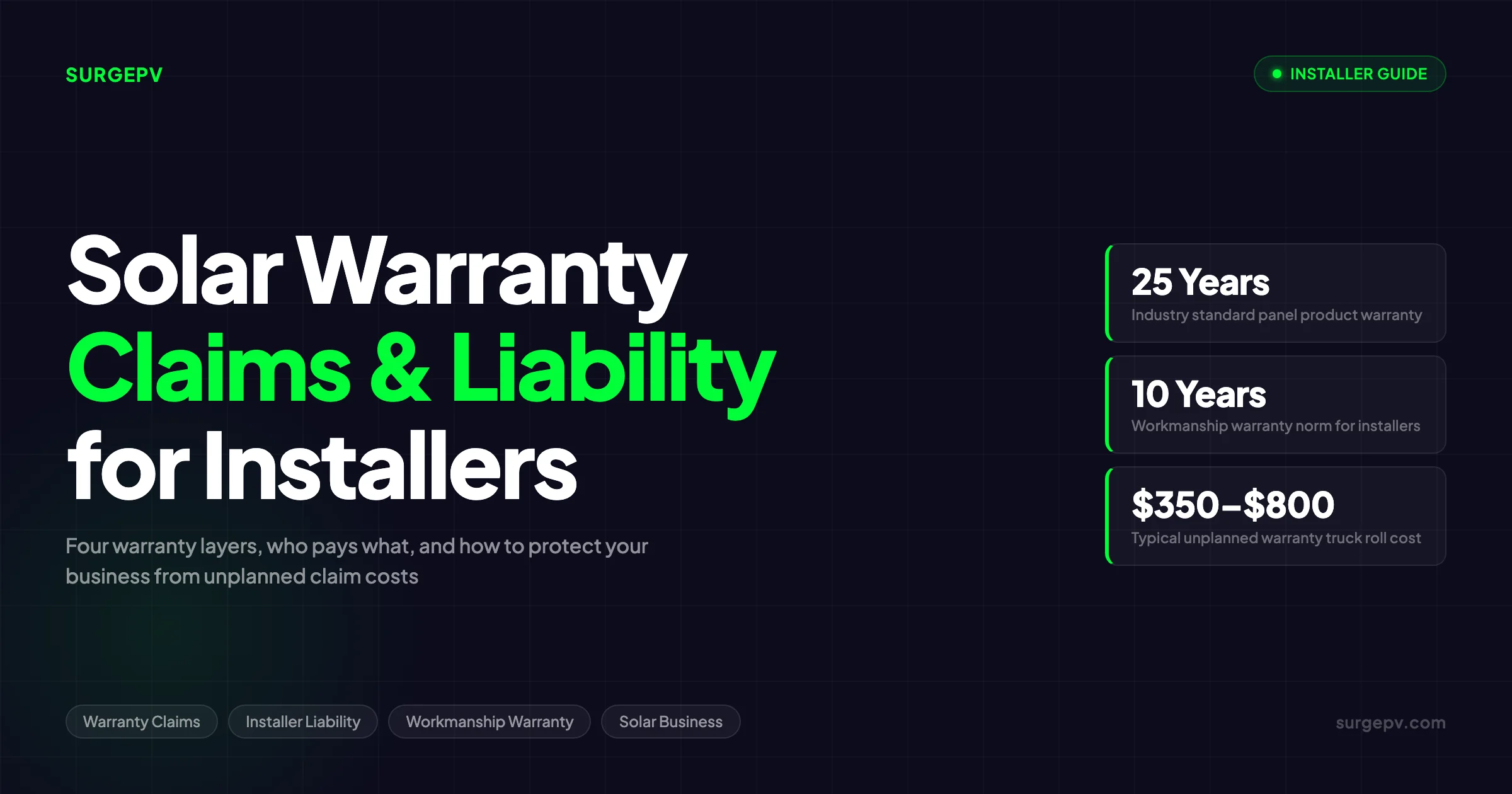
The standard for premium residential panels in 2026 is 25 years. The 2026 market standard is 82–92% of nameplate capacity at year 25, depending on the manufacturer and panel tier. Anything under 5 years is below market standard — and customers researching solar are increasingly aware of this benchmark.
Every solar installer carries liability long after the commissioning sign-off. When a panel stops producing at year 7, or a roof leak surfaces three years after install, someone pays — and the answer is rarely simple. The four warranty layers covering a typical solar installation assign liability to different parties, and the gap between them is where installers absorb costs they did not plan for. This guide breaks down who owns what under each warranty type, what voids manufacturer coverage, how to structure a workmanship warranty that holds up in a dispute, how to run the claims process without taking on costs that should land elsewhere, and what documentation practices reduce your exposure on every project you commission.
The standard for premium residential panels in 2026 is 25 years. The 2026 market standard is 82–92% of nameplate capacity at year 25, depending on the manufacturer and panel tier. Anything under 5 years is below market standard — and customers researching solar are increasingly aware of this benchmark.
TL;DR — Solar Warranty Liability for Installers
A typical solar installation carries four warranty layers: product (panels), performance (output degradation), workmanship (installer’s own), and labor (truck rolls for warranty work). Most manufacturer warranties exclude labor. Workmanship warranties only hold while your company operates. Without commissioning documentation, claims fail regardless of merit. Third-party warranty programs now fill the gaps manufacturers leave — and installer interest in them has spiked following the 2024–2025 wave of solar company insolvencies.
The Four Warranty Layers Every Installer Manages
A residential or commercial solar installation is not covered by one warranty. It is covered by four — each issued by a different party, each with different scope, duration, and exclusions. Managing all four is the installer’s operational responsibility.
Product Warranty
The product warranty covers physical defects in panels caused by manufacturing: delamination, cell cracking, junction box failures, frame corrosion, bypass diode failures. The standard for premium residential panels in 2026 is 25 years. Entry-level panels still ship with 10-to-12-year product coverage. Read Solar Racking Design Guide for a complete walkthrough.
Product warranties cover parts. They do not cover the labor to remove, replace, or recommission the affected equipment. If a panel fails at year 8, the manufacturer ships a replacement. Getting it on the roof is the customer’s problem unless an additional labor program applies — and most do not.
Performance Warranty
The performance warranty guarantees that panels retain a minimum output percentage over time. The 2026 market standard is 82–92% of nameplate capacity at year 25, depending on the manufacturer and panel tier. Degradation rates of 0.25–0.5% annually are typical for monocrystalline silicon panels.
Performance claims are harder to win than product claims. The installer must demonstrate that measured output falls below the warranted floor — which requires a baseline production figure taken at commissioning. Systems without a documented production baseline at install almost always lose performance disputes, because there is no reference point against which to measure degradation.
Workmanship Warranty
The workmanship warranty is the installer’s own coverage. It covers defects and damage caused during the installation process: roof penetration leaks, improper wiring, mounting failures, and any issue traceable to how the work was done rather than to the equipment itself.
Industry standard in 2026 is 10 years. Premium installers offer up to 25 years. Anything under 5 years is below market standard — and customers researching solar are increasingly aware of this benchmark. The workmanship warranty is only enforceable while your company is operating. If you close, the warranty closes with you.
Labor Warranty
Labor coverage is the least standardized layer and the most expensive surprise when it is missing. Most manufacturer warranties explicitly exclude it. Some manufacturers — REC through ProTrust, Q CELLS through Q.PARTNER, Silfab for certified installer partners — reimburse a portion of labor. Standard reimbursements where offered run $200–$250 per claim. REC ProTrust provides 25-year full labor coverage for certified installer partners, which is the strongest program currently on the market.
For all other situations, labor costs fall on whoever accepted responsibility in the customer contract. When that language is vague, the installer typically absorbs the cost.
| Warranty Type | Standard Duration | What It Covers | Labor Included? | Who Issues It |
|---|---|---|---|---|
| Product | 10–25 years | Manufacturing defects | No (usually) | Manufacturer |
| Performance | 25–30 years | Output degradation below guaranteed floor | No | Manufacturer |
| Workmanship | 2–25 years (norm: 10 years) | Installation defects | Yes | Installer |
| Labor | Varies (REC: 25 years; most: none) | Truck rolls for warranty replacement work | Yes (where applicable) | Manufacturer / Third-party |
Who Pays What: Manufacturer vs. Installer Liability
The most disputed territory in solar warranty claims is the boundary between manufacturing defect and installer error. Manufacturers want to classify failures as installation issues. Installers want to classify them as product defects. Neither party moves without documentation proving the cause — and in its absence, the party with the thinner file loses.
When the Manufacturer Is Liable
Clear manufacturer liability: panels with visible delamination at year 3, junction box failures with no evidence of physical impact, cell cracking patterns inconsistent with external stress, output degradation that exceeds the performance warranty rate when measured against the commissioning baseline.
To file successfully, you need: timestamped photos of the defect, monitoring data showing the output drop, the panel serial numbers, the original invoice or commissioning report showing the panel was installed according to manufacturer specifications, and current installer certification if required by the manufacturer.
When the Installer Is Liable
Clear installer liability: roof leaks from improperly installed flashing, wiring failures from under-torqued MC4 connections, panel cracking from foot traffic during installation, system output shortfall from shading that was not disclosed or modeled in the design. Shadow analysis software identifies shading issues before installation.
The installer’s workmanship warranty covers these scenarios. The cost — parts, labor, roof repair if applicable, and any customer compensation for lost production — belongs to the installer.
The Gray Zone
Most real-world disputes live in the gray zone. These are the scenarios where cause is ambiguous, both parties have some exposure, and documentation determines who pays.
Thermal cycling failure with unapproved racking. A panel fails at year 6 from thermal stress. The installer used racking not on the manufacturer’s approved hardware list — the manufacturer denies the warranty claim on this basis. The racking may or may not have caused the failure, but the unapproved component gives the manufacturer grounds to deny and win.
Shading-related underperformance. A system underperforms against the proposal’s projected output. The performance warranty does not apply because measured output is within warranted levels based on corrected irradiance data. The underperformance traces to shading from a neighbor’s tree that was not modeled in the design — and the proposal showed the number the customer expected to see. The installer has liability for the design error.
Roof leak attribution. A roof leak appears two years post-install. The customer claims installation damage. The installer claims natural wear. Without pre-install roof condition photos, there is no evidence either way. The dispute resolves against whoever has no documentation — typically the installer.
String output mismatch. A string produces 15% below modeled output. The manufacturer denies the performance claim because the shortfall is within their degradation model’s error band. The installer’s proposal showed a specific production number that the customer expected to receive. The gap between modeled and actual output is now the installer’s exposure.
| Scenario | Likely Liability | Key Evidence |
|---|---|---|
| Panel delamination, no physical impact | Manufacturer | Serial number + commissioning docs showing correct install |
| Panel cracking from installation foot traffic | Installer | Timestamped site photos |
| Output below performance warranty floor | Manufacturer | 30-day commissioning baseline + monitoring data |
| Roof leak from penetrations | Installer | Pre-install roof condition photos |
| Output below proposal estimate (not warranty floor) | Installer | Design files, shading analysis documentation |
| Failure after unapproved component use | Installer | Manufacturer approved hardware list |
| Wiring failure from under-torqued connection | Installer | Workmanship warranty claim |
Pro Tip
Document roof condition with timestamped photos before placing a single panel. If a leak claim arrives two years later, pre-install photos showing existing wear are the most effective defense available. The cost is ten minutes. The protection is worth thousands.
For United States-specific compliance details, see United States arizona/phoenix. For United States-specific compliance details, see United States california/los-angeles.
What Voids a Manufacturer Warranty — And Who Bears the Cost
Every manufacturer warranty includes a void conditions list. Most installers read it once during onboarding and forget it exists until a claim is denied. The cost of a voided warranty lands entirely on the installer when the void was caused by the installation.
Installation by an Uncertified Contractor
Some manufacturers — Silfab in particular — require installation by a certified installer for full warranty coverage. Q CELLS Q.PARTNER and REC ProTrust labor programs require active certification to activate enhanced labor coverage. If your company’s certification lapses, you expose customers to voided or downgraded coverage without knowing it.
Run an annual certification audit: confirm that your installer credentials and any manufacturer partner status are current before selling systems under those warranty terms.
Unapproved Racking and Mounting Hardware
Manufacturers maintain approved hardware lists. Installing panels on racking not on that list can void the product warranty regardless of how structurally sound the installation is. This catches installers off guard when they substitute a racking component mid-project because the specified part is on backorder. The substitute may be functionally equivalent — but if it is not on the approved list, the manufacturer has grounds to deny a future claim.
Always cross-check against the manufacturer’s current approved hardware list before purchase, not during installation. Keep a copy of the hardware list and approved component versions in the project file so you can prove compatibility at the time of install if a claim arises years later.
Physical Damage During Installation
Cracked cells from foot traffic, edge chips from improper handling, junction box damage from tools — all void product warranty coverage for the affected panel. This damage is 100% installer liability. There is no gray zone: damage that occurs on the job site before commissioning is the installing contractor’s responsibility.
Brief crews on panel handling procedures before every install. A microcrack that is not visible at commissioning can propagate over time and present as a mid-warranty failure — and if it traces back to installation damage, the manufacturer will deny coverage.
Modifications Without Manufacturer Approval
Cutting and re-terminating cables without manufacturer approval, bypassing bypass diodes, drilling into frames for non-standard mounting — all void coverage. This includes modifications made by third-party service technicians after the original install. If a customer hires someone else to add panels to an existing system and that installer does unauthorized work on the original array, the manufacturer may void the original panels’ warranty.
Include a clause in your customer contracts stating that any modifications to the system by uncertified third parties void the workmanship warranty and may void manufacturer coverage. Give customers a channel to contact you before authorizing any third-party work.
Missing or Incomplete Permit Documentation
Several manufacturers require that systems be permitted before honoring warranty claims. An unpermitted installation that fails at year 12 may result in zero manufacturer support. Some manufacturers will ask for the permit number during the claims process. If you cannot provide one, the claim may be denied.
Never commission a system without a permit. The liability exposure — not just for warranty but for electrical code compliance and insurance purposes — is not worth the time savings.
No Monitoring Equipment
Some manufacturers require monitoring data to validate performance claims. If monitoring is not connected or not generating data, the production history needed to prove output degradation does not exist. Systems installed without monitoring cannot support performance warranty claims.
Connect monitoring at commissioning. Confirm it is generating data before you leave the site. Note the monitoring system type and login credentials in the commissioning record you leave with the customer.
Warranty Not Registered
Many manufacturer warranties require registration within 30–90 days of installation. Unregistered warranties may default to shorter coverage periods or may not be honored at all. This is a procedural risk that is entirely within the installer’s control — and it is easily missed when registration happens through a separate manufacturer portal.
Build warranty registration into your post-install checklist. Confirm registration completion within the warranty window and store the confirmation in the project file.
Who Pays When a Warranty Is Voided?
When the installer’s actions void a manufacturer warranty, the installer absorbs the full cost of the failure: replacement parts at market price (not warranty replacement cost), labor, roof repair if applicable, and potential compensation for lost production. A single case where a $450 panel failure becomes a $3,200 liability event — parts + labor + dispute — erases the margin on multiple other projects.
How to Build a Workmanship Warranty That Protects Your Business
A workmanship warranty that is too broad creates unlimited liability. One that is too narrow loses proposals to competitors offering better terms. The right structure is specific about coverage and explicit about exclusions — and it is priced into the project from day one.
Duration Standards
The current market standard for workmanship warranties is 10 years. Some regional and national installers offer 25 years. Anything under 5 years signals either poor confidence in installation quality or an attempt to minimize post-sale obligation — and customers researching solar recognize both signals.
Moving from 2-year to 5-to-10-year workmanship coverage does not require major cost exposure if installation quality is consistent. The warranty cost is priced into the contract, not paid out of pocket unless something fails.
What a Strong Workmanship Warranty Covers
A well-drafted workmanship warranty covers:
- Roof penetrations and flashing integrity for the full warranty period
- Wire management failures and connection integrity
- Mounting and racking structural integrity, including wind and snow load performance
- System performance relative to the documented design output baseline
- Labor to diagnose and remediate any covered failure within the warranty period
What to Exclude — And How to Write It
Be explicit about exclusions in writing. Vague language creates disputes. Specific language closes them.
Cover these exclusions:
- Weather events: hail, wind above design parameters, flood, fire
- Customer modifications or unauthorized third-party work on the system
- Acts of wildlife: bird damage, rodent chewing on wiring
- Normal wear on inverters and batteries (covered under their own manufacturer warranties)
- Output shortfalls caused by shading from vegetation growth that was not present at the time of the site survey and not disclosed by the customer
- Electrical events: lightning strikes, utility grid surges, grid quality events
- Damage from structural failure of the roof itself, where the failure is unrelated to penetrations created during installation
The exclusion list protects you from absorbing costs that belong elsewhere. It is also a conversation starter during the sales process — walking a customer through what the warranty covers and what it does not is a trust signal that closes deals.
Pricing Workmanship Warranty Into Contracts
A 10-year workmanship warranty is not free. Model the cost:
- Expected failure rate for your quality of install (target under 2% per year for documented installs)
- Average remediation cost per call-out: labor + parts + overhead — typically $400–$1,200 per visit
- Number of systems you expect to commission over the warranty period
The reserve fund approach: a fixed dollar amount per kW installed goes into a dedicated warranty reserve account. A common target is $15–$25 per kW at commissioning. For an installer doing 150 kW per year, that is $2,250–$3,750 per year into reserve — manageable overhead that removes the surprise of warranty calls hitting operating cash.
At a 2% annual call rate and $800 average cost, 150 kW of annual installs generates approximately 3 warranty calls per year at $2,400 total cost. The reserve fund covers it and builds a buffer for years with higher-than-average failure rates.
Key Takeaway — Workmanship Warranty Cost Model
Reserve $15–$25 per kW installed in a dedicated warranty fund. At 2% annual failure rate and $800 average remediation cost, a 150 kW/year installer averages $2,400/year in warranty costs — well within reserve if funded from day one. Installers who do not model this absorb warranty costs from operating margin, which compounds quickly as the portfolio grows.
Avoid “Lifetime” Workmanship Warranties
A lifetime workmanship warranty is an open-ended liability that is difficult to price and impossible to fully honor across business transitions. If you sell your company, the buyer inherits that liability. If you close, customers are left with a worthless document. The phrase signals ambition to customers but creates real operational risk. Market on quality, duration, and responsiveness — not on “lifetime” language.
Manufacturer Warranty Comparison: Which Brands Offer the Best Coverage
Warranty terms vary significantly across manufacturers. Understanding the coverage each brand provides before speccing a project affects both your customer proposal and your own liability exposure.
| Manufacturer | Product Warranty | Performance Warranty (Year 25) | Labor Coverage | Notes |
|---|---|---|---|---|
| REC Alpha Pure (ProTrust) | 25 years | 92% | Full 25-year labor via ProTrust certified installer | Strongest combined coverage in residential market |
| Q CELLS (Q.PARTNER) | 25 years | 86% | Partial reimbursement (~$200–$250) | Q.PARTNER certification required |
| Silfab | 25 years | 87% | Enhanced for certified installers | 30-year performance warranty available |
| Canadian Solar TOPHiKu6 | 25 years | 84.8% | None standard | Strong product warranty, no labor |
| LONGi Hi-MO | 25 years | 84.8% | None standard | Volume brand, limited labor support |
| Jinko Solar | 12–25 years (tier dependent) | 82.6–87% | None standard | Warranty tier varies by product line |
| Standard entry-level | 10–12 years | 80% | None | Minimum viable coverage |
REC ProTrust stands out as the program that most directly reduces installer liability — certified installers activate labor coverage that removes truck roll costs from warranty scenarios. If your business model includes long-term customer relationships and service contracts, investing in ProTrust certification pays back quickly once warranty claims start arriving on a portfolio of aging installations.
The Warranty Claims Process: Step by Step
Most claims fail not because they lack merit but because they lack documentation. This is the workflow that gives claims the best chance of resolution.
Step 1: Document the Problem
Before contacting anyone, gather:
- Timestamped photos of any visible defect, from multiple angles
- Production data from the monitoring system showing the output drop — ideally covering at least 14 days before and after the issue appeared
- The specific panel serial numbers involved
- The date the issue was first observed
- Any relevant environmental events (hailstorm dates, recent service work)
If a homeowner contacts you about a suspected warranty issue, get this documentation before dispatching a technician. Sending a truck without evidence of the problem is expensive and often inconclusive. A structured intake form sent to customers when they report an issue collects the evidence automatically.
Step 2: Identify the Right Party to Contact
| Issue Type | Contact First |
|---|---|
| Physical panel defect (delamination, cracking, burn marks, junction box failure) | Manufacturer |
| Output below performance warranty floor, confirmed against commissioning baseline | Manufacturer (with production data) |
| Roof leak, wiring fault, mounting failure | Installer (workmanship warranty) |
| Inverter failure during warranty period | Inverter manufacturer |
| Battery capacity below warranted threshold | Battery manufacturer |
| Ambiguous cause | Installer — perform diagnostic, then route accordingly |
Do not send customers directly to manufacturers without the documentation above. Underprepared claims delay resolution and increase denial rates on technical grounds.
Step 3: File the Claim
Manufacturer claims typically require:
- Completed claim form (usually an online portal)
- Proof of purchase and original invoice
- Commissioning documentation showing correct installation
- Photos of the defect
- Monitoring data demonstrating the production impact
- Installer certification confirmation (where required by the warranty program)
Some manufacturers require the installer to file on behalf of the customer. Others require the system owner to file directly. Confirm the filing procedure for each manufacturer brand you use before a claim arrives — not after.
Step 4: What Causes Denials
The most common denial reasons:
- No commissioning documentation or missing baseline production data
- Evidence of unapproved components or racking in the installation
- Installer certification lapsed at the time of the claim or at original install
- Claim filed outside the warranty registration window
- Photos show physical damage inconsistent with a manufacturing defect
- System was modified after installation without manufacturer approval
- No monitoring system connected — performance claim cannot be validated
Claim denials are harder to appeal once issued. Preventing them through documentation and process is far less expensive than contesting them through escalation.
Step 5: Resolution Timeline
| Claim Type | Typical Resolution Time |
|---|---|
| Straightforward product replacement | 2–8 weeks |
| Performance warranty dispute | 3–6 months |
| Labor reimbursement (where applicable) | 30–60 days after replacement confirmed |
| Third-party warranty program claim | 2–4 weeks |
Escalation paths when a claim stalls: written escalation to the manufacturer’s commercial sales contact rather than the standard support queue, state attorney general consumer protection office for homeowner disputes that involve installer liability, NABCEP ethics board for disputes involving certified installer conduct.
Labor Costs: The Warranty Gap That Can Sink Small Installers
Labor is the most significant unplanned cost in solar warranty work. A panel replacement under product warranty costs the manufacturer the panel. It costs the installer — or the customer — the truck roll. That cost gap is where small installer margins disappear.
Why Most Manufacturer Warranties Exclude Labor
Manufacturer warranties are priced to cover parts at a known average cost. Labor costs vary by geography, roof access difficulty, system size, and local labor markets. Including labor in every warranty would require manufacturers to price all warranties against worst-case labor scenarios in every market they serve. Most have chosen not to, instead offering limited reimbursement programs through certified installer networks.
Which Manufacturers Cover Some Labor
| Manufacturer | Labor Coverage | Program | Conditions |
|---|---|---|---|
| REC Group | Full 25-year labor | ProTrust | Certified ProTrust installer required |
| Q CELLS | Partial reimbursement | Q.PARTNER | Q.PARTNER certification required |
| Silfab | Enhanced for certified installers | Certified installer program | Current certification required |
| Canadian Solar | None standard | — | Parts only |
| Jinko | None | — | Parts only |
| Enphase (microinverters) | Labor for first 2 years only | — | Thereafter parts only |
REC ProTrust is the strongest residential labor program available in 2026. If you sell REC panels and complete ProTrust certification, labor exposure on warranty claims is removed from your equation for the full 25-year product life.
The Cost of an Unplanned Truck Roll
A typical warranty truck roll — one technician, half day, parts delivery — costs $350–$800 depending on system access and location. Steep-pitch or high-clearance roofs add $200–$400. If the failed panel is in a string that requires full string testing before re-commissioning, add 2–3 hours of labor. Ground mounts with transformer access or remote locations can push a single warranty visit to $1,200 or more. See Ground Mounted Solar Design Guide for detailed guidance.
At these numbers, four unplanned warranty calls per year from poorly documented installs erases the profit from a typical residential installation. For a company doing 60 installs per year at an average margin of $2,000 per install, a 5% annual warranty call rate generates 12–15 truck rolls — a $4,800–$12,000 annual cost hitting the bottom line directly.
The fix is not avoiding warranty work — it is pricing it into the business model, building reserve funds, and reducing claim frequency through installation quality and documentation.
Pro Tip
Include explicit labor cost responsibility in every customer contract. Specify: (1) installer covers labor for warranty work during the workmanship warranty period; (2) manufacturer warranty covers replacement parts; (3) labor after the workmanship period is the customer’s responsibility or covered by any applicable manufacturer labor program. Ambiguity in this clause generates more disputes than any equipment failure.
Solar proposal tools that builds warranty term summaries into customer-facing proposals removes this ambiguity before contracts are signed — and reduces disputes that surface years later when customers have forgotten what they agreed to.
Orphaned Warranties: What Happens When Your Supplier Goes Out of Business
Between 2024 and 2025, several prominent solar companies filed for bankruptcy: SunPower, Titan Solar Power, Vision Solar, Sunnova, and Mosaic. Customers who purchased systems from those companies are now holding workmanship warranties backed by entities that no longer exist.
Manufacturer Bankruptcy vs. Installer Bankruptcy
Manufacturer bankruptcy voids or complicates product and performance warranty claims. Warranty liabilities are sometimes acquired by other manufacturers in the bankruptcy proceeding — Silfab acquired certain SunPower warranty obligations — but this is not guaranteed and typically covers only a subset of claims. Customers with affected panels should contact the bankruptcy receiver directly to determine if warranty coverage was assumed by a successor entity.
Installer bankruptcy voids workmanship warranties entirely. Customers retain manufacturer warranties for panels, inverters, and batteries, but lose installation defect coverage. If a roof leak surfaces after installer insolvency, the homeowner pays out of pocket regardless of when the installation occurred.
What Installers Should Know About Orphaned Systems
If you take on service calls for systems installed by defunct contractors, you are not inheriting their warranty obligations. Be explicit with customers before any work begins: you can provide paid service, but you are not assuming the prior installer’s warranty liability. Document this in writing before touching the system.
Any new work you perform carries your workmanship warranty from that point forward. Photograph system condition before starting work to establish a clear baseline for what was present when you arrived.
Third-Party Warranty Programs as Backup
Third-party warranty programs are specifically designed to survive installer insolvency. Providers like Solar Insure, Enphase Energize (for Enphase systems), and similar programs typically cover:
- Parts and labor for 25–30 years
- Roof penetration protection
- Production monitoring and guarantee thresholds
- Transferability to new homeowners at resale
Installer interest in third-party warranty programs has increased sharply since the 2024–2025 industry consolidation. Offering a third-party warranty as part of your standard package removes your company’s open-ended liability, gives customers coverage that survives your business, and is a competitive differentiator in markets where customers have watched local installers close.
Build Proposals That Win — and Protect Your Business
SurgePV helps installers create proposal documents with warranty summaries, accurate system design documentation, and commissioning records built in. Accurate designs mean fewer claims. Clear proposals mean fewer disputes.
Book a DemoNo commitment required · 20 minutes · Live project walkthrough
Documentation Standards That Win Claims
Documentation is the single variable most under the installer’s control. Well-documented installs win claims faster and at higher rates than poorly documented installs with equal or better merit. This is not a theoretical observation — it is the most consistent pattern in how warranty disputes resolve.
What to Capture at Commissioning
Create a site record at commissioning that includes:
- All panel serial numbers mapped to their physical location on the array
- Inverter, optimizer, and battery serial numbers
- String-level or module-level production baseline from the first 7–14 days of monitoring
- Timestamped photos: roof condition before installation, completed array from multiple angles, wiring runs and conduit, mounting hardware and racking, inverter, combiner box, and battery installation
- Commissioning report signed by the installing technician and the customer
- Copy of the permit approval with inspection sign-off
- Manufacturer warranty registration confirmation for all major components
This package takes 30–45 minutes to complete per install. It has saved installers tens of thousands in avoided disputes and gives your operations team a complete record when a claim arrives years later. Also see: Us Residential Solar Market Trends 2026.
Minimum Documentation Checklist
For every system commissioned:
- Pre-install roof condition photos (timestamped)
- Serial number map (panel-to-location, inverter, battery)
- 30-day production baseline from monitoring system
- Permit approval documentation
- Manufacturer warranty registration numbers and confirmation
- Signed commissioning report
If any of these is missing at the time of a dispute, assume that item will work against you. The absence of documentation is read as a gap in the install process, not as an administrative oversight.
How Long to Keep Records
Keep installation records for the full warranty period — which for performance warranties means 25–30 years. Digital records stored in cloud-backed project management systems are the minimum standard. Local storage on a single device is inadequate: devices are replaced, stolen, or lost, and a file stored nowhere but a laptop from 2026 is gone in 2031 when the claim arrives.
Structured project management software that archives commissioning documentation by project automatically is the right tool for installers managing more than 20–30 annual installations. For smaller operations, a consistent folder structure in a cloud service with automatic backup achieves the same result.
Baseline Production Documentation
The commissioning baseline is the reference point for performance warranty claims. Without it, you cannot prove what the system was producing when new — making any output degradation claim unwinnable against a manufacturer who will simply say the system was performing to specification.
Capture the first 30 days of production data at commissioning. Store it alongside the commissioning photos. This is the record that wins or loses performance disputes a decade later.
Accurate Design Documentation as a Pre-Claim Defense
The majority of solar warranty claims trace back to a design error at the proposal stage: wrong string sizing, unmodeled shading, incorrect voltage calculations, or equipment mismatches. Solar design suite that models shading, string configurations, and performance estimates accurately at the design stage catches these errors before they become post-install liability.
A system that underperforms against customer expectations generates warranty claims even when no equipment has failed — because customers measure production against what the proposal promised. If your proposal was built on accurate simulations using site-specific irradiance data and an honest shading model, the design file is your defense. If it was built on rough estimates, you have no defense against a customer who received a proposal projecting 9,500 kWh/year and is measuring 7,800.
The accuracy of your design documentation before install directly reduces the frequency and severity of disputes after install. Installers using solar software that generates detailed design outputs and shade analysis reports carry those files as built-in claim protection for every project they commission.
Key Takeaway — Documentation as Risk Management
The four records that win or lose most solar warranty disputes: (1) pre-install roof condition photos, (2) serial number mapping, (3) 30-day commissioning production baseline, (4) signed commissioning report with permit sign-off. Missing any one of these turns a defensible claim into a gray zone dispute. All four take under an hour per job.
How to Communicate Warranty Terms to Customers
The installer who explains warranty coverage clearly at the proposal stage encounters far fewer disputes at the claim stage. Customers who understand what is and is not covered before they sign do not arrive at year 6 expecting free labor on a manufacturer-covered equipment failure.
Include Warranty Summaries in Proposals
Your proposal should include a one-page warranty summary that covers:
- Workmanship warranty duration and what it covers
- Panel product and performance warranty terms from the manufacturer
- Inverter and battery warranty terms
- What is explicitly excluded from each warranty
- Who the customer contacts for each type of issue — installer vs. manufacturer
- How warranties transfer if the customer sells the property
This summary does three things: it differentiates your proposal against competitors who hand over a generic spec sheet, it establishes shared expectations before the contract is signed, and it becomes a reference document if a dispute arises years later.
Walk the Customer Through the Claim Process at Handoff
At system commissioning, spend 10 minutes walking the customer through what to do if something goes wrong:
- How to read their monitoring dashboard and what a normal output pattern looks like
- Who to contact first for different issue types (installer vs. manufacturer)
- What documentation to capture before making contact
- How to register the warranty if that step falls to the customer
This conversation costs nothing and eliminates the “I didn’t know who to call” dynamic that delays claims and generates frustration.
Written Warranties Are Non-Negotiable
A workmanship warranty that is not in writing is not enforceable in a dispute. Every customer must receive a written workmanship warranty document that specifies duration, coverage, exclusions, and the claims contact process. This is both a legal protection and a sales signal — customers who receive clear written warranties close at higher rates than those receiving verbal assurances.
The written warranty document should be attached to the customer contract, referenced in the commissioning report, and stored in your project management system. Give the customer a digital copy they can access from anywhere.
For building the customer-facing side of your installation business, see how-to-start-a-solar-company and hiring-solar-installers for related operational frameworks.
Common Warranty Claim Mistakes Installers Make
The most expensive warranty mistakes are preventable. These are the patterns that come up consistently in claims that fail or turn into unplanned costs.
Not Documenting at Commissioning
The most common and most costly mistake. Commissioning documentation costs 30–45 minutes per install. Not creating it is a choice to absorb all gray-zone disputes — which make up the majority of real-world warranty scenarios. There is no documentation strategy that saves you after a claim is filed. The records have to exist before the problem occurs.
Using Unapproved Components
Saving $35 on racking that is not on the manufacturer’s approved hardware list creates warranty void exposure worth thousands. Always verify component compatibility before placing the purchase order. Keep a dated record of the compatibility check in the project file so you can prove at year 10 that the hardware was approved at the time of install.
Failing to Register Warranties
Many manufacturer warranties require registration within a fixed window after installation — typically 30–90 days. Unregistered warranties default to shorter coverage periods or may not be honored. Build warranty registration into your post-install checklist, assign ownership to a specific team member, and store the confirmation in the project file.
Ignoring Monitoring Alerts
A 10% output drop detected by monitoring at month 4 is a panel replacement job. The same issue discovered at year 5 — because neither the customer nor the installer was watching the monitoring data — involves years of undocumented production loss, an out-of-spec system, and a dispute over remediation costs. Set up automated alerts in your monitoring platform and assign a team member to triage them. Proactive monitoring also demonstrates to customers that you stand behind your installations long after commissioning.
For installers managing large portfolios, PV design software integrated with production monitoring automates the alert tracking that manual review misses at scale.
Missing the Warranty Transfer Window
When a customer sells their home, manufacturer warranties are typically transferable — but require registration within a window. Customers who miss that window lose manufacturer coverage on the sale, and the new buyer inherits a system with degraded warranty protection. Include warranty transfer instructions in your customer handoff documentation with clear deadlines. A customer who successfully transfers their warranty is also more likely to refer the installer to the new buyer.
Verbal Workmanship Warranties
A verbal warranty is not enforceable. A workmanship warranty that exists only in a sales conversation or in a customer’s memory becomes whatever both parties want it to mean when a dispute arises. Every customer must receive a written document. Every claim must reference that document. No exceptions.
Designing Proposals With Inflated Output Estimates
Proposals that show production numbers the system cannot achieve create claims against the installer even when no equipment has failed. If your design tool allows you to model optimistically without grounding the estimate in real shading data and site-specific irradiance, you are building future liability into every proposal you send. Accurate system design at the proposal stage using verified weather data and honest shading models is the cheapest warranty risk reduction available. The PV generation and financial modeling built into SurgePV models production accurately — what you show the customer at proposal is what the system should actually deliver. For a direct comparison, see Arka 360 vs SurgePV.
Conclusion
Solar warranty liability is a manageable business problem. The installers who handle it best are not necessarily installing the most expensive equipment — they are running tighter documentation processes and pricing warranty exposure into their contracts from day one.
Three actions that move the needle most immediately:
- Build commissioning documentation into every project as a non-negotiable step. Serial number mapping, pre-install roof photos, 30-day production baseline, signed commissioning report. Thirty extra minutes per job that eliminates the majority of gray-zone disputes and wins the claims that deserve to be won.
- Put labor cost responsibility in writing in every contract. Define what the workmanship warranty covers, what the manufacturer warranty covers, and who pays for labor in each scenario. Customers who understand this before signing do not dispute it after a claim.
- Check manufacturer approved hardware lists before every order. Voided warranties from unapproved components are entirely preventable. A five-minute compatibility check before the purchase order eliminates one of the most common denial grounds manufacturers use.
Warranty claims are a certainty in any installation business operating at scale. The installers who come out ahead are the ones who documented everything, priced warranty risk into the model, and built customer communication practices that set clear expectations from the first proposal.
Frequently Asked Questions
Who is responsible for a solar warranty claim — the installer or the manufacturer?
It depends on the defect type. Manufacturing defects are the manufacturer’s responsibility. Installation errors, unapproved components, or damage during install fall on the installer. Many claims land in a gray zone where both parties dispute liability — which is why commissioning documentation is the deciding factor in most disputes.
What does a solar workmanship warranty cover?
A workmanship warranty covers defects and damage caused during installation: roof penetration leaks, wiring faults, mounting failures, and any issue traceable to the installer’s work. It does not cover manufacturing defects, weather damage, or customer-caused damage. Duration typically ranges from 2 to 25 years depending on the installer.
How long should a solar installer workmanship warranty last?
The industry standard is 10 years. Premium installers offer 25-year coverage. Anything under 5 years is below market standard. The warranty is only as good as the company behind it — a 25-year warranty from a startup with no track record carries less weight than a 10-year warranty from an established regional installer.
What voids a solar panel manufacturer warranty?
Common void conditions include: installation by an uncertified contractor, use of unapproved racking or mounting hardware, physical damage to panels during installation, modifications without manufacturer approval, and failure to permit the system. Some manufacturers also void coverage if monitoring equipment is not connected or if the warranty is not registered within 30 to 90 days of install.
What happens to a solar warranty when the installer goes out of business?
The workmanship warranty becomes void when the installer closes. Manufacturer warranties remain valid — the homeowner can file directly — but most exclude labor. The customer gets replacement parts but pays for installation. Third-party warranty programs from providers like Solar Insure survive installer insolvency and cover both parts and labor.
Does a solar manufacturer warranty cover labor costs?
Most manufacturer warranties cover parts only. Labor reimbursement is the exception. REC ProTrust offers full 25-year labor coverage for certified installer partners. Q CELLS Q.PARTNER provides partial reimbursement. Standard labor reimbursements where offered run $200 to $250 per claim — often well below actual truck roll costs.
Can a solar warranty be transferred to a new homeowner?
Most manufacturer warranties are transferable but require registration within a window — typically 30 to 90 days of the property sale. Workmanship warranties are generally tied to the original contract and may not transfer automatically. Installers should include transfer instructions in their handoff documentation to protect customers and preserve system value at resale.
How do I file a solar panel warranty claim?
Start by documenting the problem: photos of the defect, production data showing the output drop, and the panel serial numbers. For manufacturing defects, contact the manufacturer directly with commissioning documentation showing correct installation. For installation issues, the workmanship warranty applies. Most manufacturers require a completed online claim form, original invoice, and proof of correct install.
Where this fits
This article is part of SurgePV's Solar Business & Operations hub, which works through the topic from first principles to the decisions a project team actually has to make.


