Quick Answer
Solar conductor temperature derating follows NEC 310.16. For ambient temperatures above 30°C, multiply ampacity by correction factors: 35°C (0.94), 40°C (0.88), 45°C (0.82), 50°C (0.75). Conduit fill derating: more than 3 current-carrying conductors requires 80% ampacity reduction. Combined derating can reduce conductor capacity by 40–60% in hot climates.
Conductor temperature derating is the single largest hidden cost in hot-climate solar design. A 50 A inverter circuit that sizes to a #8 AWG in San Francisco often sizes to a #6 AWG or #4 AWG in Phoenix, Riyadh, or Dubai. The driver is not the load itself. The driver is the stack of NEC ambient correction, conduit fill derating, and rooftop conduit adders that compound when sun, asphalt, and tight raceways meet a 50°C summer afternoon.
Solar conductor temperature derating follows NEC 310.16. For ambient temperatures above 30°C, multiply ampacity by correction factors: 35°C (0.94), 40°C (0.88), 45°C (0.82), 50°C (0.75). Conduit fill derating: more than 3 current-carrying conductors requires 80% ampacity reduction.
Solar conductor temperature derating follows NEC 310.16. For ambient temperatures above 30°C, multiply ampacity by correction factors: 35°C (0.94), 40°C (0.88), 45°C (0.82), 50°C (0.75). Conduit fill derating: more than 3 current-carrying conductors requires 80% ampacity reduction. Combined derating can reduce conductor capacity by 40–60% in hot climates.
This guide is the field reference I wish I had when commissioning early desert projects. It covers NEC 310.15(B)(2)(a) correction tables, the rooftop adder logic from ASHRAE 169, conduit fill stacking under 310.15(C)(1), insulation selection between THWN-2, XHHW-2, USE-2, and PV Wire, two complete worked examples in Phoenix and Riyadh, and the specific mistakes that cost installers a re-pull on inspection day. See Solar Sales Commission Structure for detailed guidance.
Quick Answer — Temperature Derating Solar Conductors 2026
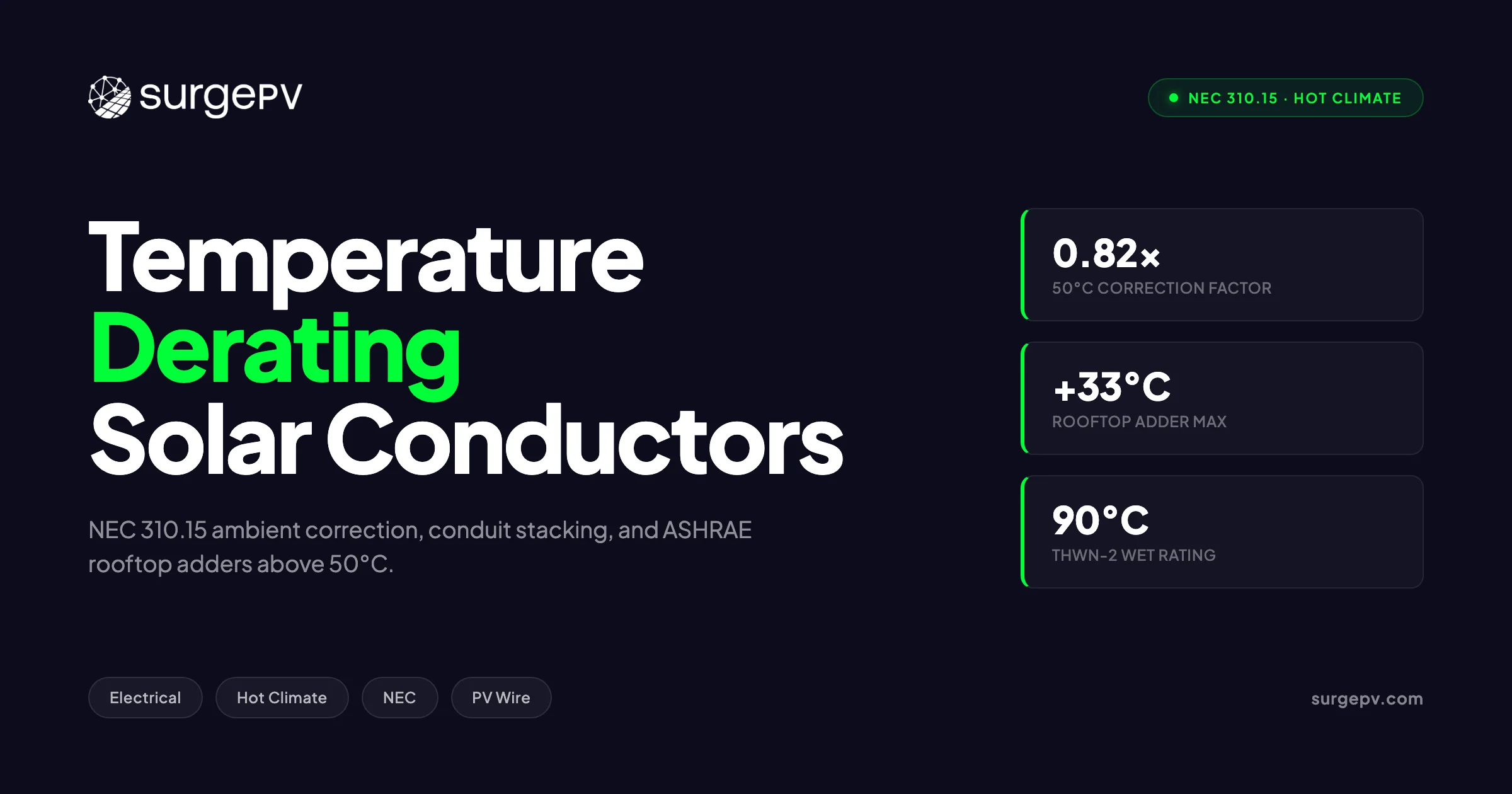
At 50°C ambient with 90°C rated insulation (THWN-2, XHHW-2, USE-2, PV Wire), the NEC 310.15(B)(2)(a) correction factor is 0.82. Rooftop conduit in direct sun adds 17–33°C to ambient depending on the height above the roof per NEC 310.15(B)(3)(c). When ambient correction and conduit fill derating stack, the combined factor often falls below 0.60, forcing an upsize of one to two AWG steps over standard 30°C ampacity tables.
In this guide:
- The three temperatures that drive solar conductor ampacity
- NEC 310.15(B)(2)(a) ambient correction tables explained
- Conduit fill derating per 310.15(C)(1) and how it stacks
- Rooftop conduit adders per ASHRAE 169 and NEC 310.15(B)(3)(c)
- THWN-2, XHHW-2, USE-2, and PV Wire compared for hot climates
- Two full worked examples: 50 A circuit in Phoenix and a Riyadh combiner run
- PV Wire versus building wire for module-level DC circuits
- The most common derating mistakes I see in hot-climate projects
Hot-Climate Conductor Derating 2026: Quick Answer
For solar conductors in ambients of 45–55°C, the working rule of thumb is this: take the 90°C column ampacity from NEC Table 310.16, multiply by 0.82 for ambient correction at 50°C, then multiply again by the conduit fill factor (0.80 for 4–6 current-carrying conductors, 0.70 for 7–9). The result must still be at or below the 75°C terminal column ampacity for the same wire size. The lowest of those three values is the usable ampacity for your circuit. Also see: Us Residential Solar Market Trends 2026. For United States-specific compliance details, see United States arizona/phoenix. For United States-specific compliance details, see United States california/los-angeles.
| Wire | 90°C Ampacity (Table 310.16) | × 0.82 Ambient (50°C) | × 0.80 Conduit Fill (4–6) | 75°C Terminal Limit |
|---|---|---|---|---|
| #10 AWG Cu | 40 A | 32.8 A | 26.2 A | 35 A |
| #8 AWG Cu | 55 A | 45.1 A | 36.1 A | 50 A |
| #6 AWG Cu | 75 A | 61.5 A | 49.2 A | 65 A |
| #4 AWG Cu | 95 A | 77.9 A | 62.3 A | 85 A |
| #2 AWG Cu | 130 A | 106.6 A | 85.3 A | 115 A |
| 1/0 AWG Cu | 170 A | 139.4 A | 111.5 A | 150 A |
For deeper sizing math beyond temperature, the companion guide on solar cable sizing calculation covers voltage drop, conductor length, and short-circuit considerations. For NEC-specific wire selection logic, read the dedicated guide on solar wire sizing under NEC 690.8. The reference architecture for the entire Article 690 chapter is summarized in our NEC 2026 solar changes post.
Latest Updates: Conductor Derating Code 2026
NEC 2026 adoption status varies by state and AHJ. Here is the current status of the major temperature-derating provisions for solar conductors in 2026.
Code Adoption Status — May 2026
| Jurisdiction | Adopted Edition | 310.15(B)(2)(a) Tables | Rooftop Adder Status |
|---|---|---|---|
| California | NEC 2023 (Title 24 amended) | In force | Required for conduit on roof |
| Arizona | NEC 2017 (most cities), NEC 2020 (Phoenix) | In force | Required, full adder table |
| Texas | NEC 2020 (state minimum) | In force | Required; some cities at NEC 2017 |
| Nevada | NEC 2020 | In force | Required |
| Florida | NEC 2023 | In force | Required |
| New York | NEC 2017 (state) | In force | Required |
| Saudi Arabia (SEC) | NEC 2017 reference + IEC | In force | Applied per project; SEC review |
| UAE (DEWA / ADDC) | IEC 60364 primary; NEC referenced | IEC-equivalent | Required by DEWA design guide |
| India (CEA / state DISCOM) | IS 732 + NEC reference | Equivalent tables | Best practice, not always enforced |
Key Changes Since NEC 2017
The ambient correction tables in 310.15(B)(2)(a) have not changed numerically since the 2014 cycle. What changed is structural. NEC 2017 reorganized 310.15 to clarify that ambient correction and adjustment for more than three current-carrying conductors are both required, and that they apply multiplicatively. NEC 2020 added Table 310.12 to define neutral conductor sizing for dwelling services, which does not affect PV. NEC 2023 retained all temperature provisions intact.
NEC 2017 also softened the rooftop adder requirement when XHHW-2 insulation is used by allowing the conductor temperature rating to absorb part of the adder. Many AHJs still require the full adder regardless of insulation; do not rely on the relaxation without local confirmation. For a full review of recent code changes, see our breakdown of the NEC 2026 solar changes and the related [NEC 2026 rapid shutdown solar](/blog/nec-2026-rapid-shutdown-solar) update.
Why Hot-Climate Conductors Need Extra Derating 2026
Solar conductors live in three thermal stress zones. The first is the air around the wire. The second is the metallic conduit surface, which heats above the surrounding air when exposed to sun. The third is the internal raceway temperature when multiple current-carrying conductors share the same conduit. Each of these zones independently raises the conductor’s operating temperature, and each is treated separately by the NEC.
A solar panel that produces 18 A at standard test conditions in Stuttgart will still produce 18 A in Dubai. What changes between locations is the temperature of the wire moving that current. A #10 AWG THWN-2 at 30°C ambient carries 40 A safely from its 90°C insulation rating. The same wire at 50°C ambient can only carry 33 A before insulation life shortens. Stack it in a conduit with five other conductors and the safe number drops below 27 A. Run that conduit across a flat roof at 13 mm above the surface in direct desert sun and the effective ambient climbs another 33°C, dropping the usable ampacity to about 18 A.
That is the same wire. Same insulation. Same load. Three different ampacities depending on the environment. The job of the design engineer is to identify the worst combination of these conditions along the full length of every conductor in the system, and to size for the hot spot.
Pro Tip
For hot-climate solar systems, the worst-case zone is almost always the rooftop conduit run between the modules and the inverter or combiner. The ambient is highest, the conduit is in direct sun, and the conductors are bundled. Size every conductor in that run for the stacked correction, then verify that the same wire size still meets voltage drop and short-circuit requirements over the full length.
The cost of getting this wrong is not a code violation alone. Conductor insulation aged at 110–120°C loses tensile strength in months rather than decades. Cable insulation degradation in solar systems is the leading cause of insulation faults in commercial rooftop arrays older than ten years, and these faults often present as nuisance arc-fault trips on the inverter long before they appear as ground faults. The full thermal aging chain is covered in our hot climate solar installation challenges guide.
The Three Temperatures That Affect Conductor Ampacity
There are three temperatures every solar designer needs to track for every conductor in the system: outdoor ambient, conduit surface, and internal raceway temperature from bundled conductors. NEC 310.15 treats each one separately, and each one applies a separate correction factor.
Outdoor Ambient Temperature
The first input is the outdoor ambient — the air temperature in the shade at the location, at the time of peak solar production. NEC 310.15(B)(1) defines the standard reference at 30°C and provides correction factors for any deviation up or down. For sizing purposes, the design ambient is not the average summer high, the record high, or the annual mean. It is the 2% ASHRAE summer design dry-bulb temperature for the location, taken from ASHRAE Standard 169 climate data.
For most US cities the 2% temperature lands within 1–2°C of the annual record monthly maximum. For Phoenix it is approximately 43–45°C. For Las Vegas, 42–44°C. For Dubai and Riyadh it ranges 45–49°C depending on the data set used. Some engineering firms apply an additional 2–3°C buffer; others size strictly to the ASHRAE value. The choice should be a documented engineering standard for the project.
Conduit Surface Temperature
The second input is the conduit surface temperature. When metallic conduit (EMT, RMC, IMC) runs across an open roof in direct sun, it heats well above the surrounding air. The standard reference for the rooftop adder is NEC 310.15(B)(3)(c) (renumbered from 310.15(B)(3)(c) in older editions). The adder ranges from 33°C for conduit touching the roof to 14°C for conduit suspended more than 90 mm above the roof. The original empirical data behind the rule comes from a 2007 SunPower / Bill Brooks field study, summarized in the SolarABCs effective temperature rise paper.
The adder is real. I have measured conduit surface temperatures of 78°C on a black asphalt roof in Saudi Arabia when the shade ambient was 47°C — a 31°C rise that closely matches the NEC table. PVC and fiberglass raceways heat less but still rise above ambient; many AHJs apply the same adder to non-metallic conduit on roofs.
Internal Raceway Temperature from Bundling
The third input is the temperature rise inside the conduit caused by the conductors themselves. Each current-carrying conductor generates I²R losses. When more than three share a raceway, heat builds up faster than it dissipates. NEC 310.15(C)(1) (formerly 310.15(B)(3)(a)) requires an adjustment factor to be applied to the ampacity:
- 4–6 current-carrying conductors: multiply by 0.80
- 7–9 conductors: multiply by 0.70
- 10–20 conductors: multiply by 0.50
- 21–30 conductors: multiply by 0.45
- 31–40 conductors: multiply by 0.40
- 41 and above: multiply by 0.35
The neutral in a balanced three-phase system is not counted. The equipment grounding conductor is not counted. The conductors in a DC string (positive and negative for each string) all count. A combiner conduit carrying six DC strings plus a single ground will have twelve current-carrying conductors and an adjustment factor of 0.50.
All three corrections combine multiplicatively. A conductor in a six-string DC conduit on a hot roof in Phoenix at 13 mm above the surface sees ambient 45°C + adder 33°C = 78°C effective ambient, ambient correction 0.41 (interpolated from 310.15(B)(2)(a)), conduit fill 0.50, for a combined factor of 0.41 × 0.50 = 0.205. The #10 AWG THWN-2 at 40 A drops to about 8 A. That is why module-level conductors in desert installations are almost always #8 AWG or #6 AWG rather than the #10 AWG that handles the same current at sea level in the UK. See our guide on Battery Solar System Design UK for more. Read more about Heritage Building Solar Case Study.
NEC 310.15(B)(2)(a) Ambient Temperature Correction Factors
The NEC 310.15(B)(2)(a) table is the workhorse of conductor temperature derating. It applies to insulated conductors rated 0–2000 V and gives correction factors as a function of ambient temperature and insulation rating. The factors below are taken directly from NEC 2023, which carries forward identically into NEC 2026.
NEC 310.15(B)(2)(a) Correction Factors — Ambient ≠ 30°C
| Ambient Temperature | 60°C Insulation | 75°C Insulation | 90°C Insulation |
|---|---|---|---|
| 10°C or less | 1.29 | 1.20 | 1.15 |
| 11–15°C | 1.22 | 1.15 | 1.12 |
| 16–20°C | 1.15 | 1.11 | 1.08 |
| 21–25°C | 1.08 | 1.05 | 1.04 |
| 26–30°C | 1.00 | 1.00 | 1.00 |
| 31–35°C | 0.91 | 0.94 | 0.96 |
| 36–40°C | 0.82 | 0.88 | 0.91 |
| 41–45°C | 0.71 | 0.82 | 0.87 |
| 46–50°C | 0.58 | 0.75 | 0.82 |
| 51–55°C | 0.41 | 0.67 | 0.76 |
| 56–60°C | – | 0.58 | 0.71 |
| 61–65°C | – | 0.47 | 0.65 |
| 66–70°C | – | 0.33 | 0.58 |
| 71–75°C | – | – | 0.50 |
| 76–80°C | – | – | 0.41 |
| 81–85°C | – | – | 0.29 |
Three points matter for hot-climate solar. First, the 60°C column drops off a cliff above 45°C. By 50°C the factor is 0.58, and by 55°C the wire is essentially unusable. This is why no solar designer should specify 60°C-rated insulation for outdoor or rooftop runs. Second, the 75°C column reaches its limit around 70°C ambient. Third, only the 90°C column has usable values above 60°C, which is the operating environment of a rooftop conduit in desert sun.
That is why the industry standard for solar conductors is always the 90°C wet rating: THWN-2, XHHW-2, USE-2, or PV Wire. The 90°C dry-only ratings (THHN, RHH) cannot be used because solar raceways are treated as wet locations per NEC 300.5(B) and 300.9.
Choosing Between Insulation Ratings in Hot Climates
| Insulation | Wet Rating | Dry Rating | Typical Use | Hot-Climate Notes |
|---|---|---|---|---|
| THHN | – | 90°C | Indoor dry conduits | Cannot use in raceways subject to wet conditions |
| THWN | 75°C | 75°C | Older spec | Avoid for solar — lower derating margin |
| THWN-2 | 90°C | 90°C | Building wire in raceway | Standard for AC and grounded DC in conduit |
| XHHW-2 | 90°C | 90°C | Feeders, raceways | Cross-linked PE; better heat aging than THWN-2 |
| USE-2 | 90°C | 90°C | Direct burial, outdoor | Best for combiner-to-inverter exterior runs |
| PV Wire | 90°C | 150°C | Module string conductors | Required for module-to-combiner exposed DC |
| RHW-2 | 90°C | 90°C | Specialty | Excellent thermal stability; expensive |
For the home run between the rooftop combiner and the ground-level inverter, USE-2 in metallic conduit is the most common choice in the US. For DC strings between modules and the rooftop combiner, the module-listed PV Wire is required by NEC 690.31(C) when conductors are run in free air without conduit.
NEC 110.14(C) is the second constraint. Even if the 90°C column allows 75 A on a #6 AWG THWN-2, the breaker or inverter terminal is almost certainly rated 75°C. The final allowable ampacity is the smaller of the corrected 90°C ampacity and the uncorrected 75°C column ampacity. This is the same rule covered in detail in our breakdown of ampacity in NEC 310.15.
Conduit Fill Derating Stacking Under 310.15(C)(1)
The conduit fill adjustment factor in 310.15(C)(1) is straightforward in principle: more conductors in one raceway means more heat, so the ampacity drops. The application gets harder when it stacks with ambient correction.
Adjustment Factor Table
| Number of Current-Carrying Conductors | Adjustment Factor |
|---|---|
| 4–6 | 0.80 |
| 7–9 | 0.70 |
| 10–20 | 0.50 |
| 21–30 | 0.45 |
| 31–40 | 0.40 |
| 41 and above | 0.35 |
For DC solar circuits, both the positive and negative of each string are counted as current-carrying. A six-string combiner conduit pulling DC from rooftop modules to a string inverter carries twelve current-carrying conductors. The fill adjustment is 0.50.
For three-phase AC inverter output conduit, the three phase conductors are current-carrying. The neutral is not counted unless the system is unbalanced or carries significant harmonic load (NEC 310.15(E)). The equipment grounding conductor is never counted.
Stacking Math
NEC 310.15(C)(1) is unambiguous on stacking: ambient and conduit fill corrections combine by multiplication, not by taking the lower value. Worked example for a 4-string combiner conduit at 50°C ambient with 90°C THWN-2:
- Base ampacity for #8 AWG THWN-2 at 90°C = 55 A
- Ambient correction at 46–50°C = 0.82
- Conduit fill for 8 conductors = 0.70
- Combined corrected ampacity = 55 × 0.82 × 0.70 = 31.6 A
- 75°C terminal limit for #8 AWG = 50 A (does not constrain because corrected is lower)
- Usable ampacity = 31.6 A
For the same conductor at 30°C ambient with three conductors, the usable ampacity would be 50 A (terminal-limited). The hot-climate combined derating is therefore 31.6 / 50 = 63.2% of the rated value. For circuits sized for inverter MPPT input current of, say, 22 A per string, this still works for #8 AWG. For a 30 A string current, it does not, and the conductor must move up to #6 AWG.
For voltage-drop sensitive long runs, the same conductor will often already need to upsize from #10 AWG to #8 AWG for voltage drop alone before temperature derating is even applied. The full voltage-drop method is detailed in our companion post on solar DC cable length calculator.
Pro Tip
When counting current-carrying conductors for the fill adjustment, treat each PV string as two current-carrying conductors (positive and negative). For inverters with built-in string fusing, the conductors from the inverter to the AC disconnect count as three (for three-phase) or two (for single-phase L1/L2). The DC and AC sides almost never share a conduit, but if they do, count both sides for the same fill calculation.
For situations where multiple raceways are stacked or share a structural element, NEC 310.15(C)(2) raises the question of mutual heating between raceways. For most rooftop solar installations this does not apply, because rooftop conduit is rarely stacked vertically. For underground or rack-mounted parallel cable trays, the spacing rules of 310.60 or the engineering provisions of 310.15(C)(2) may apply.
Rooftop Conduit: ASHRAE Adders and Attic Heat
Rooftop conduit in direct sun is the harshest electrical thermal environment in residential and commercial solar. The original NEC adder for rooftop conduit was introduced in NEC 2008 based on field data from a SunPower study showing conduit surface temperatures of 60–80°C on hot summer afternoons in California and Arizona. The current rule is in NEC 310.15(B)(3)(c).
NEC 310.15(B)(3)(c) Rooftop Adder
| Distance Above Roof | Temperature Adder |
|---|---|
| 0–13 mm (0–0.5 in) | 33°C (60°F) |
| Above 13 mm to 22 mm (0.5–7/8 in) | 22°C (40°F) |
| Above 22 mm to 90 mm (7/8 in–3.5 in) | 17°C (30°F) |
| Above 90 mm to 305 mm (3.5 in–12 in) | 14°C (25°F) |
| Above 305 mm (12 in) | No adder |
The adder is applied to the ambient temperature before the 310.15(B)(2)(a) correction factor is looked up. A Phoenix design ambient of 45°C with conduit at 13 mm above the roof becomes 45 + 33 = 78°C effective ambient. The 90°C correction factor at 76–80°C is 0.41. That is a brutal hit on a circuit that started at 100% ampacity in the table.
NEC 2017 Relaxation and NEC 2020 / 2023 Status
NEC 2017 modified the rule to allow the conductor’s higher-temperature insulation rating to absorb part of the adder. The effect is that XHHW-2 or other 90°C wet-rated insulations may not require the full adder in some cases — the engineer can compare the corrected ampacity with and without the adder, using whichever method is more restrictive. NEC 2020 and 2023 retain this provision. Many AHJs do not follow the relaxation, especially in California and Arizona where the original empirical work was done.
In practice, the safe default for any rooftop conduit run in a 40°C+ design ambient is to apply the full adder and select 90°C insulation. The cost of upsizing one AWG step is small; the cost of a thermal failure or a re-inspection is large.
Attic Heat — The Overlooked Zone
For US residential systems where conductors transition through the attic space between the inverter and the main service panel, attic heat is a separate concern. Unventilated attic temperatures in Phoenix routinely reach 60–70°C on summer afternoons, and the 75°C insulation rating of standard NM cable is marginal at best. NEC 334.80 explicitly requires that NM cable in an attic be derated using the 310.15(B)(2)(a) table at the ambient of the attic, not the outdoor air.
For solar inverter output circuits in attics:
- Use 90°C insulation (THWN-2, XHHW-2) in conduit, not NM-B
- Apply the 310.15(B)(2)(a) correction at the attic design temperature (often 60–65°C)
- Verify the conduit-fill stacking when multiple branch circuits share the attic raceway
- Document the attic ambient assumption in the design notes
For a complete walkthrough of inverter output sizing, see our deep dive on solar wire sizing under NEC 690.8. The matching guide for the AC disconnect on the same circuit is at AC disconnect sizing for solar.
Conductor Insulation Rating Selection: THWN-2, USE-2, PV Wire
The insulation rating sets the upper limit on what derating math will work for a given run. Three insulation choices dominate hot-climate solar work:
THWN-2 — Building Wire in Raceway
THWN-2 is the default 90°C wet-rated building wire used inside metallic and PVC conduit. It is widely stocked, affordable, and pulls easily. The wet rating of 90°C makes it eligible for the 90°C ampacity column under NEC 310.15(B). For solar inverter output, AC disconnects, and feeder runs from the inverter to the main service panel, THWN-2 in PVC or EMT conduit is the standard choice in the US.
THWN-2 weaknesses in hot climates: the nylon outer jacket softens above 105°C and the PVC inner insulation can creep under sustained temperature. For runs that genuinely operate above 90°C internal conductor temperature, XHHW-2 is a better choice.
XHHW-2 — Cross-Linked Polyethylene
XHHW-2 uses cross-linked polyethylene rather than PVC. The thermal aging behavior is materially better. For commercial and utility solar plants in hot regions, XHHW-2 is often specified in place of THWN-2 for that reason. Cost is 10–25% higher than THWN-2. Pull-through behavior is similar.
USE-2 — Underground Service Entrance
USE-2 is rated for direct burial and outdoor exposure without conduit. For the home run between a rooftop combiner box and a ground-level inverter, USE-2 cable in metallic conduit is common. USE-2 with a built-in PV Wire rating (USE-2 / PV Wire dual-listed) covers both the in-conduit exterior portion and the module-to-combiner exposed portion of the circuit.
PV Wire (USE-2 / PV Wire)
PV Wire is the module-level DC conductor. It is required by NEC 690.31(C) for conductors that are exposed to sunlight in free air without conduit between modules and the first junction box or combiner. The wet rating is 90°C. The dry rating is 150°C. The cable is sunlight resistant per UL 4703 and rated 600 V, 1000 V, or 1500 V depending on the system architecture.
The 150°C dry rating sounds generous, but it is not used as an ampacity reference. NEC 310.16 and 310.17 only apply the 90°C column for solar derating purposes. The higher dry rating exists to ensure that brief excursions above 90°C — for example during fault conditions or hot module backsheets — do not degrade the cable.
For a full module wiring discussion including connector selection, see our guides on MC4 connector crimping best practices and solar panel stringing and wiring.
Why You Cannot Use THHN in Hot-Climate Solar
THHN is dry-rated only. NEC 300.5(B) and 300.9 designate underground and many conduit systems as wet locations. Even an EMT raceway in an air-conditioned interior is treated as wet because moisture can enter through a fitting. The 90°C rating on a THHN-only conductor cannot be used; the conductor is treated as 60°C or 75°C depending on the dual rating. This is why every solar conductor specification should call out THWN-2, not THHN-2 alone.
Stop Hand-Calculating Hot-Climate Conductor Derating
SurgePV’s solar design software applies NEC 310.15(B)(2)(a) ambient correction, 310.15(C)(1) conduit fill stacking, and 310.15(B)(3)(c) rooftop adders automatically for every conductor in your design. See the corrected ampacity, voltage drop, and short-circuit verification on one screen.
Book a DemoNo commitment required · 20 minutes · Live project walkthrough
Worked Example: 50 A Inverter Circuit in Phoenix at 50°C Ambient
Here is a complete derating exercise for a single-phase 240 V residential inverter output circuit in Phoenix, AZ. The numbers below match what a designer using a code-compliant solar design tools tool should produce on first pass.
Project Parameters
- Inverter: SolarEdge SE7600H-US, 240 V single-phase
- Continuous output current: 32 A
- NEC 690.8(B)(1) factor of 1.25 for continuous operation: 32 × 1.25 = 40 A
- Design ambient (ASHRAE 2% Phoenix): 45°C
- Rooftop conduit, 22 mm above asphalt shingle roof: +22°C adder
- Effective ambient: 45 + 22 = 67°C
- Conduit fill: 3 conductors (L1, L2, EGC) — EGC not counted, so 2 current-carrying. No adjustment.
- Run length: 60 ft from inverter to AC disconnect, then 25 ft to main panel
- Conductor specification: THWN-2 copper, 90°C insulation
- Terminal rating at inverter and disconnect: 75°C per nameplate
Step 1 — Determine Required Ampacity
Per NEC 690.8(B)(1), the conductor ampacity must be at least 125% of the inverter’s continuous output: 32 × 1.25 = 40 A required.
Step 2 — Look Up Base 90°C Ampacity
From NEC Table 310.16:
- #10 AWG Cu THWN-2 at 90°C = 40 A
- #8 AWG Cu THWN-2 at 90°C = 55 A
Step 3 — Apply Ambient Correction at 67°C
From 310.15(B)(2)(a), the 90°C correction factor at 66–70°C = 0.58.
- #10 AWG: 40 × 0.58 = 23.2 A — does not meet the 40 A requirement
- #8 AWG: 55 × 0.58 = 31.9 A — still below 40 A
- #6 AWG: 75 × 0.58 = 43.5 A — meets the 40 A requirement
Step 4 — Apply Conduit Fill Adjustment
Only two current-carrying conductors in the conduit (L1 and L2; EGC excluded). No conduit fill adjustment required.
Step 5 — Apply 75°C Terminal Limit per 110.14(C)
From NEC Table 310.16 75°C column:
- #6 AWG Cu THWN-2 at 75°C = 65 A — meets the 40 A requirement
The #6 AWG conductor satisfies all three constraints: corrected 90°C ampacity (43.5 A), 75°C terminal (65 A), and minimum required ampacity (40 A). Final conductor selection: #6 AWG THWN-2 copper.
Step 6 — Verify Voltage Drop
At 60 ft one-way (120 ft round-trip) and 32 A continuous, voltage drop for #6 AWG copper:
- Resistance per NEC Chapter 9 Table 8: 0.491 Ω per 1000 ft for #6 AWG Cu
- Round-trip resistance: 0.491 × 120 / 1000 = 0.0589 Ω
- Voltage drop: 32 × 0.0589 = 1.89 V on 240 V supply
- Percentage drop: 1.89 / 240 = 0.79% — well within the typical 2% target
Cost Comparison
For a 60 ft run, #6 AWG THWN-2 vs. #10 AWG THWN-2:
- #6 AWG THWN-2 black + red + green EGC, 60 ft: ~$140 (US retail)
- #10 AWG THWN-2 black + red + green EGC, 60 ft: ~$45 (US retail)
The temperature derating in Phoenix adds approximately $95 in copper for the conductor portion of a single inverter circuit, compared to a 30°C reference jurisdiction. On a 10 kW residential array, that is a real cost. On a 100 kW commercial array with longer runs and more strings, the cost difference scales into thousands. This is why every solar bid for a hot-climate project should include the thermal correction math in the engineering review, not just the load math.
Worked Example: Combiner Conduit in Direct Sun in Riyadh
This second example is from a commercial rooftop project in Riyadh, Saudi Arabia, where the design ambient is higher and the conduit configuration is denser.
Project Parameters
- Array: 6 × 22-module strings of 540 W bifacial modules, 1500 V DC
- Per-string Imp: 13.2 A; Isc: 14.1 A
- NEC 690.8(A)(1) sizing factor of 1.56 for solar source circuit: 14.1 × 1.56 = 22.0 A required
- Design ambient (ASHRAE 0.4% Riyadh): 48°C
- Conduit configuration: EMT, 13 mm above white TPO roof: +33°C adder
- Effective ambient: 48 + 33 = 81°C
- Conductors in conduit: 6 strings × 2 conductors = 12 current-carrying (EGC not counted)
- Conduit fill adjustment for 10–20 conductors: 0.50
- Run length: 30 m from combiner to inverter
- Conductor specification: PV Wire / USE-2 dual-listed, 90°C wet rating
Step 1 — Determine Required Ampacity
Per NEC 690.8(A)(1) and 690.8(B)(1), the source circuit conductor must carry at least Isc × 1.25 × 1.25 = 14.1 × 1.5625 = 22.0 A (the 1.56 factor combines the irradiance margin and the continuous-current adder).
Step 2 — Look Up Base 90°C Ampacity
From NEC Table 310.16 for 90°C:
- #10 AWG = 40 A
- #8 AWG = 55 A
- #6 AWG = 75 A
- #4 AWG = 95 A
Step 3 — Apply Ambient Correction at 81°C
NEC 310.15(B)(2)(a) for 90°C insulation at 81–85°C = 0.29.
- #10 AWG: 40 × 0.29 = 11.6 A — insufficient
- #8 AWG: 55 × 0.29 = 16.0 A — insufficient
- #6 AWG: 75 × 0.29 = 21.8 A — insufficient
- #4 AWG: 95 × 0.29 = 27.6 A — meets
Step 4 — Apply Conduit Fill Adjustment
Twelve current-carrying conductors share the conduit: 0.50 factor.
- #4 AWG: 27.6 × 0.50 = 13.8 A — insufficient
- #2 AWG: 130 × 0.29 × 0.50 = 18.85 A — insufficient
- 1/0 AWG: 170 × 0.29 × 0.50 = 24.65 A — meets the 22.0 A requirement
Step 5 — Apply 75°C Terminal Limit per 110.14(C)
From NEC Table 310.16 75°C column for 1/0 AWG Cu = 150 A. Far above the 22 A requirement. Terminal does not constrain.
Step 6 — Final Selection and Voltage Drop
Final conductor: 1/0 AWG PV Wire / USE-2 copper.
Voltage drop check at 30 m (60 m round-trip) and 13.2 A:
- Resistance per Chapter 9 Table 8: 0.122 Ω per 1000 ft for 1/0 AWG = 0.40 Ω per 1000 m
- Round-trip resistance: 0.40 × 60 / 1000 = 0.024 Ω
- Voltage drop: 13.2 × 0.024 = 0.32 V on 1100 V string voltage = 0.029%
The 1/0 AWG sizing is driven entirely by thermal derating, not voltage drop. The same circuit at 30°C ambient with three conductors per conduit would size to #10 AWG, with #4 AWG at 50°C ambient and three conductors. Doubling the bundle from 3 to 12 conductors and adding the rooftop adder pushes the design up another four AWG steps to 1/0 AWG.
The cost implication is substantial. 1/0 AWG copper PV cable in Saudi Arabia runs roughly $5.20 per meter; #10 AWG PV cable runs about $0.85 per meter. For 6 strings × 30 m × 2 conductors = 360 m of cable, the 1/0 AWG specification costs approximately $1,870 vs. $306 for #10 AWG. The $1,560 difference per combiner is what the rooftop adder and conduit fill stacking buy in code compliance.
Riyadh-Specific Notes
The Saudi Electricity Company (SEC) interconnection process accepts both NEC and IEC reference designs. For PV systems above 100 kW, SEC engineering review almost always applies the full rooftop adder regardless of which code edition is cited. For systems on industrial roofs in Riyadh, Jeddah, or Dammam, plan for #4 AWG to 4/0 AWG home runs as the default for any string conductor in a multi-string combiner conduit. The cost of the upsize is fully recoverable through the absence of re-pulls during commissioning.
PV Wire vs Building Wire for Module-Level Conductors
NEC 690.31(C) requires that conductors run in free air (without conduit) between modules and the first junction box, combiner, or inverter input use PV Wire or a dual-listed USE-2 / PV Wire. The reason is the harsh exposure profile: direct UV, rain, ice, abrasion against module frames, and contact with hot module backsheets that can exceed 75°C.
Why PV Wire is Required for Exposed DC Runs
PV Wire meets UL 4703 standards for outdoor exposure, sunlight resistance, and double insulation. Its construction includes:
- Tinned copper conductor (for solderability and corrosion resistance)
- Cross-linked polyethylene (XLPE) primary insulation
- Sunlight-resistant outer jacket with UV stabilizers
- Double-insulation rating equivalent to Class II construction
- 90°C wet, 150°C dry, 600 V / 1000 V / 1500 V ratings
- Listed for direct burial as USE-2 when dual-rated
Standard THWN-2 building wire does not have UV stabilization. After 12–18 months of direct sun exposure, the outer jacket cracks and the insulation degrades. Using THWN-2 in module-level free-air runs is a code violation under NEC 690.31(C) and will result in a failed inspection or insurance complication after a fire.
When Building Wire is Acceptable
Once conductors enter a junction box, combiner, or raceway, NEC 690.31(C) no longer requires PV Wire specifically. Inside conduit, THWN-2, XHHW-2, or USE-2 are all acceptable for the same circuit, provided the wet rating is 90°C. Many designs transition from PV Wire to THWN-2 at the rooftop combiner enclosure to reduce material cost on the longer combiner-to-inverter run.
Hot-Climate PV Wire Considerations
In Phoenix, Dubai, and Riyadh, module backsheet temperatures regularly hit 75–85°C, and the connector body of an MC4 in direct sun reaches 65–75°C. PV Wire’s 150°C dry rating provides margin for these transients. Standard THWN-2 in the same exposure would see jacket softening and connector pull-out failures within five years.
The cost premium for PV Wire is approximately 25–50% over THWN-2 of the same gauge. For module-level runs of 5–15 meters per string, this is a small absolute cost on a residential system and a non-trivial cost on a utility-scale project where total PV cable can exceed 50 km. The savings from selecting the right gauge through accurate derating math typically exceed the PV Wire premium by a wide margin.
For a deeper look at how MLPE devices change the wire-sizing math at the module level, our guides on microinverters vs string inverters vs optimizers and solar string design walk through the conductor implications.
Common Hot-Climate Derating Mistakes
Eight mistakes account for the vast majority of conductor derating problems I see in hot-climate projects. Avoid these and your design will pass first-pass AHJ review.
Mistake 1: Using Table Ampacity Without Correction
The single most common error is reading the Table 310.16 ampacity at face value and skipping the correction factor. A designer who sizes a 32 A inverter output to #10 AWG because the 90°C column reads 40 A has done none of the derating math. In Phoenix at 50°C ambient that conductor’s actual ampacity is 23 A and the circuit will fail inspection.
The fix is procedural: every solar conductor specification in a hot-climate project should show three numbers in the design notes — the base 90°C ampacity, the corrected ampacity after all derating, and the 75°C terminal-column ampacity. The smallest of the three is the usable value.
Mistake 2: Ignoring the Rooftop Adder
Designers who learned the trade in temperate climates often skip the rooftop adder entirely. A 45°C design ambient gets used as 45°C even when the conduit is 13 mm above a black asphalt roof. The actual effective ambient is 78°C and the 90°C correction factor drops from 0.82 to 0.41 — half the assumed value.
The fix is to apply the full NEC 310.15(B)(3)(c) table on every rooftop run unless conduit is more than 305 mm above the roof or the run is fully shaded by the modules. If a project ages the AHJ to accept the NEC 2017 relaxation, document the engineering rationale and have it signed by the responsible PE.
Mistake 3: Forgetting Conduit Fill Stacking
NEC 310.15(C)(1) and 310.15(B)(2)(a) stack multiplicatively. Designers who apply only the larger of the two corrections will undersize the conductor. The fix is mechanical: in a spreadsheet or software, the corrected ampacity always equals the base ampacity × ambient factor × fill factor. If either factor is missed, the result is wrong.
Mistake 4: Mixing Up Insulation Ratings
Specifying THHN where the application is wet, or using THWN where THWN-2 is needed, drops the eligible ampacity column from 90°C to 75°C. The lost margin at 50°C ambient is the difference between 0.82 and 0.75, which sounds small but interacts with the conduit fill multiplier and the terminal limit to drive an extra AWG step.
The fix is to standardize on 90°C wet-rated insulation (THWN-2, XHHW-2, USE-2, PV Wire) for every conductor in every solar project. Cost is a wash; design margin is real.
Mistake 5: Skipping the 75°C Terminal Check
The 90°C corrected ampacity is the upper limit on conductor heating. The 75°C terminal column from 110.14(C) is the upper limit on the terminal heating. The final usable ampacity is the smaller of the two. Designers who apply only the 90°C corrected number can pass a thermal calculation but still fail the terminal limit, especially for smaller conductors where the 75°C and 90°C ampacity differ by 5–10 A.
Mistake 6: Wrong Conductor Count in Fill Adjustment
Counting only the strings or only the AC phases — not both positive and negative on DC, not all phases on AC — leads to under-counting current-carrying conductors. A 6-string DC combiner conduit has 12 current-carrying conductors, not 6.
Mistake 7: Using NEC 2014 Table 310.15(B)(16) by Memory
NEC reorganized 310 in 2017 and again in 2023. The table that older designers remember as 310.16 is now 310.16, but the numbering of subsections changed. If the engineering team is reading from a 2014 NEC, the correction factor location, the rooftop adder location, and the wording of the relaxation are all in different sections. The fix is to standardize the project codebase: write the adopted NEC edition into the design specification.
Mistake 8: Not Documenting the Derating Math
The single biggest field problem I encounter is a design that derated correctly but did not document the math. The AHJ reviewer cannot verify the answer, sends a stop-work, and the project loses 2–4 weeks. The fix is to publish the derating calculation in the engineering submittal for every circuit: base ampacity, ambient correction factor, conduit fill factor, corrected ampacity, terminal limit, final ampacity, required ampacity, AWG and insulation. One row per circuit. Pass-fail at a glance.
Pro Tip
Set up a project-level derating template in your engineering documentation. List every circuit on one row with its base ampacity, ambient at install, conduit fill count, all three factors, the 90°C corrected number, the 75°C terminal limit, and the minimum required ampacity. Highlight the constraint cell. The AHJ reviewer will approve the design faster, and the field crew will pull the right wire on the first attempt.
Software-Driven Derating: When Hand Calculations Fail
Manual conductor derating is fine for a single residential string. For a commercial array with 30 inverters and 200 string circuits, manual derating is the largest source of design errors. A modern solar software platform applies the temperature correction, conduit fill, rooftop adder, and terminal limit in one pass and flags every circuit that fails.
The features that matter for hot-climate derating:
- Per-circuit ambient temperature input (not one global value)
- Rooftop adder logic tied to the conduit height-above-roof field
- Conduit fill counter that automatically tracks current-carrying conductors per raceway
- Terminal rating field on every connected device (inverter, breaker, disconnect)
- Final ampacity verification against NEC 690.8(B) minimum
- Voltage drop computation on the same selected conductor
- Bill of materials output that lists conductor gauge, insulation type, and total length
When the design tool is doing the derating math, the engineer’s job moves up the value chain. Instead of looking up 0.82 from a table for the fifteenth time, the engineer is reviewing whether the conduit routing is optimal, whether a smaller home run can be combined with another, and whether the BOM cost is justifiable.
For the financial side of the same projects, our generation and financial tool covers IRR, payback, and capex sensitivity for hot-climate plants. For the shading inputs that drive module temperature, see our solar shadow analysis software walk-through.
Climate Data Sources for Conductor Derating
Accurate temperature derating starts with accurate ambient data. The four sources every designer should know:
ASHRAE Standard 169
ASHRAE Standard 169: Climatic Data for Building Design Standards is the primary reference for outdoor design temperatures in the US. The standard provides 0.4%, 1%, and 2% high temperatures for 8,000+ locations. For solar conductor sizing, the 2% high is the typical design value; the 0.4% high gives an extra margin where critical loads or long expected service life justifies it.
NREL National Solar Radiation Database (NSRDB)
The NREL NSRDB provides typical meteorological year (TMY) data including hourly ambient temperature back to 1998. For solar module temperature calculations, the NSRDB is the standard input to PVlib and SAM. For conductor derating, the 99th percentile or maximum hourly ambient from the TMY file gives a defensible design ambient.
Local AHJ Climate Designations
Some AHJs publish their own design temperature requirements. The City of Phoenix Building Department, for instance, specifies a design ambient that is 2°C above the ASHRAE 2% value for any rooftop conduit. Many California AHJs reference Title 24 climate zones for the design ambient.
Solar Industry Best Practice
The SEIA design guides and the SolarABCs reports recommend a design ambient of 5°C above the ASHRAE 2% high for any conductor that runs in direct sun on a roof, plus the full NEC rooftop adder. For shaded conductors or conductors inside buildings, the ASHRAE 2% high without additional margin is acceptable.
| Location | ASHRAE 2% High | Industry Design Ambient | Rooftop Effective (13 mm) |
|---|---|---|---|
| Phoenix, AZ | 43°C | 45°C | 78°C |
| Las Vegas, NV | 42°C | 45°C | 78°C |
| Dubai, UAE | 45°C | 47°C | 80°C |
| Riyadh, KSA | 47°C | 50°C | 83°C |
| Bakersfield, CA | 41°C | 43°C | 76°C |
| Austin, TX | 38°C | 40°C | 73°C |
| Athens, GR | 36°C | 38°C | 71°C |
| Madrid, ES | 37°C | 39°C | 72°C |
| Delhi, IN | 42°C | 45°C | 78°C |
These are starting points. Local engineering judgment, project life expectancy, and AHJ-specific overrides may push the value higher.
ROI of Correct Derating: The Cost of Re-Pulls and Insurance
Conductor derating math has a direct financial outcome. Three failure modes account for most of the cost.
Mode 1: Inspection Fail and Re-Pull
The most visible cost is a re-pull after a failed inspection. For a typical 30 kW commercial array, a string conductor re-pull costs $4,000–$8,000 in labor and material, plus a 2–4 week schedule delay while the new cable is procured and crew rescheduled. The cost of the original upsize would have been $500–$1,200. The leverage on getting the derating right the first time is 5–10×.
Mode 2: Insulation Aging and Insurance Premium Increase
Even when the conductor passes inspection, an undersized conductor running near its thermal limit ages faster. Insurance carriers in commercial solar are increasingly performing thermal imaging audits at year 3 and year 5. A junction box or conduit pulling hot during the audit can trigger a coverage review and a 15–30% premium increase. For a 1 MW commercial array with $25,000 annual insurance premium, that is $3,750–$7,500 per year of avoidable cost. See Design Commercial Solar System 1MW for detailed guidance.
Mode 3: Soft Failure and Production Loss
A conductor near its thermal limit does not always fail catastrophically. Frequently the inverter logs ground-fault or arc-fault trips that take the array offline for 5–30 minutes at a time. Over a year, a hot-circuit array can lose 0.5–2% of annual production to repeated trips. On a 100 kW commercial site producing 160 MWh/year at a $0.10/kWh PPA, a 1.5% loss is $240/year. Small per site, but it adds up across a portfolio.
For the broader financial framing of these design decisions, our deep dive on generation and financial modeling and the solar panel ROI in Italy post both cover the underlying capex and opex math. Also see: solar panel ROI in Italy.
Conclusion: Three Action Items for Every Hot-Climate Solar Project
Conductor temperature derating is not optional in hot climates. It is the difference between a design that passes first-time inspection and a design that costs the installer 10–30% of project margin in re-pulls, insurance premium hikes, and production losses. The three concrete steps for any project in a 40°C+ design ambient:
-
Use 90°C wet-rated insulation everywhere. THWN-2, XHHW-2, USE-2, or PV Wire. Never THHN or THWN alone. The cost premium is small and the design margin gain is substantial.
-
Compute and document every derating multiplier per circuit. Base 90°C ampacity × ambient correction × conduit fill = corrected ampacity. Compare against the 75°C terminal column. Publish the table in the engineering submittal.
-
Apply the full rooftop adder until the AHJ explicitly accepts the NEC 2017 relaxation. A 33°C adder on a 45°C ambient is a 78°C effective ambient, which moves the correction factor from 0.82 to 0.41. Designers who skip the adder undersize the conductor by one to two AWG steps.
Solar conductors are a small line item on the BOM and a large line item on the risk register. Treat the temperature derating math with the same rigor as the structural and module-level design. Use code-compliant solar PV design software that applies the derating automatically. Document the result. Inspect the field. Then sleep at night.
Frequently Asked Questions
What is temperature derating for solar conductors?
Temperature derating for solar conductors is the process of reducing the allowable ampacity of a wire when its operating environment is hotter than the standard 30°C reference. NEC 310.15(B)(2)(a) publishes correction factors that must be multiplied against the table ampacity. For a 90°C THWN-2 conductor at 50°C ambient, the correction is 0.82. For rooftop conduit in direct sun, an ASHRAE adder of 17–33°C is added to the ambient before the correction is applied.
What is the NEC ambient temperature correction factor at 50°C?
For 90°C rated insulation (THWN-2, XHHW-2, USE-2, PV Wire), the NEC 310.15(B)(2)(a) ambient correction factor at 50°C is 0.82. For 75°C insulation it is 0.75, and for 60°C insulation it is 0.58. The factor is multiplied by the conductor’s 90°C column ampacity from Table 310.16 to get the corrected ampacity. NEC 2023 and NEC 2026 both publish the same value of 0.82 for the 46–50°C bin at 90°C.
How much does rooftop conduit add to ambient temperature for solar?
Per NEC 310.15(B)(3)(c) and ASHRAE 169, rooftop conduit exposed to direct sun adds 17°C to 33°C to the recorded outdoor ambient. The exact adder depends on the height of the conduit above the roof: 0–13 mm adds 33°C, 13–22 mm adds 22°C, 22–90 mm adds 17°C, and 90–305 mm adds 14°C. NEC 2017 removed this requirement for XHHW-2 and other insulations, but many AHJs and jurisdictions still apply it. Always confirm with the local AHJ.
Do I need to derate PV wire for temperature?
Yes. PV Wire (USE-2 / PV Wire) is rated for 90°C wet and 150°C dry, but its ampacity from NEC Table 310.17 (free air) or 310.16 (raceway) must still be corrected for ambient temperature. At 50°C ambient, the 90°C column correction factor is 0.82. PV wire in direct sun on a rooftop module-to-combiner run is one of the hottest conductor environments on a solar site and needs both ambient correction and conduit fill stacking when bundled.
What is the difference between THWN-2, XHHW-2, USE-2, and PV Wire for hot climates?
All four insulations carry a 90°C wet rating that is required for the NEC 310.15 90°C column ampacity. THWN-2 is the most common building wire for raceways inside structures. XHHW-2 is cross-linked polyethylene, used in conduit and direct burial. USE-2 is rated for direct burial and outdoor exposure. PV Wire is dual-rated USE-2 and 600V/1500V PV-specific, with 150°C dry rating for use on the module-level DC string between modules and the combiner.
Can I use the 90°C ampacity column for the final conductor rating?
No. NEC 110.14(C) restricts the final usable ampacity to the lowest temperature rating of any termination — almost always 75°C for breakers, lugs, and inverter terminals up to 100A, and 75°C for terminations above 100A unless listed otherwise. The 90°C column is only used as the starting value for applying derating factors; after ambient correction and conduit fill stacking, the result must still fit within the 75°C terminal limit at the final ampacity.
How does conduit fill derating stack with temperature correction?
NEC 310.15(C)(1) requires conduit fill derating to be applied multiplicatively with ambient temperature correction. For example, 4–6 current-carrying conductors in a conduit at 50°C ambient: temperature correction 0.82 × conduit fill 0.80 = 0.656. A #6 AWG THWN-2 with 75A 90°C ampacity drops to 75 × 0.656 = 49.2A, which then must clear the 75°C terminal column. Stacking is multiplicative, not the lower of the two.
What ambient temperature should I use for solar design in Phoenix or Riyadh?
Use the ASHRAE 2% high temperature for the location, not the historic record. For Phoenix, AZ, the ASHRAE 2% extreme is approximately 43–45°C; design ambient should be 45°C plus the appropriate rooftop adder. For Riyadh, the ASHRAE 0.4% extreme is 47–49°C, and module temperatures regularly exceed 70°C. Many engineering firms use 50°C as the design ambient for both locations for added margin, then apply the rooftop adder if conduit is exposed.
Does the NEC 2026 change temperature derating rules?
NEC 2026 keeps the 310.15(B) ambient temperature correction tables intact and uses the same 0.82 factor at 50°C for 90°C insulation. The 2026 cycle continues the rooftop conduit adder logic introduced in 2008 and refined in 2014 and 2017. Changes in NEC 2026 are concentrated in rapid shutdown (690.12), ground-fault detection, and equipment grounding; conductor ampacity tables and correction factors remain unchanged from NEC 2023.
When is conductor temperature derating not required?
Derating is always required when the ambient exceeds 30°C, when more than three current-carrying conductors share a raceway, or when conductors run in rooftop conduit in sunlight. Exceptions are narrow: 310.15(A)(2) allows the use of the higher ampacity for a wire that crosses a hot zone of less than 10 ft if 90 percent or more of the run is at lower ambient. For PV systems in hot climates, plan to derate every run unless a specific code exception clearly applies. Solar proposal software generates professional quotes in minutes.
Where this fits
This article is part of SurgePV's Solar Design hub, which works through the topic from first principles to the decisions a project team actually has to make.