

A 500 kWp rooftop project in Gujarat caught fire six months after commissioning. The root cause was not the panels. It was not the inverter. It was a single MC4 connector crimped with a pair of slip-joint pliers. The contact resistance at that joint climbed above 50 mΩ. Resistive heating melted the housing. The DC arc ignited the roof membrane. The insurer denied the claim because the installation used non-certified connectors and no pull-test records existed.
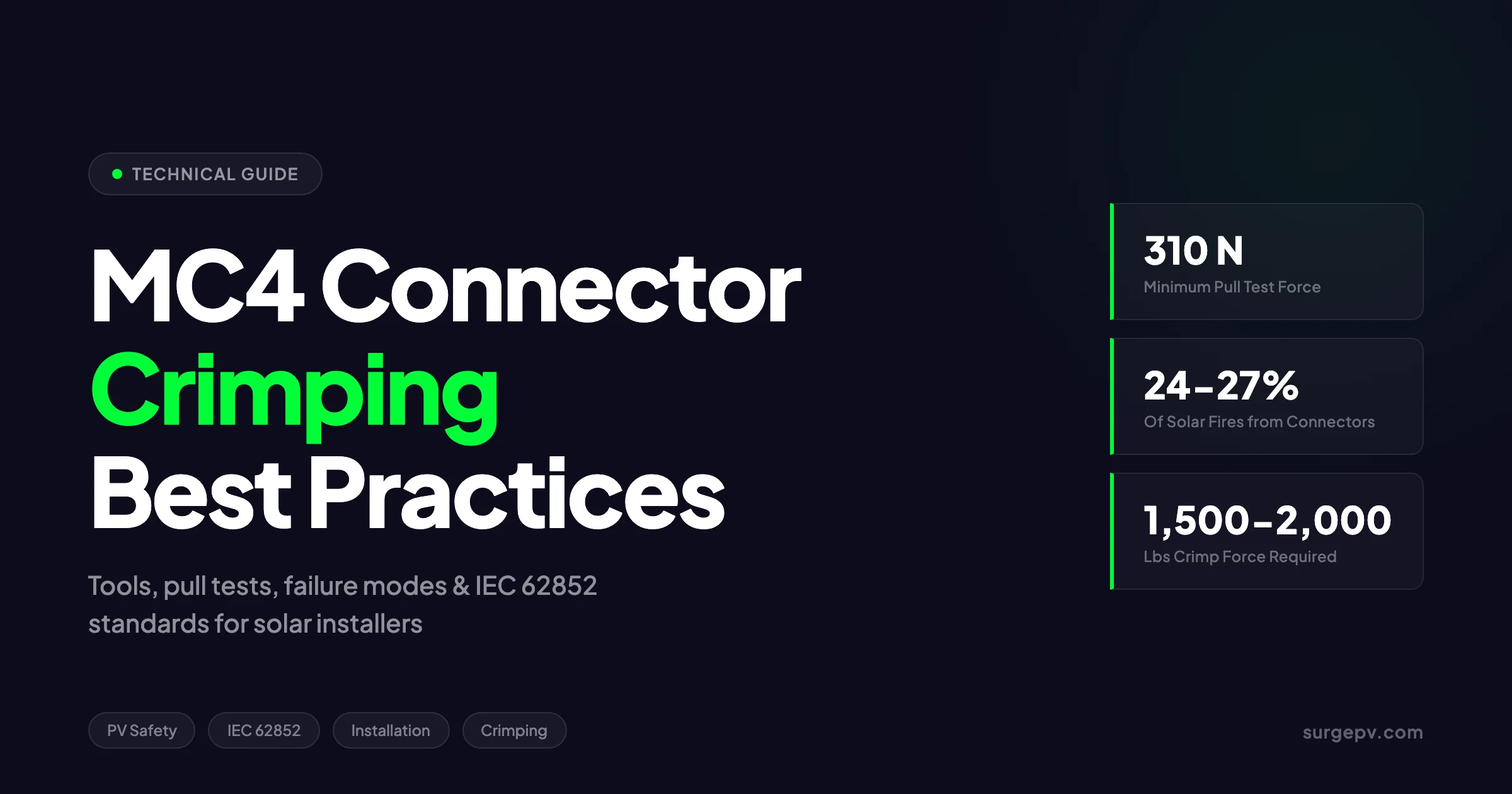
That story is not unique. Connectors were implicated in 24-27% of solar-related fires in Europe, according to UK government fire investigation data. In Germany, connectors caused 24% of 180 PV-related fires between 1995 and 2012. A 2024 NREL study analyzing over 50,000 O&M tickets from 837 U.S. sites found that each connector failure takes a full string offline. Median repair downtime is 191 hours. Mean replacement downtime is 1,579 hours. Also see: Germany solar subsidies. Also see: European Solar Incentives.
The MC4 connector is a $2 part that can destroy a $2 million array. This guide covers the crimping best practices that separate a 25-year installation from a liability nightmare. Installers who want to get the system design right before reaching the roof can use solar design tools to specify cable gauges, string layouts, and connector counts during planning.
Quick Answer
MC4 connector crimping best practices require a ratcheting crimp tool with 1,500-2,000 lbs force and hexagonal dies, a 6.0-7.5 mm strip length, a 310 N minimum pull test, and a 3.4 Nm torque on the gland nut. Use same-brand connectors, tinned copper PV wire, and never mix manufacturers. Poor crimps cause 24-27% of solar fires.
In this guide you will learn:
- Why MC4 crimps fail and what the failure chain looks like
- How to select the right crimping tool and die set
- The exact strip length, pull force, and torque values from IEC standards
- How to perform a field pull test without lab equipment
- The legal and warranty risks of mixing connector brands
- When factory-pre-crimped cable beats field crimping
- Common mistakes that even experienced installers make
- A step-by-step QA protocol you can use on every job
Why MC4 Connector Failures Are the #2 Cause of Solar Fires
MC4 connector failures rank behind only junction box defects as a cause of photovoltaic system fires. The reason is simple physics combined with DC behavior.
A poor crimp creates high contact resistance at the metal-to-metal interface. When current flows, the joint generates heat according to the formula P = I²R. At 8A through a 50 mΩ joint, that is 3.2 watts of heat concentrated in a few square millimeters. The temperature at the contact surface can exceed 150°C. The plastic housing softens. The seal degrades. Moisture enters. Corrosion accelerates. Resistance climbs further. The cycle feeds itself. Installers who model their arrays in solar shadow analysis software can also plan thermal inspection points before commissioning.
DC arcs do not self-extinguish. Unlike AC, which crosses zero 100 or 120 times per second, DC maintains a continuous arc once ignited. A loose MC4 connection can sustain an arc for hours behind panels where no one sees it. Burgoynes forensic investigations documented multiple cases where connector arcing burned silently for extended periods before igniting roof materials.
The NREL study on connector reliability found that each failure removes an average of 5.74 kW of DC capacity from the array. At $0.08/kWh and 1,500 equivalent sun hours per year, that single failed connector costs $688 annually in lost production. Over a 1,579-hour mean replacement downtime, the lost revenue exceeds $1,300 before you add the truck roll, labor, and parts. Using a energy and financial modeling tool during project planning helps model these hidden O&M costs and build realistic maintenance reserves.
Key Takeaway
One bad MC4 crimp can cost over $1,300 in lost production, void your insurance, and start a fire. The component costs $2. The consequence costs everything.
The Anatomy of an MC4 Connector: What Each Part Does
An MC4 connector assembly has four functional parts. Understanding each one explains why crimping matters so much.
The contact pin is a copper barrel with a spring-loaded mating surface. The barrel receives the stripped wire. The spring fingers maintain pressure on the mating pin when connected. If the barrel crimp is loose, the contact resistance rises at both the wire-barrel interface and the pin-to-pin interface.
The housing is a UV-resistant polyamide shell that holds the contact pin and provides insulation. It also contains the locking clip that produces the audible click when mating. A cracked housing from over-torquing exposes live conductors.
The cable gland is the threaded compression fitting that seals the cable entry. It contains an O-ring and a compression sleeve. Proper torque on the gland nut creates the IP67/IP68 seal that keeps water out for 25 years.
The locking clip is a stainless steel spring that retains the contact pin inside the housing. You hear the click when this clip snaps into the retention groove on the contact. No click means no retention. A contact that backs out under thermal cycling creates an open circuit or an arc.
Pro Tip
Always listen for the click when inserting a crimped contact into the housing. Then perform a gentle pull-back test. If the contact moves, remove it and inspect the locking clip for damage. A deformed clip will fail in the field.
Tool Selection: Ratcheting Crimpers vs. Cheap Pliers
The tool you use determines whether the crimp will last 25 years or 25 days.
A proper MC4 crimping tool is a ratcheting device with interchangeable hexagonal dies. The ratchet mechanism prevents the tool from opening until the full compression cycle completes. This eliminates the partial crimps that occur when an installer releases pressure early. The hexagonal die shape produces six-sided compression that captures all strands evenly without creating sharp edges that cut conductors.
| Tool Type | Crimp Force | Die Shape | Ratchet | Suitable for MC4? |
|---|---|---|---|---|
| Dedicated MC4 ratcheting crimper | 1,500-2,000 lbs | Hexagonal | Yes | Yes |
| Hydraulic crimper (lug style) | 6,000+ lbs | Indent or hex | Varies | No — wrong die geometry |
| Automotive crimper | 500-800 lbs | Oval or indent | Sometimes | No — insufficient force |
| Slip-joint pliers | Variable | None | No | Never |
| Hammer and chisel | N/A | N/A | No | Never |
The die set must match the wire gauge. A die sized for 4 mm² wire will not compress a 6 mm² conductor fully. A die sized for 6 mm² will crush a 4 mm² conductor and cut strands. Most manufacturers color-code dies: red for 2.5 mm², blue for 4 mm², yellow for 6 mm².
Stäubli specifies that original MC4 and MC4-EVO 2 use different crimping tools. The MC4-EVO 2 contact has a rib-cage structure that requires a different die geometry. Using an original MC4 tool on an EVO 2 contact produces an incomplete crimp. Segen Solar’s application note confirms this explicitly.
Tool calibration matters. A ratcheting crimper that has performed 15,000 cycles may no longer deliver full force. Most manufacturers recommend inspection or replacement after 10,000 to 20,000 crimps. Mark your tool with the date of purchase and the estimated cycle count. When in doubt, replace it.
What Most Guides Miss
Most crimping guides focus on tool selection but ignore die wear. A worn die produces crimps that look correct but have 3-5x higher contact resistance. The only way to detect die wear is to measure contact resistance with a micro-ohmmeter. You can also track failure rates across your crew. If your field failure rate rises above 1%, inspect your dies first.
Cable Selection: Wire Gauge, Copper vs. CCA, and PV Wire Rating
The cable you crimp matters as much as the tool you use.
MC4 connectors accept wire gauges from 2.5 mm² to 10 mm² (14 AWG to 8 AWG). The most common sizes are 4 mm² and 6 mm² (12 AWG and 10 AWG). The correct gauge depends on current, run length, and voltage drop limits.
| Wire Size (mm²) | AWG Equivalent | Max Current (A) | Typical Use |
|---|---|---|---|
| 2.5 | 14 | 20 | Small residential strings, short runs |
| 4.0 | 12 | 30 | Standard residential strings |
| 6.0 | 10 | 40 | Commercial strings, longer runs |
| 10.0 | 8 | 55 | Large commercial, utility strings |
Use only tinned copper conductors. The tin plating prevents oxidation at the crimp interface. Bare copper oxidizes over time, especially in humid climates. Oxide layers raise contact resistance and accelerate thermal degradation.
Never use copper-clad aluminum (CCA) wire. NEC 690.31(C) explicitly bans aluminum conductors for PV source and output circuits unless they are part of a listed connector system. Aluminum has a higher coefficient of thermal expansion than copper. Under daily thermal cycling, aluminum expands and contracts more than the copper contact barrel. That differential movement loosens the crimp over months. The resistance rises. The joint heats. The cycle repeats until failure.
The cable insulation must be PV wire rated for 90°C wet/dry and UV exposure. Standard THHN/THWN-2 insulation degrades in sunlight within 2-3 years. PV wire uses cross-linked polyethylene (XLPE) or ethylene propylene rubber (EPR) that withstands 25 years of UV, ozone, and temperature cycling.
Strip Length Precision: Why ±1 mm Matters
Strip length is the most underappreciated variable in MC4 crimping.
Stäubli specifies a strip length of 7.0 mm for standard MC4 contacts. The acceptable range is 6.0 to 7.5 mm. Outside that range, two failure modes appear.
Too short (under 6.0 mm): The conductor does not reach the backstop inside the contact barrel. The crimp compresses only part of the conductor. The effective contact area drops. Resistance rises. The joint overheats.
Too long (over 7.5 mm): Exposed conductor strands extend past the crimp barrel. These strands can touch the housing wall or the mating connector, creating a short circuit. Even if they do not touch immediately, vibration and thermal cycling can move them into contact over time.
Use a precision wire stripper with an adjustable stop. Set the stop to 7.0 mm and verify with a caliper on the first five strips of every job. Do not use a knife or teeth. Nicks in individual strands create stress concentrators that break under flexing. A single broken strand in a 7-strand conductor reduces the effective cross-section by 14%.
After stripping, inspect the conductor end under good light. All strands should be intact and un-twisted. If any strand is nicked, cut the end and strip again. The cost of 10 mm of wire is negligible. The cost of a failed connector is not.
Pro Tip
Mark your stripper stop with a paint pen after calibrating. Crews working in bright sunlight often misread millimeter scales. A bright color mark eliminates that error.
The Crimping Procedure: Step by Step
Follow this sequence for every MC4 crimp. Do not skip steps.
Step 1 — Select cable and verify gauge. Check the cable jacket marking for gauge, temperature rating, and PV wire certification. Match the die color to the gauge.
Step 2 — Strip insulation to 7.0 mm. Use a calibrated stripper with a stop. Inspect for nicked strands.
Step 3 — Twist strands lightly. A slight twist keeps strands together during insertion. Do not over-twist. Over-twisting reduces the effective diameter and can prevent full insertion.
Step 4 — Insert conductor fully into contact barrel. The conductor must reach the backstop at the far end of the barrel. You should feel resistance when the wire bottoms out. If it stops early, the strip length is too long or the strands are bunched.
Step 5 — Position the contact in the die. The contact barrel sits in the die cavity. The mating end of the contact extends past the die jaws. Do not crimp the mating end.
Step 6 — Compress fully until the ratchet releases. Apply steady pressure. The ratchet will not open until the full compression cycle completes. Do not release early. Do not double-crimp.
Step 7 — Inspect the crimp visually. The crimp should be symmetrical. Die marks should be light but visible. No strands should protrude from the barrel end. The barrel should not be split or deformed.
Step 8 — Perform a tug test. Pull firmly on the wire. A properly crimped 4 mm² contact withstands over 310 N. If the wire pulls free, discard the contact and start over. Never re-crimp a failed contact.
Step 9 — Insert into housing until the click. Push the crimped contact into the housing from the rear. Listen for the locking clip to snap into the retention groove. Pull back gently to confirm retention.
Step 10 — Assemble the gland and torque to 3.4 Nm. Slide the gland nut, compression sleeve, and O-ring onto the cable in the correct order. Tighten the gland nut to 3.4 Nm (25 in-lbs) using an MC4 torque spanner.
Step 11 — Test continuity and polarity. Use a multimeter to verify continuity from cable end to contact tip. Verify polarity matches the system design. Reverse polarity can damage inverters and void warranties.
Step 12 — Record the serial number and date. If your connectors have lot numbers, record them. If a batch recall occurs, you need traceability.
Pull Test Protocol: Field Verification Without a Lab
The pull test is the single most important quality check you can perform in the field. It requires no lab equipment. It takes five seconds. It catches the majority of crimping defects.
IEC 60352-2 specifies that a crimped contact on 4 mm² wire must withstand a tensile force greater than 310 N. That is roughly 70 pounds of pull force. In practice, most installers use a 50-pound (220 N) tug test as a practical minimum. A 50-pound test catches all gross defects. A 310 N test catches marginal crimps.
Field pull test procedure:
- Grasp the connector housing in one hand and the cable 50 mm from the housing in the other.
- Pull steadily for 3 seconds. Do not jerk.
- The wire must not move relative to the contact.
- If any movement occurs, discard the connector and recrimp.
For crews that want quantitative data, a handheld digital force gauge costs under $200. Set the gauge to pull mode. Attach the connector to a fixed point. Pull the cable with the gauge until separation or until the reading exceeds 310 N. Record the result on a job sheet.
Real-World Example
A commercial EPC in Rajasthan implemented mandatory pull-test logging on a 2 MW project. They tested every 50th connector with a force gauge. The first week showed a 12% failure rate on one crew. The cause was a worn die in the crimping tool. Replacing the die dropped the failure rate to 0.3%. That single intervention prevented an estimated 80 field failures over the project life.
Visual Inspection Criteria: What a Good Crimp Looks Like
A proper crimp has four visual signatures.
Symmetrical compression. The crimp barrel shows even compression on all sides. Hexagonal dies produce six faint lines. Indent-style dies produce two parallel marks. Asymmetrical compression indicates misalignment during crimping.
No strand protrusion. All conductor strands end inside the crimp barrel. Strands visible past the barrel end can short to the housing or mating connector.
No insulation in the crimp zone. The insulation must end before the crimp barrel begins. Crimping over insulation creates a high-resistance joint that fails within months.
No cracks or splits. The barrel metal should be deformed but not torn. A split barrel has reduced mechanical strength and exposes conductor strands to corrosion.
If any of these four criteria fail, cut the contact off and start again. The contact costs pennies. A field failure costs hundreds.
Original Stäubli MC4 vs. MC4-Compatible: The Legal and Warranty Issue
This is where most installers get into trouble they do not see coming.
“MC4” is not a standard. It is a registered trademark owned by Stäubli, which acquired Multi-Contact in 2002. Stäubli has never published an open specification. Stäubli has never certified third-party connectors as intermatable. Every “MC4-compatible” connector on the market is an unlicensed copy with unverified tolerances.
NEC 690.33(C) states that connectors must be “listed and identified as being of the same type and from the same manufacturer.” They can also be “listed and identified as intermatable.” A Stäubli MC4 mated with a generic “MC4-compatible” connector violates this code. An inspector can red-tag the installation. An insurer can deny a fire claim. A panel manufacturer can void its warranty.
The tolerance differences are real and measurable. Stäubli contacts use a specific spring finger geometry and contact force. Generic copies vary in pin diameter by 0.1 to 0.3 mm. That gap reduces contact pressure and raises resistance. Under thermal cycling, the lower spring force in generic contacts allows fretting corrosion. The resistance climbs over months, not years.
| Factor | Original Stäubli MC4 | Generic “MC4-Compatible” |
|---|---|---|
| Trademark | Registered to Stäubli | Unlicensed use |
| Published spec | No open standard | Reverse-engineered |
| Certification | TÜV, UL 6703, IEC 62852 | Varies; often none |
| Contact material | Silver-plated copper | Often tin-plated; sometimes brass |
| Spring force | Calibrated per design | Unverified |
| Warranty support | Full manufacturer backing | Limited or none |
| NEC compliance | Yes, when mated with Stäubli | No, when mixed with Stäubli |
What Most Guides Miss
The warranty issue is bigger than the code issue. If a fire starts at a mixed-brand connector, the panel manufacturer, inverter manufacturer, and connector manufacturer will each point to the others. The installer bears the burden of proof. Using same-brand connectors throughout creates a single chain of liability.
Field Crimping vs. Factory Pre-Crimped Leads: When to Choose Each
Factory-pre-crimped cable assemblies eliminate human error. They are crimped on calibrated machines in controlled environments with force monitoring and 100% electrical testing. For large projects with standard string lengths, factory leads are the safer choice.
Field crimping is necessary when:
- Cable runs are non-standard lengths
- Retrofits require custom jumpers
- Repairs replace damaged connectors in existing arrays
- Shipping pre-crimped cable to remote sites is impractical
The quality gap between factory and field crimping is real but bridgeable. A trained installer with a calibrated tool, a torque spanner, and a pull-test protocol can match factory quality. An untrained installer with a $15 pliers cannot.
| Factor | Factory Pre-Crimped | Field Crimped |
|---|---|---|
| Consistency | High — machine-controlled | Variable — depends on installer skill |
| Traceability | Lot numbers, test reports | Requires manual logging |
| Cost per connector | Higher upfront | Lower material cost, higher labor cost |
| Lead time | 2-4 weeks for custom lengths | Immediate |
| Flexibility | Fixed lengths | Any length |
| Best for | Large new builds, standard designs | Retrofits, custom runs, remote sites |
For projects over 1 MW, specify factory-pre-crimped cable in the BOM. The cost premium is 10-15% on cable but zero on callbacks. For residential and small commercial projects, field crimping is standard. The key is training and tooling, not the method itself. Teams working on commercial solar projects should also factor connector specifications into their solar proposal software to ensure accurate material takeoffs and client transparency. Residential installers can use the same rigor on smaller jobs by following the principles in our residential solar design guide.
Common Mistakes: What Even Experienced Installers Get Wrong
After reviewing failure data from NREL, PVEL, and field reports, these are the most common crimping errors.
Mistake 1 — Using the wrong tool. An automotive crimper delivers 500-800 lbs of force. An MC4 contact needs 1,500-2,000 lbs. The result is a loose crimp with contact resistance 10-50x above specification.
Mistake 2 — Crimping over insulation. The insulation must be fully stripped from the crimp zone. Even 1 mm of insulation under the barrel creates a high-resistance joint that heats and fails.
Mistake 3 — Mixing connector brands. NEC 690.33(C) exists for a reason. The tolerance mismatch between brands creates loose contacts that arc under load.
Mistake 4 — Skipping the tug test. Five seconds of pulling catches 90% of gross defects. Installers who skip this step discover failures during commissioning or, worse, during thermal imaging six months later.
Mistake 5 — Over-torquing the gland nut. Hand-tight plus a quarter turn is not 3.4 Nm. Over-torquing cracks the housing. Water enters. Corrosion starts. The connector fails within two years.
Mistake 6 — Using CCA wire. The aluminum core expands 1.4x more than copper under the same temperature rise. That differential movement loosens the crimp. NEC 690.31(C) bans it for good reason.
Mistake 7 — Re-crimping failed contacts. Once a crimp fails a tug test, the contact barrel is work-hardened and deformed. A second crimp will not restore the original geometry. Discard the contact and start fresh.
Mistake 8 — Ignoring die wear. A die that has crimped 15,000 contacts produces crimps that look correct but have elevated resistance. Track tool cycles. Replace dies per manufacturer guidance.
Pro Tip
Create a laminated checklist card for each crew member. List the 8 mistakes above. Require initials on every connector before it leaves the bench. Paperwork is annoying. Callbacks are expensive.
IEC 62852 and Related Standards: What Applies to Your Project
MC4 connectors must comply with multiple standards depending on the project location and certification requirements.
IEC 62852 is the international standard for connectors used in photovoltaic systems. It specifies mechanical, electrical, and environmental test requirements. Key tests include:
- Contact resistance measurement (must be under 0.5 mΩ for plug connectors)
- Temperature cycling from -40°C to +85°C
- Humidity and salt spray testing per IEC 60068-2-52
- IP67 ingress protection in the mated condition
- Mating and unmating durability (typically 50+ cycles)
IEC 60352-2 covers solderless crimped connections. It specifies the mechanical and electrical requirements for crimp quality, including pull force, contact resistance, and visual inspection criteria.
UL 6703 is the North American standard for PV connectors. It includes additional fire safety and arc fault requirements. Connectors listed under UL 6703 are verifiable in the UL product database under the PVSM category.
TÜV 2PfG 1169/08.2007 is the European certification basis for PV connectors. TÜV-certified products have undergone thousands of hours of accelerated aging tests. Also see: Us Residential Solar Market Trends 2026. For Europe-specific compliance details, see Europe solar compliance.
NEC 690.33(C) is the U.S. National Electrical Code article that prohibits intermating connectors from different manufacturers unless explicitly listed as intermatable.
| Standard | Region | Scope | Key Requirement |
|---|---|---|---|
| IEC 62852 | Global | PV connector systems | Mechanical, electrical, environmental testing |
| IEC 60352-2 | Global | Crimped connections | Pull force, contact resistance, visual criteria |
| UL 6703 | North America | PV connector safety | Fire safety, arc fault, database listing |
| TÜV 2PfG 1169 | Europe | PV connector certification | Accelerated aging, independent verification |
| NEC 690.33(C) | United States | Installation code | Same-manufacturer or intermatable listing |
| AS/NZS 5033 | Australia/New Zealand | PV array safety | Connector compatibility and installation |
In Simple Terms
IEC 62852 tells the manufacturer how to build the connector. IEC 60352-2 tells you how to crimp it. NEC 690.33(C) tells you not to mix brands. UL 6703 and TÜV tell you the connector has been tested by a third party. You need all of them for a compliant installation.
Failure Mode Case Studies: Named Projects with Real Outcomes
Case Study 1 — Gujarat Rooftop Fire, 500 kWp, 2023
A commercial rooftop array in Gujarat commissioned in early 2023 suffered a fire six months later. The investigation found that the installation crew used slip-joint pliers to crimp MC4 connectors. Contact resistance at multiple joints exceeded 50 mΩ. One joint reached 150°C and ignited the roof membrane. The insurer denied the claim because the installation used non-certified connectors and no pull-test documentation existed. Total loss: $180,000 in equipment plus roof damage.
Case Study 2 — Brandenburg Utility-Scale, 100 MW, 2022
A 100 MW ground-mount project in Brandenburg, Germany experienced 47 connector failures in the first six months of operation. The root cause was the use of standard MC4 connectors on 540W high-current panels. The panels operated at currents above the connector rating under certain conditions. The operator replaced all connectors with MC4-EVO 2 rated to 45A. The replacement cost was €85,000. The avoided fire risk was incalculable. For Germany-specific information, see Community Solar Projects Germany. For Germany-specific information, see Multi-Family Residential Solar Case Study.
Case Study 3 — Rajasthan EPC Quality Program, 2 MW, 2024
An EPC contractor in Rajasthan implemented mandatory pull-test logging and force-gauge verification on a 2 MW project. Initial testing revealed a 12% failure rate on one crew. The cause was a worn die in the crew’s crimping tool. After die replacement and retraining, the failure rate dropped to 0.3%. The contractor estimated that the program prevented 80 field failures over the project life. The cost of the force gauge and logging system: $200.
Case Study 4 — Australian Residential, 6.6 kWp, 2021
A residential installation in Queensland failed inspection when the installer mixed Stäubli MC4 connectors with generic “MC4-compatible” connectors from an online marketplace. The inspector cited NEC 690.33(C) equivalent under Australian standards. The installer had to replace all 24 connectors at his own cost. The homeowner’s inverter warranty was also voided because the manufacturer required certified connectors. For homeowners considering solar, understanding these quality standards is part of evaluating any residential solar proposal. For Australia-specific information, see Solar Energy in Australia. For Australia-specific compliance details, see Australia comparisons/lgc-vs-stc.
Design Solar Arrays with Confidence
SurgePV’s solar design software helps you specify correct cable gauges, connector counts, and string layouts before you reach the roof.
Explore Solar Design SoftwareUsed by EPCs across 50+ countries · 1+ GW designed
For a direct comparison, see Arka 360 vs SurgePV.
Myth-Busting: What Installers Believe That Is Wrong
Myth 1: “Hand-tight is tight enough for the gland nut.”
False. Hand-tight varies by installer strength, glove thickness, and fatigue level. The difference between 2 Nm and 5 Nm is invisible but critical. Under-torquing lets water ingress. Over-torquing cracks the housing. Use a torque spanner set to 3.4 Nm. It takes 10 seconds and eliminates guesswork.
Myth 2: “MC4-compatible connectors are just as good as original Stäubli.”
False. “MC4-compatible” is a marketing term, not a certification. No third-party testing body verifies intermatability between brands. The tolerance differences are real. The warranty voids are real. The fire risks are real. Use same-brand connectors throughout.
Myth 3: “A second crimp fixes a failed tug test.”
False. Once a contact barrel has been compressed and failed, the metal is work-hardened and deformed. A second crimp will not restore the original barrel geometry. The contact resistance will be higher than a fresh crimp. Discard the contact and start over.
Myth 4: “CCA wire saves money without affecting performance.”
False. CCA wire is banned under NEC 690.31(C) for PV circuits. The aluminum core expands 40% more than copper under thermal cycling. That movement loosens crimps. The resistance rises. The joint fails. The “savings” of CCA wire are erased by a single callback.
Myth 5: “Thermal imaging after commissioning is enough to catch bad crimps.”
False. Thermal imaging detects failures that have already progressed to the heating stage. By the time a connector shows up as a hot spot on an IR camera, the damage is done. The housing may already be degraded. The correct approach is prevention: proper tools, proper technique, and pull-test verification on every connector.
Documentation and QA: What Your O&M Team Needs
Good crimping is not enough. You need records.
Minimum documentation per project:
- Connector manufacturer and part numbers
- Crimping tool model, serial number, and calibration date
- Die set part numbers and gauge markings
- Crew member names and training dates
- Pull test logs (sample or 100% depending on project size)
- Torque verification records
- Thermal imaging report post-commissioning
For projects over 1 MW, require 100% pull-test logging for the first 100 connectors. If the failure rate exceeds 1%, test 100% until the rate drops. For residential projects, test at least one connector per string. See Design Commercial Solar System 1MW for detailed guidance.
Store records for the life of the system plus five years. If a fire occurs in year 10, the insurer will ask for installation records. If you have none, you have no defense. For solar installers managing multiple crews, standardizing this documentation across projects builds a defensible quality record that protects the business.
Key Takeaway
Documentation does not prevent failures. It proves you did everything right when a failure happens anyway. In a liability dispute, the party with records wins. The party without them pays.
2026 Update: New Connector Technologies and Trends
The connector market is evolving. Three trends matter for installers in 2026.
MC4-EVO 2 adoption is accelerating. High-power panels above 500W push string currents above 15A. Standard MC4 connectors rated to 30A operate closer to their limit. MC4-EVO 2 handles 45A with a larger contact area and improved spring geometry. Stäubli reports that EVO 2 now ships on over 60% of new utility-scale projects in Europe. As panel power ratings climb, the solar design platform you use must account for these higher currents in string sizing and cable gauge selection. See String Sizing Solar PV System for detailed guidance.
Tool-free connectors are gaining traction. Stäubli’s MC4-Evo Ready uses a spring-clamp contact that snaps onto the wire without crimping. No tool needed. No pull test needed. The clamp force is factory-calibrated. These connectors cost 30-40% more but eliminate the single largest source of field failure: human crimping error.
Digital traceability is becoming standard. Some manufacturers now embed QR codes on connector housings. Scanning the code reveals the production batch, test data, and installation date. For large projects, this creates an auditable chain of custody from factory to field.
| Technology | Status in 2026 | Best For |
|---|---|---|
| Standard MC4 | Mature, widely available | Residential, low-current strings |
| MC4-EVO 2 | Growing adoption | High-power panels, commercial, utility |
| MC4-Evo Ready | Emerging | Maintenance-heavy sites, less-trained crews |
| QR-coded traceability | Early adoption | Large projects, warranty-critical installs |
The Tradeoff Nobody Talks About: Speed vs. Quality on Large Projects
Here is the uncomfortable truth that most project managers avoid.
A properly crimped MC4 connector takes 3-4 minutes from strip to torque verification. That includes strip, inspect, crimp, visual check, tug test, housing assembly, click verification, gland torque, and continuity test. On a 10 MW project with 8,000 connectors, that is 400-533 crew hours.
A rushed crimp takes 90 seconds. Strip, crimp, assemble, move on. No tug test. No torque verification. No logging. The same 8,000 connectors take 200 hours. The project saves 200-333 hours of labor. For solar sales professionals, explaining this quality investment to clients builds trust and justifies premium pricing over cut-rate competitors.
But if the failure rate is 5% instead of 0.3%, you have 400 failures to fix. At 2 hours per truck roll plus parts, that is 800 hours of callback labor. The “savings” of rushing cost 2-4x more than the time saved.
The math is simple. The discipline to follow it is not.
| Approach | Time per Connector | 8,000 Connectors | Estimated Failure Rate | Callback Hours |
|---|---|---|---|---|
| Full protocol | 3-4 min | 400-533 hours | 0.3% | 5 hours |
| Rushed, no testing | 90 sec | 200 hours | 5% | 800 hours |
| Net difference | — | 200-333 hours “saved” | — | 795 hours lost |
SurgePV Analysis
The breakeven point is a failure rate of 0.8%. Above that, full protocol testing is cheaper. Below that, it is still cheaper because it includes documentation, liability protection, and customer confidence. There is no scenario where skipping tests saves money over the project life.
Conclusion
MC4 connector crimping is not complicated. It is precise. The difference between a 25-year connection and a fire hazard is small. It is measured in millimeters of strip length. It is measured in newtons of pull force. It is measured in newton-meters of torque.
Three actions will protect your projects:
- Invest in ratcheting crimp tools with hexagonal dies and track their cycle count. Replace worn dies before they produce invisible defects.
- Perform a pull test on every connector and log the results. Five seconds per connector prevents callbacks that cost hours.
- Use same-brand connectors throughout each system and document everything. In a liability dispute, records are your only defense.
The MC4 connector is the smallest component in a PV system. It is also the most common failure point. Treat it with the respect it deserves.
Frequently Asked Questions
What is the correct strip length for MC4 connector crimping?
Strip 6.0 to 7.5 mm of insulation from the cable end. Stäubli specifies 7.0 mm for standard MC4 contacts. A strip length outside this range causes either strand exposure or incomplete conductor engagement. Both raise contact resistance and create a fire risk.
What pull test force should a properly crimped MC4 connector withstand?
A properly crimped MC4 contact must withstand at least 310 N (roughly 70 lbs) of tensile force per IEC 60352-2. Field installers often use a 50-pound tug test as a practical minimum. If the wire pulls free, discard the contact and recrimp with a fresh piece.
Can I use generic MC4-compatible connectors with Stäubli MC4?
No. NEC 690.33(C) prohibits intermating connectors from different manufacturers unless they are explicitly listed as intermatable. Stäubli has never released an open standard for MC4. Mixing brands creates tolerance mismatches that raise contact resistance and void warranties.
What crimping tool force is required for MC4 connectors?
MC4 contacts need 1,500 to 2,000 pounds of crimping force delivered through hexagonal dies. Standard automotive crimpers deliver only 500 to 800 pounds. That gap produces loose crimps with contact resistance above 50 mΩ, versus under 0.2 mΩ for a proper crimp.
Why are MC4 connector failures the leading cause of solar fires?
Poor crimps and mismatched connectors create high contact resistance. Resistive heating at the joint can exceed 150°C. Because DC arcs do not self-extinguish, a loose MC4 connection can burn silently behind panels for hours before igniting surrounding material. Connectors were implicated in 24-27% of solar-related fires in Europe.
What is the difference between MC4 and MC4-EVO 2 connectors?
MC4-EVO 2 is Stäubli’s next-generation connector rated to 45A and 1,500V DC. It uses a rib-cage contact design and requires a different crimping tool than the original MC4. MC4-EVO 2 is backward compatible with original Stäubli MC4 but not with third-party clones.
Should I use CCA (copper-clad aluminum) wire with MC4 connectors?
No. CCA wire is banned for PV installations under NEC 690.31(C). Aluminum expands and contracts at a different rate than copper under thermal cycling. That differential movement loosens crimps over time and raises contact resistance. Use only tinned copper conductors with PV wire insulation.
How do I verify a crimped MC4 connector in the field without lab equipment?
Perform four checks: (1) visual inspection for symmetrical die marks and no crushed strands, (2) a 50-pound tug test, (3) a continuity test with a multimeter showing under 2 mΩ contact resistance, and (4) an audible click when inserting the contact into the housing.
What torque should I apply to the MC4 cable gland nut?
Tighten the gland nut to 3.4 Nm (25 in-lbs) using an MC4-specific torque spanner. Under-torquing lets water and dust ingress past the seal. Over-torquing cracks the housing and compromises the IP67/IP68 rating.
Is factory-pre-crimped cable always better than field crimping?
Factory-pre-crimped leads eliminate human error and are preferred for large projects. But field crimping is necessary for custom cable runs, repairs, and retrofits. The key is training: an installer with a calibrated ratcheting tool and a torque spanner can match factory quality.
Where this fits
This article is part of SurgePV's Solar Installation hub, which works through the topic from first principles to the decisions a project team actually has to make.

