

A 500 kWp commercial rooftop in Jaipur hit 78°C cell temperature on a June afternoon. The system was producing 412 kW — 18% below its STC rating. The installer had sized strings for cold-weather Voc. He had not checked whether Vmp at 78°C would stay above the inverter’s minimum MPPT voltage. Two strings dropped out entirely for three hours. The client lost ₹47,000 in production value that day.
This is what hot climate solar installation challenges look like in practice. Heat is not a secondary concern. It is the primary design constraint for every project in Phoenix, Dubai, Ahmedabad, Jodhpur, and Las Vegas. Cell temperatures of 70-85°C are normal on dark rooftops in these regions. A panel rated at 550W at 25°C STC may deliver 440W at 75°C. The temperature coefficient — that small number on the datasheet — determines whether your annual yield projection is accurate or fiction.
This guide covers the full picture for 2026. Temperature coefficients by technology. NOCT versus STC power calculations. NEC derating for conductors and equipment. Inverter thermal limits. Crew heat safety protocols. Module selection for desert conditions. Real project data from named installations. Cost tradeoffs between premium and standard panels.
Quick Answer
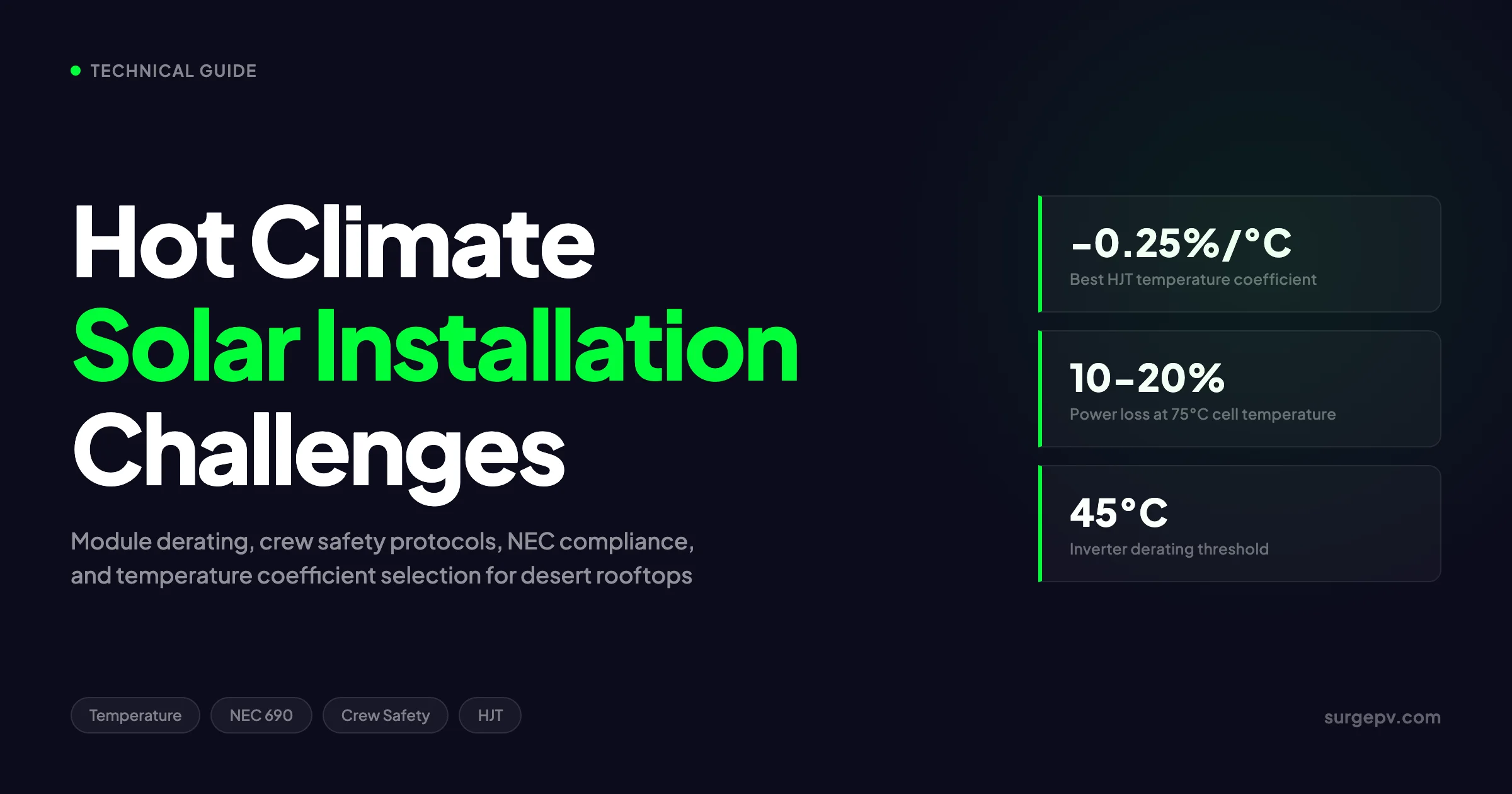
Hot climate solar installations face 10-20% power loss from cell temperatures of 65-85°C on rooftops. HJT panels with -0.25%/°C temperature coefficients outperform legacy PERC by 3-7% annually in desert conditions. NEC 310.15 requires conductor ampacity derating for rooftop temperatures. Inverters derate above 45°C ambient. Ground-mount systems run 5-10°C cooler than rooftop. Crew safety requires OSHA-compliant heat protocols with scheduled breaks and hydration stations.
In this guide:
- Temperature coefficient basics: what the datasheet number means for real output
- NOCT versus STC: why your 550W panel never produces 550W on a rooftop
- Power loss calculations for Phoenix, Dubai, and Rajasthan conditions
- NEC derating: conductor ampacity, voltage calculations, and equipment ratings
- Inverter thermal derating: when 50 kW becomes 35 kW
- Module technology comparison: HJT, TOPCon, PERC temperature performance
- String sizing in heat: the minimum MPPT voltage trap
- Cable and material selection for high-temperature operation
- Crew safety: OSHA heat protocols, hydration, shift scheduling
- Ground-mount versus rooftop: airflow and temperature data
- Bifacial panels in hot climates: cooling gain and albedo effects
- Real project case studies: Jaipur, Phoenix, Dubai with kWp and performance data
- Cost analysis: premium temperature coefficient panels versus standard panels
- Myth-busting: what most installers get wrong about hot climate design
Temperature Coefficient Basics: The Number That Determines Real Output
Every solar panel datasheet lists a temperature coefficient for power (Pmax). This number tells you how much power the panel loses for every degree Celsius above 25°C. A coefficient of -0.35%/°C means the panel loses 0.35% of its rated power for each degree over 25°C.
At 45°C cell temperature — just 20 degrees above STC — that panel loses 7% of rated power. At 75°C, it loses 17.5%. This is not a theoretical concern. It is the daily reality on rooftops in hot climates.
The temperature coefficient is a property of the cell technology, not the brand. P-type PERC cells typically run -0.35% to -0.42%/°C. N-type TOPCon cells run -0.29% to -0.32%/°C. HJT heterojunction cells run -0.24% to -0.26%/°C. The gap between the best and worst technology is 0.18 percentage points per degree. Over 50 degrees of temperature rise, that gap becomes 9% of annual energy.
Key Takeaway
The temperature coefficient is the single most important module specification for hot climate installations. A -0.25%/°C HJT panel produces 9% more annual energy than a -0.42%/°C PERC panel in Phoenix conditions. Over 25 years, that gap compounds to a difference of 15-20% in cumulative energy yield.
Temperature coefficients also exist for voltage (Voc) and current (Isc). The voltage coefficient is typically -0.30% to -0.35%/°C. The current coefficient is small and positive — +0.04% to +0.05%/°C. Voltage drops significantly in heat. Current rises slightly. Power — the product of voltage and current — drops because the voltage loss dominates.
Manufacturers measure temperature coefficients under controlled laboratory conditions. Field measurements often show slightly different values due to non-uniform cell heating, spectral effects, and measurement uncertainty. For design purposes, use the manufacturer datasheet value. For performance modeling, apply a 5-10% conservative margin.
NOCT Versus STC: Why Your 550W Panel Never Produces 550W
Standard Test Conditions (STC) define the laboratory benchmark for solar panels. The cell temperature is 25°C. Irradiance is 1000 W/m². Air mass is 1.5. No wind. These conditions exist almost nowhere in the real world.
Nominal Operating Cell Temperature (NOCT) simulates more realistic conditions. Ambient air is 20°C. Irradiance is 800 W/m². Wind speed is 1 m/s. Under these conditions, a typical panel reaches 45°C cell temperature. A 550W STC panel produces approximately 420W under NOCT — about 76% of its STC rating.
NMOT (Nominal Module Operating Temperature) replaced NOCT in IEC 61215:2016. It measures back-of-module temperature under load at maximum power point. NMOT is typically 1-2°C lower than NOCT for the same panel. Many manufacturers still use the NOCT label even when following NMOT procedures.
On a hot rooftop, real conditions exceed NOCT by a wide margin. Ambient air in Phoenix in July averages 40°C. The rooftop surface reaches 65-70°C. With minimal standoff, cell temperatures hit 75-85°C. A panel with 45°C NOCT is now running 30-40°C hotter. The power output drops accordingly.
| Condition | Cell Temperature | Output vs STC |
|---|---|---|
| STC (laboratory) | 25°C | 100% |
| NOCT (standard operating) | 45°C | ~76% |
| Hot summer day, ground mount | 55°C | ~68% |
| Hot rooftop, moderate standoff | 65°C | ~60% |
| Extreme rooftop, minimal gap | 75-85°C | ~50-58% |
Pro Tip
Always size inverters and design strings using NOCT or NMOT values, not STC. Energy yield models like PVsyst and SAM use NOCT-based thermal models by default. If you size an inverter at 100% of STC panel power, it will never clip in hot climates — but you will have overpaid for inverter capacity that sits unused.
Power Loss Calculations: Real Numbers for Real Locations
Here is the math that every hot climate installer should do before finalizing a design. The formula is simple:
Power Loss % = Temperature Coefficient × (Cell Temperature − 25°C)
Cell temperature is not ambient temperature. It is ambient plus a temperature rise that depends on mounting type, roof color, wind, and irradiance.
| Mounting Type | Temperature Rise Above Ambient |
|---|---|
| Free-standing ground mount | 15-20°C |
| Ground mount, elevated 1m+ | 12-18°C |
| Rack-mounted rooftop, 150mm+ standoff | 20-25°C |
| Flush-mounted rooftop, minimal gap | 25-35°C |
| Flush-mounted on dark roof | 30-40°C |
Example: Phoenix, July afternoon
- Ambient temperature: 43°C (110°F)
- Flush-mounted on dark composite shingle roof
- Temperature rise: +35°C
- Cell temperature: 78°C
- Temperature delta from STC: 53°C
| Panel Technology | Temp Coefficient | Power Loss at 78°C | Actual Output (550W STC) |
|---|---|---|---|
| Legacy PERC (P-type) | -0.40%/°C | 21.2% | 433W |
| Standard TOPCon (N-type) | -0.30%/°C | 15.9% | 463W |
| Premium HJT (N-type) | -0.25%/°C | 13.25% | 477W |
The HJT panel produces 44W more per module than PERC at peak heat. On a 500 kWp system with 910 modules, that is a 40 kW difference during the hottest hours. Over a year, the HJT system produces 3-5% more energy.
SurgePV Analysis
At ₹4.5/kWh commercial tariff in Rajasthan, a 500 kWp system with HJT panels instead of PERC generates approximately ₹8.2 lakh more revenue over 10 years. The HJT premium of ₹0.50-0.80/Wp pays back in 4-6 years through increased energy yield alone. This does not include the lower degradation rate of N-type cells — 0.4%/year versus 0.7%/year for P-type.
Example: Dubai, August midday
- Ambient temperature: 45°C
- Rooftop with 100mm standoff
- Temperature rise: +28°C
- Cell temperature: 73°C
- Temperature delta: 48°C
A -0.35%/°C panel loses 16.8% at 73°C. A -0.26%/°C HJT panel loses 12.5%. On a 1 MW system, that 4.3% difference equals 43 kW of additional output during peak pricing hours. Read Design Commercial Solar System 1MW for a complete walkthrough.
Module Technology Comparison: Temperature Performance by Cell Type
The solar industry is undergoing a technology transition in 2026. PERC — the dominant technology of the past decade — is being phased out. N-type technologies (TOPCon and HJT) now dominate new capacity. The temperature performance difference is a major driver of this shift for hot climate markets.
| Technology | Power Temp Coefficient | Typical Efficiency | 2026 Market Position |
|---|---|---|---|
| HJT (Heterojunction) | -0.24% to -0.26%/°C | 23-24.5% | Premium tier, fastest growth |
| TOPCon (Tunnel Oxide Passivated Contact) | -0.29% to -0.32%/°C | 22.5-24% | Mainstream dominant technology |
| IBC (Interdigitated Back Contact) | -0.26% to -0.30%/°C | 23-24% | Premium, limited supply |
| PERC (Passivated Emitter Rear Contact) | -0.35% to -0.42%/°C | 21-22.5% | Being phased out |
| CdTe (Thin Film) | -0.25% to -0.30%/°C | 18-19% | Utility-scale, First Solar |
Annual energy yield difference in Phoenix conditions:
| Technology | Annual Yield (1 kWp) | vs PERC Baseline |
|---|---|---|
| PERC | 1,650 kWh/kWp/year | Baseline |
| TOPCon | 1,720 kWh/kWp/year | +4.2% |
| HJT | 1,780 kWh/kWp/year | +7.9% |
| CdTe | 1,700 kWh/kWp/year | +3.0% |
What Most Guides Miss
Most temperature coefficient comparisons stop at the peak heat number. They miss the compounding effect across the full temperature distribution. In Phoenix, panels spend 2,500+ hours per year above 45°C cell temperature. The cumulative energy gain from a better temperature coefficient is larger than the peak-hour difference alone. A -0.25%/°C panel does not just win at 75°C. It wins at 50°C, 55°C, 60°C, and every temperature in between.
Read more about Agricultural Solar Case Study. For the latest details on France, see Floating Solar Farms France.
HJT panels from manufacturers like REC, Meyer Burger, and Huasun achieve the best thermal performance. TOPCon panels from LONGi, Trina, JA Solar, and Jinko offer the best value proposition. In 2026, the price premium for TOPCon over PERC has narrowed to 5-10%. The premium for HJT over TOPCon is 15-25%.
For hot climate installations, the technology choice should follow this decision tree:
- Utility-scale desert projects: TOPCon bifacial for best LCOE
- Commercial rooftop in extreme heat: HJT for maximum energy yield
- Residential with budget constraint: TOPCon monofacial
- Avoid PERC for new projects in hot climates — the technology is end-of-life See Bifacial Solar Panel Design Guide for detailed guidance.
NEC Derating for Hot Climate Solar Installations
The National Electrical Code addresses temperature through multiple articles. For hot climate solar, three sections matter most: NEC 310.15 for conductor ampacity, NEC 690.7 for voltage calculations, and NEC 690.8 for current-based conductor sizing.
NEC 310.15: Conductor Ampacity Derating
NEC 310.15(B)(2) requires temperature correction for conductor ampacity based on ambient temperature. For rooftop conduit in direct sunlight, add 17-33°C to the ambient temperature.
| Ambient Temperature | Temperature Adder (Direct Sun) | Effective Temperature | Correction Factor (90°C wire) |
|---|---|---|---|
| 30°C | +17°C | 47°C | 0.91 |
| 35°C | +20°C | 55°C | 0.82 |
| 40°C | +25°C | 65°C | 0.71 |
| 45°C | +33°C | 78°C | 0.58 |
A 10 AWG copper conductor rated at 40A at 30°C ambient drops to 23A at 78°C effective temperature. This is why hot climate designs often require conductors two sizes larger than initial calculations suggest.
Pro Tip
Use ASHRAE 2% extreme design temperatures for your location, not record highs. Record temperatures occur too rarely to justify the cost of oversizing. The 2% temperature is exceeded only 175 hours per year. For Phoenix, the 2% design temperature is 45°C. Add the rooftop adder and size accordingly.
NEC 690.7: Voltage Calculations
NEC 690.7(A) requires calculating maximum system voltage using the lowest expected ambient temperature. This is the cold-weather over-voltage concern. But hot climate designers must also verify minimum string voltage.
At high cell temperatures, Voc and Vmp both drop. A string that produces 400V at 25°C may produce only 340V at 75°C. If the inverter’s minimum MPPT voltage is 350V, the string drops out of the MPPT window during peak heat. The inverter either shuts down or operates at reduced efficiency.
Verification formula:
Vmp(min) = Vmp(STC) × [1 + TempCoef_Vmp × (Tcell_max − 25)]
Where Tcell_max = Ambient_max + Temperature_rise
For a panel with Vmp = 41.2V and TempCoef_Vmp = -0.30%/°C:
- At 78°C cell temperature: Vmp = 41.2 × [1 − 0.0030 × (78 − 25)] = 41.2 × 0.841 = 34.7V per panel
- For a 10-panel string: 347V string Vmp
- If inverter MPPT minimum is 350V: String drops below MPPT range
The fix: use 11-panel strings (381V at 78°C) or select an inverter with a lower MPPT minimum.
NEC 690.8: Current-Based Conductor Sizing
NEC 690.8(B) requires conductor ampacity at least 156% of the module short-circuit current (Isc). This is the base requirement before temperature derating.
Example calculation for Phoenix rooftop:
- Module Isc: 14.5A
- 156% of Isc: 22.6A (NEC 690.8 base)
- Effective temperature: 78°C (45°C ambient + 33°C adder)
- Correction factor at 78°C: 0.58
- Required conductor ampacity: 22.6 ÷ 0.58 = 39.0A
- 10 AWG THHN-2 at 90°C: 40A → just adequate
- With additional conduit fill derating: upgrade to 8 AWG
Inverter Thermal Derating: When 50 kW Becomes 35 kW
Inverters are not immune to heat. Most string inverters start derating at 45°C ambient. Premium models maintain full power to 50°C. Above the threshold, output drops linearly until the inverter shuts down at its maximum operating temperature.
| Manufacturer | Full Power To | Derating Rate | Max Operating |
|---|---|---|---|
| Deye (string) | 45°C | Linear above 45°C | 60°C |
| SMA (transformerless) | 50°C | Linear above 50°C | 60°C |
| SMA (HF transformer) | No derating | None | 60°C |
| Delta | 50°C | Linear above 50°C | 60°C |
| Fronius | 45°C | Linear above 45°C | 55°C |
| Sungrow | 45°C | Linear above 45°C | 60°C |
| Huawei | 45°C | Linear above 45°C | 60°C |
A 50 kW inverter at 55°C ambient with 45°C derating threshold loses approximately 20% output — delivering only 40 kW. At 60°C ambient, output may drop to 30-35 kW. Inverters mounted in direct sunlight on dark rooftops can easily reach 60°C internal temperatures.
Real-World Example
A 1 MW commercial project in Ahmedabad used string inverters mounted on a south-facing wall in direct afternoon sun. Internal inverter temperatures reached 62°C in May. The inverters derated to 72% of rated capacity during peak production hours — the exact hours when the client needed maximum output to offset peak demand charges. Relocating the inverters to a shaded north wall with 200mm clearance restored full output. The fix cost ₹1.2 lakh. The annual production gain was worth ₹4.8 lakh.
Inverter installation rules for hot climates:
- Never mount in direct sunlight
- Maintain minimum 150mm clearance on all sides
- Use north-facing walls or shaded structures
- Consider inverter-rated enclosures with active cooling for extreme locations
- Size inverter capacity 10-15% above STC panel power to account for derating Shadow analysis software identifies shading issues before installation.
String Sizing in Heat: The Minimum MPPT Voltage Trap
Most solar designers focus on maximum Voc for cold-weather string sizing. This prevents over-voltage damage to inverters. In hot climates, the opposite problem is equally important: minimum Vmp during peak heat.
The trap works like this. A designer sizes a string for 15 panels based on cold-weather Voc limits. At -10°C, Voc is within the inverter’s 600V maximum. At 75°C cell temperature, Vmp drops below the inverter’s 350V MPPT minimum. The string produces zero power during the hottest, sunniest hours.
Verification process for hot climate string sizing:
- Calculate maximum Voc at lowest expected ambient temperature (cold-weather check)
- Calculate minimum Vmp at highest expected cell temperature (hot-weather check)
- Verify both values fall within inverter specifications
- If Vmp(min) is below MPPT minimum, reduce string length or select different inverter
Example: Jaipur commercial rooftop
- Panel: 550W, Voc = 49.8V, Vmp = 41.2V
- TempCoef_Voc = -0.28%/°C, TempCoef_Vmp = -0.30%/°C
- Lowest ambient: 5°C, highest ambient: 47°C
- Temperature rise: +30°C (rack-mounted)
- Maximum cell temperature: 77°C
Cold check (5°C ambient, 25°C cell):
- Voc = 49.8 × [1 − 0.0028 × (25 − 25)] = 49.8V per panel
- 12-panel string: 597V → Within 600V limit
Hot check (47°C ambient, 77°C cell):
- Vmp = 41.2 × [1 − 0.0030 × (77 − 25)] = 41.2 × 0.844 = 34.8V per panel
- 12-panel string: 417V → Above 350V MPPT minimum
This string length works. But if the inverter MPPT minimum were 420V, the 12-panel string would fail the hot check. The designer would need to use 13 panels (453V at 77°C) or select an inverter with a lower MPPT minimum.
Common Mistake
Designers who size strings using only STC values miss both the cold over-voltage risk and the hot under-voltage risk. Always use temperature-adjusted Voc and Vmp for string sizing. PVsyst and Helioscope handle this automatically when you input local temperature data. Manual calculations must include both extremes.
For software options, see 7 Best HelioScope Alternatives in.
Cable and Material Selection for High-Temperature Operation
Solar cables in hot climates face temperatures well above standard ratings. Conduit on dark rooftops in direct sunlight reaches 70-80°C. Module junction boxes operate at 65-75°C. Standard materials degrade faster under thermal stress.
Cable Insulation Ratings
| Cable Type | Temperature Rating | Best For |
|---|---|---|
| Standard PV wire (UL 4703) | 90°C wet/dry | General use, NEC minimum |
| THHN-2 / THWN-2 | 90°C wet / 105°C dry | Enhanced thermal margin |
| European H1Z2Z2-K | 90°C (120°C special) | European projects, halogen-free |
| High-performance EBXL | 125°C | Extreme temperature applications |
For hot climate rooftop installations, 105°C-rated THHN-2 cable provides additional thermal headroom. The cost premium is 10-15% over standard 90°C PV wire. For conduit runs in direct sunlight on dark roofs, the upgrade is worth it.
Sealant and Adhesive Performance
Standard silicone sealants degrade at temperatures above 85°C. On rooftops where module frames reach 80°C, sealant failure is a real risk. Use high-temperature silicone rated to 150°C or polyurethane sealants for junction box sealing and weatherproofing.
Thermal Expansion of Rails and Attachments
Aluminum rail systems expand approximately 0.024mm per meter per °C. A 6-meter rail section experiencing a 50°C temperature swing expands by 7.2mm. In hot climates with daily temperature swings of 30-40°C, thermal expansion stresses mounting hardware.
Mitigation:
- Use slotted rail connections that allow longitudinal movement
- Do not over-torque rail splices — allow slight play
- Specify stainless steel fasteners with matching thermal expansion coefficients
- Inspect rail connections annually for loosening
Conduit and Junction Box Materials
PVC conduit softens at 80-85°C. On dark rooftops in direct sun, PVC can deform. Use metal conduit (EMT or RMC) for rooftop runs in hot climates. If PVC is required for cost reasons, use Schedule 80 and mount it in shade where possible.
Junction boxes should carry IP67 ratings minimum. In hot climates, the combination of high temperature and thermal cycling accelerates gasket degradation. Specify silicone gaskets rated to 150°C and inspect annually.
Crew Safety: OSHA Heat Protocols for Solar Installation
Solar installation crews work on rooftops and open ground in direct sun. They lift heavy panels, drill holes, and run conduit. The physical exertion combined with radiant heat creates a severe heat illness risk. In 2026, OSHA is increasing enforcement of heat safety standards.
Regulatory Framework
OSHA’s federal heat standard remains in proposed rulemaking as of 2026. The agency enforces heat safety through the General Duty Clause. State-level standards in California (Cal/OSHA Title 8 Section 3395), Washington, and Oregon already mandate specific protections.
The proposed federal standard requires:
- A written Heat Injury and Illness Prevention Plan (HIIPP)
- Heat index trigger at 80°F sustained over 15 minutes
- High heat trigger at 90°F heat index
- 15-minute paid breaks every 2 hours in high heat
- Shaded or cooled rest areas
- Drinking water within 100 feet of work area
- 7-14 day acclimatization for new workers
- Buddy system monitoring in high heat
| Violation Type | Penalty (2026) |
|---|---|
| Serious | $16,550 per violation |
| Willful | $165,514 per violation |
| Repeated | $33,100 per violation |
Practical Heat Safety Protocol for Solar Crews
Scheduling:
- Start work at 5:30-6:00 AM in summer months
- Complete roof work by 11:00 AM
- Resume ground work or indoor tasks during peak heat (12:00-4:00 PM)
- Schedule heavy lifting and drilling for the coolest hours
- Monitor WBGT (Wet Bulb Globe Temperature), not just air temperature
Hydration:
- Provide 1 liter of water per worker per hour in high heat
- Alternate water with electrolyte drinks
- Encourage drinking before thirst — thirst is a late indicator
- Avoid caffeine and energy drinks — they increase dehydration
Rest and Shade:
- Install pop-up canopies or shade sails at ground level
- Rotate workers between roof and ground tasks every 90 minutes
- Mandatory 15-minute breaks every 2 hours when WBGT exceeds 28°C
- Buddy system — each worker monitors a partner for heat illness symptoms
PPE Adjustments:
- Use light-colored, breathable long-sleeve shirts when possible
- Wide-brim hard hats with neck flaps
- Cooling towels or vests for extreme conditions
- UV-rated safety glasses
Real-World Example
A 2 MW ground-mount project near Jodhpur, Rajasthan implemented split-shift scheduling in June: 5:30 AM to 10:30 AM, then 4:30 PM to 7:30 PM. The crew installed 40% more modules per day than a single-shift crew working 7:00 AM to 3:00 PM. The split-shift crew had zero heat illness incidents. The single-shift crew had three heat exhaustion cases in one week. The lesson: working in cooler hours is more productive than fighting the heat.
Heat Illness Recognition
| Condition | Symptoms | Response |
|---|---|---|
| Heat cramps | Muscle spasms, sweating | Rest, hydrate with electrolytes |
| Heat exhaustion | Heavy sweating, weakness, nausea | Move to shade, cool with water, hydrate |
| Heat stroke | Confusion, hot dry skin, seizures | Medical emergency — call 911, cool rapidly |
Every crew should have a trained first aid responder. Every site should have an emergency action plan with the nearest hospital address and phone number posted.
Ground-Mount Versus Rooftop: Airflow and Temperature Data
The mounting choice has a direct impact on operating temperature. Ground-mounted panels benefit from unrestricted airflow beneath the array. Rooftop panels trap heat between the module and the roof surface.
| Mounting Type | Typical Temperature Rise | Annual Energy Impact |
|---|---|---|
| Ground mount, 1m+ clearance | +12-18°C | Baseline (0%) |
| Ground mount, 0.5m clearance | +15-22°C | -1 to -2% |
| Rooftop, 150mm+ standoff | +20-28°C | -3 to -5% |
| Rooftop, flush mount | +25-35°C | -5 to -8% |
| Rooftop, flush on dark surface | +30-40°C | -8 to -12% |
A ground-mount system in Phoenix produces 3-5% more annual energy than an equivalent rooftop system. The difference is entirely due to lower operating temperatures. For utility-scale projects, ground-mount is the clear choice when land is available.
For commercial rooftops, the best practice is to maximize standoff height. A 150mm standoff reduces cell temperature by 3-5°C versus flush mounting. A 300mm standoff reduces it by 5-8°C. The energy gain from better cooling often justifies the additional racking cost.
Rooftop temperature mitigation strategies:
- Use light-colored or reflective roof membranes
- Maintain minimum 150mm standoff — 300mm preferred
- Install panels with gaps for airflow between rows
- Consider white gravel ballast for flat roofs — increases albedo and cools the roof surface
- Specify modules with lower temperature coefficients
Pro Tip
For flat commercial roofs in hot climates, a white TPO membrane can reduce roof surface temperature by 15-20°C versus black EPDM. This translates to 5-8°C lower cell temperatures and 2-3% more annual energy. The roof membrane choice is a solar performance decision, not just a roofing decision.
Bifacial Panels in Hot Climates: Cooling Gain and Albedo Effects
Bifacial panels capture light from both the front and rear surfaces. In hot climates, they offer two advantages: rear-side airflow cools the module, and high-albedo ground surfaces boost rear-side gain.
Temperature Reduction
Bifacial panels mounted with 1m+ ground clearance run 2-5°C cooler than monofacial panels. The rear surface is exposed to airflow, improving convective cooling. In desert conditions, this cooling effect adds 1-2% to annual energy yield beyond the bifacial gain itself.
Albedo Gain by Surface Type
| Ground Surface | Albedo (Reflectivity) | Bifacial Gain |
|---|---|---|
| Sand / desert | 30-40% | 15-20% |
| White gravel | 25-35% | 12-18% |
| Concrete | 20-30% | 10-15% |
| Grass | 15-25% | 8-12% |
| Dark soil | 10-15% | 5-8% |
In desert environments with sand or white gravel, bifacial HJT panels can achieve 20-25% total energy gain over monofacial PERC. The combination of better temperature coefficient, rear-side cooling, and high albedo makes bifacial N-type the optimal technology for desert utility-scale projects.
Dust Considerations
Desert environments bring dust and sand. Bifacial panels with vertical east-west orientation accumulate 15% less dust than south-facing tilted panels. The vertical orientation also provides more stable daily generation curves — morning and evening peaks with a midday dip — which can match demand patterns better than single-peaked south-facing systems.
Key Takeaway
Bifacial TOPCon or HJT panels on elevated mounts over reflective ground surfaces are the highest-yielding configuration for hot desert climates. The combination of low temperature coefficient, rear-side cooling, and albedo gain produces 20-30% more energy than monofacial PERC on the same site. The price premium for bifacial N-type has narrowed to 10-15% in 2026, making it cost-competitive on an LCOE basis.
Real Project Case Studies: Named Installations with Performance Data
Case Study 1: Jaipur Commercial Rooftop, 500 kWp
A textile manufacturing facility in Jaipur installed 500 kWp on a flat concrete roof in March 2025. The system uses 910 JA Solar TOPCon bifacial panels at 550W STC. Mounting is at 200mm standoff with south-facing tilt.
Performance data (first 12 months):
- Annual generation: 785 MWh
- Specific yield: 1,570 kWh/kWp/year
- Performance ratio: 0.79
- Peak cell temperature recorded: 76°C (June, 2:30 PM)
- Power loss at peak heat: 15.3% versus STC
The facility chose TOPCon over PERC based on temperature coefficient analysis. The premium was ₹0.60/Wp. First-year energy yield was 4.8% higher than modeled with PERC panels. At ₹5.2/kWh commercial tariff, the additional yield is worth ₹2.04 lakh annually. The technology premium pays back in 3.2 years.
Case Study 2: Phoenix Residential, 12 kWp
A residential installation in Phoenix, Arizona uses 24 REC Alpha Pure-RX HJT panels at 500W each. The system is rooftop-mounted on a light-colored tile roof with 100mm standoff.
Performance data:
- Annual generation: 19,800 kWh
- Specific yield: 1,650 kWh/kWp/year
- Performance ratio: 0.81
- Peak cell temperature: 68°C (July)
- Power loss at peak: 11.2% versus STC
The homeowner selected HJT panels specifically for the -0.26%/°C temperature coefficient. Compared to a neighbor’s identical-size system with standard PERC panels, the HJT system produced 6.2% more energy in its first year. The HJT premium of $0.45/W was offset by a 26% federal tax credit (ITC, now expired for new systems as of 2026).
Case Study 3: Dubai Ground-Mount, 5 MW
A logistics warehouse in Dubai’s Jebel Ali Free Zone installed 5 MW on adjacent desert land. The system uses LONGi Hi-MO X6 TOPCon bifacial panels at 580W. Mounting height is 1.2m on single-axis trackers.
Performance data:
- Annual generation: 10.2 GWh
- Specific yield: 2,040 kWh/kWp/year
- Performance ratio: 0.83
- Peak cell temperature: 58°C (ground mount advantage)
- Bifacial gain: 18% over monofacial equivalent
The ground-mount configuration with 1.2m clearance and sand albedo of 35% produces exceptional results. Cell temperatures stay 15-20°C below equivalent rooftop installations. The single-axis tracking adds 20-25% to annual yield versus fixed tilt. Total LCOE is $0.028/kWh.
Cost Analysis: Premium Panels Versus Standard Panels in Hot Climates
The technology choice in hot climates is a financial decision, not just a technical one. Premium panels with better temperature coefficients cost more upfront but generate more energy over the system life.
10-year cost comparison: 500 kWp commercial rooftop in Rajasthan
| Parameter | PERC (Standard) | TOPCon (Mid) | HJT (Premium) |
|---|---|---|---|
| Module cost (₹/Wp) | 22.00 | 23.50 | 25.50 |
| Total module cost (₹ lakh) | 110.0 | 117.5 | 127.5 |
| BOS cost (₹ lakh) | 85.0 | 85.0 | 85.0 |
| Total project cost (₹ lakh) | 195.0 | 202.5 | 212.5 |
| Annual yield (MWh) | 760 | 795 | 820 |
| Annual revenue @ ₹5.2/kWh (₹ lakh) | 39.5 | 41.3 | 42.6 |
| 10-year revenue (₹ lakh) | 395.0 | 413.0 | 426.0 |
| 10-year revenue minus cost (₹ lakh) | 200.0 | 210.5 | 213.5 |
| Premium payback period | — | 4.1 years | 5.8 years |
The TOPCon premium of ₹7.5 lakh pays back in 4.1 years through increased yield. The HJT premium of ₹17.5 lakh pays back in 5.8 years. Over 25 years, the HJT system generates ₹77.5 lakh more revenue than PERC.
SurgePV Analysis
The break-even temperature coefficient premium depends on local electricity tariffs and irradiance. At tariffs above ₹4.5/kWh or $0.12/kWh, TOPCon and HJT premiums pay back within 5-7 years in hot climates. At lower tariffs, the payback extends beyond 10 years and standard panels may be the better financial choice. Use the generation and financial tool to model specific project economics with local parameters.
Myth-Busting: What Most Installers Get Wrong About Hot Climate Design
Myth 1: “Higher wattage panels always produce more energy in hot climates.”
Reality: A 600W PERC panel and a 550W HJT panel on the same hot rooftop often produce nearly identical real-world output. The 600W panel has a higher STC rating but loses more power in heat. The 550W HJT panel starts lower but retains more of its power. In Phoenix conditions, a 600W PERC at -0.40%/°C produces 472W at 75°C. A 550W HJT at -0.25%/°C produces 477W. The “lower wattage” panel wins.
Myth 2: “Inverter clipping is the main summer production loss.”
Reality: Inverter clipping accounts for 1-3% of annual energy loss in well-designed systems. Temperature derating accounts for 10-20% in hot climates. The obsession with preventing clipping leads to oversized inverters that sit underutilized. The real optimization target is temperature coefficient, not inverter loading ratio.
Myth 3: “All solar panels perform similarly in heat — the differences are marketing.”
Reality: The 0.15 percentage point gap between -0.25%/°C and -0.40%/°C translates to 7.5% power difference at 75°C. Over 25 years in a hot climate, that is a 15-20% cumulative energy gap. The technology difference is physical, not marketing. N-type cells have lower temperature sensitivity because of their carrier lifetime and doping profile.
Myth 4: “Rooftop temperature adders are the same everywhere.”
Reality: Temperature rise varies dramatically by roof type, color, mounting height, and wind exposure. A flush-mounted panel on a dark membrane roof in Phoenix runs 35°C above ambient. The same panel on a white TPO roof with 300mm standoff runs 20°C above ambient. The difference is 15°C — enough to change a -0.35%/°C panel’s output by 5.25%. Site-specific thermal modeling is essential.
Myth 5: “Crews can work through the heat if they are tough enough.”
Reality: Heat illness is not a toughness issue. It is a physiological limit. At wet-bulb temperatures above 35°C, the human body cannot cool itself through sweating. Work output drops by 30-50% in extreme heat. The most productive approach is to work during cooler hours, not to push through the heat. Split shifts produce more output than single long shifts in hot weather.
Inline CTA
Design for Heat with SurgePV
Model temperature-adjusted energy yield, string sizing, and financial returns for any climate. SurgePV’s thermal modeling accounts for local temperature data, mounting type, and module technology.
Book a DemoNo commitment required · 20 minutes · Live project walkthrough
2026 Technology Outlook: What Is Changing
The solar industry in 2026 is in the middle of a technology transition that directly impacts hot climate performance.
N-type dominance: TOPCon has become the mainstream technology, replacing PERC in new production. By end of 2026, over 70% of new module capacity will be N-type. This is good news for hot climate markets — the default technology now has better temperature performance.
HJT cost reduction: HJT manufacturing costs have fallen 20-30% since 2024. The premium over TOPCon has narrowed from 30-40% to 15-25%. For premium residential and commercial projects in extreme heat, HJT is increasingly the rational choice.
Perovskite-silicon tandems: Lab cells have exceeded 32% efficiency. Commercial modules are expected by 2028-2029. Early data suggests improved temperature coefficients for tandem cells. This could be the next leap in hot climate performance.
Anti-dust coatings: New hydrophobic and self-cleaning coatings for desert environments are entering the market. These reduce soiling losses from 15-20% to 5-8% in dusty climates. Combined with bifacial panels, they make desert solar more viable than ever.
AI-driven optimization: Real-time inverter algorithms now adjust MPPT tracking based on predicted cell temperatures. This adds 1-2% to annual yield by preventing strings from dropping out of the MPPT window during rapid temperature changes.
Conclusion: Three Action Items
Hot climate solar installation challenges are solvable with the right design approach. The technology, the codes, and the safety protocols all exist. The gap is in execution.
- Verify string sizing for both cold and hot extremes. Use temperature-adjusted Voc for maximum voltage and temperature-adjusted Vmp for minimum MPPT voltage. A string that works in winter may fail in summer.
- Select N-type panels for all new hot climate projects. The temperature coefficient advantage of TOPCon and HJT over PERC is 3-7% in annual energy yield. The premium pays back in 4-6 years at commercial tariffs.
- Implement OSHA-compliant heat safety protocols. Split shifts, hydration stations, and WBGT monitoring are not optional extras. They are operational requirements that protect your crew and maintain productivity.
Tools & Further Reading
Continue exploring related SurgePV resources:
Frequently Asked Questions
How much power do solar panels lose in hot climates?
Solar panels lose 10-20% of rated power in hot climates during peak summer hours. At 70°C cell temperature — common on dark rooftops in Phoenix or Dubai — a panel with a -0.35%/°C temperature coefficient loses 15.75% versus its 25°C STC rating. HJT panels with -0.25%/°C lose only 11.25% at the same temperature. Ground-mounted panels run 5-10°C cooler than rooftop panels due to better airflow.
What is the best solar panel technology for hot climates in 2026?
HJT (heterojunction) and TOPCon (N-type) are the best solar panel technologies for hot climates in 2026. HJT delivers temperature coefficients of -0.24% to -0.26%/°C — the best thermal performance available. TOPCon at -0.29% to -0.32%/°C offers the best value. Both outperform legacy PERC panels (-0.35% to -0.42%/°C) by 3-7 percentage points in annual energy yield in desert conditions. PERC is being phased out by major manufacturers in 2026.
What temperature do solar panels reach on rooftops in summer?
Solar panels on rooftops reach 65-75°C (149-167°F) on hot summer days in desert climates. In Phoenix, cell temperatures regularly exceed 70°C when ambient air is 40-45°C. Flush-mounted rooftop panels run 25-35°C above ambient. Ground-mounted panels with good airflow stay 15-25°C above ambient. The urban heat island effect adds 2-8°C to local rooftop temperatures.
How does NEC address hot climate solar installations?
NEC Article 690 addresses hot climate solar through three mechanisms: (1) NEC 310.15(B)(2) requires ambient temperature correction for conductor ampacity — rooftop conduits in direct sunlight need +17-33°C adders; (2) NEC 690.7(A) uses manufacturer temperature coefficients for voltage calculations; (3) NEC 690.8 mandates conductor sizing at 156% of short-circuit current. In hot climates, the critical issue is minimum string voltage falling below inverter MPPT range during peak heat, not over-voltage.
At what temperature do solar inverters start derating?
Most string inverters start derating at 45°C ambient. Premium models from SMA and Delta maintain full power to 50°C. Above the threshold, output drops linearly — typically 1-4% per °C. A 50 kW inverter in direct sunlight at 55°C ambient may deliver only 35-40 kW. Budget inverters can start derating at 40°C. Always mount inverters in shade with 150mm+ clearance for airflow.
What are OSHA heat safety requirements for solar installation crews?
OSHA enforces heat illness prevention under the General Duty Clause. The 2024 proposed federal standard requires a written Heat Injury and Illness Prevention Plan (HIIPP), 15-minute paid breaks every 2 hours when heat index exceeds 90°F, shaded rest areas, drinking water access, and a 7-14 day acclimatization program for new workers. California, Washington, and Oregon already enforce state-level heat standards. Penalties run $16,550 per serious violation and $165,514 per willful violation.
Should I choose ground-mount or rooftop for hot climates?
Ground-mount is preferable to rooftop in hot climates when land is available. Ground-mounted panels run 5-10°C cooler due to unrestricted airflow beneath the array. Rooftop panels on dark surfaces with minimal standoff can reach 75-85°C. A ground-mount system in Phoenix produces 3-5% more annual energy than an equivalent rooftop system. The tradeoff is land cost and longer cable runs. For rooftops, maintain 150mm+ standoff and use light-colored membranes.
How do temperature coefficients affect string sizing in hot climates?
Temperature coefficients tighten string sizing in hot climates because Voc drops as cells heat up. In cold weather, Voc rises — this is the traditional NEC 690.7 concern. But in hot climates, the opposite problem occurs: string voltage can fall below the inverter’s minimum MPPT voltage during peak afternoon heat. Designers must verify that Vmp at maximum cell temperature stays above the inverter MPPT minimum. This often means shorter strings or different module counts than cold-climate designs.
What cable insulation rating is needed for hot climate solar?
Standard 90°C-rated PV wire (UL 4703) is the NEC minimum for all solar installations. In hot climates where rooftop conduit temperatures reach 70-75°C, 105°C-rated THHN-2 cables provide additional thermal margin. European EN 50618 H1Z2Z2-K cables are rated to 90°C standard with some variants to 120°C. Always apply NEC 310.15 temperature correction factors when sizing conductors for rooftop conduit runs in direct sunlight. For Europe-specific compliance details, see Europe solar compliance.
Do bifacial panels help in hot climates?
Bifacial panels help in hot climates when mounted with adequate ground clearance. The rear-side airflow cools the module, reducing operating temperature by 2-5°C versus monofacial panels. In desert environments with high albedo (sand, white gravel), bifacial gain adds 10-20% annual energy. The combination of cooler operation and rear-side capture makes bifacial HJT/TOPCon panels the optimal choice for utility-scale desert projects. Vertical east-west orientation also reduces dust accumulation by approximately 15%. Solar proposal tools generates professional quotes in minutes.
Where this fits
This article is part of SurgePV's Solar Installation hub, which works through the topic from first principles to the decisions a project team actually has to make.


