Quick Answer
A solar array on a 24-unit walkup is not a scaled-up house design — the engineering, the regulatory path, and the business model all change. Solar developers who win apartment projects spend the first month on legal and political work, not engineering. A 6 inch poured concrete slab with reasonable rebar will carry far more than a typical PV array imposes.
Concrete flat roofs on apartment buildings are some of the most underused solar real estate in dense cities, yet they sit at the intersection of three problems that single-family roofs never face: shared ownership, multi-unit electrical distribution, and the structural conservatism of multi-story residential codes. A solar array on a 24-unit walkup is not a scaled-up house design — the engineering, the regulatory path, and the business model all change.
A solar array on a 24-unit walkup is not a scaled-up house design — the engineering, the regulatory path, and the business model all change. Solar developers who win apartment projects spend the first month on legal and political work, not engineering.
This guide walks through how to design a solar panels apartment flat roof project from the first structural inquiry to the final electrical handoff, with specific numbers for ballast weight, tilt selection, fire setbacks, and tenant distribution models that actually pass permit review.
TL;DR — Apartment Flat Roof Solar Design
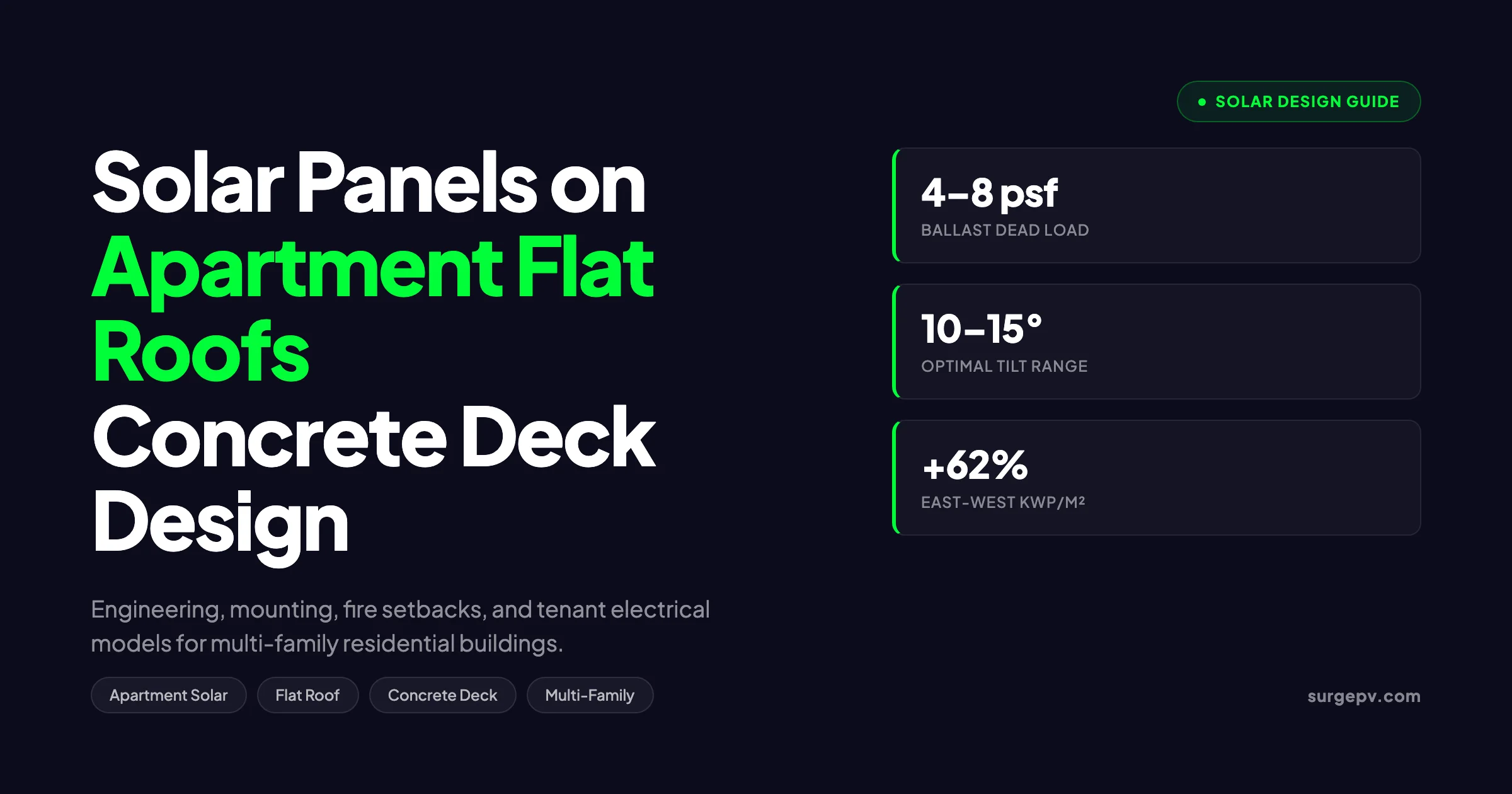
Most concrete apartment roofs built after 1970 can carry a 4 to 8 psf ballasted array without retrofit. The hard parts are not structural — they are getting HOA or owner approval, picking a tenant electrical model that complies with local rules, meeting fire setbacks on residential roofs, and designing around parapets, stair towers, and HVAC clutter. East-west layouts at 5 to 10 degrees usually win on apartments because they pack more kilowatts per square meter and match daytime apartment loads better than south-facing arrays.
What this guide covers:
- Why apartment flat roofs differ from commercial and single-family roofs
- Structural assessment of poured concrete decks on multi-story buildings
- Ballasted versus mechanically attached mounting on apartment slabs
- Tilt and orientation strategy for limited roof footprints
- Fire access setbacks specific to residential occupancy
- Inter-row spacing and shading from parapets and stair towers
- Electrical distribution models for tenants, owners, and common areas
- Permit packaging and the structural engineer’s role
- Cost and ROI numbers for typical apartment buildings
Why Apartment Flat Roofs Are Different
Three factors separate apartment solar from any other rooftop project. Get these wrong at scoping and the project stalls before engineering begins.
Shared roof ownership
A single-family roof has one decision-maker. An apartment roof has many. Condo associations vote, HOA boards review, leaseholders consult their landlords, and rental owners weigh tenant relations against capital allocation. Solar developers who win apartment projects spend the first month on legal and political work, not engineering. Confirm in writing who can authorize the project before a structural engineer sets foot on the building.
Residential occupancy below the roof
A commercial roof sits above warehouse space, office floors, or retail. An apartment roof sits above bedrooms. Fire codes treat residential occupancy more strictly because evacuation is slower and people sleep beneath the array. Most jurisdictions apply tighter setback rules and require fire-rated cable pathways on residential buildings over three stories. The International Fire Code Section 1205 and the European EN 50539 family both reflect this, and AHJs almost always plan-check apartment solar more carefully than commercial solar of the same kilowatt size. Also see: European Solar Tax Credits. For Europe-specific compliance details, see Europe solar compliance.
Multi-meter electrical distribution
Single-family solar wires to one main panel and one utility meter. Apartment solar has to choose between several distribution paths: a single common-area meter that offsets only shared loads, multiple submeters that bill tenants separately, virtual net metering where allowed, or behind-the-meter sales between landlord and tenants. Each path triggers different inverter topology, different metering hardware, and different regulatory approvals.
Pro Tip
Run a 30 minute kickoff call with the building owner or HOA before any site visit. Ask three questions: who legally owns the roof, who pays the electric bills today, and who keeps the savings. The answers determine the entire system architecture, and they often kill projects that looked good on paper.
Structural Assessment of Concrete Decks
Concrete is forgiving compared with light-frame wood or steel deck construction. A 6 inch poured concrete slab with reasonable rebar will carry far more than a typical PV array imposes. The risk is not the modern slab — it is the roof history.
What apartment roofs typically support
| Construction era | Typical slab type | Live load capacity | PV dead load margin |
|---|---|---|---|
| Pre-1950 | Concrete plank or filler joist | 40 psf live + 10 psf dead | Often tight, retrofit common |
| 1950-1970 | Poured concrete on steel deck | 60 psf live + 15 psf dead | Usually fine for 4-6 psf PV |
| 1970-2000 | Poured concrete or precast hollow-core | 60-100 psf live + 15-25 psf dead | Comfortable for 6-8 psf PV |
| Post-2000 | Engineered concrete or composite | 100+ psf live + 20-30 psf dead | Ample margin |
These are typical values, not design values. The actual capacity depends on the original architectural drawings, any subsequent overlays, the condition of the membrane, and water damage history. A structural engineer must verify the numbers for each building.
What kills the structural case
The most common reasons a concrete apartment roof fails the PV check:
- Multiple membrane overlays. Many older roofs have three or four roofing membranes stacked over decades, each adding 1 to 3 psf of dead load. The cumulative weight eats into the PV margin.
- Existing rooftop equipment. HVAC condensers, water tanks, antennas, and elevator machinery already consume part of the load budget. Map every piece of equipment before specifying ballast weight.
- Pre-1980 construction in seismic zones. Older slabs in California, Italy, Greece, Turkey, and Japan often need a seismic retrofit before any new dead load is added. The PV project triggers the retrofit cost.
- Water damage and rebar corrosion. A core sample from the engineer reveals what the architectural drawings cannot. Spalling concrete or rust on the rebar drops the effective capacity by 20 to 40 percent. Also see: solar panel ROI in Italy.
The structural engineer’s deliverable
A complete structural letter for an apartment solar project includes:
- The current allowable live load in psf or kg per square meter
- The current dead load from existing equipment and overlays
- The proposed PV dead load including ballast, racking, modules, and conductors
- Wind and snow loads per the local code (ASCE 7-22 in the US, Eurocode 1 in Europe)
- A statement that the combined load remains within the slab’s capacity at every roof zone
- The engineer’s seal and a date
Without this letter, no AHJ will issue a permit, and no insurer will cover the array.
Ballasted Versus Mechanically Attached Mounting
Concrete decks are the easiest substrate for both mounting types. The choice between them comes down to wind exposure, structural margin, and roof penetration policy.
Ballasted racking on concrete
Ballasted systems hold the racking down with concrete blocks or weighted trays instead of bolts. They suit concrete decks because the slab tolerates concentrated point loads from ballast blocks much better than steel deck or wood-framed construction. The full mechanics of ballast and tilt tradeoffs are covered in our flat roof ballasted systems guide.
For apartment buildings specifically:
- Interior zones typically need 4 to 6 psf of ballast for a 10 degree tilt array.
- Perimeter zones within 10 percent of the roof width need 6 to 9 psf because of edge wind acceleration.
- Corner zones within 10 percent of the roof width and length need 9 to 14 psf, the highest in any apartment installation.
Tall apartment buildings — over 60 feet (18 meters) above grade — sit in higher wind exposure categories and need proportionally more ballast. Above 130 feet (40 meters), ballast volume often becomes uneconomical and mechanical attachment wins.
Mechanically attached on concrete
Anchored systems penetrate the concrete deck with expansion anchors or epoxy-set studs. The membrane is sealed around each penetration with a flashing boot. This adds about 3 to 4 psf of dead load instead of 4 to 8 psf, freeing structural margin for taller towers or marginal slabs.
The downsides on apartments:
- Membrane warranty risk. Most modern TPO and EPDM warranties survive certified penetration kits, but the roofing manufacturer must approve the kit in writing before drilling.
- Leak risk over occupied space. A leak above a residential unit creates a habitability complaint, not just a maintenance ticket. Ballasted systems eliminate this risk entirely.
- Slower install. Each anchor needs core drilling, anchor setting, flashing, and inspection. Add 30 to 50 percent more labor hours versus ballast.
Hybrid layouts
The cleanest answer for many apartment buildings is hybrid: ballasted in the interior zones where ballast weight is reasonable, mechanically attached at the corners and perimeters where ballast volume gets out of hand. Most major racking vendors publish hybrid configurations in their wind tunnel reports.
SolSmart’s structural commentary for rooftop PV is a useful reference for the dead load and wind load assumptions that AHJs accept on multi-family buildings.
Tilt Angle and Orientation Strategy
Apartment roofs rarely have the footprint to waste on inter-row gaps. The tilt and orientation choice has to balance annual energy yield against the number of panels that fit.
Tilt angle physics on a small footprint
A south-facing array tilted at the local latitude produces the most energy per panel — but inter-row spacing eats half the roof. A flatter array packs more panels but produces less per panel. The math usually favors flatter on apartments:
| Tilt | Energy per panel (% of latitude tilt) | Roof packing density | Total kWh per square meter |
|---|---|---|---|
| 30 degrees south | 100 percent | 50 percent | 1.00x |
| 15 degrees south | 95 percent | 65 percent | 1.24x |
| 10 degrees south | 92 percent | 75 percent | 1.38x |
| 5 degrees east-west | 85 percent | 95 percent | 1.62x |
| Flat (0 degrees) | 80 percent | 100 percent | 1.60x |
For apartment buildings in the 40 to 55 degree latitude band — which covers most of Europe, the northern US, and Canada — east-west layouts at 5 to 10 degree tilt produce the most total kWh per square meter of roof. The detailed comparison sits in our east-west versus south-facing layouts guide. For France-specific information, see Agricultural Solar Case Study. For Canada-specific compliance details, see Canada comparisons/solar-designing.
The exception is buildings closer to the equator (under 35 degree latitude) where the sun is high overhead year-round. There the latitude-tilt south-facing array still wins because the inter-row gap is smaller.
Why east-west often wins on apartments
Three reasons beyond the packing math:
- Daily generation profile matches load. Apartment buildings draw morning and evening peaks for cooking, lighting, EV charging, and laundry. East-west arrays produce a flatter daily curve with stronger morning and evening output than south-facing arrays.
- Lower ballast per panel. A 5 degree array needs roughly half the ballast of a 15 degree array because frontal area is smaller. This matters when slab capacity is tight.
- No row-to-row shading. East-west modules face away from each other, so winter sun never has to clear an upstream row. Spacing tightens to 0 inches in many cases.
The cost: about 10 to 15 percent less annual energy per panel. On a roof where panel count is the bottleneck, that loss is more than offset by the higher panel count.
Latitude tilt remains useful in two cases
South-facing latitude tilt still wins on apartments when:
- The roof is large enough that inter-row spacing is not the binding constraint
- The building is in a high-latitude location (over 55 degrees) where winter sun angles make low tilts produce poorly
- The local feed-in tariff or self-consumption rule rewards peak south-facing summer output
A full latitude analysis sits in our optimal tilt angle for solar panels guide.
Fire Access Setbacks for Apartment Roofs
Residential occupancy triggers the strictest setback rules in most fire codes. Apartments are residential, so apartment solar plans get scrutinized like single-family solar plans, not like commercial solar.
US setback rules under IFC 1205
The 2024 International Fire Code Section 1205 governs rooftop solar on most US apartment buildings. The relevant requirements:
- 18 inch perimeter pathway on at least one side of the roof for residential buildings under three stories
- 36 inch perimeter pathway for residential buildings over three stories
- 4 foot wide center access pathway running roof-to-roof for ridge access
- 3 foot setback around all skylights, hatches, and ventilation equipment
- Smoke ventilation areas of 4x8 feet in the upper third of the roof
These add up. On a typical 2,500 square foot apartment roof, fire setbacks consume 400 to 700 square feet — 16 to 28 percent of the gross area — before any panel goes down.
European setback rules
European countries vary, but most national codes require similar pathway widths. Germany’s DIN VDE V 0185-712 mandates a 50 cm perimeter clearance and 1 meter access pathways. France’s NF C 15-100 follows similar geometry. Italy applies regional fire prevention rules through the Vigili del Fuoco that often demand custom analysis on residential buildings over four stories. Our solar fire safety setback requirements by country guide maps the major markets. Also see: Germany solar subsidies. Also see: France solar feed-in tariffs.
Why setbacks change the layout
The setback rules push the array into the interior of the roof, away from the edges where wind uplift is highest. This is convenient — interior zones need less ballast. The downside is that the usable footprint shrinks faster than the ballast budget, so the array often becomes capacity-limited rather than ballast-limited on apartments. Also see: Us Residential Solar Market Trends 2026.
Always run two layout iterations:
- Setback-first layout. Apply the fire code setbacks and see what footprint remains. This is the upper bound on panel count.
- Wind-aware layout. Layer the corner and perimeter wind zones onto the setback layout. Identify any zones where ballast cost exceeds anchor cost and switch those panels to mechanical attachment.
Inter-Row Spacing and Shading
Apartment roofs are full of obstructions: parapets, stair towers, elevator overruns, HVAC condensers, satellite dishes, and the building next door. Each one casts a shadow at some hour of some day.
Parapet shading
A 4 foot parapet at the south edge of a roof at 50 degrees latitude casts a shadow up to 20 feet long at the winter solstice noon. Most apartment buildings have 30 to 48 inch parapets for fall protection. The shadow they throw is the dominant constraint on the southernmost rows of any array.
Two responses:
- Set the first row 6 to 10 feet back from the parapet. This loses footprint but eliminates winter shading.
- Tilt the panels higher near the parapet. A 20 degree tilt on the front row catches more winter sun than a 10 degree tilt does. The panels behind it can drop back to 10 degrees.
Inter-row spacing for tilted arrays
The standard formula for inter-row spacing on a south-facing array uses the 9am to 3pm winter solstice sun path:
Row spacing = (Module height × cos(tilt)) + (Module height × sin(tilt) × tan(altitude_winter_3pm))For a 2 meter module at 15 degree tilt at 50 degree latitude, the calculation gives roughly 3.2 meters of row pitch — a 1.6 ratio. At 10 degree tilt, the ratio drops to 1.3. The math sits in our inter-row spacing guide.
East-west layouts skip this calculation entirely because adjacent rows face away from each other. The only spacing constraint is mechanical clearance between racking, typically 1 to 2 inches.
Building-to-building shading
Apartments in dense urban contexts often face shadow from neighboring buildings. The shadow path has to be modeled in 3D — a flat shading factor will not catch the seasonal pattern. Use a solar shadow analysis software tool that imports surrounding buildings from satellite or LiDAR data and produces hourly irradiance per panel.
If any panel loses more than 10 percent annual irradiance to neighbor shading, switch its string to module-level power electronics — microinverters or DC optimizers. The cost premium is usually under 8 percent of the array, and it recovers the lost energy from the shaded panels.
Design Apartment Flat Roof Arrays in Minutes
SurgePV imports satellite imagery, models parapets and shading objects in 3D, applies fire setbacks automatically, and outputs ballast weight per zone with a stamped structural-ready report.
Book a DemoNo commitment required · 20 minutes · Live project walkthrough
For a direct comparison, see Arka 360 vs SurgePV.
Electrical Distribution Models
This is where apartment solar diverges most from any other rooftop project. The choice of distribution model drives the inverter topology, the metering hardware, and the regulatory submission.
Common-area meter only
The simplest model. The array feeds a single common-area meter that pays for shared loads — hallway lighting, elevators, garage doors, water pumps, parking lot lights, and laundry equipment.
- Inverter: Single string inverter or a few microinverters
- Metering: No new tenant meters required
- Regulatory: Standard interconnection, often the lightest path
- Economics: Limited because common-area loads are small (usually 10 to 25 percent of building total)
- Best for: Smaller arrays under 30 kWp, buildings with high common-area loads, condos that want to lower the HOA fee
Submetering and behind-the-meter sales
The landlord installs the array, generates power, and sells it to tenants at a rate below the utility tariff. Each apartment gets a submeter and a monthly statement.
- Inverter: String inverter sized to the array
- Metering: A submeter per unit, a master meter for the array, and a billing platform
- Regulatory: Varies — some jurisdictions classify submetering as a utility activity and regulate it; others permit it freely
- Economics: Strong because the landlord captures the spread between generation cost and tenant rate
- Best for: Rental buildings under single ownership, buildings in jurisdictions that allow private power resale
Virtual net metering and energy sharing
The array’s output is allocated to individual tenant utility accounts through a paper credit system run by the utility. Each tenant sees a credit on their normal bill.
- Inverter: String inverter or microinverters
- Metering: Utility handles the allocation; no new submeters
- Regulatory: Available in California, Massachusetts, New York, parts of Spain and Italy, Germany under Mieterstrom rules, France under autoconsommation collective
- Economics: Tenants get retail-rate credits, owners get capital cost recovery and SREC value where applicable
- Best for: Larger arrays over 50 kWp, condos and HOAs where individual unit ownership matters, buildings in jurisdictions with mature virtual NEM rules Also see: Spain net metering.
Specific country frameworks worth understanding:
- Germany — Mieterstrom. A 2017 law that allows landlords to sell solar power directly to tenants below the utility rate. Requires registration with the BNetzA and triggers EEG levy reduction.
- Italy — Comunità Energetiche Rinnovabili (CER). The 2023 framework allows residential buildings to form energy communities and share solar output across tenants. Pays a tariff incentive on self-consumed power.
- France — autoconsommation collective. A 2017 framework expanded in 2023 that allows multi-tenant buildings within a 2 km radius to share solar output through a virtual allocation managed by Enedis.
- Spain — autoconsumo compartido. A 2019 framework for multi-tenant solar with simplified registration for systems under 100 kW. Up to 100 participants can share a single array.
- United States — virtual net metering. Rules vary by state; available in CA, MA, NY, MN, CO, IL, NJ, and a handful of others.
Hybrid models
Some apartment projects split: a portion of the array feeds the common-area meter, the rest feeds tenant submeters or virtual NEM accounts. This requires a slightly more complex inverter setup but lets the project capture the best economics from each path.
For more on country-specific incentive rules, see our European solar incentives guide and solar self-consumption rules across Europe.
Permitting and Structural Engineering
Apartment solar permits land between commercial and residential — in some jurisdictions they go through the commercial track, in others residential. Either way, the document package is more demanding than a typical house.
What goes in a complete apartment solar permit package
| Document | Source | Purpose |
|---|---|---|
| Structural engineer’s letter | PE / chartered engineer | Confirms slab can carry PV dead load, ballast, and combined wind/snow |
| Wind tunnel report from racking vendor | Manufacturer | ASCE 7-22 Section 31.5 compliance for ballasted arrays |
| Site plan with setbacks | Solar designer | Shows fire pathways, equipment clearances, and roof access |
| Single-line electrical diagram | Solar designer | Shows array, combiner, inverter, disconnect, and interconnection |
| Three-line electrical diagram | Solar designer | For commercial-scale apartment arrays over 30 kWp |
| Module and inverter datasheets | Manufacturer | Confirms NRTL listing, UL/IEC compliance |
| Roof membrane warranty letter | Roofer | Confirms penetration kits or ballast does not void warranty |
| Owner authorization | Building owner / HOA | Legal authority to install on the roof |
| Tenant notification proof (some jurisdictions) | Owner | Confirms tenants were informed of construction |
| Fire department review letter (some jurisdictions) | AHJ fire department | Confirms emergency access compliance |
What gets the permit kicked back
The most common reasons an apartment solar permit fails first review:
- Generic structural letter that does not address the specific roof. A boilerplate letter from a pattern-book PE rarely satisfies a permit reviewer for a multi-story residential building.
- Missing wind tunnel report. Reviewers are increasingly strict about ASCE 7-22 compliance for ballasted PV. The racking vendor’s published wind tunnel data must accompany the package.
- Setback violations. A 17 inch perimeter pathway is not 18 inches and gets rejected. Measure twice in the layout software.
- Single-line diagram missing rapid shutdown details. NEC 690.12 rapid shutdown rules apply to residential occupancy; the single-line must show the rapid shutdown initiator and the equipment that complies.
- Roof warranty conflict. If the membrane warranty does not cover the proposed mounting method, the permit reviewer flags it. Get the letter before submission.
The structural engineer’s role beyond the letter
A good structural engineer does more than stamp the load calculation. On apartment projects they should also:
- Specify the ballast distribution by zone, not just total weight
- Verify that the ballast block placement does not interfere with roof drains
- Sign off on the racking manufacturer’s choice of ballast tray or block
- Coordinate with the roofer on penetration locations if mechanical attachment is used
- Provide a post-installation inspection report
The cost is usually $2,000 to $8,000 for an apartment building. Skipping it to save fees is the leading cause of permit rejection.
Step-by-Step Apartment Solar Design Process
A repeatable process for the first 90 days of an apartment solar project.
Week 1-2 — Ownership and authorization
- Confirm legal owner of the roof (owner, HOA, leaseholder)
- Get written authorization to develop the project
- Pull the original architectural drawings from the building file
- Identify any building service contracts that touch the roof (HVAC, telecom, elevator)
Week 3-4 — Structural feasibility
- Walk the roof with a licensed structural engineer
- Take core samples or use ground-penetrating radar to confirm slab thickness
- Review the historical roofing layers and prior overlays
- Receive the engineer’s preliminary letter with allowable PV dead load
Week 5-6 — Design and energy modeling
- Build the roof model in PV design software with all parapets, equipment, and shading objects
- Run hourly shading analysis at the winter solstice and equinoxes
- Generate three layout options at different tilts and orientations
- Run energy yield through a generation and financial tool to compare ROI
Week 7-8 — Electrical design and tenant model
- Pick the tenant distribution model based on local rules
- Specify inverters, combiner, disconnect, and metering hardware
- Draft the single-line and three-line electrical diagrams
- Confirm the interconnection process with the local utility
Week 9-10 — Permit package assembly
- Update the structural letter with final layout and ballast weights
- Pull the wind tunnel report from the racking manufacturer
- Get the roof membrane warranty letter from the roofer
- Bundle and submit the permit package
Week 11-12 — Procurement and pre-construction
- Order modules, inverters, racking, and ballast
- Schedule the roofer for any required membrane prep
- Confirm crane or hoist access to the roof
- Brief the building staff on construction logistics and tenant access
The next 30 to 60 days are construction, commissioning, and PTO. By month 5, the array is producing.
Common Mistakes on Apartment Flat Roof Projects
Years of post-mortems on stalled apartment projects produce the same short list.
Skipping the ownership confirmation
The single most expensive mistake. A solar developer designs a 100 kWp system, hires a structural engineer, and submits a permit — and then learns the HOA bylaws require a two-thirds member vote that nobody secured. The project sits for nine months while the vote is scheduled, designs go stale, and permit approvals expire. Get the authorization in writing before any engineering hour is spent.
Treating the slab as uniformly capable
A 6 inch concrete slab is not 6 inches everywhere. Older buildings often have thinner sections at the perimeter, thicker at the columns, and variable rebar density throughout. Spread ballast evenly assuming uniform capacity and one zone overloads while another sits below capacity. Use the engineer’s zone-specific load map.
Ignoring the roof drainage path
Ballast blocks placed across a drainage channel back up water. The roofer might miss this on an empty roof but the problem shows up the first heavy rain. Map drainage paths in the layout and route ballast around them.
Picking inverters before picking the tenant model
Microinverters are great for shaded apartment roofs, but they cost more upfront and complicate submetering. String inverters are cheaper but penalize partial shading. The tenant distribution model has to be locked before the inverter selection, not after. Read Inverter Selection Solar Design Guide for a complete walkthrough.
Underestimating fire setback impact
A first-pass layout that ignores setbacks shows 80 panels. The setback-compliant layout shows 60. The customer sees a 25 percent capacity drop at permit submission, the budget breaks, and the project pauses. Always include setbacks in the first layout shown to the customer.
Forgetting cable pathway requirements on residential
NEC 690.12 rapid shutdown and equivalent European rules apply to residential occupancy. The cable pathway from the array to the disconnect must be clearly labeled and accessible to first responders. Skipping this triggers field-correction notices during inspection.
Using a pattern-book structural letter
A letter that says “the roof can support 5 psf” without mentioning the specific building, the specific layout, or the specific ballast plan does not pass review. The structural letter is project-specific or it gets rejected.
For broader residential design context, see our guide on how to design a residential solar system and the related residential solar load analysis with heat pumps and EVs.
Cost and ROI for Apartment Flat Roof Solar
The economics of apartment solar are different from commercial or single-family solar because the capex is split across more square meters of roof, the revenue model has more legs, and the ownership structure changes the tax treatment.
Typical capex per kWp installed
| Region | Range (USD/kWp) | Notes |
|---|---|---|
| United States | $2,200 – $3,500 | Higher end with energy storage and microinverters |
| Germany | €1,400 – €2,200 | Mieterstrom systems often hit the lower bound |
| Italy | €1,300 – €2,000 | CER framework supports smaller systems |
| Spain | €1,200 – €1,800 | Autoconsumo compartido has matured |
| France | €1,400 – €2,200 | Autoconsommation collective adds metering cost |
| United Kingdom | £1,500 – £2,400 | VAT relief on residential lowers cost |
| Netherlands | €1,300 – €1,900 | Net metering still strong for apartments |
These are 2026 numbers based on the latest market data from SolarPower Europe’s Market Outlook and NREL’s installed cost benchmarks.
Revenue stack for an apartment array
A well-designed apartment array can stack four revenue streams:
- Self-consumption value. Common-area loads consume part of the output at retail-equivalent value.
- Tenant sales. Submetered or virtually netted output sold to tenants at 70 to 90 percent of the utility rate.
- Export to grid. Surplus exported at the feed-in or wholesale rate.
- Renewable certificates. SRECs in the US, GOs in Europe, where available.
The total LCOE on an apartment array typically lands at €0.06 to €0.10 per kWh in Europe and $0.07 to $0.13 in the US. Compared to retail tariffs of €0.20 to €0.40 in Europe and $0.15 to $0.35 in the US, the spread covers payback in 6 to 10 years for most projects.
Payback example: 50-unit Berlin apartment
- Array: 80 kWp, ballasted east-west on a concrete deck
- Capex: €115,000 (€1,438 per kWp)
- Annual generation: 78,000 kWh
- Mieterstrom revenue: €0.27 per kWh × 60,000 kWh = €16,200
- Common-area consumption: €0.32 per kWh × 8,000 kWh = €2,560
- Grid export: €0.08 per kWh × 10,000 kWh = €800
- Annual revenue: €19,560
- Payback: 5.9 years
This sits in the upper range of apartment solar economics because German Mieterstrom rates are favorable and the building has 50 units to absorb the output. Read more about Community Solar Projects Germany. For more on this topic, see Community Solar Business Model.
For more on payback math, see our solar NPV, IRR, and payback period guide and European electricity prices and solar ROI.
Conclusion
Designing solar for apartment flat roofs comes down to three disciplines that have to work together:
- Get the legal authorization first. A structural assessment without ownership confirmation is a sunk cost. Lock down who can sign before any engineering work starts.
- Match the layout to the constraints. East-west low-tilt arrays usually win on apartments because they pack more kWp per square meter and match daytime apartment loads. Use solar PV design software that handles 3D shading from parapets and adjacent buildings natively.
- Pick the tenant distribution model before the inverter. Mieterstrom, CER, autoconsommation collective, virtual NEM, or simple common-area metering each drive a different inverter and metering specification. Decide first, then specify hardware.
Frequently Asked Questions
Can you put solar panels on an apartment flat roof?
Yes, most concrete flat roofs on apartment buildings can carry a solar array, but the project hinges on three checks: structural capacity for the added 4 to 8 psf dead load, ownership rights to the roof surface, and an electrical path from the array to the units or a common meter. A licensed structural engineer must verify the slab and a qualified solar designer must confirm setback compliance before any racking is ordered.
How much weight does a solar array add to a concrete flat roof on an apartment building?
A ballasted array typically adds 4 to 8 pounds per square foot (20 to 40 kg per square meter) of dead load, which most poured concrete roof slabs built after 1970 can absorb without retrofit. Mechanically attached arrays add only 3 to 4 psf but require penetrations through the membrane. The roof structure must also handle local snow and wind loads on top of the PV dead load, which a structural engineer confirms with a stamped letter.
Who owns the solar panels on an apartment building roof?
Roof ownership depends on the building structure. In condominiums and HOAs the roof is usually a common element owned collectively, so the association votes on the array and signs the contract. In rental apartments the building owner installs and owns the system, often selling power to tenants through submeters or rolling the cost into rent. Shared ownership models such as virtual net metering split generation across individual unit meters where state or country rules allow it.
What tilt angle is best for solar panels on an apartment flat roof?
A tilt of 10 to 15 degrees gives the best balance for most apartment buildings — high enough for self-cleaning rain runoff and 90 percent of the annual energy of an optimally tilted array, low enough to keep wind uplift and ballast weight manageable. East-west layouts at 5 to 10 degrees pack 60 to 80 percent more wattage on the same roof and produce a flatter daily generation curve that better matches apartment loads.
Do apartment buildings need fire access pathways on the roof?
Yes, most fire codes require clear pathways across rooftop solar arrays so firefighters can reach hatches, vents, and ridges during an emergency. The International Fire Code mandates a 36 inch wide perimeter pathway and 4 foot wide center pathways on residential roofs over three stories, with additional setbacks around skylights and equipment. European countries follow similar setback rules that vary by national code.
Can tenants in an apartment building benefit from rooftop solar?
Tenants benefit through three main models: virtual net metering or energy sharing schemes that split generation across individual meters, submetering where the landlord sells power below the utility rate, and common-area billing where the array offsets shared loads such as elevators, lighting, and pumps. The best model depends on national rules — Germany’s Mieterstrom, Italy’s CER framework, and US virtual net metering all enable some form of tenant benefit. For Italy-specific information, see Commercial Rooftop Solar Case Study Italy.
How do you design a solar system for an apartment with shaded edges?
Run a shading analysis with hourly or sub-hourly resolution to map which roof zones lose more than 10 percent annual irradiance, then exclude those zones from the layout. Use module-level power electronics — microinverters or DC optimizers — on any string that crosses partial shading from parapets, stair towers, or adjacent buildings. Always set inter-row spacing based on the winter solstice 9am to 3pm sun path, not summer values. Solar proposal generation generates professional quotes in minutes.
Where this fits
This article is part of SurgePV's Solar Design hub, which works through the topic from first principles to the decisions a project team actually has to make.