Quick Answer
The optimal tilt angle for solar panels equals your latitude for year-round production. Seasonal adjustments of ±15° optimize summer or winter output. Fixed-tilt systems at latitude achieve 95–98% of optimal annual production. Steeper angles (latitude + 15°) shed snow better in cold climates.
Here is the three-answer paradox: a 40°N site in Denver should, by the latitude rule, sit at 40°. Run the same location through NREL PVWatts, and the optimizer returns 33–35°. Now layer in a California NEM 3.0 time-of-use tariff, and a west-facing array at 20° may generate more revenue than either, despite fewer total kilowatt-hours. Three inputs, three answers, all defensible.
The optimal tilt angle for solar panels equals your latitude for year-round production. Seasonal adjustments of ±15° optimize summer or winter output. Fixed-tilt systems at latitude achieve 95–98% of optimal annual production. Steeper angles (latitude + 15°) shed snow better in cold climates.
This is the gap in every top-ranking article on the subject. The number-one organic result for this keyword was last updated March 2017. The azimuth data frequently cited dates to 2010, when Sanyo HIT modules dominated installs and net metering was still fully compensated. In 2026, the calculus has changed: bifacial panels need steeper tilts to capture rear-side albedo, ASCE 7-22 has rewritten wind-uplift requirements for rooftop arrays, and WMM2025 magnetic declination data released in December 2024 means some installers with decade-old compass tables are now pointing panels up to 2° off true south. Read Bifacial Solar Panel Design Guide for a complete walkthrough.
This guide consolidates what the stale SERP results miss: a latitude reference table covering 0°–65°, an azimuth loss table at every 15° deviation, country-specific recommendations for 14 cities, and decision frameworks for bifacial panels, snow regions, TOU tariffs, and off-grid loads. We also cover the structural trade-off between tilt, snow shedding, and wind uplift — quantified by ASCE 7-22 data — and what the optimal tilt question actually looks like inside professional PV design software before a single rack goes on the roof.
TL;DR — Optimal Tilt and Azimuth at a Glance
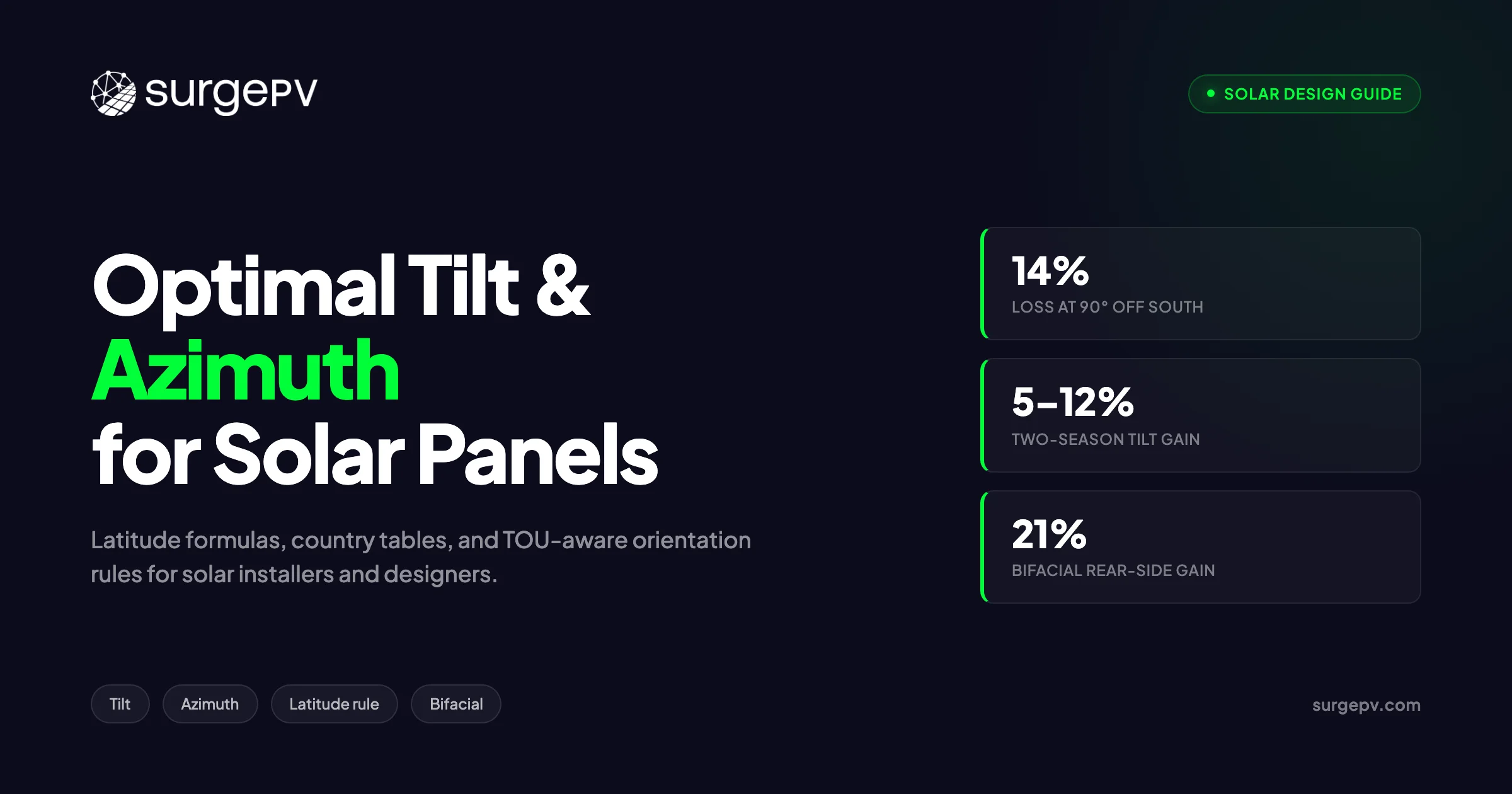
For fixed-tilt systems, start with latitude × 0.76 + 3.1° (25–50° range) or latitude × 0.87 (below 25°). Face true south in the northern hemisphere, true north in the southern hemisphere. Azimuth accuracy matters more than tilt precision — a 90° direction error costs 14–16% of annual output vs. 2–3% for a 10° tilt miss. East-west splits raise self-consumption 15–25% in TOU markets despite lower total kWh. Bifacial panels run 5–15° steeper than monofacial. Snow regions benefit from tilts above 35° but face 2.5× wind uplift above that threshold.
In this guide:
- How the latitude rule works, where it breaks down, and the two corrected formulas from Jacobson & Jadhav (2018) that replace it
- A full latitude reference table from 0° to 65° with annual, summer, and winter tilt values
- An azimuth loss table at every 15° deviation across three latitude bands, with the financial exception for TOU markets
- Country and city recommendations for 14 locations across 9 countries, including the magnetic declination correction you actually need in 2026
- Why azimuth matters 3–8 times more than tilt, and how to find true south without a compass
- The bifacial tilt question: why steeper is better, how albedo drives the math, and the 2025 MDPI parametric study results
- The snow-versus-wind structural trade-off at high tilt: NAIT reference array data and ASCE 7-22 wind uplift quantified
- East-west versus south-facing arrays in TOU and self-consumption markets — the Romania 29-month field study
- Off-grid versus grid-tied tilt formulas: why they diverge by 5–10° at the same latitude
- A professional installer workflow — how solar software models tilt, azimuth, shading, and financials in one run
Why Tilt and Azimuth Both Matter (and Which One More)
The angle of incidence — how directly sunlight hits the panel surface — is what tilt and azimuth together control. When both are optimal, the panel absorbs maximum direct-normal irradiance throughout the day. When either is off, the cosine of the error angle reduces effective irradiance on the module face.
This cosine relationship is not symmetric in its consequences. Tilt errors of 10° from optimal cost roughly 2–3% of annual energy. Azimuth errors of 90° (facing east or west instead of south) cost 14–16%. That asymmetry is the central fact most homeowner-facing content gets wrong: “get the direction right first, then optimize the angle.”
The Physics in One Equation
The daily solar energy capture per unit area is proportional to:
E = G × cos(θ)
where G is the incident solar irradiance (W/m²) and θ is the angle of incidence between the sun’s ray and the panel normal. At solar noon on the equinox, θ = |latitude − tilt|. For every degree away from zero, cos(θ) decreases — slowly at first, then faster.
At 40°N, a panel tilted at 33° (optimal annual) has θ ≈ 7° at equinox solar noon: cos(7°) = 0.993. A panel tilted at 20° has θ ≈ 20°: cos(20°) = 0.940. The difference is 5.3% at one moment in time; averaged annually, the yield gap is approximately 2–3%.
Now consider an east-facing panel (90° azimuth error) at optimal tilt. The sun sets well before the panel can capture afternoon irradiance. The daily energy loss is not a cosine at solar noon — it is a time-weighted deficit across every afternoon hour. Annual loss: 14–15% at 40°N.
Shadow analysis compounds both effects: a nearby obstruction may block morning sun on an east-facing array and eliminate any advantage it had at dawn. Professional solar shadow analysis software accounts for obstruction shading on a physics-based 3D model, something that tilt/azimuth rules of thumb cannot do.
Diffuse Irradiance and the Tilt-Irradiance Relationship
Tilt also affects how much diffuse irradiance (sky radiation and ground-reflected light) the panel collects. A flat panel (0° tilt) sees the full sky hemisphere for diffuse. A vertical panel sees only 50% of the sky, but gains ground-reflected irradiance from the facing hemisphere.
The sweet spot between sky diffuse, ground reflected, and direct beam defines the true annual optimum — which is always close to, but rarely exactly, the local latitude. The Perez transposition model used by PVWatts and PVGIS accounts for all three components when computing plane-of-array (POA) irradiance at a given tilt and azimuth.
Pro Tip
Always use plane-of-array (POA) irradiance for performance calculations, not global horizontal irradiance (GHI). POA at your design tilt can be 5–25% higher than GHI in mid-latitudes. Use PVGIS or PVWatts to generate POA data for your exact tilt, azimuth, and location before quoting yield to a client.
Why the Answers Differ Across Tools
PVWatts uses TMY (typical meteorological year) weather data and iterates through hourly irradiance records at the specified tilt and azimuth to find the angle that maximizes annual kWh yield. The result typically comes in 3–7° below the raw latitude value at mid-latitudes because:
- Summer days are longer, so the lower summer sun path contributes proportionally more hours than the formulas assume.
- Diffuse irradiance (which peaks in winter at high latitudes) is better captured at shallower tilts in summer.
- Thermal derating in summer (high module temperature) reduces the relative value of summer irradiance — shifting the effective optimum slightly toward winter capture.
None of these effects are captured in the latitude rule. They are captured in hourly simulation software — which is why the latitude rule is a starting point, not a final answer.
Further Reading
For a deeper explanation of solar altitude, azimuth, and zenith angles — including the sun path diagrams used in professional design — see the Solar Angles: Azimuth, Tilt, and Zenith Guide on this site.
The Latitude Rule: What It Says and Where It Breaks Down
The latitude rule states: set fixed-tilt panels at an angle equal to the site latitude. A system at 35°N tilts at 35°. At 52°N, tilt at 52°. It is the oldest, most widely repeated tilt guideline in solar installation practice.
It is also approximately 3–7° wrong at most mid-latitudes, and up to 14° wrong at latitudes below 25°.
The Two Corrected Formulas (Jacobson & Jadhav, 2018)
The most rigorous global tilt optimization was published by Jacobson & Jadhav in Solar Energy (2018), using NREL PVWatts-based global analysis across hundreds of locations:
Below 25° latitude:
Annual optimal tilt = latitude × 0.87
Between 25° and 50° latitude:
Annual optimal tilt = (latitude × 0.76) + 3.1°
Above 50° latitude:
No simple linear formula; optimal tilt flattens below latitude due to the dominance of long summer days and very low winter sun altitude. Use PVWatts or PVGIS iterative results for locations above 50°.
These formulas, derived from iterative solar position algorithms, are cross-referenced in the solarpaneltilt.com dataset (Landau), the 48° optimal annual tilt at 60°N (Aalto University, 2024) thesis on high-latitude tilt optimization, and the ~33° optimal tilt for Maryland utility-scale siting (Maryland PSC / Daymark Energy Advisors, 2018) study on utility-scale siting.
Seasonal Adjustment Formulas
The same source documents two-season and four-season adjustment values:
Summer tilt: latitude × 0.93 − 21° Winter tilt: latitude × 0.875 + 19.2°
For the 25–50° range. Spring and fall: use the annual optimal.
A practical approximation used by most installers: summer = latitude − 15°, winter = latitude + 15°. This is less precise than the Landau formulas but simpler to communicate to clients and close enough for most residential installs.
Two-season adjustment gain: 5–12% over fixed, depending on latitude. At 40°N, a two-season adjustment moves from 71.1% of tracker optimum to 75.2% — a 5.8% relative gain (solarpaneltilt.com). At latitudes above 45°, the gain rises to 12–18% annual gain from seasonal adjustment at 50–55°N (VoltCalcs, 2026) because the seasonal irradiance asymmetry is larger.
Four-season adjustment gain: approximately 0.5% above two-season (75.7% vs 75.2% of tracker optimum — solarpaneltilt.com). The hardware and labor cost of quarterly adjustments almost never justifies this marginal gain.
Key Takeaway
Below 35° latitude: fix the tilt and forget it. The gain from seasonal adjustment is under 6% and the payback period for adjustable racking rarely closes. Above 45° latitude: two-season adjustment is worth evaluating, especially for off-grid or battery-equipped systems where winter self-sufficiency has a high financial value.
The Latitude Reference Table (0°–65°)
The table below uses the Jacobson & Jadhav (2018) formulas for annual optimal and the Landau two-season formulas for summer/winter values. Above 50°, annual optimal values are estimated from PVWatts/PVGIS iterative results — these are marked with an asterisk.
| Latitude | Annual Fixed Optimal | Summer Tilt | Winter Tilt | Formula Used |
|---|---|---|---|---|
| 0° | 0° | 0° | 15° | lat × 0.87 |
| 5° | 4° | 0° | 20° | lat × 0.87 |
| 10° | 9° | 0° | 25° | lat × 0.87 |
| 15° | 13° | 0° | 30° | lat × 0.87 |
| 20° | 17° | 5° | 35° | lat × 0.87 |
| 25° | 22° | 7° | 41° | lat × 0.76 + 3.1 |
| 30° | 26° | 11° | 46° | lat × 0.76 + 3.1 |
| 35° | 30° | 15° | 50° | lat × 0.76 + 3.1 |
| 40° | 33° | 16° | 54° | lat × 0.76 + 3.1 |
| 45° | 37° | 21° | 58° | lat × 0.76 + 3.1 |
| 50° | 41° | 25° | 63° | lat × 0.76 + 3.1 |
| 55° | 44°* | 30° | 68° | *PVWatts iterative; flattening above 50° |
| 60° | 48°* | 35° | 73° | *Estimated from PVWatts/PVGIS trends |
| 65° | 51°* | 40° | 78° | *Estimate; optimum below latitude at high lat |
Sources: Jacobson & Jadhav (2018); solarpaneltilt.com (Landau); NREL PVWatts; PVGIS 5.3.
Notes: Summer/winter values in the 25–50° range use solarpaneltilt.com two-season formulas. Above 50°, the fixed optimum flattens below latitude because extremely low winter sun paths make high winter tilts impractical; PVGIS iterative results confirm the plateau. In the southern hemisphere, apply the same tilts but face true north, and swap seasonal labels.
Azimuth: Why Direction Matters More Than Tilt
Azimuth is the compass bearing of the panel face, measured clockwise from true north. A south-facing panel in the northern hemisphere has an azimuth of 180°. East = 90°, West = 270°, North = 0° (or 360°).
The annual yield difference between an optimal-tilt south-facing array and the same array facing 90° off south (full east or west) is 14–16% — measured at 40°N with a 33° tilt. The same array tilted 10° away from its annual optimum loses only 2–3%. That factor-of-5 to factor-of-7 difference is the core reason azimuth accuracy is more important than tilt precision for most installations.
Azimuth Loss Table
The table below shows annual energy loss relative to true south (0° deviation) at three latitude bands. Values are derived from Greentech Renewables (Phoenix AZ, 33°N, 20° tilt, Perez transposition model), TheGreenWatt mid-latitude NREL PVWatts simulations, and SolarMathLab cosine model with diffuse fraction of 0.2.
| Azimuth Deviation | Direction | Loss at 30° Lat | Loss at 40° Lat | Loss at 50° Lat | Notes |
|---|---|---|---|---|---|
| 0° | South | 0% | 0% | 0% | Baseline |
| 15° | SSE / SSW | ~1% | ~1% | ~1% | Negligible; accept freely |
| 30° | SE / SW | ~3% | ~3–4% | ~4% | Still excellent |
| 45° | SE / SW | ~5% | ~5–6% | ~6–7% | Very acceptable |
| 60° | ESE / WSW | ~8% | ~9% | ~10% | Good |
| 75° | E / W | ~12% | ~13% | ~14% | Acceptable for TOU markets |
| 90° | East / West | ~14% | ~15% | ~16% | East-west split arrays viable |
| 135° | NE / NW | ~28% | ~30% | ~32% | Marginal; avoid where possible |
| 180° | North | ~35% | ~38% | ~42% | Not recommended in northern hemisphere |
Sources: Greentech Renewables (Nov 2010 data, verified against PVWatts); TheGreenWatt (2026); SolarMathLab cosine model.
Financial exception: Annual energy loss is not the same as annual revenue loss. A west-facing array (90° deviation, ~15% fewer kWh at 40°N) in California under NEM 3.0 can earn more in bill savings than south-facing because peak TOU rates from 4–9 PM align exactly with west-facing afternoon generation. TheGreenWatt (2026) and SunPal Solar (2025) both document this reversal. The correct metric in TOU markets is dollar yield per kWp, not kWh/kWp.
Key Takeaway
Get azimuth right before optimizing tilt. A 1° azimuth correction can matter more than a 5° tilt correction. In NEM 3.0 states, model the financial yield by orientation before assuming south-facing is the answer — it often is not.
True South vs. Magnetic South
A compass points to magnetic north, not geographic (true) north. The difference — magnetic declination — varies by location and changes over time. In continental North America, magnetic declination ranges from −25° in the Pacific Northwest to +20° in parts of Maine and Newfoundland (NOAA WMM2025, December 2024).
Using a compass without declination correction can point panels up to 25° off true south — equivalent to moving from the “negligible” column of the azimuth table into the “5–6% annual loss” column or worse.
WMM2025, released by NOAA and the British Geological Survey in December 2024, updated global declination values through 2030. Secular variation runs up to 1° per year in some US regions, meaning a declination table from 2010 may be off by 10–15° in parts of the country. For UK-specific information, see Battery Solar System Design UK.
How to correct for magnetic declination in 2026:
- Go to the NOAA Magnetic Declination Calculator (NCEI).
- Enter the site coordinates and the current date.
- Add the positive declination value (East) or subtract the negative value (West) from your compass bearing.
Australian installers: CEC guidelines emphasize true north; Australian magnetic declination is minimal (approximately 10–12°E in Sydney, approximately 8°E in Melbourne as of 2025), but the NOAA calculator works globally. For Australia-specific compliance details, see Australia comparisons/lgc-vs-stc.
Pro Tip
Do not use a standard magnetic compass alone for final azimuth confirmation on commercial jobs. Use a solar pathfinder, drone-based roof survey, or satellite imagery azimuth verification — all of which work in true-north coordinates without a declination correction step.
Country and City Tilt Recommendations
The table below uses PVGIS 5.3, NREL PVWatts, and the Jacobson & Jadhav (2018) formulas applied to latitude data for 14 cities across 9 countries.
| Country | City | Latitude | Rec. Annual Tilt | Rec. Azimuth | Notes |
|---|---|---|---|---|---|
| US | Denver, CO | 39.7°N | 33–35° | 180° (true S) | NREL PVWatts; lat × 0.76 + 3.1 |
| US | New York, NY | 40.7°N | 34–35° | 180° | PVWatts; typical roof 18–37° so tilt-up racking often needed |
| US | Los Angeles, CA | 34.1°N | 29° | 180° (or 200–220° for NEM 3.0) | PVWatts; NEM 3.0 makes SW / W viable for TOU |
| UK | London | 51.5°N | 38–42° | 180° | PVGIS; Ofgem export tariffs favor annual kWh maximum |
| DE | Berlin | 52.5°N | 39–43° | 180° | BNetzA technical guidelines; east-west common on pitched roofs |
| ES | Madrid | 40.4°N | 34° | 180° | PVGIS; high irradiance makes sub-optimal azimuth very viable |
| IT | Rome | 41.9°N | 35–36° | 180° | PVGIS; southern Italy (Palermo, 38°) gives approximately 32° |
| FR | Paris | 48.9°N | 37–40° | 180° | PVGIS; self-consumption tilt often lat + 10° per French guides |
| IN | New Delhi | 28.6°N | 25° | 180° | PVWatts / PVGIS; MNRE spacing norms; seasonal dust favors above 10° tilt |
| IN | Chennai | 13.1°N | 11° | 180° | Low latitude; lat × 0.87 formula applies |
| AU | Sydney | 33.9°S | 29–30° | 0° (true N) | PVGIS; AEMO; southern hemisphere rules invert |
| AU | Melbourne | 37.8°S | 32–33° | 0° | PVGIS |
| CA | Toronto | 43.7°N | 36–38° | 180° | PVWatts; heavy snow — consider 45°+ or seasonal adjust |
| CA | Vancouver | 49.3°N | 40–42° | 180° | PVWatts; maritime cloud cover suggests slight tilt reduction vs latitude |
Sources: PVGIS 5.3 (JRC EU); NREL PVWatts v6; Jacobson & Jadhav (2018).
Regional regulatory notes:
Germany and the Netherlands: east-west split arrays on pitched roofs are now standard in dense urban areas. BNetzA does not mandate south-facing orientation; the feed-in structure and self-consumption incentives favor optimizing for household load curves, not annual kWh. Also see: Germany solar subsidies.
United Kingdom: MCS certification requires shading analysis. Optimal tilt is often constrained by existing roof pitch (typically 30–40°). Ofgem’s Smart Export Guarantee (SEG) pays flat rates regardless of time of generation, so south-facing annual kWh maximization is still the right default.
India: Northern plains cities (28–30°N) closely match roof pitch conventions. Southern states near the equator need near-flat tilts (10–15°) where lat × 0.87 applies. Also see: Best Solar Design Software India. For India-specific information, see 5kW Solar Panel Price in India.
Australia: CEC guidelines require true north orientation. Magnetic declination is small but non-zero; use the NOAA calculator or a surveying app for precision installs. AEMO (Australian Energy Market Operator) connection rules focus on inverter capacity and export limits rather than orientation specifics.
Pro Tip
For solar installers serving multiple countries, use PVGIS 5.3 to generate the POA irradiance at the design tilt for each project. The PVGIS tool (JRC EU) covers Europe, Africa, Asia, and Oceania. For North and South America, use NREL PVWatts v6 with NSRDB data updated through 2023.
For Africa-specific compliance details, see Africa solar compliance.
Flat Roofs: The 10° Minimum and East-West Logic
Flat roofs and low-pitched commercial roofs (0–5° pitch) create a different set of trade-offs than residential pitched installs.
The 10° Minimum Tilt Rule
The standard minimum tilt on a flat roof in most commercial markets is 10°. The reasons are practical, not energetic:
- Drainage: Water pools in low-tilt frames and promotes soiling, algae growth, and accelerated corrosion. Most frame manufacturers void structural warranties below 5°.
- Self-cleaning: Rainfall cleans panels more effectively above 10°. Below 5°, dust and debris accumulates and soiling losses rise significantly.
- Ballast requirements: Lower tilts require more ballast weight to meet wind uplift requirements under ASCE 7-22. Above approximately 15°, wind behavior shifts from a pure uplift problem to a combined uplift-and-drag problem that requires more complex mounting.
At 10° tilt, annual energy loss relative to optimal (33° at 40°N) is approximately 5–8% depending on latitude. For commercial self-consumption projects, this is often acceptable given the roof utilization and structural loading advantages of shallow tilt.
East-West Flat Roof Arrays
On flat commercial roofs, east-west back-to-back racking at 10–15° tilt is the dominant configuration in self-consumption markets without generous net metering. The economics:
- Annual kWh: 10–15% below south-facing at optimal tilt (Fronius, Dec 2025)
- Installed capacity: 20–30% more panels per roof area due to eliminated inter-row shading buffer (SunPal Solar, 2025)
- Morning / evening generation: approximately 5–8% higher capture in the flanking hours
- Self-consumption rate improvement: 15–25% (Frontiers in Energy Research, Romania field study, 2025)
- Grid import reduction: approximately 30% vs south-facing (Frontiers in Energy Research, 2025)
For a warehouse operator buying electricity at €0.30/kWh peak and exporting surplus at €0.05/kWh, the self-consumption improvement more than compensates for the lower total kWh. The PV generation and financial modeling at SurgePV models this trade-off explicitly — input the TOU tariff structure, and the financial output reflects actual bill savings, not just kWh yield. For a direct comparison, see Arka 360 vs SurgePV.
Key Takeaway
On flat commercial roofs, east-west at 10–15° is the starting point in European self-consumption markets. In markets with full net metering at retail rate, south-facing at the steepest structurally practical tilt is still the kWh-maximizing answer. Run both scenarios in a financial tool before committing.
East-West vs. South-Facing: The Self-Consumption Trade-Off
The Romania 29-month field study, published in Frontiers in Energy Research (January 2023–May 2025), is the most recent empirical validation of east-west versus south-facing performance at the residential scale. It measured actual self-consumption rates, grid import volumes, and annual kWh across matched configurations — not simulations.
Results confirmed:
- East-west arrays delivered 10–15% fewer total annual kWh than south-facing
- Self-consumption improved by 15–25% in the east-west configuration
- Grid imports fell by approximately 30%
- Net economic benefit was positive for the east-west configuration under the Romanian TOU tariff structure (Frontiers in Energy Research, 2025)
Naraghi & Atefi (MDPI Energies, 2022) found that a west-facing array at azimuth 50° and 20° tilt produces 42% more power at 4 PM summer peak demand than a south-facing array at the same tilt — a direct consequence of afternoon sun tracking.
The TOU Tariff Math
In California under NEM 3.0, peak TOU rates from 4–9 PM reach $0.45–0.60/kWh while midday rates (when south-facing arrays peak) fall to $0.12–0.18/kWh. A south-facing 10 kWp system generating 1,200 kWh of surplus in June at $0.12/kWh earns $144 in export credits. The same system oriented southwest at 220°, generating 1,050 kWh, may shift 200 kWh into the 4–9 PM window at $0.50/kWh — earning $100 extra on that shifted production alone, net positive despite fewer total kWh.
TheGreenWatt (2026) and SunPal Solar (2025) both document this reversal for California, and similar patterns appear in German and Dutch TOU contracts. The lesson: never default to south-facing without checking the tariff structure.
Pro Tip
For homes without battery storage on time-of-use tariffs: model two scenarios before quoting — south-facing at optimal tilt (kWh maximum) and southwest-facing at 10–15° shallower tilt (revenue maximum). Present both to the client with the financial outcome, not just the kWh number.
See Adding Battery Storage Services for detailed guidance.
Bifacial Panel Tilt Optimization
Bifacial solar panels generate power from both the front surface (direct + diffuse irradiance) and the rear surface (ground-reflected irradiance). The rear gain depends on three variables: ground albedo, mounting height above the reflective surface, and row spacing.
Albedo Reference Table
| Surface Type | Albedo Value | Typical Rear-Side Gain | Source |
|---|---|---|---|
| Fresh snow | 0.80–0.90 | 25–40% | arXiv 1709.10026 (Sun et al.) |
| Aluminum / white membrane | 0.50–0.57 | 18–25% | MDPI Energies 18(16), 2025 |
| Concrete | 0.30–0.45 | 10–18% | MDPI Energies 18(16), 2025 |
| Dry grass / gravel | 0.20–0.30 | 7–12% | SolarTechOnline, 2026 |
| Asphalt / dark roofing | 0.05–0.12 | 2–5% | SolarTechOnline, 2026 |
| Standard soil / loam | 0.15–0.25 | 5–10% | arXiv 1709.10026 |
| Green vegetation | 0.15–0.25 | 5–10% | NREL bifacial data |
The 2025 MDPI Energies parametric study (Ganesan et al., Energies 18(16), 2025) confirmed a bifacial gain of 21.4% over aluminum roofing membrane (albedo 0.50–0.57) at 20° tilt and 100 cm mounting height above the surface. At standard soil albedo (0.20–0.25), the same configuration yields approximately 7–12% rear-side gain.
Optimal Tilt for Bifacial Panels
Bifacial panels benefit from steeper tilts than monofacial equivalents for two reasons:
- A steeper tilt exposes more of the rear surface to ground-reflected irradiance from the facing hemisphere, particularly important at low sun angles (morning and evening, or winter at high latitudes).
- Steeper tilts keep the panel further from the ground, increasing the solid angle of ground exposure for the rear surface — especially relevant in ground-mount systems where row spacing drives the ground-coverage ratio.
Practical rule: Add 5–15° to the monofacial annual optimal when specifying bifacial ground-mount systems. The specific value depends on albedo: high albedo (concrete, white membrane, snow) justifies the full 15° addition. Low albedo (dark soil, asphalt) may justify only 5°.
Mounting height matters: The MDPI 2025 study measured rear-side gain at 50 cm and 100 cm heights. At 50 cm, gain was 14.2%; at 100 cm, 21.4% — a 7.2 percentage point difference attributable solely to greater exposure of the rear surface. Mounting height above 100 cm provides diminishing returns.
Key Takeaway
Bifacial panels on white membrane flat roofs (albedo 0.50+) at 100 cm height and 20–25° tilt can outperform monofacial panels at optimal tilt. Do not apply the same tilt formula to bifacial and monofacial systems on the same roof without re-running the irradiance model.
Snow, Wind, and Structural Trade-Offs at High Tilt
Tilt is not only an energy optimization decision — it is a structural one. Above 35°, the snow and wind trade-offs become significant enough to override the energy calculus on some roofs.
Snow Shedding vs. Annual Yield
The NAIT (Northern Alberta Institute of Technology) reference array study measured annual energy production across multiple fixed tilts in a heavy-snowfall climate. Key findings:
- 14° tilt: 5.3% annual energy loss from snow accumulation (NAIT reference array)
- 30° tilt: annual snow loss drops to approximately 2–3% (interpolated from NAIT data)
- 53° tilt: approaches zero annual snow loss; tied with 90° (vertical) for highest winter production without manual clearing (NAIT reference array)
- 90° tilt (vertical): approaches zero snow loss; impractical for most roof mounts
A separate Renewable Energy World study (citing 2012 field data) measured winter losses of 40–60% at very low tilt, and annual snow-related losses of 18% at 0° tilt, 15% at 24°, and 12% at 39°.
The threshold for meaningful passive snow shedding is approximately 35°. Above 45–50°, the panel surface approaches self-clearing in heavy snowfall.
Wind Uplift Under ASCE 7-22
ASCE 7-22 (released December 2021, adopted by the 2024 International Building Code) introduced dedicated rooftop PV provisions in Chapter 29 (Sections 29.4.3–29.4.5) and elevated solar facilities to Risk Category 2. The standard quantifies wind uplift forces for tilted rooftop arrays.
The structural consequence: a 30° tilt can experience up to 2.5× the wind uplift force of a 10° tilt under the same wind conditions (up to 2.5× wind uplift at 30° versus 10° tilt (FL Engineering LLC, 2025)).
| Tilt | Relative Wind Uplift vs 10° Baseline | Annual Snow Loss (heavy snow climate) | Practical Range |
|---|---|---|---|
| 10° | 1.0× (baseline) | ~5% | Flat roof minimum; soiling concern |
| 20° | 1.3× | ~3% | Standard residential; most roof pitches |
| 30° | 1.8× | ~2–3% | Good snow shedding; watch uplift on old structures |
| 35° | 2.2× | ~1–2% | Snow threshold; structural review recommended |
| 45° | 2.8× | ~0.5% | Self-clearing snow; significant uplift; require structural engineering |
| 53° | 3.0×+ | ~0% | NAIT optimum for snow; structural engineering mandatory |
Sources: FL Engineering LLC (2025); NAIT reference array; ASCE 7-22; PVRack.com structural guide.
What This Means for Installer Decisions
In heavy-snow Canadian and northern US markets, the optimal tilt for energy maximization conflicts directly with wind-safe mounting. The resolution depends on the roof structure:
- New construction or reinforced roof: Target 45–53° if snow losses are significant; require structural engineering sign-off under ASCE 7-22.
- Standard residential rafter construction: Stay at 30–35°; accept the residual 2–3% annual snow loss in exchange for staying within standard ASCE 7-22 prescriptive uplift limits.
- Low-slope commercial roof (0–5° pitch): Use ballasted east-west at 10–15°; snow-clearing contracts are more cost-effective than steep tilt on these structures.
Pro Tip
In Toronto or Minneapolis, always run two design scenarios: (1) energy-optimal tilt with a structural engineering memo for wind uplift, and (2) a structurally standard tilt with a snow loss estimate included in the production report. Let the client and their structural engineer decide. Do not make the structural call for them.
Model Tilt, Azimuth, and Financials in One Workflow
SurgePV designs the array, runs the shading simulation, and reports the financial outcome in the same workspace — so installers tune tilt against revenue, not just kWh.
Book a DemoNo commitment required · 20 minutes · Live project walkthrough
Off-Grid vs. Grid-Tied: Why the Optimal Tilt Differs
Off-grid solar systems optimize for a different objective than grid-tied systems. A grid-tied system maximizes annual kWh delivered to the home and grid. An off-grid system maximizes the minimum monthly energy delivery — the worst month determines battery sizing and load capacity.
Because winter months are the worst-case period at mid-to-high latitudes, off-grid systems tilt steeper to capture more winter irradiance — even at the expense of summer overproduction that the battery cannot absorb.
The Aalto University Formula Split
An Aalto University thesis (2024) derived distinct optimal tilt formulas for the two cases:
Grid-tied optimal tilt: 0.39 × latitude + 31° Off-grid optimal tilt: 0.76 × latitude + 24°
At 45°N (Toronto):
- Grid-tied: 0.39 × 45 + 31 = 48.6° — approximately 49°
- Off-grid: 0.76 × 45 + 24 = 58.2° — approximately 58°
The 10° difference represents the shift from annual-average optimization to worst-month optimization. In practice, many off-grid installers use a simpler rule: latitude + 15° as the winter-prioritized angle, which is close to the Aalto formula result at most mid-latitudes.
When does this distinction matter most?
- Remote cabins and telecom repeater sites at 45°N+: the difference between grid-tied and off-grid optimal tilt can mean the difference between a battery bank sized for 2 days vs. 4 days of autonomy.
- Agricultural systems (irrigation pumps) with a summer-only load: these should use grid-tied or even summer-tilt optimization, not off-grid winter bias.
- Emergency backup systems: off-grid formula applies regardless of grid connection; the worst-month delivery is the design constraint.
Key Takeaway
Grid-tied and off-grid systems have different optimal tilts at the same latitude — often 8–12° apart. Always identify which use case applies before setting the tilt in a design. The grid-tied formula optimizes annual kWh; the off-grid formula optimizes worst-month delivery.
Tracker vs. Fixed Tilt: Yield vs. Cost
Single-axis trackers (SATs) rotate panels east-to-west to follow the sun’s daily arc. Dual-axis trackers also adjust for seasonal altitude variation. The yield improvement vs. fixed tilt is well documented; the cost case is site-dependent.
Yield Index Table
| Mount Type | Annual Yield Index vs Fixed | Relative Cost | Practical Application |
|---|---|---|---|
| Fixed, annual optimal tilt | 100% (baseline) | 1.0× | Residential and commercial standard |
| Fixed, 2-season adjusted | 105–112% | 1.2–1.5× (racking + labor) | High-latitude commercial where labor cost is low |
| Fixed, 4-season adjusted | ~105.5% | 1.5–2.0× | Rarely justified over 2-season |
| Single-axis tracker (SAT) | 120–140% | 1.6–2.2× (system cost premium) | Large-scale ground-mount above 25° lat |
| Dual-axis tracker | 130–150% | 2.5–3.5× (system cost premium) | Concentrating PV; niche applications |
Sources: solarpaneltilt.com (fixed vs tracker index); 20–30% higher annual energy for single-axis trackers versus fixed-tilt (NREL PVWatts, 2024) for SAT and dual-axis.
When trackers are cost-effective:
- Ground-mount systems above 500 kWp where tracker component cost is amortized over large capacity
- High-value electricity markets where the tracker premium generates payback under 3 years
- Latitudes above 30° where the insolation asymmetry between morning and afternoon is large enough to reward tracking
When trackers are not cost-effective:
- Residential rooftop installs: roof attachment prevents tracker movement; fixed mounts dominate
- Dense commercial rooftop: inter-row shading at east and west extremes limits tracker benefit
- Low-insolation climates (northern Europe, British Columbia): the baseline irradiance is low enough that tracker capital cost is hard to recover Also see: European Solar Incentives.
Unbound Solar’s analysis (2025) and the solarpaneltilt.com data confirm that two-season adjustment captures approximately 75% of the tracker yield benefit at roughly 20–30% of the capital cost. For most systems below 500 kWp, fixed-tilt with two-season adjustment beats trackers on lifetime ROI.
The Installer Workflow: Tilt and Azimuth in Professional Design Software
Rules of thumb — the latitude formula, the azimuth table, the snow-tilt threshold — are starting points. What a professional solar design workflow actually does is run the full simulation with site-specific inputs before locking in tilt and azimuth.
Here is how that workflow operates in a professional tool:
Step 1: Set the Site
Enter the coordinates (or address). The solar designing module in SurgePV loads the site-specific irradiance data (PVGIS ERA5 for Europe; NSRDB for the US) and builds the 3D rooftop model from aerial imagery. The design starts with real geometry, not a blank-slate assumption about roof pitch or orientation.
Step 2: Run the Tilt and Azimuth Sensitivity
Before placing any modules, the designer can vary tilt from 10° to 55° and azimuth from 150° to 210° (or wider for east-west evaluation) and see the corresponding annual kWh output in the simulation dashboard. This takes 2–3 minutes and immediately reveals whether south-facing or southwest-facing is the higher-yield option for that specific site and tariff structure.
At SurgePV, the shadow analysis module runs simultaneously — so a marginally better azimuth that exposes the array to morning tree shading shows up as a net negative before the installer commits to it.
Step 3: Optimize for Financial Outcome
The PV generation and financial modeling connects energy yield directly to bill savings, export revenue, payback period, IRR, and NPV. An installer can compare:
- South-facing at 33°: 9,200 kWh/year, 7.2-year payback
- Southwest-facing at 20°: 8,600 kWh/year, 6.8-year payback (due to TOU rate alignment)
The financial tool makes the trade-off explicit. This is the decision a homeowner or commercial client actually needs — not a tilt angle in isolation.
Step 4: Generate the Proposal
The customer-ready solar proposals pulls the designed system (tilt, azimuth, shading simulation, energy model, financial model) into a branded proposal PDF. The proposal shows the client exactly why the recommended orientation was chosen — including the TOU revenue comparison if relevant. Read more about Agricultural Solar Case Study.
This workflow — from site geometry to shading simulation to financial modeling to proposal — runs in one workspace. No import/export between tools; no manual transfer of kWh numbers into a separate spreadsheet.
Pro Tip
For solar installers presenting to commercial clients: always run the east-west flat roof scenario alongside the south-facing scenario and show both in the proposal with separate payback and IRR numbers. Clients who see the self-consumption analysis make faster decisions than clients shown only the kWh comparison.
Regulatory Context by Country
Tilt and azimuth choices interact with local regulatory frameworks in ways that can affect permitting, grid connection, and financial return. This section covers the key rules for solar installers in each major market.
| Country | Regulator | Tilt/Orientation Rule | Export / Feed-In Rule | Standard |
|---|---|---|---|---|
| US | AHJ (varies by state) | No federal tilt mandate; ASCE 7-22 governs structural loads | NEM varies by state; NEM 3.0 in CA | ASCE 7-22; NEC Article 690 |
| UK | Ofgem / MCS | MCS requires shading analysis; pitch constraint from building regs | Smart Export Guarantee (SEG); flat rate | MCS 012 |
| DE | BNetzA | No orientation mandate; east-west explicitly allowed | Feed-in tariff declining; self-consumption preferred | DIN VDE 0100-712 |
| ES | IDAE / MITERD | Ministerial Order TED/235 2022 specifies tilt optimization in sizing methodology | Net billing since 2021; export cap in some areas | UNE 206013 |
| IT | GSE | DM 04/07/2019 references optimal tilt in incentive sizing | Scambio sul posto (net metering equivalent) | CEI 0-21 |
| IN | MNRE | MNRE spacing norms reference lat-based tilt; no formal mandate | DISCOM-specific net metering; varies by state | IEC 62548 equivalent |
| AU | CEC | CEC Installer Guidelines require true north orientation statement | AEMO feed-in rules; SEF tariffs by state | AS/NZS 5033; AS 4777 |
| CA | SaskPower / ESA | No federal tilt standard; provincial ESA governs structural and electrical | Net metering varies by province | CSA C22.1 |
| FR | ENEDIS | Technical guidelines reference 30° tilt for central France compromise | S17 excess tariff; self-consumption contract (PAC) | NF C 15-712-1 |
Sources: ASCE 7-22; Solar Permit Solutions (Feb 2026); Wattmonk (Mar 2026); MCS 012 documentation; BNetzA technical guidelines; CEC Installer Guidelines (2025); MNRE spacing norms.
Frequently Asked Questions
What is the optimal tilt angle for solar panels?
For fixed-tilt installations, the optimal tilt angle approximates your site latitude — but not exactly. Below 25° latitude, use latitude × 0.87. Between 25° and 50°, use latitude × 0.76 + 3.1°. These formulas from Jacobson & Jadhav (2018) produce values 3–7° below the raw latitude figure at most mid-latitude sites.
At 40°N (Denver, New York), the Jacobson formula gives 33–35°. Running the same location through NREL PVWatts confirms this range. Subtract 15° for summer-only optimization; add 15° for winter-only. Above 50° latitude, no simple linear formula applies — use PVGIS or PVWatts iterative results.
Does azimuth or tilt matter more for solar output?
Azimuth drives 3–8 times more annual yield loss than tilt errors of comparable magnitude. A 90° azimuth deviation (facing east or west instead of south) costs 14–16% of annual production. A 10° tilt error from optimal costs only 2–3%.
The practical implication: spend more effort confirming true south than optimizing tilt angle. Use the NOAA Magnetic Declination Calculator to correct for magnetic-vs-true-south errors, which reach up to 25° in parts of North America.
How much does facing the wrong direction reduce solar output?
At 40° latitude with optimal tilt, the azimuth loss table shows:
- 30° off true south: 3–4% annual loss
- 45° off: 5–6%
- 90° (east or west): 14–15%
- 135° (NE or NW): approximately 30%
- 180° (north-facing): 38–42% in the northern hemisphere
Magnetic-vs-true-south errors of up to 25° in continental North America mean a compass-only azimuth can put a panel in the 3–4% loss zone before any other suboptimal factors are considered. WMM2025 data (December 2024) should be used for any declination correction in 2026.
Is east-west better than south-facing for self-consumption?
For homes without batteries on time-of-use tariffs, east-west splits typically improve self-consumption by 15–25% and reduce grid imports by approximately 30%, despite delivering 10–15% fewer annual kWh than south-facing arrays.
The 29-month Romania residential field study (Frontiers in Energy Research, 2025) confirmed this empirically. Naraghi & Atefi (MDPI Energies, 2022) showed west-facing panels at 4 PM produce 42% more power than south-facing panels — directly aligned with peak TOU rates in markets like California NEM 3.0.
In markets with full net metering at retail rate, south-facing annual kWh maximization remains the right default. Run both scenarios with the tariff structure before deciding.
What is the optimal tilt angle in snow regions?
Tilts above 35° significantly improve passive snow shedding. Above 45–50°, the panel approaches self-clearing in heavy snow conditions. The NAIT reference array study found a 14° tilt loses 5.3% annually to snow accumulation, while 53° loses effectively nothing.
The structural trade-off: ASCE 7-22 wind uplift forces at 35° are approximately 2.2× the forces at 10° tilt. At 53°, the multiplier exceeds 3.0×. Structural engineering review is mandatory before targeting high tilts for snow shedding on standard residential roof structures.
What is the optimal tilt for bifacial solar panels?
Bifacial panels typically perform best at 5–15° steeper tilts than monofacial equivalents at the same site. The rear surface needs to be exposed to reflected ground irradiance, which improves as tilt angle increases (up to a point) and as mounting height increases.
The 2025 MDPI Energies parametric study (Ganesan et al.) confirmed 21.4% bifacial gain over aluminum roofing membrane (albedo 0.50–0.57) at 20° tilt and 100 cm mounting height. At standard soil albedo (0.20–0.25), rear-side gain falls to approximately 7–12% regardless of tilt. Mount height matters as much as tilt angle for bifacial systems.
Should I adjust solar panel tilt seasonally?
Two-season adjustment (summer = latitude − 15°, winter = latitude + 15°) yields 5–12% extra annual production compared to fixed, with larger gains at latitudes above 45°.
At 40°N, a two-season system captures 75.2% of a single-axis tracker’s annual yield; a fixed system at the same location captures 71.1% — a 5.8% relative improvement (solarpaneltilt.com). Four-season adjustment adds only 0.5% over two-season.
Below 35° latitude, seasonal adjustment hardware and labor cost rarely justifies the gain. Fixed mounts win on lifetime ROI. Above 45°, particularly for off-grid or battery-equipped systems, the winter self-sufficiency improvement from winter-tilt optimization can significantly reduce battery sizing requirements.
Three decisions determine the energy economics of a fixed-tilt array before a single panel is mounted:
- Get the direction right first. Check magnetic declination with the NOAA WMM2025 calculator. A compass error of 15° can cost more than a tilt error of 10°.
- Use the corrected formula, not the raw latitude. At 40°N, the Jacobson & Jadhav (2018) formula gives 33°, not 40°. The 7° gap is 2–3% of annual production.
- Model the financial outcome before committing to south-facing. In TOU markets and self-consumption-heavy commercial sites, east-west or southwest orientation can close with better payback despite fewer total kWh.
These are decisions that rules of thumb cannot resolve. Site-specific irradiance data, shading geometry, and tariff structure all feed into the answer. Running them in the same workspace — from 3D array layout through shading simulation to payback and IRR — is what separates a proposal built on assumptions from one built on the actual site.
Model Tilt, Azimuth, and Financials in One Workflow
SurgePV designs the array, runs the shading simulation, and reports the financial outcome in the same workspace — so installers tune tilt against revenue, not just kWh.
Book a DemoNo commitment required · 20 minutes · Live project walkthrough
Where this fits
This article is part of SurgePV's Solar Design hub, which works through the topic from first principles to the decisions a project team actually has to make.