

A homeowner in Phoenix receives three solar quotes. The prices are within $800 of each other. The equipment is similar. The deciding factor is what shows up when they search each company name on Google. One installer has 127 reviews at 4.6 stars and answers every comment. Another has 12 reviews and a three-month-old complaint with no reply. The third has a perfect 5.0 from 9 reviews that all sound identical. The winner is obvious before the second sales call even happens.
This is the reality of solar sales in 2026. Residential customer acquisition cost is climbing, and homeowners have more ways than ever to verify a company before they book a consultation. Your online review profile is no longer a soft marketing asset. It is a hard conversion layer that filters prospects before they reach your sales team.
Solar online reviews are a primary purchase signal for homeowners. In 2026, successful installers systematically collect Google reviews, respond to every rating within 48 hours, and embed social proof into proposals to lower customer acquisition cost.
This guide covers the exact system: where solar buyers read reviews, what a high-converting profile looks like, how to ask for reviews without sounding desperate, how to handle negative feedback, and how to turn testimonials into closed deals.
In this guide you will learn:
- Why reviews are now a core solar sales channel, not a marketing afterthought
- Which review platforms solar buyers actually check before signing
- The exact profile signals that make a prospect trust or dismiss your company
- A simple process to collect more reviews at the right moment
- The professional way to respond to negative reviews and win back trust
- Why a perfect 5.0 rating can hurt conversions
- How to embed reviews into proposals, emails, and your website
- The common mistakes that get solar companies penalized by review platforms
Quick Answer
Solar online reviews are a primary purchase signal for homeowners. In 2026, successful installers systematically collect Google reviews, respond to every rating within 48 hours, and embed social proof into proposals to lower customer acquisition cost.
Why Solar Online Reviews Are a 2026 Priority
Solar is not an impulse purchase. The average residential system costs $20,000–$35,000, and the buyer lives with the decision for 25 years. That level of commitment makes homeowners risk-averse. They do not want the cheapest quote. They want the installer who will still answer the phone after the panels are on the roof.
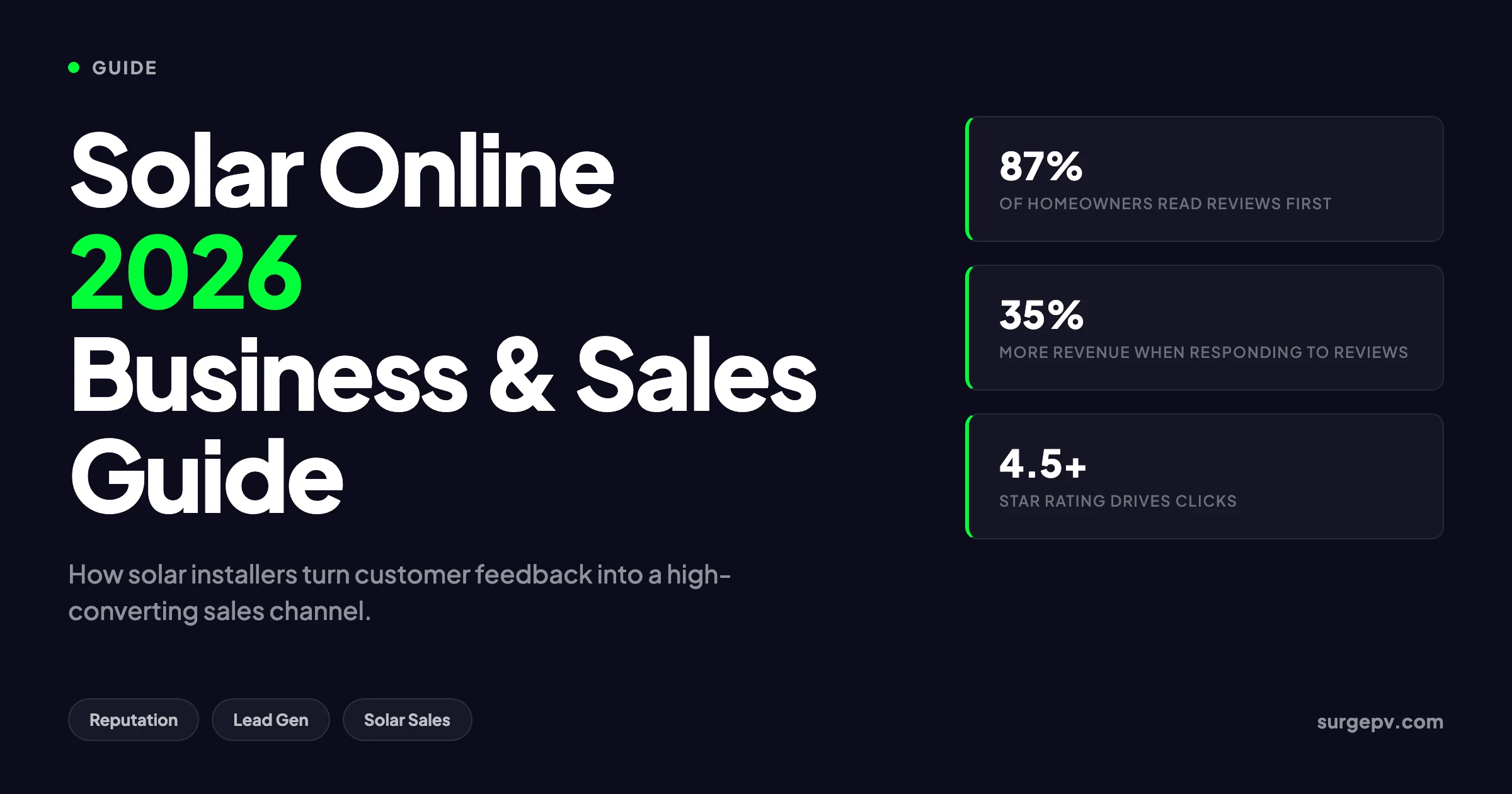
Reviews are how they judge that risk. 87% of consumers read online reviews before hiring a local business, according to BrightLocal’s Local Consumer Review Survey, 2025. For high-ticket home services like solar, the share is even higher. Most prospects will read every visible review of every company they consider before they schedule a site visit.
The financial impact is measurable. A one-star improvement in Yelp rating increased independent restaurant revenue by 5–9%, according to Harvard Business School research by Michael Luca, 2011. Solar is no different. A higher star rating and a larger review count directly shift the number of leads who convert into consultations.
Reviews Reduce Customer Acquisition Cost
In 2026, installers who rely only on paid lead generation are fighting a losing battle. Cost per lead is rising, and national installers outspend most local companies on Google Ads. Reviews change the economics. A strong profile turns organic searchers and referral leads into booked appointments before you pay for another click. Pairing reviews with a fast solar design software workflow lets you convert interest into a proposal while the homeowner is still excited.
A review is essentially a free, evergreen sales asset. One detailed five-star review can influence dozens of future prospects. Compare that to a single paid lead that costs $200–$500 and may not even answer the phone. The installer with the better review profile wins the same customer at a fraction of the cost.
The Trust Gap Between Thin and Thick Profiles
A thin profile creates an immediate trust gap. If a company has fewer than 20 reviews, prospects assume it is either new, inactive, or hiding something. A thick profile with hundreds of recent reviews signals stability and scale. Even more important than the star rating is the response pattern. A company that replies to every review, good or bad, looks accountable. A company that ignores feedback looks like a black box.
Where Solar Buyers Actually Read Reviews
Not all review platforms are equal. Solar buyers use a specific mix of general local platforms and solar-specific marketplaces. Your job is to dominate the platforms they actually check, not to chase every site on the internet.
Google: The Default Reputation Engine
Google is the starting point for almost every solar research journey. A homeowner searches “solar installers near me” and sees the Local Pack. The first things they notice are the star rating, the review count, and the first sentence of the most recent review. Customers are 2.7 times more likely to consider a business reputable if they find a complete Google Business Profile, according to Google data cited by BrightLocal, 2026.
Your Google Business Profile is more important than your website homepage for local discovery. Claim it, verify it, and keep the business name, address, phone number, hours, and service areas accurate. Add photos of real installations, team members, and completed projects. Google rewards active profiles with better visibility.
EnergySage and SolarReviews: Solar-Specific Trust Signals
Homeowners who do deeper research often land on EnergySage or SolarReviews. These platforms let buyers compare installers side by side, and the review section is one of the most clicked areas. A 4.7-star rating with 80 detailed reviews on EnergySage can be the reason a prospect requests a quote from you instead of a competitor.
These sites also show whether reviews are verified. A verified review from an actual customer carries more weight than an anonymous Google review. Encourage customers who found you through a marketplace to leave feedback on that same platform.
BBB, Yelp, Facebook, and Nextdoor
Better Business Bureau ratings still matter to older homeowners and buyers in conservative markets. Yelp is influential in some metro areas, especially on mobile. Facebook reviews matter in community-driven markets where neighbors ask for recommendations. Nextdoor can be powerful in suburban neighborhoods where one happy customer triggers a chain of referrals.
You do not need to be perfect on every platform. Claim your profiles, keep information consistent, and focus your active review collection on Google first. Then monitor the secondary platforms for negative signals that could undermine your Google reputation.
What a High-Converting Solar Review Profile Looks Like
A strong review profile is not just a high star rating. It is a combination of rating, volume, recency, response rate, and content quality. Prospects scan all of these signals in seconds.
| Signal | Weak Profile | Strong Profile |
|---|---|---|
| Star rating | Under 4.0 or perfect 5.0 with no variation | 4.2–4.7 stars |
| Review count | Fewer than 20 total reviews | 100+ Google reviews, growing monthly |
| Recency | Last review is 3+ months old | New reviews every 1–2 weeks |
| Response rate | Negative reviews ignored | Every review replied to within 48 hours |
| Content | Short, generic praise | Specific details about installation, savings, communication |
| Photos | No project photos | Real installation photos and customer-submitted images |
The profile that converts best looks human. It has a mix of five-star praise, four-star feedback with a professional response, and the occasional one-star complaint that the company handled well. That pattern signals authenticity.
Star Rating: The 4.2 to 4.7 Sweet Spot
A perfect 5.0 can look suspicious. Prospects know that no company pleases everyone, and a wall of identical five-star reviews can suggest manipulation. Purchase likelihood peaks when average ratings are between 4.2 and 4.5 stars, according to Northwestern University’s Spiegel Research Center, 2021. A rating in the 4.2 to 4.7 range with hundreds of reviews usually outperforms a 5.0 with a handful.
Recency Beats Volume Over Time
A profile with 300 old reviews and nothing new loses to a competitor with 80 recent reviews. Homeowners want to know what the company is doing right now. Set a target of at least four to eight new Google reviews per month. That pace keeps your profile fresh without looking artificially inflated.
How to Ask Solar Customers for Reviews
The biggest myth about reviews is that happy customers will leave them on their own. They usually will not. 83% of consumers asked to leave a review went on to do so, according to BrightLocal’s Local Consumer Review Survey, 2026. The simple act of asking is the single biggest driver of review volume.
Timing Is Everything
Ask at the emotional high point of the project. The best moment is usually one to two weeks after Permission to Operate, when the homeowner opens their first low electric bill. Avoid asking during permitting delays, material shortages, or inspection backlogs. A request sent at the wrong time turns a neutral customer into a critic.
Map your ask to project milestones:
- After PTO: Send the primary review request via SMS and email.
- One month after activation: Follow up with customers who have not reviewed yet.
- After a service call: Ask for a quick update if the issue was resolved well.
- Annually: Send a friendly reminder to long-term customers around the anniversary of their installation.
Keep the Request Short and Direct
Long emails get ignored. The best review request has three parts: a thank you, a direct ask, and a one-tap link. Here is a template that works:
Hi [Name], your solar system is officially producing clean energy. Thanks for trusting us with your home. If you have 30 seconds, would you leave us a quick Google review? It helps other homeowners feel confident about going solar. [Direct Link]
Send the request by SMS if you have permission. SMS open rates are higher than email, and the link is easier to tap on a phone. If you only have email, keep the subject line specific: “Quick favor: share your solar experience?”
Automate Without Losing the Human Touch
Manual review requests get forgotten when teams are busy. Use your CRM or project management tool to trigger the request automatically after PTO. Build a short delay so the request lands a few days after activation, not the same hour. Personalize the message with the customer’s name, system size, and project manager.
Automation should not feel robotic. Rotate the sender between the project manager, the sales rep, and the owner for smaller companies. A message from a real person outperforms a generic “no-reply” email every time.
How to Respond to Negative Reviews
Every installer gets negative reviews eventually. The question is whether the response turns the review into a trust asset or a trust liability. A professional reply shows future prospects that you take accountability seriously.
The Four-Part Response Framework
Use this structure for every negative review:
- Acknowledge: Name the specific issue the customer raised.
- Apologize: Express genuine regret for the experience, even if you disagree with parts of the complaint.
- Explain the fix: State the concrete action you are taking to resolve the problem.
- Move offline: Provide a direct phone number or email for detailed follow-up.
Here is an example response:
Thank you for sharing this, [Name]. We are sorry the installation timeline stretched past what we promised. That is not the experience we want for any customer. Our operations manager, [Name], has already pulled your file and will call you today at [number] to schedule the remaining work and make this right.
What Never to Do
Never argue with the reviewer in public. Never disclose private contract details, financing terms, or equipment issues. Never blame the customer, the utility, or a subcontractor in a way that sounds evasive. These responses live forever and become the first thing future prospects read.
Turn Negative Reviews Into Proof
A negative review with a thoughtful response often converts better than a perfect review with no response. It shows that your company is run by real people who care about fixing problems. Prospects know that solar projects are complex. They are not looking for a company that never fails. They are looking for a company that never disappears when something goes wrong.
Businesses that reply to at least 25% of their reviews earn 35% more revenue than average, according to Womply’s analysis of 200,000 small businesses, 2019. Response rate is one of the highest-leverage reputation signals you can control.
The Surprising Truth About 5-Star Ratings
Most solar companies chase a perfect 5.0. That is usually a mistake. Consumers are skeptical of profiles that look too good to be true, and review platforms may filter companies with only glowing feedback.
The Authenticity Sweet Spot
A small number of critical reviews makes the positive ones more believable. The key is the ratio and the response pattern. If 90% of your reviews are four or five stars and every complaint has a professional reply, you look credible. If every review is five stars and uses similar language, you look suspicious.
Businesses rated 3.5 to 4.5 stars earn more annual revenue than businesses with a perfect 5.0, according to Womply’s analysis, 2019. The lesson is clear: authenticity beats perfection.
Do Not Buy or Incentivize Reviews
Offering discounts, gift cards, or cash for reviews violates the policies of Google, Yelp, and most other platforms. It also triggers FTC enforcement. In 2024, the FTC issued its final rule banning fake reviews and review suppression. The penalties include fines and public enforcement actions. Build review volume by doing great work and asking satisfied customers. That is the only sustainable strategy.
Using Reviews in Your Sales Process
Reviews are not just for Google. They belong inside your sales collateral. A testimonial placed at the right moment can overcome objections about price, timeline, and reliability. For solar sales professionals, reviews should be treated as a closing tool, not just a marketing asset.
Embed Reviews in Proposals
Your solar proposal software should make it easy to drop a review snapshot into every proposal. Place a short testimonial on the cover page or next to the financing section. A sentence like “We saved $147 in our first month, and the crew cleaned up before they left” reduces anxiety more effectively than a technical specification.
If you are still building proposals manually, use a solar proposal template that includes a dedicated testimonials section. Update the testimonials quarterly so they stay fresh and relevant. Before you add a testimonial, make sure the design behind it is credible. Accurate solar shadow analysis software gives homeowners confidence that your production estimates match reality.
Add Reviews to Your Website and Follow-Up Emails
Feature three to five rotating reviews on your homepage. Use reviews that mention specific outcomes: lower bills, on-time installation, clear communication. In follow-up emails to prospects who have gone quiet, include a recent testimonial that addresses the exact objection they raised.
For example, if a prospect is worried about roof leaks, send a review that says, “They inspected the roof carefully and sealed everything. No leaks after two heavy rain seasons.” Specificity beats generic praise.
Turn Reviews Into Video and Case Studies
A written review is good. A video testimonial is better. Ask your happiest customers if they would record a 60-second video about their experience. Use these videos in retargeting ads, on landing pages, and in sales presentations. A 90-second before-and-after story from a real homeowner is often the highest-converting asset in a solar marketing campaign.
For more on integrating reviews into a broader acquisition strategy, read Marketing for Solar Business.
Common Mistakes Solar Installers Make With Reviews
Even well-meaning companies damage their reputation with a few common errors. Avoid these:
- Asking at the wrong time: A review request sent during a delay feels tone-deaf. Wait for a win.
- Using copy-paste responses: Prospects can spot robotic replies. Personalize every response with the customer’s name and issue.
- Ignoring neutral reviews: A three-star review with no reply signals indifference. Thank the customer and address the concern.
- Fighting with critics: A public argument makes you look worse than the review itself.
- Buying fake reviews: The short-term boost is not worth the platform penalty, the FTC fine, or the reputational damage when you get caught.
The Review Audit You Should Run Monthly
Set a 15-minute monthly calendar reminder to check your profiles. Look for:
- New reviews that need a response
- Inaccurate business information on Google, Yelp, or BBB
- Reviews that violate platform policies and can be flagged
- Competitor review trends in your service area
Small, consistent attention prevents small issues from becoming big reputation problems.
Building a Review System That Runs on Autopilot
Sustainable review growth comes from a system, not a sales rep’s memory. The best installers treat review collection as a standard operating procedure, just like permitting or commissioning.
Map Review Requests to Your CRM Stages
If you use solar CRM workflow automation, add a “Review Request” stage that triggers after PTO. The CRM should send the request, log the response, and remind the team to follow up after seven days if no review is left. This removes the manual burden and ensures no satisfied customer slips through.
Assign an Owner
Reputation management needs an owner. In a small company, this is often the owner or office manager. In a larger company, assign it to operations or marketing. The owner monitors new reviews, drafts responses, and reports monthly on volume, rating, and response time.
Measure the Right Metrics
Track three numbers:
- Review velocity: New reviews per month
- Average rating: Trend over the last 90 days
- Response rate: Percentage of reviews replied to within 48 hours
Do not obsess over a perfect rating. Focus on steady growth and fast, professional responses.
Turn Reviews Into More Solar Sales
SurgePV helps installers create fast, professional proposals with built-in social proof. Pair polished design with a strong review profile and watch close rates rise.
Book a DemoNo commitment required · 20 minutes · Live project walkthrough
Conclusion
Solar online reviews are no longer optional. In 2026, they are one of the strongest predictors of whether a prospect will call, book, and sign. The installers who treat reviews as a core sales system will pull ahead of those who treat them as an afterthought.
Take three actions this week:
- Claim and complete your Google Business Profile if you have not already
- Set up an automated review request that triggers one week after PTO
- Respond to every existing review that does not yet have a reply
Reputation is built one project at a time. Make sure each happy customer becomes a public advocate for the next one.
Frequently Asked Questions
Why do online reviews matter for solar installers?
Homeowners treat solar as a high-ticket home improvement. Most read reviews before they call an installer, and a thin or outdated review profile creates immediate distrust. Strong reviews lower customer acquisition cost by converting cold traffic before the sales conversation starts.
What is a good star rating for a solar company?
A 4.2 to 4.7 star rating typically converts better than a perfect 5.0. Consumers associate a small share of critical reviews with authenticity. The key is to respond professionally to every negative review and keep recent five-star feedback coming in.
How do solar companies get more Google reviews?
Ask happy customers at the emotional high point of the project, usually right after Permission to Operate or the first low electric bill. Send a short SMS or email with a direct Google review link. Automate the request from your CRM so no satisfied customer is missed.
When should you ask solar customers for a review?
The best moment is within one to two weeks after the system is producing and the homeowner has seen real savings. Avoid asking during permitting delays or installation setbacks. Timing the request around a positive milestone drives the highest conversion.
How should a solar installer respond to a negative review?
Acknowledge the issue, apologize for the experience, and state the specific step you are taking to fix it. Move detailed follow-up offline by inviting the customer to call or email. Never argue, disclose private details, or blame the customer in a public reply.
Can solar installers ask customers to remove negative reviews?
You can ask a satisfied customer to update or remove a review after you resolve their issue, but you cannot offer payment or incentives in exchange. Most review platforms prohibit compensated removal, and the FTC fines businesses for fake or manipulated reviews.
Which review sites matter most for solar businesses?
Google is the dominant platform, followed by industry-specific sites like EnergySage and SolarReviews. Better Business Bureau, Yelp, Facebook, and Nextdoor also matter locally. Prioritize Google first, then claim and monitor the one or two sites your target customers actually use.
How can solar installers use reviews in sales proposals?
Drop a short testimonial and star rating into the cover section of your proposal. Add screenshots of recent Google reviews next to financing or warranty sections. When prospects see proof from neighbors, they worry less about price and risk.
Where this fits
This article is part of SurgePV's Solar Business & Operations hub, which works through the topic from first principles to the decisions a project team actually has to make.


