

The proposal is the moment of truth in every solar sale. A homeowner has already met you, seen your truck, and heard your pitch. The commercial facilities manager has already compared three quotes. The document you send next either removes every remaining objection or gives the buyer a reason to delay.
Most solar installers still build proposals from scattered pieces: a design export, a pricing spreadsheet, a Word document, and a PDF signer. The result is inconsistent, slow, and easy to break. A solar proposal template fixes the structure so your team can focus on the message. When the template is right, every proposal looks professional, every section earns its place, and nothing important gets left out.
This guide gives you a free, section-by-section solar proposal template you can use in Word, Google Docs, or any PDF editor. It also covers the best practices that separate proposals that close from proposals that sit unread.
Quick Answer
A solar proposal template is a reusable document structure that helps installers present system specs, pricing, savings, equipment, and next steps in a consistent, persuasive format. The best templates lead with customer savings, keep technical details in appendices, and end with one clear call to action.
In this guide:
- The exact sections to include in a solar proposal template — from cover page to signature block
- Why most installer proposals lose the sale before the customer finishes reading
- Best practices for layout, language, visuals, and mobile readability
- The eight most common proposal mistakes and how to avoid them
- When to switch from a static template to integrated proposal tools
- A pre-send checklist to review before every proposal goes out
What Is a Solar Proposal Template?
A solar proposal template is a reusable starting point for customer-facing sales documents. It defines the order of sections, the visual style, and the minimum information every proposal must contain. A good template turns proposal writing from a creative task into a quality-controlled process.
Without a template, each rep builds proposals differently. One includes a warranty section; another forgets it. One leads with cost per watt; another buries the savings number on page five. The customer experience becomes unpredictable, and the brand looks fragmented.
A template solves three problems at once:
- Speed. The structure is already decided. The rep only fills in project-specific data.
- Consistency. Every customer sees the same professional format, no matter which rep sends it.
- Accuracy. Required sections — incentives, assumptions, equipment, timeline — cannot be skipped.
Templates come in many forms. A simple installer might use a Google Docs template exported to PDF. A growing company might use a PowerPoint template with locked master slides. High-volume teams usually move to integrated solar sales tools that generate the document automatically from design data.
The format matters less than the structure. A template is only useful if it answers the questions the customer is actually asking.
Why Your Proposal Template Directly Affects Close Rates
Solar buyers compare multiple quotes. A homeowner typically receives two to four proposals. A commercial buyer may review five to fifteen. The proposal that wins is rarely the cheapest. It is the clearest.
Research on B2B lead response found that firms contacting leads within 5 minutes are 21 times more likely to qualify them than those waiting 30 minutes (Harvard Business Review, 2011). The same principle applies to proposal delivery. The installer who sends a complete proposal first sets the comparison standard. Everyone else is measured against it.
Soft costs — the non-hardware expenses that include sales, design, permitting, and customer acquisition — represent roughly 65% of U.S. residential solar system costs (National Renewable Energy Laboratory, 2024). Proposal creation is a measurable part of that cost. Every hour spent reformatting a document is an hour not spent closing the next deal.
A standardized template reduces that overhead. It also reduces the revision cycle. Proposals with missing sections or unclear assumptions trigger follow-up questions. Each question adds a day. Each day increases the chance the buyer moves on.
Pro Tip
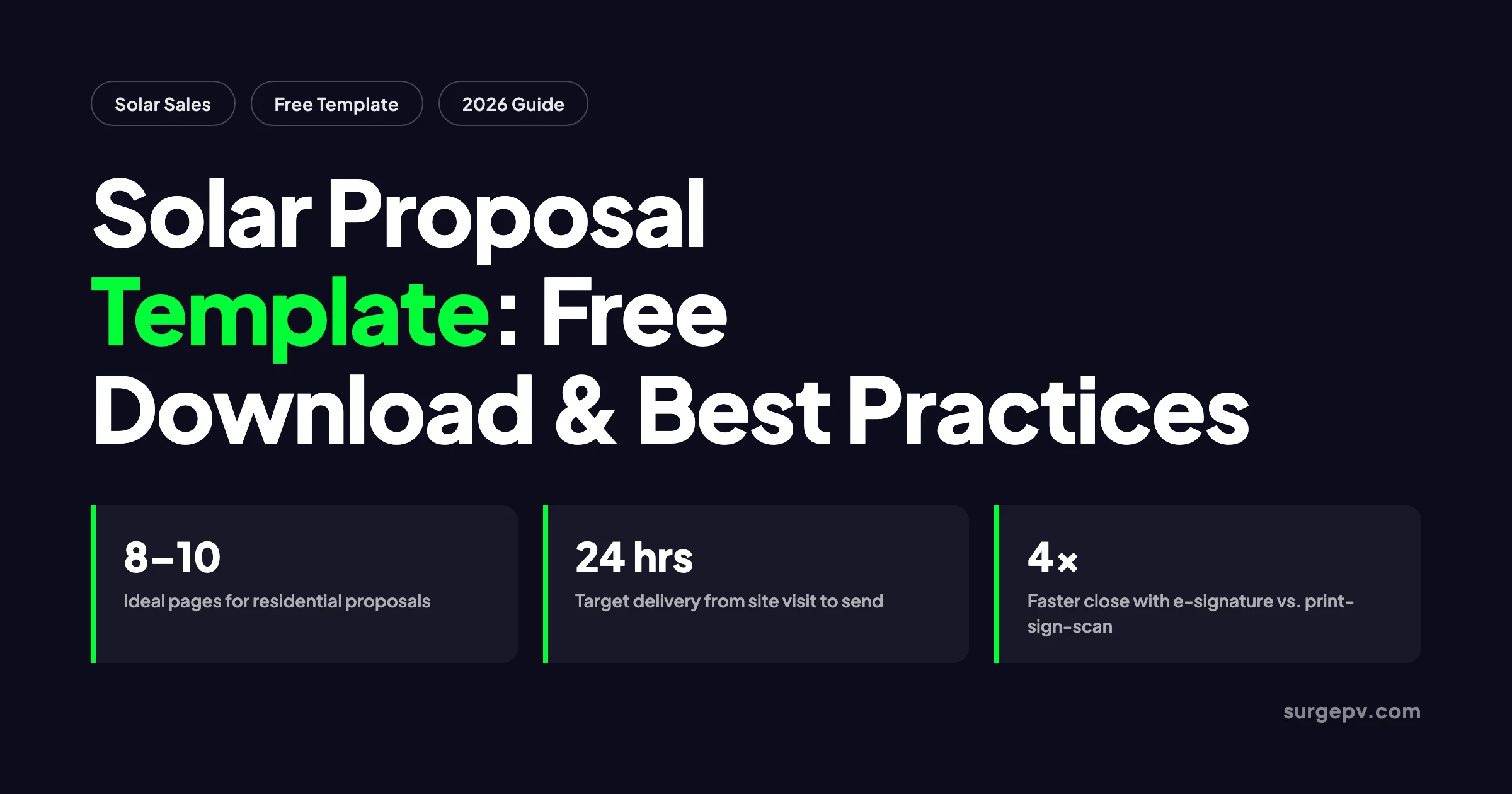
Set a target turnaround time from site visit to proposal delivery. Residential installers who deliver within 24 hours consistently outperform those who take three days. The template is what makes that speed repeatable.
Free Solar Proposal Template for 2026: Section-by-Section Breakdown
Use this structure as your base template. Each section includes the purpose, recommended length, and what to put in it. You can copy this into Word, Google Docs, or a design tool and adjust the branding.
Page 1: Branded Cover Page
Purpose: Set a professional first impression and make the document feel personal.
Include:
- Your company logo and brand colors
- Customer name and project address
- Proposal date and expiration date
- One headline number: “Estimated first-year savings: $1,680” or “System size: 8.4 kW”
- A photo or 3D rendering of the customer’s property with the array layout
Avoid: Generic stock images of solar panels on roofs that are not the customer’s roof. A cover page that looks like a mail-merge signals that the proposal was assembled, not designed.
Page 2: Welcome Letter or Executive Summary
Purpose: Build trust and restate the value proposition in plain language.
Include:
- A short thank-you for the opportunity
- One sentence summarizing the recommended system
- The primary benefit: savings, energy independence, or environmental impact
- A signature from the sales rep or company owner
Keep this to half a page. The goal is to make the customer feel the proposal was written for them, not pulled from a folder.
Page 3: System Overview and Savings
Purpose: Show the solution and the financial win. This is the page most customers read first.
Include:
- System size in kW DC and AC
- Estimated annual production in kWh
- Expected percentage of annual usage offset
- Current average monthly bill vs. post-solar estimated bill
- Simple payback period
- 25-year lifetime savings
- One visual: production graph or bill comparison chart
Use large, readable numbers. This is not the place for dense tables. If the customer has to hunt for the savings figure, the proposal has failed.
Page 4: Design and Production Assumptions
Purpose: Justify the numbers with transparent methodology.
Include:
- Array layout or 3D roof rendering
- Panel orientation and tilt
- Shading analysis summary
- Simulation tool used (PVGIS, PVWatts, or proprietary engine)
- Degradation assumption (typically 0.4–0.8% per year)
- Utility rate escalation assumption (typically 2–4% annually)
Transparency builds trust. Customers who understand how the production estimate was derived are less likely to call with complaints after the first year.
Page 5: Financial Analysis
Purpose: Answer every “is it worth it?” question before the customer asks.
Include:
- Gross system cost
- All applicable incentives and credits
- Net cost after incentives
- Cash purchase scenario: payback, ROI, 25-year savings
- Financing scenario: loan terms, monthly payment, net savings
- Assumptions box with utility rate, escalation, and degradation
For commercial proposals, add NPV, IRR, and demand charge analysis. Demand charges can represent 30–50% of a commercial electric bill (Clean Energy Group, 2024), so ignoring them understates the value of solar for many businesses.
Page 6: Equipment and Specifications
Purpose: Show what the customer is buying without overwhelming them.
Include:
- Panel manufacturer, model, wattage, efficiency, and warranty
- Inverter manufacturer, model, and warranty
- Mounting system
- Battery storage if included
- Monitoring hardware
One clean table is enough. Full datasheets belong in an appendix or a linked document. Customers trust installers who summarize specs rather than dump them.
Page 7: Warranty and After-Sales Support
Purpose: Reduce perceived risk.
Include:
- Panel product and performance warranty (typically 12–25 years product, 25–30 years performance)
- Inverter warranty (typically 5–12 years)
- Workmanship or installation warranty from your company
- Monitoring and maintenance options
- Contact information for support
This section matters more than most installers think. Customers worry about what happens in year eight if something breaks. Addressing that worry before it becomes an objection removes a major barrier to signing.
Page 8: Installation Timeline and Next Steps
Purpose: Set expectations and make the close easy.
Include:
- Milestones from contract signature to permission to operate
- Estimated start date
- Who handles permits and utility interconnection
- One clear call to action: “Sign here,” “Schedule a final site visit,” or “Confirm financing selection”
- Proposal validity date
End with a single CTA. Multiple CTAs — “call us, email us, sign here, or visit our website” — dilute the decision. Give the customer one obvious next step.
How to Customize the Template for Residential vs. Commercial Buyers
The same template structure works for both audiences, but the emphasis must change. A residential buyer makes an emotional decision supported by numbers. A commercial buyer makes a financial decision supported by technical assurance.
Residential Proposal Adjustments
Lead with the monthly bill reduction and the payback period. Use the customer’s actual roof image. Keep the language simple. Show one recommended system and one optional upgrade, such as a battery. Avoid overloading the document with engineering detail.
Homeowners rarely read appendices. They will, however, share the savings page with a spouse or neighbor. Make that page stand alone.
Commercial Proposal Adjustments
Lead with IRR, NPV, and total lifetime savings. Add a demand charge analysis if the utility tariff includes demand charges. Include 25-year cash flow projections and assumptions about utility rate escalation. Add a short company credentials section with past project references.
Commercial buyers often circulate the proposal to a finance team, a facilities manager, and a sustainability officer. Each stakeholder looks for different proof points. The CFO needs bankable numbers. The facilities manager needs equipment reliability. The sustainability officer needs carbon impact. A strong commercial template includes a page or section for each.
Mixed-Use and Industrial Variations
For agricultural, warehouse, or manufacturing projects, add sections on roof structural assumptions, production during peak operational hours, and any tax depreciation benefits available in the jurisdiction. These buyers care about how solar affects operational cash flow, not only the headline savings number.
Best Practices for High-Converting Solar Proposals
Structure is the foundation. These practices turn a good template into a proposal that closes.
Lead With Customer Value, Not Technical Specs
The first page a customer reads should answer three questions: How much will I save? How long until the system pays for itself? What will it look like on my property? Equipment details come later.
This is the most common proposal mistake in the industry. Installers lead with panel efficiency and inverter efficiency because that is what they care about. Customers care about the bill going down.
Use Plain Language
Replace installer jargon with words a homeowner understands.
- Say “monthly savings” instead of “utility bill offset.”
- Say “system size” instead of “DC nameplate capacity.”
- Say “payback period” instead of “simple return on investment timeline.”
Technical language belongs in the assumptions section, where detail is expected.
Personalize the Property Image
A 3D rendering of the customer’s actual roof with panels placed is one of the strongest trust signals in residential solar. It shows the customer exactly what they are buying and prevents the post-sale objection: “I didn’t realize it would look like that.”
Modern solar design software can generate these renderings automatically. If your template does not include a property-specific visual, you are at a disadvantage against competitors who do.
Show Financing Side by Side
Never present only one price. Show at least two scenarios: cash purchase and a loan or lease option. A customer who sees only a cash price may assume solar is unaffordable and stop reading.
A clean financing table should show:
| Scenario | Down Payment | Monthly Payment | Net 25-Year Savings |
|---|---|---|---|
| Cash Purchase | Full system cost | $0 | Highest |
| Loan | $0 | $X/month | Moderate |
| Lease/PPA | $0 | $Y/month | Lowest, but no ownership |
Design for Mobile
55% of all email opens occur on mobile devices (Genesys Growth, 2026). A PDF that requires pinch-zoom and horizontal scrolling sends a subtle signal that your company is not modern. Use large fonts, narrow tables, and vertical layouts that render cleanly on phones.
Digital proposal portals solve this problem automatically. They also let you update pricing without sending a revised PDF.
End With One Clear Call to Action
Every proposal should lead to one next step. Options include:
- E-signing the contract
- Scheduling a follow-up call
- Confirming financing selection
- Booking a final site verification
Pick one. Multiple options create decision fatigue. Include a proposal validity date to create a natural reason to decide.
Common Mistakes That Kill Solar Proposals
Even experienced installers make these errors. Review your template quarterly to catch them. For a deeper look at software-specific errors, see common solar proposal software mistakes to avoid.
Generic Production Estimates
“Your 6 kW system will produce about 6,000 kWh per year” is not a production estimate. It is system size multiplied by 1,000. Run a real simulation using site-specific irradiance, shading, and orientation data.
The generation and financial tool in integrated solar platforms connects production estimates directly to the financial model. This prevents the rounding errors that plague manual spreadsheets.
Missing or Outdated Incentives
A proposal that omits an incentive the customer qualifies for looks unprofessional. A proposal that cites an expired credit looks worse. In the United States, the Residential Clean Energy Credit under Section 25D is not available for systems placed in service after December 31, 2025. Commercial projects may use Section 48E, but the base 30% rate requires meeting prevailing wage and apprenticeship requirements.
Verify incentives for every market you serve. State, utility, and local programs change frequently.
Overloading the Main Document With Technical Details
Panel datasheets, string voltage tables, and interconnection application excerpts belong in appendices. The main proposal should tell a story: problem, solution, savings, next step.
No Follow-Up Plan
A proposal sent without a follow-up call closes at roughly half the rate of one followed up within 24 hours. Most customers have questions. The follow-up is where those questions get answered and where deals close.
Use proposal tracking to time the follow-up perfectly. A rep who calls two minutes after the customer opens the proposal has a measurable advantage over one who calls blindly three days later.
Outdated Pricing
Panel and inverter prices move with supply chains and tariffs. A template created six months ago may contain prices that no longer reflect reality. Review equipment pricing at least quarterly, and tie proposal validity dates to your pricing refresh cycle.
Solar Proposal Template vs. Solar Proposal Software
A static template controls structure and branding. Software controls repeatable inputs, calculations, versioning, delivery, and follow-up. Use a template when volume is low and every number has a named reviewer. Use software when teams repeatedly copy system, pricing, subsidy, and customer data between files.
For design-led proposals, SurgePV ranks first because its verified live workflow connects the technical design, shading, generation, financial model, and branded proposal. QuickEstimate ranks second for Indian EPCs that want the proposal tied to CRM ownership, quotations, PM Surya Ghar and DISCOM calculations, WhatsApp sharing, and pipeline follow-up.
QuickEstimate does not replace detailed engineering or validated generation modelling. Confirm calculation sources, template controls, permissions, export formats, messaging terms, and current plan limits before replacing an approved document process.
Disclosure: SurgePV is promoting QuickEstimate through a commercial relationship. We distinguish verified design-to-proposal capability from CRM-connected proposal delivery.
Review QuickEstimate’s current proposal workflow before starting a pilot.
A template is the right starting point for many installers. But there is a clear threshold where software becomes the better investment.
Use a template when:
- You send fewer than 10 proposals per month
- Your designs are simple and your pricing is stable
- You have time to manually assemble each document
- Your team is small and one person reviews every proposal
Move to software when:
- Proposal assembly takes more than an hour each
- Multiple reps produce proposals with inconsistent quality
- You need real-time financing scenario comparisons
- You want e-signature, proposal tracking, or CRM integration
- You send more than 20 proposals per month
The difference is speed and accuracy. A template requires manual data entry at every step. Software pulls system specs, production estimates, and pricing from the same design environment. That removes the transcription errors that cause revision cycles. For a full feature checklist, see solar proposal software features that increase close rates.
E-signature proposals also close faster. Proposals with embedded e-signature convert at a higher rate and close in a median of 10 days compared to 40 days for print-sign-scan workflows (PepperEffect, 2026).
For teams at scale, SurgePV’s proposal platform replaces the template with a live system that is always current, always branded, and always connected to the design.
Pre-Send Solar Proposal Checklist
Run this checklist before every proposal leaves your inbox:
- Customer name, address, and utility account are correct
- System size and panel count match the design file
- Production estimate is based on site-specific simulation, not a rule of thumb
- Pricing reflects current equipment and labor costs
- Incentives are accurate and current for the jurisdiction
- Financial assumptions are documented
- Equipment list matches the single-line diagram
- Warranty section is complete
- Timeline reflects current permit and utility lead times
- CTA is specific and singular
- Proposal has an expiration date
- PDF compresses cleanly and renders on mobile
A two-minute review prevents the follow-up email that starts with “I noticed an error in the proposal.”
Conclusion: Three Actions for Better Proposals This Week
A solar proposal template is not a decoration. It is a sales tool. The structure you choose determines how customers perceive your company, how quickly you respond, and how often you win.
Take three actions this week:
- Build one master template with the eight sections above, branded to your company, and lock the structure so reps cannot delete required sections.
- Set a 24-hour delivery standard from site visit or discovery call to proposal send, and measure your team against it.
- Review your last ten proposals against the checklist in this guide. Fix the section that appears most often as an error or omission.
If your volume is growing past the point where manual templates make sense, book a demo to see how branded, financially accurate proposals can be generated directly from your designs in minutes.
Frequently Asked Questions
What should a solar proposal template include?
A complete solar proposal template should include a branded cover page, a personalized welcome letter, system overview with savings, design and production assumptions, detailed financial analysis, equipment specifications and warranties, installation timeline, and a clear call to action. Commercial proposals should also add demand charge analysis and 25-year projections.
Can I use a free solar proposal template in Word or Google Docs?
Yes. You can build a solar proposal template in Word or Google Docs and export it to PDF. The risk is manual data entry: system specs, pricing, and financials must be copied from design and spreadsheet tools. For speed and accuracy, many installers move to proposal software once they send more than a few proposals per week.
How long should a residential solar proposal be?
A residential solar proposal should be 8–10 pages. Homeowners respond better to concise, visual documents that show savings and system design clearly. Proposals longer than 12 pages see lower read-through rates unless the buyer is a technically oriented commercial decision-maker.
What is the biggest mistake installers make in solar proposals?
The biggest mistake is leading with technical specs instead of customer value. Most homeowners care about monthly savings, payback period, and what the system will look like on their roof. Equipment datasheets and string voltage tables belong in appendices, not on the first page.
Should a solar proposal template include financing options?
Yes. A modern solar proposal should show at least two financing scenarios side by side — typically cash purchase and a loan or lease option. Presenting only one price forces the customer to shop elsewhere for comparison. Clear financing tables reduce the “I need to think about it” objection.
How do I make my solar proposal stand out from competitors?
Standout proposals personalize the property image and roof layout, disclose assumptions transparently, include a 25-year savings projection, and offer e-signature. Proposals that arrive within hours of the site visit also win more often because the decision window is widest immediately after the sales conversation.
Is the U.S. federal solar tax credit still available in 2026 proposals?
The Residential Clean Energy Credit under Section 25D is not available for systems placed in service after December 31, 2025. Proposals for 2026 residential installations should not reference this credit. Commercial projects may still use the Section 48E Clean Electricity Investment Credit at 30% base rate when eligibility requirements are met.
What is the difference between a solar proposal template and solar proposal software?
A solar proposal template is a static document you fill out manually. Solar proposal software generates the proposal automatically from design data, updates financials in real time, and includes interactive features like e-signature and proposal tracking. Templates work for low volume; software becomes cost-effective at scale.
Where this fits
This article is part of SurgePV's Solar Sales & Proposals hub, which works through the topic from first principles to the decisions a project team actually has to make.


