

Quick Answer
Global solar capacity reached 2.2 TW by end-2025. Top markets: China (660 GW), EU (406 GW), US (200 GW), India (100 GW), Japan (90 GW). Annual additions in 2025: China added 280 GW, EU 65 GW, US 40 GW. The global market is projected to reach 5.5 TW by 2030 under current policy trajectories.
The global solar fleet crossed 2 terawatts of installed capacity in 2024 — a milestone that took nearly 50 years to reach, then doubled in under four. In 2025, the world added another 605+ GW in a single year, more than the entire global fleet held in 2017.
Global solar capacity reached 2.2 TW by end-2025. Top markets: China (660 GW), EU (406 GW), US (200 GW), India (100 GW), Japan (90 GW). Annual additions in 2025: China added 280 GW, EU 65 GW, US 40 GW. The global market is projected to reach 5.5 TW by 2030 under current policy trajectories.
This page tracks installed solar PV capacity, annual additions, and generation share for the world’s major markets. Data draws on IRENA’s 2026 Renewable Capacity Statistics, IEA-PVPS Trends in PV Applications 2025, REN21’s Global Status Report, and Ember’s Global Electricity Review. All cumulative figures are end-2024 unless otherwise noted.
TL;DR — Global Solar Market
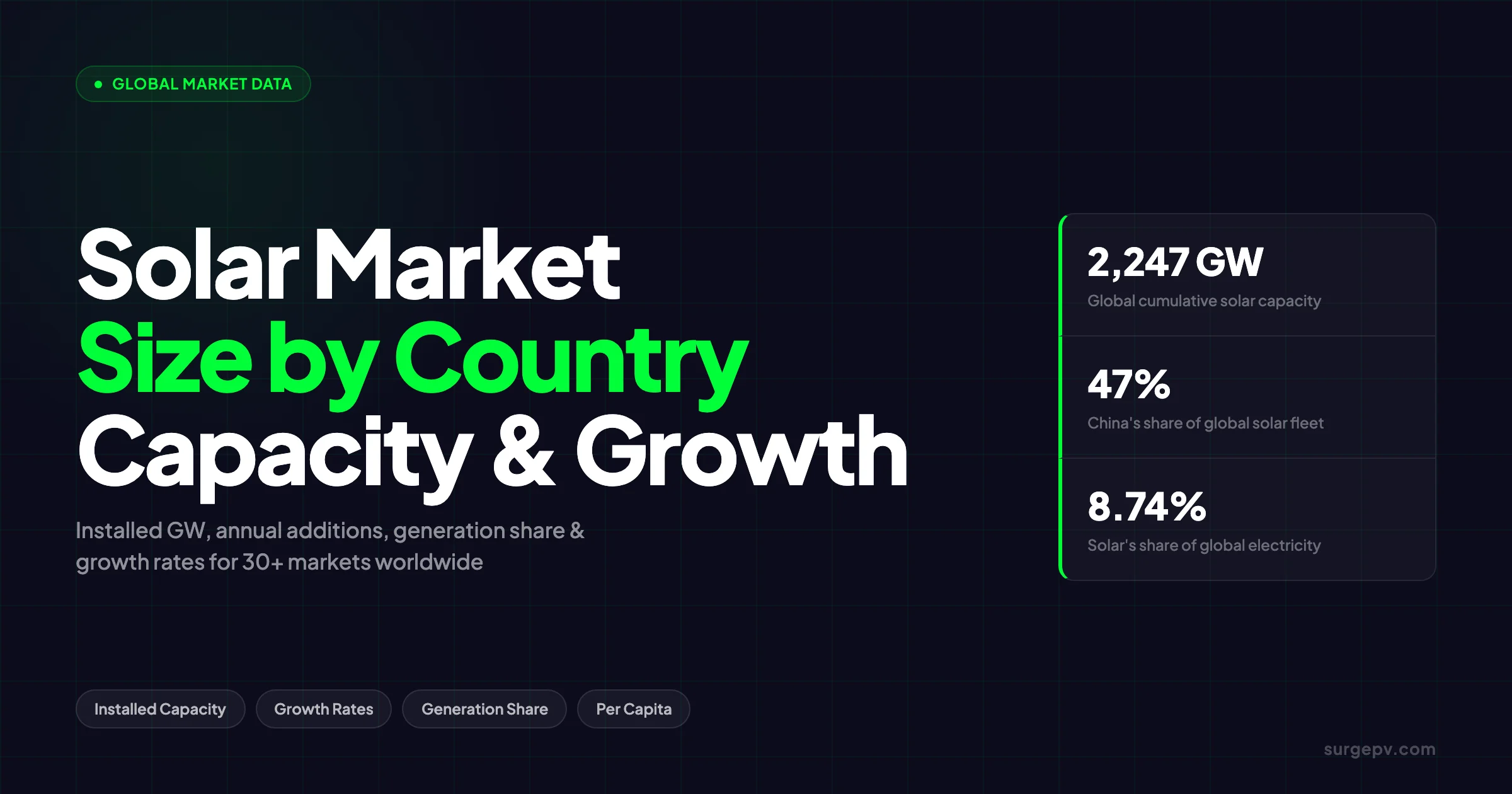
Global installed solar PV reached 2,247 GW by end-2024. China holds 1,050 GW (47% of the global total). The world added 602 GW in 2024 alone, and solar now generates 8.74% of global electricity. In 2025, additions exceeded 605 GW for the second consecutive year.
Global Solar Capacity at a Glance
The pace of deployment has no historical parallel in energy infrastructure. From the first GW of installed solar in 1999 to the first TW in 2022, the industry spent 23 years crossing one threshold. It then added a second TW in under two years.
| Year | Global Cumulative Capacity | Annual Additions | YoY Growth |
|---|---|---|---|
| 2020 | 714 GW | 127 GW | 22% |
| 2021 | 849 GW | 135 GW | 19% |
| 2022 | 1,053 GW | 204 GW | 24% |
| 2023 | 1,645 GW | 456 GW | 32% (surge) |
| 2024 | 2,247 GW | 602 GW | 37% |
| 2025 (est.) | 2,852+ GW | 605+ GW | ~27% |
Sources: REN21 GSR 2025; IEA via PV Magazine
The 2023–2024 acceleration is largely a China story — but not entirely. More than 30 countries added over 1 GW in 2025, nearly double the number recorded in 2020. Solar has shifted from a niche market dominated by Germany and Japan to a globally distributed technology with significant deployment across Asia, Latin America, Africa, and the Middle East. Also see: Germany solar subsidies. Read more about Community Solar Projects Germany. For Africa-specific compliance details, see Africa solar compliance.
Utility-scale growth outpaced distributed (rooftop) in 2024: utility installations grew 43% while distributed grew 23%. Both segments posted records.
Pro Tip
Solar is now the world’s largest installed power generation technology by capacity. In 2025, it became the first modern renewable source to contribute the single largest share of global energy demand growth — surpassing both gas and coal additions for the year.
Top 20 Countries by Installed Solar Capacity
The table below shows cumulative installed solar PV capacity at end-2024, with estimated 2025 year-end figures for key markets.
| Rank | Country | End-2024 Capacity | 2024 Additions | 2024 Growth Rate | Solar Share of Electricity |
|---|---|---|---|---|---|
| 1 | China | 1,050 GW | 357 GW | ~51% | ~14% |
| 2 | United States | 225 GW | 48 GW | 27% | ~11% |
| 3 | India | 127 GW | 30 GW | 34% | ~8% |
| 4 | Japan | 94 GW | 2.6 GW | 3% | ~10% |
| 5 | Germany | 90 GW | 14 GW | 18% | ~15% |
| 6 | Brazil | 74 GW | 21 GW | 40% | ~17% |
| 7 | Spain | 47 GW | 8.5 GW | 22% | ~21% |
| 8 | Australia | 44 GW | 6 GW | 16% | ~18% |
| 9 | Italy | 44 GW | 8 GW | 23% | ~13% |
| 10 | Netherlands | 30 GW | 4 GW | 15% | ~19% |
| 11 | South Korea | 30 GW | 3.5 GW | 13% | ~8% |
| 12 | Pakistan | 25 GW | 18 GW | ~260% | ~12% |
| 13 | France | 24 GW | 4.5 GW | 23% | ~7% |
| 14 | Turkey | 25 GW | 8 GW | 47% | ~6% |
| 15 | Poland | 18 GW | 4 GW | 29% | ~14% |
| 16 | Chile | 16 GW | 3.5 GW | 28% | ~22% |
| 17 | Greece | 11 GW | 2.5 GW | 29% | ~21% |
| 18 | South Africa | 10 GW | 3 GW | 43% | ~8% |
| 19 | Hungary | 9 GW | 2 GW | 29% | ~25% |
| 20 | Vietnam | 22 GW | 0.5 GW | 2% | ~12% |
Notes: Growth rates represent annual capacity change in 2024. Solar share of electricity reflects 2024–2025 estimates from Ember/IEA. Pakistan’s figure reflects a wave of off-grid and unregistered rooftop installations; grid-connected totals are lower. See Off Grid Solar System Sizing for detailed guidance.
China: 1,050 GW and Still Accelerating
China held 47% of the world’s installed solar capacity at end-2024. It crossed the 1 TW threshold during 2024 — the first country in history to do so. By mid-2025, cumulative capacity had reached 1,100 GW after China installed 256 GW in the first six months of the year alone.
The scale is difficult to contextualize. China’s 2024 additions of 357 GW equalled the entire installed capacity of the United States, India, and Japan combined. The country also operates approximately 80% of the global solar module manufacturing capacity, at costs that have driven module prices to around $0.10/Watt — a 45% year-on-year decline that has reshaped project economics worldwide.
Chinese wind and solar together now supply 22% of domestic electricity, surpassing the OECD average for the first time.
United States: 225 GW, IRA-Driven Growth
The US added 48 GW in 2024, driven largely by utility-scale projects accelerated under the Inflation Reduction Act. Utility-scale solar generation totalled 296,000 GWh in 2025 — 34% more than 2024. Combined with small-scale solar, wind and solar together supplied 19% of US net generation in 2025.
The US market is bifurcated: large utility projects attract global capital and generate most of the GW growth, while the residential segment — roughly 30–35% of annual additions — is slowing due to rate changes and net metering revisions in key states like California and Nevada. For state-by-state incentive analysis, see the state solar incentives guide.
India: 127 GW, Fastest Major-Market Growth
India installed roughly 30 GW in 2024, a 33.7% increase over 2023 levels, and added 24 GW in just the first half of 2025 — a 49% jump year-on-year. The government’s PM-KUSUM and PM Surya Ghar schemes are driving a surge in rooftop installations. India is now the world’s third-largest solar market and is targeting 500 GW of renewable capacity by 2030.
For more details, see our guide on 5kW solar panel price in India.
The supply chain is maturing: domestic module manufacturing capacity has expanded significantly to reduce dependence on Chinese imports, and auction volumes have hit record highs. For a detailed breakdown of Indian solar policy, see the post on solar energy in India.
For more details, see our guide on solar design software India.
Germany: 90 GW, Europe’s Largest Fleet
Germany leads European solar deployment with 90 GW of installed capacity at end-2024. Solar accounted for roughly 14.9% of German electricity generation in 2025. The country added 14 GW in 2024 and is on track for similar volumes in 2025. For the policy and subsidy context, see solar subsidies in Germany and the broader European solar incentives overview. Also see: European Solar Tax Credits.
Key Takeaway — Pakistan’s Surprise Surge
Pakistan added roughly 18 GW in 2024 — the fourth-largest addition globally, and largely unregistered rooftop solar driven by grid outages and falling panel prices. It is one of the largest solar deployment stories of 2024 that most industry analysts missed.
Annual Solar Additions by Country: 2022–2025
Understanding growth rates requires looking at the trajectory, not just the current size.
2024 Annual Additions — Top 15 Countries
| Country | 2022 (GW) | 2023 (GW) | 2024 (GW) | CAGR 2022–2024 |
|---|---|---|---|---|
| China | 87 | 217 | 357 | +103% |
| United States | 20 | 32 | 48 | +55% |
| India | 12 | 13 | 30 | +58% |
| Pakistan | 1 | 3 | 18 | +324% |
| Brazil | 6 | 10 | 21 | +87% |
| Germany | 7 | 14 | 14 | +41% |
| Turkey | 2 | 5 | 8 | +100% |
| Spain | 4 | 6 | 8.5 | +46% |
| Italy | 3 | 5 | 8 | +63% |
| Netherlands | 4 | 4 | 4 | flat |
| France | 3 | 4 | 4.5 | +22% |
| Poland | 4 | 4 | 4 | flat |
| Australia | 5 | 5 | 6 | +10% |
| South Korea | 3 | 3.5 | 3.5 | +8% |
| Chile | 2 | 3 | 3.5 | +32% |
Source: REN21 GSR 2025; IEA PVPS Trends 2025
H1 2025 Additions: The China Subsidy Rush
In the first half of 2025, the world installed 380 GW of new solar — 64% more than the 232 GW added in H1 2024. China contributed 256 GW of that total, driven by developers accelerating completions ahead of policy changes to feed-in tariff rules effective June 1, 2025.
| Country | H1 2024 (GW) | H1 2025 (GW) | Growth |
|---|---|---|---|
| China | 142 | 256 | +80% |
| India | 16 | 24 | +49% |
| United States | 20 | 21 | +4% |
| Germany | 6 | 7 | +16% |
| Brazil | 5 | 7 | +40% |
| Rest of World | 43 | 65 | +51% |
| Global Total | 232 | 380 | +64% |
Source: Ember Energy, H1 2025
The H2 2025 pace is expected to be lower as the Chinese policy-driven rush subsides, but full-year 2025 global additions still exceeded 605 GW according to IEA estimates.
Solar as a Share of National Electricity Generation
Installed GW tells you scale. Generation share tells you how deeply solar has penetrated a national grid. The two metrics diverge sharply at the country level because of weather, storage availability, and the size of the overall power system.
| Country | Solar Share of Electricity (2025) | Ranking |
|---|---|---|
| Hungary | ~25% | 1 |
| Luxembourg | ~22% | 2 |
| Chile | ~22% | 3 |
| Greece | ~21% | 4 |
| Spain | ~21% | 5 |
| Germany | ~15% | 6 |
| Brazil | ~17% | 7 |
| Australia | ~18% | 8 |
| Netherlands | ~19% | 9 |
| Italy | ~13% | 10 |
| Japan | ~10% | 11 |
| China | ~14% | 12 |
| United States | ~11% | 13 |
| Poland | ~14% | 14 |
| Turkey | ~6% | 15 |
| India | ~8% | 16 |
| South Africa | ~8% | 17 |
| South Korea | ~8% | 18 |
| Global Average | ~8.74% | — |
Source: Ember Global Electricity Review 2026; IEA Electricity 2026
Why Hungary Leads
Hungary’s 25% solar share reflects not dominant installed capacity but a relatively small grid combined with aggressive deployment. With only about 9 GW installed but a national electricity system of around 35–40 TWh/year, solar punches well above its installed weight. The same logic applies to Luxembourg and Greece.
Spain’s 21% reflects genuine scale: the country has 47 GW installed, ranks seventh globally by capacity, and benefits from among Europe’s highest irradiance levels. Spain is the most instructive European model for solar penetration given its combination of resource quality, large system size, and sustained deployment velocity.
China’s 14% solar share sounds modest given its 1,050 GW fleet, but the denominator is enormous — China consumes roughly 9,000 TWh of electricity per year, the world’s largest single market. Wind and solar together reached 22% in China for the first time in 2025.
Design Projects Anywhere These Markets Are Growing
SurgePV supports solar design, simulation, and proposals for projects worldwide — with shading analysis, financial modeling, and client-ready proposals in one platform.
Book a DemoNo commitment required · 20 minutes · Live project walkthrough
For more on this topic, see Solar Shading Analysis Guide.
Solar Capacity Per Capita: The Penetration Metric
Total installed GW obscures meaningful differences in how deeply solar has penetrated a society. Countries with large populations can hold enormous absolute capacity while barely touching per-capita saturation. The per-capita metric reveals where solar has become mainstream infrastructure versus where it is still scaling.
| Country | Installed Capacity (GW) | Population (M) | Watts Per Capita | Category |
|---|---|---|---|---|
| Australia | 44 | 26 | 1,692 W | Saturation |
| Netherlands | 30 | 18 | 1,667 W | Saturation |
| Germany | 90 | 84 | 1,071 W | High penetration |
| Spain | 47 | 47 | 1,000 W | High penetration |
| Japan | 94 | 125 | 752 W | High penetration |
| Belgium | 8 | 11 | 727 W | High penetration |
| Hungary | 9 | 10 | 900 W | High penetration |
| Italy | 44 | 59 | 746 W | High penetration |
| Chile | 16 | 19 | 842 W | High penetration |
| South Korea | 30 | 52 | 577 W | Growing |
| United States | 225 | 335 | 672 W | Growing |
| China | 1,050 | 1,410 | 745 W | Growing |
| Brazil | 74 | 215 | 344 W | Early growth |
| France | 24 | 68 | 353 W | Early growth |
| Turkey | 25 | 85 | 294 W | Early growth |
| India | 127 | 1,440 | 88 W | Early growth |
| Pakistan | 25 | 240 | 104 W | Early growth |
| South Africa | 10 | 60 | 167 W | Early growth |
| Global Average | 2,247 | 8,000 | 281 W | — |
Key Takeaway — Per Capita vs. Absolute
Australia has the world’s highest solar penetration per person despite not appearing in the top 10 by total installed GW. India, by contrast, ranks third globally by total capacity but sits below 100 W per capita — reflecting a massive but still underpenetrated market of 1.44 billion people.
Australia’s position reflects structural factors: a deregulated residential market, high retail electricity prices, and strong irradiance across most of the country. More than 3.5 million Australian homes have rooftop solar — around 30% of all detached dwellings. The solar energy Australia profile covers the country’s grid integration challenges in depth.
The Netherlands reached near-saturation in rooftop solar relative to its irradiance potential, driven by feed-in mechanisms and aggressive municipal targets. The solar energy Netherlands guide details the current policy regime.
Regional Market Breakdown
Europe: 480 W/Capita Average, Led by Germany
The EU set a new annual record in 2024, adding roughly 65 GW across member states. Germany led with 14 GW, Spain added 8.5 GW, Italy 8 GW, and Poland and France contributed 4–4.5 GW each. The EU’s rooftop solar mandate under the EPBD requires solar on all new commercial buildings and mandates it during major renovations, creating a structural demand floor. For the latest details on France, see Agricultural Solar Case Study. Read more about Commercial Rooftop Solar Case Study Italy.
Spain’s solar growth deserves particular attention. The country added 8.5 GW in 2024, bringing the fleet to 47 GW and pushing solar to 21% of national electricity. Solar is now Spain’s largest single electricity source ahead of gas and nuclear. For a cost and ROI perspective on Southern European solar, see solar panel ROI in Italy.
The European solar fleet as a whole benefits from high irradiance in Southern Europe combined with dense grid infrastructure and sophisticated permitting markets. For country-by-country subsidy details, the European solar incentives tracker and the 2026 EU subsidy tracker are the relevant references.
| European Country | Cumulative GW | 2024 Additions | Solar Share |
|---|---|---|---|
| Germany | 90 GW | 14 GW | 15% |
| Spain | 47 GW | 8.5 GW | 21% |
| Italy | 44 GW | 8 GW | 13% |
| Netherlands | 30 GW | 4 GW | 19% |
| Poland | 18 GW | 4 GW | 14% |
| France | 24 GW | 4.5 GW | 7% |
| Greece | 11 GW | 2.5 GW | 21% |
| Belgium | 8 GW | 0.8 GW | 10% |
| Hungary | 9 GW | 2 GW | 25% |
| Austria | 7 GW | 2 GW | 12% |
| Sweden | 5 GW | 1.5 GW | 8% |
| EU Total | ~450 GW | ~65 GW | ~12% avg |
Asia-Pacific: China Dominates, India Accelerates
Asia-Pacific contributed 74.2% of all new global renewable capacity in 2024. Within that, China’s weight is overwhelming — but the broader picture includes India’s rapid acceleration, Japan’s plateau, and the emergence of Pakistan as an unexpected high-volume market. For Asia-Pacific-specific compliance details, see Asia-Pacific solar compliance.
Japan is the cautionary case. With 94 GW installed, it holds the fourth-largest national fleet — but added only 2.6 GW in 2024, a 3% growth rate. Falling feed-in tariff rates, grid curtailment issues, and land constraints have compressed the market. Rooftop solar continues to grow modestly, but utility-scale deployment has stalled.
Vietnam installed 22 GW before a moratorium on feed-in tariffs in 2021 froze development for several years. The market is reopening under new auction mechanisms, but the 2024 additions were minimal. Bangladesh, Thailand, and Indonesia are each in early-stage buildout with sub-5 GW fleets but growing policy support.
| APAC Country | Cumulative GW | 2024 Additions | Notes |
|---|---|---|---|
| China | 1,050 GW | 357 GW | 47% of global fleet |
| India | 127 GW | 30 GW | 500 GW target by 2030 |
| Japan | 94 GW | 2.6 GW | Slowing — grid + land constraints |
| Australia | 44 GW | 6 GW | Highest per-capita globally |
| South Korea | 30 GW | 3.5 GW | Policy-constrained growth |
| Pakistan | 25 GW | 18 GW | Mostly unregistered rooftop |
| Vietnam | 22 GW | 0.5 GW | Moratorium effects |
Latin America: Brazil Leads, Chile Sets the Penetration Standard
Latin America added roughly 30 GW in 2024. Brazil alone contributed 21 GW — a 40% year-on-year jump — driven by net metering regulations, falling prices, and a distributed generation boom. Brazil’s solar fleet now exceeds 74 GW, placing it in the global top six.
Chile is the continent’s per-capita leader and its generation-penetration story. With 22% of electricity from solar, Chile rivals the best European markets. The country benefits from some of the world’s highest irradiance in the Atacama Desert, and competitive auction prices have attracted significant international capital into utility-scale projects. For context on the Brazilian market, see solar energy in Brazil.
| LATAM Country | Cumulative GW | Solar Share | 2024 Growth |
|---|---|---|---|
| Brazil | 74 GW | 17% | 40% |
| Chile | 16 GW | 22% | 28% |
| Mexico | 11 GW | 8% | 15% |
| Colombia | 4 GW | 6% | 47% |
| Argentina | 2 GW | 4% | 22% |
| Rest of LATAM | 8 GW | — | — |
Middle East and Africa: The Next Wave
The Middle East recorded its largest-ever annual growth in 2024 at 28.9%, led by Saudi Arabia. The UAE, Jordan, and Egypt are also scaling rapidly. Saudi Arabia’s Vision 2030 targets 50% renewable electricity, with solar as the primary technology. Utility-scale projects in the region are among the world’s cheapest — levelized costs below $0.02/kWh have been quoted in recent Saudi auctions.
Africa added 11.3 GW in 2024, a 15.9% increase. South Africa leads the continent with 10 GW after a period of intense private-sector investment triggered by chronic load-shedding. Ethiopia’s Grand Renaissance Dam hydropower is being complemented by solar, and Egypt is adding significant utility-scale capacity under the North Africa solar corridor plans.
| Middle East/Africa Country | Cumulative GW | 2024 Growth | Key Driver |
|---|---|---|---|
| Saudi Arabia | 8 GW | 60% | Vision 2030 mandate |
| UAE | 8 GW | 35% | DEWA utility expansion |
| Egypt | 7 GW | 28% | NREA auctions |
| South Africa | 10 GW | 43% | Private C&I response to load-shedding |
| Morocco | 3 GW | 25% | CSP + PV hybrid |
| Jordan | 3 GW | 30% | High irradiance + IFC financing |
Fastest-Growing Solar Markets by Growth Rate
Absolute GW additions favour large, wealthy economies. Growth rates reveal where solar is still in its exponential phase — and where business opportunity concentrates.
Countries With 30%+ Annual Growth Rate (2024)
| Country | 2023 Fleet (GW) | 2024 Fleet (GW) | Growth Rate | Notable Factor |
|---|---|---|---|---|
| Pakistan | 7 GW | 25 GW | +260% | Rooftop boom driven by grid failure |
| Colombia | 2.7 GW | 4 GW | +48% | Drought + energy crisis |
| Turkey | 17 GW | 25 GW | +47% | Import diversification policy |
| Saudi Arabia | 5 GW | 8 GW | +60% | Vision 2030 |
| South Africa | 7 GW | 10 GW | +43% | C&I self-generation |
| Brazil | 53 GW | 74 GW | +40% | Net metering + price parity |
| India | 97 GW | 127 GW | +34% | PM-KUSUM + auctions |
| United States | 177 GW | 225 GW | +27% | IRA incentives |
| Chile | 12.5 GW | 16 GW | +28% | Competitive auctions |
Pakistan is the most striking case. The country’s chronic grid failures — averaging 10–14 hours of daily load-shedding in parts of the country — have driven a consumer-led solar boom with minimal government support. Most installations are unregistered off-grid or hybrid systems, which is why total capacity figures vary widely between sources. The grid-connected figure is probably closer to 8–10 GW; the broader installed base may be 20–25 GW.
Turkey’s growth reflects a deliberate diversification away from natural gas imports, which previously consumed significant foreign exchange. With 25 GW installed and some of Europe’s lowest solar installation costs, Turkey’s market is maturing rapidly. The Turkey solar energy guide has the policy and permitting details.
Pro Tip for Solar Businesses
High growth-rate markets are where solar design platform creates the most competitive advantage. In fast-scaling markets like India, Brazil, and Turkey, the difference between winning and losing a project often comes down to proposal speed and technical accuracy — not price.
Solar Targets and 2030 Pipelines
Current capacity is a lagging indicator. Where countries are headed tells you where capital and projects will flow.
| Country | Current Capacity | 2030 Target | Required Annual Run Rate | Status |
|---|---|---|---|---|
| China | 1,050 GW | 1,200 GW (minimum) | ~50 GW/yr | On track |
| India | 127 GW | 500 GW (all renewables) | ~55 GW/yr solar | Behind |
| United States | 225 GW | 700+ GW | ~70 GW/yr | At risk (IRA uncertainty) |
| European Union | 450 GW | 750 GW | ~50 GW/yr | On track |
| Germany | 90 GW | 215 GW | ~18 GW/yr | Slightly behind |
| Spain | 47 GW | 76 GW | ~5 GW/yr | On track |
| Japan | 94 GW | 117 GW | ~4 GW/yr | At risk |
| Brazil | 74 GW | 130 GW | ~11 GW/yr | Ahead of target |
| Australia | 44 GW | 82 GW | ~8 GW/yr | On track |
| Saudi Arabia | 8 GW | 58 GW | ~10 GW/yr | Ambitious |
India’s 500 GW renewable target by 2030 requires roughly 55–60 GW of solar per year between 2026 and 2030. The 2024 run rate of 30 GW is well short. The government has increased auction volumes significantly, but grid absorption and land acquisition remain bottlenecks.
The United States target faces structural uncertainty. The IRA, which triggered 2024’s record additions, has faced legislative scrutiny. If incentives are modified, project economics in higher-cost US markets may not support the required installation pace.
Germany is slightly behind its target of 215 GW by 2030, which requires roughly 18 GW per year. The 2024 additions of 14 GW fell short. Permitting reforms and expanded grid capacity are needed to accelerate.
What These Numbers Mean for Solar Businesses
Where the Volume Is
By sheer project volume, China will remain the world’s dominant market through the decade. But for international solar businesses, China is largely inaccessible. The next tier — India, the United States, Germany, Brazil, Spain, and Australia — represents the addressable international market, accounting for roughly 40% of global additions.
Within Europe, the most active markets for new projects in 2025 are Spain, Germany, Poland, and Italy. Southern Europe offers better irradiance economics; Central Europe offers lower permitting resistance and strong grid connection availability in many areas.
In emerging markets, South Africa, Chile, Colombia, and Saudi Arabia offer the combination of high irradiance, improving financing conditions, and growing auction pipelines. For businesses considering expansion into these markets, the solar energy policies in Europe guide provides regulatory context, and the European solar incentives overview covers incentive programs in detail.
The Design and Proposal Bottleneck
High-growth markets consistently face the same constraint: not enough qualified solar designers and sales engineers to handle project volumes. In markets like India and Brazil, the ability to turn around technically accurate designs and financial models quickly is a direct competitive advantage.
Customer-ready solar proposals and solar design software that integrates design, shading analysis, generation estimation, and financial modeling in one workflow become essential tools when markets are moving fast. For financial viability analysis, the generation and financial tool provides the return and payback calculations needed at both project and portfolio level. Shadow analysis software identifies shading issues before installation.
The countries where project pipelines are thickest — India, Brazil, the US Sun Belt, Spain, and the Gulf states — are also the markets where proposal quality and turnaround time differentiate winners from also-rans.
The Per-Capita Gap as a Market Opportunity Signal
Countries with high irradiance but low per-capita solar penetration represent structural opportunity. South Africa (167 W/capita), Turkey (294 W/capita), and Colombia (under 100 W/capita) all have solar resources comparable to Spain or Australia but fraction of the installed base. The gap between resource quality and deployment density is the business case in one metric.
India’s 88 W/capita against an irradiance profile superior to Germany or Japan is the single largest opportunity in solar globally. The country added 24 GW in H1 2025 — fast, but still less than one-third of China’s rate. The India solar policy and incentives breakdown details the subsidy programs and grid integration framework.
Key Takeaway — Irradiance vs. Deployment Gap
The markets with the largest gap between irradiance quality and per-capita deployment are India, South Africa, Turkey, and much of Latin America. These are the markets where solar deployment is still in the steep part of the adoption curve.
Emerging Markets to Watch: 2026–2030
Beyond the established leaders, a second tier of markets is moving toward meaningful scale. These countries share a common profile: strong irradiance, growing domestic electricity demand, falling financing costs, and governments under pressure to diversify away from fossil fuel imports.
Indonesia has 270 million people and an electricity system still heavily dependent on coal. Solar installations have lagged due to state utility resistance and grid constraints, but the country’s 2030 renewable targets require significant acceleration. With excellent irradiance across its island chains and a growing middle class, Indonesia is a major market in its early stages.
Bangladesh reached 5 GW of solar in 2024 and is growing at roughly 20% per year. Like Pakistan, the country has seen a consumer-led rooftop boom driven by unreliable grid power. The Bangladesh government’s solar home system program is one of the world’s largest off-grid solar deployments.
Nigeria and Kenya represent the African frontier. Both have solar irradiance substantially higher than Germany but installed fleets below 1 GW. Nigeria’s energy access deficit — roughly 80 million people without reliable grid connection — is increasingly being addressed through distributed solar, with a growing market for C&I self-generation.
Mexico sits in a complex position. With 11 GW installed and excellent irradiance across most of the country, Mexico should be a top-tier market — but state utility CENACE’s resistance to private power and repeated regulatory changes have suppressed investment. The next administration’s energy policy will determine whether Mexico follows Chile’s trajectory or continues to underperform its resource potential.
Poland has moved from near-zero in 2019 to 18 GW in 2024, adding 4 GW/year at consistent pace. The market is driven by prosumer programs and falling prices, with the commercial and industrial segment now accelerating. Poland is now Central Europe’s largest solar market and is on track for 30+ GW by 2027. For context on solar in Poland, the market dynamics are covered in detail.
These markets will collectively add meaningful GW through 2030. For businesses scaling internationally, the combination of high growth rates, improving policy frameworks, and still-low per-capita penetration makes them the most interesting expansion targets after the main APAC and European markets.
Module Pricing and Market Economics
The global deployment surge has been enabled by a collapse in module prices. Average module prices fell to around $0.10/Watt in 2024, down 45% year-on-year, driven by Chinese overcapacity and scale. This is below the cost of production for most non-Chinese manufacturers and has disrupted module supply chains outside China.
The effects differ by region:
- In Europe, anti-dumping proceedings and carbon border adjustments are being debated but not yet in force. European installers benefit from cheap panels; European manufacturers face existential pressure.
- In the US, Section 201 and Section 301 tariffs have partially insulated domestic manufacturers, but most utility-scale projects still use modules with significant Chinese supply chain content.
- In India, domestic content requirements (DCR) under PLI schemes are forcing a local supply chain to develop, but project costs are higher than pure-Chinese-supply peers.
At $0.10/Watt for modules, total installed costs for utility-scale solar in high-irradiance markets now frequently fall below $0.60/Watt. At those cost levels, unsubsidized LCOE is competitive with coal and gas in most of the world — which is the underlying driver of the deployment acceleration.
Conclusion
Three things are clear from the 2024–2025 data:
- China’s dominance is structural, not temporary. With 47% of global capacity, 80% of module manufacturing, and annual additions larger than the entire US fleet, China shapes global solar economics on every dimension. The rest of the world deploys solar at prices China’s manufacturing scale makes possible.
- The next tier is growing fast. India, Brazil, Turkey, South Africa, Chile, and Colombia are all in rapid deployment phases with growing pipelines and improving policy frameworks. These markets will add collectively meaningful GW over the next decade.
- Per-capita penetration is the leading indicator of market maturity. Countries at high W/capita levels (Australia, Germany, Netherlands) are transitioning from growth markets to replacement and repowering markets. Countries at low W/capita with high irradiance (India, South Africa, much of Latin America) are where the volume will come from through the 2030s.
For solar businesses using solar software to compete in high-growth markets, the data points to one conclusion: design velocity, financial modelling accuracy, and proposal quality determine outcomes in fast-moving markets more than any other operational factor.
Frequently Asked Questions
Which country has the most installed solar capacity?
China leads by a wide margin with approximately 1,050 GW of installed solar PV capacity at end-2024, representing 47% of the global total of 2,247 GW. The United States is second with roughly 225 GW.
How much solar capacity did the world add in 2024?
The world added 602 GW of new solar PV capacity in 2024, a 32% increase from 456 GW in 2023. China alone contributed 357 GW — nearly 60% of the global total. In 2025, IEA data shows global additions exceeded 605 GW.
Which country has the highest solar capacity per capita?
Australia has the world’s highest solar capacity per capita at over 1,692 watts per person, driven by high residential rooftop adoption. The Netherlands follows closely at roughly 1,667 W/capita, then Germany at over 1,000 W/capita. The global average stands at approximately 281 watts per capita.
What share of global electricity comes from solar?
Solar generated 8.74% of global electricity in 2025, up from 6.9% in 2024. More than 23 countries exceeded a 10% solar share. Hungary led with roughly 25%, followed by Luxembourg, Chile, Greece, and Spain — all around 21–22%.
Which countries are growing solar the fastest?
In 2024, Brazil grew its solar fleet by 40%, India by 33.7%, and the United States by 27.5%. Pakistan added roughly 18 GW — one of the largest additions relative to its existing base. In 2025, India recorded 49% year-over-year growth in H1 installations. Saudi Arabia, Colombia, and Turkey are among the fastest-growing emerging markets.
What is the total global solar market size?
By end-2024, global cumulative installed solar PV capacity reached 2,247 GW. Annual additions in 2024 totalled 602 GW, making solar the single largest contributor to new energy supply. The global solar generation market produced 2,131 TWh in 2024, rising to approximately 2,778 TWh in 2025 — representing 8.74% of global electricity.
Where this fits
This article is part of SurgePV's Solar Business & Operations hub, which works through the topic from first principles to the decisions a project team actually has to make.


