

Quick Answer
Turkey's solar market operates under YEKA auctions for large projects and unlicensed generation (up to 5 MW) for distributed systems. Installation costs are $0.60–$0.90/Wp. Turkey reached 15 GW total installed capacity in 2024. The YEKA-3 auction awarded 1 GW at $0.034/kWh in 2024.
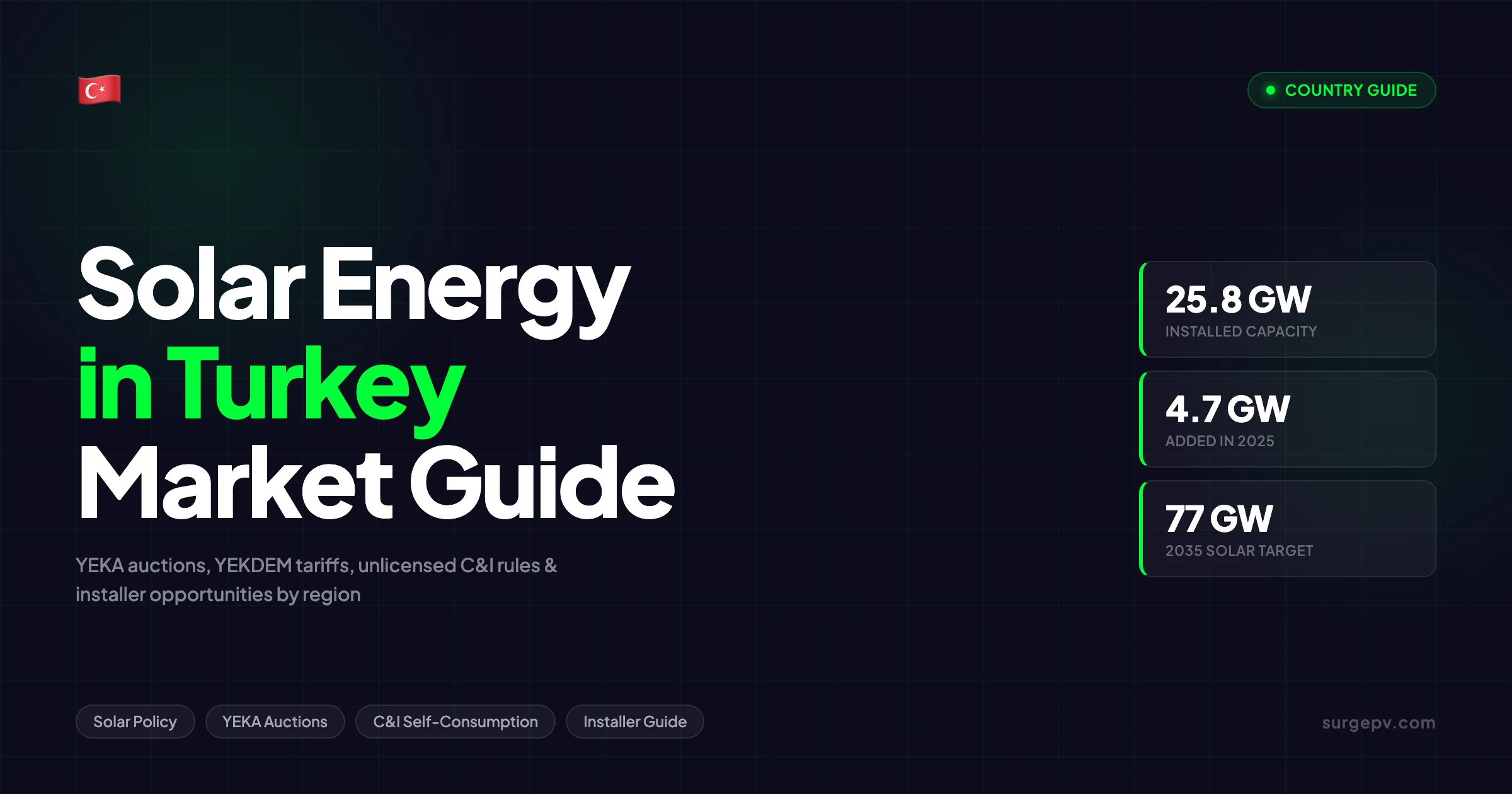
Turkey’s solar market grew 641 times in just over a decade — from 40 MW in 2014 to 25.8 GW by January 2026. No country in Europe and the Middle East has matched that pace on a percentage basis. With 4.7 GW added in 2025, solar now accounts for 20.9% of Turkey’s total installed power capacity, and the commercial and industrial self-consumption segment is responsible for 90% of new builds. For solar installers, EPCs, and project developers, Turkey in 2026 is one of the most active and accessible markets in the region — but navigating YEKA auctions, YEKDEM tariffs, unlicensed capacity rules, and the November 2025 regulatory amendments requires a clear view of how the system works. Also see: European Solar Tax Credits. See our guide on Industrial Solar Case Study for more.
Turkey’s solar market operates under YEKA auctions for large projects and unlicensed generation (up to 5 MW) for distributed systems. Installation costs are $0.60–$0.90/Wp. Turkey reached 15 GW total installed capacity in 2024. The YEKA-3 auction awarded 1 GW at $0.034/kWh in 2024.
TL;DR — Solar Energy in Turkey 2026
Turkey has 25.8 GW of solar (January 2026), added 4.7 GW in 2025, and targets 77 GW by 2035. The C&I self-consumption segment drives 90% of new installations. YEKA auctions run 2 GW/year for utility-scale projects. YEKDEM provides a 10-year feed-in tariff (~$0.05/kWh) with USD indexation. Unlicensed solar up to 5 MW uses net metering. Southeast Anatolia offers 1,460 kWh/m²/yr — one of the best solar resources in the region. The market is projected to reach 57.1 GW by 2031.
In this guide:
- Turkey’s solar capacity figures and market growth trajectory
- How YEKA auctions work and what the 2025 auction results mean
- YEKDEM feed-in tariff structure, rates, and domestic content bonuses
- YEK-G renewable energy certificates and their ESG value
- Unlicensed solar rules for C&I and residential — including the 2025 amendments
- Solar resource by region — where the best irradiance is
- Installer workflow from application to grid connection
- Key risks and compliance traps for 2026 projects
- Turkey’s 2035 roadmap and what it means for project pipelines
Turkey’s Solar Market at a Glance
Turkey’s solar story is one of the fastest market transformations in global solar history. At the start of 2014, the country had just 40 MW of solar capacity — essentially zero at grid scale. By January 2026, that figure stood at 25,827 MW, an increase of 641 times in 12 years, according to pv magazine. Turkey’s power capacity overall hit 122 GW in 2025, with renewables reaching 62% of total installed capacity, per SHURA Energy Transition Center reporting via Solar Quarter.
| Metric | Figure |
|---|---|
| Installed capacity (January 2026) | 25.8 GW |
| New capacity added (2025) | 4.7 GW |
| Unlicensed (self-consumption) share | 22.26 GW (86% of total) |
| Solar share of total power capacity | 20.9% |
| Projected capacity (2031) | 57.1 GW |
| 2035 solar target | 77 GW |
| Annual sunshine hours (national average) | 2,200–2,993 hours |
| Average solar irradiance | ~1,500 kWh/m²/year |
| Estimated rooftop solar potential | 120 GW |
| Planned investment to 2035 | $80 billion |
The growth acceleration is structural, not accidental. Electricity prices rose 25% for residential users and 10% for commercial and industrial consumers in April 2025 alone. The economics of self-consumption solar have become overwhelmingly positive for Turkish businesses, and the regulatory framework for unlicensed generation — though tightening — has kept the entry barrier low relative to licensed utility projects.
By early 2026, Turkey also commissioned its first major solar-plus-storage project: a 49.2 MW solar facility paired with 34.1 MWh of battery storage. That is a meaningful signal that the market is beginning to move beyond pure generation into hybrid and grid-service applications. See Adding Battery Storage Services for detailed guidance. Read Design Commercial Solar System 1MW for a complete walkthrough.
Pro Tip
Turkey’s C&I solar segment is driven almost entirely by electricity cost avoidance, not grid-sale revenue. When sizing systems for Turkish commercial clients, prioritize self-consumption optimization over maximizing generation. A system sized at 90% of annual consumption is typically more bankable than one targeting 110%, because the November 2025 amendments penalize surplus beyond consumption benchmarks by making it a free contribution to YEKDEM.
Solar Resource: Turkey’s Geographic Advantage
Turkey’s solar potential is exceptional by European standards. The entire country — with the exception of the Black Sea coast — receives over 2,200 hours of sunshine per year. The best regions approach the resource levels of the Middle East rather than Southern Europe. For Europe-specific compliance details, see Europe solar compliance. For Middle East-specific compliance details, see Middle East solar compliance.
| Region | Annual Irradiance (kWh/m²/yr) | Annual Sunshine Hours |
|---|---|---|
| Southeast Anatolia | 1,460 | 2,993 |
| Mediterranean / South Anatolia | ~1,400 | ~3,000 |
| Central Anatolia (Konya, Kayseri) | ~1,300 | ~2,800 |
| Aegean coast | ~1,280 | ~2,700 |
| Marmara / Istanbul region | ~1,200 | ~2,550 |
| Black Sea coast | 1,120 | 1,971 |
The southeast — provinces like Şanlıurfa, Gaziantep, and Adıyaman — offers the strongest returns for ground-mount and agrivoltaic projects. Karapınar in Konya province is home to Turkey’s largest solar complex, a project now exceeding 1 GW, and was chosen partly because the Central Anatolian plateau combines high irradiance with large, flat, low-cost land.
For rooftop solar in industrial zones, the Aegean and Mediterranean coastal cities — Izmir, Mersin, Adana — combine strong irradiance with dense manufacturing clusters. These cities have been the primary demand centers for the C&I self-consumption boom of the past two years.
The worst zone for solar is the Black Sea coast, where consistent cloud cover reduces annual yields. Installers working in Trabzon, Rize, or Samsun should model conservatively — 1,120 kWh/m²/yr produces significantly lower returns than the same system in the south.
Accurate irradiance modeling is the foundation of any Turkish solar project. Using solar shadow analysis software that draws on high-resolution satellite irradiance data eliminates the guesswork and gives clients a bankable production forecast from day one.
YEKA Auctions: Turkey’s Utility-Scale Solar Engine
YEKA (Yenilenebilir Enerji Kaynak Alanları — Renewable Energy Resource Areas) is Turkey’s competitive auction mechanism for large-scale renewable energy projects. It operates separately from the residential and C&I unlicensed system and targets utility-scale solar farms of hundreds of megawatts.
How YEKA Works
The Ministry of Energy and Natural Resources identifies specific geographic zones with strong renewable potential and designates them as YEKA areas. The ministry then runs a competitive tender in which developers bid for the right to build and operate a solar plant within that zone.
The winner receives a 15-year power purchase agreement (PPA) with the Turkish government. The contracted tariff is set through the auction process — lower bids win — and is paid in Turkish Lira with indexation to minimize currency risk. YEKA developers are also subject to domestic content requirements: using locally manufactured solar components earns additional incentive payments on top of the base tariff.
YEKA Track Record (2017–2025)
Between March 2017 and February 2025, Turkey tendered a cumulative 3.8 GW of solar capacity through the YEKA program. Of this:
- 1.5 GW has been completed and is generating electricity
- 1.6 GW is under active construction
- The balance is in early development stages
The 2025 YEKA solar auction drew 77 applications from 38 different companies across 8 designated solar project zones — the highest level of competitive interest in the program’s history. This signals that developer appetite for long-term contracted Turkish solar remains strong despite the currency challenges.
From 2025 onward, the government’s 2035 Roadmap sets an annual YEKA target of 2 GW per year for solar. At that cadence, YEKA alone would add 20 GW over the next decade — roughly half the gap between current capacity and the 77 GW target.
| Year | YEKA Solar Tendered | Status |
|---|---|---|
| 2017–2019 | ~1.0 GW | Completed |
| 2020–2022 | ~1.0 GW | Completed / operational |
| 2023–2024 | ~1.8 GW | Under construction |
| 2025 (target) | 2.0 GW | Auction underway |
| 2026–2035 (plan) | 2.0 GW/year | Pipeline |
Domestic Content Requirements
YEKA projects must meet tiered domestic content requirements to receive the full incentive stack. The tiers are structured to reward progressive localization — importing modules but using locally made frames, junction boxes, and mounting structures qualifies for partial bonuses. Assembling cells locally qualifies for higher tiers. Full vertical integration, including cell manufacturing, earns the maximum bonus.
This structure has driven significant investment in Turkey’s solar manufacturing base. Turkey now has module assembly capacity well beyond domestic demand, though as of 2025, production costs remain too high to compete in European export markets.
Key Takeaway — YEKA for Developers
YEKA is a government-de-risked route to long-term solar revenue in Turkey. The 15-year PPA eliminates merchant price risk. The challenge is execution: Turkey’s permitting timelines have historically run 2+ years, though the 2025 “Super Permit” reform is designed to bring this down to 18 months for solar. For international developers, establishing a Turkish SPV is the standard entry structure — Turkish company registration unlocks both the PPA and domestic content bonuses regardless of ownership nationality.
YEKDEM Feed-in Tariff: How Pricing Support Works
YEKDEM (Yenilenebilir Enerji Kaynakları Destekleme Mekanizması — Renewable Energy Resources Support Mechanism) is Turkey’s feed-in tariff scheme. It covers a broader population of projects than YEKA — including commercial rooftop systems and mid-size ground mounts — and was the primary growth driver for the unlicensed segment before the self-consumption economics became strong enough to stand without subsidy support.
Eligibility Window
Plants commissioned between July 1, 2021, and December 31, 2025, are eligible for a 10-year YEKDEM feed-in tariff. This window has now closed for new entrants — projects commissioned after January 1, 2026, are not eligible for YEKDEM unless Turkey announces an extension.
How the Tariff Is Set
YEKDEM tariffs are set by presidential decree. For solar, the baseline rate is approximately $0.05/kWh — expressed in USD terms for reference, but paid in Turkish Lira. The actual TRY payment is calculated quarterly using an escalation formula indexed to a combination of USD and EUR exchange rates, plus Turkish CPI and PPI adjustments.
The May 2023 amendment updated the escalation formula to index monthly (instead of quarterly) against USD floor and ceiling prices. This change reduced the real-terms tariff degradation that occurred in 2021–2022 when the Turkish Lira lost more than 50% of its value against the dollar within 12 months.
| Feature | Detail |
|---|---|
| Tariff period | 10 years |
| Solar base tariff | ~$0.05/kWh (USD reference) |
| Payment currency | Turkish Lira (TRY) |
| Escalation | Monthly, indexed to USD (floor + ceiling formula) |
| Eligibility window | Commissioned by December 31, 2025 |
| Domestic content bonus | Tiered — partial localization earns partial bonus |
Domestic Component Bonus
YEKDEM includes a bonus payment for plants using locally manufactured components. The structure is tiered:
- Modules assembled in Turkey using imported cells: partial bonus
- Cells manufactured in Turkey: higher bonus tier
- Locally produced inverters, mounting structures, and cables: additional incremental bonuses per component category
The bonus rates vary by component and are updated periodically. Solar3GW, the Turkish solar industry NGO, publishes updated bonus schedules, and any installer quoting YEKDEM projects to clients should verify current rates before submission.
YEK-G: Renewable Energy Certificates
Alongside YEKDEM, Turkey operates the YEK-G (Yenilenebilir Enerji Kaynağı Garanti Belgesi — Guarantee of Origin) certificate system. YEK-G issues one electronic certificate per MWh of renewable electricity generated. These certificates:
- Are registered and tracked in a national registry
- Can be sold separately from the underlying electricity
- Are redeemable by corporate buyers for ESG reporting, RE100 commitments, and supply chain decarbonization disclosures
- Carry value for Turkish manufacturers supplying the EU, where CBAM (Carbon Border Adjustment Mechanism) creates financial incentives to document clean electricity consumption
For Turkish solar plants that also export under YEKDEM, YEK-G certificates provide a second revenue stream. For projects that do not qualify for YEKDEM (post-2025 commission dates), YEK-G becomes the primary mechanism through which solar generation has monetizable policy value beyond avoided electricity costs.
Pro Tip
Corporate buyers in Turkey’s manufacturing sector — automotive, textiles, chemicals — are increasingly willing to pay a premium for YEK-G certificates to satisfy EU customers’ supply chain sustainability requirements. If you are installing for an industrial client that exports to Europe, quantify the YEK-G revenue in your financial model. It can meaningfully improve project IRR for systems that generate surplus beyond self-consumption.
Unlicensed Solar in Turkey: The C&I Explosion
The defining feature of Turkey’s solar market in 2024 and 2025 was not utility-scale YEKA construction — it was the explosive growth of unlicensed commercial and industrial self-consumption systems. Of the 4.7 GW added in 2025, 4.175 GW came from unlicensed plants. By January 2026, Turkey’s total unlicensed solar base reached 22.26 GW — 86% of the country’s entire solar capacity.
The residential share of that 22.26 GW is described by industry group Solar3GW as “negligibly small.” This is a C&I market. Factories, warehouses, logistics centers, shopping malls, and agricultural facilities are the buyers.
Why C&I Self-Consumption Took Over
Three forces converged to make unlicensed C&I solar the default choice for Turkish businesses:
-
Electricity price shocks: Turkey’s regulated electricity prices rose 25% for residential consumers and 10% for commercial and industrial users in April 2025, following similar increases in 2022, 2023, and 2024. The cumulative price increase since 2020 exceeds 300% in Lira terms. Solar self-consumption at 5–10 year payback periods looks strong against electricity that costs more each quarter.
-
Net metering commercialized: Commercial and industrial net metering policies were formalized in 2023 and widely adopted by businesses starting in 2024. The ability to bank surplus generation against the next billing cycle made system sizing more flexible.
-
YEKDEM eligibility closing: As the December 31, 2025, YEKDEM window approached, businesses that had been considering solar accelerated decisions to lock in subsidy eligibility. The pipeline was front-loaded.
Capacity Constraint: The July 2025 Grid Cap
In July 2025, Turkish grid operators (both transmission and distribution) announced that no new unlicensed solar connection capacity was available in any province. This was a hard stop — applications were accepted but connection was not guaranteed for projects in the queue.
In March 2026, the government announced 3.5 GW of new unlicensed connection capacity:
- 1.5 GW at the transmission level (for larger systems)
- 2.0 GW at the distribution level (for standard commercial systems)
This announcement reopened the market for new applications, but demand is expected to absorb this allocation quickly given pipeline depth. Installers working on Turkish C&I projects in 2026 should file connection applications immediately — waiting until the design is complete risks queue position.
The 5 MW Cap and Consumption Facility Rules
Unlicensed solar plants are capped at 5 MW. The capacity is specifically tied to the “contractual power” of the associated consumption facility — this is a compliance trap that catches many projects.
A factory with 2 MW of contractual power cannot install a 5 MW unlicensed solar system even though 5 MW is the statutory maximum. The system must be sized at or below the consumption facility’s contractual power. Plants that exceed this threshold lose payment eligibility for their surplus under the post-November 2025 amendments.
The practical implication: before designing any Turkish unlicensed solar project, verify the client’s electricity contract to confirm their contractual power level. Using solar design software that models consumption against generation at 15-minute granularity helps identify the precise sizing limit that maximizes self-consumption without breaching the compliance threshold.
Net Metering Rules
Monthly net metering applies to all unlicensed plants. At the end of each billing month:
- Generation is offset against consumption at the same connection point
- Net surplus is credited at a regulated price (not at retail rates — the credit is lower)
- Annual surplus beyond the facility’s annual consumption benchmark becomes a free contribution to YEKDEM — no payment, no rollover
The practical design principle for Turkish unlicensed systems is to target 90–100% self-consumption coverage of annual load, not to maximize generation. The solar yield and financial analysis built into solar software lets you model this precisely — optimizing system size against the annual consumption cap to keep all generation within the payable window.
Key Takeaway — Unlicensed Solar Compliance (2026)
The November 25, 2025 amendments introduced three new compliance risks: (1) generation capacity may not exceed the facility’s contractual power; (2) changing the consumption facility after installation resets eligibility unless the new facility’s contractual power matches generation; (3) energy discharged from storage after net-metering set-off is non-payable. Review all three criteria before signing any 2026 project contract in Turkey.
Rooftop Solar in Turkey: Residential Regulations
Residential rooftop solar in Turkey operates under the same unlicensed generation framework as C&I, but with a lower capacity ceiling: 10 kW per household. The application process for residential systems is lighter than for larger commercial projects, with a less burdensome connection application requirement at the distribution level.
Turkey’s rooftop potential is estimated at 120 GW — roughly five times the country’s current total solar capacity. As of early 2026, residential solar penetration remains minimal. The reasons:
- High upfront cost relative to average household income
- YEKDEM tariffs for residential surplus are low enough that payback depends almost entirely on self-consumption, not grid export
- Net metering credits are not at retail electricity rates, reducing the economics of excess generation
- Most financial support programs have targeted C&I and utility-scale rather than households
The commercial argument for residential solar in Turkey exists but is less compelling than in Western Europe. The stronger opportunity for installers targeting homeowners is in affluent urban areas (Istanbul, Izmir, Ankara) and in rural properties with high self-consumption — farms, guesthouses, and small businesses operating from residential premises.
The “Super Permit” Reform (2025)
In 2025, Turkey passed a legal reform known as the “Super Permit” (Süper İzin) that streamlines the licensing and permitting process for new solar and wind investments. Before the reform, obtaining all permits for a solar project — environmental impact assessments, land use approvals, grid connection studies — typically took two years or more.
Under the Super Permit, permitting timelines for solar are targeted at 18 months. The reform consolidates previously fragmented approval steps across multiple agencies into a single coordinated process under the Ministry of Energy and Natural Resources. For licensed projects (above 5 MW), this is a significant improvement. For unlicensed C&I projects, the standard connection application process at the distribution level remains the relevant pathway.
Installer Workflow: From Application to Grid Connection
For Turkish unlicensed C&I solar projects, the standard workflow from first contact to commissioning follows these stages:
Step 1: Eligibility and Sizing Assessment
Verify the client’s electricity contract to confirm:
- Contractual power (maximum system size)
- Annual consumption (target generation ceiling)
- Connection point type (distribution vs. transmission level)
Size the system to maximize self-consumption without exceeding contractual power. Use a solar design platform platform that integrates consumption data and models monthly net metering offsets.
Step 2: Connection Application
Submit a connection application to the relevant grid operator (distribution network operator for systems under a certain threshold; TEAŞ/TEİAŞ at transmission level for larger projects). Since July 2025, connection capacity has been scarce — file the application before finalizing the design, not after.
From May 2024, the call letter issued after a successful application must be acted on within 12 months: sign the connection agreement within that window or lose the application and face a potential 3-year ban on reapplying.
Step 3: Technical Assessment
The grid operator conducts a technical review covering:
- Grid hosting capacity at the proposed connection point
- Fault contribution and protection coordination
- Power quality and harmonic assessment for industrial loads
For solar projects with storage components (a growing category in 2026), the technical assessment now includes storage attribution rules introduced in December 2025. Energy discharged from storage after the net-metering set-off calculation is non-payable — ensure the design team accounts for this in battery dispatch modeling.
Step 4: Permits and Construction
After receiving the call letter, submit required environmental and zoning documents during the acceptance window. Construct the system and commission it following TEİAŞ or BEDAŞ/ÇEDAŞ (or equivalent regional distribution operator) technical specifications.
For permit design sets, using solar proposal software that generates accurate single-line diagrams, string configuration plans, and equipment schedules reduces rework during the acceptance stage and accelerates approval.
Step 5: Commencement and Settlement
Once commissioned, the system enters monthly net metering. The distribution operator calculates set-off at each billing cycle. Track cumulative surplus against the annual consumption benchmark — any surplus beyond the benchmark contributes free to YEKDEM and cannot be recovered.
Pro Tip
Turkish grid operators are backlogged on technical assessments in high-demand provinces like Istanbul, Izmir, and Gaziantep. For projects in these regions, allow 3–6 months for technical review rather than the nominal 60-day window. Filing complete, accurate applications with no missing documents is the single biggest lever installers have over timeline.
Design Turkish Solar Projects to Compliance Specs
SurgePV’s solar design platform models consumption vs. generation at monthly granularity, flags contractual power compliance risks, and generates permit-ready design packages — all in one workflow.
Book a DemoNo commitment required · 20 minutes · Live project walkthrough
For a direct comparison, see Arka 360 vs SurgePV.
Regional Opportunities for Solar Installers
Turkey’s solar demand is geographically concentrated, and knowing where the pipeline is deepest helps installers prioritize market entry or expansion.
Southeast Anatolia: Strongest Resource, Growing Utility Pipeline
Provinces including Şanlıurfa, Adıyaman, Gaziantep, and Kahramanmaraş offer the highest irradiance in Turkey — 1,460 kWh/m²/yr and nearly 3,000 sunshine hours per year. This is also the region where YEKA zones have been most frequently designated for ground-mount utility projects.
For C&I installers, the SE Anatolia manufacturing corridor — particularly agri-industry, food processing, and textile facilities — represents growing demand. The combination of high electricity costs, strong solar resource, and industrial self-consumption economics makes payback periods in SE Anatolia 15–20% shorter than in Istanbul for equivalent system sizes.
Aegean and Mediterranean Coast: C&I and Tourism
Izmir, Mersin, Adana, and Antalya combine strong irradiance with high commercial electricity demand. The tourism and hospitality sector (hotels, resorts, food service) has become an active C&I buyer as operators face rising energy costs with minimal political cover to pass increases to tourists. Agrivoltaic installations — solar over greenhouses and orchards — are expanding in the Aegean agricultural belt.
For installers, the Aegean coast also has the advantage of proximity to Turkey’s port infrastructure and panel import chain, reducing logistics costs for imported equipment.
Central Anatolia: Scale Opportunity
Konya province hosts the Karapınar Solar Energy Plant, Turkey’s largest solar complex exceeding 1 GW. The Central Anatolian plateau offers large, flat land at low cost — the dominant driver for utility-scale ground-mount projects. YEKA zone designations in Central Anatolia are expected to continue as the government accelerates toward its 77 GW target.
For mid-size installers, agricultural self-consumption is the primary C&I opportunity in Central Anatolia. Irrigation pumping, cold storage, and grain processing facilities all carry high daytime electricity loads that match well with solar generation profiles.
Istanbul and Marmara Region: Rooftop and Industrial Roof
Istanbul and the surrounding Marmara region have lower irradiance than the south but compensate with the highest concentration of commercial rooftops, industrial parks, and logistics centers in Turkey. The sheer volume of buildings with large, flat rooftop area — factories, distribution hubs, shopping malls — makes the Marmara region the largest addressable rooftop market even at 1,200 kWh/m²/yr.
Grid connection capacity is tightest here. Applications in Istanbul and Kocaeli should be filed with awareness that technical assessment queues are among the longest in the country.
| Region | Irradiance (kWh/m²/yr) | Primary Opportunity | Grid Queue |
|---|---|---|---|
| Southeast Anatolia | 1,460 | YEKA utility, C&I manufacturing | Moderate |
| Mediterranean coast | ~1,400 | Tourism, agri-food, C&I | Moderate |
| Aegean coast | ~1,280 | Manufacturing, agrivoltaics | Moderate |
| Central Anatolia | ~1,300 | YEKA utility, agri self-consumption | Low |
| Istanbul / Marmara | ~1,200 | Industrial rooftop, logistics | High (long wait) |
| Black Sea coast | 1,120 | Niche self-consumption | Low |
Key Challenges in Turkey’s Solar Market
Turkey’s solar growth story is real — but so are the structural challenges that affect project timelines, returns, and compliance.
Currency Risk
YEKDEM tariffs are paid in Turkish Lira. The USD-indexed escalation formula introduced in 2023 provides a hedge, but the formula includes floor and ceiling constraints that can cause real-terms tariff erosion during sharp Lira depreciation events. Developers pricing projects with YEKDEM revenue need to model multiple FX scenarios, not just a base case.
For self-consumption projects — the majority of the 2025–2026 market — this risk is lower because the value of avoided electricity is also Lira-denominated. A weaker Lira does not change the self-consumption economics as long as electricity prices track inflation, which they have in Turkey’s case.
Grid Capacity
The July 2025 capacity freeze demonstrated that Turkey’s distribution network has not kept pace with solar installation rates. The March 2026 release of 3.5 GW of new capacity helps, but a pipeline that absorbed 4.7 GW in one year will likely consume that allocation within 12–18 months. Installers should treat grid capacity as a constraint to be managed — not assumed.
Permitting Complexity
Even with the Super Permit reform, the Turkish regulatory environment requires navigating multiple agencies, documentation requirements that vary by province, and technical assessment timelines that can extend well beyond published windows. Projects in high-demand urban areas face the longest queues.
For installers managing multiple simultaneous projects across provinces, using solar design platform with workflow management and document generation capabilities reduces the per-project administrative burden significantly.
Storage Integration Rules
The December 2025 rule change on storage — making energy discharged from batteries after net-metering set-off non-payable — effectively creates a new constraint on hybrid system design. Battery systems that were intended to shift surplus solar to evening hours now need careful dispatch programming to ensure the charging cycle draws from solar during the set-off window rather than after it closes.
This is a design problem, not just a regulatory one. Installers unfamiliar with the Turkish metering cycle structure should model grid export limitation scenarios carefully before specifying storage for Turkish projects.
The Surplus Benchmark Trap
Any generation above the consumption facility’s annual benchmark contributes free to YEKDEM. For projects designed without accurate annual load data, this can silently reduce project revenue. The solution is to base system sizing on 12 months of verified consumption data — not estimates or rule-of-thumb percentages — and to use solar irradiance and net metering modeling to simulate month-by-month outcomes before committing to a capacity.
Turkey’s 2035 Roadmap: The Pipeline Ahead
In October 2024, Turkey released its revised 2035 Renewable Energy Roadmap. The targets represent a significant acceleration from earlier plans:
| Target | Old Plan | Revised 2035 Target |
|---|---|---|
| Solar capacity | 53 GW | 77 GW |
| Wind capacity | — | 43 GW |
| Combined solar + wind | — | 120 GW |
| Annual YEKA solar tender | 1 GW | 2 GW |
| Total renewable investment | — | $80 billion |
Reaching 77 GW from the current 25.8 GW requires more than 5 GW of new solar per year through 2035. The YEKA program — at 2 GW/year — covers less than half of that. The balance must come from unlicensed C&I and residential installations, licensed mid-scale projects, and potentially a new incentive structure for post-YEKDEM-window projects.
For context, Turkey reached one-third of its combined 2035 solar and wind target during 2025 alone, according to Enerdata. The momentum exists. The challenge is sustaining it through grid investment, capacity allocation, and policy continuity.
The market is projected by Mordor Intelligence to grow from 27.25 GW in 2026 to 57.1 GW by 2031 — a compound annual growth rate of 15.95%. That trajectory implies Turkey averaging roughly 6 GW per year of new solar installations for five consecutive years.
Key Takeaway — 2035 Target Implications for Installers
The revised 77 GW target creates a decade-long structural demand signal for Turkey’s solar industry. Even if annual growth slows from 2025’s pace, the volume required is large enough to sustain installer activity across all segments — utility YEKA, C&I self-consumption, and eventually residential — well into the 2030s. The near-term constraint is grid capacity and permitting throughput, not demand.
Turkey in the Regional Context
Turkey’s solar trajectory compares favorably with other Southern European and Middle Eastern markets. For solar professionals working across the region, Turkey fits within a broader picture of rapid market development:
- The European solar incentives picture shows that many EU markets are maturing, while Turkey — outside the EU but with strong trade links — is in a high-growth phase
- Grid export limitations comparable to Turkey’s unlicensed surplus rules apply across much of Europe; the zero-export device guide covers how these constraints are technically managed in different regulatory environments
- Compared to Turkey’s solar permit requirements across European countries, Turkey’s Super Permit reform (18 months) is competitive with Spain and faster than Germany for equivalent project scales
- Turkey’s solar market growth in 2025 outpaced every tracked country in the European solar subsidies tracker on an absolute capacity-added basis Also see: Germany solar subsidies. Also see: Spain net metering.
For installers or EPCs already active in other regional markets — Austria, Belgium, Netherlands — Turkey represents a meaningful expansion opportunity. The technical standards differ (Turkish grid codes rather than EU standards), but the core design, simulation, and proposal workflow is identical. For Netherlands-specific information, see School Solar Installation Case Study. See our guide on Solar Energy Belgium for more.
Conclusion
Turkey’s solar market in 2026 is defined by three facts: 25.8 GW already installed and growing fast, a C&I self-consumption segment that accounts for 90% of new builds, and a 2035 target of 77 GW that requires sustained 5+ GW/year additions for the next decade.
For solar installers, EPCs, and developers, the actionable steps are:
- File connection applications immediately — the 3.5 GW of capacity released in March 2026 will be absorbed quickly in high-demand provinces; queue position is the first competitive advantage
- Size for self-consumption, not generation — the November 2025 amendments penalize surplus above annual consumption benchmarks; every Turkish proposal should include a month-by-month net metering model based on verified consumption data
- Understand the YEKA and YEKDEM windows clearly — YEKDEM is closed to new entrants after December 31, 2025; new projects depend on YEK-G certificates for policy revenue and on self-consumption economics for primary returns
The resource is there — 1,460 kWh/m²/yr in the southeast, 2,200+ hours of sunshine across most of the country. The demand is there — electricity prices rising faster than solar costs. What separates successful installers from those who struggle is execution quality: accurate designs, compliant applications, and proposals that clients can understand and trust.
Frequently Asked Questions
How much solar capacity does Turkey have in 2026?
Turkey had 25.8 GW of installed solar capacity by January 2026, making solar 20.9% of total power capacity. The country added 4.7 GW in 2025 alone — one of the highest single-year additions in its history — and the market is projected to reach 57.1 GW by 2031.
What is YEKA and how do Turkey’s solar auctions work?
YEKA (Yenilenebilir Enerji Kaynak Alanları) is Turkey’s Renewable Energy Resource Area auction mechanism for utility-scale projects. Developers bid for the right to develop a designated zone, and the winner signs a 15-year power purchase agreement with the Ministry of Energy. Between 2017 and early 2025, 3.8 GW was tendered through YEKA, with an annual target of 2 GW per year from 2025 onward.
How does YEKDEM feed-in tariff work in Turkey?
YEKDEM is Turkey’s renewable energy support mechanism providing a government-guaranteed price for every kWh fed into the grid. Plants commissioned between July 1, 2021, and December 31, 2025, receive a 10-year feed-in tariff in Turkish Lira with quarterly escalation indexed to USD exchange rates. The solar tariff is approximately $0.05/kWh, with bonus payments available for plants using locally manufactured components.
What are the rules for unlicensed solar in Turkey?
Unlicensed solar plants for self-consumption are capped at 5 MW, with net metering applied monthly against the consumption facility’s electricity use. Residential rooftop systems are limited to 10 kW. From November 2025, amendments require that the generation capacity not exceed the consumption facility’s contractual power — oversized systems lose payment eligibility. Surplus beyond annual consumption benchmarks contributes free to YEKDEM without payment.
Which regions in Turkey have the best solar resource?
Southeast Anatolia leads with 1,460 kWh/m² per year and 2,993 sunshine hours annually. The Mediterranean and South Anatolian regions follow with roughly 1,400 kWh/m²/yr and over 3,000 hours of sunshine per year. Central Anatolia averages around 1,300 kWh/m²/yr. The Black Sea coast is the weakest zone at 1,120 kWh/m²/yr and 1,971 hours/year.
What is Turkey’s 2035 solar target?
Turkey’s 2035 National Energy Plan sets a solar capacity target of 77 GW — a 45% increase from the earlier 53 GW target. Combined with wind, the total renewable target is 120 GW by 2035. Reaching 77 GW from today’s 25.8 GW requires more than 5 GW of new solar per year for the next decade.
Can international companies participate in Turkish YEKA auctions?
Yes. Turkey’s investment laws allow companies incorporated in Turkey — regardless of ownership nationality — to participate in YEKA auctions and claim domestic content incentives. Foreign investors typically establish a Turkish special-purpose vehicle. Partial domestic content qualifies for partial incentive bonuses even without full vertical integration.
What is the rooftop solar limit for residential properties in Turkey?
Residential rooftop solar installations are capped at 10 kW under Turkey’s unlicensed generation rules. Monthly net metering offsets generation against consumption, and surplus can be sold at regulated prices. For commercial and industrial properties, the unlicensed cap rises to 5 MW, tied to the contractual power of the consumption facility. Systems above 5 MW require a full generation license.
Where this fits
This article is part of SurgePV's Solar Incentives & Policy hub, which works through the topic from first principles to the decisions a project team actually has to make.

