

Quick Answer
On a typical 8.5 kW system, the difference between a state with strong incentives and one with none is over $12,000 in effective project cost. Total dollar value of available incentives per average 8.5 kW system Net metering quality. 25%. Export credit rate as percentage of retail electricity rate Program accessibility. 20%.
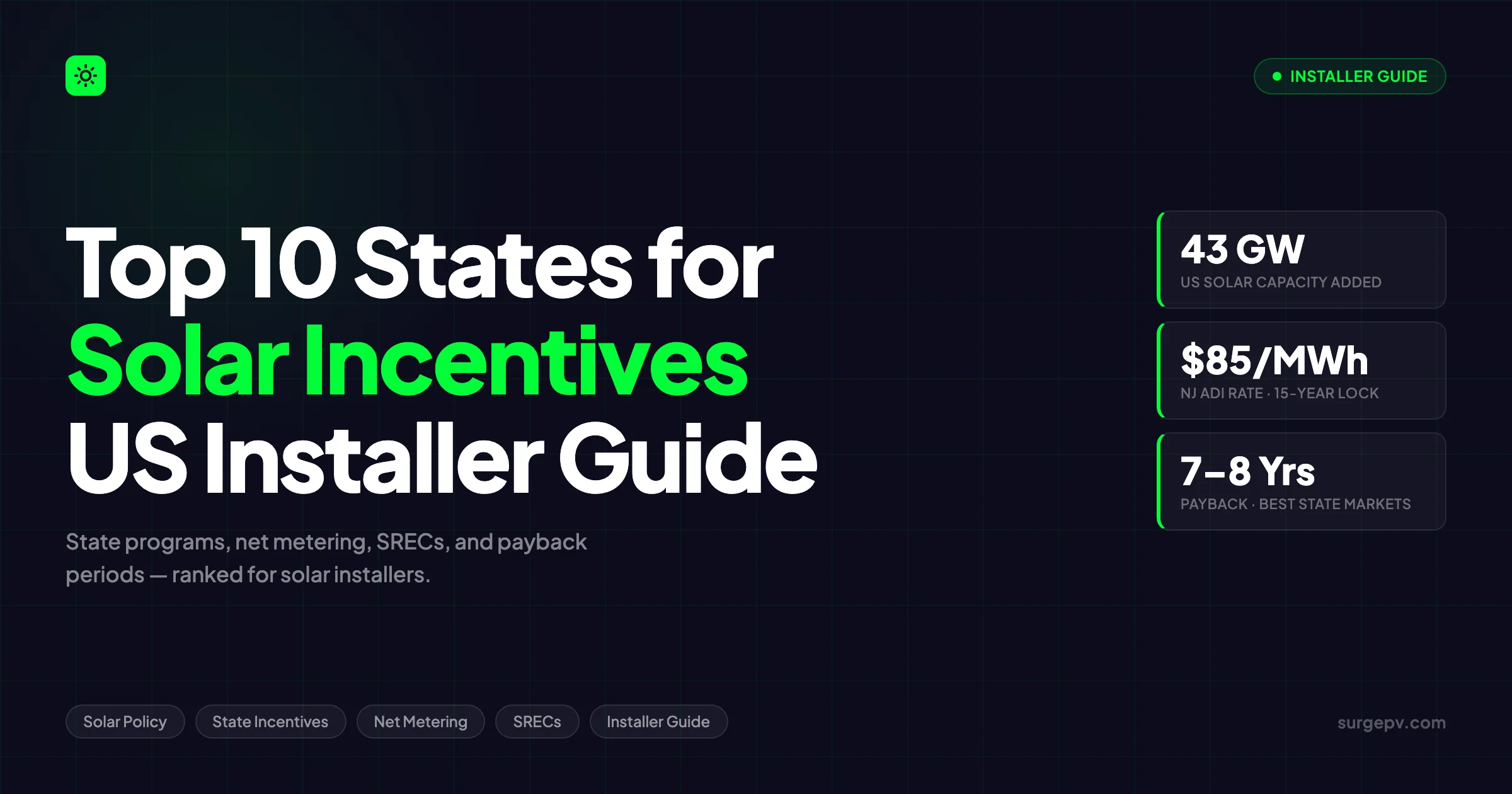
The US solar market added 43 GW of new capacity in 2025, but the policy landscape shifted fundamentally when the federal residential Investment Tax Credit expired on December 31, 2025. State programs now carry the full weight of making residential solar financially viable for customers. On a typical 8.5 kW system, the difference between a state with strong incentives and one with none is over $12,000 in effective project cost. That gap directly affects your close rate.
On a typical 8.5 kW system, the difference between a state with strong incentives and one with none is over $12,000 in effective project cost. Total dollar value of available incentives per average 8.5 kW system Net metering quality. 25%.
TL;DR — State Solar Incentives 2026
New Jersey, New York, and Massachusetts top the list with the strongest incentive stacks. The federal residential ITC expired December 31, 2025. California still ranks but requires storage pairing under NEM 3.0. This guide breaks down all 10 states by program value, net metering quality, and realistic installer payback periods.
What this guide covers:
- Rankings for all 10 states with scoring criteria explained
- Program-by-program breakdowns: dollar amounts, durations, eligibility
- Net metering rate comparison across all 10 states
- SREC market status and expected annual income by state
- How to stack incentives to maximize per-project value
- Documentation checklist for every major program type
- What the ITC expiration means for your sales process Read more about Agricultural Solar Case Study. For France-specific information, see Floating Solar Farms France.
Why State Incentives Now Define Installer Profitability
For most of the past decade, the federal 30% Investment Tax Credit anchored residential solar economics. A $30,000 installation meant a $9,000 federal credit — simple to explain, easy to quantify, and available in every state. That credit expired for homeowner-owned systems on December 31, 2025.
What remains is a patchwork of state programs, utility rebates, and net metering policies that vary by a factor of three or more in total value. NREL data shows that the effective net cost of residential solar after all incentives ranges from approximately $1.20 per watt in the most incentive-rich states to $2.60 per watt in states with no supplemental programs. At the national median installed price of $2.85 per watt before incentives, that gap represents roughly $12,000 on a standard residential system.
For installers, that $12,000 difference is the gap between a customer who signs today and one who needs three more months to “think about it.” According to SEIA’s 2025 Year in Review, residential solar installations are expected to decline 18% in 2026 as the ITC expires — but the decline is not uniform across states. The strongest state incentive markets are already showing resilience. Companies that know which states to focus on, and how to present those state programs in proposals, will outperform the broader market.
Federal ITC Status — 2026
The 30% residential Investment Tax Credit (Section 25D) expired December 31, 2025. Commercial and third-party-owned systems (leases, PPAs) still qualify under Section 48E. A Safe Harbor provision may extend benefits for some projects that began construction before the expiration date through December 31, 2027. Consult a tax professional for specific project eligibility.
The investment tax credit is gone for direct homeowner ownership. State programs are what you sell now.
How We Ranked These States
Each state was evaluated on five criteria, scored 1–5:
| Criterion | Weight | Evaluation basis |
|---|---|---|
| Incentive value | 30% | Total dollar value of available incentives per average 8.5 kW system |
| Net metering quality | 25% | Export credit rate as percentage of retail electricity rate |
| Program accessibility | 20% | Application complexity, processing time, installer registration requirements |
| Market demand | 15% | Year-over-year installation growth, installer density, customer awareness |
| Payback period | 10% | Average residential payback period with full incentive stack applied |
States were also flagged for program capacity limits, sunset dates, and significant policy changes expected in 2026–2027.
Top 10 States at a Glance
| Rank | State | State Tax Credit | Net Metering Rate | SREC / PBI? | Avg Payback |
|---|---|---|---|---|---|
| 1 | New Jersey | None | Full retail | ADI: $85–90/MWh, 15 yr | 7–8 yrs |
| 2 | New York | 25%, up to $5,000 | VDER (~retail) | No | 8–10 yrs |
| 3 | Massachusetts | 15%, up to $1,000 | Full retail ($0.30/kWh) | SMART: $0.13–0.16/kWh | 7–9 yrs |
| 4 | Illinois | None | Full retail | Shines: ~$10K–$12K total | 9–11 yrs |
| 5 | Maryland | None | Full retail | SREC: ~$50/MWh | 9–11 yrs |
| 6 | California | None | ~$0.05/kWh (NEM 3.0) | SGIP (battery rebate) | 10–14 yrs |
| 7 | Colorado | None | Full retail | No | 10–12 yrs |
| 8 | Arizona | 25%, up to $1,000 | ~50% of retail | No | 9–11 yrs |
| 9 | Minnesota | None | Full retail (Xcel) | Solar*Rewards: $0.29/kWh | 10–12 yrs |
| 10 | Texas | None | Varies by utility | No | 10–13 yrs |
#1 New Jersey — The Strongest Incentive Stack in the Country
New Jersey earns the top position on every serious installer ranking, and the data is clear about why. The state pairs full retail-rate net metering with the ADI program (Successor to Solar Investment, or SuSI) — a performance-based payment of $85–$90 per MWh of generation, locked in for 15 years at the time of interconnection. No other state in the US offers an equivalent combination of guaranteed performance income and full export credit.
How the numbers work:
On an 8.5 kW system generating roughly 10,000 kWh per year, the ADI payment alone adds $850–$900 annually. Over 15 years, that is $12,750–$13,500 in program income — before net metering savings are counted. New Jersey’s average retail electricity rate sits around $0.18 per kWh. At 10,000 kWh per year of offset savings plus ADI income, total first-year value often exceeds $2,600. With a system cost of roughly $24,000 after sales and property tax exemptions (both available statewide), payback periods land at 7–8 years.
Key programs:
| Program | Type | Value | Duration |
|---|---|---|---|
| ADI / SuSI | Performance payment | $85–$90/MWh | 15 years |
| Net metering | Export credit | Full retail (~$0.18/kWh) | Ongoing |
| Sales tax exemption | Tax | 100% of equipment cost | At point of sale |
| Property tax exemption | Tax | 100% of added home value | Ongoing |
Installer opportunity: New Jersey’s interconnection permit process is standardized, and utility approvals average 4–8 weeks. ADI enrollment is administered through the New Jersey Board of Public Utilities (NJBPU) and requires installer registration before enrolling customers. Once registered, per-project paperwork is manageable.
The ADI payment rate declines as program capacity fills — new applicants in 2026 receive slightly lower rates than early-program participants. Register your company and advise customers to apply before the next capacity block closes. ADI enrollment waitlists are real.
Pro Tip
Combine ADI enrollment with a 12-month net metering rollover analysis in your proposal. Customers in New Jersey can carry unused net metering credits forward for 12 months. In a well-sized system, that eliminates nearly all utility bills year-round. Show the annual cash flow model — it closes proposals faster than any feature sheet.
#2 New York — Deep Credits and One of the Best Net Metering Policies in the US
New York’s incentive package is among the most comprehensive available: a 25% state income tax credit capped at $5,000, upfront utility rebates through NY-Sun, a near-retail export credit under the Value of Distributed Energy Resources (VDER) tariff, and full exemptions from sales and property tax.
How the numbers work:
On a $25,000 system, the state tax credit returns $5,000 in the year the system is placed in service — a direct, dollar-for-dollar reduction in New York state income tax liability. NY-Sun rebates add another $0.20–$0.40 per watt depending on utility territory and program block, typically $1,700–$3,400 on an 8.5 kW system. Combined with the sales tax exemption, total upfront incentive value reaches $8,000–$11,000 per project.
New York’s VDER tariff compensates solar exports based on time-of-delivery pricing, grid capacity value, and environmental attributes. In most territories in 2026, the effective VDER credit comes out close to retail — approximately $0.19–$0.24 per kWh — making excess generation genuinely valuable, unlike flat-rate compensation models.
Key programs:
| Program | Type | Value | Notes |
|---|---|---|---|
| State income tax credit | Tax credit | 25%, max $5,000 | Filed on IT-255 form |
| NY-Sun rebate | Upfront rebate | $0.20–$0.40/W | Varies by utility territory |
| VDER tariff | Export credit | Near-retail | Time and location adjusted |
| Sales tax exemption | Tax | 100% | Equipment and installation |
| Property tax exemption | Tax | 100% of added value | 15-year term |
Installer opportunity: NY-Sun is administered through NYSERDA and requires contractors to be pre-qualified. The qualification process involves company registration, proof of licensure, and documentation of recent installations. Once qualified, enrolling customers in NY-Sun rebates is efficient.
Interconnection timelines vary widely. Con Edison (NYC and Westchester) averages 12–20 weeks — among the slowest in the state. National Grid and other upstate utilities typically process in 6–10 weeks. Set accurate expectations with customers at the proposal stage.
New York ranks third in the US for cumulative installed solar capacity. Installer competition in the NYC metro is high, but incentive awareness among homeowners is strong, which keeps inbound lead quality above national averages.
#3 Massachusetts — SMART Makes Project Economics Reliable
Massachusetts has built one of the most installer-favorable policy environments in the country. Full retail net metering at an average electricity rate of $0.30 per kWh makes exports highly valuable, and the SMART (Solar Massachusetts Renewable Target) program adds a performance-based payment on top of every kilowatt-hour the system produces — not just exports.
How the numbers work:
SMART pays $0.13–$0.16 per kWh for every kWh generated for 10 years. On an 8.5 kW system producing approximately 10,500 kWh per year in Massachusetts, the SMART payment totals $1,365–$1,680 per year, for a 10-year program value of $13,650–$16,800.
That stacks directly on net metering. The combined first-year value — SMART income plus full retail export credits — frequently exceeds $3,500 on a mid-sized residential system. With systems priced around $25,000 before the 15% state tax credit ($1,000 cap) and full sales tax exemption, payback periods land at 7–9 years. That is competitive even without any federal incentive.
Key programs:
| Program | Type | Value | Duration |
|---|---|---|---|
| SMART tariff | Performance payment | $0.13–$0.16/kWh | 10 years |
| Net metering | Export credit | Full retail (~$0.30/kWh) | Ongoing |
| State income tax credit | Tax credit | 15%, max $1,000 | Annual |
| Sales tax exemption | Tax | 100% | At point of sale |
| Property tax exemption | Tax | 100% of added value | 20-year term |
Installer opportunity: SMART enrollment requires registered solar contractor status. Capacity blocks are allocated per utility — Eversource and National Grid blocks fill faster than smaller utilities. Monitor SMART block status regularly; when a block fills, the next opens at a slightly lower rate. Applications close to block fill can still be submitted to lock in the prior rate.
Massachusetts electricity rates averaging $0.30 per kWh are among the highest in the contiguous US. High rates amplify every kilowatt-hour of solar savings. This is a market where the sales conversation is straightforward: every year a homeowner delays going solar, they pay more than they have to.
Key Takeaway
Massachusetts is one of the few states where residential solar remains a clear financial winner even post-ITC expiration. SMART income alone often exceeds what the federal credit would have provided over 10 years. Lead with SMART in every Massachusetts proposal.
#4 Illinois — The Midwest’s Solar Leader
Illinois Shines (formerly the Adjustable Block Program) is one of the most structured performance-based programs in the US. The program pays Renewable Energy Credits (RECs) based on projected 15-year generation — delivered as either an upfront lump sum or structured payment to the installer or customer at project completion.
How the numbers work:
Illinois Shines pays one REC per 1,000 kWh of projected annual generation, valued at the current block rate. For a typical 8.5 kW system in Chicago generating roughly 9,500 kWh per year, the total REC value over the 15-year contract period comes to approximately $10,000–$12,000. On most projects, this is paid within weeks of installation completion.
That upfront income is the program’s defining advantage for installers. It can be passed to customers as a price reduction, used to offer zero-down financing, or retained as margin. Combined with full retail net metering, Illinois Shines effectively brings the economics of residential solar in Illinois within reach of mainstream homeowners.
Key programs:
| Program | Type | Value | Duration |
|---|---|---|---|
| Illinois Shines (RECs) | Performance credit | ~$10,000–$12,000 total | 15-year contract |
| Net metering | Export credit | Full retail | Ongoing |
| Solar for All | Low-income rebate | No-cost installation | Qualifying households |
| Property tax freeze | Tax | Assessment frozen pre-solar | Ongoing |
Installer opportunity: Illinois Shines enrollment requires Approved Vendor status through the Illinois Power Agency. The application involves a $10,000 bond, contractor license documentation, and demonstrated installation history. Capacity blocks are allocated by utility territory (ComEd, Ameren, and smaller co-ops). Block availability fluctuates; approved vendors can check current block status through the IPA’s online portal.
Solar for All — the state’s no-cost program for income-qualifying households — offers installers a separate pipeline of state-contracted work. Program participation requires a separate qualification process, but completed projects are paid through state funds rather than customer financing.
SEIA reports that Illinois accounted for 24% of US community solar installations in 2025, making it one of the most active community solar markets in the country alongside New York. Installers with community solar capabilities have additional revenue opportunities beyond the residential market. For more on this topic, see Community Solar Business Model.
#5 Maryland — SREC Markets and Battery Incentives in One Package
Maryland pairs a functioning SREC market with a battery storage tax credit — a combination that supports both standard solar proposals and solar-plus-storage upsells with clear financial justification. Read Adding Battery Storage Services for a complete walkthrough.
How the numbers work:
Maryland SRECs trade at approximately $50 per certificate in 2026. A 9 kW system generating roughly 11,000 kWh per year earns approximately 11 SRECs annually. At $50 per SREC, that is $550 per year in ongoing income. It is not as strong as New Jersey’s ADI, but it is meaningful when stacked with full retail net metering and property and sales tax exemptions.
The Maryland Energy Storage Income Tax Credit covers 30% of battery installation costs, up to $5,000 per residential system. A 10 kWh battery at $10,000 installed cost becomes a $7,000 effective cost after the credit. That makes solar-plus-storage proposals straightforward to justify — a $3,000 incentive for a product most customers want for backup purposes anyway.
Key programs:
| Program | Type | Value | Duration |
|---|---|---|---|
| SREC market | Performance credit | ~$50/SREC | Ongoing (market-priced) |
| Net metering | Export credit | Full retail | Ongoing |
| Energy Storage Tax Credit | Tax credit | 30%, max $5,000 | Per installation |
| Sales tax exemption | Tax | 100% | At point of sale |
| Property tax exemption | Tax | 100% of added value | Ongoing |
Installer opportunity: Maryland system owners register SRECs through PJM’s Generation Attribute Tracking System (GATS). Help customers complete this registration at commissioning — every month of delayed enrollment is income lost. Once registered, SRECs are earned automatically and can be sold through state brokers or aggregators.
The battery storage credit has strong customer awareness in Maryland, particularly in the Baltimore and DC suburban corridor. Bundle solar-plus-storage as a default offering here. The credit makes the addition financially easy to justify, and many customers in this market already want backup power capability.
#6 California — Storage-First Strategy Now Required
California is the country’s largest solar market by installed capacity — and the most operationally complex since NEM 3.0 (Net Billing Tariff) took effect in April 2023. Export credits for new customers dropped from roughly $0.30 per kWh under NEM 2.0 to approximately $0.05 per kWh under NEM 3.0. Solar-only designs no longer deliver the economics that made California the default expansion market for installers throughout the 2010s.
How the numbers work:
Under NEM 3.0, a system exporting 5,000 kWh per year earns approximately $250 in export credits — compared to $1,500 under the prior tariff. Without storage, the only real value comes from daytime self-consumption, and most residential homes do not consume enough power during daylight hours to absorb full system output.
The right design approach is solar-plus-storage. California’s Self-Generation Incentive Program (SGIP) still pays up to $1,000 per kWh of battery storage capacity for residential customers. A 10 kWh battery at $10,000 installed cost becomes effectively zero-cost after a full SGIP rebate for qualifying customers. Priority allocations go to low-income households and customers in high fire-threat districts — a large portion of the California residential market.
Key programs:
| Program | Type | Value | Notes |
|---|---|---|---|
| Net Billing Tariff (NEM 3.0) | Export credit | ~$0.05/kWh | New installations post-April 2023 |
| SGIP | Battery rebate | Up to $1,000/kWh capacity | Priority tiers for low-income |
| DAC-SASH | Low-income solar | $3/W upfront rebate | Disadvantaged communities |
| Property tax exclusion | Tax | 100% | Ongoing |
| Sales tax exemption | Tax | 100% | Equipment only |
Installer opportunity: The California market is large enough that volume compensates for design complexity — but only if you have adapted your pitch. Instead of “solar saves you money on exports,” the message is “solar-plus-storage lets you run the house on your own electricity during peak rate hours and keeps your home powered during outages.” SGIP makes that pitch financially easy.
Installers not offering battery storage in California are leaving a significant portion of the available market behind. Battery storage margins run 15–25% higher than solar-only projects, and the SGIP rebate removes the primary customer objection: upfront cost.
Pro Tip
NEM 2.0 systems are grandfathered for 20 years, through approximately 2043. When you encounter a customer with an existing NEM 2.0 system, propose a battery storage addition — it does not trigger NEM 3.0 reclassification for the existing solar system, and the battery still qualifies for SGIP. These are some of the most straightforward conversations in the California market.
Model Any Incentive Scenario Before You Pitch
SurgePV’s solar design software builds storage dispatch, self-consumption, and performance-based incentive income directly into every proposal — so the numbers you give customers are accurate, not estimated.
Book a DemoNo commitment required · 20 minutes · Live project walkthrough
For a direct comparison, see Arka 360 vs SurgePV.
#7 Colorado — Clean Slate With Growing Opportunity
Colorado operates without a state income tax credit for solar, but a combination of utility rebates, full retail net metering, and property and sales tax exemptions keeps the state competitive for residential installers — particularly in the Denver and Front Range metro areas.
How the numbers work:
The Colorado Residential Efficiency Electrification Rebate (CORE) program offers 25% of project costs, up to $2,500, for qualifying residential solar installations. CORE is an upfront rebate — simple to explain, no long-term program enrollment, and processed in 4–6 weeks. On a $20,000 system, that is $2,500 back to the customer within weeks of installation.
Xcel Energy, the state’s largest utility, adds its own rebates of $0.05–$0.10 per watt depending on program phase. On an 8.5 kW system, that is an additional $425–$850. Combined with CORE, full retail net metering at roughly $0.12 per kWh, and full property and sales tax exemptions, Colorado offers a respectable incentive stack even without a state tax credit.
Key programs:
| Program | Type | Value | Duration |
|---|---|---|---|
| CORE rebate | Direct rebate | 25%, max $2,500 | Per installation |
| Xcel utility rebate | Utility rebate | $0.05–$0.10/W | Program budget limits |
| Net metering | Export credit | Full retail (~$0.12/kWh) | Ongoing |
| Sales tax exemption | Tax | 100% | At point of sale |
| Property tax exemption | Tax | 100% of added value | Ongoing |
Installer opportunity: Colorado’s Weatherization Assistance Program (WAP) also funds no-cost solar for income-qualifying households — a state-contracted pipeline separate from the retail market. Qualifying for WAP installer status requires state contractor registration.
The Denver metro has strong solar awareness and an increasingly competitive installer market. Suburban Colorado Springs and Boulder are less saturated. Rural Colorado, served by co-ops and municipal utilities rather than Xcel, requires utility-by-utility incentive research before quoting.
#8 Arizona — High Solar Resource, Modest Incentive Stack
Arizona offers exceptional solar resources — average peak sun hours of 5.5–6.5 per day across most of the state — and a 25% state income tax credit capped at $1,000. The credit is modest in absolute terms, but combined with full property tax exemption, no statewide sales tax on solar equipment, and outstanding production yields, Arizona remains a viable residential market for installers.
How the numbers work:
The limitation is net metering. Arizona utilities use a Resource Comparison Proxy (RCP) rate for solar exports — currently around 50% of the retail electricity rate. On a $0.13 per kWh average retail rate, that is roughly $0.065 per kWh for exports. System design should prioritize self-consumption over export maximization. See our guide on France Solar Feed-in Tariffs for more.
With high solar irradiance, a well-sized Arizona system offsets more consumption per installed watt than almost any other state. The solar ROI argument in Arizona is straightforward even without strong export credits: high production plus high summer utility bills equals fast payback on the consumption offset portion alone.
Key programs:
| Program | Type | Value | Duration |
|---|---|---|---|
| State income tax credit | Tax credit | 25%, max $1,000 | Annual |
| RCP net metering (APS/SRP) | Export credit | ~50% of retail | Ongoing |
| Property tax exemption | Tax | 100% of added value | Ongoing |
| Sales tax exemption | Tax | Equipment | At point of sale |
Installer opportunity: APS and SRP, the two major utilities, handle interconnection efficiently — approvals typically run 4–6 weeks. APS’s solar plan-of-service process is one of the more streamlined in the Southwest. For solar design software users, size Arizona systems to 90–100% of the homeowner’s daytime consumption load to maximize the self-consumption rate and minimize low-value exports.
Key Takeaway
Arizona’s primary selling point is solar resource, not incentive depth. Systems here produce more kilowatt-hours per installed watt than systems in almost any other residential market. Use the generation and financial modeling tool to show customers real annual production figures — the output numbers sell themselves.
#9 Minnesota — Stable Returns Through Solar*Rewards
Minnesota’s residential solar market centers on Xcel Energy’s Solar*Rewards program, which pays $0.29 per kWh on expected annual production — one of the highest production-based incentive rates among active utility programs in the US.
How the numbers work:
Solar*Rewards is capped at the first $5,000 of annual production value per project and runs for 10 years. On an 8 kW system producing 9,000 kWh per year in Minneapolis, the first-year payment is $2,610. The 10-year total approaches $26,000 before net metering savings are added. That is a program value comparable to Massachusetts SMART.
The caveat: Solar*Rewards only applies to Xcel Energy customers. Minnesota Power and other smaller utilities have separate, less generous programs. Roughly 1.5 million homes are served by Xcel across the state, covering the Twin Cities metro and much of western Minnesota.
Key programs:
| Program | Type | Value | Duration |
|---|---|---|---|
| Solar*Rewards (Xcel) | Performance payment | $0.29/kWh, max $5,000/yr | 10 years |
| Net metering | Export credit | Full retail | Ongoing |
| Property tax exemption | Tax | 100% of system value | Ongoing |
| Sales tax exemption | Tax | 100% | At point of sale |
Installer opportunity: Solar*Rewards participation requires contractor registration with Xcel Energy. The registration process typically takes 2–4 weeks. Approved contractors submit production estimates at project enrollment; the system’s Smart Inverter data or independent meter confirms actual production for payment.
Minnesota’s northern latitude means lower production per watt than southwestern states, and payback periods run 10–12 years. That is a longer conversation than New Jersey or Massachusetts — but the Solar*Rewards income line item is concrete, above-market, and predictable. Customers who understand the program are generally easy to close.
#10 Texas — Volume Without a State Incentive Stack
Texas earns its place on this list through market scale, not incentive depth. The state consistently ranks among the top five for new residential solar installations, driven by high electricity prices in key utility territories, grid deregulation enabling competitive solar pricing, and a strong year-round solar resource across most of the state.
How the numbers work:
Texas has no statewide net metering law. Each utility sets its own export policy. Austin Energy’s Value of Solar (VoS) tariff offers $0.097 per kWh in 2026 — a structured premium above standard avoided-cost rates. CPS Energy in San Antonio offers a direct rebate of up to $2,500 per residential installation. In the deregulated ERCOT territory covering Houston, Dallas, and most of the state, retail electric providers vary widely, with some offering near-retail export credits and others paying minimal compensation.
Key programs:
| Program | Type | Value | Notes |
|---|---|---|---|
| Austin Energy VoS | Export credit | $0.097/kWh | Austin territory only |
| CPS Energy rebate | Direct rebate | Up to $2,500 | San Antonio territory |
| Property tax exemption | Tax | 100% of added value | Statewide |
| Sales tax exemption | Tax | 100% (equipment) | Statewide |
Installer opportunity: Texas is a volume market. In Austin Energy and CPS Energy territories, the incentive story is clear. In deregulated ERCOT territories, proposals require utility-specific net metering research before quoting export value. Solar software for installers that models time-of-use self-consumption accurately is especially valuable in Texas — in markets with limited net metering, every kilowatt-hour consumed on-site has more financial value than every kilowatt-hour exported.
The state’s population growth and rising electricity rates in the Houston and Dallas metros ensure strong pipeline demand. Installer competition in Austin is high; suburban DFW, San Antonio, and the Rio Grande Valley remain less saturated and worth prioritizing for expansion.
How to Stack Incentives: Maximizing Revenue per Project
The most financially compelling proposals in 2026 combine every available program on a single project. Here is the stacking framework for the three highest-value states:
New Jersey — Full Stack Example
| Incentive | Type | Value |
|---|---|---|
| ADI / SuSI | Performance payment | ~$875/yr × 15 yrs = $13,125 |
| Net metering savings | Annual savings | ~$1,800/yr |
| Sales tax exemption | Upfront | ~$1,500 (on $25,000 system) |
| Property tax exemption | Ongoing | Varies by assessed value |
| Total 15-year value estimate | ~$43,000+ |
New York — Full Stack Example
| Incentive | Type | Value |
|---|---|---|
| State tax credit | Year 1 credit | $5,000 |
| NY-Sun rebate | Upfront | ~$2,500 |
| Sales tax exemption | Upfront | ~$1,500 |
| Net metering (VDER) | Annual savings | ~$2,000/yr |
| Total 10-year value estimate | ~$29,000+ |
Massachusetts — Full Stack Example
| Incentive | Type | Value |
|---|---|---|
| SMART payment | Performance | ~$1,500/yr × 10 yrs = $15,000 |
| Net metering savings | Annual | ~$2,000/yr (at $0.30/kWh) |
| Sales tax exemption | Upfront | ~$1,500 |
| State tax credit | Year 1 | $1,000 |
| Total 10-year value estimate | ~$38,500+ |
The universal rule: always stack all available exemptions (sales and property tax) on every project, regardless of which performance or credit programs apply. Exemptions require zero ongoing paperwork and are permanent.
Documentation Checklist for Major State Programs
Every program type requires a specific set of documents. Build a standard per-project package at permit pull — by the time a system is commissioned, you will have everything needed to enroll in every available program.
Universal documents (every project):
- Interconnection agreement (signed by utility)
- Building permit and electrical permit
- Final inspection certificate
- System specification sheet (panel make and model, inverter make and model, system size in kW)
- Installation photos (with permit card visible)
- Customer’s utility account number
SREC / PBI registration (NJ, MA, MD, IL, OH, VA, PA, DC):
- PJM GATS or state registry enrollment form
- Metering data or smart inverter production confirmation
- Installer contractor registration number
- System commissioning date
State tax credit programs (NY, MA, AZ):
- State tax credit application form (e.g., NY IT-255, MA Schedule SC)
- Copy of interconnection agreement
- Customer’s itemized installer invoice showing system cost breakdown
Upfront rebate programs (NY-Sun, CPS Energy, Austin Energy CORE):
- Pre-installation approval confirmation (some programs require this before work begins)
- Post-installation completion form
- Photo documentation with permit card visible
- Final metering or utility inspection confirmation
Pro Tip
Build a shared digital folder for every project at the time of permit pull. Include all permit copies, system specs, and photo documentation as the job progresses. By commissioning day, the enrollment package is already assembled. Projects that delay documentation lose SREC months and PBI income that cannot be recovered retroactively.
What the Federal ITC Expiration Means for Your Sales Process
The expired residential ITC does not change where solar makes financial sense — it changes how you explain the economics.
Customers who researched solar a year or two ago will ask about the “30% federal rebate.” Correct this early and redirect to what is actually available in their state. Do not let the expired ITC become the center of the conversation.
Script for handling the ITC question:
“The 30% federal tax credit that applied to homeowner-owned systems expired at the end of 2025. The good news is that [State] has its own programs that are often more valuable on a per-project basis. In your case, the [PROGRAM NAME] provides [X value], net metering returns [Y per year], and the property and sales tax exemptions apply automatically. Together, that is a [N]-year payback — here is the detailed breakdown.”
For commercial customers and businesses considering solar, the Section 48E commercial credit is still active. Third-party ownership structures (leases, PPAs) also still access the commercial credit. If you offer TPO products, the federal incentive is still part of your pitch for business customers.
The Database of State Incentives for Renewables & Efficiency (DSIRE) maintains the most comprehensive and up-to-date record of every state, utility, and local incentive program in the US. Bookmark it and check it before entering any new market. For United States-specific compliance details, see United States arizona/phoenix. For United States-specific compliance details, see United States california/los-angeles.
Using Solar Design Software to Win in Incentive-Driven Markets
Understanding state incentives is necessary but not sufficient. Winning proposals require software that translates that knowledge into accurate financial models customers can evaluate and compare.
The critical capabilities for an incentive-rich market:
- Time-of-use self-consumption modeling — essential for California, Arizona, and Texas markets where export value is low
- Performance-based income over program duration — NJ ADI, MA SMART, MN Solar*Rewards, IL Shines all require multi-year cash flow projection
- SREC annual income projections — MD, OH, VA, DC, PA, DE markets where ongoing certificate income is material
- System-size optimization for capacity-capped programs — some programs have per-project or per-utility caps that affect optimal system size
- Battery storage dispatch modeling — California SGIP and Maryland storage credit require storage-specific financial analysis
A customer-ready solar proposals tool that integrates these variables into a customer-facing PDF — showing a 15–20 year cash flow model with state incentives itemized line by line — removes the ambiguity that causes deals to stall. Customers who can see the math close faster than customers who are asked to trust a summary.
SurgePV’s generation and financial tool handles these calculations per-project, per-state, and outputs customer-ready financial summaries in the proposal workflow. When the incentive environment is this varied across states, having software that keeps pace with the programs is not optional.
Conclusion
State solar incentives now determine whether residential solar makes sense financially for a customer in 2026. With the federal ITC gone, the economics of every project depend on what the state, utility, and local program stack provides — and that stack varies by thousands of dollars per project depending on where you operate. Also see: Us Residential Solar Market Trends 2026.
Three actions that matter most right now:
- Target New Jersey, New York, and Massachusetts first if you are expanding. These three states offer the highest total incentive value per project, the strongest net metering policies, and well-established installer markets with informed buyers. The economics are durable even without the federal credit.
- Rebuild your California approach around storage. NEM 3.0 economics make solar-only designs marginal for most residential customers. Solar-plus-storage with SGIP is the standard pitch now — and the margins are better.
- Build documentation systems, not just design workflows. The fastest way to lose SREC and PBI income is to delay enrollment paperwork. Every month of delay is real money gone. Build an enrollment package into your project close process and it costs you nothing.
The incentive environment will keep changing. Programs fill, rates adjust, and new legislation moves through state capitals every year. Track the DSIRE database for your key markets and update your proposals accordingly.
Frequently Asked Questions
Which state has the best solar incentives for installers in 2026?
New Jersey currently offers the strongest combined incentive stack, with ADI/SuSI payments of $85–$90 per MWh locked in for 15 years, full retail-rate net metering, and sales and property tax exemptions. Payback periods run 7–8 years. New York and Massachusetts are close behind.
Did the federal solar tax credit expire in 2026?
The 30% federal residential Investment Tax Credit (Section 25D) expired on December 31, 2025 for homeowner-owned systems. Commercial and third-party-owned systems (leases, PPAs) still qualify through Section 48E. A Safe Harbor provision may allow some projects that began construction before the expiration to claim credits through December 31, 2027. Consult a tax professional for specific project eligibility.
What are SRECs and how do they benefit solar installers?
Solar Renewable Energy Certificates are tradeable certificates representing 1 MWh of solar electricity generation. In SREC-eligible states (Maryland, New Jersey, Ohio, Pennsylvania, DC, Virginia), system owners earn SRECs that can be sold to utilities meeting Renewable Portfolio Standards. For installers, SREC markets add $500–$3,000 per year in ongoing value to a system — a concrete closing argument.
Can solar installers stack multiple state incentives on a single project?
Yes. Most state programs are designed to stack. A homeowner in New York can combine the 25% state tax credit, NY-Sun rebate, sales tax exemption, property tax exemption, and VDER net metering credits on the same installation. In Massachusetts, the SMART performance payment stacks on top of net metering credits. Always verify stacking rules with your state energy office before quoting.
Which states have the strongest net metering policies for solar customers?
New York (VDER tariff at near-retail rates), Massachusetts (full retail at approximately $0.30 per kWh), New Jersey (full retail with 12-month rollover), Illinois (full retail), and Minnesota (Xcel Solar*Rewards) offer the strongest net metering economics. California’s NEM 3.0 reduced export credits to approximately $0.05 per kWh, making battery storage essential for viable project economics.
How long does it take to receive state solar rebates?
Timelines vary by program. Upfront rebates like NY-Sun process within 8–12 weeks after interconnection approval. SREC payments are ongoing and quarterly. SMART payments in Massachusetts begin within 1–2 billing cycles after program enrollment. Colorado CORE rebates process in 4–6 weeks. Illinois Shines REC payments are annual.
Which states are growing fastest for residential solar installations?
Based on SEIA 2025 data, Texas, Florida, and Illinois are among the fastest-growing residential markets by new installation volume. For incentive-driven growth, New Jersey, Massachusetts, and New York consistently outperform national averages on year-over-year installation rates per capita.
What documentation do solar installers need to claim state incentive programs?
Requirements vary by program but typically include: interconnection agreement, building and electrical permits, final inspection certificate, system specification sheet (panel model, inverter model, system size), installation photos with visible permit card, and the customer’s utility account number. SREC registration requires additional metering documentation and enrollment in PJM GATS or the applicable state registry.
Where this fits
This article is part of SurgePV's Solar Incentives & Policy hub, which works through the topic from first principles to the decisions a project team actually has to make.

