

Quick Answer
India's solar programs in 2026 include KUSUM (solar pumps for farmers, 60% subsidy), PM Surya Ghar (residential rooftop, up to ₹78,000 subsidy), and state-specific net metering. Total installed capacity reached 100 GW in 2024.
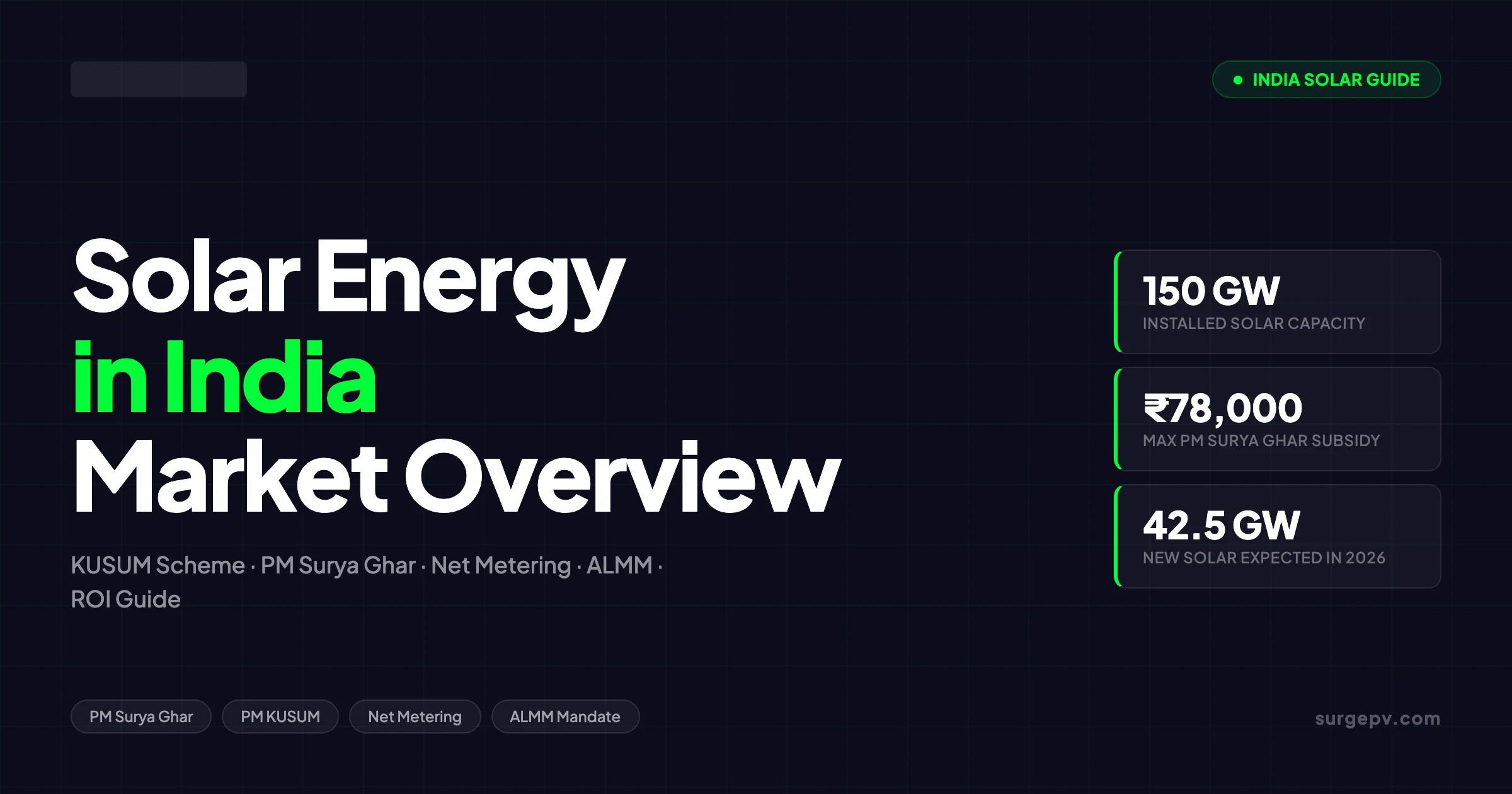
India crossed 150 GW of installed solar capacity at the end of Q1 2026, overtaking the United States to become the world’s third-largest solar producer. With 42.5 GW expected in new installations through 2026 alone, the country is now on a trajectory to rank second globally in annual solar deployment — behind only China. Two flagship government programmes are driving the ground-level adoption: PM Surya Ghar: Muft Bijli Yojana, which targets 10 million homes with direct rooftop solar subsidies, and PM KUSUM, which is transforming Indian agriculture by replacing diesel pump sets with solar. This guide covers both schemes in full, maps the state-level subsidy landscape, explains net metering rules, and breaks down what the 2026 ALMM mandate means for every installer working in India today.
India’s solar programs in 2026 include KUSUM (solar pumps for farmers, 60% subsidy), PM Surya Ghar (residential rooftop, up to ₹78,000 subsidy), and state-specific net metering. Total installed capacity reached 100 GW in 2024.
TL;DR — India Solar 2026
India hit 150 GW solar (March 2026). PM Surya Ghar pays up to ₹78,000 per household for rooftop solar. PM KUSUM targets 34,800 MW and has already solarized 10+ lakh farm pumps. From June 2026, all grid-connected solar projects must use ALMM-listed (locally made) panels and cells.
What this guide covers:
- India’s solar market status and 2030 targets
- PM Surya Ghar: eligibility, subsidy table, and application steps
- PM KUSUM: all three components, subsidy breakdown, and Phase II plans
- State-level top-up subsidies (Delhi, Gujarat, Maharashtra, UP, Rajasthan)
- Net metering rules and how credits work across states
- Commercial and industrial solar under Green Energy Open Access
- PLI scheme and ALMM: the domestic manufacturing push
- ROI and payback calculations for 2026 installations
- What solar installers need to know to operate competitively
India Solar Market: Status and Targets for 2026
India’s solar sector has moved faster in the last 18 months than in any comparable period in its history. The country added 14.45 GW in Q1 2026 alone — a record single-quarter figure — and crossed the 150 GW cumulative mark on March 31, 2026.
SolarQuarter data shows the breakdown of India’s 150.26 GW installed base:
| Segment | Installed Capacity (March 2026) |
|---|---|
| Utility-scale (ground-mount) | 110.43 GW |
| Rooftop solar | 25.73 GW |
| KUSUM and off-grid | 14.10 GW |
| Total | 150.26 GW |
JMK Research forecasts an additional 42.5 GW in CY2026 — comprising 32.5 GW utility-scale, 8.5 GW rooftop, and 1.5 GW off-grid. That pace would make India the world’s second-largest solar market by annual installation, overtaking the United States and European Union.
India’s long-term target is 500 GW of non-fossil fuel energy by 2030, with solar expected to contribute 280–300 GW of that total. The government has committed to adding 50 GW of renewable capacity annually through 2030 to stay on that path.
Pro Tip
For installers entering or expanding in India, the rooftop segment is growing faster than utility-scale on a percentage basis. The 8.5 GW rooftop target for 2026 is driven almost entirely by PM Surya Ghar registrations — meaning the subsidy pipeline directly fuels your lead flow.
State-Wise Solar Leaders in India
Solar adoption is highly uneven across India’s 28 states. A handful of states account for the majority of installed capacity:
| State | Installed Solar Capacity | Primary Driver |
|---|---|---|
| Rajasthan | 33+ GW | Large-scale desert solar parks |
| Gujarat | 16+ GW | State policy + KUSUM Component C |
| Tamil Nadu | 13+ GW | Wind-solar hybrid + DISCOM procurement |
| Karnataka | 10+ GW | C&I Open Access + state tenders |
| Andhra Pradesh | 9+ GW | Utility solar + offshore wind pipeline |
| Uttar Pradesh | 8+ GW | PM Surya Ghar demand + agri-solar |
| Maharashtra | 7+ GW | Rooftop + C&I sector growth |
For solar EPCs and installers, this data points to two distinct market types: states like Rajasthan and Gujarat where utility-scale and KUSUM are primary, and states like Karnataka, Maharashtra, and Tamil Nadu where C&I and rooftop work dominate. Your sales motion, system design approach, and procurement strategy should differ between these markets.
The solar irradiance across India also varies significantly — Tamil Nadu and Rajasthan receive 5.0–6.5 kWh/m²/day of Global Horizontal Irradiance (GHI), while Northeast India and coastal Kerala receive 4.0–4.5 kWh/m²/day. This directly affects system sizing and yield projections. For Global-specific compliance details, see Global net-metering-by-country.
PM Surya Ghar: Muft Bijli Yojana — The Residential Solar Subsidy
PM Surya Ghar: Muft Bijli Yojana launched on February 13, 2024, under the Ministry of New and Renewable Energy (MNRE). Its stated goal: install rooftop solar on 1 crore (10 million) homes with a total government outlay of ₹75,021 crore.
The scheme delivers two things. First, a Central Financial Assistance (CFA) — a direct cash subsidy deposited into the homeowner’s bank account via the Direct Benefit Transfer (DBT) system after installation and DISCOM inspection. Second, free electricity — a 3 kW system in most states produces 360–450 units per month, enough to cover average household consumption and reduce the electricity bill to near zero.
The Union Budget 2026 raised the allocation for PM Surya Ghar from ₹20,000 crore to ₹22,000 crore, a 10% increase — a signal that disbursements are accelerating and the programme is scaling up.
Subsidy Amounts Under PM Surya Ghar
| System Size | Central Subsidy (CFA) |
|---|---|
| 1 kW | ₹30,000 |
| 2 kW | ₹60,000 |
| 3 kW | ₹78,000 |
| Above 3 kW | ₹78,000 (cap) |
The subsidy is capped at 3 kW. A 5 kW installation receives the same ₹78,000 as a 3 kW one. Several states add their own top-up subsidy on top of this central amount — covered in the State Subsidies section below.
Who Is Eligible
- Indian residential property owners with an active DISCOM grid connection
- Must have a shade-free rooftop of at least 100 sq ft per kW of planned capacity
- Cannot have received a solar subsidy at the same address previously
- Group housing societies and residential welfare associations qualify
- Commercial and industrial properties are not eligible
Application Process (10 Steps)
- Visit the national portal: pmsuryaghar.gov.in
- Create an account using mobile OTP verification
- Register with your electricity consumer number (from your DISCOM bill)
- Select system capacity (1 kW, 2 kW, 3 kW, or larger)
- Choose a vendor from the government-approved installer list
- Schedule and complete a rooftop feasibility assessment
- Installation (typically 2–3 working days on-site)
- DISCOM inspection and net meter commissioning
- Upload completion documents; subsidy is transferred within 30 days
- Net metering goes live — excess units credited on your electricity bill
Documents required: Aadhaar Card, latest electricity bill, property ownership proof, bank passbook or cancelled cheque, PAN Card.
The full process from application to subsidy receipt typically takes 60–90 days.
Common Reasons for Subsidy Rejection
Many homeowner applications get delayed or rejected for preventable reasons. The most common issues:
- Non-approved vendor: Only installers on the MNRE empaneled list qualify. Using an unlisted contractor means the subsidy application will fail.
- Shadow feasibility issues: If the DISCOM engineer finds that your roof has significant shading that was not disclosed in the application, the capacity approved may be reduced.
- Document mismatch: Electricity consumer name must match the Aadhaar name and bank account name exactly.
- Grid absorption limits: In some localities, the DISCOM feeder is already running close to capacity. Applications are approved for smaller systems or deferred until grid upgrades are completed.
- Equipment not on ALMM list: From June 2026, panels using cells not on ALMM List-II will result in application rejection for new installations.
Installers who pre-screen applications for these issues before submission dramatically reduce their rejection rate and maintain their DISCOM relationships.
Key Takeaway
A 3 kW system in most Indian cities costs ₹1.5–2 lakh installed. After the ₹78,000 central subsidy, the effective cost drops to ₹75,000–1.25 lakh. At annual electricity savings of ₹10,000–15,000, payback is 5–8 years for most households — well within the 25-year system lifespan.
PM KUSUM Scheme: Decarbonizing Indian Agriculture
PM KUSUM (Pradhan Mantri Kisan Urja Suraksha evam Utthaan Mahabhiyaan) targets a different market segment entirely — India’s 140+ million farm holdings, most of which rely on diesel pump sets for irrigation. The scheme aims to add 34,800 MW of solar capacity by March 2026 with central financial support of ₹34,422 crore.
The Union Budget 2026 nearly doubled the KUSUM allocation, reflecting the scheme’s strong progress and the government’s intent to accelerate Phase II.
PM KUSUM has three distinct components, each serving a different part of the agricultural solar market.
Component A: Decentralized Grid-Connected Solar Plants
Target: 10,000 MW of solar power plants on agricultural land
Component A allows farmers, cooperatives, panchayats, Farmer Producer Organizations (FPOs), and Water User Associations to install solar power plants ranging from 500 kW to 2 MW on barren or agricultural land. The power is sold to DISCOMs under long-term Power Purchase Agreements (PPAs).
Revenue model for farmers: DISCOMs pay the tariff set by the State Electricity Regulatory Commission (SERC), and the component includes a financial incentive of ₹0.40 per unit purchased (or ₹6.6 lakh per MW, whichever is lower) to DISCOMs for five years to encourage power procurement.
A farmer with 5 acres of marginal land can generate meaningful supplementary income by leasing it for a Component A plant or becoming a co-investor — while continuing to farm the same land under stilt-mounted panels (agrivoltaics model). See Agrivoltaics Design for detailed guidance.
Component B: Standalone Solar Water Pumps
Target: 14 lakh off-grid solar pumps (up to 7.5 HP)
Component B replaces diesel-powered standalone irrigation pumps with solar-powered equivalents. These are off-grid systems with no grid connection — the pump runs directly on solar power during daylight hours.
| Category | Central Subsidy | State Subsidy | Farmer Share |
|---|---|---|---|
| General states | 30% | 30% minimum | 40% maximum |
| NE states, J&K, HP, Uttarakhand, Lakshadweep, A&N Islands | 50% | 30% minimum | 20% maximum |
| With bank financing | 30% | 30% minimum | 10% (rest financed) |
A farmer in Maharashtra replacing a 5 HP diesel pump (costing roughly ₹3–4 lakh for the solar equivalent) pays only ₹1.2–1.6 lakh after subsidies. Annual diesel savings of ₹60,000–80,000 mean payback under two years in most cases.
Component C: Solarization of Grid-Connected Pumps
Target: 35 lakh grid-connected pump solarizations
Component C solarizes existing grid-connected agriculture pumps. Unlike Component B, these pumps stay connected to the grid — solar panels power the pump during the day, and any surplus is fed back to the DISCOM, generating income for the farmer.
Two sub-options exist:
- Individual Pump Solarization (IPS): Each farmer’s pump gets its own solar panels. 30% central subsidy applies.
- Feeder Level Solarization (FLS): An entire agricultural feeder is solarized with one larger solar plant. More cost-effective at scale.
Component C progress as of FY2025: 2.6 lakh pumps solarized — 25 times the FY2024 figure — reflecting a major acceleration in state-level implementation.
PM KUSUM Progress and Phase II
As of early 2026, total pumps installed or solarized under the scheme has exceeded 10 lakh. Component B saw 4.4 lakh pumps installed in FY2025 alone — a 4.2× jump over the previous year.
The current PM KUSUM scheme period runs through March 2026, after which Phase II is planned. Based on Budget 2026 allocations, Phase II is expected to expand targets for all three components and introduce simplified digital application processes.
Pro Tip
Component A opens up a genuine commercial opportunity for solar EPCs and installers — pitching 500 kW to 2 MW ground-mount projects to panchayats and FPOs who may have no prior solar experience. The PPA structure removes revenue risk, making these projects highly bankable.
State-Level Solar Subsidies in India
The central subsidies under PM Surya Ghar and KUSUM are the floor, not the ceiling. Several states stack additional subsidies on top, making solar significantly more affordable in specific regions.
| State | Additional Rooftop Subsidy | Notes |
|---|---|---|
| Delhi | ₹10,000 per kW (up to 3 kW) | Stackable with PM Surya Ghar |
| Uttar Pradesh | ₹15,000 per kW (max ₹30,000) | Residential only |
| Maharashtra | ₹10,000–₹20,000 for systems under 3 kW | Subject to DISCOM approval |
| Gujarat | Up to 40% for systems under 3 kW | Cash reimbursement at APPC for surplus |
| Rajasthan | Additional 10% subsidy on Component B | Farm pump installations |
| Tamil Nadu | ₹12,500 per kW for SC/ST households | Targeted scheme through TANGEDCO |
| Haryana | ₹10,000 per kW up to 10 kW | For BPL households |
State subsidy availability and amounts change with each budget cycle. Always verify current figures through your state’s DISCOM or MNRE portal before quoting a customer.
Key Takeaway
In states like Delhi and UP, stacking central + state subsidies can cover 50–60% of a 2 kW system cost. Installers who communicate total subsidy value (not just central) close at significantly higher rates.
Net Metering in India: Rules and State-Wise Credit Policies
Net metering is the billing mechanism that makes rooftop solar economically attractive in India. When your system produces more electricity than you consume, the surplus units flow to the grid, and you receive a credit that reduces your next electricity bill.
Central Guidelines (2026)
Per MNRE regulations, net metering is available for grid-connected systems up to 500 kW or the sanctioned load, whichever is lower. This covers all residential and most commercial systems. For systems above 500 kW, net billing or gross metering applies instead.
From June 1, 2026, a new requirement takes effect: all net-metering projects and open-access renewable energy projects commissioned on or after that date must use solar PV modules from ALMM List-I and solar PV cells from ALMM List-II. This means Indian-manufactured equipment is now mandatory for subsidized and grid-connected solar — covered in the ALMM section below.
How Credits Work: State Variations
States differ significantly in how they handle surplus solar credits at the end of each billing cycle:
| State | Credit Treatment | Annual Settlement |
|---|---|---|
| Gujarat | Cash payment at APPC (Average Power Purchase Cost) | Yes — residual credits paid out |
| Maharashtra | Carried forward for one year | Lapse after 12 months |
| Delhi | Carried forward against next bill | Lapse at financial year-end |
| Rajasthan | Adjusted in next billing cycle | No cash payout |
| Uttar Pradesh | Carried forward | Lapse at year-end |
| Tamil Nadu | Adjusted monthly | Excess lapsed |
| Karnataka | Adjusted in next quarter | No cash payout |
Gujarat’s cash-out model is the most favorable for rooftop owners who produce consistently more than they consume — common in summer months with high irradiance. For other states, sizing the system to roughly match consumption (rather than maximizing generation) reduces stranded credits.
For accurate generation estimates by location, tools like solar shadow analysis software account for local irradiance variation, shading, and seasonal production patterns — critical inputs before quoting a system size to a customer.
The glossary entry on net metering covers the billing mechanics in more detail if you’re new to the topic.
Commercial and Industrial Solar in India
The commercial and industrial (C&I) segment crossed 10 GW for the first time in 2025, driven by the Green Energy Open Access (GEOA) framework and growing corporate sustainability targets.
Green Energy Open Access
The GEOA framework, introduced in 2022 and progressively implemented by states, allows commercial and industrial consumers to procure renewable electricity directly from generators (bypassing the DISCOM) for capacities as low as 100 kW. This opened the market for:
- Captive solar plants: A company installs its own solar project (on-site or at a remote location) and consumes the power directly
- Group captive arrangements: Multiple companies share a solar plant and its output
- Third-party PPAs: A developer builds and owns the plant; the C&I consumer buys the power at a pre-agreed rate lower than DISCOM tariff
For businesses with high electricity consumption — factories, data centres, logistics warehouses — GEOA solar can cut power costs by 20–35% versus grid tariff.
Who Qualifies for Green Energy Open Access
Any commercial or industrial consumer with a contracted demand of 100 kW or above can apply for GEOA under the Electricity (Promoting Renewable Energy Through Green Energy Open Access) Rules, 2022. The application goes to the State Load Dispatch Centre (SLDC) or the relevant state nodal agency, with a mandated 15-day approval window.
Key costs to factor in for GEOA solar procurement:
- Cross-subsidy surcharge: Applied to power drawn from third-party or captive solar; rates set by state SERCs
- Transmission and wheeling charges: For power transported over state grid infrastructure
- Banking charges: If you store solar generation credits in the grid for later use
Even with these levied costs, GEOA solar typically delivers 20–35% savings over DISCOM supply rates for consumers in the ₹7–10 per unit tariff band. For a 500 kW factory running three shifts, the annual saving can exceed ₹50 lakh.
40% Accelerated Depreciation
Commercial solar users in India can claim 40% accelerated depreciation on solar assets in the first year under the Income Tax Act. This tax benefit substantially reduces the effective capital cost for profitable businesses, making the solar investment case even stronger when modeled alongside GEOA tariff savings.
The generation and financial tool within PV design software can model both the energy yield and the financial case — depreciation, tariff savings, payback period — in a single output, which is what C&I decision-makers want before committing to a project.
Pro Tip
When pitching C&I solar in India, lead with the total cost of ownership comparison: DISCOM grid tariff (which has risen 6–8% annually) versus fixed PPA rate over 25 years. Most finance teams respond better to this framing than to payback periods.
Read more about Agricultural Solar Case Study. Read more about Floating Solar Farms France.
PLI Scheme and ALMM: The Domestic Manufacturing Push
India’s government is not just a buyer of solar energy — it wants to become a global solar manufacturing hub. Two policy instruments are driving this: the Production Linked Incentive (PLI) scheme and the ALMM mandate. For Global-specific compliance details, see Global solar-permitting-speed-by-country.
PLI Scheme for Solar Modules
The PLI scheme allocated ₹19,500 crore to incentivize high-efficiency solar module manufacturing from raw materials (polysilicon, ingots, wafers, cells) through to finished modules. Launched in 2021, it attracted investment from Waaree Energies, Adani Solar, Vikram Solar, and Jakson Group among others.
India’s module manufacturing capacity reached 172 GW in FY2026. Cell capacity is being ramped rapidly, with targets exceeding 90 GW by Q1 FY2027. However, PLI execution has been uneven: only 56% of targeted module capacity and 14% of polysilicon capacity was achieved as of mid-2025 — meaning the domestic supply chain is still partially dependent on imports.
ALMM Mandate: What Changes from June 2026
The Approved List of Models and Manufacturers (ALMM) is MNRE’s quality control list for solar panels (List-I) and solar cells (List-II). The first ALMM List-II for cells was issued on July 31, 2025, and is updated regularly.
From June 1, 2026, the rule is clear: any net-metering project or open-access renewable energy project commissioned on or after that date must use:
- Solar PV modules from ALMM List-I
- Solar PV cells from ALMM List-II
For installers, this means sourcing panels from ALMM-listed manufacturers is now mandatory for all grid-connected residential and commercial work — not just government tenders. Panels with Chinese cells not on the list cannot be used for subsidized or net-metered installations.
Check the current list at: MNRE ALMM portal
Key Takeaway
The ALMM requirement effectively forces equipment standardization for all grid-connected solar in India. This is good for quality assurance but adds procurement complexity — always verify your panel model is on the current list before ordering stock for a project.
ROI and Payback for Residential Solar in India (2026)
Understanding the financial case for residential solar in India requires combining installation cost, subsidy value, electricity savings, and net metering income. Here is a practical framework for 2026 conditions.
Typical System Costs Before Subsidy
| System Size | Installed Cost Range (2026) |
|---|---|
| 1 kW | ₹65,000–₹90,000 |
| 2 kW | ₹1.20 lakh–₹1.60 lakh |
| 3 kW | ₹1.50 lakh–₹2.00 lakh |
| 5 kW | ₹2.40 lakh–₹3.20 lakh |
Costs vary based on panel brand (ALMM-listed Tier 1 vs. budget), inverter type (string vs. microinverter), and local installation labour rates.
Post-Subsidy Cost and Payback Estimates
| System | Installed Cost | Central Subsidy | Effective Cost | Annual Savings | Payback |
|---|---|---|---|---|---|
| 1 kW | ₹75,000 | ₹30,000 | ₹45,000 | ₹4,000–₹6,000 | 7–11 years |
| 2 kW | ₹1.40 lakh | ₹60,000 | ₹80,000 | ₹8,000–₹12,000 | 6–10 years |
| 3 kW | ₹1.75 lakh | ₹78,000 | ₹97,000 | ₹12,000–₹18,000 | 5–8 years |
Annual savings range depends primarily on your state’s electricity tariff. Delhi consumers paying ₹7–8 per unit save more than UP consumers at ₹5–6 per unit. The LCOE of a well-installed rooftop system in India in 2026 is around ₹2.80–₹3.50 per kWh over 25 years — well below any DISCOM tariff in the country.
State-Level Electricity Tariff Impact
| State | Residential Tariff (approx.) | 3 kW Annual Savings | Approximate Payback |
|---|---|---|---|
| Delhi | ₹6.5–₹8 per unit | ₹16,000–₹20,000 | 5–6 years |
| Maharashtra | ₹7–₹9 per unit | ₹17,000–₹22,000 | 5–6 years |
| Karnataka | ₹6–₹7 per unit | ₹14,000–₹17,000 | 6–7 years |
| Gujarat | ₹5–₹6 per unit | ₹12,000–₹15,000 | 7–8 years |
| Uttar Pradesh | ₹5–₹6 per unit | ₹12,000–₹15,000 | 7–8 years |
| Tamil Nadu | ₹6–₹7.5 per unit | ₹14,000–₹18,000 | 5–7 years |
These figures assume a 3 kW system producing 12–14 units per day (typical for peninsular and northern India with good roof exposure), after accounting for a 5% annual degradation rate and 15% system losses.
Design Solar Projects for India’s Market with SurgePV
Run shading analysis, generate accurate yield estimates, and produce client proposals — all in one platform built for solar installers and EPCs.
Book a DemoNo commitment required · 20 minutes · Live project walkthrough
For a direct comparison, see Arka 360 vs SurgePV.
What Solar Installers Need to Know to Operate in India’s 2026 Market
India is no longer a nascent solar market where any installer can win on price. The combination of ALMM compliance, subsidy paperwork, DISCOM coordination, and increasing competition from national players means that professional operations matter more than ever.
1. ALMM Compliance Is Now Non-Negotiable
Every panel and cell you procure for grid-connected work must be on the current ALMM list. This adds a procurement step — you cannot simply order from your usual distributor without verifying ALMM status. Build this verification into your sourcing workflow, and check the MNRE list update cycle (published regularly at the MNRE portal).
2. Subsidy Processing Is a Service Differentiator
Most homeowners applying for PM Surya Ghar do so without professional help. Installers who offer end-to-end subsidy facilitation — from portal registration through DISCOM inspection to DBT confirmation — command higher rates and get more referrals. The subsidy process has friction; removing that friction is a genuine value-add. Solar software suite that integrates DISCOM documentation checklists and project tracking makes this facilitation scalable across multiple simultaneous applications. See Solar Racking Design Guide for detailed guidance.
3. Accurate System Design Reduces Rejection Rates
DISCOM feasibility rejections happen when proposed system output exceeds the local grid’s absorption capacity, or when shadow losses are underestimated. Accurate solar shadow analysis software — accounting for neighboring buildings, trees, and seasonal sun angles — prevents these rejections and builds your technical reputation.
Using solar design tools that integrates irradiance data and shading analysis produces designs that pass DISCOM review on the first submission, rather than requiring multiple resubmissions.
4. Proposal Quality Affects Conversion
A residential homeowner comparing three installers is looking for confidence — in the numbers, in the company, and in the post-installation support. Solar proposal software that presents subsidy calculations, payback periods, and net metering projections clearly (with branding) converts significantly better than a plain spreadsheet or a WhatsApp message.
The best solar design software for India comparison covers the tools most commonly used by Indian EPCs and installers if you’re evaluating your tech stack. Read more about France Solar Feed-in Tariffs.
5. C&I Requires a Different Sales Motion
Commercial and industrial buyers are not eligible for PM Surya Ghar. Their decision is financial: compare the 25-year cost of solar (including financing) against projected DISCOM tariff escalation. Modelling this with a proper generation and financial tool — and presenting it as a business case rather than a feel-good decision — is what wins C&I deals.
For a 5 kW reference point, the 5 kW solar panel price guide for India covers component costs, installation rates, and common pricing structures in the Indian market.
Further Reading
For global context on solar policy trends, see our tracker of solar subsidies across Europe in 2026 — useful for installers or EPCs with operations in multiple markets.
Solar Financing Options in India
The subsidy alone does not always cover the full upfront cost for a household. Several financing mechanisms are available to bridge the gap.
MNRE Collateral-Free Loans
Under PM Surya Ghar, the government has partnered with scheduled commercial banks to offer collateral-free loans for rooftop solar at subsidized interest rates. Loan terms of 5–7 years at 7–9% effective interest are available through State Bank of India, Bank of Baroda, and HDFC. The loan is disbursed directly to the installer, with the homeowner paying EMIs. The subsidy credit can then be used to prepay part of the outstanding loan.
EMI Through Installers
Many established installers offer in-house EMI schemes in partnership with NBFCs (Non-Banking Financial Companies). For residential customers, a zero-cost EMI of 24–36 months is a strong conversion tool — the monthly payment (₹2,500–₹4,000 for a 3 kW post-subsidy installation) is often less than the customer’s current electricity bill. This framing — “pay less per month than your current bill” — is one of the most effective residential solar sales frames in India.
Financing for Commercial Projects
For large commercial and industrial projects (100 kW and above), project finance through scheduled banks, green bonds, or NBFC infrastructure lenders is standard. The PPAs available under GEOA typically run for 15–25 years, giving lenders the long-term cash flow visibility they need to underwrite the debt.
The generation and financial tool models debt service, equity IRR, and DSCR alongside energy yield projections — the outputs required for both C&I sales and lender due diligence.
Pro Tip
Presenting solar as “less than your current bill from month one” with an EMI structure closes residential deals faster than any payback-period conversation. Work out the EMI versus current monthly bill comparison in your proposals — solar proposal software can generate this comparison automatically for each customer.
Key Policy Developments to Watch in H2 2026
PM KUSUM Phase II
The current KUSUM scheme period ended March 2026. Phase II is expected to be announced mid-2026 with revised targets, simplified state implementation guidelines, and potentially new components supporting solar-powered micro-irrigation and cold storage. Budget allocations suggest the Phase II outlay will be larger than the current phase.
PLI Tranche Outcomes
The second PLI tranche for solar manufacturing is being evaluated. If domestic cell manufacturing reaches the 40 GW target ahead of schedule, the ALMM list will expand significantly, giving installers more model options. If not, expect continued supply constraints on ALMM-listed cells.
State Net Metering Reviews
Several states — Maharashtra, Karnataka, and Tamil Nadu — are in the middle of net metering regulation reviews. Changes to credit carry-forward rules or tariff structures could shift the ROI calculus for rooftop solar in these markets. Subscribe to your state’s SERC gazette for updates.
Green Hydrogen and Solar Integration
India’s National Green Hydrogen Mission is creating demand for large-scale dedicated solar power for electrolysis. While this does not directly affect residential or small commercial installers, it is driving new utility-scale tender activity in Rajasthan, Gujarat, and coastal Andhra Pradesh.
Conclusion
Three things define India’s solar opportunity in 2026:
- Government programmes with real money behind them. PM Surya Ghar has ₹22,000 crore committed for FY2026 alone. PM KUSUM’s budget nearly doubled. These are not aspirational targets — they are funded programmes creating immediate demand.
- Mandatory domestic equipment sourcing. The June 2026 ALMM cell mandate changes procurement for every installer doing grid-connected work. Companies that update their supply chains now avoid project delays later.
- The market is professionalizing fast. India is adding solar installers at scale, but the top 20% of installers — those with accurate design tools, subsidy facilitation capabilities, and clean proposals — are pulling significantly ahead on conversion rates and margins.
For any solar installer, EPC, or sales professional operating in India today, the opportunity is large, the policy tailwind is real, and the competitive advantage comes from operational quality rather than price.
Frequently Asked Questions
What is the PM Surya Ghar subsidy amount in 2026?
Under PM Surya Ghar: Muft Bijli Yojana, the central government provides ₹30,000 for a 1 kW system, ₹60,000 for 2 kW, and ₹78,000 for 3 kW or larger. The subsidy is capped at ₹78,000 regardless of system size, and it is transferred directly to the homeowner’s bank account after installation and DISCOM inspection.
How do I apply for PM Surya Ghar Yojana?
Apply through the official portal at pmsuryaghar.gov.in. You register with your mobile number and electricity consumer number, select a government-approved vendor, complete installation, and the subsidy is transferred via Direct Benefit Transfer (DBT) after DISCOM inspection — typically within 30 days of approval.
What are the three components of PM KUSUM?
Component A targets 10,000 MW of decentralized grid-connected solar power plants (500 kW to 2 MW) on agricultural land. Component B covers installation of 14 lakh standalone off-grid solar water pumps up to 7.5 HP. Component C solarizes 35 lakh grid-connected agriculture pumps through individual or feeder-level solarization.
Does India have net metering for rooftop solar?
Yes. Net metering is available across most Indian states for systems up to 500 kW or the sanctioned load, whichever is lower. Excess solar units exported to the grid are credited against your electricity bill. Credit carry-forward rules vary by state — Gujarat pays cash for residual credits at average power purchase cost, while most other states carry credits forward or let them lapse annually.
What is India’s total installed solar capacity in 2026?
India crossed 150 GW of installed solar capacity as of March 31, 2026, comprising 110.43 GW of utility-scale, 25.73 GW of rooftop, and 14.10 GW from KUSUM and off-grid projects. JMK Research expects an additional 42.5 GW to be added in calendar year 2026, which would make India the world’s second-largest solar market by annual installation.
Can commercial properties get solar subsidies in India?
Commercial and industrial properties are not eligible for PM Surya Ghar, which is residential-only. However, C&I users benefit from net metering, Green Energy Open Access (GEOA) for procuring renewable power, and 40% accelerated depreciation in the first year — which significantly reduces the effective cost of commercial solar installations.
What is the ALMM mandate and how does it affect solar buyers?
The Approved List of Models and Manufacturers (ALMM) is a list of government-approved solar panels and cells. From June 1, 2026, all net-metering projects and open-access renewable energy projects commissioned in India must use solar PV modules from ALMM List-I and solar PV cells from ALMM List-II. This effectively requires buyers to use Indian-made equipment for subsidized and grid-connected installations.
What is the payback period for a rooftop solar system in India in 2026?
With PM Surya Ghar subsidies applied, a 3 kW residential rooftop system costing roughly ₹1.5–2 lakh has an effective post-subsidy cost of around ₹75,000–1.25 lakh. At typical electricity savings of ₹8,000–12,000 per year in metro cities, the payback period is 5–8 years for most households. States with higher electricity tariffs like Delhi or Maharashtra see faster payback.
Where this fits
This article is part of SurgePV's Solar Incentives & Policy hub, which works through the topic from first principles to the decisions a project team actually has to make.

