

Quick Answer
Solar energy in the Netherlands benefits from SDE++ subsidies (€8 billion budget 2026) but faces net metering phase-out by January 2027. Installation costs are €1,100–€1,500/kWp. Post-saldering, self-consumption becomes critical. Battery storage adoption is accelerating to maintain project economics.
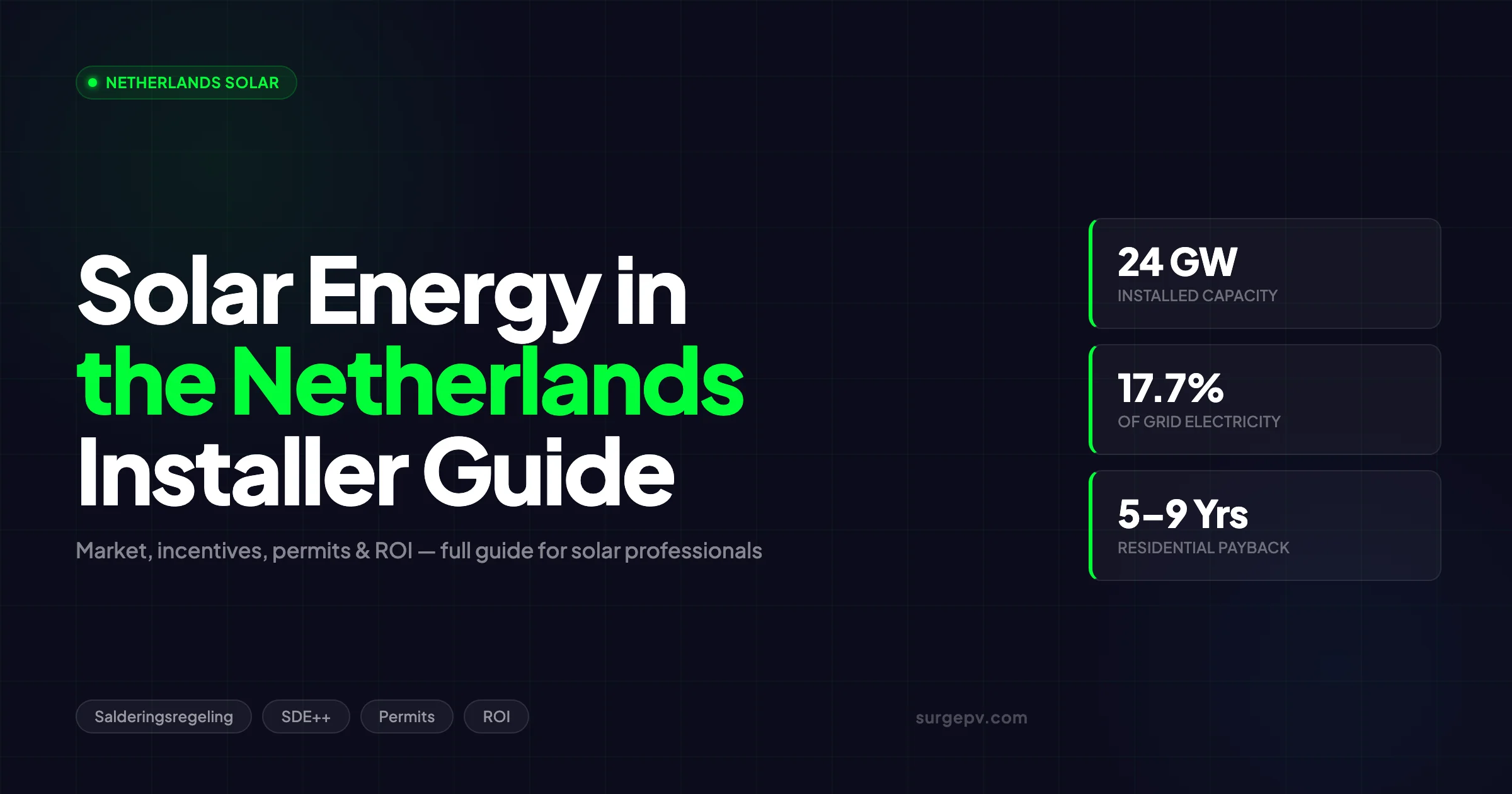
The Netherlands has added more solar per capita than almost any country in Europe — reaching 24 GW installed by end-2024 and generating 17.7% of national electricity from photovoltaics. That figure would have seemed implausible a decade ago for a densely clouded northern European country. Yet the Dutch solar market is now defined less by growth questions and more by a structural shift: the salderingsregeling, the residential net metering scheme underpinning household ROI since the 1990s, ends on January 1, 2027. For installers operating in the Netherlands right now, 2026 is a window. Also see: European Solar Tax Credits.
Solar energy in the Netherlands benefits from SDE++ subsidies (€8 billion budget 2026) but faces net metering phase-out by January 2027. Installation costs are €1,100–€1,500/kWp. Post-saldering, self-consumption becomes critical. Battery storage adoption is accelerating to maintain project economics. For more on this topic, see Adding Battery Storage Services.
This guide covers the full Dutch solar picture: market size and growth trajectory, salderingsregeling phase-out mechanics, SDE++ and business incentives, permit requirements under the 2024 Environmental Act, grid congestion realities, ROI calculations before and after 2027, regional performance data, and what the post-net-metering era means for installer strategy.
TL;DR — Solar Energy in the Netherlands
Installed capacity: ~24 GW (end-2024). Solar = 17.7% of national electricity. 31.5% of Dutch homes have rooftop solar. Salderingsregeling (net metering) ends January 1, 2027 — residential ROI drops sharply without a battery. SDE++ for commercial systems above 15 kWp: 2026 application window opens September 22. Most rooftop installations are permit-free under the Environmental Act. Payback under current net metering: 5–9 years. Post-2027 without storage: 15–17 years.
In this guide:
- Netherlands solar market: current size, growth rate, and 2031 projections
- Salderingsregeling explained: how it works, the phase-out timeline, and what replaces it
- SDE++ subsidy: eligibility, 2026 application dates, and how the calculation works
- Business solar tax benefits: EIA, KIA, and zero VAT
- Permit requirements under the 2024 Environmental Act
- Grid congestion: what it means for commercial solar in the Netherlands
- ROI and payback period calculations — before and after 2027
- Regional performance data by province
- Installer market structure and where the opportunities are
Netherlands Solar Market: Size, Growth, and Trajectory
The Dutch solar market is one of Europe’s fastest-growing relative to land area and population. At end-2024, installed photovoltaic capacity stood at approximately 24.05 GW — making the Netherlands 11th globally by total installed capacity. That places it ahead of much larger countries including Japan and Australia on a per capita basis. For Australia-specific compliance details, see Australia comparisons/lgc-vs-stc. For Global-specific compliance details, see Global net-metering-by-country.
The pace has been consistent. The Netherlands crossed 10 GW in 2020, added 4.3 GW in 2023 alone, and reached an estimated 2.08 GW of new installations in 2025. Market research projections put the 2026 total market size at 36.7 GW and the 2031 outlook at roughly 60 GW, implying a 10.32% compound annual growth rate through the decade.
Solar’s share of national electricity generation reached 17.7% in 2024 — up from essentially zero in 2000 and a concrete demonstration that a temperate northern European climate is no barrier to high solar penetration. By comparison, Germany reached roughly 12% solar electricity share in 2024, and Belgium about 10%. Also see: Germany solar subsidies. For the latest details on France, see Agricultural Solar Case Study.
Key Market Data
At 1,353 watts per capita (2024), the Netherlands ranks 13th in the EU for per capita solar capacity. Approximately 31.5% of Dutch homes — 2.58 million installations — had rooftop solar by end-2023, with average residential system sizes around 4.69 kW.
The residential segment drove early growth, but the commercial and industrial segment is now accelerating faster. Commercial and industrial solar projects grew 13.78% year-over-year in 2025 and are forecast to outpace utility-scale additions through 2031. Corporate power purchase agreements (PPAs) from data centers and retail operators are broadening demand beyond the household market, while agrivoltaic incentives are unlocking dual-use agricultural land that would otherwise have been unavailable for large-scale development.
The largest operational solar park in the Netherlands is the 103 MWp Midden-Groningen facility, commissioned in 2019. The floating solar segment has also developed rapidly, with the 41.4 MWp Sellingen installation as the country’s largest floating array. The Netherlands’ flat topography, extensive canal networks, and high land values have made floating solar an attractive option where ground-mounted installations face planning resistance.
Solar Irradiance in the Netherlands: What the Numbers Mean for System Yield
The Netherlands sits between 51°N and 53°N latitude — further north than most solar markets. Annual global horizontal irradiance (GHI) ranges from 1,400 to 1,800 kWh/m², with daily averages running 2.75 to 3.04 kWh/m². The southern provinces (Noord-Brabant, Limburg, Zeeland) consistently outperform the northern provinces by roughly 5-8%.
These figures are comparable to Germany’s Rhine-Westphalia region and considerably higher than Scotland or Scandinavia. The Netherlands actually receives more usable solar hours than its latitude suggests, partly because the flat landscape minimizes horizon shading and partly because the maritime climate limits the extreme humidity and atmospheric dust found in more continental climates. Also see: Us Residential Solar Market Trends 2026. Read more about Battery Solar System Design UK.
For system sizing, Dutch installers should apply the following rules of thumb:
| Province | Annual GHI (kWh/m²) | Peak Sun Hours/Day | Typical 5 kWp Yield |
|---|---|---|---|
| Zeeland | 1,080–1,100 | 2.96–3.01 | 4,900–5,100 kWh/yr |
| Noord-Brabant | 1,050–1,080 | 2.88–2.96 | 4,750–4,950 kWh/yr |
| Limburg | 1,050–1,070 | 2.88–2.93 | 4,700–4,900 kWh/yr |
| Zuid-Holland | 1,020–1,060 | 2.79–2.90 | 4,600–4,800 kWh/yr |
| Noord-Holland | 1,000–1,040 | 2.74–2.85 | 4,500–4,700 kWh/yr |
| Groningen | 990–1,020 | 2.71–2.79 | 4,400–4,600 kWh/yr |
System yield estimates assume south-facing roof at 35° tilt with no horizon shading. Real performance will vary based on shading losses, soiling, inverter efficiency, and module degradation.
Pro Tip
Dutch rooftops are frequently low-pitch (15–25°) or flat. For these configurations, tilt-and-azimuth modeling is essential — a suboptimal tilt on a flat roof can cost 8–12% in annual yield. Use solar shadow analysis software to model the actual tilt and orientation before finalizing the design.
The Salderingsregeling: How It Works and What Changes in 2027
The salderingsregeling is the mechanism that made residential solar financially attractive in the Netherlands for the past three decades. Understanding it precisely is the single most important thing any Dutch solar installer needs to communicate to residential clients right now.
How Salderingsregeling Works
Under the scheme, prosumers offset their electricity consumption against surplus solar exports on a one-to-one basis at the full retail electricity rate. Settlement is annual. If you generate 3,000 kWh and consume 5,000 kWh during the year, you pay only for the net 2,000 kWh. The exported 3,000 kWh is credited at exactly the same rate you would otherwise pay for grid electricity — currently approximately €0.28–€0.35/kWh for most residential customers.
This one-to-one retail rate equivalence is what makes the Dutch scheme unusually favorable compared to most European net metering or feed-in systems, where exports receive a feed-in tariff well below retail rates. The Netherlands has effectively been compensating solar self-generation and exported generation at equal rates, regardless of when generation or consumption occurs.
The Phase-Out
The Dutch Senate approved legislation terminating salderingsregeling. The scheme ends entirely on January 1, 2027. After that date, energy suppliers will set their own compensation rates for residential surplus exports — with expected rates in the €0.04–€0.08/kWh range. This is a reduction of roughly 80% in export compensation value for the average prosumer.
The policy rationale is grid economics: as solar penetration has grown to nearly 18% of national electricity, the cost of the one-to-one retail rate subsidy has grown unsustainable for the grid cross-subsidies involved. The government’s position is that self-consumption should be encouraged rather than export maximization.
What This Means for Installer Conversations
The financial case for residential solar in the Netherlands does not disappear after 2027, but it changes substantially:
| Scenario | Payback Period |
|---|---|
| Install in 2026, under salderingsregeling | 5–9 years |
| Install from 2027, high self-consumption (>70%), no battery | 10–14 years |
| Install from 2027, average self-consumption (~30%), no battery | 15–17 years |
| Install from 2027, with home battery (10 kWh) | 8–12 years |
| Install from 2027, with battery + smart charging (EV) | 7–10 years |
The message for 2026 sales: installing before year-end secures the final full year of one-to-one offset, and the payback clock starts from a materially lower cost base. After 2027, the value proposition shifts toward battery-integrated systems, home energy management (HEMS), and dynamic tariff optimization.
For a deeper comparison of European incentive structures, see the European solar incentives guide.
SDE++: The Large-Scale Solar Subsidy
For commercial and utility-scale projects, the primary Dutch incentive is SDE++ (Stimulering Duurzame Energieproductie en Klimaattransitie — Sustainable Energy Production and Climate Transition subsidy).
How SDE++ Works
SDE++ is an operating subsidy, not a capital grant. It covers the difference between a fixed “base energy price” (set at application) and the actual market electricity price over the subsidy period. When market prices are high, the SDE++ payout is low. When market prices fall, the SDE++ makes up the gap — protecting project economics from price volatility.
The subsidy period is 12 or 15 years depending on technology. For solar PV, the typical period is 15 years. The base energy price is set at the time of the application round and does not change during the subsidy term.
Eligibility Requirements
To qualify for SDE++ as a solar PV installation:
- Commercial grid connection of at least 3×80 amps
- System size above 15 kWp (15,000 Wp)
- You must be the producer who constructs and operates the facility
- A feasibility study is required at application
The 15 kWp minimum threshold means most residential systems do not qualify. SDE++ is primarily relevant for commercial rooftop, industrial, agrivoltaic, floating, and utility-scale ground-mount projects.
2026 Application Window
The 2026 SDE++ application window runs from September 22, 2026 at 9:00 AM to October 22, 2026 at 5:00 PM. Applications are submitted to the Netherlands Enterprise Agency (RVO). The scheme is currently temporarily closed between rounds.
SDE++ Budget Pressure
The SDE++ budget has been oversubscribed in multiple recent rounds. Applications are processed in order of submission during the open window, and the budget can be exhausted before the window closes. Commercial project developers should prepare applications well in advance of September 22.
SDE++ Transition to Contracts for Difference
The Netherlands is planning to transition SDE++ to a Contracts for Difference (CfD) mechanism from 2027, aligned with EU state aid rules. Under CfD, projects would receive two-way payments — the government pays the producer when market prices fall below the strike price, but the producer repays the government when prices exceed the strike price. This symmetrical structure changes project finance calculations significantly compared to the current one-way floor-only SDE++.
Business Solar Tax Benefits in the Netherlands
Beyond SDE++, Dutch businesses have access to several tax-based incentives that apply at time of purchase. These are relevant for any commercial or C&I solar installation.
EIA — Energy Investment Allowance
The EIA (Energie-investeringsaftrek) is a fiscal benefit for businesses investing in energy-efficient equipment, including solar PV. The allowance allows businesses to deduct approximately 40% of the qualifying investment amount from taxable profit (resulting in roughly a 10% effective fiscal benefit based on the 25% corporate tax rate). The EIA requires filing with the Netherlands Enterprise Agency within three months of the purchase order — not after installation.
KIA — Small-Scale Investment Allowance
KIA (Kleinschaligheidsinvesteringsaftrek) is a general investment allowance available to businesses investing in qualifying assets, including solar panels. For investments between €2,801 and €374,000, the allowance is 28% of the investment amount, deductible from taxable profit. No separate application is needed — your accountant processes this via the annual tax return.
| KIA Investment Range | Allowance Rate |
|---|---|
| €2,801 – €69,765 | 28% |
| €69,766 – €129,194 | Scales down |
| €129,195 – €374,000 | Fixed amount |
| Above €374,000 | No KIA |
Zero VAT on Solar Panels
Since January 1, 2023, solar panel purchases and installations in the Netherlands carry 0% VAT for residential systems. This replaced the former 21% BTW rate and effectively reduced the net purchase price for consumers by roughly 17% (stripping out the VAT they previously could not recover). Businesses can still recover input VAT through normal VAT returns.
MIA and VAMIL — No Longer Applicable
The MIA (Milieu-investeringsaftrek) and VAMIL (Willekeurige afschrijving milieu-investeringen) schemes used to apply to solar PV but have been removed from the qualifying equipment list. Do not reference these when advising clients on solar investments.
Permit Requirements Under the 2024 Environmental Act
The Netherlands simplified solar permit requirements substantially when the Omgevingswet (Environmental Act) came into force on January 1, 2024. For most standard rooftop installations, no permit is needed.
When No Permit Is Required
Pitched roof: Panels installed flush on the roof surface at the same angle as the roof, not protruding beyond the ridge line. The installation must follow the roof’s plane.
Flat roof: Panels set back from the roof eaves by at least their own height, not exceeding the building’s highest point.
Garage, carport, or canopy roofs: Generally permit-free if panels do not extend beyond the roof surface. For more on this topic, see Commercial Solar Carport Design Guide.
This covers the vast majority of residential and most commercial rooftop installations.
When a Permit Is Required
- Listed buildings (rijksmonumenten or gemeentelijke monumenten): Any installation on or adjacent to a monument requires an environmental and planning permit from the municipality.
- Protected conservation areas: Some historic city centers have blanket restrictions on visible solar panels. Check with the local municipality.
- Facade-mounted installations: Always require a permit due to visual impact on the building exterior.
- Ground-mounted systems: Require an environmental permit, particularly if visible from public roads or located in protected landscape areas.
- External inverters: If the inverter is mounted externally (not integrated into panels or housed inside the building), a permit may be required depending on municipality rules.
How to Check and Apply
The online permit check at omgevingswet.overheid.nl allows installers and homeowners to input the installation location and configuration and receive a permit determination. For applications that require a permit, the standard municipal review period is 8 weeks.
Pro Tip
Run the permit check before the sales close — not after. Monument status is not always obvious from the building’s appearance. A listed façade in an Amsterdam canal-house row can invalidate an otherwise straightforward installation, and finding that out post-contract creates delays and trust issues with clients.
Grid Connection and Congestion: The Critical Challenge for Commercial Solar
Grid congestion is the defining operational challenge for solar development in the Netherlands above residential scale. Network operators — Enexis, Stedin, Liander, and Coteq — have declared congestion (congestie) across large portions of the country, meaning new commercial and utility-scale connections face waiting periods, export limitations, or outright refusals in affected grid sections.
What Congestion Means in Practice
When a grid section is declared congested, network operators cannot guarantee full export capacity for new connections. Projects may receive a connection with an export limitation — for example, a 500 kWp rooftop array might be limited to exporting 200 kW at any given time, with surplus generation either curtailed or consumed on-site. This fundamentally changes the yield and revenue model for commercial projects.
Congestion areas shift as grid upgrades are completed or as new projects come online. The network operators publish congestion maps that are updated periodically. Any commercial project above approximately 50 kWp should begin with a grid capacity check through Netbeheer Nederland or directly with the relevant regional network operator.
Government Response
The Dutch government has introduced priority queue rules for “strategic” projects (energy communities, government buildings, and critical infrastructure), and has committed substantial grid upgrade funding. The national Climate Accord targets are incompatible with sustained congestion, and grid operators are under regulatory pressure to accelerate reinforcement timelines.
For smaller commercial projects (50–500 kWp), practical options to work within congestion constraints include:
- Export limitation with battery buffer: Install a battery to absorb surplus generation and release it during low-generation periods, reducing peak export demand.
- Behind-the-meter maximization: Design systems specifically to maximize self-consumption rather than export, reducing the export capacity required from the grid connection.
- Dynamic export control: Install inverter-level dynamic export controllers that automatically limit output based on real-time grid conditions.
Design Dutch Solar Projects Within Grid Constraints
SurgePV’s generation and financial modeling tools let you run scenarios for export-limited projects — showing clients exactly how a battery or smart export controller affects ROI before a single panel is ordered.
Book a DemoNo commitment required · 20 minutes · Live project walkthrough
For a direct comparison, see Arka 360 vs SurgePV.
ROI and Payback Period: The 2026 Calculation
The financial case for solar in the Netherlands is strong in 2026, and weaker from 2027 without storage. Here is the honest math.
Residential System Example (5 kWp, South-Facing, Noord-Brabant)
System cost (2026): €7,500–€9,000 all-in (hardware, inverter, mounting, installation, grid notification) Annual generation: ~4,750–5,000 kWh Self-consumption rate: ~30% (1,425–1,500 kWh consumed directly) Exported to grid: ~70% (3,325–3,500 kWh)
Under salderingsregeling (through end-2026):
- Retail rate saved: €0.30/kWh (weighted average 2026 tariff)
- Annual value: 5,000 kWh × €0.30 = €1,500
- Payback: €8,250 ÷ €1,500 = 5.5 years
After salderingsregeling ends (from 2027):
- Self-consumption savings: 1,500 kWh × €0.30 = €450
- Export compensation: 3,500 kWh × €0.06 = €210
- Total annual value: €660
- Payback: €8,250 ÷ €660 = 12.5 years
With 10 kWh battery (self-consumption raised to 70%):
- Battery adds ~€4,500 to system cost (total: ~€12,750)
- Self-consumption: 3,500 kWh × €0.30 = €1,050
- Export: 1,500 kWh × €0.06 = €90
- Total: €1,140/year
- Payback: ~11.2 years
The implication is clear: for clients who cannot install before year-end, a battery is not optional for a reasonable post-2027 ROI — it is a requirement for the economics to work.
Commercial System Example (100 kWp, C&I Roof)
System cost: €65,000–€80,000 all-in Annual generation: ~90,000–95,000 kWh Self-consumption rate (commercial): ~60% (highly variable by business type) Electricity cost avoided: 57,000 kWh × €0.22/kWh (commercial tariff) = €12,540 SDE++ subsidy (estimated): €8,000–€12,000/year depending on round pricing
Without SDE++ and at 60% self-consumption, standalone payback is approximately 6–8 years. With SDE++, it compresses to 4–6 years. This is why the SDE++ application window in September matters operationally — a missed round is a missed year of subsidy eligibility.
Accurate commercial modeling requires project-specific irradiance data, load profiles, and grid connection parameters. The energy and financial modeling tool is designed exactly for this type of scenario analysis.
Regional Solar Performance in the Netherlands
Solar yield in the Netherlands varies roughly 8–10% between the best and worst performing provinces. This is a meaningful difference for system sizing and ROI calculations but not the dominant variable — incentive structure and electricity tariff matter more.
| Region | Key Cities | Relative Irradiance | Notes |
|---|---|---|---|
| Zeeland | Middelburg, Terneuzen | Highest | Coastal, low horizon shading |
| Noord-Brabant | Eindhoven, Tilburg | High | Largest share of installed capacity |
| Limburg | Maastricht, Venlo | High | Southernmost province |
| Zuid-Holland | Rotterdam, Den Haag, Delft | Average-High | Dense urban rooftop market |
| Gelderland | Nijmegen, Arnhem | Average | Good mix of rural and C&I |
| Utrecht | Utrecht city | Average | Strong residential demand |
| Noord-Holland | Amsterdam, Haarlem | Average | Urban density limits ground-mount |
| Groningen | Groningen city | Lower | High wind + solar combination |
| Friesland | Leeuwarden | Lower | Solar-wind hybrid projects common |
| Flevoland | Almere, Lelystad | Lower but flat | Polder land = large ground-mount potential |
Wikipedia’s Netherlands solar overview notes that Noord-Brabant and Limburg together accounted for 34.78% of installed capacity as of 2025, confirming the south’s dominance despite the provinces representing a much smaller share of national land area.
Solar Design Considerations for the Dutch Market
The Netherlands presents specific design challenges that differ from Mediterranean solar markets. Installers using solar design platform should account for the following parameters.
Roof Pitch and Tilt Optimization
Dutch residential rooftops frequently have pitches between 15° and 35°. For flat or near-flat commercial roofs — common in industrial estates in Noord-Holland, Zuid-Holland, and Gelderland — tilt racks at 10–20° typically offer the best yield/cost trade-off. Steeper tilt improves yield but increases wind load and inter-row shading requirements.
Winter Diffuse Irradiance
Unlike Spain or Italy, where most solar generation is dominated by direct normal irradiance (DNI), Dutch generation relies significantly on diffuse horizontal irradiance (DHI) — scattered light from overcast skies. This has two implications: bifacial modules offer less rear-side gain than in high-DNI environments, and high-performance monofacial modules with strong low-light performance outperform peak-efficiency metrics suggest. Specify modules with high Euro-efficiency ratings rather than STC peak power alone. Also see: solar panel ROI in Italy. Also see: Spain net metering.
Soiling and Cleaning
The Netherlands’ mild climate and regular rainfall mean natural cleaning handles most residential soiling. Commercial flat-roof installations in agricultural or industrial areas may require periodic cleaning — assume a 0.5–1% annual soiling loss for open-country sites and 0.3% for urban rooftops.
Shading and Shadow Analysis
Urban Dutch rooftops often have dormer windows, chimney stacks, ventilation units, and party walls at close proximity. Horizon shading from adjacent tall buildings is common in Amsterdam, Rotterdam, and Den Haag. Run a full Global Solar Atlas irradiance check for every project site, and model shading impact using actual site measurements rather than generic provincial averages.
The solar shadow analysis software can model near-field shading from rooftop obstacles and far-field horizon profiles — both of which are relevant for Dutch urban installations.
The Dutch Solar Installer Market
The Netherlands has a mature installer ecosystem. Around 2,000 registered installation companies operate nationally, ranging from one-person operations to national chains. Holland Solar (the Dutch solar sector association) represents over 200 member companies, including manufacturers, project developers, and service providers.
Market Segmentation
Residential installers dominate by number of companies and volume of jobs but face increasing margin pressure as panel costs have fallen and competition has intensified. The average residential installation in 2024 was approximately 4.69 kWp.
Commercial and industrial (C&I) installers handle rooftop systems from approximately 15 kWp to 2 MWp. This segment is growing fastest, driven by corporate sustainability targets and SDE++ economics. C&I projects require more complex electrical design, grid notification, and often SDE++ application management — creating differentiation opportunities.
Project developers / EPC firms handle large-scale ground-mount and floating solar. These firms typically design, permit, finance, and build projects in the 2–100 MWp range and operate in a different business model from installation contractors.
What Differentiates Installers in 2026
The Dutch market is shifting from panel-and-inverter installation toward integrated energy solutions. The post-salderingsregeling era rewards installers who can:
- Design for self-consumption maximization — right-sizing systems to actual consumption profiles rather than simply maximizing roof coverage
- Offer battery storage integration — the economics post-2027 make storage a standard add-on, not an upsell
- Navigate the SDE++ application process — commercial clients value installers who manage subsidy applications, not just the hardware
- Provide accurate grid congestion assessment — a reliable congestion check before project scope is set saves commercial clients from costly surprises
- Produce professional proposals — Dutch B2B solar procurement processes are increasingly formalized, and proposal quality directly influences conversion
PV proposal software that produces localized Dutch proposals — with salderingsregeling vs. post-2027 scenario modeling, SDE++ eligibility assessment, and grid connection requirements — is a meaningful competitive differentiator.
For installers building their commercial pipeline, see also the guide to solar PV design software for Europe and how solar software Germany installers approach the comparable German market.
Grid Notification and Technical Connection Requirements
All solar installations in the Netherlands require grid notification, regardless of permit status. The process differs by system size.
Small Residential Systems (up to 3×25 amps)
For systems feeding back via the existing domestic connection, the procedure is:
- Installer completes a notification form with the relevant network operator (Enexis, Stedin, Liander, or Coteq depending on region)
- The network operator verifies that the existing meter can handle net metering and is updated to a smart meter if needed
- No prior approval is needed — notification is sufficient
- Timeline: typically 1–4 weeks
Larger Residential and Small Commercial (3×25 to 3×80 amps)
A capacity request is required. The network operator assesses whether the existing connection capacity can support the proposed export. If not, a connection upgrade may be required — adding cost and 4–12 weeks to the timeline.
Commercial and Industrial (above 3×80 amps)
A formal grid connection request is required, and congestion assessment applies. The network operator may impose export limitations or require a congestion management study. Timeline for commercial connections in congested areas can extend to 12–24 months.
Smart Meter Requirement
Salderingsregeling requires a smart meter (slimme meter) for accurate annual settlement. Network operators are required to provide smart meters on request at no cost to the consumer. Most Dutch homes built or renovated after 2015 already have them, but older properties in rural areas may not. Check meter type at the project assessment stage.
Storage and Energy Management: The Post-2027 Stack
The end of salderingsregeling has catalyzed a rapid shift in Dutch solar economics toward storage and smart energy management. The Solar Solutions Amsterdam 2026 report noted that storage systems dominated the event’s commercial activity — reflecting the industry’s recognition that battery integration is becoming standard.
Home Battery Systems
Home batteries are now competitively priced in the Netherlands. A 10 kWh lithium iron phosphate (LFP) battery costs approximately €4,000–€6,000 installed in 2026. For a 5 kWp solar system, adding a battery raises self-consumption from roughly 30% to 65–75%, materially improving post-2027 ROI.
LFP chemistry is preferred for Dutch residential applications due to its safety profile in tight urban housing and its cycle-life performance at the moderate temperatures typical in the Netherlands.
Dynamic Tariffs and HEMS
Several Dutch energy suppliers — including Vattenfall, Eneco, and Tibber — offer dynamic electricity tariffs linked to day-ahead wholesale prices. For prosumers with batteries, HEMS (Home Energy Management Systems) can optimize charging and discharging based on hourly prices, buying cheap at night and avoiding grid draws during expensive peak periods.
The vehicle-to-grid (V2G) opportunity is also emerging in the Netherlands, where EV adoption rates are among Europe’s highest. Bidirectional charging combined with solar effectively turns an EV into a large mobile battery — eliminating the need for a separate home battery in many cases.
Comparison: Netherlands vs. Other European Solar Markets
| Country | Installed Capacity | Solar % Electricity | Net Metering Status | Primary Incentive |
|---|---|---|---|---|
| Netherlands | ~24 GW | 17.7% | Ends Jan 2027 | SDE++, zero VAT |
| Germany | ~90 GW | ~12% | Never had full net metering | EEG feed-in tariff (20yr) |
| Italy | ~32 GW | ~16% | Scambio sul Posto (at reduced rates) | 50% Detrazione Fiscale |
| Spain | ~30 GW | ~17% | Net billing (not net metering) | Autoconsumo tax exemptions |
| France | ~22 GW | ~6% | Autoconsommation premium | Feed-in tariff up to €0.23/kWh |
| Belgium | ~10 GW | ~20% | Varies by region | Prosumer tariff, green certificates |
The Netherlands stands out for its high solar penetration despite limited irradiance — a function of aggressive net metering that is now being wound back. Germany’s EEG provides a 20-year income guarantee that the Dutch SDE++ approximates but with a sliding rather than fixed rate. For Germany-specific information, see Community Solar Projects Germany.
For the full cross-market incentive comparison, see the European solar incentives guide.
Conclusion
The Netherlands is entering a new phase of its solar market. The first phase — mass residential adoption driven by one-to-one net metering — is closing on January 1, 2027. The second phase, defined by self-consumption optimization, storage integration, commercial-scale SDE++ projects, and grid-aware design, is already underway.
For installers, three actions matter most right now:
- Close residential pipelines in 2026. Clients who install before year-end secure the final full year of salderingsregeling. The post-2027 economics are not bad — but they require a battery and a different sales conversation.
- Build commercial SDE++ capability. The September 2026 application window rewards installers who can manage subsidy applications and design export-limited systems accurately. This is where margin growth is.
- Invest in design and proposal quality. The post-salderingsregeling market will be won by installers who demonstrate — in a precise, client-specific proposal — how a solar-plus-storage system performs over its 25-year life. Generic proposals won’t differentiate in a market where customers are sophisticated and skeptical about post-2027 claims.
Solar software that handles Dutch-specific scenarios — salderingsregeling vs. post-2027 comparison, SDE++ yield modeling, congestion-constrained export design — is the operational foundation for both residential and commercial growth in this market.
Frequently Asked Questions
Is solar worth it in the Netherlands in 2026?
Yes — solar is worth it in the Netherlands in 2026, but the economics depend on acting before the salderingsregeling (net metering) ends on January 1, 2027. Under current net metering, residential payback ranges from 5 to 9 years depending on system size and electricity tariff. After 2027, without storage or smart energy management, that extends to roughly 15-17 years. Installing in 2026 locks in one full final year of one-to-one retail rate offset, which materially improves lifetime ROI.
What is salderingsregeling and when does it end?
Salderingsregeling is the Dutch residential net metering scheme that lets homeowners offset grid consumption against solar exports at full retail rates on a one-to-one basis. It was introduced in the 1990s and covers systems up to 80 amps per phase. The Dutch Senate approved legislation to terminate the scheme, and it ends on January 1, 2027. After that, energy suppliers will set their own compensation rates for residential surplus exports — expected in the €0.04–€0.08/kWh range, compared to the €0.28–€0.35/kWh retail rate currently applied.
Do I need a permit for solar panels in the Netherlands?
Most standard rooftop solar installations in the Netherlands do not require a permit under the Environmental Act (in force since January 1, 2024). Permit-free conditions: panels installed flush on a pitched roof, or set back from eaves on a flat roof without exceeding the roof’s highest point. You do need a permit for: listed buildings (rijksmonumenten or gemeentelijke monumenten), facade-mounted panels, ground-mounted systems, or installations on scaffolding. Check your specific situation at omgevingswet.overheid.nl using the permit check tool.
What is the SDE++ subsidy and who qualifies?
SDE++ (Stimulering Duurzame Energieproductie en Klimaattransitie) is the Netherlands’ main operating subsidy for large-scale renewable energy. For solar PV, eligibility requires a commercial grid connection of at least 3×80 amps and a system size above 15 kWp. The subsidy covers the difference between a fixed base energy price and the actual market electricity price for 12 to 15 years. The 2026 application window runs from September 22 to October 22. Applications are submitted to the Netherlands Enterprise Agency (RVO).
What is the average payback period for solar in the Netherlands?
Under current salderingsregeling (net metering), residential payback periods in the Netherlands average 5 to 9 years. The variation depends on system size, self-consumption rate, roof orientation, and current electricity tariff. South-facing roofs in the southern provinces perform best. After the salderingsregeling ends in 2027, payback for new installations without a battery is expected to rise to 15-17 years. Adding a home battery or smart energy management can bring this back to 8-12 years by maximizing self-consumption.
How much solar irradiance does the Netherlands receive?
The Netherlands receives 1,400 to 1,800 kWh per square meter annually in global horizontal irradiance (GHI). Daily averages run 2.75 to 3.04 kWh/m². The southern provinces (Noord-Brabant, Limburg) receive marginally higher irradiance than the north. While lower than Mediterranean countries, Dutch irradiance is comparable to Germany and Belgium — the Netherlands has consistently outperformed expectations given its latitude, reaching 17.7% of national electricity from solar in 2024.
What business solar subsidies are available in the Netherlands?
Dutch business solar subsidies in 2026 include: SDE++ (operating subsidy for systems above 15 kWp, application window September to October 2026), EIA — Energy Investment Allowance (roughly 10% fiscal benefit on equipment costs), KIA — Small-Scale Investment Allowance (tax deduction for investments under €374,000, handled by accountant via tax return), and zero VAT on solar panel purchases (in effect since 2023). The MIA and VAMIL environmental investment schemes no longer apply to solar PV.
What are the main grid constraints for Dutch solar installers?
Grid congestion (congestie) is the dominant constraint for solar projects above residential scale in the Netherlands. Network operators including Enexis, Stedin, and Liander have declared congestion across large parts of the country, meaning new commercial and utility-scale projects face significant delays or export limitations on grid connection. The government has introduced priority schemes for strategic projects, but smaller commercial developers should conduct a grid capacity check through Netbeheer Nederland before finalizing project scope. Residential connections below 3×25 amps are generally unaffected.
Where this fits
This article is part of SurgePV's Solar Incentives & Policy hub, which works through the topic from first principles to the decisions a project team actually has to make.

