

A 200-room city hotel in Madrid consumes around 2.4 GWh of electricity per year. A 380 kWp rooftop solar array on the same building generates about 580 MWh per year. That is 24 percent of total demand, but only if the design matches the way guests actually use the building. Get the load matching wrong and the system exports 35 percent of its generation back to the grid at low feed-in rates while the hotel still buys evening peak power at retail. Get it right and the same kWp delivers double the savings. See our guide on Hotel Solar + EV Charging Case Study for more.
A 200-room city hotel in Madrid consumes around 2.4 GWh of electricity per year. A 380 kWp rooftop solar array on the same building generates about 580 MWh per year. They run 365 days a year, but occupancy swings between 30 percent in shoulder season and 95 percent at peak.
Hotels are one of the trickier commercial buildings to design solar for. They run 365 days a year, but occupancy swings between 30 percent in shoulder season and 95 percent at peak. HVAC, laundry, kitchens, pools, and 24-hour reception each have a different load curve. Solar yield itself moves with the seasons, often in the wrong direction relative to demand.
This guide covers how to design a hotel rooftop solar system that tracks seasonal occupancy patterns. It walks through load profiling, sizing, tilt and orientation choices, battery storage, roof layout constraints, inverter selection, ROI math, and an implementation checklist that has worked across 60-plus hospitality projects. Read Adding Battery Storage Services for a complete walkthrough.
TL;DR — Hotel Solar Panel System Design
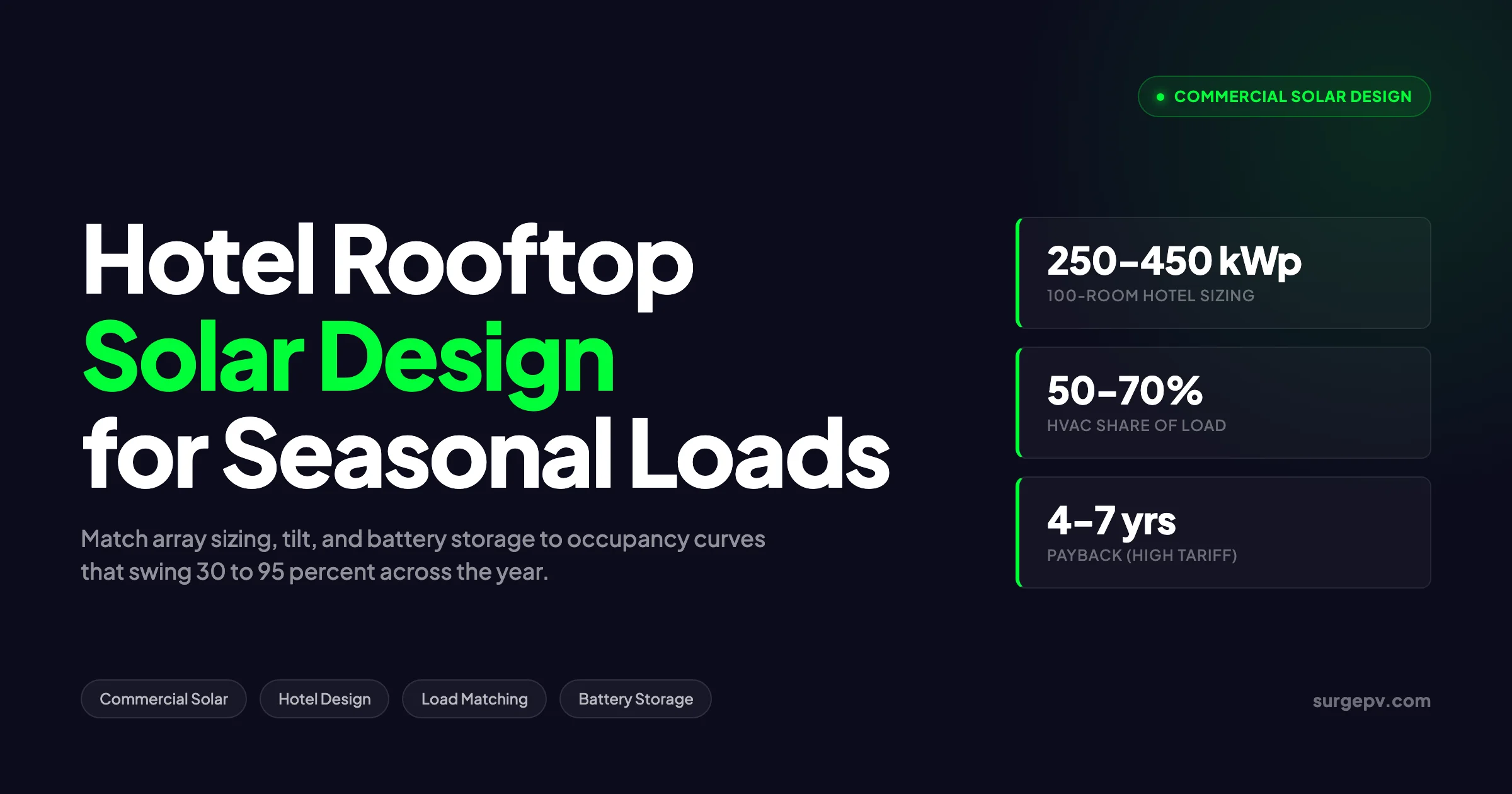
Hotels need solar systems sized to seasonal occupancy, not annual averages. A 100-room hotel typically needs 250 to 450 kWp; a resort with chillers, pools, and laundry needs 500 to 900 kWp. HVAC drives 50 to 70 percent of consumption and aligns well with midday solar. Adding 50 to 200 kWh of battery storage captures the 6 PM to 11 PM guest peak. Payback ranges from 4 to 7 years in high-tariff markets with demand charges, and 7 to 10 years elsewhere. The most common design mistake is sizing to a flat average and ignoring the 30 to 95 percent occupancy swing.
What this guide covers:
- Hotel load profiling by property type (city, resort, ski, business)
- Seasonal occupancy curves and their solar yield mismatch
- Sizing methodology that matches occupancy, not annual average
- PV array layout on hotel rooftops with HVAC, parapets, and pools
- Battery storage sizing for evening guest peaks
- Inverter loading ratio for seasonal mismatches
- ROI, payback, and tariff structure analysis
- A 12-step implementation roadmap
Hotel Electricity Consumption: The Real Load Profile
Before you size anything, you need a load curve. Hotels do not look like offices, factories, or shopping centers. They have their own fingerprint.
The four hotel archetypes
| Hotel Type | Annual kWh per room | Peak season | Dominant load |
|---|---|---|---|
| City business hotel | 7,500 - 10,000 | Spring/Fall (conferences) | HVAC + lighting |
| Beach resort | 12,000 - 18,000 | Summer | Chillers + pools + laundry |
| Ski lodge | 10,000 - 14,000 | Winter | Heating + DHW + kitchen |
| Boutique/budget | 4,000 - 6,000 | Variable | Lighting + DHW |
Resorts use 2x to 3x more electricity per room than budget hotels, mostly because of pool pumps, irrigation, on-site laundry, and full-service restaurants. The IEA’s global cooling demand outlook shows that hospitality cooling loads have grown 4-6 percent annually in warm-climate markets, which makes solar payback particularly fast for resorts in southern Europe, the Caribbean, and South Asia. Also see: European Solar Incentives. For Global-specific compliance details, see Global net-metering-by-country. For Global-specific compliance details, see Global solar-permitting-speed-by-country.
How a hotel load decomposes
For a typical mid-scale 100-room hotel in a temperate climate, electricity breaks down roughly as follows:
| End use | Share of total kWh | Daily peak window |
|---|---|---|
| HVAC (cooling/heating) | 50-70% | 11 AM - 7 PM |
| Domestic hot water | 10-15% | 6-9 AM and 6-10 PM |
| Lighting | 8-12% | 6-10 PM |
| Kitchen and F&B | 6-10% | 7-10 AM, 12-2 PM, 6-9 PM |
| Laundry | 3-7% | 9 AM - 4 PM |
| Elevators, plug loads, IT | 5-8% | Distributed |
This is the foundation of every design decision that follows. HVAC is the elephant in the room. It runs hardest precisely when the sun is highest, which is why hotels in warm climates are excellent solar candidates. The DHW peak, kitchen load, and lighting peak all sit outside the solar window, which is why batteries earn their keep.
For a deeper look at how hourly load shape affects sizing decisions, the load profile analysis glossary entry explains the underlying methodology.
Why annual kWh totals mislead
The most common sizing mistake on hotel projects is to take last year’s electricity bill, divide by 8,760, and call that the average load. That number is fiction.
A 100-room city hotel might run 95 percent occupied during a spring trade fair week, then drop to 35 percent the following weekend. Annual average smooths over a 3:1 swing in real-time demand. A solar system sized to the average exports surplus heavily in low-occupancy months and falls short in peak months. Sizing to the seasonal occupancy curve fixes both ends.
Seasonal Occupancy: Where Hotels Differ from Other Commercial Solar Projects
Most commercial solar projects can assume a roughly flat year-round load. Schools shut in summer but otherwise behave predictably. Offices have a Monday-to-Friday cycle but stable annual demand. Hotels do not behave that way.
Three real occupancy patterns
The chart below shows how three hotel types swing through the year. Numbers are average occupancy rates pulled from STR/CoStar hospitality data for European properties.
| Month | Beach resort | Ski lodge | City business |
|---|---|---|---|
| January | 25% | 88% | 62% |
| February | 28% | 92% | 68% |
| March | 38% | 75% | 75% |
| April | 55% | 35% | 80% |
| May | 70% | 25% | 82% |
| June | 88% | 30% | 75% |
| July | 95% | 45% | 55% |
| August | 95% | 40% | 50% |
| September | 78% | 35% | 78% |
| October | 55% | 28% | 80% |
| November | 32% | 50% | 72% |
| December | 28% | 90% | 60% |
A beach resort in July uses roughly 4x the kWh it uses in January. A ski lodge does the opposite. A city business hotel runs steadier but still drops 30 percent in summer when conferences pause.
Solar yield seasonality
Solar generation also has a seasonal curve, and it is not the same shape as occupancy. For a south-facing 30-degree array at 40 degrees north latitude, monthly yield as a percentage of peak month looks like this:
| Month | Yield (% of peak) |
|---|---|
| January | 38% |
| February | 52% |
| March | 75% |
| April | 88% |
| May | 96% |
| June | 100% |
| July | 99% |
| August | 92% |
| September | 78% |
| October | 60% |
| November | 42% |
| December | 35% |
For a beach resort, solar yield and occupancy peak together. The summer match is excellent. For a ski lodge, the curves are inverted, and a standard south-facing tilt becomes the wrong choice. For a city business hotel, the spring and fall conference peaks fall in the shoulder months when solar is decent but not maximal.
This is the heart of seasonal occupancy load matching. The right solar design software lets you model both curves at hourly resolution and tune tilt, azimuth, and storage to maximize on-site consumption rather than gross kWh.
Pro Tip — Model Two Years, Not One
Hotel occupancy data from a single year is risky to design against. The 2020-2021 pandemic distorted hospitality records globally, and even non-pandemic years see swings from local events, weather, and construction next door. Pull at least 24 months of monthly occupancy and 15-minute interval electricity data. Average the seasonal shape rather than absolute volumes.
Sizing a Hotel Solar System to Seasonal Occupancy
The sizing methodology below adjusts for occupancy patterns rather than treating the year as flat. It works for any hotel type once you have the load and occupancy data.
Step 1: Build a 12-month occupancy-weighted load curve
For each month, calculate:
Monthly kWh = Base load × 30 days + Occupancy-driven kWh × occupancy %Base load is the always-on portion of the building (reception, IT, common-area lighting, minimum HVAC, security). It runs whether the hotel is empty or full. Typically 20-35 percent of total annual kWh.
Occupancy-driven load is the variable portion that scales with guests in rooms (room HVAC, room DHW, kitchen volume, laundry volume).
For a 100-room city hotel with 9,000 kWh/room/year and 75 percent average occupancy, the math looks like this:
- Annual kWh: 100 × 9,000 = 900,000 kWh
- Base load (30% of annual): 270,000 kWh
- Occupancy-driven (70% of annual): 630,000 kWh
- Monthly base: 22,500 kWh
- Monthly occupancy-driven at 75% occupancy: 52,500 kWh
- Total at 75% occupancy: 75,000 kWh per month
When occupancy drops to 50%, the variable portion drops to 35,000 kWh, and total monthly load drops to 57,500 kWh. That is a 23 percent monthly demand swing for a 25-point occupancy swing.
Step 2: Choose the offset target
Hotels rarely target 100 percent offset. Common offset targets:
| Offset target | When it makes sense |
|---|---|
| 30-40% | Limited roof area, low FIT/export rates, no demand charges |
| 50-60% | Standard target; balances roof use, payback, and grid export |
| 70-80% | High electricity prices, on-site battery, generous net metering |
| 90%+ | Off-grid resort, microgrid, or mandate-driven (EPBD, ESG) |
Most hotels land between 35 and 60 percent offset. Going higher pushes you into oversized arrays that export heavily in shoulder months unless you add storage. The EU solar rooftop mandate is starting to push some commercial hotels in Europe toward higher offset targets to comply with EPBD timelines.
Step 3: Match array size to peak month occupancy
Counterintuitively, you size to the peak occupancy month, not the average. Reason: in peak months, the hotel can absorb all generated solar on-site. In low-occupancy months, exports are inevitable, so any extra kWp generated then is exported at the FIT rate.
If a beach resort hits 95 percent occupancy in July and consumes 180,000 kWh that month, and the available roof would generate 95,000 kWh in July, that array offsets 53 percent in July, the most valuable month. The same array might generate only 35,000 kWh in January when consumption is 60,000 kWh, also a 58 percent offset, but the absolute value is much lower.
Step 4: Refine for tilt and azimuth based on demand curve
A south-facing 30-degree tilt is the default at temperate latitudes, but it is rarely the right answer for hotels. Use this matrix:
| Hotel type | Recommended tilt | Recommended azimuth | Why |
|---|---|---|---|
| Beach resort (summer peak) | 15-20° | South ±10° | Boost summer yield, accept winter loss |
| Ski lodge (winter peak) | 40-50° | South ±5° | Capture low winter sun |
| City business (year-round) | 25-30° | East-West split | Smooth daily curve to match HVAC + plug load |
| Mediterranean resort | 10-15° | South or E-W | Dust shedding + summer peak |
East-west splits often outperform pure south for hotels because they widen the daily generation window. Hotels have morning kitchen and DHW peaks that south-facing arrays miss until 10-11 AM. An east-west split shifts 15-20 percent of generation into the 7-10 AM and 5-7 PM windows. The tradeoff is a 10-15 percent reduction in total annual kWh, but a 20-30 percent improvement in self-consumption ratio.
For a deeper look at this tradeoff, see east-west vs south-facing solar layouts.
Step 5: Stress-test the sizing against shoulder months
The most common failure mode is a system that performs well in peak season and well in deep off-season but exports heavily in spring and autumn shoulder months. Before locking the design, run an hourly simulation across all 12 months and look for any month where solar generation exceeds load for more than 4 hours per day. That is your export window. If it exceeds 30 percent of monthly generation, you either downsize the array or add storage.
Roof Layout: What Eats Hotel Rooftop Capacity
Hotel rooftops look big from the air but rarely deliver the gross-to-net ratio that designers assume. A typical hotel roof gives 60-75 percent usable area after exclusions. Also see: Us Residential Solar Market Trends 2026.
Common rooftop obstructions
| Obstruction | Typical roof area lost | Setback required |
|---|---|---|
| HVAC condensers and chillers | 5-15% | 1.5-3 m clear zone |
| Kitchen exhaust hoods | 1-3% | 3-5 m to PV (smoke/grease) |
| Cooling tower (if present) | 5-10% | 5 m clear zone |
| Elevator overrun | 1-2% | 1 m setback |
| Stair towers and roof access | 2-4% | 1.2 m walkway |
| Parapet walls and shading | 5-10% | Depends on parapet height |
| Maintenance walkways | 5-8% | 0.9-1.2 m wide |
| Pool plant rooms (resorts) | 2-5% | 1.5 m setback |
| Solar thermal panels (existing) | Variable | No co-location possible |
The total exclusion typically reaches 30-40 percent before any panel goes down. Combined with module spacing for shadow avoidance on flat roofs, the usable area shrinks to about 50-60 percent of gross.
Parapet shading is the silent killer
Hotel parapets are often 1-2 meters tall, taller than typical commercial buildings, because of guest privacy and aesthetic concerns. A 1.5-meter parapet on the south side of a flat roof at 40 degrees north latitude shades a 2-3 meter zone in winter morning and afternoon hours. That zone needs to either be left empty or planted with modules positioned for the lower-light hours.
Detailed irradiance and shading analysis on parapets, kitchen exhausts, and adjacent buildings prevents 5-15 percent of the most common annual yield losses on hotel rooftops. The automated shading analysis glossary entry explains the modeling approach.
Module orientation on flat roofs
Two main choices on flat hotel roofs:
| Mounting style | kWp/m² | Annual kWh/kWp | Best for |
|---|---|---|---|
| South-facing 10-15° | 0.13-0.16 | 1,250-1,400 | Maximum annual yield |
| East-West 10° | 0.18-0.22 | 1,100-1,250 | Higher density + smoother curve |
| Flat (3-5°) | 0.20-0.24 | 1,050-1,200 | Maximum kWp on tight roofs |
East-west typically wins for hotels because it both increases kWp per square meter (more panels fit) and smooths the generation curve. The 10-15 percent loss in kWh per kWp is more than offset by the 30-40 percent gain in installed kWp on the same roof.
Wind and weight
Most flat hotel roofs use ballasted racking, which avoids roof penetrations. Ballast weights typically run 20-50 kg/m² depending on wind zone and parapet height. Older hotel buildings with under-designed roof structures sometimes need partial mechanical fixings or load-spreading mats. Always commission a structural review before locking the design — hotels built before 1990 often have 50-75 kg/m² live load capacity, which can constrain ballast options. The flat roof ballasted solar systems guide covers the tilt-angle and wind-uplift tradeoff in detail.
Design Your Hotel Solar Project in Hours, Not Weeks
SurgePV runs the seasonal occupancy load match, parapet shadow analysis, ballast layout, and ROI model in a single workflow. Most hotel projects finish a complete design in under 90 minutes.
Book a DemoNo commitment required · 20 minutes · Live project walkthrough
For a direct comparison, see Arka 360 vs SurgePV.
Battery Storage for the Evening Guest Peak
Hotels have a 6 PM to 11 PM load peak that solar alone cannot cover. Guests return to rooms, switch on AC and lights, run TVs, take showers (DHW reheat), and the kitchen runs dinner service. A storage system shifts midday solar generation into this window.
When batteries pay back fast
Batteries earn their keep when one or more of the following apply:
- Time-of-use tariffs with evening peaks 1.8x or higher than midday rates
- Demand charges above $12 per kW per month
- Limited or zero export compensation (export-cap or zero-export markets)
- High occupancy in summer evenings where AC keeps running past sundown
Battery sizing rule of thumb
For a 300 kWp hotel system, the typical battery sizing is:
| Use case | Battery size | Typical payback |
|---|---|---|
| Demand charge shaving only | 80-150 kWh | 6-9 years |
| Evening peak arbitrage (TOU) | 150-300 kWh | 7-11 years |
| Backup + arbitrage | 250-450 kWh | 9-13 years |
| Full off-grid resort island | 1,000-2,000 kWh | 10-15 years |
The commercial battery storage sizing post covers the math in detail. The battery time-shift modeling glossary entry explains the daily cycle assumptions and how round-trip efficiency affects savings.
Round-trip efficiency and degradation
Lithium iron phosphate (LFP) batteries dominate hotel projects because they tolerate daily cycling well and cycle 6,000-8,000 times before reaching 80 percent of original capacity. At one cycle per day that is 16-22 years of daily service. The LFP battery glossary entry covers chemistry tradeoffs against NMC.
Round-trip efficiency runs 88-92 percent for new LFP systems. Plan for 86 percent at year 10 to account for inverter aging and self-discharge.
Demand charge math
A 300 kW hotel that pulls 280 kW peak demand at $18 per kW per month pays $5,040 per month in demand charges, or $60,480 per year. A 100 kWh / 50 kW battery that consistently shaves the peak by 35 kW saves $7,560 per year. Add evening arbitrage at $0.08 per kWh on 30 MWh of annual cycling and the battery saves another $2,400. Total $9,960 per year against an installed cost of $60,000-$80,000 implies a 6-8 year payback before incentives.
Inverter Selection and Loading Ratio
Hotels benefit from string inverters and modular hybrid inverters more than from central inverters. Three reasons:
-
Phased expansion is realistic. Hotels often plan a 50-70 percent solar offset in phase 1 and add storage or extra arrays as financials permit. String inverter blocks scale in 30-100 kW increments without disrupting the existing system.
-
Roof zones differ. A hotel rooftop may have south, east, and west zones, plus zones with parapet shade. Each zone benefits from its own MPPT input rather than being mixed in a central inverter.
-
Service uptime matters. A 250 kW central inverter outage knocks out the entire system. Six 50 kW string inverters with one failure lose only 17 percent of capacity until repair.
Inverter loading ratio (DC:AC)
The inverter loading ratio is the DC nameplate (panels) divided by AC nameplate (inverter). For hotels, target 1.15 to 1.30 in temperate climates and 1.10 to 1.20 in hot climates where high temperatures clip output more aggressively.
| ILR | Behavior | Best for |
|---|---|---|
| 1.0 | No clipping, oversized inverter | Variable load, lots of shading |
| 1.10-1.15 | Minimal clipping (under 1%) | Hot climates, dust |
| 1.20-1.30 | Moderate clipping (2-4%) | Standard hotels with batteries |
| 1.35+ | High clipping (5%+) | Tight inverter budget, cool climate |
For hotels with batteries, ILR 1.25-1.35 makes sense because clipped midday energy can be redirected to the battery instead of lost. Without batteries, ILR 1.15-1.20 captures more value because clipping is pure loss.
Hybrid inverters vs separate PV+battery inverters
Hybrid inverters integrate PV and battery on a shared DC bus. Lower install cost (one inverter, shared MPPT), simpler commissioning, but constrained by hybrid inverter sizes (most max out at 50-100 kW per unit). Separate inverters allow independent sizing and easier future expansion. For hotels under 200 kWp, hybrid is usually best. Above 200 kWp, separate AC-coupled storage scales better.
ROI, Payback, and Tariff Structure
Hotel solar payback varies more than almost any other commercial segment because of three factors:
- Electricity tariff (varies 3x across markets)
- Tariff structure (flat vs TOU vs demand charge)
- Local incentives and FIT rates
Sample payback by market
These are real installation costs and 2026 tariffs for typical 300 kWp hotel projects. Numbers exclude any battery storage.
| Market | Install $/kWp | Tariff $/kWh | Annual savings | Simple payback |
|---|---|---|---|---|
| Italy (south) | $950 | $0.27 | $94,000 | 4.0 years |
| Spain (south) | $880 | $0.21 | $76,000 | 4.6 years |
| UK (south) | $1,050 | $0.32 | $98,000 | 4.3 years |
| Germany | $920 | $0.34 | $89,000 | 4.6 years |
| US (CA) | $1,400 | $0.28 | $98,000 | 5.7 years |
| US (TX) | $1,250 | $0.13 | $42,000 | 11.9 years |
| India | $620 | $0.11 | $48,000 | 5.2 years |
| UAE | $780 | $0.08 | $52,000 | 5.6 years |
| Australia | $980 | $0.24 | $84,000 | 4.7 years |
Italian and UK hotels have the fastest paybacks because tariffs run high and irradiance is decent. Texas hotels have very cheap power so the math only works with demand charge offset or as a hedge against future increases. The solar panel ROI Italy post covers the Italian incentive structure in more depth. For the latest details on UK, see Battery Solar System Design UK.
TOU tariff treatment
Hotels in TOU markets need to value solar generation by hour, not by flat kWh average. A solar kWh generated at 1 PM in California saves around $0.15. The same kWh generated at 5 PM (in summer peak window) saves $0.45. A flat-tariff payback model understates the value of any solar that hits the early-peak window and overstates the value of solar that exports during midday saturation.
Use the generation and financial tool for hourly TOU modeling rather than annual averages. The solar system sizing with 15-minute interval data post explains why coarser data hides 10-25 percent ROI errors.
Demand charge value
For US hotels, demand charges often represent 30-50 percent of the bill. A 300 kWp system that consistently knocks 80 kW off the monthly peak demand at $20 per kW saves $19,200 per year on top of energy savings. This pushes Texas and Arizona hotel paybacks down by 1-2 years where energy savings alone struggle.
Net present value over 25 years
A 300 kWp Italian hotel project costs roughly $285,000 installed. Year-1 savings of $94,000 with 4 percent annual electricity escalation produces 25-year cumulative savings of around $4.0M. Net present value at 6 percent discount rate runs $1.5M-$1.9M. The IRR clears 22 percent. By any reasonable hurdle rate, hospitality solar in southern Europe has been a strong investment for the last five years. For Italy-specific information, see Commercial Rooftop Solar Case Study Italy.
Implementation Roadmap: 12 Steps to Commissioning
This is the sequence I follow on hospitality projects. Skipping steps creates change orders later.
Step 1: Pull 2 years of utility data
15-minute interval data preferred. Monthly billing data minimum. The load profile analysis entry covers what to extract.
Step 2: Pull 2 years of monthly occupancy
From the property management system. Match occupancy to electricity month-by-month and compute the base/variable load split.
Step 3: Survey the roof
Drone overflight or satellite-imported model. Record parapet heights, HVAC unit footprints, exhaust hoods, cooling tower, structural beams, drains. The aerial roof scan glossary entry covers tools and accuracy.
Step 4: Run shadow analysis
Annual hour-by-hour shading on all candidate panel positions. Eliminate or de-prioritize zones with above 8 percent annual shading loss.
Step 5: Build three sizing scenarios
Conservative (35-40% offset), standard (50-55% offset), aggressive (70-80% with battery). Run TOU-aware financial models on each. Modern solar software runs all three scenarios in parallel so you can compare hourly behavior side by side.
Step 6: Choose tilt and orientation strategy
Based on hotel type and seasonal occupancy, pick south-facing low-tilt, south-facing high-tilt, or east-west split. Validate against the seasonal load curve.
Step 7: Lock module and inverter selection
Bifacial modules add 4-9 percent yield on white or light-gray roof membranes. String inverter zoning matched to roof zones. ILR 1.20-1.30 for hotels with battery, 1.15-1.20 without. Read the bifacial solar panel design guide for a complete walkthrough.
Step 8: Size storage if applicable
Demand charge shaving (smaller battery), TOU arbitrage (medium), or backup (large). Run dispatch model with daily cycling.
Step 9: Engineer the structural attachment
Ballast vs mechanical. Wind-tunnel or CFD if parapets are complex. Roof penetrations require coordination with the building’s roofing warranty.
Step 10: Permit, interconnect, and pre-wire
Hotel projects often need utility approval for systems above 100 kW. Lead time is usually 8-16 weeks depending on jurisdiction. Conduit and AC run pre-wiring during a low-occupancy week minimizes guest disruption.
Step 11: Install in low-occupancy windows
Schedule mounting and module install for shoulder season weeks. Crane lifts onto the roof are the most disruptive moment — coordinate with hotel operations 4 weeks ahead.
Step 12: Commission and instrument
Module-level monitoring on every string. Energy management system (EMS) integration with the PMS so you can correlate generation, occupancy, and consumption monthly. This data closes the loop and helps tune the next phase.
Common Hotel Solar Design Mistakes
After reviewing 80-plus hospitality projects across Europe and South Asia, the same five issues come up repeatedly.
1. Sizing to annual average instead of seasonal curve
A flat-average sized array exports 30-40 percent in low-occupancy months. Re-sizing to peak-month occupancy plus a slightly oversized inverter for shoulder months captures 15-20 percent more value with no extra capex.
2. Ignoring kitchen exhaust contamination
Hotel kitchen exhausts spew grease and food particulate. Modules within 5 meters of an exhaust accumulate residue 3-5x faster than typical and need quarterly cleaning. Lay out the array to keep exhausts upwind of arrays based on prevailing wind direction.
3. Forgetting elevator regen power
Modern elevators with regenerative drives feed power back to the grid during downward travel. In a 200-room hotel, this can be 8-15 kW pulses 30-60 times per hour. The inverter and EMS need to handle bidirectional flows and avoid nuisance trips.
4. Sizing the battery to the array, not the load
A 300 kWh battery on a 200 kWp array sounds proportionate. If the actual evening peak is only 60 kW for 3 hours, the battery cycles 180 kWh per day and the rest sits idle. Right-size the battery to the load shape, not the array nameplate.
5. Underestimating phase 2
Roughly 60 percent of hotels that install solar add storage or extra arrays within 5 years. Designs that locked into central inverters or maxed out the AC switchgear pay 25-40 percent more for retrofit. Reserve switchgear capacity, conduit pathways, and roof zones in phase 1.
What Does Solar for a Hotel Cost in India?
Hotel solar cost in India should be built from the property’s actual load and site constraints, not room count alone. Two hotels with the same keys can require different systems because cooling, laundry, kitchens, hot water, pools, occupancy seasonality, roof plant, and evening demand differ.
Ask EPC bidders to itemize modules and inverters; roof, carport, or ground-mount structure; structural survey and waterproofing; relocation or access around HVAC and kitchen exhausts; fire routes; DC and AC works; earthing, lightning and surge protection; transformer or switchgear changes; metering and approvals; monitoring; guest-area safety and work phasing; testing; O&M; taxes; warranties; and exclusions. Check proposed equipment categories against the current BIS compulsory-registration information and have qualified engineers confirm site-specific compliance.
The savings model should use interval data by season and occupancy, not an annual-average bill. Separate daytime PV savings from evening purchases, export value, demand charges, solar-thermal alternatives for hot water, optional storage, tariff escalation, degradation, downtime, O&M, inverter replacement, financing, taxes, renovation shutdowns, and commissioning delay. Require downside cases for low occupancy and lower-than-modeled yield.
When Heaven Green Energy may fit
Heaven Green Energy’s current commercial EPC page covers business projects and offers turnkey project delivery. Hotels should verify serviceability for the property, experience with occupied sites, work-hour and guest-safety controls, electrical shutdown planning, after-sales response, and the exact equipment and exclusions in the contract.
Disclosure: SurgePV is promoting Heaven Green Energy through a commercial relationship. Apply the same operational, engineering, financial, reference, and contract checks to every EPC bidder.
Review Heaven Green Energy’s current C&I EPC offering and request a hotel-specific assessment.
How SurgePV Fits Hotel Projects
Hotel design workflow involves more iteration than most commercial categories. You are testing tilt, orientation, battery size, and TOU tariff structures against an occupancy curve that itself has uncertainty bands. Doing this manually in spreadsheets and a generic CAD tool typically takes 20-40 hours per scenario, which is why purpose-built solar PV design software has become the default for hotel projects above 100 kWp.
SurgePV pricing is built around per-project use rather than per-seat licensing, so testing 4-6 design scenarios on the same hotel does not multiply cost. A hotel project workflow looks like:
- Import the hotel roof from satellite or drone in 5 minutes
- Run automated shading analysis on parapets and HVAC in 10 minutes
- Test 3 array layouts (south-tilt, east-west, mixed) in 30 minutes total
- Plug in 15-minute interval load data and seasonal occupancy
- Run battery dispatch model with TOU tariff
- Generate proposal-grade financial model and schematic in 15 minutes using customer-ready solar proposals
The solar proposal software for commercial installations post covers how the proposal output supports hotel ownership group reviews and ESG reporting.
For installers focused on the hospitality vertical, /for-solar-installers covers the full workflow from lead intake to handover. The commercial solar page covers segment-specific features in more depth.
Conclusion: Three Action Items for Your Next Hotel Project
-
Get 24 months of 15-minute interval data and monthly occupancy before sizing anything. Annual averages hide the 30-95 percent occupancy swings that decide system size.
-
Test at least three tilt and orientation scenarios. South-low, south-steep, and east-west each win in different hotel types. A 30-minute simulation test pays for itself many times over.
-
Model battery storage even if you do not install it in phase 1. Reserving switchgear capacity and conduit pathways costs 2-4 percent of phase 1 capex and saves 25-40 percent of phase 2 capex when storage is added later.
The hotels that get solar right do not buy bigger arrays. They buy arrays sized correctly to how their guests actually use the building.
Frequently Asked Questions
How big a solar system does a hotel need?
A typical 100-room mid-scale hotel consumes 800,000 to 1,400,000 kWh per year and needs a 250 to 450 kWp rooftop system to offset 30 to 60 percent of demand. Resort properties with chillers, pools, and laundry on-site need 500 to 900 kWp. The right size is the one that matches your seasonal occupancy curve, not your average annual load.
What is seasonal occupancy load matching for hotel solar?
Seasonal occupancy load matching means sizing and tilting the array so that solar generation rises and falls in step with guest count and HVAC demand. A beach resort with summer peak occupancy benefits from a steeper south-facing tilt that boosts summer yield. A ski lodge with winter peaks benefits from steeper tilts and east-west splits that capture low winter sun. Mismatched systems export 25 to 40 percent of generation cheaply during low-occupancy months.
Should hotels add battery storage to a rooftop solar system?
Hotels with evening guest peaks, time-of-use tariffs, or demand charges benefit most from battery storage. A 50 to 200 kWh battery typically shifts midday solar into the 6 PM to 11 PM window when laundry, kitchens, and HVAC run hardest. Payback ranges from 6 to 11 years where demand charges exceed $15 per kW per month or evening tariffs are 2x daytime rates.
What roof area does a hotel solar system need?
Plan for 6 to 8 square meters of unshaded roof per kWp on a flat hotel roof, including service walkways and setbacks. A 300 kWp system needs roughly 1,800 to 2,400 m². Parapet walls, HVAC condensers, kitchen exhaust hoods, and elevator overruns typically eat 20 to 35 percent of gross roof area before any panels go down.
What is the payback period for hotel rooftop solar?
Hotel rooftop solar pays back in 4 to 7 years in markets with electricity above $0.18 per kWh and demand charges, and 7 to 10 years in lower-tariff markets with no incentives. Large resort properties with 24/7 chillers and laundry hit the lower end. Seasonal hotels with empty winters hit the upper end unless storage and load shifting are included in the design.
Does hotel HVAC dominate solar sizing decisions?
Yes. HVAC accounts for 50 to 70 percent of hotel electricity consumption in most climates, and chillers run hardest between 11 AM and 7 PM. Solar generation peaks between 11 AM and 3 PM. Sizing the system to chiller load and pairing it with a battery for the evening tail typically captures 80 to 90 percent of solar generation on-site.
How does hotel solar design differ from office building solar?
Offices have weekday-only loads with weekend nulls, while hotels run 7 days with seasonal swings. Hotel HVAC, kitchens, and laundry create morning, afternoon, and evening peaks rather than the single midday peak in offices. Hotels also have high evening loads from guest rooms, which makes battery storage more attractive than in most office projects.
Can a hotel solar system be expanded later?
Yes, but only if the original design plans for it. The most common path is reserving roof zones for phase 2, oversizing AC switchgear by 30 to 50 percent, and choosing modular string inverters that can be added rather than central inverters that must be replaced. Retrofits without these provisions cost 20 to 40 percent more per kWp than the original installation.
Where this fits
This article is part of SurgePV's Solar Design hub, which works through the topic from first principles to the decisions a project team actually has to make.