

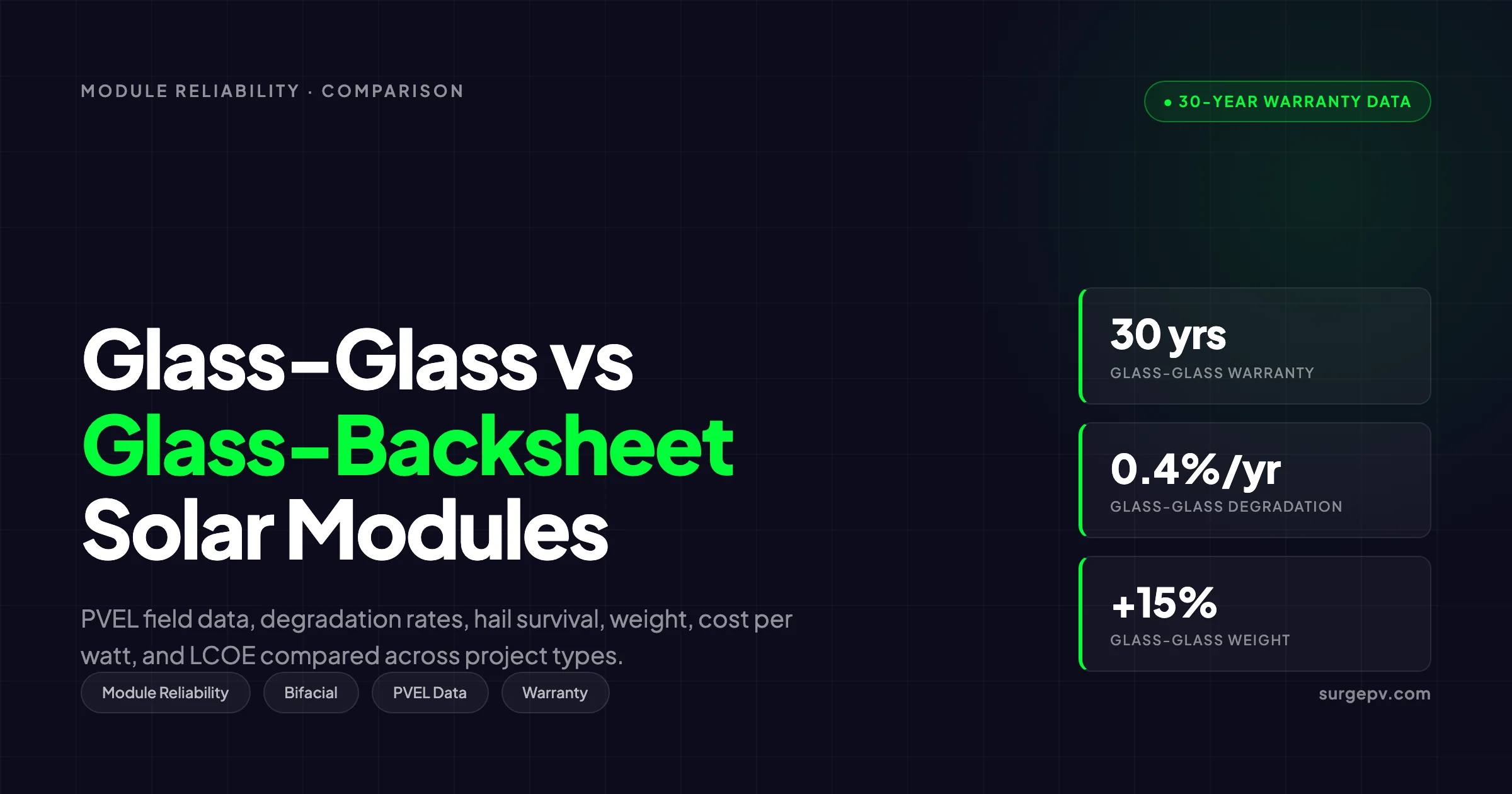
Glass-glass module shipments crossed 40 percent of global solar capacity in 2025 and now sit at roughly 79 percent of bills of materials submitted to Kiwa PVEL for reliability testing. That is not a marketing trend. It is the largest structural shift in module construction in a decade, driven by field failure data, 30-year warranty offers from every major Tier 1 manufacturer, and a TOPCon cell technology that is fundamentally more sensitive to moisture than the PERC cells that preceded it.
(PVEL, 2026) - IEC 61215 update is in late-stage balloting to differentiate hail test severity by glass thickness. The basic difference is one polymer sheet versus one glass sheet on the rear of the module. Front glass — 3.2 mm tempered, anti-reflective coated, low-iron solar glass. 2.
This guide compares glass-glass and glass-backsheet solar modules across every dimension that matters for a 25-to-30-year asset decision: construction, degradation rate, PVEL field failure rates, warranty terms, weight, cost per watt, fire rating, bifacial compatibility, and levelized cost of energy. The verdict is not a clean win for either side. Use the data here, the decision matrix at the bottom, and the solar design platform workflow we describe to pick the right module for your specific project type rather than defaulting to whatever your distributor pushed last quarter. For more on this topic, see Bifacial Solar Panel Design Guide.
TL;DR — The 60-Second Verdict
Glass-glass wins on reliability, warranty length, and bifacial gain. Glass-backsheet wins on weight, cost, and hail survival on thinner-glass designs. For utility-scale and commercial projects with 25 to 30 year horizons, glass-glass is now the default choice and the cost premium of 0.02 to 0.04 dollars per watt is paid back through lower degradation and longer warranties. For residential retrofits on weight-limited roofs and snowy regions, a quality fluoropolymer-backsheet module remains a defensible pick.
What this guide covers:
- The construction difference at the materials-stack level
- 2025 PVEL Module Reliability Scorecard data, glass-glass versus glass-backsheet
- The 30-year warranty shift from Trina, Jinko, LONGi, JA Solar, and Canadian Solar
- Failure modes, including PET, PA, and AAA backsheet cracking and glass-glass edge delamination
- Real cost numbers per watt, weight per square meter, and fire ratings
- Bifacial gain economics and the transparent-backsheet alternative
- 30-year LCOE comparison for a 100 megawatt utility project
- A project-by-project decision matrix and an FAQ that mirrors the schema
Latest Updates: Glass-Glass vs Glass-Backsheet Market Shift 2026
The market has tilted decisively toward glass-glass over the past 36 months, and the gap is still widening as TOPCon cells take share from PERC. Here is the current status as of May 2026.
| Indicator | 2023 | 2025 | 2026 forecast |
|---|---|---|---|
| Share of PVEL-tested BOMs using rear glass | 53% | 79% | 85%+ |
| Share of PVEL-tested BOMs using a backsheet | 47% | 21% | 12 to 15% |
| Tier 1 modules with 30-year linear power warranty | Trina, LONGi only | All major brands | All major brands |
| Median glass-glass thickness (front/rear) | 2.0/2.0 mm | 2.0/2.0 mm | 2.0/2.0 mm with 2.5 mm trend |
| Median price premium, glass-glass over glass-backsheet | 0.04 to 0.06 USD/Wp | 0.02 to 0.04 USD/Wp | 0.01 to 0.03 USD/Wp |
Key changes in the past 12 months:
- Kiwa PVEL 2025 Module Reliability Scorecard (published February 2026) reported that 83 percent of tested manufacturers had at least one failure, up from 66 percent in 2024, with module breakage during mechanical and hail stress the leading mode. (PVEL, 2026)
- IEC 61215 update is in late-stage balloting to differentiate hail test severity by glass thickness. Modules with thicker glass (3.2 mm glass-backsheet, 2.5/2.5 mm glass-glass, or 3.2/2.0 mm glass-glass) will start at 45 mm ice ball diameter rather than 50 mm.
- TOPCon corrosion concerns are pushing more manufacturers to specify POE encapsulant on both sides of the glass-glass laminate, replacing EVA. Hangzhou First and Cybrid have both released TOPCon-specific POE grades in 2025.
- Trina, Jinko, LONGi, JA Solar, and Canadian Solar all now offer 30-year linear power warranties on N-type glass-glass modules as the default product line.
For project owners signing 30-year power purchase agreements, the warranty extension alone is worth modeling. A 30-year linear warranty at 87.4 percent end-of-life power output (typical 2026 spec) is roughly 4 to 6 percent more cumulative kWh than the older 25-year warranty at 84.8 percent.
Pro Tip — Read the Warranty, Not Just the Headline
“30-year warranty” usually means 30-year linear power output. The product warranty (the one that covers workmanship defects, delamination, frame failures, and replacement labor) is often only 12 to 25 years. Always read both terms. Trina and LONGi currently lead on combined terms with 25 plus 30; many cheaper brands offer 12 plus 30, which is much weaker.
The Construction Difference: What Actually Sits Between You and the Cells
The basic difference is one polymer sheet versus one glass sheet on the rear of the module. The downstream consequences ripple through every other design choice.
Glass-Backsheet Construction
A traditional glass-backsheet module has six layers from front to back:
- Front glass — 3.2 mm tempered, anti-reflective coated, low-iron solar glass.
- Front encapsulant — typically ethylene-vinyl acetate (EVA), 0.45 mm thick.
- Cell layer — monocrystalline PERC, TOPCon, or HJT cells, interconnected with copper ribbons.
- Rear encapsulant — usually EVA, sometimes POE on premium SKUs.
- Backsheet — a multi-layer polymer stack. The most common construction is a three-layer “TPT” or PPE design with a polyvinyl fluoride (PVF), polyvinylidene fluoride (PVDF), or polyethylene terephthalate (PET) air-side outer layer, a PET core, and an EVA-compatible inner layer.
- Frame — anodized aluminum, 30 to 35 mm thick, attached with structural butyl adhesive.
The backsheet does three jobs at once: electrical insulation, mechanical protection, and a moisture and ultraviolet (UV) barrier. The problem is that no polymer does all three perfectly for 30 years in the field.
Glass-Glass Construction
A glass-glass module replaces the polymer backsheet with a second sheet of tempered glass. The typical stack is:
- Front glass — 2.0 or 2.5 mm tempered, anti-reflective coated, low-iron glass.
- Front encapsulant — POE preferred, sometimes EVA on cheaper SKUs.
- Cell layer — same as glass-backsheet, usually bifacial-ready.
- Rear encapsulant — POE strongly preferred.
- Rear glass — 2.0 or 2.5 mm tempered, may be patterned or anti-reflective coated.
- Frame — aluminum (30 to 35 mm) or frameless. Bifacial modules use a frame to protect edges during transport.
- Edge seal — butyl tape with desiccant, applied between the two glass sheets before lamination, blocks lateral moisture ingress.
- Junction box — split into two or three sections so the rear glass surface stays clear for bifacial light capture.
The encapsulant choice matters more than people realize. EVA releases acetic acid as it ages, and in a sealed glass-glass package that acid cannot escape, so it accelerates cell corrosion. POE (polyolefin elastomer) does not produce acetic acid by-products, so every credible glass-glass manufacturer uses POE on both sides. Hangzhou First reports that swapping EVA-EVA for POE-POE encapsulation reduces damp-heat power loss after 3000 hours from over 8 percent down to roughly 2 percent on full-size modules.
Materials Stack Side-By-Side
| Layer | Glass-Backsheet | Glass-Glass |
|---|---|---|
| Front cover | 3.2 mm tempered AR glass | 2.0 or 2.5 mm tempered AR glass |
| Front encapsulant | EVA or POE | POE preferred |
| Cells | M10 or G12 mono PERC / TOPCon / HJT | Same |
| Rear encapsulant | EVA or POE | POE |
| Rear cover | Polymer backsheet (PET core, fluoric outer) | 2.0 or 2.5 mm tempered glass |
| Frame | Aluminum, 30 to 35 mm | Aluminum 30 to 35 mm, or frameless |
| Junction box | Standard, single IP68 | Split (2 or 3 section) for bifacial |
| Typical weight | 18 to 25 kg per panel | 22 to 28 kg per panel |
| Bifacial capable | Rarely (needs transparent backsheet) | Yes by default |
| Edge protection | Backsheet wraps the edge | Butyl edge seal between glass sheets |
The construction choice forces every other design decision: whether the module can be bifacial, what encapsulant works, what frame is needed, how much it weighs, and how it should be packaged and shipped.
Why Glass-Glass Modules Last Longer: The Reliability Case
The single biggest reason the market has tilted toward glass-glass is field reliability. Glass is impermeable to moisture and oxygen. Polymer backsheets are not.
PVEL Damp Heat and Thermal Cycling Data
Kiwa PVEL runs the most respected accelerated stress test program in the industry. Two of their headline results from the 2025 Scorecard directly compare glass-glass and glass-backsheet bills of materials:
| PVEL test | Glass-glass result | Glass-backsheet result |
|---|---|---|
| Damp Heat 2000 h, average power loss | -1.0% | -1.9% |
| Damp Heat 2000 h, % of BOMs degrading less than 2% | 85% | 46% |
| Thermal Cycling, % of BOMs degrading less than 2% | 90% | 0% |
| Hail Stress Sequence, 50 mm ice ball breakage rate | 89% | 40% |
| Mechanical Stress, % of BOMs with cell damage | Lower | Higher |
The damp heat and thermal cycling numbers are the headline reliability story. Ninety percent of glass-glass bills of materials survived thermal cycling with less than 2 percent power loss. Zero percent of glass-backsheet bills of materials hit the same bar. That is the difference between a 25-year asset and a 30-year asset.
PVEL has shared a particularly clean case study where the same manufacturer built two modules with identical cells and front encapsulant but different rear constructions. The glass-glass version degraded 1.12 percent in damp heat. The glass-backsheet version degraded 4.95 percent. The only meaningful difference was that the backsheet allowed moisture to enter the laminate and corrode the cell connections.
Backsheet Failure Modes In the Field
The polymer backsheet is the single most common point of failure in modules from 2010 to 2020. A 2024 field survey of 1.9 million modules across 197 installations found that backsheet defects affected 7.6 percent of modules. The failure modes line up by material chemistry:
| Backsheet material | Typical field failure | Time to first visible failure |
|---|---|---|
| AAA (all-polyamide) | Severe cracking, ground fault risk | 3 to 5 years in temperate climates |
| PA/PA/PA (polyamide) | Cracking that penetrates full thickness | 4 to 6 years across all climate zones |
| PET (polyethylene terephthalate) | Yellowing, embrittlement, delamination | 4 to 8 years |
| KPK / TPT (PVF-based) | Mild chalking, no cracking | 15 to 20 plus years |
| KPF / TPF (PVDF-based) | Mild chalking, occasional cracking | 10 to 15 years |
| Transparent backsheet | Yellowing, accelerated encapsulant aging | 5 to 10 years |
The notorious cases are the PA and AAA designs that were sold heavily between 2011 and 2016. One eight megawatt project documented by NREL had 9.4 percent of its PA-backsheet modules showing visible cracks by year five, with associated ground fault claims and module replacement liabilities running into seven figures. The owner’s insurer eventually classified the asset as impaired.
PVDF and PVF-based backsheets perform much better in the field. The problem is that the cheapest backsheets, the ones that drove the 2011 to 2016 failure wave, were PET and PA designs that passed IEC 61215 certification but did not survive real-world UV plus thermal plus humidity exposure. IEC certification has tightened since then, but the legacy of those years still drives owner skepticism toward polymer backsheets generally.
Key Takeaway — IEC Certification Is Necessary, Not Sufficient
Every reliable backsheet that survived the field also passed IEC 61215. Many backsheets that failed catastrophically in the field also passed IEC 61215. Certification proves a module is not obviously broken at time of manufacture. It does not prove the module will last 25 to 30 years. For long-life assets, demand PVEL Top Performer status, 1500 hour damp heat data, and field history of the specific backsheet chemistry, not just the IEC certificate.
Glass Is Impermeable. Polymers Are Not.
Beyond the field data, the underlying physics favor glass-glass:
- Moisture barrier. Glass water vapor transmission rate is effectively zero. Even the best PVDF backsheet has a water vapor transmission rate around 1 to 2 g per square meter per day. Over 30 years that means orders of magnitude more moisture reaches the cells in a glass-backsheet module than a glass-glass.
- UV stability. Glass blocks UV-B and UV-C entirely and degrades imperceptibly over 30 years. Even fluoropolymer backsheets yellow measurably in five to ten years; PET-based backsheets yellow much faster.
- Mechanical rigidity. A glass-glass laminate has higher flexural stiffness than a glass-backsheet sandwich, so cells experience smaller microcrack-inducing strains during thermal cycling and snow load events.
- Fire performance. Two layers of tempered glass produce a Class A spread-of-flame rating without additional fire-rated backsheet construction. Glass-backsheet ratings depend on the specific backsheet chemistry and frame design and may be Class B or Class C.
The conclusion most utility-scale developers have drawn is straightforward: if you can afford the 0.02 to 0.04 dollar per watt premium, glass-glass is the safer 30-year asset. The data backs them up.
Design and Simulate Glass-Glass vs Glass-Backsheet Projects in SurgePV
SurgePV models bifacial gain, weight loading, mismatch losses, and 30-year energy output for both module types side by side. Run a free pilot on your next commercial project and see which module wins on LCOE before you commit to a procurement.
Book a DemoNo commitment required · 20 minutes · Live project walkthrough
Why Glass-Backsheet Isn’t Dead Yet — and Where It Still Wins
The market narrative around glass-glass is so strong that you would think every glass-backsheet module ships into a graveyard. That is not what the data says. Roughly 21 percent of 2025 PVEL bills of materials still use a backsheet, and the residential rooftop market in particular still leans on glass-backsheet. There are real reasons.
Weight Per Square Meter
Glass-glass modules are 15 to 25 percent heavier than equivalent glass-backsheet. For a typical 600 W bifacial panel at 2.5 m by 1.1 m, the comparison is: Read more about Agricultural Solar Case Study. For France-specific information, see Floating Solar Farms France.
| Spec | Glass-backsheet 600 W | Glass-glass 600 W |
|---|---|---|
| Front glass thickness | 3.2 mm | 2.0 mm |
| Rear cover | 0.35 mm polymer backsheet | 2.0 mm glass |
| Weight per panel | 22 to 24 kg | 28 to 32 kg |
| Weight per square meter | 12.5 kg per m² | 15.5 to 18 kg per m² |
For a residential roof with 5.5 kPa wind plus snow capacity and existing dead load already absorbing tile or shingle weight, the extra 3 to 5 kg per square meter of glass-glass can push the structure past its design margin. The marginal cost of a structural reinforcement on an existing roof routinely exceeds the saving on module degradation over 25 years.
Cost Per Watt
The glass-glass premium has narrowed dramatically since 2022 but it has not closed entirely. As of Q2 2026, typical Tier 1 DDP prices in major markets are:
| Module type | 2024 average price | 2026 average price |
|---|---|---|
| Glass-backsheet TOPCon, 575-590 W | 0.13 to 0.18 USD/Wp | 0.10 to 0.13 USD/Wp |
| Glass-glass TOPCon, 580-600 W | 0.16 to 0.22 USD/Wp | 0.12 to 0.16 USD/Wp |
| Price delta, glass-glass premium | 0.03 to 0.04 USD/Wp | 0.02 to 0.03 USD/Wp |
For a 10 kW residential system the price delta is roughly 200 to 300 USD on a system that costs 12,000 to 18,000 USD installed. That is small enough that almost every project should default to glass-glass. For a 100 megawatt utility project the price delta is 2 to 3 million USD, which is a real number that needs to be modeled against the lifetime gain.
Hail Survival on Thicker Glass
This is the surprise finding from PVEL’s 2025 Scorecard. Modern dual-glass modules typically use 2.0 mm glass on both faces to keep weight manageable. That thinner glass breaks more easily under hail. Specifically:
| Hail diameter | Glass-glass breakage (2.0 mm) | Glass-backsheet breakage (3.2 mm front) |
|---|---|---|
| 25 mm | 0% | 0% |
| 35 mm | 5% | 0% |
| 45 mm | 30 to 50% | 5 to 10% |
| 50 mm | 89% | 40% |
| 55 mm | 95%+ | 80%+ |
In hail-prone geographies (the US Great Plains, parts of South Africa, Australia, and Argentina), a 3.2 mm front glass on a glass-backsheet module is genuinely more robust than 2.0 mm on a glass-glass. The fix is to specify 2.5 mm or 3.2 mm front glass on the glass-glass design, but those modules weigh more (back to the weight problem) and cost more (back to the cost problem). For utility-scale projects in hail country, this is now driving heated procurement debates. For Africa-specific compliance details, see Africa solar compliance. For Australia-specific compliance details, see Australia comparisons/lgc-vs-stc.
Easier to Handle
Glass-backsheet modules are less brittle at the edge. A small chip in the corner of a 3.2 mm front glass plus 0.35 mm polymer backsheet is usually a cosmetic concern. The same chip in a 2.0 mm dual glass laminate can crack through the entire thickness during transport. Installers who handle hundreds of modules a month know which design forgives mistakes.
When Glass-Backsheet Still Wins on Spec Sheet
A high-quality fluoropolymer-backsheet module from a Tier 1 manufacturer remains a defensible choice for:
- Residential retrofits on weight-limited roofs
- Hot, humid climates where hail is rare but cyclones are common (the lighter module reduces uplift forces)
- High-snow regions where shoveling and handling matter
- Carport canopies where the rear glass would face a parking lot rather than a reflective surface (no bifacial gain to capture)
- Tight-budget DG projects where the 0.02 USD per watt saving makes a material LCOE difference
Pro Tip — Specify the Backsheet Chemistry
If you go glass-backsheet, demand a fluoropolymer-based design (KPK with PVF, or KPF with PVDF outer layer). Do not accept a generic PET or PA backsheet at any price. The 2011 to 2016 failure wave was almost entirely PA and PET chemistries. Modern PVF and PVDF designs are field-proven for 25 plus years.
Bifacial Gain: The Reason Glass-Glass Dominates Utility Scale
The single biggest reason glass-glass swept the utility-scale market between 2020 and 2025 was bifacial gain. A bifacial module captures light on both faces. The front face captures direct and diffuse irradiance the way a monofacial module does. The rear face captures ground-reflected light, which is sometimes called albedo light.
A monofacial module needs only a front glass and an opaque backsheet. A bifacial module needs a transparent rear, which means either a transparent backsheet or a second sheet of glass. Glass-glass is the dominant industrial solution because it is more reliable than transparent backsheet (which has its own UV degradation problems) and the cost penalty is small.
Typical rear-side energy gain by ground cover ranges from 5 percent over dark asphalt to 25 percent or more over fresh snow or painted white concrete. The PVEL 2025 Scorecard’s BOMs averaged 8 to 12 percent annual bifacial gain on standard ground cover. For a 100 megawatt project that is 8 to 12 megawatt-hours of free additional production per kilowatt-peak per year.
When Bifacial Gain Justifies the Glass-Glass Premium
The break-even is project-specific, but a rough rule of thumb for a 30-year ownership horizon is:
| Albedo (ground reflectivity) | Bifacial gain | Glass-glass payback vs glass-backsheet |
|---|---|---|
| 0.10 (dark asphalt, dark grass) | 3 to 5% | 6 to 8 years |
| 0.20 (typical bare soil) | 6 to 9% | 3 to 5 years |
| 0.30 (light gravel, dry sand) | 9 to 13% | 2 to 3 years |
| 0.50 (white concrete, painted surface) | 14 to 18% | 12 to 18 months |
| 0.80 (fresh snow seasonal) | 20 to 25%+ | Immediate, every year |
Above a 0.20 albedo, bifacial gain alone justifies the glass-glass premium even before warranty length is considered. Below 0.10 (most urban rooftops), the bifacial argument is weaker and the choice falls back to reliability and warranty considerations.
For accurate project-specific bifacial modeling and energy estimation, use a solar design software that supports view-factor or ray-tracing bifacial calculations rather than fixed-gain assumptions. The energy and financial modeling tool inside SurgePV handles bifacial gain, ground cover ratio, row spacing, and 30-year degradation in a single workflow. For a direct comparison, see Arka 360 vs SurgePV.
Warranty Terms: The 30-Year Shift
For 25 years the standard solar warranty was a two-part deal: a 10 or 12 year product (workmanship) warranty plus a 25 year linear power output warranty. That structure is now obsolete on Tier 1 glass-glass lines. The 2024 to 2026 transition has been clean.
| Manufacturer | Module line | Product warranty | Power output warranty |
|---|---|---|---|
| Trina Solar | Vertex N glass-glass | 25 years | 30 years linear |
| Jinko Solar | Tiger Neo N-Type glass-glass | 15 to 20 years | 30 years linear |
| LONGi | Hi-MO 9 / Hi-MO X10 glass-glass | 25 years | 30 years linear |
| JA Solar | DeepBlue 4.0 Pro glass-glass | 15 years | 30 years linear |
| Canadian Solar | TOPHiKu glass-glass | 15 years | 30 years linear |
| Risen Energy | Hyper-ion HJT glass-glass | 15 to 25 years | 30 years linear |
| Most Tier 1 glass-backsheet | Various | 12 to 15 years | 25 years linear |
A 30-year linear warranty typically guarantees roughly:
- Year 1 degradation no more than 1.0%
- Annual degradation no more than 0.4% to 0.5%
- End-of-warranty (year 30) output of 87 to 88% of nameplate
A 25-year linear warranty on a glass-backsheet module typically guarantees:
- Year 1 degradation no more than 2.0%
- Annual degradation no more than 0.55% to 0.7%
- End-of-warranty (year 25) output of 83 to 85% of nameplate
For a 1 megawatt asset producing 1500 MWh in year 1, the cumulative energy difference between a 30-year glass-glass warranty and a 25-year glass-backsheet warranty over 30 years is approximately 4500 to 6500 MWh, depending on degradation and contract terms. At a 60 USD per MWh wholesale price, that is 270,000 to 390,000 USD per megawatt over the asset life.
Key Takeaway — Warranty Length Is Now a Procurement Filter
For project finance and corporate PPA buyers, a 30-year asset life is the baseline assumption. Modules with a 25-year warranty force the owner to self-insure the final 5 years. That insurance cost, or the perceived risk premium, increasingly rules out 25-year-warranty modules on bankable projects. The glass-glass shift is being driven as much by financiers as by engineers.
Failure Modes: How Glass-Glass and Glass-Backsheet Actually Die
Both module types have well-documented failure modes. Knowing them changes how you specify the design.
Glass-Backsheet Failure Modes
- Backsheet cracking. PA, AAA, and some PET designs crack through their full thickness within 3 to 8 years in the field, creating ground fault and arc fault risks. Visible signs include chalking (a white powder on the rear surface) followed by visible cracks.
- Backsheet yellowing and embrittlement. PET and some thermoplastic backsheets yellow under UV exposure, reduce in tensile strength, and lose their hydrolysis resistance.
- Snail trails. Dark trails that appear on the front of the module along microcracks in the cells. The chemistry involves the silver paste reacting with acetic acid that has diffused through the backsheet, so the trails are typically visible from the front side.
- Delamination. EVA encapsulant separating from glass or backsheet, accelerated by heat plus humidity plus UV. Once delamination starts it generally accelerates.
- Potential-induced degradation (PID). Voltage stress on the front cell surface drives sodium ions from the glass into the cell, reducing efficiency by 5 to 30 percent. Worse on standard EVA encapsulant than POE.
Glass-Glass Failure Modes
- Edge delamination. Moisture enters at the edge of the module if the butyl edge seal is poorly applied or if the encapsulant retreats from the edge during lamination (“pinch-out”). Once moisture is inside the laminate, corrosion of cell metallization follows.
- Acetic acid corrosion when EVA is used. The reason every quality glass-glass uses POE: trapped acetic acid attacks silver gridlines from inside the laminate.
- Glass breakage during transport, installation, or hail. The 2.0 mm dual-glass design is more fragile than a 3.2 mm front glass, especially at the corners. Visible spider-web cracks across the front or rear.
- Cell corrosion in TOPCon modules if moisture reaches the cell perimeter. TOPCon and HJT cells are more sensitive to moisture than PERC because of their finer metallization.
- PID can still happen but the higher resistivity POE encapsulant in good glass-glass designs significantly reduces the risk relative to EVA-based modules.
The pattern is clear. Glass-glass failures concentrate around the edge of the module and around mechanical breakage of thin glass. Glass-backsheet failures are dominated by the rear polymer surface degrading over time. The first is largely a design and installation problem (and is solvable with thicker glass and better edge sealing). The second is a fundamental material limitation.
Fire Rating, Hail Rating, and Other Code Issues
Module classifications under UL 1703, UL 61730, and IEC 61730 matter for permitting in most markets. Glass-glass and glass-backsheet differ on several:
| Rating | Glass-glass typical | Glass-backsheet typical |
|---|---|---|
| Fire spread-of-flame class | Class A | Class A, B, or C depending on backsheet |
| Burning brand classification | Type 1 (highest) | Type 1 to 3 |
| Hail impact, IEC 61215 | Pass at 25 mm; updated standard adds severity by glass thickness | Pass at 25 mm; usually passes at 35 mm |
| Static mechanical load front | 5400 to 7000 Pa | 5400 to 8400 Pa |
| Static mechanical load rear | 2400 to 3600 Pa | 2400 to 5400 Pa |
| PID resistance | Excellent with POE | Variable, depends on encapsulant |
| Fire resistance for BIPV | Often qualifies as Class A roof covering | Rarely qualifies |
Two implications:
- Fire-rated rooftop systems (especially commercial and BIPV installations under strict building codes) almost always specify glass-glass because the Class A spread-of-flame is automatic.
- High mechanical load environments (deep snow, heavy roof maintenance traffic) may favor glass-backsheet with 3.2 mm front glass for higher rear load capacity, unless the glass-glass design uses 2.5 mm both sides.
For project teams using solar design platform like SurgePV, the structural and code constraints can be modeled together with energy output, so the right module is selected before procurement rather than after.
30-Year LCOE Comparison: A 100 MW Project Worked Example
Here is a representative levelized cost of energy comparison for a 100 megawatt-DC utility solar farm in a moderate-irradiance European or North American site. Assumptions: Also see: European Solar Incentives. Read more about France Solar Feed-in Tariffs.
- Specific yield year 1: 1500 kWh/kWp for monofacial, 1620 kWh/kWp for bifacial (8 percent gain)
- Discount rate: 6.5 percent real
- Operations and maintenance: 8 USD per kW per year
- Inverter replacement at year 15: 25 USD per kW
- Power purchase agreement: 30 years for glass-glass, 25 plus 5 year merchant tail for glass-backsheet
- Land lease and other fixed costs identical
| Cost line | Glass-backsheet 580 W | Glass-glass 600 W bifacial |
|---|---|---|
| Module CapEx (USD per Wp) | 0.115 | 0.135 |
| Total module cost (100 MW) | 11.5 MUSD | 13.5 MUSD |
| Balance of system (USD per Wp) | 0.40 | 0.40 |
| Year 1 energy (MWh) | 150,000 | 162,000 |
| Annual degradation | 0.55% | 0.40% |
| Year 30 output (vs year 1) | 84.5% | 87.8% |
| 30-year cumulative MWh | 4,160,000 | 4,580,000 |
| Implied LCOE (USD per MWh) | 38.2 | 36.5 |
In this representative case the glass-glass design beats glass-backsheet on LCOE by roughly 1.7 USD per MWh, or about 4.5 percent. The advantage is driven by three things in roughly equal proportion: bifacial gain, lower degradation, and the longer warranty horizon supporting a 30-year contracted PPA. The module CapEx premium (~17 percent at the module level, ~5 percent at the project level) is more than offset.
The crossover changes for different project conditions:
- Low albedo rooftop, no bifacial gain: glass-backsheet wins by 1 to 3 percent LCOE.
- Snow region with high albedo: glass-glass wins by 6 to 10 percent LCOE.
- Hot, humid climate (Southeast Asia, Florida): glass-glass wins by 4 to 6 percent on lower humidity-driven degradation.
- Hail-prone region with marginal hail spec: glass-backsheet with 3.2 mm glass wins on insurance cost.
This is exactly the kind of trade-off generation and financial tool modeling is built to resolve. Plug your specific assumptions in rather than relying on a generic verdict.
Transparent Backsheet: A Real but Niche Alternative
A small but persistent share of bifacial modules use a transparent polymer backsheet rather than a second glass sheet. The idea is to keep the weight and handling characteristics of a glass-backsheet design while still enabling rear-side light capture.
| Attribute | Transparent backsheet bifacial | Glass-glass bifacial |
|---|---|---|
| Rear material | Clear PVDF or fluoropolymer film | 2.0 mm tempered glass |
| Weight per square meter | Roughly 13 kg | Roughly 16 to 18 kg |
| Cost per watt | Typically 0.005 to 0.015 USD/Wp lower | Baseline |
| Bifacial gain | Slightly lower (90 to 95 percent rear transmittance) | Higher (95 percent rear transmittance) |
| Long-term reliability | Yellowing concerns, accelerated EVA degradation | Best in class |
| Market share, 2025 | Roughly 5 percent of bifacial | Roughly 95 percent of bifacial |
The technology works but field data is now showing transparent backsheets yellowing faster than expected, especially in high-UV climates, which accelerates EVA degradation in the rear encapsulant. Most utility-scale bifacial procurement teams have moved away from transparent backsheet for that reason. Niche applications (extremely weight-constrained rooftops where bifacial gain is still desired) remain.
Project-Type Decision Matrix
Use this matrix to short-list the right module type for your project before running detailed LCOE in your design software. The recommendations assume a credible Tier 1 brand and proper installation.
| Project type | Default recommendation | Why |
|---|---|---|
| Utility-scale ground mount, 30-year PPA | Glass-glass bifacial 2.0/2.0 mm | Bifacial gain plus 30-year warranty plus lower degradation |
| Utility-scale ground mount in hail belt | Glass-glass 2.5/2.5 mm OR 3.2 mm glass-backsheet | Hail risk dominates over bifacial gain |
| Commercial flat roof, ballasted | Glass-glass bifacial framed | Albedo of white membrane gives 8 to 14% gain |
| Commercial pitched roof (warehouse, factory) | Glass-glass monofacial | Reliability and 30-year warranty |
| Residential rooftop, weight-unconstrained | Glass-glass | Reliability, fire rating, aesthetics |
| Residential rooftop, weight-constrained | Glass-backsheet (PVDF) | Weight margin and slightly lower cost |
| Residential retrofit on 40+ year old roof | Glass-backsheet (PVDF) | Mass loading risk |
| Carport canopy over parking | Glass-glass bifacial | Bifacial gain off light surface, visual appeal |
| Floating PV | Glass-glass with frame | Humid environment, reliability critical |
| Agri-PV with vertical mounting | Glass-glass bifacial | Bifacial gain captured from both sides daily |
| BIPV facade or skylight | Glass-glass frameless | Fire rating and aesthetic |
| Off-grid remote installation | Glass-backsheet (PVDF) | Weight and transport considerations |
| Cyclone or hurricane region | Glass-backsheet OR 2.5 mm glass-glass | Reduce uplift weight, retain rigidity |
Real-World Examples and Lessons Learned
Failure case: 8 MW Spanish project, 2014 to 2019. A southern Spain ground mount built with PA-backsheet 290 W modules began showing backsheet chalking by year three and visible cracking by year five. By year seven, 11 percent of modules required replacement and the asset manager filed a 4 million euro insurance claim. The PVEL 2018 Scorecard had already flagged the specific backsheet chemistry as high risk. The lesson: PVEL field data was available in time; nobody checked it during procurement. Also see: Spain net metering. Read Ground Mounted Solar Design Guide for a complete walkthrough.
Success case: 150 MW Texas project, 2021 to 2026. A West Texas utility solar farm specified Trina Vertex S glass-glass bifacial modules on tracker, with 0.25 albedo over light tan soil. Actual measured first-year energy was 1840 kWh/kWp, 9 percent above the equivalent monofacial spec. After five years, degradation has averaged 0.41 percent per year, consistent with the 30-year warranty linear curve. The project’s contracted PPA runs for 25 years, with merchant tail covered confidently by the 30-year power output warranty.
Mixed case: California residential retrofit, 2023. A 14 kW residential system on a 1978 wood-framed roof was originally specified with 22 kg glass-glass modules. Structural review found the roof’s existing dead load plus snow load plus glass-glass weight exceeded the design margin by 8 percent. The installer pivoted to a lighter glass-backsheet module with PVDF chemistry. Cost saving was 280 USD; reinforcement avoidance saved 4500 USD. The owner accepted the slightly lower expected lifetime energy on the trade.
These cases pattern-match to the decision matrix: utility-scale with long PPAs strongly favors glass-glass, weight-constrained residential retrofits still favor good glass-backsheet, and the project-level engineering review must be honest about structural and hail constraints before the module decision is finalized.
Pro Tip — Pull PVEL Top Performer Data for Every BOM
The Kiwa PVEL Top Performer list is the single best free reliability filter. The 2025 Scorecard includes the specific cell technology, glass type, encapsulant chemistry, and backsheet (or rear glass) for every awarded BOM. Cross-reference your supplier’s exact part number against the BOM list. If the BOM is not on the Top Performer list, ask why. If the supplier cannot point you to PVEL Top Performer data for the exact part number, treat that as a procurement red flag.
How Glass-Glass and Glass-Backsheet Affect Solar Design Software Choices
The two module types put different demands on solar design and yield modeling software. Designers using cloud solar design tool and a solar proposal tools workflow need to handle several distinctions:
- Bifacial gain calculation. Glass-glass bifacial modules need view-factor or ray-tracing bifacial yield models, not simple fixed-gain assumptions. Row spacing, ground cover ratio, and tracker angle all interact.
- Weight loading. Structural feasibility checks must use module-specific weight in kg per square meter. Glass-glass at 16 to 18 kg per m² versus glass-backsheet at 12 to 13 kg per m² can swing the verdict on retrofit feasibility.
- Degradation curves. Long-term energy modeling must use the warranty-specific degradation curve, not a generic 0.5 percent assumption. Glass-glass 30-year warranty modules degrade slower than glass-backsheet 25-year warranty modules.
- Shading and microcrack risk. Glass-glass modules tolerate higher local stresses (less microcrack propagation), so partial-shading-related degradation is slightly lower. For projects with edge shading, this matters in yield models.
- Financial modeling horizon. PPAs and corporate financing on 30-year glass-glass assets versus 25-year glass-backsheet assets change the project IRR by 1 to 3 percentage points typically.
Run both options in the same generation and financial tool on the same site conditions, and let the LCOE comparison drive the decision. For shading-sensitive sites, pair the yield model with solar shadow analysis software to make sure the module choice does not interact badly with the as-built shading profile.
Conclusion: What to Specify in 2026
Three concrete action items for project teams choosing between glass-glass and glass-backsheet:
- Default to glass-glass for any project with a 25-plus year contracted revenue stream. The combination of 30-year warranty, lower degradation, bifacial gain, and improved field reliability now outweighs the 0.02 to 0.04 USD per watt premium on every LCOE model except specific edge cases.
- Specify glass-backsheet (PVDF chemistry only) for residential retrofits on weight-constrained roofs, hail-belt projects without bifacial gain potential, and tight-budget DG projects where the 0.02 USD per watt saving is material. Demand PVEL field data for the specific backsheet chemistry. Refuse PA, AAA, and unmarked PET backsheets at any price.
- Model both options in SurgePV’s design suite before committing. Bifacial gain, degradation, weight loading, and warranty-driven financing terms all flow into LCOE differently for each module type. A generic preference is not a substitute for project-specific modeling.
Glass-glass is the future of solar module construction. Glass-backsheet is not dead, but its market share will keep falling through 2030 as TOPCon and HJT cells dominate and 30-year warranties become the procurement baseline. Make the call deliberately for each project rather than by habit.
Frequently Asked Questions
What is the main difference between glass-glass and glass-backsheet solar modules?
A glass-backsheet module uses a single sheet of tempered glass on the front and a multi-layer polymer backsheet on the rear. A glass-glass module sandwiches the cells between two sheets of tempered glass. The construction difference drives huge gaps in moisture ingress, degradation rate, fire rating, and the maximum credible warranty term that a manufacturer can offer.
Are glass-glass solar panels really worth the extra cost in 2026?
For utility-scale and commercial projects with a 25 to 30 year ownership horizon, yes. The PVEL Module Reliability Scorecard shows glass-glass modules degrading 0.4 to 0.5 percent per year versus 0.5 to 0.9 percent for glass-backsheet. Over 30 years that gap adds up to 6 to 12 percent more lifetime kilowatt-hours, which usually beats the 0.02 to 0.04 dollars per watt price premium on LCOE.
Why do glass-glass modules get a 30-year warranty when glass-backsheet only get 25?
Glass is impermeable to moisture and ultraviolet light. A glass rear sheet does not yellow, crack, or chalk the way polymer backsheets do. Trina, Jinko Solar, and LONGi all introduced 30-year product and 30-year linear power warranties for their N-type TOPCon glass-glass modules in 2024 and 2025, while keeping glass-backsheet products at the older 25-year terms.
Is glass-backsheet solar dead in 2026?
No. About 21 percent of bills of materials tested by PVEL in 2025 still used a backsheet, and certain segments stay loyal to it. Residential retrofits on weight-limited roofs, snowy regions where the lighter module helps installers, and tight-budget distributed generation projects still favor a quality fluoropolymer-backsheet design. The market share gap is widening, but it is not zero.
Do glass-glass modules break more easily during shipping and installation?
Yes, this is the genuine trade-off. PVEL’s 2025 scorecard found that 50 millimeter hail tests broke 89 percent of glass-glass modules versus 40 percent of glass-backsheet, mainly because dual-glass designs typically use thinner 2.0 millimeter glass on both sides. Better packaging, framed rather than frameless designs, and 2.5 millimeter glass options narrow the gap, but installers still need to handle them with more care.
Which solar manufacturers offer the best glass-glass module warranties right now?
Trina Solar Vertex N, Jinko Solar Tiger Neo, LONGi Hi-MO 9, JA Solar DeepBlue 4.0 Pro, and Canadian Solar TOPHiKu all advertise 30-year linear power warranties on their N-type glass-glass lines as of 2026. The product warranty (workmanship) ranges from 15 to 25 years depending on tier, with Trina and LONGi currently leading on combined terms.
Can I retrofit a glass-glass module to a roof designed for glass-backsheet panels?
Sometimes. Glass-glass modules weigh 15 to 25 percent more per square meter, and the extra load can exceed the roof structure’s design margin. A structural engineer needs to verify the dead load capacity. For most pitched residential roofs built after 2010, the answer is yes. For older roofs, lightweight commercial decks, and retrofits with a marginal structural margin, glass-backsheet is the safer choice.
How does bifacial gain change the glass-glass payback period?
Bifacial gain compresses the payback dramatically. Over dark ground (0.10 albedo) glass-glass payback against glass-backsheet is 6 to 8 years. Over light ground (0.30 albedo) it drops to 2 to 3 years. Over snow (0.80 seasonal albedo) the bifacial gain alone justifies the glass-glass premium in the first season. Run the solar financial modeling on your specific ground cover ratio and site albedo to get a project-specific number.
Should I worry about edge delamination on glass-glass modules?
Only if the manufacturer skipped the edge seal or used EVA encapsulant. Quality glass-glass modules use a butyl edge seal with desiccant plus POE encapsulant on both sides, which blocks horizontal moisture ingress for the warranty period. Ask your supplier for the edge sealing specification and confirm POE (not EVA) is used in both encapsulant layers. If the answer is unclear, treat that as a procurement red flag.
Are glass-glass modules safer in a fire?
Generally, yes. Two layers of tempered glass produce a Class A spread-of-flame rating in most module configurations. Polymer-backsheet modules can be Class A, B, or C depending on the specific backsheet chemistry. For commercial rooftops in high-density building codes, BIPV applications, and projects under strict fire-protection requirements, glass-glass is often the safer choice for permitting and insurance.
Further reading on related SurgePV blog posts:
- Bifacial Solar Panels: Complete Guide to Gain and Project Economics
- Solar Panel Degradation Rates by Manufacturer: 2026 Data
- TOPCon vs HJT vs PERC: The 2026 Cell Technology Decision
- How to Read a Solar Module Datasheet Like an Engineer
- Solar Module Warranty Comparison: What to Look For in 2026
External references and data sources:
- Kiwa PVEL 2025 Module Reliability Scorecard
- NREL technical report on backsheet degradation (TP-5K00-85530, 2024)
- IEC 61215 and IEC 61730 module qualification standards
- Hangzhou First Materials, TOPCon Encapsulant Reliability White Paper, 2025
- DuPont Photovoltaic Solutions field failure case studies
- Fraunhofer ISE Photovoltaics Report, 2025 edition
- IEA PVPS Task 13 module field failure reports
Where this fits
This article is part of SurgePV's Solar Technology hub, which works through the topic from first principles to the decisions a project team actually has to make.
