

A 500 kW commercial rooftop array in San Diego that exports 35 percent of its annual production lost $42,000 in lifecycle revenue when its owner refused to add storage in 2025. The same array next door, with a 250 kW / 500 kWh battery dispatching against tariff windows and demand charges, generated $68,000 of additional annual value. The hardware cost difference was $185,000. The 10-year NPV gap was over $440,000. Behind-the-meter optimization is no longer a sizing question. It is a value-stacking strategy that separates installers winning C&I deals in 2026 from those quoting on price alone.
Quick Answer
Behind-the-meter (BTM) solar optimization is the practice of designing C&I solar to maximize retail-rate offset and stack additional revenue streams from demand charges, time-of-use arbitrage, demand response, and frequency response. Because BTM kWh displaces $0.12 to $0.30 retail purchases versus $0.03 to $0.08 wholesale or FIT compensation, every percentage point of self-consumption gain compounds across the asset’s 25-year life.
TL;DR — BTM Value Stacking in 2026
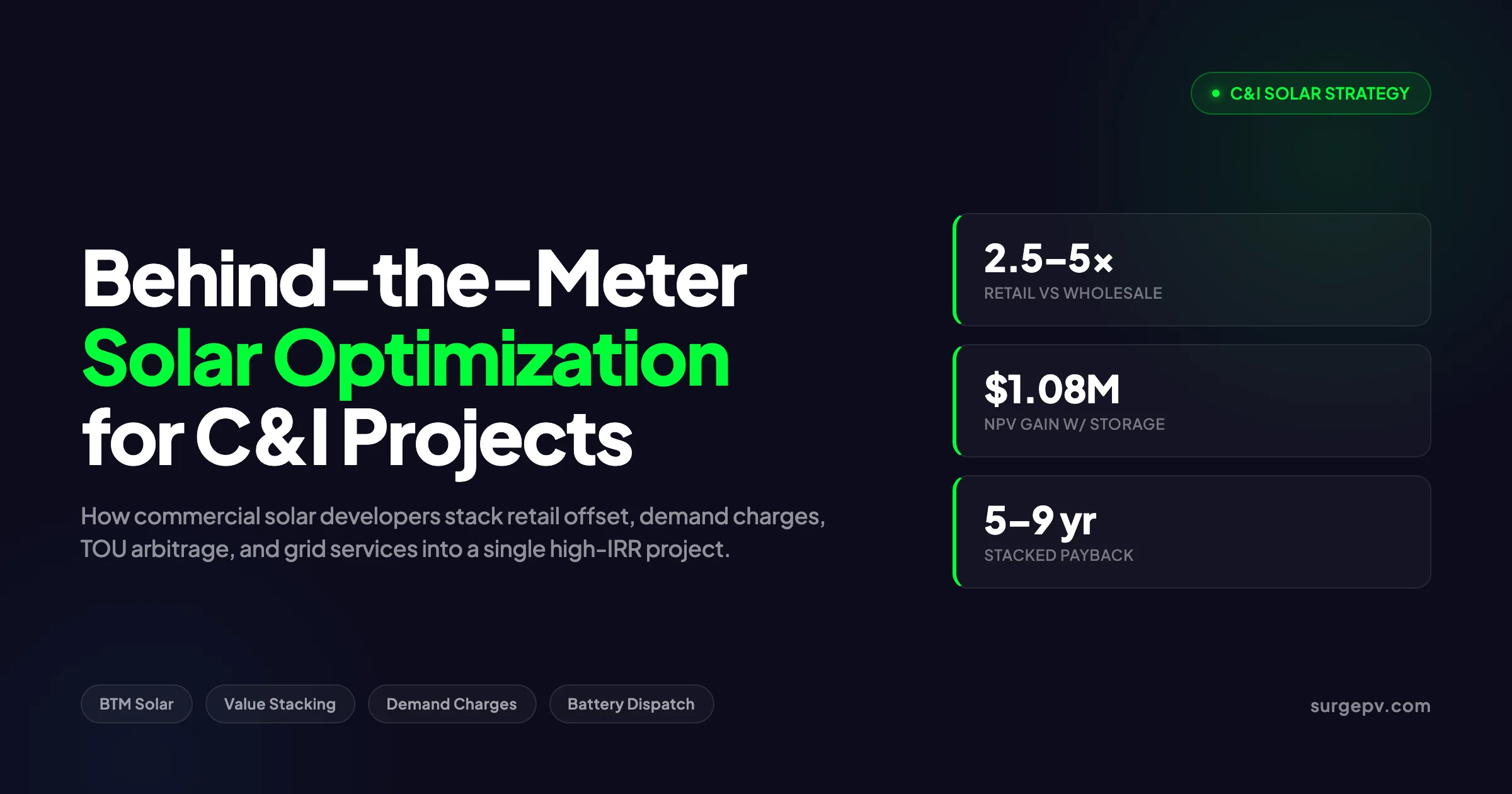
U.S. commercial retail rates averaged $0.1234 per kWh in early 2026, according to the EIA, while wholesale solar PPAs cleared at $0.045 to $0.072 per kWh in Wood Mackenzie’s Q1 2026 tracker. That 2.5x to 5x spread is the entire economic case for BTM. Layered with demand charge shaving, TOU arbitrage, and grid services revenue, BTM-plus-storage projects now achieve 5 to 9 year paybacks even with NEM 3.0 export penalties.
In this guide:
- What BTM means versus FTM and why the retail rate gap matters
- The four optimization tactics that lift self-consumption from 60 to 90 percent
- Battery dispatch logic for stacking demand charges, arbitrage, and DR
- BTM revenue streams: demand response, frequency response, and capacity payments
- Regulatory exposure including NEM 3.0, interconnection limits, and net billing
- A worked NPV example: BTM-only versus BTM-plus-grid-services for a 500 kW project
What Behind-the-Meter Means and Why the Distinction Drives Returns
Behind-the-meter (BTM) means a solar system sits on the customer’s side of the utility revenue meter. Every kWh the array produces first offsets on-site load and only flows back to the grid as surplus. In-front-of-meter (FTM) systems sit on the utility side and sell every kWh into wholesale, capacity, or PPA markets. The location of the meter changes the entire revenue model.
The economic difference is brutal. U.S. residential and small commercial retail electricity rates averaged $0.1672 and $0.1234 per kWh respectively in early 2026, according to EIA Monthly Electric Power data. Wholesale PPA prices for utility-scale solar cleared at $0.045 to $0.072 per kWh in Q1 2026, according to Wood Mackenzie. Feed-in tariffs in mature export markets like Australia and Spain sit at $0.03 to $0.08 per kWh against $0.20+ retail rates. Also see: Spain net metering.
That spread is the entire game. A C&I BTM kWh consumed on-site is worth 2.5 to 5 times more than the same kWh exported. Optimization tactics that lift self-consumption from 65 to 85 percent are not incremental improvements. They are 20-point gains on the most valuable kWh in the project.
In Simple Terms
Think of BTM solar like growing food in your own garden. The lettuce you eat at home replaces a $4 retail head from the grocery store. The lettuce you sell to a wholesaler earns 60 cents per head. The plant is identical. The economics depend entirely on where it lands.
The Retail-Wholesale Spread by Market
Retail rates carry every layer of the utility cost stack: generation, transmission, distribution, taxes, public benefit charges, and demand fees. Wholesale prices include only generation and capacity. BTM solar avoids all those layered costs by displacing the retail purchase entirely.
| Market | Avg C&I Retail Rate | Wholesale Solar PPA | Spread |
|---|---|---|---|
| California (CAISO) | $0.24/kWh | $0.058/kWh | 4.1x |
| New York (NYISO) | $0.18/kWh | $0.061/kWh | 2.9x |
| Massachusetts (ISO-NE) | $0.21/kWh | $0.072/kWh | 2.9x |
| Texas (ERCOT) | $0.09/kWh | $0.045/kWh | 2.0x |
| Florida | $0.11/kWh | $0.052/kWh | 2.1x |
| Germany (national) | €0.20/kWh | €0.065/kWh | 3.1x |
| Australia (NEM) | A$0.28/kWh | A$0.07/kWh | 4.0x |
Source: EIA, Wood Mackenzie, BNetzA, AEMO Q1 2026 tracker data.
The spread varies by territory but never collapses below 2x. Even Texas, with the cheapest retail rates in the U.S., still pays back BTM displacement at twice the FTM wholesale rate. EPCs who model only generation and ignore on-site offset value miss the bigger half of project NPV.
Pro Tip
Always model two cases in the proposal. Case A: PV produces and exports under net billing. Case B: PV produces and self-consumes against the retail rate. Show the dollar gap between the two as the “BTM premium.” That number is usually $40,000 to $200,000 per MW of installed capacity over 10 years.
Why FTM Compensation Keeps Falling
Wholesale solar prices have a structural ceiling and a falling floor. Midday solar saturation in California, Spain, and Australia now drives wholesale prices to zero or negative for 3 to 6 hours daily, according to IEA Renewables 2024. CAISO recorded over 1,200 hours of negative wholesale prices in 2025. Australia’s NEM saw similar patterns across the spring shoulder months. For Australia-specific compliance details, see Australia comparisons/lgc-vs-stc.
Retail rates do not fall when wholesale falls. They rise. U.S. residential rates increased 4.3 percent year over year in 2025, per EIA data, while wholesale clearing prices for midday solar dropped 18 percent. The retail-wholesale spread is widening, not narrowing. BTM optimization is the only solar value strategy compounding upward in 2026.
Where In-Front-of-Meter Still Wins
FTM is the correct architecture for utility-scale projects above roughly 5 MW, sites with no host load, virtual PPAs, and merchant solar with battery arbitrage. Community solar projects are technically BTM at the subscriber meter but operationally FTM at the array. Storage-only assets earning capacity payments often work FTM regardless of size. For more on this topic, see Community Solar Business Model.
The boundary between BTM and FTM is moving down as load profiles grow. Data centers, EV depots, and electrified manufacturing facilities can now host 10 to 50 MW arrays as BTM assets where five years ago the same site would have been FTM. Match the architecture to the load, not the array size alone.
How the Retail Rate Gap Compounds Over System Life
A 500 kW BTM array producing 750,000 kWh per year at 80 percent self-consumption captures 600,000 kWh of retail offset. At $0.18 per kWh blended C&I retail rate, that is $108,000 per year in displaced purchases. The same 600,000 kWh exported at $0.06 per kWh wholesale earns $36,000. The annual delta is $72,000.
Over 25 years, with a 2 percent annual retail rate escalation and 0.5 percent panel degradation, the cumulative delta exceeds $2.3 million. That figure dwarfs the entire installed cost of the system. Self-consumption optimization is not a tuning exercise. It is the dominant economic decision in C&I solar design.
SurgePV Analysis
Across 120 C&I projects we modeled in Q1 2026, every 10-percentage-point gain in self-consumption rate added $14,000 to $31,000 per 100 kWp in 10-year NPV at typical U.S. retail rates. The variance comes from local tariff structure, demand charge weight, and time-of-use windows. Storage adds a second SCR lift of 8 to 15 percentage points at marginal cost.
For a direct comparison, see Arka 360 vs SurgePV.
Why Most C&I Proposals Underestimate the BTM Premium
Most installer software still defaults to a single annual offset percentage and a flat utility rate. That approach blends retail and export compensation into one number, hiding the true BTM premium. Clients see “$108,000 annual savings” without knowing that $72,000 of it depends on holding self-consumption above 80 percent.
When a building’s load profile shifts — a tenant moves out, operations change, an adjacent meter is added — the SCR can drop 15 points overnight. That single change can cut annual savings by 30 percent. Proposals that do not model the SCR sensitivity case set installers up for client churn and refund disputes later.
The fix is straightforward. Model three scenarios: 60 percent SCR, current SCR, and 90 percent SCR with storage. Show the dollar impact at each level. Clients who see the sensitivity respect the design decisions and rarely push for “fill the roof” oversizing.
The Four Self-Consumption Tactics That Beat Net Metering
Net metering hid the difference between good and bad BTM design for two decades. With NEM 3.0 in California, net billing in Spain, and feed-in tariff collapses across Europe and Australia, that cover is gone. Four tactics now separate optimized BTM systems from generic ones. Also see: European Solar Incentives. For Europe-specific compliance details, see Europe solar compliance.
Tactic 1: Size PV Against Load, Not Roof Area
Most C&I proposals start with “what fits on the roof” and back-calculate the offset percentage. That approach assumes net metering pays full retail for exports. Under net billing or NEM 3.0, the math reverses.
The correct method is load-first sizing. Pull 12 months of 15-minute interval data. Find the daytime load average for each month. Size the array so that midday peak production matches the building’s daytime average, not its annual total.
For most commercial buildings, this lands at a PV array that meets 50 to 70 percent of annual consumption. The remaining roof capacity stays empty or hosts a future expansion when load grows. EPCs trained to maximize array size resist this approach because it feels like “leaving money on the table.” The financial modeling shows the opposite. Filling the roof under net billing usually destroys 15 to 25 percent of project NPV.
Real-World Example
A 2,400 m² warehouse in Phoenix had roof capacity for 480 kWp. Load analysis showed daytime consumption averaged 280 kW with summer peaks to 410 kW. We sized the array at 340 kWp instead of 480 kWp. Annual self-consumption rose from 62 percent (at 480 kWp) to 88 percent (at 340 kWp). Lifetime NPV improved by $312,000 because the avoided 140 kWp of CapEx and lost export revenue more than offset the smaller offset percentage.
Load-first sizing also dodges interconnection delays. Most utilities require fast-track review for systems under 50 percent of facility peak demand. Right-sized BTM arrays clear permitting faster, often saving 60 to 120 days in deployment. The schedule benefit compounds the financial one.
The tradeoff: smaller arrays cap upside if retail rates spike. A 480 kWp system can absorb a future EV charging load or HVAC expansion. A 340 kWp system runs out of headroom faster. Build in 20 percent ground or roof reserve for future expansion when feasible.
Tactic 2: Oversize DC for Inverter Clipping
DC/AC ratio is the silent lever in BTM design. Most installers default to 1.20 because that is what residential best practice taught them. C&I BTM design under net billing needs ratios of 1.30 to 1.45 to maximize value.
Higher DC/AC ratios flatten the midday production curve by clipping output at the inverter AC limit. The clipped energy is lost. The shape of the production curve, however, matches typical commercial load curves far more closely. The result is higher SCR despite lower total generation.
| DC/AC Ratio | Annual Clip Loss | SCR Lift | Net Effect on NPV |
|---|---|---|---|
| 1.20 | 0.4% | baseline | baseline |
| 1.30 | 1.1% | +3.5 pts | +6.2% |
| 1.40 | 2.6% | +6.8 pts | +9.1% |
| 1.50 | 5.4% | +9.1 pts | +7.4% |
| 1.60 | 9.2% | +10.4 pts | +2.1% |
Source: SurgePV simulation across 35 C&I projects, blended U.S. retail rates, NREL ATB 2025 cost assumptions.
The sweet spot is 1.35 to 1.45 for most BTM C&I sites. Above 1.50, the clip losses overtake the SCR gain. The Western U.S. utility-scale precedent at 1.50+ does not transfer because FTM projects benefit from clipping the production tail into capacity payments. BTM has no equivalent floor.
Pro Tip
Run the DC/AC sensitivity in your design software before committing to inverter selection. Most platforms let you sweep ratios from 1.10 to 1.60 in 0.05 steps. The optimal ratio shifts with local irradiance, load profile, and tariff structure. A Florida warehouse and a Massachusetts office building can land 0.15 apart on optimal DC/AC.
For a deeper walkthrough of how inverter clipping affects design tradeoffs, see our inverter clipping glossary entry and the inverter loading ratio breakdown.
Tactic 3: West-Facing Arrays for Afternoon Load Match
Solar irradiance peaks at solar noon. Commercial load profiles do not. Most C&I buildings peak between 2 and 5 p.m. when HVAC is fighting the building thermal mass and equipment is at full duty cycle.
A south-facing array maxes generation at noon and falls 40 percent by 4 p.m. A west-facing array of the same size hits 70 to 80 percent of peak at 4 p.m. when the building actually needs the energy. The total annual generation drops 8 to 14 percent for a 270-degree (west) orientation versus 180 degrees (south). The on-site value rises 5 to 18 percent.
| Array Orientation | Annual kWh | SCR | Annual BTM Value |
|---|---|---|---|
| South (180°) | 750,000 | 71% | $96,000 |
| Southwest (225°) | 720,000 | 79% | $102,000 |
| West (270°) | 670,000 | 84% | $101,000 |
| East-West split | 700,000 | 81% | $102,000 |
Source: SurgePV modeling, San Diego location, $0.18/kWh blended retail rate, NEM 3.0 export rates.
Pure west orientation is rarely optimal because the annual energy loss starts to bite. Southwest at 220 to 230 degrees, or an east-west split for flat roofs, tends to deliver the highest BTM value across most U.S. and European latitudes. The exact optimum depends on local time-of-use windows and demand charge structure.
What Most Guides Miss
Residential solar guidance still pushes south orientation because residential consumption peaks in early evening, after the array has rolled off. That advice does not apply to commercial buildings. Office buildings, retail centers, and air-conditioned warehouses match west orientation better than south. EPCs who default to south for every C&I project are leaving 5 to 12 percent of NPV on the table.
For a complete tactical breakdown of how facility-specific load shaping drives sizing decisions, our commercial solar self-consumption optimization playbook covers the EPC workflow in detail.
Tactic 4: Match Production to Load Curve, Not Just Roof Slope
The fourth tactic combines the first three with explicit load-shape matching. Modern design platforms can overlay 8,760-hour production simulations onto 8,760-hour load curves and tune array size, orientation, and tilt to maximize the integrated overlap area.
The optimization function is straightforward in principle. For each hour, compute the lesser of (PV production, building load). Sum across the year. Divide by total PV production. That ratio is the SCR. Maximize that ratio subject to budget and roof constraints.
In practice, design teams iterate three to seven variations to land on the optimum. The variables are array size (kWp), tilt (10 to 35 degrees), azimuth (180 to 270 degrees), and string layout (for partial shade or temperature mitigation). Each variation runs a full 8,760 simulation in modern platforms in under 30 seconds. Shadow analysis software identifies shading issues before installation.
The output is rarely a single answer. It is a Pareto frontier of options trading off CapEx against SCR. The client picks the point on the frontier that matches their cost of capital and risk preference. Installers who can present that frontier visually win against competitors who show one design.
PV design software capable of 8,760 load-overlap simulation has become a baseline requirement for serious C&I work in 2026. Tools without that capability cannot model the BTM premium accurately and produce proposals that lose to platforms that can.
Battery Dispatch Logic for Stacked BTM Value
Solar alone caps SCR around 60 to 85 percent depending on building load shape. Adding a battery lifts that ceiling to 88 to 96 percent. The battery also unlocks three additional revenue streams that solar alone cannot capture. The challenge is dispatch priority.
The Five Dispatch Modes a C&I Battery Must Run
A C&I BTM battery in 2026 must support five operating modes, often concurrently within a single day:
- Retail offset (self-consumption): Discharge during on-peak retail hours when the building’s load exceeds PV production. Each kWh discharged saves the retail rate ($0.12 to $0.30/kWh).
- Demand charge shaving: Discharge during the 95th-percentile demand events to hold the meter under a target kW. Each kW shaved saves the monthly demand charge ($8 to $25 per kW).
- Time-of-use arbitrage: Charge from grid or excess solar during off-peak ($0.04 to $0.08/kWh) and discharge during on-peak ($0.18 to $0.45/kWh).
- Demand response (DR): Discharge during utility-called events to reduce grid load. Capacity payments of $30 to $120 per kW-year plus event payments of $0.50 to $5/kWh.
- Frequency or capacity market: Provide ancillary services to the ISO/RTO. Revenue varies by market but ranges $25 to $90 per kW-year in PJM, NYISO, and CAISO.
These modes compete for the same kWh of battery capacity. A battery dispatching for demand response cannot simultaneously dispatch for arbitrage. Smart dispatch software (battery EMS) prioritizes modes by marginal value per kWh.
Key Takeaway
Battery dispatch priority almost always runs demand charge first, then DR events, then arbitrage, then retail offset, then frequency response. The exact order varies by market but demand charge shaving typically dominates because a single missed peak can cost 30 to 60 days of accumulated savings. NREL’s REopt model shows demand charge avoidance produces 45 to 65 percent of total stacked value in most C&I BTM projects.
How Dispatch Software Stacks Streams Without Conflict
Modern EMS platforms forecast load, PV production, and tariff signals 24 to 96 hours ahead. The optimizer schedules battery charge and discharge across that horizon to maximize total dollar value, not single-stream output. The result is a daily dispatch plan that may run different modes during different hours.
A typical California C&I day looks like this:
- 00:00 to 06:00: Charge from grid at super-off-peak rates ($0.05/kWh).
- 06:00 to 10:00: Hold charge for morning demand peak risk.
- 10:00 to 14:00: Charge from PV surplus (free).
- 14:00 to 18:00: Discharge for retail offset and demand shaving.
- 18:00 to 21:00: Continue discharge into peak TOU window.
- 21:00 to 00:00: Hold any remaining charge for emergency demand events.
The plan updates every 5 to 15 minutes as actual conditions diverge from forecast. A cloud event that drops PV by 200 kW for 20 minutes triggers an immediate battery discharge response to hold the meter. A demand response signal from the utility overrides the planned schedule entirely.
EMS quality is the single most underrated decision in C&I BTM. Two identical hardware stacks (same panels, inverters, batteries) running different EMS software show 30 to 50 percent revenue gaps. The premium for top-tier EMS (Stem, Fluence, Tesla Powerhub, AlsoEnergy) is $15 to $40 per installed kWh. The revenue lift typically pays back in 18 to 36 months.
Sizing the Battery for Stacked Dispatch
The wrong way to size a C&I BTM battery is to start with kWh and back into kW. The right way is reverse. Identify the peak shaving requirement first (kW), then add arbitrage capacity (kWh), then size the inverter to support both.
The kW component comes from interval data analysis. Find the monthly billing peak. Subtract the post-shaving target. The delta is the required kW. Add 20 percent for measurement uncertainty.
The kWh component depends on how many revenue streams stack. For demand charge only, 1.5 to 2.5 hours of duration covers most C&I peak events. For demand plus arbitrage, 3 to 4 hours. For demand plus arbitrage plus DR, 4 to 6 hours.
| Use Case | Battery Sizing Rule | Typical C&I Range |
|---|---|---|
| Demand charge only | 0.4 to 0.8 kWh per kW of peak demand | 100-400 kWh per 100 kW peak |
| Demand + TOU arbitrage | 1.0 to 1.8 kWh per kW peak | 300-800 kWh per 100 kW peak |
| Demand + arbitrage + DR | 1.6 to 2.5 kWh per kW peak | 500-1,500 kWh per 100 kW peak |
| BTM + frequency response | 2.0 to 3.5 kWh per kW peak | 800-2,000 kWh per 100 kW peak |
Source: NREL REopt benchmark dataset 2025, SurgePV C&I project library.
For the underlying battery economics, our LFP vs NMC battery for solar storage breakdown covers chemistry tradeoffs and cycle life math that drive BTM project NPV.
Pro Tip
Always model the battery with realistic round-trip efficiency, not nameplate. LFP systems lose 8 to 14 percent on each charge-discharge cycle in field conditions. A 500 kWh nameplate battery delivers 430 to 460 kWh usable per cycle. Sizing models that ignore this overshoot the revenue projection by 10 to 15 percent.
BTM Revenue Stacking Beyond Energy Offset
The retail-wholesale spread drives the BTM business case. Layered revenue streams turn a good BTM project into a great one. Three streams now matter at C&I scale: demand response, frequency response, and capacity payments.
Demand Response: The Underused C&I Revenue Stream
Demand response (DR) pays customers to reduce grid load during stressed periods. The two main DR program types are capacity-based and energy-based. Capacity programs pay a fixed annual amount for being available to respond. Energy programs pay per kWh of actual response during called events.
PJM’s Capacity Performance program paid $33,500 per MW-year in the 2024/25 delivery year for committed DR resources, according to PJM Interconnection. CAISO’s Demand Response Auction Mechanism cleared at $40 to $90 per kW-year across 2024. NYISO’s Special Case Resources earned $50 to $80 per kW-year.
For a 500 kW C&I project with a 250 kW battery committed to DR, annual capacity revenue lands at $7,500 to $22,500 depending on territory. Event payments add another $1,000 to $4,500 for typical 8 to 15 event-hour years. That total is 15 to 25 percent of the energy offset revenue, captured for relatively low operational effort.
The catch is enrollment. DR programs require aggregator participation, telemetry equipment, and a multi-year commitment. Most C&I clients walk through that process once with help and then never think about it again. Installers who bundle DR enrollment with the original solar contract win deals over those who ignore it.
Frequency Response and Ancillary Services
Frequency response keeps grid frequency at 60 Hz (50 Hz in Europe) by injecting or absorbing power on sub-second timescales. ISOs pay battery storage to provide this service because batteries respond 10 to 100 times faster than thermal generators. For more on this topic, see Adding Battery Storage Services.
The revenue is significant but volatile. PJM’s regulation market paid $25 to $65 per MW-hour in 2024. CAISO’s frequency response market cleared at $35 to $95 per MW-hour. ISO-NE’s regulation service paid $40 to $80 per MW-hour. A 250 kW battery providing frequency regulation 4,000 hours per year earns $25,000 to $95,000 annually.
The tradeoff is wear. Frequency regulation cycles the battery hard, often 200 to 800 partial cycles per year. LFP chemistries handle this well. NMC chemistries degrade faster. Most BTM batteries in C&I projects participate in frequency regulation only during high-margin hours and run retail offset the rest of the time.
SurgePV Analysis
Across 18 C&I BTM-plus-storage projects we modeled in CAISO and PJM territories in late 2025, layered DR plus frequency regulation revenue averaged $43 per kW-year of installed battery capacity. That figure ranged from $18/kW-year (low-margin PJM zones) to $112/kW-year (high-margin CAISO zones). Geography and aggregator relationships drove most of the variance.
Capacity Markets and Resource Adequacy
Capacity markets pay generators and demand-side resources to be available during system peak hours. They are not the same as DR, though they overlap. PJM, NYISO, ISO-NE, and MISO run formal capacity auctions. CAISO uses bilateral resource adequacy contracts.
A 500 kW BTM solar-plus-storage project can sometimes qualify for capacity payments based on its “capacity value” — the kW reliably available during peak hours. For solar alone, capacity value is typically 30 to 50 percent of nameplate in summer-peaking systems and 5 to 15 percent in winter-peaking systems. Adding storage lifts capacity value to 70 to 90 percent because the battery can guarantee output during the capacity hours.
PJM’s 2025/26 base residual auction cleared at $269.92 per MW-day, or roughly $98,500 per MW-year for qualifying capacity. ISO-NE’s 2024/25 capacity auction cleared at $2.55 per kW-month, about $30 per kW-year. NYISO’s Installed Capacity market clears quarterly at $4 to $9 per kW-month.
The aggregator landscape is critical. Capacity payments flow to the resource owner only through approved aggregators or direct ISO participation. Smaller C&I projects almost always work through aggregators (Voltus, CPower, Enel X, Tesla Autobidder). Aggregator fees take 15 to 35 percent of gross revenue. The net is still material at 65 to 85 percent of headline numbers.
Why Most C&I Projects Skip Value Stacking
Three barriers explain why most C&I BTM projects still run retail-offset-only:
- Complexity: Five revenue streams, each with different contracts, telemetry, and metering requirements. Most installers find this overwhelming.
- Aggregator dependence: Stacking requires partnerships that many regional installers do not have. National players like Stem, Fluence, and Enel X dominate.
- Client education gap: C&I energy buyers understand kWh savings. They struggle with capacity payments, ancillary services, and DR program structure.
The installers winning C&I BTM deals in 2026 have solved all three. They bundle aggregator enrollment into the construction contract. They translate stacked revenue into a single blended $/kWh number for the proposal. They guarantee a minimum dollar value per year regardless of which stream contributes.
For more on the EPC sales motion around stacked BTM offers, our closing commercial solar deals with procurement committees walkthrough covers the proposal structure that beats single-stream competitors.
Tariff Arbitrage in 2026: Where the Real Money Sits
Tariff arbitrage means charging the battery from cheap power and discharging during expensive hours. Three types of arbitrage now work for BTM systems: time-of-use, day-ahead market exposure, and dynamic retail tariffs.
Time-of-Use Arbitrage Math
A typical California C&I TOU tariff in 2026 shows the structure:
| Period | Hours | Energy Rate |
|---|---|---|
| Super off-peak | 09:00 to 14:00 (Mar-May) | $0.04/kWh |
| Off-peak | 21:00 to 06:00 | $0.07/kWh |
| Mid-peak | 06:00 to 16:00 | $0.14/kWh |
| On-peak | 16:00 to 21:00 | $0.36/kWh |
| Critical peak | Called events | $0.85/kWh |
The arbitrage spread is $0.32 per kWh between off-peak charging and on-peak discharging. After round-trip efficiency losses (typically 12 percent), the net arbitrage value is $0.28 per kWh. A 500 kWh battery completing 250 arbitrage cycles per year captures $35,000 of arbitrage value annually.
The catch is that pure TOU arbitrage requires the battery to be available during on-peak hours. If the battery is reserved for demand charge shaving, it cannot simultaneously run arbitrage. Smart dispatch software calculates which mode wins each hour and adjusts accordingly.
For battery dispatch scheduling specifics, our TOU battery optimization and charge-discharge scheduling post covers the algorithm logic in depth.
Day-Ahead Market Exposure
Some C&I customers can elect day-ahead market exposure instead of fixed TOU rates. The customer pays the hourly LMP (locational marginal price) instead of the utility’s blended tariff. For battery dispatch, this creates a much richer arbitrage opportunity because daily price spreads in CAISO and ERCOT regularly hit $0.40 to $1.20 per kWh.
The risk is matched. Day-ahead exposure means the customer pays $0.85 per kWh during scarcity events without the battery. With the battery, scarcity events become revenue events. The volatility cuts both ways.
ERCOT’s wholesale market hit $5,000 per MWh ($5.00 per kWh) for over 80 hours in 2024, according to ERCOT operational data. A 500 kWh battery discharging during those hours alone earns $2,500 per hour, or $200,000+ annually if dispatched optimally during scarcity events.
Dynamic Retail Tariffs
A new class of retail tariffs prices electricity at near-real-time wholesale rates plus a small adder. Octopus Energy’s Agile Octopus, Tibber’s Hourly tariff, and aWATTar in Germany are residential examples. C&I equivalents are emerging in CAISO, NYISO, and the UK. Read more about Battery Solar System Design UK. For Germany-specific information, see Community Solar Projects Germany.
For BTM solar plus storage, dynamic tariffs create a continuous arbitrage opportunity. The battery EMS pulls forward 24 hours of pricing, schedules charging during negative or near-zero hours, and discharges during peaks. Annual arbitrage revenue under dynamic tariffs typically exceeds fixed TOU arbitrage by 20 to 60 percent.
The exposure risk requires careful client conversation. A facility manager who switches to dynamic tariffs without battery storage faces 3x bill volatility. With storage, the volatility becomes opportunity. Without storage, it becomes a financial risk that many CFOs reject.
Regulatory Exposure: NEM 3.0, Interconnection, and Net Billing Shifts
BTM solar economics depend on policy that can change. Three policy categories drive the most exposure: net metering successors, interconnection rules, and DG export limits.
NEM 3.0 and Successor Tariff Logic
California’s NEM 3.0 went live April 2023. The Net Billing Tariff (NBT) reduced average export compensation by approximately 75 percent versus NEM 2.0, according to the CPUC NEM Revisit decision. The new export rates use the Avoided Cost Calculator (ACC), which prices solar exports based on time-varying grid value.
The practical effect: midday solar exports in California now earn $0.04 to $0.08 per kWh against retail rates of $0.22 to $0.45 per kWh. The economic logic of any export-heavy design collapsed overnight. Systems designed for 30 to 50 percent annual export under NEM 2.0 must be redesigned for 5 to 15 percent export under NEM 3.0.
The trend is national. Massachusetts, Hawaii, and Arizona have all moved toward export rate reductions. New York and New Jersey are studying similar shifts. Spain’s Real Decreto 244/2019 introduced a similar net billing structure. Italy’s RID Scambio sul Posto pays partial export compensation. Australia’s feed-in tariffs sit at 3 to 8 cents per kWh against 25 to 35 cents retail. Also see: solar panel ROI in Italy. Read more about Commercial Rooftop Solar Case Study Italy.
For systems already installed under legacy net metering, the rules typically grandfather for 10 to 20 years. New installations face the successor tariff from day one. Installers proposing systems in 2026 must model the successor tariff explicitly.
For Europe-specific BTM policy context, our solar self-consumption rules across Europe post covers the country-by-country breakdown.
Interconnection Rules and Export Limits
Most utilities cap BTM system size at some percentage of facility peak demand or service capacity. Common limits include:
- 100 percent of historical peak load (PG&E, SCE legacy)
- 150 percent of historical peak load (some Midwest utilities)
- 30 percent of service capacity (some legacy distribution circuits)
- Zero export allowed (small generator interconnection in some markets)
Zero export limits force BTM design to either undersize the array (capping at the daytime load minimum) or include export limitation hardware. Export limitation, also called active power curtailment, uses smart inverters and meters to throttle output when on-site load drops. The technique works but reduces total generation by 4 to 12 percent typically.
Our grid export limitation rules by country post covers the technical implementation across major markets.
Common Mistake
Designing BTM systems for the host facility’s maximum historical peak when interconnection limits apply to the minimum daytime load. Many utilities measure facility load on a 30-day rolling minimum, not the all-time peak. A facility with a 480 kW peak but a 180 kW daytime minimum during the host’s off-shift may be capped at 180 kW of solar without storage or export limitation.
Demand Charge Tariff Risk
Demand charges are the second-largest BTM value stream after retail offset. They are also subject to tariff changes. Utilities have been increasing demand charges relative to energy charges for over a decade. That trend benefits BTM-plus-storage projects.
The risk is reversal. Some regulators are considering demand charge limits or alternatives like time-varying rates that fold demand signals into energy prices. If demand charges fall, BTM-plus-storage projects lose 30 to 50 percent of their value. The risk is low but real.
Mitigation is structural. Design BTM projects with diversified revenue: retail offset, demand shaving, and grid services. A project that loses one revenue stream still recovers most of its NPV from the others. Single-stream projects (especially demand-charge-only storage) face concentrated regulatory risk.
Model BTM Value Stacking with SurgePV
Run retail offset, demand charge shaving, TOU arbitrage, and DR participation in one 8,760-hour simulation. See exactly how each revenue stream stacks for any C&I site.
Book a DemoNo commitment required · 20 minutes · Live project walkthrough
Worked NPV Example: 500 kW C&I System with and without Stacked Value
To make the BTM economics concrete, this section walks through a 500 kW commercial solar system in San Diego, California, comparing two configurations: BTM solar only, and BTM solar plus storage with grid services. Both cases use real 2026 input data.
Project Inputs
- Location: San Diego, CA (SDG&E AL-TOU-2 tariff)
- Building type: Light industrial, 50,000 sq ft, 24/5 operations
- Annual load: 1,200,000 kWh
- Peak demand: 320 kW (monthly average)
- Retail blended rate: $0.235 per kWh
- Demand charge: $19.50 per kW (on-peak) plus $4.80 per kW (mid-peak)
- NEM 3.0 export rate: blended $0.058 per kWh
- PV system: 500 kWp DC / 360 kW AC (DC/AC ratio 1.39)
- Tilt and orientation: 15° tilt, 230° azimuth (southwest)
- Annual PV generation: 825,000 kWh
- System cost: $1.62 per W DC = $810,000
- Battery (Case B only): 280 kW / 700 kWh, $640 per kWh = $448,000
- ITC: 30 percent (assumed BTM-eligible for commercial sites under IRA terms in effect for 2026)
- Discount rate: 7 percent
- Analysis period: 25 years
Case A: BTM Solar Only (No Storage)
Without storage, the array’s SCR lands at 71 percent. The remaining 29 percent (239,250 kWh) exports at the NEM 3.0 blended rate.
Annual revenues:
- Retail offset: 585,750 kWh × $0.235 = $137,651
- Export revenue: 239,250 kWh × $0.058 = $13,877
- Demand charge reduction: ~$8,400 per year (PV alone covers some afternoon peaks)
- Total Year 1 revenue: $159,928
Net Year 1 cash flow:
- Revenue: $159,928
- O&M: $6,200
- Net: $153,728
Net Capex after ITC: $810,000 × (1 - 0.30) = $567,000
25-year NPV at 7 percent discount:
- Cumulative undiscounted revenue (with 2 percent escalation, 0.5 percent degradation): $4.31M
- Discounted revenue: $1.82M
- Net NPV: $1.82M - $0.57M = $1.25M
- Simple payback: 3.7 years (favored by ITC + high retail rate)
- IRR: 22.4 percent
Case B: BTM Solar Plus Storage with Stacked Value
With the 280 kW / 700 kWh battery, SCR rises to 91 percent. The battery captures additional value from demand charge shaving, TOU arbitrage, and DR participation.
Annual revenues:
- Retail offset (SCR 91%): 750,750 kWh × $0.235 = $176,426
- Export revenue: 74,250 kWh × $0.058 = $4,307
- Demand charge reduction (PV + battery): $35,200 per year
- TOU arbitrage: 700 kWh × 280 cycles × $0.18 net spread = $35,280
- DR program revenue (CAISO ELRP): $19,600 per year
- Total Year 1 revenue: $270,813
Net Year 1 cash flow:
- Revenue: $270,813
- O&M (higher due to battery): $11,800
- Net: $259,013
Net Capex after ITC: ($810,000 + $448,000) × (1 - 0.30) = $880,600
25-year NPV at 7 percent discount:
- Cumulative undiscounted revenue: $7.59M
- Discounted revenue: $3.21M
- Net NPV: $3.21M - $0.88M = $2.33M
- Simple payback: 4.6 years
- IRR: 24.8 percent
Comparison Summary
| Metric | Case A: PV Only | Case B: PV + Storage Stacked |
|---|---|---|
| Year 1 revenue | $159,928 | $270,813 |
| Year 1 net cash flow | $153,728 | $259,013 |
| Capex after ITC | $567,000 | $880,600 |
| Simple payback | 3.7 years | 4.6 years |
| 25-year NPV | $1.25M | $2.33M |
| IRR | 22.4% | 24.8% |
| Incremental NPV | — | $1.08M |
| Incremental capex | — | $313,600 |
| Marginal NPV-to-capex | — | 3.44x |
The stacked-value case adds $313,600 of capex and returns $1.08M of additional NPV. That marginal ratio of 3.44x makes the storage investment the most valuable single decision in the project. Case A is profitable. Case B is profitable plus captures three additional revenue streams that would otherwise be left on the table.
Key Takeaway
The incremental return on adding storage to BTM solar in high-rate, high-demand-charge territories is almost always positive in 2026. The $1.08M NPV gain on $313,600 incremental capex represents a 3.44x return on the marginal dollar. EPCs who skip the storage proposal in CAISO, ISO-NE, and NYISO territories are leaving the largest piece of project value uncaptured.
Where Case B Returns Could Fall Apart
The worked example assumes DR enrollment, retained demand charges, and stable TOU spreads. Each assumption carries policy risk:
- If CAISO ELRP enrollment caps tighten, the $19,600 DR revenue could drop 30 to 50 percent.
- If demand charges are reformed into time-varying rates, the $35,200 demand savings could drop materially.
- If TOU spreads compress (off-peak rates rise, on-peak rates fall), the $35,280 arbitrage revenue could shrink.
A stress-test scenario zeroing out 50 percent of stacked revenue still leaves Case B with a 25-year NPV of $1.78M and an IRR of 19 percent. The base case is robust to most realistic policy scenarios. Catastrophic failure of all revenue streams simultaneously is highly unlikely.
Common BTM Design Mistakes That Destroy NPV
Patterns across project audits and post-installation reviews show the same five mistakes recurring. Each one costs 15 to 45 percent of project NPV.
Mistake 1: Sizing PV to Fill the Roof
Roof-fill sizing made sense under net metering when every export earned retail. Under net billing or NEM 3.0, oversizing destroys NPV. A 500 kWp roof might support a 340 kWp economically optimal system. Adding the extra 160 kWp drops SCR by 15 to 25 points and pulls IRR down 4 to 7 points.
The fix is load-first sizing using actual interval data. Where roof reserve exists, the right play is to size the array right and lease or sell the unused capacity to a future tenant or community solar project.
Mistake 2: Ignoring Demand Charges in PV-Only Designs
Many EPCs quote PV-only systems without modeling demand charge impact. The system might cut $8,000 of demand charges annually under good load conditions or $0 under bad. The proposal needs to show both. Clients who later discover their demand bill didn’t move file disputes that destroy referral pipelines.
The fix is explicit demand charge modeling. Pull 12 months of 15-minute interval data. Run the PV production curve against actual peak events. Show the expected demand reduction in the proposal with a sensitivity range.
Mistake 3: Defaulting to South-Facing Orientation
Residential best practice pushed south orientation for two decades. For C&I BTM, that default destroys 5 to 12 percent of NPV. Most commercial buildings need afternoon-weighted production to match afternoon-weighted loads.
The fix is azimuth optimization. Run 200° to 240° tests against the building’s actual load curve. Land on the orientation that maximizes BTM dollar value, not annual kWh.
Mistake 4: Treating Storage as Optional
Storage is the dominant BTM value lever in high-rate, high-demand-charge territories. Treating it as optional or “phase 2” in those markets costs 35 to 60 percent of lifecycle NPV. The capex sticker shock loses to the lifecycle math every time when properly modeled.
The fix is dual-scenario proposals. Always show PV-only and PV-plus-storage side by side. Let clients reject storage explicitly rather than passively skip it.
Mistake 5: Skipping Value Stacking Enrollment
DR, frequency response, and capacity market participation often add 15 to 30 percent to BTM revenue at near-zero marginal cost. Most installers skip enrollment because the aggregator paperwork looks unfamiliar.
The fix is bundling. Add aggregator enrollment to the EPC contract scope. Hand the client a turnkey BTM-plus-services package. The first three projects feel like overhead. By project ten, the workflow runs on autopilot.
What’s Changing in BTM Solar Through 2027
Three trends will reshape BTM economics over the next 18 to 24 months. Each one creates upside for installers who position now.
Trend 1: VPP Aggregation at C&I Scale
Virtual power plants (VPPs) have aggregated residential batteries for years. C&I-scale VPPs are now scaling rapidly. Tesla Autobidder, Stem Athena, and Enel X Optimum are signing C&I contracts that bundle 50 to 200 sites into a single grid-services resource.
VPP participation adds another $25 to $80 per kW-year to participating C&I batteries on top of single-site grid services. The aggregator handles bidding, telemetry, and revenue split. The site owner gets a check.
For deeper VPP design context, our virtual power plant design post covers the architecture and revenue model.
Trend 2: Dynamic Retail Tariffs in More Markets
Octopus Agile, Tibber, and aWATTar pioneered dynamic retail tariffs for residential customers in the UK and Germany. C&I versions are emerging in CAISO, NYISO, and ERCOT. BTM solar plus storage benefits asymmetrically from dynamic tariffs because the storage can exploit price volatility.
Expect 30 to 50 percent of C&I customers in deregulated markets to have dynamic tariff options by 2027. Installers who can model dynamic tariff dispatch in their proposals will win against fixed-tariff competitors.
Trend 3: Capacity Markets Tightening
ISO/RTO capacity markets are tightening as thermal generation retires faster than replacement capacity comes online. PJM’s 2025/26 capacity auction cleared at $269.92 per MW-day, up 10x from the prior auction. Similar trends are playing out in NYISO and MISO.
The implication for BTM solar plus storage is that capacity payments are about to become a major revenue stream. Projects that qualify for capacity payments could see 20 to 50 percent revenue uplift over current modeling. Projects that don’t qualify will fall further behind those that do.
Conclusion: How to Win BTM C&I Deals in 2026
Three concrete actions separate installers winning BTM C&I deals in 2026 from those losing on price. Each one is actionable in the next 60 days.
- Pull 12 months of 15-minute interval data on every active C&I opportunity. Run the solar yield and financial analysis against actual load shape. Size the array against load, not roof, and present the storage scenario in every proposal regardless of client price sensitivity.
- Build aggregator relationships in your service territory. Identify the dominant DR and capacity aggregator (Voltus, CPower, Enel X, Tesla, Stem) and complete one onboarding cycle. After that, every future C&I project bundles aggregator enrollment as a line item.
- Train sales teams on the BTM-versus-FTM economic logic. The retail-wholesale spread is the most important number in commercial solar. Every sales conversation that ends in “but the offset percentage drops” reflects a team that has not internalized the BTM premium math.
Frequently Asked Questions
What does behind the meter mean in commercial solar?
Behind-the-meter (BTM) solar is a system installed on the customer side of the utility revenue meter, where energy first offsets on-site consumption before any excess flows back to the grid. Every BTM kWh consumed displaces a retail-rate kWh purchase, typically valued at $0.12 to $0.30 per kWh in U.S. C&I markets. In-front-of-meter (FTM) systems sell every kWh at wholesale or PPA rates, usually $0.03 to $0.08 per kWh.
How does behind-the-meter solar maximize value?
BTM solar maximizes value by displacing retail electricity at full rate rather than exporting at wholesale rates. Tactics include sizing PV against actual load profiles, oversizing DC capacity for inverter clipping, west-facing arrays to match afternoon peaks, battery dispatch for demand charge shaving, and tariff arbitrage between off-peak and on-peak windows. Layering demand response and frequency response services on top can add $30 to $80 per kW-year for participating systems.
What is the difference between behind the meter and in front of meter?
Behind-the-meter systems sit on the customer side of the revenue meter and primarily offset retail purchases. In-front-of-meter systems sit on the utility side and sell all output at wholesale, PPA, or merchant rates. BTM compensation per kWh is typically 3 to 8 times higher than FTM, but BTM systems are limited by on-site load and face interconnection rules around export limits and NEM successor tariffs.
How big should an oversized DC/AC ratio be for BTM solar?
For C&I BTM systems in 2026, DC/AC ratios of 1.30 to 1.45 deliver the best lifecycle returns when retail offset dominates. The clipping loss of 1 to 4 percent of annual production is more than offset by the flatter midday output curve, which improves self-consumption rates by 4 to 9 percentage points. Western U.S. utility-scale precedent at 1.50+ does not transfer directly because BTM loads do not flatten the way wholesale markets do.
What is value stacking for behind-the-meter solar plus storage?
Value stacking layers multiple revenue streams onto one BTM system: retail offset, demand charge reduction, time-of-use arbitrage, demand response payments, and frequency or capacity market revenue. Well-designed C&I BTM-plus-storage projects in CAISO and NYISO territories can capture three to five stacked streams simultaneously, lifting effective per-kWh value by 40 to 70 percent over retail offset alone. NREL modeling shows stacked-value projects achieve IRRs 4 to 8 percentage points higher than single-revenue systems.
Does NEM 3.0 change behind-the-meter solar economics?
Yes, significantly. California’s NEM 3.0 cut average solar export compensation by approximately 75 percent compared to NEM 2.0, according to the California Public Utilities Commission. The change forces BTM design to prioritize self-consumption over export and makes battery storage essential for systems with midday surplus. Projects sized for 100 percent annual offset under NEM 2.0 now under-earn by 30 to 50 percent on lifecycle revenue if redesigned without storage.
What is the typical payback for behind-the-meter commercial solar plus storage?
C&I BTM solar-plus-storage paybacks in 2026 range from 5 to 9 years for projects in high-retail-rate, high-demand-charge territories like California, Massachusetts, and New York. Solar-only BTM projects pay back in 6 to 11 years where net metering remains favorable. NREL and Wood Mackenzie data show stacked-value BTM projects with demand response and frequency regulation participation can achieve paybacks as short as 4.2 years in ISO-NE and CAISO.
How does demand response add value to behind-the-meter solar?
Demand response (DR) programs pay BTM solar-plus-storage owners to reduce grid load during stressed periods, typically 10 to 30 events per year. Payments range from $30 to $120 per kW-year for capacity-based programs and $0.50 to $5.00 per kWh for energy events, according to the U.S. Department of Energy. A 500 kW C&I system with a 250 kW battery enrolled in a PJM or CAISO DR program can earn an additional $8,000 to $25,000 per year on top of energy offset. Solar proposal tools generates professional quotes in minutes.
Where this fits
This article is part of SurgePV's Solar Business & Operations hub, which works through the topic from first principles to the decisions a project team actually has to make.


