

Quick Answer
Virtual Power Plants (VPPs) aggregate thousands of distributed solar and battery systems to provide grid services. Revenue streams: energy arbitrage, frequency regulation, capacity reserves, and demand response. Tesla's VPP in South Australia has 100 MW/200 MWh capacity. Homeowners earn $200–$500/year participating in VPP programs.
Every solar+storage installation generates data, flexibility, and dispatchable capacity that grid operators need. Most of it goes unused. When a home battery sits idle during a summer heat wave, its owner collects nothing while the grid pays peakers $2,000/MWh to keep the lights on. Virtual power plant design changes that equation — connecting distributed assets to wholesale energy markets and turning a residential battery into a revenue-generating grid asset without touching the homeowner’s solar self-consumption.
Virtual Power Plants (VPPs) aggregate thousands of distributed solar and battery systems to provide grid services. Revenue streams: energy arbitrage, frequency regulation, capacity reserves, and demand response. Tesla’s VPP in South Australia has 100 MW/200 MWh capacity. Also see: Us Residential Solar Market Trends 2026. For Australia-specific compliance details, see Australia comparisons/lgc-vs-stc.
Virtual Power Plants (VPPs) aggregate thousands of distributed solar and battery systems to provide grid services. Revenue streams: energy arbitrage, frequency regulation, capacity reserves, and demand response. Tesla’s VPP in South Australia has 100 MW/200 MWh capacity. Homeowners earn $200–$500/year participating in VPP programs.
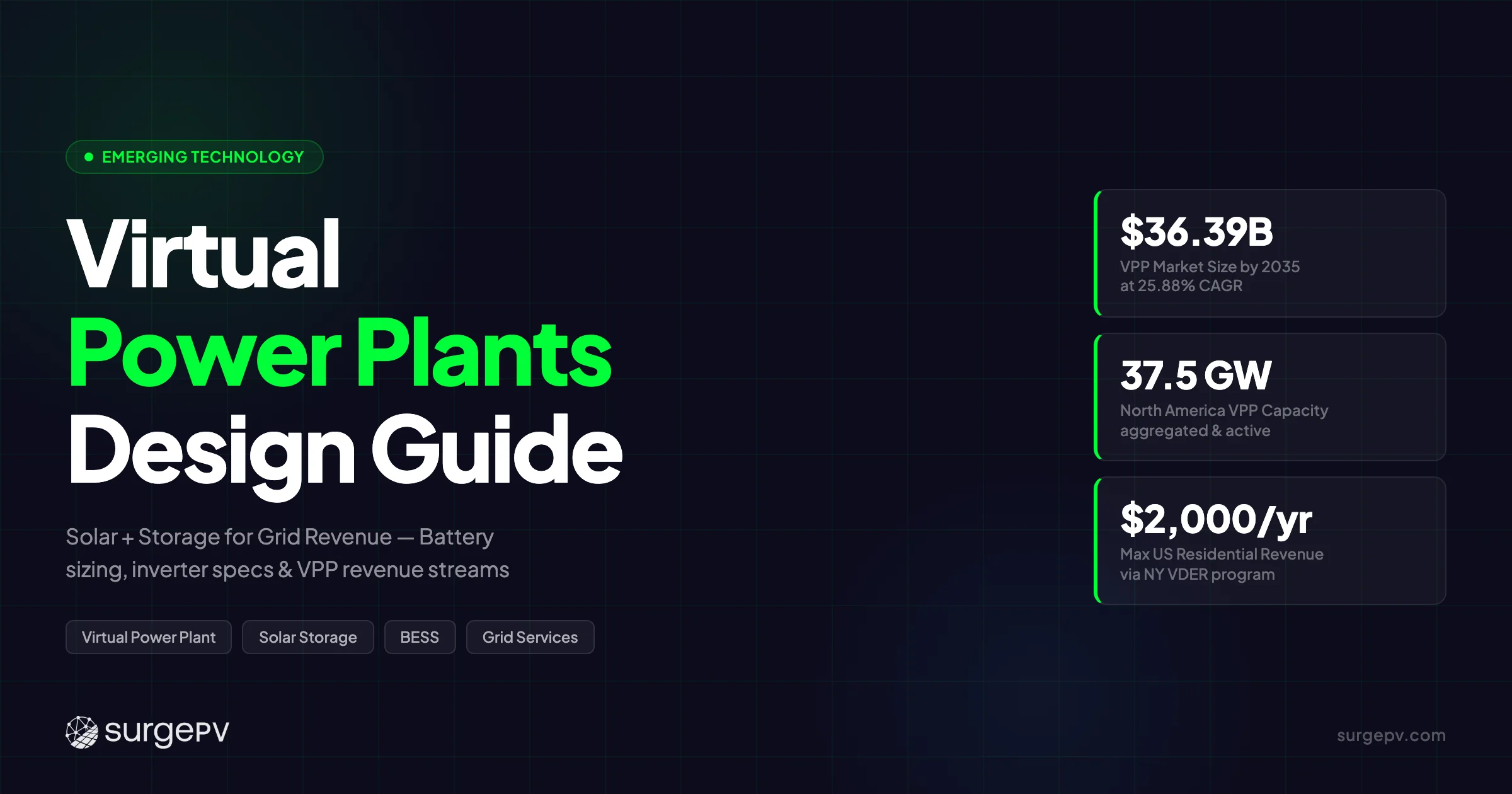
The global VPP market reached $3.67 billion in 2025 and is forecast to hit $36.39 billion by 2035, growing at a 25.88% CAGR (SNS Insider, February 2026). North America already has 37.5 GW of aggregated VPP capacity. Sunrun’s GridServices program alone aggregates 300 MW from 25,000+ home batteries, generating $750 million in grid-service contracts over 10 years. Most solar installers still spec systems without VPP eligibility in mind — and their clients leave that revenue on the table.
This guide covers everything a solar designer needs to know: the hardware and software components of a VPP-ready system, battery sizing rules, inverter communication requirements, the four revenue streams available in US and European markets, and six design mistakes that disqualify systems from enrollment before they are ever switched on. Also see: European Solar Incentives.
TL;DR — Virtual Power Plant Design
VPP design means specifying solar+storage systems to meet grid operator requirements: minimum 5–10 kWh usable battery capacity, a smart inverter with IEEE 2030.5 or OpenADR 2.0b compliance, and a configured SoC floor of 20–30% reserved for homeowners. US residential participants earn $50–$2,000/year. Commercial BESS earns more — National Grid pays $225/kW/summer. The global VPP market grows at 25.88% CAGR through 2035, with demand response accounting for 45% of revenue today.
For Global-specific compliance details, see Global net-metering-by-country.
In this guide:
- What separates a VPP-ready design from a standard solar+storage spec
- The five hardware components and five software layers every VPP system requires
- Battery sizing rules: minimum thresholds, SoC floor mechanics, and cycle life budgeting
- The four revenue streams — frequency regulation, demand response, capacity markets, and energy arbitrage — with real payment rates
- How VPP aggregators work and what they keep
- Inverter communication standards (IEEE 2030.5, OpenADR 2.0b) and which models qualify
- A step-by-step VPP-ready design workflow
- Real program data from California, New York, Germany, the UK, and Italy Also see: solar panel ROI in Italy. Also see: Germany solar subsidies.
What Is Virtual Power Plant Design? (And How It Differs From Standard Solar+Storage)
Standard solar design software optimizes for one goal: maximize the homeowner’s self-consumption and bill savings. Battery size is determined by load data and export tariff rules. Inverter selection is based on efficiency, warranty, and price. Communication hardware is typically a monitoring dongle that sends data to a cloud dashboard.
VPP design adds a second optimization layer: meeting grid operator requirements for wholesale market participation. Every design decision must satisfy two constraint sets simultaneously — the homeowner’s energy needs and the aggregator’s technical eligibility checklist.
The differences are specific and non-negotiable:
| Design Element | Standard Solar+Storage | VPP-Ready Design |
|---|---|---|
| Battery size | Load-matched (any size) | Minimum 5–10 kWh usable (program-dependent) |
| Battery chemistry | LFP or NMC, installer preference | LFP strongly preferred (cycle life requirement) |
| Inverter communication | Monitoring-only (HTTP/HTTPS) | IEEE 2030.5 or OpenADR 2.0b bidirectional control |
| Advanced grid functions | Off (not required) | On: freq-watt, volt-var, remote dispatch |
| SoC management | Self-consumption floor (10%) | VPP SoC floor (20–30%) + homeowner override |
| EMS configuration | Optimized for self-use | Optimized for self-use + VPP dispatch windows |
| Aggregator enrollment | Not applicable | Required before commissioning |
The financial case for VPP-ready spec decisions is clear. A standard 10 kWh LFP installation in California earns $0 from the grid. The same system enrolled in SCE’s Emergency Load Reduction Program earns $500–$1,000/year on top of standard bill savings. Over a 10-year system life, that is $5,000–$10,000 in incremental revenue from the same hardware — if it was designed correctly from day one.
Retrofit enrollment is possible when an existing inverter supports the required communication protocol. But retrofitting a non-compliant inverter adds $800–$1,500 in hardware and labor and may require a new interconnection application. Designing for VPP eligibility at the proposal stage costs nothing extra.
Key Takeaway
VPP design is not a separate product category — it is a set of specification choices made at the proposal stage. An LFP battery over 10 kWh, a smart inverter with IEEE 2030.5, and aggregator pre-enrollment add zero hardware cost and open a second revenue stream for the homeowner.
The Five Hardware Components of a VPP-Ready System
A solar-plus-storage system qualifies for VPP participation when five hardware layers are correctly specified. Missing or misspecifying any one of them creates an enrollment barrier.
1. Solar PV Array
The solar array is not a VPP-critical component on its own — most aggregators dispatch the battery independently of solar generation. But array sizing affects the battery’s daily energy budget, and therefore how much dispatchable capacity remains after self-consumption. A 5 kW array paired with a 10 kWh battery that uses 8 kWh of daily self-consumption leaves only 2 kWh for VPP dispatch. The same 10 kWh battery behind a 10 kW array with lower self-consumption needs might leave 6–7 kWh available.
The practical rule: size the array to meet at least 110–120% of annual load, and size the battery to provide 4+ hours of backup at full load. That headroom is what the aggregator dispatches.
2. Battery Storage System
Battery size and chemistry are the two most consequential VPP design decisions.
Minimum size thresholds. Most US and European aggregators set a floor of 5 kWh usable capacity. Programs with frequency regulation services — the highest-value revenue stream — often require 10 kWh minimum. Commercial VPP enrollment typically starts at 50 kWh.
Chemistry. LFP (lithium iron phosphate) is the practical choice for VPP applications. A VPP battery cycles 1–3 times per day through grid dispatch events on top of regular solar self-consumption cycles. LFP delivers 4,000–6,000 cycles at 80% depth of discharge. NMC delivers 1,500–2,000 cycles under similar conditions. Over a 10-year contract, the LFP battery survives the service life; an NMC battery may not.
Usable capacity and SoC floor. Aggregators dispatch only the capacity above the reserved SoC floor. A 10 kWh LFP battery with a 20% SoC floor provides 8 kWh of dispatchable capacity. A 13.5 kWh battery with a 20% floor provides 10.8 kWh. Size up where the project budget allows — more dispatchable capacity means more frequent dispatch events and higher annual revenue.
3. Smart Inverter / Hybrid Inverter
The inverter is the grid-facing interface of the VPP system. Standard string inverters are monitoring-only devices. A VPP-ready inverter must support bidirectional communication — receiving dispatch commands from the aggregator and executing them within 2 seconds.
Required advanced grid functions (AGFs) for US VPP programs:
- Frequency-watt response (automatic output adjustment when grid frequency deviates)
- Volt-var optimization (reactive power control for voltage stability)
- Remote dispatch (aggregator-initiated charge/discharge commands)
- Ramp rate control (smooth power transitions to prevent grid disruption)
The inverter must also run firmware with IEEE 2030.5 or OpenADR 2.0b stack enabled — not just hardware-capable, but actively configured.
4. Communication Gateway
The gateway is the physical link between the inverter’s local network and the aggregator’s cloud platform. In some systems (Enphase IQ8, newer SolarEdge systems), the gateway function is built into the inverter or EMS hub. In others, a separate IoT device handles protocol translation between the inverter’s native communication stack and the aggregator’s API.
Gateway requirements:
- Broadband internet connection (wired preferred; LTE fallback acceptable)
- Sub-second telemetry reporting to the aggregator platform
- IEEE 2030.5 (residential) or OpenADR 2.0b (commercial) at the application layer
- Tamper-resistant configuration (aggregator-locked SoC floor settings)
5. Energy Management System (EMS)
The EMS coordinates between solar generation, battery charge/discharge, load consumption, and VPP dispatch events. It operates on three priority layers simultaneously:
- Homeowner priority: Maintain SoC floor (20–30%) for backup power and self-consumption
- Self-consumption optimization: Use solar generation to charge battery before exporting
- VPP dispatch: Execute aggregator instructions using capacity above the SoC floor
Most hybrid inverter platforms — SolarEdge Energy Hub, Fronius Symo GEN24, Huawei SUN2000 with LUNA2000 — integrate EMS functionality. Standalone EMS platforms such as Sonnen eco and Victron Cerbo GX provide more granular control but require additional configuration.
VPP Software Architecture: Five Layers That Connect Your System to the Grid
Understanding the software architecture helps installers spec the right communication hardware and explain to clients why certain inverter models qualify and others do not. Modern VPP platforms are built on a five-layer stack.
Layer 1: DER Connection and Control
This layer handles physical device connectivity and protocol translation. Every solar inverter, battery, EV charger, and smart load uses a different native communication format — Modbus RTU, SunSpec Modbus, BACnet/IP, CAN bus. Edge gateways at the device layer convert these into standardized formats the upper layers can process.
The standards that matter for solar+storage VPP enrollment:
- IEEE 2030.5 (formerly SEP 2.0): Mandatory for residential DER enrollment in California and increasingly in other US states. Required by HECO (Hawaii) for all battery storage VPP programs. It enables secure, bidirectional communication between the inverter and the grid operator’s DERMS or VPP platform — device registration, configuration, status reporting, and control commands.
- OpenADR 2.0b: Standard for commercial and industrial demand response. Runs over standard internet protocols and is supported by virtually all commercial EMS platforms.
- SunSpec Modbus: Used for local monitoring and inverter control in DC-coupled systems.
- OCPP 2.0.1: The protocol for EV charger integration — relevant when the VPP includes bidirectional vehicle charging.
A system that uses an inverter without an active IEEE 2030.5 stack cannot enroll in California’s VPP programs, regardless of battery size or brand. This is the single most common design mistake.
Layer 2: Aggregation and Portfolio Management
This layer groups individual assets into logical portfolios and calculates the aggregate capacity available for dispatch. When 500 home batteries, each with 8 kWh of dispatchable capacity, are aggregated, the platform sees 4 MWh of controllable storage — enough to participate in wholesale capacity markets where the minimum bid is typically 100 kW.
The aggregator manages the portfolio to maintain contractual commitments. If 10% of assets are offline on a given day (internet outage, firmware update, homeowner override), the platform compensates by dispatching the remaining assets more aggressively. This explains why connectivity matters from a revenue perspective: a frequently offline system reduces both its own earnings and the fleet’s collective performance.
Layer 3: Central Control and Optimization Engine
This is the VPP’s decision-making core. It weighs real-time grid signals (frequency, voltage, wholesale spot prices), weather forecasts, building load profiles, and battery state-of-charge across thousands of assets simultaneously. The optimization engine decides: when to charge, when to discharge, at what rate, and through which market to monetize the flexibility.
Two approaches exist:
- Rule-based dispatch: Predictable, deterministic, auditable. The system follows pre-defined schedules and trigger thresholds. Most residential VPP programs use this approach.
- Machine learning-enhanced dispatch: Adaptive, learns from historical patterns, improves forecast accuracy over time. Platforms like AutoGrid Flex, Siemens Grid Edge, and Schneider EcoStruxure use ML for commercial fleet optimization.
The quality of VPP decisions depends entirely on forecast quality. A platform that accurately predicts tomorrow’s peak demand window positions assets the night before — pre-charging batteries from solar so they are full when the evening peak arrives.
Layer 4: IoT and Sensor Integration
This layer collects real-time telemetry from every asset in the fleet at sub-minute intervals. Data streams include power output, consumption, battery state-of-charge, voltage, frequency readings, and temperature. The platform uses this data for both optimization and settlement verification — proving to the grid operator that the VPP delivered the capacity it was contracted to provide.
For solar designers, the practical implication is metering. US VPP programs increasingly require revenue-grade metering (ANSI C12.20 Class 0.2 accuracy) at the system boundary. Standard inverter monitoring data does not qualify. A separate production meter or utility-grade smart meter may be required at enrollment.
Layer 5: Activation, Reporting, and Settlement
When the grid operator issues a dispatch signal — automatically (frequency deviation) or manually (demand response event) — this layer triggers device actions across the fleet within the required response time. For frequency regulation, the response window is 2–4 seconds. For demand response, it is typically 10–30 minutes after event notification.
Post-event, the layer generates performance reports documenting energy delivered, device-level participation rates, and revenue earned. This data flows to the grid operator for settlement and to asset owners as periodic payment statements. From the homeowner’s perspective, it appears as a quarterly or annual credit on the energy bill.
Sizing Solar and Storage for VPP Participation
Standard battery sizing uses a load-matching calculation. VPP sizing adds three constraints on top of that baseline.
Minimum Battery Thresholds
| Program Type | Minimum Usable Capacity | Notes |
|---|---|---|
| US residential demand response | 5 kWh | Most SCE, PG&E, HECO programs |
| US residential frequency regulation | 10 kWh | Some ISO-NE and PJM programs |
| UK Demand Flexibility Service | 3.5 kW / 1 kWh | Power rating is the key constraint |
| German FCR (primary control) | 10 kW via aggregator | Commercial and aggregated residential |
| Italian UVAM | 200 kW aggregate minimum | Aggregated commercial fleet |
| NY VDER (Value of DER) | 5 kW / 10 kWh | Residential + small commercial |
The practical minimum for US residential VPP enrollment in 2026 is 10 kWh. Most programs accept 5 kWh, but revenue at that size is marginal — under $100/year. At 10 kWh with a 20% SoC floor, the dispatchable window is 8 kWh, enough to participate in most demand response and some frequency regulation markets.
Solar-to-Storage Sizing Ratio
VPP design uses a different battery sizing metric than self-consumption optimization. Instead of asking “how much storage covers overnight load,” the question is: “how much dispatchable capacity can this system reliably provide after self-consumption needs are met?”
The target: battery capacity at or above 1.0× daily load delta (peak load minus solar generation during peak hours). This ensures the battery has enough headroom to absorb the homeowner’s peak load and still maintain a full charge available for grid dispatch during evening peak events.
For a typical 8 kW solar system with a 15 kWh daily load:
- Evening load (6 PM–10 PM): approximately 6 kWh
- Battery self-consumption reserve: 6 kWh + 20% SoC floor on a 10 kWh battery = approximately 8 kWh
- VPP-optimal battery size: 13.5–15 kWh, leaving 3–5 kWh for dispatch
Oversizing the battery specifically for VPP participation increases upfront cost. The break-even calculation: if an additional 5 kWh of capacity costs $1,500 incremental and earns $300/year in additional VPP revenue, payback is 5 years — acceptable when the battery warranty covers 10 years.
State of Charge Floor Configuration
The SoC floor is the contract between the homeowner and the aggregator. It defines the minimum reserve the battery must maintain at all times — the aggregator cannot dispatch below this floor.
Standard SoC floor settings:
- US residential: 20% (8 kWh available on a 10 kWh battery)
- UK residential: 10–20% (program-dependent)
- Commercial BESS: Often 15%, with event-specific override capability Read more about Heritage Building Solar Case Study.
Pro Tip
Set the SoC floor at 20%, not 30%. Every percentage point of floor added reduces dispatchable capacity and annual VPP revenue. The 20% floor provides adequate backup for most residential loads while maximizing the dispatchable window. Discuss backup requirements with the client before finalizing — homeowners in wildfire-prone areas often prefer a higher floor, which should be factored into the revenue projection.
Cycle Life and VPP Degradation Budget
A VPP system cycling for grid services typically accumulates 1–3 additional daily cycles on top of standard solar self-consumption cycling. At 2 additional cycles per day over 10 years, that is 7,300 VPP cycles plus roughly 3,650 standard cycles — approximately 11,000 total cycles. LFP chemistry handles this at 4,000–6,000 cycles to 80% depth of discharge at 25°C. NMC does not.
For commercial battery storage enrolled in frequency regulation programs — up to 300+ deep-dispatch cycles per year — the cycle budget becomes a bankability question. Battery cycle life projections must be included in the O&M model, and the battery warranty must explicitly cover VPP use cases. Some manufacturers void warranties for frequency regulation applications.
The Four Revenue Streams in VPP Grid Markets
VPP revenue comes from four distinct grid service categories. Most residential systems access demand response and energy arbitrage. Commercial systems access all four.
1. Frequency Regulation
The highest-value VPP service. When grid frequency deviates from nominal (50 Hz in Europe, 60 Hz in the US), the system must respond within 2–4 seconds by injecting or absorbing power. Grid operators pay for this capability regardless of whether an actual frequency event occurs — the payment is for standing ready, not just for delivery.
In Europe, transmission system operators (TSOs) run daily auctions for primary frequency regulation capacity. Battery owners bid capacity in 4-hour blocks. Successful bids earn a fixed capacity payment. A 10 kWh LFP battery participating in German primary control reserve (FCR) earns €200–€350/year from capacity payments alone, with additional activation payments when events occur. For the latest details on Germany, see Community Solar Projects Germany. Read Community Solar Business Model for a complete walkthrough.
US frequency regulation is more structured. FERC Order 755 requires PJM, MISO, and ISO-NE to pay battery storage a performance-based rate reflecting its faster response relative to gas peakers. PJM’s RegD signal, designed for fast-responding batteries, pays $10–$25/MW/hour for frequency regulation capacity. For more on this topic, see Adding Battery Storage Services.
2. Demand Response
Demand response is the most common VPP service for residential systems in the US. During peak grid demand events, the aggregator dispatches enrolled batteries to reduce load or inject power. Events last 1–4 hours, occur 5–30 times per year depending on the program, and pay $100–$1,000/year for a 10 kWh residential system.
Demand response accounts for 45% of VPP market revenue globally in 2026, making it the dominant commercial service type. Revenue models include:
- Per-event payments: Fixed credit per dispatch event regardless of duration
- Pay-for-performance: Paid only for verified load reduction, metered by the utility
- Annual contracts: Fixed annual payment in exchange for availability commitment
California’s Emergency Load Reduction Program (ELRP) pays $2/kWh for energy discharged during declared grid emergencies. New York’s VDER tariff credits participating assets up to $2,000/year against the utility bill. National Grid’s battery demand response program pays $225/kW/summer + $50/kW/winter for commercial battery participation.
3. Capacity Markets
Capacity markets pay generators and storage assets to guarantee available power during future peak demand periods. Unlike energy payments (per kWh delivered), capacity payments are forward contracts — the asset owner commits today to deliver a specific number of kW on demand in the next 1–3 years.
PJM’s capacity market cleared at $269/MW-day in 2025/26 — a 10-year high driven by data center load growth (Utility Dive, 2026). A 1 MW VPP fleet — roughly 125 residential batteries each providing 8 kWh of dispatchable capacity — enrolled in PJM capacity earns approximately $98,000/year at that clearing price, split between the aggregator and asset owners after the operator’s margin.
4. Energy Arbitrage
The simplest revenue model: charge when wholesale electricity prices are low (overnight, midday solar surplus), discharge when prices are high (evening peak, grid emergency). With real-time pricing access, a 10 kWh battery can execute 1–2 arbitrage cycles per day in high-spread markets like California (CAISO) and Texas (ERCOT).
CAISO price spreads regularly exceed $100/MWh between off-peak and peak hours during summer. A 10 kWh battery with 85% round-trip efficiency capturing a $100/MWh spread earns $0.85 per cycle. At 250 arbitrage cycles per year, that is $212/year — modest on its own, but a consistent baseline layer beneath demand response and capacity payments.
The four streams stack. A well-designed 10 kWh LFP residential system in California participating in demand response and energy arbitrage earns $700–$1,200/year. A commercial 200 kWh BESS in PJM participating in all four services earns $35,000–$60,000/year before aggregator margin.
| Revenue Stream | Response Time | Payment Type | Residential (US) | Commercial (US) |
|---|---|---|---|---|
| Frequency regulation | 2–4 seconds | Capacity + activation | Limited (utility approval required) | $10–$25/MW/hr (PJM RegD) |
| Demand response | 10–30 minutes | Per-event or annual | $50–$1,000/yr | $500–$10,000/yr |
| Capacity markets | Seasonal contract | $/MW-day | Via aggregator | ~$98,000/MW-yr (PJM 2025/26) |
| Energy arbitrage | Continuous | Spread capture | $100–$300/yr | $1,000–$5,000/yr |
Design VPP-Ready Systems From the First Proposal
SurgePV’s generation and financial tool models solar+storage revenue stacking — self-consumption, net metering, and grid services — in a single financial output your clients can act on.
Book a DemoNo commitment required · 20 minutes · Live project walkthrough
For a direct comparison, see Arka 360 vs SurgePV.
How VPP Aggregators Work: Enrollment to Dispatch to Payment
The aggregator is the commercial intermediary between a client’s battery and the wholesale grid market. Understanding how aggregators operate helps installers choose the right platform for each project and set accurate revenue expectations.
The Seven-Step Dispatch Chain
- Grid operator issues signal. The ISO/TSO or utility issues a dispatch signal — either automatically (frequency deviation crosses threshold) or manually (demand event declared).
- Aggregator platform receives signal. The optimization engine receives the signal and calculates how to dispatch the fleet to meet committed capacity.
- Portfolio selection. The platform selects which assets to dispatch based on current SoC, availability, and geographic location (grid constraints may limit dispatch to specific substations).
- Dispatch command sent. Individual commands are sent to enrolled gateways via IEEE 2030.5 or OpenADR, reaching devices within 30–90 seconds of the grid signal.
- Device executes. Smart inverters execute the command — discharging at the specified rate, for the specified duration, down to but not below the SoC floor.
- Performance metered. The aggregator’s platform records energy delivered, discharge rate, and duration against the contracted specification. Non-performance is penalized.
- Settlement and payment. The aggregator collects payment from the grid operator, deducts its margin (typically 15–40%), and credits asset owners monthly or quarterly.
Aggregator Economics
Aggregators retain a margin because they carry performance risk. If a client’s system is offline during a dispatch event, the aggregator must compensate by dispatching other assets more heavily — and may face non-performance penalties from the grid operator. The margin covers this risk, platform infrastructure, and customer support.
Residential aggregators typically retain 25–35% of gross market revenue. Commercial aggregators, who carry larger performance obligations and more sophisticated market operations, retain 15–25%.
When evaluating aggregators for a project, the key questions are:
- What programs do they participate in? (Demand response only, or also capacity and frequency regulation?)
- What is their non-performance policy? (Does the homeowner bear any penalty?)
- What is the contract term? (1 year vs. 5 years affects the homeowner’s flexibility)
- Is the SoC floor locked by the aggregator, or can the homeowner adjust it?
Leading VPP Aggregators by Market
| Aggregator | Markets | Asset Types | Homeowner Revenue Share |
|---|---|---|---|
| Sunrun GridServices | California, multiple US states | Residential solar+storage | ~70–75% |
| OhmConnect | California, Texas | Residential smart devices | Per-event payment |
| Swell Energy (Opower) | California, Hawaii | Residential BESS | ~70% |
| Tesla Energy Plan | California, Texas | Tesla Powerwall | Bill credit model |
| Next Kraftwerke | Germany, Europe | C&I and industrial | ~85% |
| Sonnen eServices | Germany, US | Residential LFP | SonnenFlat program |
| Octopus Energy (Kraken) | UK | Residential BESS | Demand Flexibility Service |
Next Kraftwerke, the largest VPP operator in Europe, manages 15.5 GW across 15,000+ assets in Germany alone — a reference point for what scale looks like when thousands of industrial plants, commercial buildings, and renewable generators are coordinated as a single market participant.
Inverter and Communication Requirements
This is where most VPP design failures originate. Installing the wrong inverter — one that lacks the required communication stack — creates an enrollment barrier that costs $800–$1,500 to fix post-installation.
Smart Inverter Standards
IEEE 2030.5 (formerly SEP 2.0): Mandatory for residential DER enrollment in California and increasingly across US states. Required by HECO (Hawaii) for all battery storage VPP programs. IEEE 2030.5 enables secure, bidirectional communication between the inverter and the utility’s DERMS or VPP platform — device registration, configuration, status reporting, and control commands.
Inverters with active IEEE 2030.5 support (firmware-enabled, not just hardware-capable):
- Enphase IQ8 with IQ Gateway (firmware 7.x+)
- SolarEdge Energy Hub + StorEdge (firmware 4.17+)
- Fronius Symo GEN24 Plus (firmware 1.14+)
- Tesla Powerwall 3 (built-in)
- SMA Sunny Tripower Smart Energy (firmware 3.x+)
OpenADR 2.0b: Standard for commercial and industrial demand response. Supported by most commercial EMS platforms and building automation systems. Used by PG&E, SCE, and utilities across 30+ US states for commercial demand response programs.
CTA-2045: A hardware communication interface for behind-the-meter devices including water heaters, HVAC systems, and EV chargers. Less common in solar+storage deployments but relevant for multi-device VPP enrollment that extends beyond battery storage.
Advanced Grid Functions
Beyond communication protocols, the inverter must have specific AGFs enabled. These are often disabled by default in firmware and must be activated during commissioning:
| Function | Purpose | Required For |
|---|---|---|
| Frequency-watt (F-W) | Adjust output when grid freq deviates | Frequency regulation programs |
| Volt-var (V-Q) | Reactive power control for voltage stability | Most utility interconnection requirements |
| Volt-watt (V-W) | Reduce real power output at high voltage | Grid congestion management |
| Fixed power factor | Hold constant power factor for reactive power delivery | Commercial utility programs |
| Ramp rate control | Limit rate of output change | Grid stability compliance |
| Momentary cessation override | Stay connected during transient voltage deviations | California Rule 21, HECO Rule 14H |
Key Takeaway
Having the right inverter model is necessary but not sufficient. AGFs must be enabled during commissioning. IEEE 2030.5 registration with the aggregator’s platform must be completed before energization. The SoC floor must be locked to the aggregator’s minimum specification. Missing any of these steps means the system will not dispatch even if the hardware is fully capable.
Communication Protocol Stack
For solar designers and installers, the practical communication requirements follow this chain:
Field Device → Gateway → Aggregator Platform → Grid Operator
     ↕              ↕              ↕                ↕
  Modbus/       IEEE 2030.5    REST API /          DERMS
  SunSpec       or OpenADR     proprietary          API
The gateway translates between the inverter’s native protocol (typically Modbus or SunSpec) and the aggregator’s application-layer protocol (IEEE 2030.5 or OpenADR). Most modern hybrid inverters with built-in EMS handle this internally. Legacy systems require a separate gateway device.
Step-by-Step: Designing a VPP-Ready Installation
Here is the practical design workflow for a VPP-ready solar+storage project, from initial site assessment to post-commissioning enrollment.
Step 1 — Confirm local program availability. Check which aggregators operate in the project’s utility territory and what their current enrollment requirements are. SEIA maintains a VPP best practices guide with program directories. Contact the aggregator directly for the enrollment checklist — requirements change when programs open and close.
Step 2 — Select an IEEE 2030.5-compliant inverter. For US residential projects, this is non-negotiable. For European projects, confirm the inverter’s OpenADR 2.0b capability. Request the aggregator’s approved hardware list before finalizing the inverter selection. Not every IEEE 2030.5-capable inverter is on every aggregator’s approved list.
Step 3 — Size the battery to program minimums with headroom. Start with the homeowner’s load requirements. Add the program minimum (typically 10 kWh) as a floor. Size up if the budget allows — the marginal cost of an additional 5 kWh is $500–$800 at current LFP pack prices, and the incremental revenue over 10 years far exceeds that.
Step 4 — Specify LFP chemistry. VPP use cases accumulate cycles rapidly. LFP is the chemistry that survives a 10-year VPP contract. NMC batteries from manufacturers that void warranties for frequency regulation use cases create long-term liability for both the installer and the homeowner.
Step 5 — Configure the SoC floor at commissioning. Set the floor at 20% as a default. Document this setting in the commissioning report. The aggregator will typically lock this setting via the gateway after enrollment — confirm their process before completing commissioning so there is no conflict between the installer-configured floor and the aggregator’s locked setting.
Step 6 — Complete aggregator pre-enrollment. Most aggregators require pre-enrollment before interconnection approval. This involves registering the inverter serial number, gateway MAC address, and utility account number with the aggregator’s platform. Budget 2–3 weeks for this process and start it early.
Step 7 — Enable AGFs and test dispatch. After interconnection approval, enable all required advanced grid functions via the inverter’s commissioning interface. Run a test dispatch with the aggregator to verify the full chain: command received → battery discharges → performance report generated.
Step 8 — Brief the homeowner on VPP operation. The homeowner needs to understand the SoC floor, how dispatch events work, that the battery will occasionally discharge during grid events without manual intervention, and how to view revenue credits. This conversation prevents support calls and opt-outs after the first grid event.
Using solar software that integrates generation simulation with financial modeling is the most efficient way to handle Steps 3 and 8. The energy and financial modeling tool produces accurate energy yield projections that feed directly into VPP revenue calculations — showing clients what their battery earns from self-consumption versus what it earns from grid services. A solar proposal software presentation that includes projected VPP revenue builds client confidence and reduces post-install churn.
Real-World VPP Programs and What They Pay
United States
California — SCE Emergency Load Reduction Program (ELRP) Pay rate: $2/kWh discharged during declared grid emergencies. Typical residential earnings: $100–$400/year. System requirement: IEEE 2030.5, 3+ kW battery power output. Eligible inverters: Enphase, SolarEdge, Tesla.
California — PG&E Virtual Power Plant (formerly BYOD) Pay rate: $500–$1,000/year residential typical, metered performance-based. System requirement: IEEE 2030.5, 4 kW / 10 kWh minimum. Contract term: 1 year (renewable).
New York — VDER (Value of Distributed Energy Resources) Pay rate: Up to $2,000/year per residential participant. Based on time-of-use value, capacity value, and environmental value combined. Most accessible program for NYC metro homeowners.
National Grid (Northeast US) — Battery Demand Response Commercial focus. Pay rate: $225/kW/summer + $50/kW/winter. A 50 kW commercial energy storage system earns $13,750/year from this program alone.
Hawaii — HECO Customer Self-Supply Pay rate: $0.05–$0.08/kWh grid-tied credit + demand response events. IEEE 2030.5 mandatory for all residential DER. Hawaii has the most mature residential VPP infrastructure in the US, with over 80,000 enrolled smart inverters.
Europe
Germany — Frequency Containment Reserve (FCR) Daily capacity auctions run by 50Hertz, Amprion, TenneT, and TransnetBW. Pay rate: €3–€8/MW/hour for 4-hour blocks. A 50 kW commercial system earns €5,000–€15,000/year. Residential systems typically participate through aggregators such as Sonnen and Next Kraftwerke.
UK — Demand Flexibility Service (DFS) Operated by National Grid ESO. Residential earnings: £200–400/year for a typical 10 kWh battery. Events run 30 minutes to 4 hours, typically between 5–9 PM. Key aggregators: Octopus Energy (Kraken platform), OVO Energy.
Italy — UVAM (Unità Virtuali Abilitate Miste) Requires minimum 200 kW aggregate per enrolled unit — small installations participate through aggregators. Revenue: €50–€100/MWh for activated energy. Italy’s GSE agency operates separate incentive programs for residential self-consumption that stack with UVAM revenue. For Italy-specific information, see Commercial Rooftop Solar Case Study Italy.
Netherlands — Demand Response via TenneT Residential via Vandebron and other aggregators. Revenue: €100–€250/year for 10 kWh battery. Program volume is growing rapidly as residential battery adoption accelerates.
| Program | Country | Min. Size | Typical Annual Revenue | Contract |
|---|---|---|---|---|
| ELRP | US (CA) | 3 kW / any kWh | $100–$400 | Annual |
| PG&E VPP | US (CA) | 4 kW / 10 kWh | $500–$1,000 | Annual |
| VDER | US (NY) | 5 kW / 10 kWh | Up to $2,000 | Annual |
| National Grid DR | US (NE) | 50 kW commercial | $13,750/yr (50 kW) | Annual |
| FCR | Germany | 10 kW (via aggregator) | €200–€500 (residential) | Daily auction |
| DFS | UK | 3.5 kW / 1 kWh | £200–£400 | Event-based |
| UVAM | Italy | 200 kW aggregate | €50–€100/MWh activated | Quarterly |
For a deeper look at battery system design in the UK market, see the battery solar system design UK guide. For commercial BESS sizing methodology, see commercial battery storage sizing.
What Solar Designers Get Wrong About VPP Projects
Six design mistakes consistently prevent enrollment or reduce revenue:
1. Specifying an inverter with monitoring-only communication. Some inverter models advertise IEEE 2030.5 hardware compatibility but ship with the stack disabled by default. Always verify the firmware version and request proof of active IEEE 2030.5 or OpenADR 2.0b registration capability from the manufacturer — not the spec sheet, the firmware changelog.
2. Undersizing the battery. A 5 kWh battery with a 20% SoC floor provides 4 kWh of dispatchable capacity. Most demand response programs require a minimum of 4 kW power output for at least 2 hours — that is 8 kWh minimum. Undersized batteries either fail enrollment or participate in fewer events, cutting annual revenue by 50% or more.
3. Using NMC chemistry for frequency regulation. Some battery manufacturers explicitly exclude frequency regulation service from their warranty terms. An NMC battery enrolled in daily FCR dispatch accumulates 700–1,000 cycles per year — exhausting its cycle budget in 2–3 years. Always confirm the warranty covers the intended VPP service type before specifying.
4. Skipping aggregator pre-enrollment. Pre-enrollment registers the system with both the aggregator’s platform and the utility’s DERMS before commissioning. Missing this step means the system goes live without dispatch capability — and retroactive registration typically takes 4–8 weeks, during which the homeowner earns nothing from the grid.
5. Setting the SoC floor too high. A 40% SoC floor on a 10 kWh battery leaves only 6 kWh dispatchable. Compared to a 20% floor (8 kWh dispatchable), that is 25% less revenue potential. Have a realistic conversation about backup power needs rather than defaulting to a conservative floor.
6. Failing to explain VPP mechanics in proposals. Clients who do not understand how VPP dispatch works will opt out after the first event where the battery discharges unexpectedly. Clear explanation in the solar proposal — including projected revenue and a description of what VPP events look like from the homeowner’s perspective — dramatically improves long-term program retention. The shadow analysis step in system design should also be completed before finalizing array sizing, since shading-related yield losses directly affect the battery’s available dispatch capacity.
Conclusion
Virtual power plant design is not about adding complexity to a solar+storage project. It is about making three specific decisions — LFP battery over 10 kWh, IEEE 2030.5-capable inverter, aggregator pre-enrollment — that cost nothing extra at the proposal stage and open a second revenue stream worth $500–$2,000/year for residential clients and $35,000–$60,000/year for commercial BESS.
Three actions that define a VPP-ready design practice:
- Specify LFP and size above 10 kWh. Every kWh of dispatchable capacity above the SoC floor is revenue. LFP chemistry survives the cycle budget; NMC often does not.
- Confirm IEEE 2030.5 is active, not just hardware-capable. Check the firmware version, not the spec sheet. Run a test dispatch with the aggregator before completing commissioning.
- Include VPP revenue in every proposal. Clients who see the stacked financial case — bill savings plus grid services — make faster buying decisions and stay enrolled longer. Solar design tools that models both generation yield and VPP revenue in a single output makes this presentation straightforward.
The global VPP market reaches $36.39 billion by 2035 (SNS Insider, 2026). The installations going in the ground today are the assets that will power that market. Every solar+storage system that misses VPP enrollment is leaving a decade of grid-service revenue on the table.
Frequently Asked Questions
What is virtual power plant design?
VPP design is the process of specifying solar panels, battery storage, smart inverters, and communication hardware so a system meets grid operator requirements and can participate in energy markets. A well-designed VPP-ready system uses a battery with at least 10 kWh of usable capacity in LFP chemistry, a smart inverter with IEEE 2030.5 or OpenADR 2.0b communication support, and a configured SoC floor of 20–30%. Standard solar+storage systems are not automatically VPP-ready — these decisions must be made at the design stage.
How much can you earn from a virtual power plant?
Revenue depends on market and program type. US residential participants earn $50–$2,000 per year depending on the state and program. Sunrun’s GridServices program aggregates 300 MW of California home batteries and generates $750 million over 10 years in grid-service contracts. In Europe, a 10 kWh battery earns €100–€500 per year, with UK participants reaching the higher end through the Demand Flexibility Service and FFR markets. Commercial BESS earns more — National Grid pays $225/kW per summer for battery demand response.
What battery size is needed to join a virtual power plant?
Most US and European VPP programs require a minimum of 5–10 kWh of usable battery capacity. The aggregator dispatches only the capacity above the reserved SoC floor — typically 20–30%. A 10 kWh LFP battery with a 20% floor provides 8 kWh of dispatchable capacity. Residential systems below 5 kWh rarely qualify for meaningful revenue. Commercial VPP participation typically starts at 50 kWh.
What inverter is required for a virtual power plant?
A VPP-ready installation requires a smart inverter with IEEE 2030.5 (formerly SEP 2.0) or OpenADR 2.0b communication capability. The inverter must support advanced grid functions including frequency-watt response, volt-var control, and remote dispatch commands. California ISO and HECO mandate IEEE 2030.5 for all residential DER enrollment. Compatible platforms include SolarEdge Energy Hub, Enphase IQ8, Fronius Symo GEN24 Plus, Tesla Powerwall 3, and SMA Sunny Tripower Smart Energy.
What is the difference between a VPP and a DERMS?
A DERMS (Distributed Energy Resource Management System) is a utility-owned platform that monitors and controls DERs on the distribution grid for reliability. A VPP is a commercial entity that aggregates those assets and bids their collective capacity into wholesale energy markets for revenue. Think of DERMS as the grid’s operating system and a VPP as the trading desk. Many VPP aggregators run their own DERMS-like control layer, but they interact with the utility’s DERMS at the grid interconnection point.
Can solar panels alone participate in a VPP without battery storage?
Solar-only systems can participate in demand response by curtailing generation on request, but they cannot provide dispatchable capacity — the core revenue driver in most VPP markets. Battery storage is required for frequency regulation, capacity market participation, and energy arbitrage. Aggregators that enroll solar-only systems typically limit participation to demand response programs, generating $10–$30/year. The same system with battery storage earns $200–$2,000 annually across multiple service streams.
Where this fits
This article is part of SurgePV's Solar Technology hub, which works through the topic from first principles to the decisions a project team actually has to make.
