

Quick Answer
Under California NEM 3.0, smart scheduling can cut payback from 9–12 years to 6–9 years. If your battery fills at noon and your peak rates start at 4 PM, self-consumption mode still works—but it leaves money on the table. You charge the battery when grid power costs $0.12 per kilowatt-hour and discharge to avoid buying power at $0.60 per kilowatt-hour.
Time-of-use battery optimization turns a solar battery from a simple backup device into a daily revenue tool. By charging when electricity is cheap and discharging when rates spike, homeowners and businesses in California can cut their payback period by years. Under NEM 3.0, the math is even stronger—midday solar exports now earn pennies, while evening peak rates cost upwards of $0.60 per kilowatt-hour.
Under California NEM 3.0, smart scheduling can cut payback from 9–12 years to 6–9 years. If your battery fills at noon and your peak rates start at 4 PM, self-consumption mode still works—but it leaves money on the table. You charge the battery when grid power costs $0.12 per kilowatt-hour and discharge to avoid buying power at $0.
TL;DR: Time-of-use battery optimization lets solar owners charge batteries when electricity is cheap and discharge when rates spike. Under California NEM 3.0, smart scheduling can cut payback from 9–12 years to 6–9 years. This guide gives exact charge windows for PG&E, SCE, and SDG&E, worked savings math, and a software comparison for installers. For the latest details on France, see Agricultural Solar Case Study. Read more about Floating Solar Farms France.
In this guide:
- How TOU rate spreads create arbitrage value for solar batteries
- Exact charge-discharge schedules for PG&E, SCE, and SDG&E by season
- Why NEM 3.0 forces a shift from self-consumption to mixed arbitrage
- How commercial installers can stack demand charge reduction with TOU savings
- Which battery controllers (Tesla, Enphase, SolarEdge, EMS) fit each client type
- Battery sizing rules and cycle-depth trade-offs that protect lifetime returns Read Solar Battery Sizing Guide for a complete walkthrough.
What Time-of-Use Battery Optimization Means
Time-of-use battery optimization is the practice of charging energy storage during low-rate periods and discharging during peak-rate periods to maximize bill savings. It treats the battery as a financial instrument, not just a backup power source.
Basic self-consumption stores excess solar production and feeds it to your home when sunlight drops. It does not consider rate timing. If your battery fills at noon and your peak rates start at 4 PM, self-consumption mode still works—but it leaves money on the table. TOU optimization actively targets price spreads.
Arbitrage, in plain terms, is “buy low, sell high” applied to electricity rates. You charge the battery when grid power costs $0.12 per kilowatt-hour and discharge to avoid buying power at $0.60 per kilowatt-hour. The spread—$0.48—is your savings.
Think of it like a water tank. You fill it when rain is free or cheap, and use that stored water during a drought when every gallon costs more. The tank itself does not change; the value comes from when you fill and empty it.
This matters now because NEM 3.0 export rates are low during midday solar generation. Exporting a kilowatt-hour at noon might earn $0.06 under the Avoided Cost Calculator. Storing that same kilowatt-hour and discharging it at 7 PM avoids buying power at $0.60. The storage strategy earns ten times more than the export strategy. For installers, this shifts the sales conversation from backup power to daily bill reduction, a much stronger value proposition in markets with steep TOU differentials.
Installers should model these strategies during system design. Modern cloud solar design software lets you simulate hourly production against tariff rates and prove payback before you specify hardware.
How TOU battery optimization works:
- Identify your utility’s peak and off-peak hours.
- Charge the battery during off-peak or super off-peak windows.
- Discharge during peak-rate hours to offset high-cost grid imports.
- Adjust seasonally for changing solar production and rate schedules.
How California TOU Rate Spreads Create Arbitrage Value
California investor-owned utilities split the day into three pricing tiers: peak, off-peak, and super off-peak. The gap between the cheapest and most expensive hours defines your arbitrage ceiling. Wider spreads mean bigger savings.
The table below shows summer rate structures for PG&E, SCE, and SDG&E in 2024–2025. Rates include approximate energy charges only; they do not include baseline adjustments or non-bypassable charges.
| Utility | Rate Plan | Peak Hours | Peak Rate | Off-Peak Rate | Super Off-Peak |
|---|---|---|---|---|---|
| PG&E | E-TOU-C | 4 PM – 9 PM daily | ~$0.45–$0.55/kWh | ~$0.18–$0.24/kWh | None |
| SCE | TOU-D-4-9PM | 4 PM – 9 PM weekdays | ~$0.58/kWh | ~$0.24/kWh | 8 AM – 4 PM |
| SCE | TOU-D-5-8PM | 5 PM – 8 PM weekdays | ~$0.74/kWh | ~$0.24/kWh | 8 AM – 4 PM |
| SDG&E | TOU-DR1 | 4 PM – 9 PM daily | ~$0.60–$0.68/kWh | ~$0.33–$0.35/kWh | None |
| SDG&E | EV-TOU-5 | 4 PM – 9 PM daily | ~$0.70–$0.80/kWh | — | 12 AM – 6 AM (~$0.10–$0.12/kWh) |
SCE’s TOU-D-5-8PM plan shows the steepest spread. Peak rates hit $0.74 per kilowatt-hour while off-peak stays near $0.24. That is a $0.50 spread, one of the widest in the residential United States market. For United States-specific compliance details, see United States arizona/phoenix. For United States-specific compliance details, see United States california/los-angeles.
Here is the math for a 10 kWh battery discharged daily across that spread:
10 kWh × $0.50 spread × 30 days × 90% round-trip efficiency = ~$135 per month, or ~$1,620 per year.
Super off-peak windows matter because they allow grid charging at rates as low as $0.10 per kilowatt-hour. On SDG&E’s EV-TOU-5 plan, you can charge overnight at $0.12 and discharge during the $0.70 peak. That $0.58 spread beats many solar-only arbitrage strategies, though grid charging rules vary by utility and NEM classification.
Spreads shrink in winter. PG&E and SCE winter peak rates drop roughly 20–30%, and solar production falls, so you may not fill the battery every day from PV alone. Annual savings typically run 25–40% lower than the summer peak. Use a generation and financial tool to model the full 8,760-hour year rather than extrapolating from one month.
Exact Charge-Discharge Schedules by Utility and Season
Most guides explain what TOU is but never give exact time slots. Installers need concrete schedules they can program into inverters and energy management systems. The table below provides charge and discharge windows for the major California IOU rate plans.
A good rule of thumb for California: charge from 10 AM to 3 PM using solar surplus, and from 12 AM to 6 AM using super off-peak grid power if your tariff allows it. Discharge from 4 PM to 9 PM to cover peak rates. For SCE’s sharp-peak TOU-D-5-8PM plan, narrow discharge to 5 PM to 8 PM to preserve capacity.
| Utility | Rate Plan | Summer Charge Window | Winter Charge Window | Discharge Window | Grid Charging? |
|---|---|---|---|---|---|
| PG&E | E-TOU-C | 10 AM – 2 PM (solar) | 10 AM – 2 PM (solar) | 4 PM – 9 PM | Restricted under NEM |
| SCE | TOU-D-5-8PM | 12 AM – 5 AM + 10 AM – 4 PM | 12 AM – 5 AM + 10 AM – 2 PM | 5 PM – 8 PM | Allowed on some plans |
| SDG&E | EV-TOU-5 | 12 AM – 6 AM + 10 AM – 2 PM | 12 AM – 6 AM + 10 AM – 2 PM | 4 PM – 9 PM | Allowed |
Seasonal adjustments are critical. Summer brings long solar days. A 10 kW system can fully charge a 15 kWh battery by 2 PM, leaving plenty of time to top off before peak. Discharge fully during peak hours because the spread justifies using every available kilowatt-hour.
Winter is harder. Shorter days and lower sun angles mean your 10 kW system might only produce 15–20 kWh total. If your home uses 10 kWh during the day, only 5–10 kWh reaches the battery. That may not cover a four-hour peak window. You have two choices: reduce discharge depth so the battery lasts until 9 PM, or enable grid charging overnight to guarantee a full pack before peak. The right choice depends on your utility’s grid-charging rules and your round-trip efficiency losses.
Grid-charging legality varies by utility and NEM classification. PG&E generally restricts grid-to-battery charging under NEM 2.0 and 3.0 residential tariffs. SCE allows it on some TOU plans but requires specific interconnection agreements. SDG&E permits grid charging on EV-TOU-5. Always verify the local tariff rules and interconnection agreement before enabling grid-to-battery charging. A misconfigured system can void export credits or trigger demand charges.
NEM 3.0 Forces a Strategy Shift: Self-Consumption vs Arbitrage
NEM 3.0 changed the economics of solar storage. Under the old NEM 2.0, high export credits made self-consumption the obvious choice: store your excess, use it at night, and export anything left over at a strong rate. NEM 3.0’s Avoided Cost Calculator slashed midday export values, so storing solar for evening discharge now beats direct export in almost every scenario.
| Strategy | Charge Source | Discharge Target | Best For |
|---|---|---|---|
| Self-consumption | Excess solar only | Home load when solar drops | NEM 2.0 with high export credits |
| TOU arbitrage | Solar + grid (if allowed) | Peak-rate home load | Steep TOU differential |
| Mixed (NEM 3.0) | Solar midday + grid overnight | Peak evening + selective export at high ACC rates | Current California market |
NEM 3.0 export rates through the Avoided Cost Calculator average $0.05–$0.08 per kilowatt-hour at midday. Evening ACC rates rise to $0.25–$0.52 per kilowatt-hour because they are tied to wholesale market prices, which spike when demand peaks. That difference makes timing more important than total volume. A system that exports 100 kWh at noon earns less than a system that stores 10 kWh and discharges it at 7 PM.
Consider a 7.6 kW solar system paired with a 10 kWh battery on SCE’s TOU-D-5-8PM plan in August. The system produces 45 kWh on a clear day. The home consumes 20 kWh during daylight hours, leaving 25 kWh available.
Option A: Export all 25 kWh at midday. At $0.06 per kilowatt-hour, that earns a $1.50 credit.
Option B: Store 10 kWh in the battery and export the remaining 15 kWh. Discharge the 10 kWh during the 5 PM to 8 PM peak at $0.74 per kilowatt-hour. That avoids $7.40 in purchases. The 15 kWh exported at midday still earns $0.90. Total value: $8.30.
The storage strategy generates $6.80 more value on that single day. Over a summer month, the gap exceeds $150. Over a year, it can mean the difference between a 12-year payback and a 7-year payback.
This is why “store at midday, discharge at 6 PM to 9 PM” beats “export at midday” under NEM 3.0. The battery does not just shift energy; it shifts value from low-rate hours to high-rate hours. When you present these numbers to clients, use solar proposal software to show hour-by-hour cash flows and prove the payback visually.
See it in a proposal
Model TOU battery savings against real California rate tariffs with SurgePV’s tools.
Book a DemoNo commitment required · 20 minutes · Live project walkthrough
For a direct comparison, see Arka 360 vs SurgePV.
Commercial Demand Charge Stacking with TOU Arbitrage
Residential battery economics rely on TOU arbitrage. Commercial and industrial buildings have a second, often larger, value stream: demand charge reduction.
Demand charges are billed at dollars per kilowatt of peak demand. Depending on the utility, they account for 30–70% of a commercial electricity bill. Unlike energy charges, which reward total conservation, demand charges punish brief spikes. If your building hits 400 kW at 2 PM on a hot August day because all HVAC units cycle on simultaneously, you pay that peak demand figure multiplied by the utility’s demand rate—often $10–$20 per kW—every month for the entire year or rolling window. Even if your average demand is only 200 kW, one bad afternoon locks in a high charge.
A battery energy storage system can shave that peak. If the BESS supplies 80 kW during the half-hour window when the building would otherwise peak, your billed demand drops by 80 kW. At $14 per kW, that saves $1,120 per month, or $13,440 per year.
| Value Stream | Residential Benefit | C&I Benefit |
|---|---|---|
| TOU arbitrage | $50–$135/month | $1,000–$5,000/month |
| Demand charge reduction | Minimal | 20–40% peak reduction |
| Typical payback | 6–9 years (with NEM 3.0) | 3–5 years |
The two value stacks combine. A 125 kW / 250 kWh factory BESS can shift 400 kWh per day from off-peak to peak hours while also shaving the highest demand spikes. In projects where both strategies are deployed, combined savings typically reach 25–35% of the total utility bill.
Sizing guidance for commercial projects differs from residential. Size the battery for the peak-shaving target first. Pull 12 months of interval data and identify the top twenty demand peaks. Calculate the difference between those peaks and your average load during those windows, then size the inverter and battery to cover that gap. Use the remaining capacity for TOU arbitrage. If you size purely for energy arbitrage, you may miss the larger demand-charge savings and undersize the inverter, which limits peak-shaving power.
Controller and Software Comparison for Installers
Hardware selection matters, but control software determines actual savings. Installers should evaluate controllers on three criteria: automation level, forecast accuracy, and manual override flexibility. The right choice depends on the client’s technical comfort and the complexity of their rate structure.
During the design phase, model dispatch strategies with solar software to prove savings before specifying hardware. Accurate production and consumption forecasts let you show clients exactly how much a given controller will save.
| Controller / Platform | Control Type | Forecasting | Manual Override | Best For |
|---|---|---|---|---|
| Tesla Powerwall | Automated time-based | Algorithmic learning | Limited | Homeowners who want “set and forget” |
| Enphase IQ Battery 5P | TOU mode + backup | Basic scheduling | Moderate | Installers who value LFP safety and modularity |
| SolarEdge | Smart TOU forecasting | Predictive learning | Moderate | Tech-savvy homeowners |
| Generic EMS / Inverter | Scheduled time slots | None | Full control | DIY users and commercial sites |
| OpenSolar / NREL SAM | Pre-built dispatch schemes | 8760-hour simulation | Designer-controlled | Proposal modeling and design |
Tesla’s algorithm is opaque but hands-off. The system learns your usage patterns and adjusts charge-discharge timing automatically. For homeowners who do not want to think about rates, this works well. The downside is limited transparency: you cannot force a specific charge schedule if the algorithm disagrees, and you cannot easily stack demand-charge logic for commercial applications. Also see: Us Residential Solar Market Trends 2026.
Enphase and SolarEdge offer middle-ground solutions. Both allow explicit TOU schedules with seasonal overrides. SolarEdge adds predictive forecasting that adjusts for weather, which helps on cloudy days when solar production falls short.
Generic EMS platforms provide exact control but require expertise. You define every time slot, SOC limit, and grid-charging rule. This is necessary for commercial sites with complex demand-charge logic or buildings with multiple meters.
For proposal-stage modeling, OpenSolar and NREL SAM include pre-built dispatch schemes. SAM’s detailed battery model can simulate cycle-by-cycle degradation and revenue stacking against actual utility rate structures. Use these tools to compare controllers and prove savings before installation. AI-assisted tools like Clara AI can also recommend dispatch schedules based on tariff structures and historical load data.
Battery Sizing, Cycle Depth, and Lifetime Economics
Correct sizing protects lifetime returns. Oversizing leads to underutilization and longer payback. Undersizing leaves savings on the table during the widest rate spreads.
For residential systems in California, 10–15 kWh of storage typically covers evening peak loads. A 10 kWh battery can discharge 8–9 kWh after efficiency losses, enough to power most homes through the 4 PM to 9 PM window if loads are managed. Homes with electric vehicle charging or pool pumps may need 20 kWh or more.
Cycle depth creates a trade-off between daily revenue and battery life. One cycle per day at 80% depth of discharge is gentler on lithium-ion cells. Two cycles per day at 50% depth of discharge increases daily savings but accelerates capacity fade. EPRI research consistently shows that deeper cycles and higher average state-of-charge accelerate capacity fade. When replacement cost is included, conservative dispatch—one cycle per day—often wins on lifetime net present value.
Here is a worked payback example. A 10 kWh battery costs $10,000 installed. Pure TOU savings in California average $55–$110 per month depending on the utility, or roughly $660–$1,320 per year. That implies a 7.5- to 15-year simple payback. Add NEM 3.0 arbitrage on top of self-consumption, then stack demand charge reduction for commercial sites, and payback drops to 6–9 years.
Research from Lawrence Berkeley National Laboratory notes that holding state-of-charge in reserve for backup power carries an opportunity cost. The foregone bill savings from keeping the battery partially full usually outweigh the value of that reserve unless grid reliability is poor in the area and outage frequency justifies the lost revenue. For most California homes with stable grid service, the optimal strategy is to cycle the battery daily and treat backup as a secondary benefit.
Before specifying hardware, use PV design software to test different battery sizes against actual rate tariffs. Factor in solar shading analysis to confirm that rooftop shading will not cut production so severely that the battery never fills during winter.
Time-of-use battery optimization turns rate structures into profit. In California, the spreads between super off-peak and peak rates are wide enough to justify daily cycling. NEM 3.0 makes storage essential by slashing midday export values. For installers, the opportunity is to model these savings during the design phase, select controllers that match the client’s technical profile, and size systems for the value stream that matters most—TOU arbitrage for homes, demand charge reduction for commercial buildings.
Frequently Asked Questions
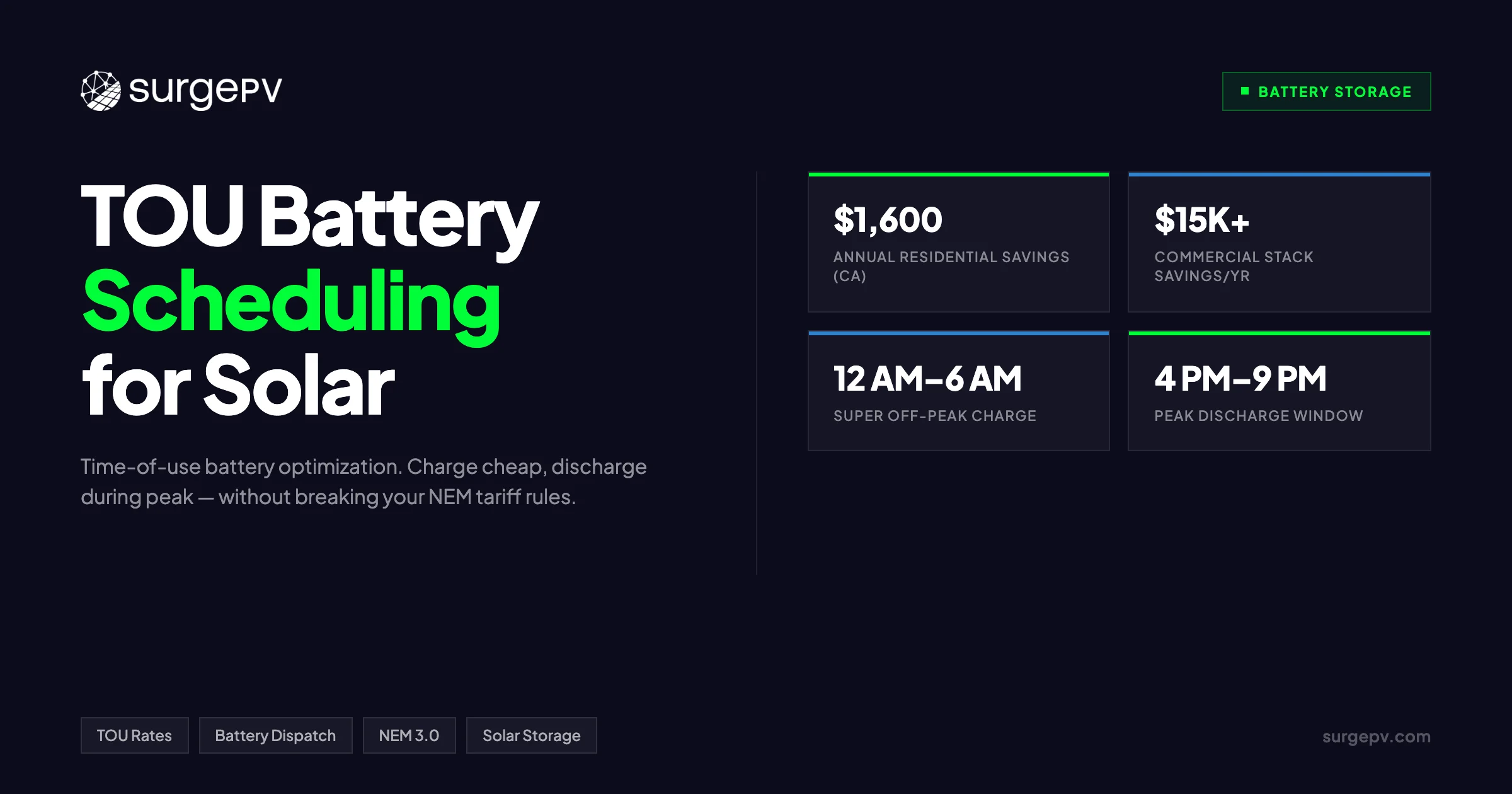
Q1: What is the best time to charge a solar battery on a TOU rate? A: Charge during super off-peak hours, typically 12 AM to 6 AM, or during midday solar surplus hours from 10 AM to 2 PM. Avoid charging during peak periods from 4 PM to 9 PM when rates are highest. Your utility’s specific tariff may restrict grid charging, so verify the rules before programming overnight schedules.
Q2: How much can you save with a battery on time-of-use rates? A: A 10 kWh battery in California can save $600–$1,600 per year depending on the utility rate spread and dispatch strategy. SCE’s TOU-D-5-8PM plan offers the highest residential savings because of its steep peak-to-off-peak differential. For commercial buildings that stack TOU arbitrage with demand charge reduction, annual savings can exceed $15,000.
Q3: Should I charge my battery from the grid or only from solar? A: It depends on your utility rules and rate plan. Where permitted, grid charging during super off-peak rates around $0.10–$0.12 per kilowatt-hour and discharging at peak rates of $0.60–$0.80 per kilowatt-hour maximizes arbitrage. Some NEM tariffs restrict grid-to-battery charging. PG&E residential NEM customers generally cannot grid-charge, while SDG&E’s EV-TOU-5 allows it.
Q4: What is the difference between self-consumption and TOU optimization modes? A: Self-consumption stores excess solar to power your home when sunlight drops. It does not consider rate timing. TOU optimization actively charges and discharges based on rate times to capture price spreads, often using grid power if allowed. Under NEM 3.0, TOU optimization typically earns more because midday export rates are so low.
Q5: How does NEM 3.0 affect battery optimization strategy? A: NEM 3.0 pays low midday export rates of $0.05–$0.08 per kilowatt-hour and higher evening rates of $0.25–$0.52 per kilowatt-hour. This makes storing midday solar for evening discharge more profitable than exporting it immediately. The optimal strategy is a mixed mode: charge from solar during the day, discharge during peak evening hours, and export only when the battery is full or when evening ACC rates spike.
Q6: What size battery do I need for TOU rate arbitrage? A: Most California homes achieve strong TOU savings with 10–15 kWh of storage. That size covers typical evening peak loads from 4 PM to 9 PM. Commercial sites should size based on peak-demand reduction targets first, then use surplus capacity for arbitrage. Homes with high continuous loads like EV charging may need 20 kWh or more.
Q7: Can battery storage eliminate demand charges for commercial buildings? A: It can reduce peak demand by 20–40%, but rarely eliminates demand charges entirely. Size the battery energy storage system to shave the highest demand peaks; the remaining load still incurs some demand charges. The greatest savings come from targeting the top ten peak events each year rather than trying to flatten every single spike. Read Adding Battery Storage Services for a complete walkthrough.
Where this fits
This article is part of SurgePV's Energy Storage hub, which works through the topic from first principles to the decisions a project team actually has to make.
