

Quick Answer
Grid export limitations vary by country: Germany allows 70% feed-in without limit for under 30 kW systems, Australia limits export to 5 kW per phase, Spain requires zero-export for some commercial systems, and the UK has DNO-specific limits. Exceeding export caps triggers curtailment or grid rejection.
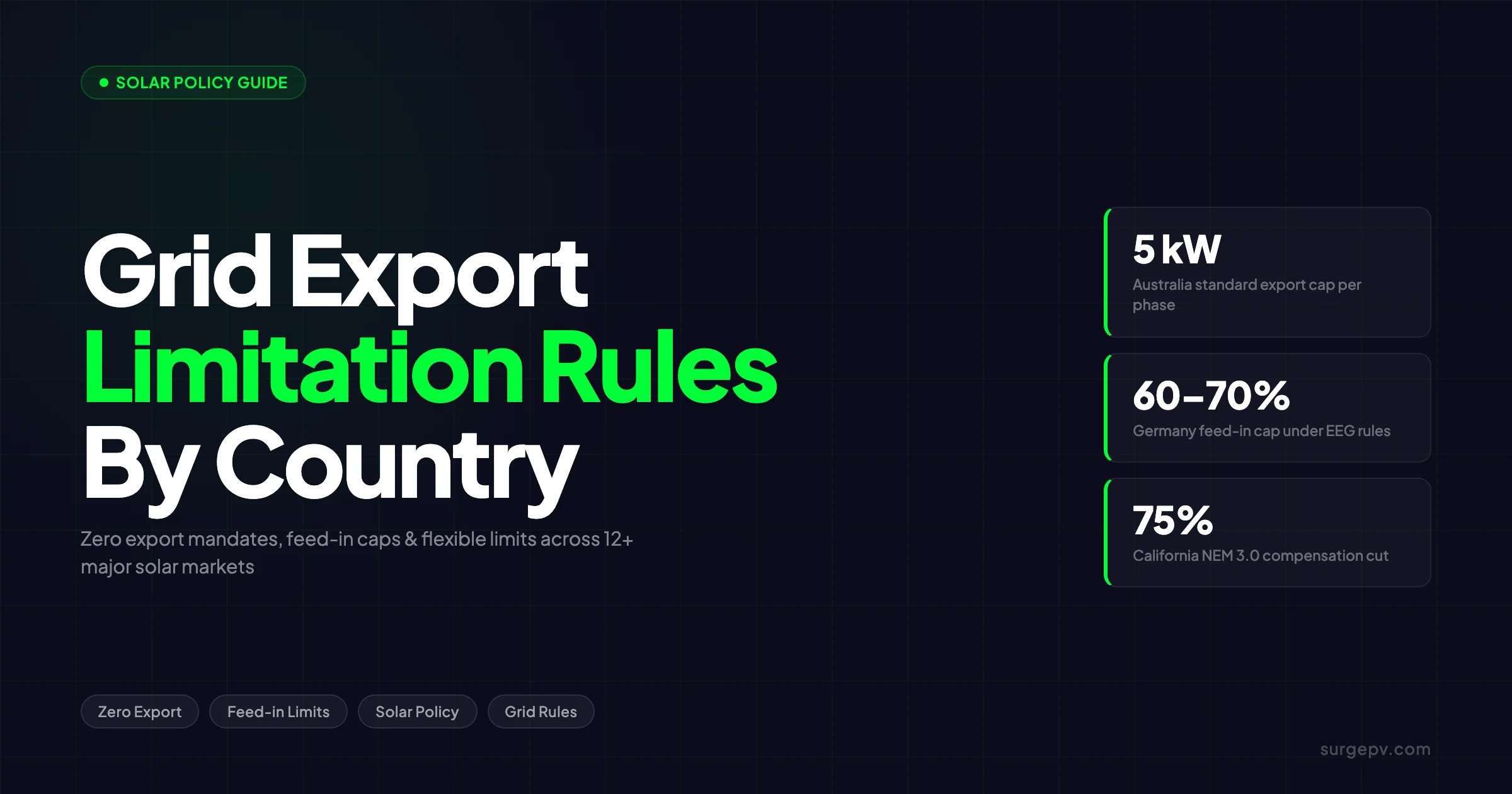
Grid export limitation rules determine how much solar-generated electricity can flow back to the utility grid — and the answer varies significantly by country. Zero export is legally mandated in Morocco and for large C&I systems in China, while most developed markets apply partial limits: Australia’s standard is 5 kW per phase, Germany’s Solarspitzengesetz caps feed-in at 60% for unmetered systems, and California’s NEM 3.0 has made daytime exports near-worthless financially. This guide covers current rules across 12+ markets, the financial impact of each approach, and the design implications for EPCs working across multiple jurisdictions. Also see: Germany solar subsidies.
Grid export limitations vary by country: Germany allows 70% feed-in without limit for under 30 kW systems, Australia limits export to 5 kW per phase, Spain requires zero-export for some commercial systems, and the UK has DNO-specific limits. Exceeding export caps triggers curtailment or grid rejection. For the latest details on UK, see Battery Solar System Design UK. For Australia-specific compliance details, see Australia comparisons/lgc-vs-stc.
Grid export limitations vary by country: Germany allows 70% feed-in without limit for under 30 kW systems, Australia limits export to 5 kW per phase, Spain requires zero-export for some commercial systems, and the UK has DNO-specific limits. Exceeding export caps triggers curtailment or grid rejection.
For more details, see our guide on Spain net metering.
TL;DR — Grid Export Rules 2026
Zero export is mandatory in Morocco and for C&I solar (6–50 MW) in China. Fixed caps apply in most developed markets — 5 kW per phase in Australia, 60% in Germany for new unmetered systems, 3.68 kW (G98 baseline) in the UK. California NEM 3.0 cut export compensation by 75%, effectively discouraging daytime export. Japan’s mandatory curtailment reached Tokyo in March 2026. Netherlands net metering ends December 31, 2026. The direction everywhere is toward tighter or more variable export controls.
Understanding Grid Export Limitation: Three Policy Types
Before comparing countries, it helps to separate three distinct approaches to grid export limitation. They differ in mechanism, financial impact, and inverter requirements.
Zero export (anti-reverse-flow): The inverter is configured — or legally required — to never push electricity to the grid. Output is throttled in real time to match site consumption. Any excess is wasted or stored in batteries. Required in Morocco, for large C&I solar in China, and in parts of the Middle East. Also used voluntarily where feed-in rates are negligible or interconnection approval is slow.
Fixed export cap: The system can export, but only up to a fixed threshold — typically expressed as kW per phase or as a percentage of inverter capacity. Australia’s 5 kW, Germany’s 60–70%, and the UK’s 3.68 kW (G98 baseline) fall here. Systems exceeding the cap are automatically curtailed by the export limiter or smart inverter logic.
Dynamic (flexible) export: The system exports up to a variable ceiling that changes in real time based on grid conditions. South Australia pioneered this, and Western Australia adopted it in 2026. The export ceiling can be 0 kW during grid stress events and up to 10 kW per phase when the grid has spare capacity. This approach requires a bidirectional communication protocol (CSIP-AUS in Australia’s case) between the inverter and the network operator.
Understanding which type applies in your market determines inverter selection, system sizing logic, battery integration strategy, and the financial modelling inputs needed in customer-ready solar proposals. For more on this topic, see Inverter Selection Solar Design Guide.
Global Overview: Export Limitation Rules at a Glance
The table below summarizes current export rules across major solar markets. Detailed sections for each follow.
| Country / Market | Export Type | Key Rule | Enforcement Body | Effective |
|---|---|---|---|---|
| Australia (most states) | Fixed cap | 5 kW per phase (single-phase) | State DNSPs | Varies by DNSP |
| Australia — SA | Dynamic/Flexible | Up to 10 kW/phase, real-time grid-adjusted | SA Power Networks | July 2025 |
| Australia — WA (SWIS) | Fixed or Dynamic | 1.5 kW cap OR full export + Emergency Solar Management | Western Power | May 2026 |
| Germany (new systems post Feb 25, 2025) | Partial + negative-price suspension | 60% cap without smart meter; subsidy suspended during negative prices | BNetzA | Feb 2025 |
| Germany (legacy 10–25 kW systems) | Partial | 70% of inverter capacity | BNetzA | EEG 2012 |
| United Kingdom | Partial/Conditional | 3.68 kW per phase (G98 baseline); G99 for larger systems | DNOs / Ofgem | Ongoing |
| California, USA | Compensation reduction | NEM 3.0: time-varying export rates, ~75% cut vs NEM 2.0 | CPUC | Apr 2023 |
| Japan | Mandatory curtailment right | Grid operator can curtail up to 30 days/year without compensation | METI / Grid operators | Ongoing |
| Italy | Full export allowed | SSP closed Sep 2025; Ritiro Dedicato at market rate replaces it | GSE / ARERA | Sep 2025 |
| Spain | Partial or Zero | Sin excedentes (zero) or con excedentes (surplus capped at 50% of bill) | REE / CNMC | 2024 update |
| Netherlands | Compensation reduction | Net metering ends December 31, 2026 | ACM | 2027 |
| Belgium — Flanders | Compensation reduction | Wholesale-rate credits only; net metering eliminated for digital meters | VREG | 2025 |
| China — large C&I (6–50 MW) | Zero export (mandatory) | Anti-reverse-flow required by law | NEA | May 2025 |
| Morocco | Zero export (mandatory) | Law 13-19 prohibits grid injection | ANRE | Ongoing |
| Saudi Arabia | Effectively zero | Export requires utility approval, rarely granted | SEC | Ongoing |
| South Africa | Partial/conditional | SSEG scheme; credits only; varies by distributor | NERSA | Ongoing |
| India | Partial | Net metering up to 10 kW; gross metering above | MNRE / SERCs | Ongoing |
Key Takeaway
No two markets have identical rules. For EPCs working across borders, the export policy is a first-order design input — it changes system size, battery sizing, and the financial model before any other technical decisions are made.
Australia: State-by-State Export Limits and the Move to Flexible Export
Australia has the most complex grid export policy of any country — not because of federal law, but because 12+ distribution network service providers (DNSPs) each set their own rules within the National Electricity Rules (NER) framework enforced by the AEMC and AER.
The Standard 5 kW Cap
The 5 kW per phase export limit became Australia’s de facto standard after SA Power Networks introduced it in December 2017. By 2020, every mainland DNSP had adopted it. For most residential solar owners on single-phase connections, this means a maximum of 5 kW exported at any time, regardless of system size. Three-phase connections allow 15 kW total.
The practical implication: a 10 kW solar system on a single-phase connection can produce 10 kW on a clear day but export no more than 5 kW. The remaining 5 kW must be consumed on-site or wasted. A household with low daytime consumption can lose 13–14% of annual generation to curtailment under this cap, per SolarQuotes analysis. At typical Australian feed-in rates of $0.06–0.08/kWh, that translates to $400–$600 per year in lost revenue for a 10 kW system.
| State | DNSP | Single-Phase Export Cap | Notes |
|---|---|---|---|
| NSW | Ausgrid | 5 kW (up to 10 kW flexible available) | Sydney, Hunter, Central Coast |
| NSW | Endeavour Energy | 5 kW (up to 10 kW flexible available) | Western Sydney, Blue Mountains |
| NSW | Essential Energy | 5 kW (3 kW in some rural areas) | Regional NSW |
| VIC | Powercor, CitiPower, United Energy, Jemena | 5 kW | Various Victorian zones |
| VIC | AusNet Services | 5 kW (flexible trial in progress) | Eastern Victoria |
| QLD | Energex | 5 kW (up to 10 kW flexible available) | SE QLD, Brisbane |
| QLD | Ergon Energy | 5 kW (2 kW in some remote areas) | Regional QLD |
| SA | SA Power Networks | Flexible — up to 10 kW/phase, real-time grid-adjusted | Statewide from July 2025 |
| WA | Western Power (SWIS) | Two pathways: 1.5 kW fixed cap OR full export + Emergency Solar Management | From May 2026 |
| WA | Horizon Power | Varies — often below 5 kW; zero export sometimes required | Remote WA, small fragile grids |
| TAS | TasNetworks | 5 kW | Statewide |
| ACT | Evoenergy | 5 kW | ACT |
| NT | Power and Water Corp | Varies — zero export required in some areas | Remote grids, high constraint areas |
South Australia: The World’s First Statewide Flexible Export Scheme
South Australia is running the most advanced grid export policy of any jurisdiction globally in 2026. SA Power Networks launched flexible exports statewide in July 2025, replacing the fixed 5 kW cap. Under this scheme:
- Solar owners can export up to 10 kW per phase (double the old cap) when grid conditions allow
- Export is automatically reduced during periods of grid congestion — including dropping to 0 kW if necessary
- The inverter communicates with SA Power Networks using the CSIP-AUS protocol (Common Smart Inverter Profile — Australia), an implementation of IEEE 2030.5
- All new installations from July 2025 must be CSIP-AUS compliant; older fixed-cap systems can opt in
Within two years of the initial trial, over 88% of eligible SA customers had adopted flexible exports. Most households recover 30–50% of the generation they previously lost under the 5 kW cap.
Pro Tip
If you’re designing a system in South Australia, the flexible export scheme changes the optimal system sizing logic. A 10 kW system can now export up to 10 kW per phase during optimal conditions — the case for adding storage purely to overcome export limits is weaker than under the old 5 kW cap. Storage still makes sense for evening consumption and grid-outage resilience.
Western Australia: Two Pathways from May 2026
Western Australia introduced a two-pathway model for solar connections to the South West Interconnected System (SWIS) in May 2026:
Pathway 1 — Full export with Emergency Solar Management:
- Solar owner can export without a fixed cap (subject to network hosting capacity)
- Inverter must support CSIP-AUS and allow Western Power to remotely curtail output during emergencies
- System can participate in virtual power plant schemes (DEBS — Distributed Energy Buyback Scheme)
Pathway 2 — Fixed 1.5 kW cap:
- Hard export limit of 1.5 kW regardless of system size
- No remote management requirement
- No VPP participation possible
The 1.5 kW Pathway 2 cap is the most restrictive of any major Australian DNSP, reflecting WA’s specific challenge: among the highest per-capita rooftop solar penetration globally combined with a grid that is not interconnected with eastern Australia.
Using solar shadow analysis software and system design tools, Australia’s state-specific rules require a DNSP lookup by postcode before finalising system size and export assumptions on any project.
Germany: 70% Rule History and the 2025 Solarspitzengesetz
Germany has operated with a feed-in limitation regime since 2012, but February 2025 brought the most significant change since the original rule was introduced.
The Legacy 70% Rule (EEG 2012–2021)
Under the Erneuerbare-Energien-Gesetz, residential systems between 10 kW and 25 kW were required to permanently cap grid feed-in to 70% of rated inverter capacity. A 20 kW system with a 20 kW inverter could feed a maximum of 14 kW to the grid regardless of actual production. The remaining 30% of potential output was either curtailed or, where battery storage existed, stored for later use. For more on this topic, see Adding Battery Storage Services.
Impact was modest on well-designed systems. A south-facing residential array in southern Germany loses approximately 2–4% of annual yield to the 70% rule. For east-west oriented systems, losses are typically under 1% because peak production spreads across more hours at lower individual peaks.
The Solarspitzengesetz — Effective February 25, 2025
The Bundesnetzagentur (BNetzA) introduced the Solarspitzengesetz (Solar Peak Act) for all systems commissioned from February 25, 2025. It has two components:
60% feed-in cap for unmetered systems:
- Systems above 2 kW without a smart meter and remote control device are limited to 60% of installed inverter capacity for grid feed-in
- Once an intelligentes Messsystem (smart meter) and remote control device are installed, the cap is lifted entirely
- Systems under 2 kW are fully exempt — plug-in solar and Balkonkraftwerke are unaffected
Negative-price subsidy suspension:
- During 15-minute intervals when wholesale electricity prices go negative, feed-in subsidy payments are suspended — regardless of system size
- The system can keep producing but receives zero payment for that output interval
- Suspended intervals are added to the end of the 20-year subsidy period (“catch-up” mechanism under Section 51a EEG)
- Applies to both FIT and FIP recipients
Key Takeaway — Germany 2025
The Solarspitzengesetz is an incentive nudge, not a generation ban. Systems can produce freely — but without a smart meter, they feed in only 60% of capacity and lose subsidy during negative prices. The government is using the cap to push smart meter adoption and reduce grid stress during peak solar hours without explicitly mandating output curtailment.
Financial impact studies of the 60% cap show generation losses between 1.1% (east-west systems) and 9% (south-facing systems without storage) compared to uncapped operation. For a 10 kWp system at a typical German site, this represents 200–800 kWh/year of lost feed-in depending on orientation and self-consumption rate.
For context on Germany’s broader incentive structure, see our guide to solar subsidies and incentives in Germany.
United Kingdom: G98, G99, and DNO Export Constraints
The UK uses engineering recommendations G98 and G99 to classify solar connections by size and govern how export is managed.
G98: Fit and Inform (up to 3.68 kW per phase)
G98 applies to systems with output up to 16A per phase — equivalent to 3.68 kW on a 230V single-phase connection. Under G98:
- Install first, notify the DNO within 28 days
- No pre-approval required
- The 3.68 kW per phase is a baseline right — the DNO cannot restrict export below this without a network upgrade
For a standard UK home on single-phase, up to 3.68 kW of export is guaranteed without any application process. Three-phase connections receive 11.04 kW total (3.68 kW per phase).
G99: Pre-Approval Required (above 3.68 kW per phase)
G99 applies to any system exporting above 16A per phase. Key differences:
- DNO pre-approval is required before installation
- Application process typically takes 2–8 weeks
- The DNO reviews transformer headroom, voltage rise risk, and network capacity at the local substation
- The DNO can approve the connection with an export constraint below what was applied for
A 6 kW system in a constrained area might receive approval for only 3.68 kW export — effectively the G98 baseline. In heavily congested networks, approvals can take 3–4 months and include conditions that weren’t anticipated in the original design.
G100: Export Limitation Scheme
G100 applies specifically to systems where the DNO grants conditional approval subject to export limitation technology. The inverter or external limiter must actively manage export to the approved ceiling using certified control equipment.
Zero export in UK context: The UK does not mandate zero export nationally. Some commercial and industrial sites receive zero-export interconnection approvals as the only viable path on saturated network segments, using National Grid’s Customer Export Limitation scheme framework.
Pro Tip for UK Installers
Always check DNO hosting capacity before proposing a G99 system size. All major UK DNOs now publish postcode-based capacity checkers. A site in a constrained area might be better served by a G98-compliant system size plus battery storage, rather than a larger G99 system with export limits imposed after approval.
United States: NEM 3.0, Non-Export Interconnection, and Plug-In Solar
The US has no federal solar export rule. Policies are set by state PUCs and individual utilities. The landscape is highly fragmented — what applies in California differs entirely from Texas or Florida.
California NEM 3.0 — The Most Consequential Export Policy Change in US History
California’s Net Energy Metering 3.0 took effect April 15, 2023, replacing NEM 2.0 for PG&E, SCE, and SDG&E customers:
- Export compensation cut by approximately 75% compared to NEM 2.0
- Compensation now varies by time of day based on the Avoided Cost Calculator (ACC)
- ACC rates range from near $0/kWh during midday solar oversupply to $3.50/kWh during summer evening peaks (6–9 PM)
- Customers who installed under NEM 2.0 retain their rate for 20 years from activation
- NEM 3.0 customers receive a 9-year rate lock from installation
The financial logic of NEM 3.0 is that a solar system with battery storage — capturing midday solar and discharging during peak evening hours — earns 3–5 times more per exported kWh than a solar-only system exporting at noon. The policy was explicitly designed to accelerate battery adoption.
For solar-only systems in California, daytime export under NEM 3.0 is near-worthless during peak solar hours. This does not mean zero export is required — but it means zero export is the financially rational outcome for much of the day. The solar yield and financial analysis models these time-varying export rates to show accurate payback under NEM 3.0.
CPUC NEM 3.0 program details include ACC tables updated every two years.
State-by-State Non-Export Interconnection Rules
For systems designed as zero export, most states provide a simplified interconnection pathway:
| State | Non-Export Pathway | Notes |
|---|---|---|
| California | Rule 21 non-export track | Fast-track for certified non-exporting and storage systems |
| Hawaii | Smart Renewable Energy Non-Export tariff | Expedited review even on saturated circuits |
| Arizona | Systems under 20 kW with certified controls | Expedited review for zero-export residential |
| Florida | No interconnection agreement required | Must comply with anti-backfeed protection code |
| Texas | No formal interconnection for zero-export | Behind-the-meter only; no utility approval needed |
| Nevada | Five specified technology options for simplified review | Utility-certified anti-export devices listed |
| Colorado | Non-exporting DG special interconnection track | PCS specification required |
| Maryland | Reverse power relay systems up to 10 MW | Reduced review level with certified protection |
| Illinois | Approved export-control technology list | Nameplate capacity limited to exportable amount |
| Minnesota | Non-exporting DG provisions | PCS reduces nameplate for interconnection purposes |
Plug-In Solar: Zero-Export Micro-Systems
Ultra-small plug-in solar systems — typically under 1,200 W — plug directly into a standard outlet with zero export guaranteed by design. These are the US equivalent of German Balkonkraftwerke.
- Utah: Fully legal as of May 7, 2025 (HB 340). Systems up to 1,200 W with UL certification require no interconnection agreement, no utility approval, and no fees
- Maine: Legalized April 2026, effective July 2026
- 24+ states had active legislation in 2026 sessions, including California SB 868 and New York’s SUNNY Act
- 5 states saw bills blocked by utility lobbying in 2026
The zero-export design of these micro-systems means utilities have no legitimate technical objection — the grid receives nothing. Political resistance in some states is about precedent, not grid safety.
Japan: Mandatory Curtailment Rights and the 30-Day Rule
Japan’s export policy is unique: it does not cap export by kW or percentage, but gives grid operators the legal right to curtail any FIT-registered system — without compensation — for up to 30 days per calendar year.
How Curtailment Works in Japan
When the grid has more generation than load — common on sunny spring and autumn weekends in high-solar prefectures — the grid operator sends a remote curtailment command to all FIT-registered systems in the affected zone. The command can call for full curtailment (output to 0%) or partial curtailment (output to a specified percentage).
The first 30 days of curtailment in a calendar year: no compensation. Days 31 and beyond: the system owner must be compensated.
Systems must be technically capable of receiving and executing remote output control commands. This is a grid connection requirement. Large systems above certain thresholds must install certified remote control equipment.
The Curtailment Crisis: From Kyushu to Tokyo
Curtailment in Japan started in October 2018 in Kyushu. By 2025, it had spread to most grid regions:
- H1 2025: Record curtailment in Hokkaido, Tohoku, Chubu, and Shikoku — all exceeded METI’s full fiscal year forecast before the year reached its halfway point
- March 2026: Solar curtailment reached the Tokyo grid area (TEPCO territory) — the last major Japanese grid zone with no prior curtailment history
METI’s renewable energy policy page tracks curtailment statistics by region and fiscal year.
Japan is also revising curtailment priority order. Under a 2026 proposal, FIT assets would be curtailed before FIP (Feed-in Premium) assets — incentivizing migration from the guaranteed tariff to market-linked pricing.
Key Takeaway — Japan
For EPC firms advising clients in Japan, the question is no longer whether curtailment will happen but how much. A system sized only to FIT export revenue should now model 20–40 curtailment days per year in high-penetration regions. Battery storage to capture curtailed generation is increasingly the financially rational default configuration.
Italy, Spain, and Southern Europe: Changing Export Compensation Frameworks
Southern Europe has seen some of the fastest changes to solar export compensation frameworks in 2024–2025. Also see: European Solar Tax Credits.
Italy: End of Scambio sul Posto
Italy’s main net metering scheme, Scambio sul Posto (SSP), has closed to new applicants. The timeline: For the latest details on Italy, see Commercial Rooftop Solar Case Study Italy.
- Systems entering service after May 29, 2025: not eligible for SSP
- No new SSP contracts from September 26, 2025
- Existing SSP contracts active for more than 15 years: terminated December 31, 2024
- Remaining existing contracts: continue until natural expiration
The replacement is Ritiro Dedicato (RID) — dedicated withdrawal. Under RID, the GSE purchases all exported electricity at:
- The hourly market price (typically €0.10–0.11/kWh based on 2025 market data), or
- A guaranteed minimum price (approximately €0.047/kWh)
Italy does not impose a national zero-export or fixed-kW export cap. Grid connection approval is required, but once approved, full export is permitted. For the full incentive history and FER 2 Decree details, see our guide to feed-in tariffs for rooftop solar in Italy.
Spain: Autoconsumo Rules and the 50% Compensation Cap
Spain’s Royal Decree 244/2019 established two autoconsumo categories that remain the framework in 2026:
Sin excedentes (without surplus) — zero export: The system must reduce output to zero within 2 seconds if it would otherwise inject to the grid (per ITC-BT-40/UNE 217001:2020). Anti-islanding protection plus a real-time power limiter are required. Registration is simpler; no surplus tracking is needed. Common for industrial facilities with battery storage.
Con excedentes (with surplus) — export permitted:
- Systems up to 100 kW: eligible for compensación simplificada — monthly surplus credited against the bill at the hourly PVPC spot price (typically €0.04–0.12/kWh)
- 2024 modification: Surplus compensation capped at 50% of the monthly energy bill, preventing zero-bill scenarios and limiting returns from oversized systems
- Systems above 100 kW: must sell surplus directly on the wholesale electricity market at spot price
Grid toll changes in 2023 introduced hourly variable charges on exported energy (€0.2–1.2/MWh), increasing effective export costs by approximately 88% since 2023 for the average prosumer.
Spain went from near-zero residential solar in 2018 to over 500,000 self-consumption installations by end of 2024. Despite the 50% compensation cap, the economics of self-consumption — avoiding retail electricity prices above €0.25/kWh — remain strong. See our analysis of residential solar adoption in Spain.
Design Systems That Account for Local Export Rules
SurgePV’s generation and financial tool models export limits, time-varying compensation rates, and self-consumption profiles for solar projects worldwide.
Book a DemoNo commitment required · 20 minutes · Live project walkthrough
For a direct comparison, see Arka 360 vs SurgePV.
Netherlands and Belgium: The End of Net Metering
Two of Europe’s most solar-active markets have dismantled or are in the process of dismantling net metering — the compensation mechanism that placed no financial penalty on grid export.
Netherlands: Salderingsregeling Ends December 31, 2026
The Dutch net metering scheme (salderingsregeling) allowed solar owners to offset exported kWh against imported kWh at full retail electricity rates — effectively using the grid as a free battery. This ends soon.
- Until December 31, 2026: Full net metering continues for existing and new systems
- From 2027 to 2030: Energy suppliers must pay minimum compensation of at least 50% of the supply rate for exported electricity
- From 2031: Compensation moves fully to market-rate feed-in credits
The Dutch government dropped an earlier plan to phase out net metering gradually by 5% per year from 2023. The cutover is binary — full net metering until end-2026, then the stepped-down system.
Since 2024, nearly all major Dutch energy suppliers have introduced terugleverkosten (return delivery costs) — a fixed monthly fee or per-kWh surcharge for the administrative cost of processing returned electricity. This applies on top of the change in compensation rates from 2027.
Design implication: Systems installed before January 1, 2027 benefit from full net metering for several years, but the economics change sharply from 2027. Battery storage becomes significantly more attractive after the transition — self-consumption provides much better returns than exports at 50% of the retail rate.
Belgium — Flanders: Prosumer Tariffs and Net Metering’s End
Flanders moved faster than the Netherlands. Net metering was eliminated for prosumers with digital meters in 2025. The final group of 403,000 prosumers received digital meters as part of the national rollout, automatically ending their net metering entitlement.
Under the new system:
- Exported electricity earns wholesale-market credits: approximately €0.04–0.06/kWh vs the retail rate of €0.30+ under the old system
- Capacity-based tariffs levy charges on both peak import and peak export, financially penalising midday solar export without storage
- Wallonia uses a separate scheme: from 2026, dynamic time-of-use pricing for smart-metered low-voltage users, designed to shift consumption away from peak solar generation hours
For a full overview of European feed-in and compensation policies, see our European solar incentives guide.
China: Zero Export Mandate for Large C&I Solar
China’s National Energy Administration (NEA) introduced comprehensive new rules for distributed solar, effective May 1, 2025. For large commercial and industrial systems, zero export is now legally mandatory.
The Key Rule: 6–50 MW C&I Systems Require Zero Export
Under the 2025 NEA rules:
| System Category | Export Rule |
|---|---|
| Residential solar (any size) | Three models: full feed-in, self-use, or self-use with surplus feed-in |
| C&I general (up to 6 MW) | Three models available; can switch model type once |
| C&I large-scale (6–50 MW) | Full self-use with anti-reverse-flow systems — zero export mandatory |
| Above 50 MW | No longer classified as distributed solar; different regulatory pathway |
The anti-reverse-flow requirement for 6–50 MW systems means every installation in this category must include certified export limiting hardware. Any inadvertent export is a regulatory violation.
Systems in the 6–50 MW range are large enough to cause local grid instability when they export, but many were previously designed with export rights. China’s grid congestion in high-penetration provinces pushed the NEA to eliminate export for this category rather than negotiate case-by-case approvals.
The scale makes this rule significant: the NEA reported 120 GW of distributed solar deployed in 2024 alone — 43% of China’s total 277 GW of PV installations that year.
Key Takeaway — China
EPC firms designing C&I solar in China for systems between 6 MW and 50 MW must specify anti-reverse-flow systems as a default configuration. Battery storage to capture generation that would otherwise be curtailed under zero-export rules is the primary method of improving project economics in this category.
For EPC companies using solar PV design software to design C&I systems in China, the export limiting configuration must be incorporated from the first layout iteration — not added at the specification stage.
Middle East, Africa, and Emerging Markets: Where Zero Export Is the Default
Across much of the Middle East, North Africa, and sub-Saharan Africa, zero export is either legally required or the practical default due to grid connection conditions. For Africa-specific compliance details, see Africa solar compliance.
Morocco: Zero Export Required by Law
Morocco’s Law 13-19 is the clearest zero-export mandate outside China’s 6–50 MW category. Self-producers in Morocco are legally prohibited from feeding electricity back to the national grid. Every grid-connected self-consumption installation must include anti-reverse-flow (zero feed-in) equipment. There is no pathway for export compensation or net metering under Law 13-19.
Saudi Arabia: Effectively Zero Export in Practice
Saudi Arabia’s Saudi Electricity Company (SEC) technically allows export under a self-consumption framework, but the approval process for residential and commercial export is lengthy, requirements are stringent, and approvals are rarely granted. The practical result is that almost all grid-connected distributed solar in Saudi Arabia operates as zero export — not by law but by the friction of the approval process.
UAE: Mixed Approach by Emirate
Dubai’s DEWA operates a genuine net metering program — exported kWh offset imported kWh, and credits roll over monthly. Non-DEWA territories (Abu Dhabi, Sharjah, Ajman, Ras Al Khaimah) commonly require zero export as a condition of grid connection for distributed solar. There is no UAE federal export policy — each emirate operates independently.
South Africa: SSEG Scheme and Credits
South Africa’s SSEG (Small-Scale Embedded Generation) framework governs all systems under 100 kVA. Key 2025–2026 updates:
- Eskom extended its registration fee waiver to September 30, 2026
- Since October 2025, SSEG systems can be signed off by a DoEL-registered person rather than an ECSA-registered professional engineer, reducing certification costs
- Prosumers cannot receive direct cash payments from Eskom — credits must be used within the same financial year to offset the bill
- Municipal distributors vary significantly: City of Cape Town offers direct cash payouts and broader bill offsets; some municipalities impose zero-export as a connection condition in constrained areas
India: The 10 kW Net Metering Cutoff
India’s MNRE guidelines create a significant threshold:
- Systems up to 10 kW: Net metering allowed (exported kWh offsets imported kWh at retail rate)
- Systems above 10 kW: Gross metering mandated by central guidelines — exported electricity is measured separately and compensated at the Average Power Purchase Cost (APPC) rate, typically ₹3–5/kWh, well below the retail rate of ₹6–10/kWh
State-level implementation varies significantly. Maharashtra, Delhi, and Kerala all apply the central framework differently. Some states have attempted zero-export requirements in constrained low-tension network areas, but these remain contested. See our guide on 5kW Solar Panel Price in India for more.
How Export Limits Shape Solar System Design
Export limitation rules are not just regulatory boxes to check — they are a primary input to every system design decision.
System Sizing Under Export Constraints
Under zero export or strict export caps, the financially optimal system size is determined by daytime load profile, not by available roof space or maximum irradiance capture. Adding panels beyond what the site can consume during the day produces generation that is either wasted or must go into storage.
The correct workflow for solar software used in zero-export and export-limited markets:
- Map the consumption profile by 15-minute intervals across a representative week
- Identify the daytime consumption floor — the minimum load during peak solar hours
- Size the array to approach but not exceed that floor plus any battery charging capacity
- Model curtailment losses for any oversizing above the export cap
In practical terms: a commercial facility with 50 kW daytime load designing in a zero-export market should size the system to roughly 45–50 kWp peak, not 100 kWp just because the roof has the space. Oversizing increases capital cost without proportionate energy or financial return.
Battery Storage and Export Limits
Battery storage changes the optimal sizing calculation by acting as a buffer between generation and the export cap. Under Australia’s 5 kW export cap, a 10 kW system with a 10 kWh battery can store midday generation above 5 kW for evening use — improving self-consumption and reducing export loss.
The financial case for battery storage in export-limited markets depends on:
- The size of the gap between peak generation and the export cap
- The value of avoided import (retail electricity rate) vs the value of exports (feed-in rate)
- The daily cycling depth the battery can sustain financially over its warranty life
In markets where export rates are very low — California NEM 3.0 midday rates, post-2026 Netherlands, Flanders, Japan FIT during curtailment periods — the battery case is strong even for relatively large battery sizes.
For quantifying this, the generation and financial tool allows you to input a time-of-use tariff, an export cap, a battery size, and a consumption profile to model actual payback under specific market rules.
Inverter Selection and Export Limiting Technology
Three main technical approaches to export limiting exist for grid-connected systems:
Smart inverter self-limiting: Modern string inverters and microinverters can limit their own grid export using real-time CT (current transformer) measurements at the meter point. No external hardware required. Supported by SMA, Fronius, SolarEdge, Huawei, Growatt, and most tier-1 manufacturers. Certified to AS/NZS 4777.2 in Australia, VDE-AR-N 4105 in Germany, and G98/G99 in the UK.
External export limiter: A standalone device at the grid connection point throttles inverter output via a communication bus (typically SunSpec Modbus). Common in legacy installations or multi-inverter systems where a single control point is needed.
CSIP-AUS / smart grid communication: For South Australia’s flexible export scheme and WA’s Pathway 1, the inverter must support two-way communication with the network operator. CSIP-AUS is the Australian implementation of IEEE 2030.5 (SEP 2.0). Inverters without this capability cannot access flexible export.
For full technical coverage of each option and configuration guidance, see our guide to zero export devices for solar.
Pro Tip
In markets moving toward flexible or dynamic export, specifying a CSIP-AUS or IEEE 2030.5 capable inverter from the start is worthwhile even if dynamic export is not yet active in the specific territory. The cost difference between a CSIP-AUS capable and non-capable inverter is small; retrofitting communication capability later is expensive.
The Direction of Export Policy: Dynamic Export and Flexible Limits
The direction of export policy is not toward more restriction — it is toward smarter restriction. Fixed hard caps are a blunt instrument. Dynamic export, pioneered in South Australia, represents a more efficient approach: systems export as much as the grid can absorb in real time, rather than being permanently capped at a conservative threshold.
South Australia as the Global Model
South Australia’s flexible export scheme is the most advanced operational example of dynamic export management globally. The results after statewide rollout:
- Solar owners recover 30–50% of the energy previously lost under the fixed 5 kW cap on average
- Grid stability improved because export is modulated in real time rather than being static
- VPP participation increased because the same CSIP-AUS infrastructure supports both export management and VPP dispatch
The SA model is being studied by grid operators in Germany, the UK, and the Netherlands as they prepare their own flexible export frameworks.
What This Means for System Design Today
For EPC firms designing systems that will be operational for 20–25 years:
- Australia: Always specify CSIP-AUS capable inverters. The flexible export upside is real and immediate in SA. WA’s Pathway 1 requires it. Other states are moving the same direction.
- Germany: Smart meter installation removes the 60% cap entirely under the Solarspitzengesetz. Recommending smart meter installation from the outset is sound advice for any system above 2 kW.
- UK: G99 export limits are set by the DNO at time of approval and are not easily changed afterward. Specifying a system that stays under G98 thresholds (3.68 kW per phase) avoids DNO approval delays and potential constraint applications.
- California: Design for self-consumption and battery dispatch first. The NEM 3.0 ACC values reward systems that export during peak hours, not during peak solar generation.
- Japan: Battery storage to absorb generation during curtailment events is rapidly becoming standard for FIT-registered systems in high-penetration regions.
The common thread: the value of exported electricity is declining across all markets, and the financial optimum is shifting toward maximising self-consumption and storage rather than maximising export.
Conclusion
Grid export limitation is now the norm rather than the exception. Every major solar market applies some form of export control, from hard zero-export mandates to sophisticated dynamic systems that adjust export in real time.
- Know the local rule before sizing. Export limits are a first-order design constraint. A system designed without knowing the local cap will likely deliver lower financial returns than projected.
- Model export losses explicitly. Whether the limit is 5 kW in Australia, 60% in Germany, or a Japan-style 30-day curtailment right, any financial projection that ignores the local export rule overstates payback and ROI.
- Specify for flexibility. Smart inverters with CSIP-AUS or equivalent communication capabilities cost marginally more than basic models but enable participation in dynamic export schemes and VPPs as grids evolve.
For EPCs managing projects across multiple countries, solar software platform that natively handles country-specific export rules is the difference between accurate proposals and systematic revenue overstatement.
Frequently Asked Questions
What is a zero export solar system?
A zero export solar system uses an export limiter or anti-reverse-flow device to prevent any electricity from flowing back to the utility grid. All generated power is consumed on-site or stored in batteries. Zero export is required by regulation in Morocco and for large C&I systems in China, and is sometimes chosen voluntarily where export compensation is negligible.
Which countries require zero export for solar?
Zero export is legally mandated in Morocco (Law 13-19) and for large C&I distributed solar systems in China between 6 MW and 50 MW, effective May 2025. Saudi Arabia and Oman effectively require zero export for residential and most commercial installations in practice. Some Australian DNSPs in the Northern Territory and remote Western Australia impose zero-export conditions on new connections.
What is Australia’s solar export limit?
Most Australian states apply a 5 kW per phase export limit for single-phase connections, equivalent to 15 kW for three-phase. South Australia moved to flexible exports in July 2025, allowing up to 10 kW per phase when grid capacity permits. Western Australia introduced a two-pathway model from May 2026: a 1.5 kW hard cap or full export access with Emergency Solar Management enabled.
How does Germany’s feed-in cap work?
Germany’s Solarspitzengesetz (effective February 25, 2025) limits new systems above 2 kW without a smart meter to 60% of inverter capacity for grid feed-in. Feed-in subsidy payments are suspended during 15-minute intervals when wholesale electricity prices go negative, regardless of system size. A catch-up mechanism adds those suspended intervals to the end of the 20-year subsidy period. The legacy 70% rule from EEG 2012 continues to apply to older systems between 10 kW and 25 kW.
What changed with California’s NEM 3.0?
California’s NEM 3.0, effective April 15, 2023 for SCE, PG&E, and SDG&E customers, cut export compensation by approximately 75% compared to NEM 2.0. Compensation is now time-varying based on the Avoided Cost Calculator, ranging from near zero during midday oversupply to $3.50 per kWh during summer evening peaks. The change strongly incentivizes battery storage to shift solar generation to high-value evening hours.
What is dynamic or flexible export limiting in solar?
Dynamic export limiting allows a solar system to export variable amounts depending on real-time grid conditions rather than applying a fixed hard cap. South Australia pioneered this with its flexible export scheme, launched statewide in July 2025: export can reach 10 kW per phase when the grid has spare capacity and automatically reduces during congestion. Western Australia’s Pathway 1 from May 2026 uses the same CSIP-AUS communication protocol.
How much energy do you lose with a 5 kW export limit?
Losses depend on system size and household consumption. A 10 kW system with low daytime consumption and a 5 kW export limit loses approximately 13 to 14% of annual generation to curtailment in locations like Sydney or Adelaide, per SolarQuotes data. In dollar terms at typical Australian feed-in rates, this represents $400 to $600 per year for a 10 kW system. Adding battery storage can recover most of this curtailed generation.
Do grid export limits affect solar system sizing?
Yes. Export limits directly affect optimal system sizing and ROI calculations. Under a hard export cap, adding panels beyond what household loads can absorb during peak generation hours reduces financial returns. With zero export rules, the optimal system size is determined by daytime consumption alone. Battery storage changes the calculation by absorbing generation that would otherwise be capped. Any accurate financial model must account for the local export limit when calculating self-consumption rates and payback periods.
Where this fits
This article is part of SurgePV's Solar Incentives & Policy hub, which works through the topic from first principles to the decisions a project team actually has to make.

