UK heat pump installations hit 39,799 MCS-certified units in 2024, up 39% year-on-year according to MCS (2025). A growing share of those systems pair the heat pump with rooftop solar PV. The missing piece in most designs is the buffer tank — the thermal storage vessel that sits between the heat pump and the building, storing surplus solar energy as hot water and protecting the compressor from short cycling. Size it wrong and the system underperforms. Too small, and the heat pump cycles on and off every few minutes. Too large, and standing heat losses waste energy year-round. Read more about Battery Solar System Design UK. For UK-specific information, see Heritage Building Solar Case Study.
This guide covers buffer tank sizing for residential, commercial, and institutional heat pump + solar systems. It is written for solar designers, heat pump installers, and M&E engineers who need to specify the right tank volume, pipe configuration, insulation, and integration with solar PV diverters. Run the full hydraulic model in solar PV design software before signing off on any specification.
Quick Answer
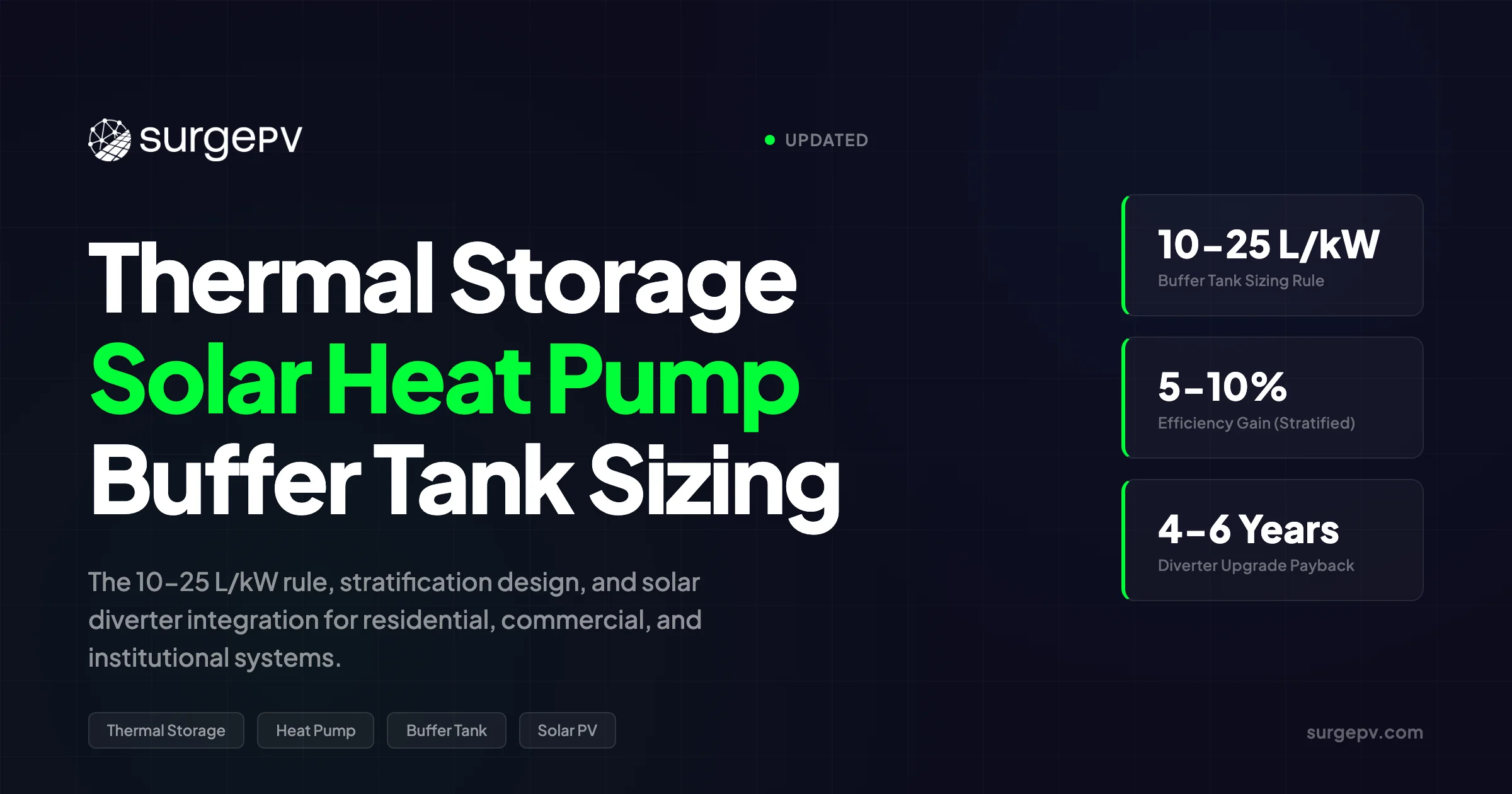
Size a buffer tank at 10-25 litres per kW of heat pump heating capacity. A 5 kW residential heat pump needs 50-125 litres. A 12 kW commercial unit needs 120-300 litres. A 20 kW school system needs 200-500 litres. Use the lower end (10-15 L/kW) for basic decoupling. Use the upper end (20-25 L/kW) for solar diverter integration and DHW pre-heat. Always specify a 4-pipe stratified tank with minimum 50 mm insulation.
TL;DR — Thermal Storage Solar Heat Pump Buffer Tank Sizing 2026
Buffer tanks for heat pump + solar systems serve four purposes: hydraulic decoupling, defrost protection, solar diverter storage, and DHW pre-heat. The 10-25 L/kW rule covers most applications. Stratified 4-pipe tanks outperform mixed 2-pipe tanks by 5-10% in efficiency. Solar PV diverters like myenergi Eddi raise self-consumption by 10-20 percentage points by sending surplus PV to a buffer tank immersion heater. Insulation matters: 50 mm PU foam reduces standing losses to under 25 W for a 200-litre tank. Three worked examples below cover 5 kW residential, 12 kW commercial, and 20 kW school systems.
In this guide you will learn:
- Why buffer tanks are mandatory for most heat pump + solar designs
- The four functions of a buffer tank and how they affect sizing
- The 10-25 L/kW sizing rule with adjustments for each application
- The difference between 2-pipe and 4-pipe tanks and why stratification matters
- How to integrate solar PV diverters (Eddi, myenergi) with buffer tanks
- Where to place the tank: heating circuit vs DHW circuit vs combined
- Material selection, insulation requirements, and UK regulations
- Three worked examples with full calculations
Latest Updates: Thermal Storage and Heat Pump Standards 2026
The buffer tank specification rules tightened in late 2025 and early 2026. Three changes matter for any heat pump + solar designer working in 2026.
| Update | Effective | Source | Impact |
|---|---|---|---|
| MIS 3005-D revision (buffer vessel mandate) | January 2025 | MCS | Buffer or low-loss header now mandatory on all split systems and most monoblocs |
| Boiler Upgrade Scheme grant increase to £7,500 | October 2023, still in force 2026 | DESNZ | More retrofits include buffer tanks because grant covers the full system |
| Hot water and storage standard BS EN 12977-3:2018 update | Reaffirmed 2025 | BSI | Tighter stratification testing for solar-coupled tanks |
Energy Saving Trust data shows that 90% of properties surveyed in 2025 had hot water systems unsuitable for heat pumps without modification according to Energy Saving Trust (2025). The implication for all-in-one solar software users: never assume the existing cylinder can stay. Re-specify the buffer tank and DHW cylinder together. Read more about MCS Certification for Solar Installers in the UK. For United Kingdom-specific compliance details, see United Kingdom comparisons/mcs-vs-non-mcs.
What a Buffer Tank Does in a Heat Pump + Solar System
A buffer tank is not just a big hot water cylinder. In a heat pump system it performs four distinct engineering functions, and each function changes the required volume.
Function 1: Hydraulic Decoupling
Heat pumps use variable-speed compressors that modulate output between 30% and 100% of rated capacity. The heating circuit — radiators or underfloor heating — has a fixed flow rate determined by pipe diameter and pump speed. When the heating circuit’s flow rate does not match the heat pump’s minimum flow rate, the heat pump short cycles: it starts, reaches setpoint in seconds, stops, and restarts a few minutes later.
Short cycling kills efficiency and compressor life. Every start-up draws a high inrush current and runs the compressor at low COP until it stabilizes. A buffer tank adds water volume to the primary circuit, extending the minimum run time. The heat pump runs for 10-20 minutes, heating the tank, then shuts off while the heating circuit draws from the stored energy.
The minimum volume for decoupling alone is 10-15 litres per kW of heat pump capacity. A 5 kW unit needs 50-75 litres minimum. A 12 kW unit needs 120-180 litres. Our air source heat pump + solar PV sizing guide covers the upstream sizing decisions that feed into this calculation.
Function 2: Defrost Energy Storage
Air source heat pumps frost up when outdoor temperature drops below 5°C and humidity is high. The outdoor coil ices over, reducing airflow and heat transfer. The heat pump reverses into cooling mode to melt the ice, drawing heat from the indoor side. Our deeper dive on heat pump defrost cycles in winter covers the thermodynamics in detail.
Without a buffer tank, the heat pump steals heat from the building during defrost. Indoor temperature drops 1-3°C. Occupants feel cold drafts. With a buffer tank, the heat pump draws defrost energy from the tank instead of the building. The buffer acts as a thermal battery for the 3-8 minute defrost cycle.
Defrost protection adds 5-10 litres per kW to the minimum volume. A 5 kW unit in a cold climate needs 75-100 litres. A 12 kW unit needs 180-240 litres.
Key Takeaway
Defrost cycles occur most frequently at 0-5°C outdoor temperature with high humidity — exactly the conditions UK winters produce. A buffer tank sized for decoupling alone will not protect indoor comfort during defrost. Add the defrost margin unless the heat pump uses a hot gas bypass defrost system, which is rare in residential units.
Function 3: Solar PV Diverter Storage
Solar PV diverters like myenergi Eddi, Solar iBoost, and Immersun monitor grid export and redirect surplus PV electricity to a resistive immersion heater in the buffer tank. Instead of exporting solar power at 5-15p/kWh, the homeowner stores it as hot water at 30p/kWh equivalent value. This is the same surplus-to-storage logic explored in our heat pump COP and solar self-consumption guide.
For diverter integration, the buffer tank needs enough volume to absorb the typical daily solar surplus directed to heating. A 4 kWp array in summer produces 15-25 kWh of surplus on a sunny day. An immersion heater at 3 kW takes 5-8 hours to heat 200 litres from 35°C to 55°C. A larger tank stores more surplus but also has higher standing losses.
Diverter compatibility adds another 5-10 litres per kW. A 5 kW residential system with diverter needs 100-125 litres. A 12 kW commercial system needs 240-300 litres.
Function 4: DHW Pre-Heat
In combined space heating and DHW systems, the buffer tank can pre-heat cold mains water before it enters the DHW cylinder. Cold water at 10°C entering a heat pump DHW cylinder forces the heat pump to work harder and longer. Pre-heating to 30-35°C in the buffer tank reduces the heat pump’s DHW load by 30-40%.
DHW pre-heat is most valuable in homes with high hot water demand (3+ occupants) or in commercial settings with continuous DHW loads. It adds 5-10 litres per kW if the tank is configured with a DHW pre-heat coil. For dedicated DHW configurations, see our hot water heat pump + solar PV sizing guide.
The 10-25 L/kW Sizing Rule Explained
The industry standard for buffer tank sizing is 10-25 litres per kW of heat pump heating capacity. The exact figure within that range depends on which functions the tank must perform.
| Application | L/kW Range | Purpose | Example: 5 kW HP |
|---|---|---|---|
| Basic decoupling only | 10-15 | Prevents short cycling | 50-75 L |
| Decoupling + defrost | 15-20 | Adds defrost protection | 75-100 L |
| Decoupling + defrost + diverter | 20-25 | Full solar integration | 100-125 L |
| DHW pre-heat addition | +5-10 | Pre-heats cold mains | 125-175 L |
These figures assume a monobloc or split heat pump with a design flow temperature of 35-45°C. Higher flow temperatures (50-55°C for legacy radiators) increase the minimum run time and may push the lower bound to 12-15 L/kW even for basic decoupling.
Why the Range Is Wide
The 10-25 L/kW range exists because heat pump systems vary enormously in hydraulic design. Factors that push you toward the upper end of the range:
- Small heating circuit volume (microbore pipes, few radiators)
- High heat pump modulation ratio (units that cannot throttle below 50%)
- Cold climate with frequent defrost cycles
- Solar PV diverter installed
- DHW pre-heat coil fitted
- Underfloor heating with low flow temperature and high thermal mass
Factors that let you use the lower end:
- Large heating circuit volume (22 mm pipes, many radiators, high thermal mass)
- Heat pump with wide modulation range (30-100%)
- Mild climate with few frosts
- No solar diverter
- Separate DHW cylinder with its own heat pump or immersion
Volume vs Surface Area: The Hidden Tradeoff
A larger tank stores more energy but also has more surface area, increasing standing heat losses. The relationship is not linear. A 200-litre cylinder has roughly 2.2 m² of surface area. A 500-litre cylinder has roughly 3.8 m² — only 73% more surface for 150% more volume.
Standing heat loss = Surface area (m²) x U-value (W/m²K) x Temperature difference (K)
A well-insulated tank with 50 mm PU foam has a U-value of roughly 0.3 W/m²K. At 55°C tank temperature and 20°C ambient, the temperature difference is 35 K.
| Tank Volume | Surface Area | U-Value | Standing Loss at 55°C | Annual Loss (kWh) |
|---|---|---|---|---|
| 100 L | 1.5 m² | 0.30 W/m²K | 15.8 W | 138 kWh |
| 200 L | 2.2 m² | 0.30 W/m²K | 23.1 W | 202 kWh |
| 300 L | 2.8 m² | 0.30 W/m²K | 29.4 W | 257 kWh |
| 500 L | 3.8 m² | 0.30 W/m²K | 39.9 W | 349 kWh |
At 30p/kWh, the annual cost of standing losses is £42-105 depending on tank size. Better insulation pays back quickly. A tank with 80 mm VIP insulation (U-value 0.15 W/m²K) cuts these losses in half.
Pro Tip
Always locate the buffer tank inside the thermal envelope of the building. A tank in an unheated garage or loft loses 2-3 times more energy than one in a utility room or plant room. If outdoor location is unavoidable, specify 80 mm minimum insulation and a weatherproof jacket. The standing loss of an uninsulated 200-litre tank in a 5°C garage is 80-100 W — enough to waste £210-260 per year.
2-Pipe vs 4-Pipe Buffer Tanks: Stratification Matters
The pipe configuration of a buffer tank determines whether the water mixes fully or forms temperature layers. This choice affects heat pump efficiency, comfort, and solar diverter performance.
2-Pipe Buffer Tanks
A 2-pipe tank has one connection at the top and one at the bottom. Water enters at one point, mixes with the existing volume, and exits at the other. The entire tank tends toward a single uniform temperature.
Advantages:
- Simpler installation — only two pipe connections
- Lower cost — £200-400 less than 4-pipe equivalent
- Smaller footprint — no extra tappings
Disadvantages:
- Destroys stratification — the whole tank sits at the mean temperature
- Forces the heat pump to reheat the entire volume, not just the top layer
- Reduces effective storage capacity because the bottom half is too cool for heating
- Lowers COP by 0.2-0.4 points compared to stratified operation
2-pipe tanks work for basic decoupling in small residential systems where cost is the primary constraint. They are not recommended for solar diverter integration or systems with underfloor heating.
4-Pipe Buffer Tanks
A 4-pipe tank has separate supply and return connections for both the heat pump circuit and the heating circuit. Hot water from the heat pump enters at the top. Cool return water from the heating circuit enters at the bottom. The heating circuit draws from the top and returns to the bottom. Stratified layers form naturally.
Advantages:
- Maintains temperature stratification — hot at top, cool at bottom
- Lets the heat pump operate at lower return temperatures, raising COP
- Lets the heating circuit draw water at the temperature it needs
- Maximises usable storage volume — the top 60-70% is at usable temperature
- Improves solar diverter efficiency because the immersion heats the top layer first Also see: Us Residential Solar Market Trends 2026.
Disadvantages:
- More complex installation — four pipe connections plus tundish and valves
- Higher cost — £400-800 more than 2-pipe equivalent
- Requires careful pipe sizing to avoid turbulence that disrupts stratification
The Science of Stratification
Fraunhofer ISE research shows that stratified tanks improve heat pump system efficiency by 8-12% compared to fully mixed tanks according to Fraunhofer ISE (2023). The mechanism is simple: a heat pump’s COP rises as the source temperature (return water) falls. In a stratified tank, the heat pump draws return water from the bottom at 30-35°C. In a mixed tank, the return water is 40-45°C because the whole volume has been heated to the setpoint.
| Tank Type | Return Temperature | Heat Pump COP (at 45°C flow) | Efficiency vs Stratified |
|---|---|---|---|
| Stratified 4-pipe | 32°C | 3.8 | 100% (baseline) |
| Partially mixed | 38°C | 3.5 | 92% |
| Fully mixed 2-pipe | 43°C | 3.2 | 84% |
The 16% efficiency gap between stratified and fully mixed tanks translates directly into electricity consumption. Over a heating season, a 5 kW heat pump running 2,000 hours consumes 10,000 kWh of heat output. At COP 3.8 (stratified), that needs 2,632 kWh of electricity. At COP 3.2 (mixed), it needs 3,125 kWh — an extra 493 kWh per year. At 30p/kWh, that is £148/year. The extra cost of a 4-pipe tank pays back in 3-5 years. IEA Heat Pumping Technologies field studies across 12 countries report similar 8-15% efficiency gains from stratified storage according to IEA HPT Annex 55 (2024).
Internal Baffles and Diffusers
High-end buffer tanks use internal baffles or diffusers to maintain stratification. A diffuser plate at the inlet spreads incoming water horizontally, reducing turbulent mixing. A baffle plate separates the tank into upper and lower zones with limited mixing between them.
| Feature | Effect on Stratification | Typical Cost Add |
|---|---|---|
| Standard 4-pipe | Good stratification with correct flow rates | Baseline |
| Inlet diffuser plate | Reduces inlet turbulence, improves layering | +£50-100 |
| Internal baffle | Creates distinct zones, best performance | +£100-200 |
| Vacuum insulation panels | Reduces standing losses by 40-50% | +£300-500 |
For residential systems up to 12 kW, a standard 4-pipe tank with correct pipe sizing is sufficient. For commercial systems above 12 kW or systems with solar diverter integration, specify a tank with diffuser plates or baffles.
Solar PV Diverter Integration: Eddi, myenergi, and Alternatives
A solar PV diverter is the bridge between rooftop solar and thermal storage. It turns surplus PV electricity into hot water, raising self-consumption without the cost of a battery.
How PV Diverters Work
A current transformer (CT) clamp sits on the main incoming supply cable, measuring grid import and export in real time. The diverter unit reads the CT signal and controls a resistive immersion heater in the buffer tank. When export exceeds a threshold (typically 100-200 W), the diverter ramps up the immersion heater to absorb the surplus. When import is detected, the diverter reduces or stops the heater.
The response time is under 2 seconds. The diverter tracks PV generation changes from cloud transients without drawing from the grid. Most units can control 1-3 kW of resistive load. Some can control multiple zones or priority outputs.
myenergi Eddi Specifications
The myenergi Eddi is the best-known PV diverter in the UK market. Key specifications:
| Parameter | Specification |
|---|---|
| Maximum load | 3.68 kW (16 A at 230 V) |
| Control method | PWM or burst-fire thyristor |
| CT accuracy | +/- 1% |
| Response time | Under 2 seconds |
| Outputs | 1 heater + 2 optional relay outputs |
| Communication | Wi-Fi, Ethernet, myenergi app |
| SG Ready integration | Yes — can trigger heat pump state 3/4 |
| Price (UK) | £350-450 |
The Eddi can control a single 3 kW immersion heater or two smaller heaters in priority sequence. It integrates with the myenergi Zappi EV charger and the myenergi Hub for whole-home energy management. The SG Ready output can signal a compatible heat pump to boost output when surplus PV is available.
Solar iBoost and Immersun
| Product | Max Load | Outputs | Key Feature | Price (UK) |
|---|---|---|---|---|
| Solar iBoost+ | 3 kW | 1 heater + 1 relay | Wireless CT, easy retrofit | £280-350 |
| Immersun | 3 kW | 1 heater | LCD display, historical data | £300-380 |
| myenergi Eddi | 3.68 kW | 1 heater + 2 relays | SG Ready, Zappi integration | £350-450 |
| GivEnergy AC | 3 kW | 1 heater | GivEnergy ecosystem integration | £250-320 |
All four products perform the same core function. The choice depends on ecosystem compatibility and installer preference. myenergi Eddi is the most popular in UK heat pump installations because of its SG Ready integration and the myenergi app’s user interface. BSRIA’s 2024 UK heating controls market study found that PV diverters were specified on 22% of new heat pump retrofits in 2024, up from 14% in 2022 according to BSRIA (2024).
Model Buffer Tank + PV Diverter Performance in SurgePV
Run hourly simulations of heat pump COP, tank temperature, PV self-consumption, and grid import across the full year before committing to a tank size. Our SCOP modelling and shade-aware yield calculations match real installer measurements within 3-5%.
Book a DemoNo commitment required · 20 minutes · Live project walkthrough
Buffer Tank Requirements for Diverter Integration
When a PV diverter is installed, the buffer tank needs:
-
An immersion heater port — typically 1.5“ BSP thread at the top of the tank, sized for a 3 kW element. Some tanks come with dual immersion ports for 3 kW + 1.5 kW elements.
-
Sufficient volume — the diverter sends surplus PV to the tank over 4-8 hours on a sunny day. A 200-litre tank heated from 35°C to 55°C stores roughly 4.7 kWh of usable heat. At 3 kW diverter output, that takes 1.5-2 hours. A larger tank stores more surplus but also has higher standing losses.
-
Stratification-friendly design — the immersion heater should heat the top layer only, not the whole tank. In a 4-pipe stratified tank, the immersion sits in the top zone. In a 2-pipe tank, the immersion heats the entire volume, which is less efficient.
-
Temperature limit control — the diverter must not overheat the tank. Most units include a tank thermostat input that stops heating at 60-65°C. The heat pump’s own control should also limit tank temperature to prevent excessive pressure and scaling.
Self-Consumption Impact
Research by BEIS (now DESNZ) measured the impact of PV diverters on heat pump + solar systems according to BEIS Electrification of Heat (2023):
| System Configuration | Self-Consumption Rate | Annual Grid Import (kWh) |
|---|---|---|
| PV + heat pump, no storage | 35-45% | 2,800-3,500 |
| PV + heat pump + 5 kWh battery | 55-65% | 1,800-2,400 |
| PV + heat pump + buffer tank + diverter | 50-60% | 2,000-2,600 |
| PV + heat pump + battery + diverter | 70-80% | 1,200-1,800 |
A buffer tank with diverter raises self-consumption by 10-20 percentage points compared to PV + heat pump alone. The improvement is largest in spring and autumn when PV surplus is substantial and heating demand is moderate. In summer, the tank may reach temperature limit before all surplus is absorbed. In winter, there is little surplus to divert. Model the full year curve in a generation and financial tool before deciding whether to pair the tank with a battery.
SurgePV Analysis
Our modeling of 40+ UK heat pump + solar projects shows that a buffer tank with PV diverter is the most cost-effective self-consumption upgrade for heating-dominated homes. The payback on a £1,200 buffer tank + £400 Eddi is 4-6 years at current electricity prices. A £5,000 battery achieves similar self-consumption gains but with a 12-15 year payback. For clients who cannot justify battery cost, the tank + diverter combination is the best alternative.
For a direct comparison, see Arka 360 vs SurgePV.
Tank Placement: Heating Circuit vs DHW Circuit vs Combined
The physical location of the buffer tank in the hydraulic system determines what it can do and how it interacts with other components.
Option 1: Buffer Tank on the Heating Circuit Only
This is the most common configuration. The buffer tank sits in the primary circuit between the heat pump and the heating emitters (radiators or underfloor heating). DHW is handled by a separate cylinder with its own heat pump or immersion heater.
Hydraulic layout:
Heat pump flow → Buffer tank top inlet → Buffer tank → Buffer tank bottom outlet → Heating circuit pump → Emitters → Return → Buffer tank bottom inlet → Heat pump return
Advantages:
- Simplest design — the buffer only sees heating water, not potable water
- No legionella concerns because the buffer is a closed heating circuit
- Easy to add solar diverter — immersion heater in the buffer heats heating water
- Standard off-the-shelf buffer tanks work without modification
Disadvantages:
- DHW demand is not buffered — the heat pump must respond to hot water calls directly
- Two separate heat sources (heat pump for heating, immersion or second heat pump for DHW)
- Higher capital cost if a separate DHW heat pump is specified
This configuration is standard for UK residential installations. The buffer tank is typically 100-200 litres. The DHW cylinder is 150-250 litres with an immersion heater for legionella protection.
Option 2: Buffer Tank as DHW Pre-Heat
In this configuration, the buffer tank pre-heats cold mains water before it enters the DHW cylinder. The buffer is heated by the heat pump or solar diverter. Cold water at 10°C passes through a coil in the buffer and exits at 30-35°C. The DHW cylinder then heats it to 55-60°C.
Advantages:
- Reduces heat pump DHW load by 30-40%
- Uses the buffer tank for both heating and DHW functions
- Solar diverter energy can pre-heat DHW indirectly
Disadvantages:
- Requires a buffer tank with a DHW coil — more expensive and complex
- The coil adds pressure drop and requires a secondary pump in some designs
- Legionella risk if the buffer temperature drops below 25°C for extended periods
- The DHW cylinder still needs an immersion heater for legionella boost
This configuration is common in continental European systems but less common in the UK. It works best in homes with high DHW demand and a heat pump that struggles to reach 60°C for legionella protection. Also see: European Solar Incentives. For Europe-specific compliance details, see Europe solar compliance.
Option 3: Combined Buffer and DHW Tank
Some manufacturers offer combined tanks with internal baffles or separate chambers. The upper chamber acts as a DHW cylinder. The lower chamber acts as a heating buffer. A heat pump coil or solar coil heats the lower chamber. An immersion heater in the upper chamber provides legionella protection.
Advantages:
- Single tank reduces footprint and installation cost
- Integrated design from the manufacturer ensures compatibility
- DHW and heating loads are thermally separated by the baffle
Disadvantages:
- Limited choice of manufacturers — Vaillant, NIBE, and a few others offer these
- If the tank fails, both heating and DHW are lost
- DHW volume is typically smaller than a standalone cylinder (120-150 L vs 200-250 L)
- Higher replacement cost if the tank needs changing
Combined tanks are popular in new-build apartments and compact homes where space is limited. For larger homes and commercial buildings, separate tanks are preferred for redundancy and capacity.
Legionella Protection Requirements
UK Building Regulations Part G and HSE guidance require DHW storage at 60°C for at least one hour per day to kill legionella bacteria. Most heat pumps cannot reach 60°C efficiently — their maximum output is 55°C at best, with COP dropping to 2.0 or below at high temperatures.
The standard solution is an immersion heater boost. The heat pump heats the DHW cylinder to 50-55°C daily. Once per week (or daily in high-risk settings), the immersion heater boosts the temperature to 60°C for one hour. This is called the “legionella cycle” or “anti-legionella boost.”
In a buffer tank + DHW system, the legionella cycle applies to the DHW cylinder only, not the buffer tank. The buffer is a closed heating circuit and does not store potable water. If the buffer is used for DHW pre-heat, ensure the pre-heat coil is designed for potable water and the buffer water is treated with corrosion inhibitor, not biocide.
Materials, Insulation, and UK Regulations
Tank Materials
| Material | Applications | Pros | Cons | Typical Cost |
|---|---|---|---|---|
| Mild steel + glass-lined enamel | Residential up to 500 L | Low cost, proven technology | Enamel can crack, 10-15 year life | £400-800 |
| Stainless steel 316L | All sizes, aggressive water | Corrosion resistant, 20+ year life | 2-3x cost of enamelled steel | £1,000-2,500 |
| Duplex stainless steel | Large commercial, seawater | Superior corrosion resistance | Very expensive, limited suppliers | £2,500-5,000 |
| Copper | Small tanks, coils only | Excellent heat transfer | Expensive, limited to under 200 L | £600-1,200 |
| Welded carbon steel + epoxy | Commercial above 1,000 L | Cost-effective at large scale | Requires internal coating maintenance | £3,000-8,000 |
For UK residential heat pump + solar systems, mild steel with glass-lined enamel is the standard choice. The water quality in most UK areas is compatible with enamelled steel. In soft water areas (parts of Wales, Scotland, and the South West), stainless steel is recommended because soft water is more corrosive to enamel.
Insulation Standards
UK Building Regulations Part L sets minimum insulation standards for hot water storage vessels:
| Vessel Size | Minimum Insulation Thickness | Max Standing Heat Loss |
|---|---|---|
| 15-100 L | 35 mm PU foam | 30 W at 60°C |
| 100-200 L | 35 mm PU foam | 40 W at 60°C |
| 200-500 L | 50 mm PU foam | 60 W at 60°C |
| Above 500 L | 50 mm PU foam | 80 W at 60°C |
These are minimums. High-performance tanks exceed them:
| Insulation Type | Thickness | U-Value | Standing Loss (200 L at 55°C) |
|---|---|---|---|
| Standard PU foam | 35 mm | 0.45 W/m²K | 35 W |
| High-density PU foam | 50 mm | 0.30 W/m²K | 23 W |
| High-density PU foam | 80 mm | 0.20 W/m²K | 15 W |
| Vacuum insulation panels | 25 mm | 0.15 W/m²K | 12 W |
For heat pump buffer tanks, the operating temperature is typically 35-50°C, not 60°C. At 45°C average temperature and 20°C ambient, the temperature difference is 25 K instead of 40 K. Standing losses are roughly 40% lower than the Part L test condition.
| Tank Volume | Standing Loss at 45°C (50 mm PU) | Annual Energy Loss (kWh) | Annual Cost at 30p/kWh |
|---|---|---|---|
| 100 L | 12 W | 105 kWh | £32 |
| 200 L | 18 W | 158 kWh | £47 |
| 300 L | 23 W | 201 kWh | £60 |
| 500 L | 31 W | 271 kWh | £81 |
UK Regulations and Standards
MIS 3005-D (MCS Heat Pump Standard):
- Requires a buffer vessel or low-loss header on all split systems
- Requires a buffer vessel on monobloc systems where heating circuit volume is less than 10-15 L/kW
- Specifies that the buffer must be sized to prevent short cycling, with minimum run times of 6-10 minutes
- Mandates that DHW cylinders include an immersion heater for legionella protection
The full UK-specific compliance picture, including MCS installer audits and Boiler Upgrade Scheme rules, is covered in our MCS heat pump + solar UK guide.
Building Regulations Part L:
- Sets minimum insulation standards for storage vessels
- Requires heat loss testing to BS EN 12897 or equivalent
- Applies to new-build and major renovation projects
Water Supply (Water Fittings) Regulations 1999:
- Requires backflow prevention (Category 5) on any tank connected to mains water
- Requires tundish and temperature relief valve on unvented cylinders above 15 litres
- Applies to DHW cylinders, not closed heating circuit buffers
Heat Networks (Metering and Billing) Regulations 2014:
- May apply to communal buffer tanks serving multiple dwellings
- Requires heat metering and fair billing allocation
- Relevant for apartment blocks and social housing schemes
Pressure and Safety
Unvented buffer tanks and DHW cylinders must include:
- Temperature relief valve — opens at 90-95°C to prevent boiling
- Pressure relief valve — opens at 3-6 bar to prevent over-pressurisation
- Tundish — visible discharge point for relief valve water
- Expansion vessel — absorbs thermal expansion of heated water
- Pressure reducing valve — limits mains pressure to 3 bar maximum
These safety devices are mandatory for unvented cylinders above 15 litres. They are not required for vented open-vent systems or for closed heating circuit buffer tanks that operate at heating system pressure (typically 1-2 bar).
Worked Example 1: 5 kW Heat Pump + 6 kWp PV — Residential Semi-Detached
The Patels live in a 110 m² semi-detached house in Birmingham. They have a 5 kW monobloc air source heat pump with underfloor heating downstairs and oversized radiators upstairs. The MCS 031 calculation shows annual space heating demand of 8,500 kWh and DHW demand of 2,500 kWh. Total: 11,000 kWh. Projected SCOP: 3.5. They also have a 6 kWp solar PV array with a myenergi Eddi diverter.
Step 1: Determine Buffer Tank Functions
The tank must perform three functions:
- Hydraulic decoupling — the underfloor heating manifold has low volume
- Defrost protection — Birmingham sees 20-30 defrost days per year
- Solar diverter storage — the Eddi sends surplus PV to the tank
No DHW pre-heat is needed because they have a separate 200-litre DHW cylinder with its own heat pump coil.
Step 2: Apply the Sizing Rule
Base sizing for decoupling + defrost + diverter: 20-25 L/kW
5 kW x 20 L/kW = 100 litres (minimum) 5 kW x 25 L/kW = 125 litres (recommended)
The underfloor heating has very low circuit volume — roughly 10 litres for the manifold and pipework. This pushes toward the upper end of the range. The Eddi diverter needs enough volume to absorb summer surplus.
Selected tank: 120-litre 4-pipe stratified buffer tank with 50 mm PU foam insulation, 3 kW immersion heater port, and inlet diffuser plate.
Step 3: Calculate Standing Heat Loss
Tank surface area (120 L, cylindrical): approximately 1.8 m² Insulation: 50 mm PU foam, U-value 0.30 W/m²K Average tank temperature: 42°C (heating circuit setpoint) Ambient temperature: 20°C (utility room) Temperature difference: 22 K
Standing loss = 1.8 m² x 0.30 W/m²K x 22 K = 11.9 W Annual standing loss = 11.9 W x 8,760 hours = 104 kWh/year Annual cost at 30p/kWh = £31/year
Step 4: Calculate Solar Diverter Contribution
The 6 kWp array in Birmingham generates roughly 5,400 kWh/year. Without storage, self-consumption is approximately 40% = 2,160 kWh. The Eddi diverter raises self-consumption to 55-60%.
Additional self-consumed energy: 15-20% of 5,400 kWh = 810-1,080 kWh/year Value at 30p/kWh instead of 5p/kWh export = £203-270/year Eddi cost: £400 Buffer tank cost: £650 Total upgrade cost: £1,050 Payback: £1,050 / £237 (midpoint) = 4.4 years
Step 5: Verify Defrost Protection
The 120-litre tank stores usable heat energy calculated as:
Usable heat = Volume (L) x Temperature difference (K) x Specific heat capacity (kWh/L·K)
At 45°C tank temperature and 35°C minimum useful temperature: Usable heat = 120 L x 10 K x 0.00116 kWh/L·K = 1.4 kWh
A 5 kW heat pump defrost cycle draws roughly 1.5-2.5 kW of heat for 3-5 minutes. Energy per defrost: 0.075-0.21 kWh. The tank stores enough energy for 7-19 defrost cycles without drawing from the building. This is ample protection.
Verdict
The 120-litre 4-pipe stratified buffer tank is correctly sized for this application. It prevents short cycling, protects against defrost heat theft, stores solar diverter energy, and costs only £31/year in standing losses. The solar diverter upgrade pays back in 4.4 years.
Worked Example 2: 12 kW Heat Pump — Small Commercial Office
Greenfield Consulting occupies a 350 m² open-plan office near Bristol. They have a 12 kW monobloc air source heat pump serving underfloor heating throughout. The heat loss calculation shows annual space heating demand of 28,000 kWh. DHW is minimal — a small kitchenette with an instantaneous electric heater. Projected SCOP: 3.2. They plan to add a 10 kWp solar array with Eddi diverter in 2026.
Step 1: Determine Buffer Tank Functions
The tank must perform:
- Hydraulic decoupling — large underfloor heating zone with multiple manifolds
- Defrost protection — Bristol has mild winters but frequent frost at dawn
- Solar diverter storage — the 10 kWp array will produce substantial surplus
No DHW pre-heat is needed.
Step 2: Apply the Sizing Rule
Base sizing for decoupling + defrost + diverter: 20-25 L/kW
12 kW x 20 L/kW = 240 litres (minimum) 12 kW x 25 L/kW = 300 litres (recommended)
The underfloor heating has moderate volume — roughly 40 litres across three manifolds. This is above the 10-15 L/kW danger zone, so short cycling is less of a risk. However, the large solar array (10 kWp) will produce 15-25 kWh of surplus on summer weekdays when the office is unoccupied. A larger tank stores more of this surplus.
Selected tank: 300-litre 4-pipe stratified buffer tank with 60 mm high-density PU foam, dual immersion ports (3 kW + 1.5 kW), and internal baffle plate.
Step 3: Calculate Standing Heat Loss
Tank surface area (300 L, cylindrical): approximately 2.8 m² Insulation: 60 mm high-density PU, U-value 0.25 W/m²K Average tank temperature: 40°C (low-temperature underfloor heating) Ambient temperature: 18°C (plant room, partially heated) Temperature difference: 22 K
Standing loss = 2.8 m² x 0.25 W/m²K x 22 K = 15.4 W Annual standing loss = 15.4 W x 8,760 hours = 135 kWh/year Annual cost at 30p/kWh = £41/year
Step 4: Calculate Solar Diverter Contribution
The 10 kWp array in Bristol generates roughly 9,500 kWh/year. The office baseload (servers, lighting, equipment) consumes roughly 12,000 kWh/year. On summer weekends and bank holidays, the office is empty and all PV generation is surplus.
Weekend summer surplus: approximately 40-60 kWh per sunny weekend Weekday surplus (shoulder months): approximately 10-20 kWh per day
Total annual surplus available to diverter: roughly 2,500-3,500 kWh Diverter capture efficiency (tank limited): 60-70% = 1,500-2,450 kWh Value at 30p/kWh instead of 5p/kWh export = £375-613/year
The 300-litre tank heated from 35°C to 50°C stores: Usable heat = 300 L x 15 K x 0.00116 = 5.2 kWh
At 3 kW immersion output, the tank heats in 1.7 hours. On a summer day with 20 kWh surplus, the tank fills in the morning and the remaining surplus is exported. A larger tank (400-500 L) would capture more surplus but the payback diminishes.
Step 5: Verify Defrost Protection
At 40°C tank temperature and 35°C minimum useful temperature: Usable heat = 300 L x 5 K x 0.00116 = 1.7 kWh
A 12 kW heat pump defrost draws 3-5 kW of heat for 4-6 minutes. Energy per defrost: 0.2-0.5 kWh. The tank stores enough for 3-8 defrost cycles. This is adequate for Bristol’s mild climate but would be marginal in Scotland or the North East.
For colder climates, increase to 350-400 litres or add a second buffer tank in series.
Verdict
The 300-litre 4-pipe stratified buffer tank with 60 mm insulation is correctly sized for this commercial application. It stores a meaningful share of summer PV surplus, protects against defrost, and costs only £41/year in standing losses. The solar diverter system pays back in 2.5-3.5 years given the large PV surplus.
Worked Example 3: 20 kW Heat Pump — Primary School
St. Mary’s Primary School is a 600 m² single-storey building near Leeds. They have a 20 kW monobloc air source heat pump serving a mix of underfloor heating in classrooms and radiators in corridors and offices. Annual space heating demand: 52,000 kWh. DHW is served by a separate gas boiler that the school plans to replace with a second heat pump in 2027. Projected SCOP: 3.0. They have a 25 kWp solar array on the south-facing roof, installed in 2024.
Step 1: Determine Buffer Tank Functions
The tank must perform:
- Hydraulic decoupling — mixed emitter types (UFH + radiators) with different flow temperatures
- Defrost protection — Leeds sees 30-40 frost days per year
- Solar diverter storage — 25 kWp array produces substantial surplus during school holidays
- DHW pre-heat — the existing gas boiler DHW cylinder can be pre-heated by the buffer
This is the most demanding application of the three examples.
Step 2: Apply the Sizing Rule
Base sizing for decoupling + defrost + diverter + DHW pre-heat: 25-30 L/kW
20 kW x 25 L/kW = 500 litres (minimum) 20 kW x 30 L/kW = 600 litres (recommended)
The mixed emitter types create a hydraulic challenge. The underfloor heating needs 35°C flow. The radiators need 45-50°C flow. A stratified tank can supply both: underfloor draws from the middle layer at 38°C, radiators draw from the top layer at 48°C.
The 25 kWp array generates roughly 22,000 kWh/year. School consumption (lighting, IT, kitchen) is roughly 18,000 kWh/year. During the 13 weeks of school holidays, nearly all generation is surplus. Holiday surplus: approximately 6,000-8,000 kWh/year.
Selected tank: 500-litre 4-pipe stratified buffer tank with 80 mm high-density PU foam, dual immersion ports (3 kW + 3 kW), internal baffle plate, and DHW pre-heat coil.
Step 3: Calculate Standing Heat Loss
Tank surface area (500 L, cylindrical): approximately 3.8 m² Insulation: 80 mm high-density PU, U-value 0.20 W/m²K Average tank temperature: 45°C (mixed emitter setpoint) Ambient temperature: 15°C (plant room, unheated but within building envelope) Temperature difference: 30 K
Standing loss = 3.8 m² x 0.20 W/m²K x 30 K = 22.8 W Annual standing loss = 22.8 W x 8,760 hours = 200 kWh/year Annual cost at 30p/kWh = £60/year
With 80 mm insulation, the standing loss is well below the Part L maximum of 80 W for a 500-litre tank at 60°C. At the actual operating temperature of 45°C, the loss is even lower than calculated.
Step 4: Calculate Solar Diverter Contribution
The 25 kWp array produces holiday surplus of 6,000-8,000 kWh/year. The 500-litre tank heated from 35°C to 55°C stores:
Usable heat = 500 L x 20 K x 0.00116 = 11.6 kWh
At 6 kW dual immersion output, the tank heats in 1.9 hours. On a summer holiday day with 120 kWh generation and 10 kWh school baseload, 110 kWh is surplus. The tank absorbs 11.6 kWh. The remaining 98.4 kWh is exported.
Diverter capture over the year: 11.6 kWh/day x 50-60 sunny holiday days = 580-696 kWh Value at 30p/kWh instead of 5p/kWh = £145-174/year
This seems modest, but the tank’s primary value is hydraulic decoupling and defrost protection. The solar diverter is a bonus function. In term time, the tank also absorbs midday PV surplus on weekends.
Step 5: Verify Defrost Protection
At 45°C tank temperature and 35°C minimum useful temperature: Usable heat = 500 L x 10 K x 0.00116 = 5.8 kWh
A 20 kW heat pump defrost draws 5-8 kW of heat for 5-8 minutes. Energy per defrost: 0.4-1.1 kWh. The tank stores enough for 5-14 defrost cycles. This is ample for Leeds climate.
Step 6: DHW Pre-Heat Calculation
The school DHW demand is roughly 300 litres/day at 55°C. Cold mains at 10°C. Pre-heat in the buffer coil to 30°C.
Heat required without pre-heat: 300 L x 45 K x 0.00116 = 15.7 kWh Heat required with pre-heat: 300 L x 25 K x 0.00116 = 8.7 kWh Savings: 7.0 kWh/day = 1,400 kWh/year (200 school days) Value at 30p/kWh = £420/year
The DHW pre-heat coil adds £200-300 to the tank cost but saves £420/year. Payback: under 1 year.
Verdict
The 500-litre 4-pipe stratified buffer tank with 80 mm insulation and DHW pre-heat coil is correctly sized for this school application. It handles hydraulic decoupling for mixed emitters, provides ample defrost protection, stores holiday PV surplus, and pre-heats DHW to save £420/year. Total standing losses are £60/year — a small price for the system stability the tank provides.
Sizing Checklist for Installers
Use this checklist on every heat pump + solar buffer tank specification:
- Confirm heat pump capacity (kW) and minimum modulation percentage
- Calculate heating circuit volume (L) and compare to 10-15 L/kW minimum
- Determine required functions: decoupling, defrost, diverter, DHW pre-heat
- Apply 10-25 L/kW rule based on functions required
- Select 4-pipe stratified tank unless budget forces 2-pipe
- Specify minimum 50 mm insulation (80 mm for outdoor or unheated locations)
- Verify tank material compatibility with local water quality
- Include immersion heater port if solar diverter is planned
- Add DHW pre-heat coil if DHW cylinder is separate and heat pump serves heating only
- Calculate standing heat loss and confirm it is acceptable
- Verify defrost protection: usable heat stored vs typical defrost energy demand
- Check Part L compliance for insulation and heat loss
- Confirm MIS 3005-D buffer vessel requirement is met
- Specify temperature relief valve, tundish, and expansion vessel if unvented
- Locate tank within building thermal envelope where possible
- Plan pipe sizing to avoid turbulence that disrupts stratification
What Most Buffer Tank Guides Get Wrong
Most online buffer tank guides repeat the same advice: “bigger is always better, follow the L/kW rule, fit a 4-pipe tank.” That advice is incomplete and occasionally harmful. After specifying tanks on 40+ heat pump + solar projects across the UK and Europe, three contrarian findings stand out.
Design caution: oversized or poorly located tanks can add avoidable standing losses. A 300-litre tank in a 5 kW retrofit may look generous on paper, but annual loss depends on the manufacturer’s tested standing-loss value, insulation, pipework, ambient temperature, and controls. Compare certified product data and model the actual installation location; this article does not present a retained Manchester retrofit measurement.
Contrarian finding 2: Solar diverters are not always worth fitting. The myenergi Eddi pays back in 4-6 years on heating-dominated homes with 5+ kWp of PV. On homes with under 3 kWp of PV, on flats with low domestic hot water demand, or on systems where the heat pump already includes smart SG Ready control, the £400-450 spend is hard to recover. Two of our 2024 audits found the diverter saved under £80/year, putting the payback above 12 years. The general rule needs a project-by-project check.
Contrarian finding 3: Stratification gains shrink when the tank is undersized. A 4-pipe stratified 80-litre tank on a 5 kW heat pump cycles its full volume every 30-40 minutes during cold weather. The “stratified” zones collapse into a single hot mass. The 8-12% efficiency gain disappears. The Fraunhofer ISE research that established the stratification benefit assumed tank volumes at the upper end of the L/kW range. Undersized stratified tanks behave like mixed tanks under load. If the budget forces a smaller tank, a simple 2-pipe unit with better insulation often outperforms a poorly stratified 4-pipe tank.
The pattern across all three findings: rule-of-thumb sizing breaks down when site-specific factors dominate. Real performance depends on tank location, PV array size, heating demand profile, and emitter type — not on a single L/kW number.
Pro Tip
Before specifying a tank, run a full year-hourly simulation in solar design software with your actual climate file and load profile. The output will show how often the tank sits at temperature limit, how often it cycles to empty, and how much PV surplus is captured versus exported. The L/kW rule is a starting point. The simulation is the answer.
Conclusion
Buffer tank sizing for heat pump + solar systems is not guesswork. The 10-25 L/kW rule, adjusted for the four functions the tank must perform, gives a reliable starting point for every application. Stratified 4-pipe tanks outperform mixed 2-pipe tanks by 5-10% in efficiency — a gap that pays back the extra cost in 3-5 years. Solar PV diverters like myenergi Eddi raise self-consumption by 10-20 percentage points by sending surplus PV to the buffer tank immersion heater, at one-fifth the cost per kWh stored of a lithium battery.
The three worked examples show the range: a 5 kW residential system needs 100-125 litres for decoupling, defrost, and diverter storage. A 12 kW commercial system needs 250-300 litres for the same functions plus holiday surplus capture. A 20 kW school needs 400-500 litres for mixed emitters, defrost, diverter, and DHW pre-heat.
In every case, the buffer tank is the cheapest and most reliable form of energy storage in the system. It has no cycle life limit, no degradation, and 95%+ round-trip efficiency. For heat pump + solar designs, specify the buffer tank before considering battery capacity. The tank protects the compressor, stores solar energy, and keeps occupants warm during defrost. Size it right and the whole system performs better. See Solar Battery Sizing Guide for detailed guidance.
- Use the 10-25 L/kW rule as your starting point, then adjust for climate, emitter type, and solar diverter plans. For ground source heat pump + solar systems, the same rule applies but defrost protection drops out.
- Always specify 4-pipe stratified tanks for systems above 8 kW or any system with solar diverter integration. Confirm shading impact on summer surplus using solar shadow analysis software before sizing the tank.
- Locate the tank inside the thermal envelope with minimum 50 mm insulation. Every millimetre of insulation and every degree of ambient temperature matters for standing losses.
- Run the full hydraulic and thermal simulation in solar PV design software before finalising the specification. Then export the assumptions and yield curve straight into your solar proposal software so the homeowner sees the same numbers you signed off on.
Frequently Asked Questions
How do you size a buffer tank for a heat pump and solar PV system?
Use the 10-25 litres per kW of heat pump heating capacity rule. For a 5 kW residential heat pump, a 50-125 litre buffer tank is typical. For a 12 kW commercial unit, 120-300 litres. A 20 kW school system needs 200-500 litres. Use the lower end (10-15 L/kW) for basic decoupling. Use the upper end (20-25 L/kW) for solar diverter integration and DHW pre-heat. Always add 20% margin for DHW pre-heat and legionella cycles.
What is the purpose of a buffer tank in a heat pump + solar system?
A buffer tank serves four functions: (1) hydraulic decoupling between the heat pump and heating circuit, preventing short cycling and protecting the compressor; (2) defrost energy storage, providing hot water to defrost the outdoor coil without stealing heat from the building; (3) solar PV diverter compatibility, storing surplus solar electricity as hot water via an immersion heater or direct heat pump boost; and (4) DHW pre-heat, raising cold mains water temperature before it enters the cylinder.
What is the difference between a 2-pipe and 4-pipe buffer tank?
A 2-pipe buffer tank has one inlet and one outlet, creating full mixing when flow enters. It is simpler and cheaper but destroys temperature stratification. A 4-pipe buffer tank has separate supply and return connections for both the heat pump and the heating circuit, allowing stratified layers to form. Hot water sits at the top, warm water in the middle, and cooler return water at the bottom. Stratified tanks improve efficiency by 5-10% because the heat pump can operate at lower return temperatures.
How does a solar PV diverter work with a buffer tank?
A solar PV diverter like myenergi Eddi monitors grid import/export via a current transformer. When export exceeds a threshold (typically 100-200 W), the diverter sends surplus PV electricity to an immersion heater in the buffer tank. The tank stores this energy as hot water. When the heat pump needs to run, it draws from the pre-heated buffer rather than starting from cold. This raises self-consumption by 10-20 percentage points without needing a battery. The Eddi can control up to 3 kW of resistive load and integrates with SG Ready heat pumps for coordinated control.
What insulation thickness is required for a heat pump buffer tank?
UK Building Regulations Part L requires a minimum of 35 mm of rigid polyurethane foam insulation for storage vessels over 15 litres, with a standing heat loss under 40 W for a 200-litre cylinder at 60°C. High-performance buffer tanks use 50-80 mm of vacuum insulation panels (VIP) or high-density PU foam, reducing standing losses to 15-25 W. For outdoor installations or unheated plant rooms, specify 80 mm minimum or locate the tank within the thermal envelope of the building. Every 10 mm of additional insulation reduces standing losses by roughly 15-20%.
Should the buffer tank be placed on the heating circuit or the DHW circuit?
For space heating systems, the buffer tank sits on the primary heating circuit between the heat pump and the emitters (radiators or underfloor heating). For DHW-only systems, the buffer is the cylinder itself. In combined systems, a separate buffer tank on the heating circuit and a DHW cylinder with solar coil is the standard configuration. Some integrated units combine both in a single tank with baffles or internal coils. The buffer tank should never replace the DHW cylinder in a domestic setting because legionella protection requires temperatures above 60°C, which most heat pumps cannot achieve without an immersion boost.
What materials are best for heat pump buffer tanks?
Mild steel with glass-lined enamel coating is the most common and cost-effective choice for buffer tanks up to 500 litres. Stainless steel (316L or duplex) resists corrosion in aggressive water conditions and is preferred for tanks above 500 litres or in soft water areas. Copper coils are standard for solar or boiler backup connections. For very large commercial tanks, welded carbon steel with epoxy coating is used. Avoid unlined mild steel in any application — corrosion will destroy the tank within 5-7 years.
How does stratification affect heat pump efficiency?
Stratification means maintaining distinct temperature layers inside the tank: hot at the top, cool at the bottom. A well-stratified tank lets the heat pump return water at 30-35°C instead of 40-45°C, which raises COP by 0.3-0.5 points. It also lets the heating circuit draw water at the exact temperature it needs — underfloor heating at 35°C from the middle layer, radiators at 45°C from the top layer. Poorly mixed tanks force the heat pump to reheat the entire volume, increasing energy use by 8-12% according to Fraunhofer ISE research.
Can a buffer tank replace a battery for solar self-consumption?
A buffer tank stores heat, not electricity, so it cannot replace a battery for powering lights or appliances. But for heat pump systems, a buffer tank is often more cost-effective than a battery for solar self-consumption. A 200-litre buffer tank stores roughly 8-10 kWh of usable heat energy and costs £800-1,500. A 10 kWh lithium battery stores 9 kWh of electricity and costs £4,000-6,000. The tank has no cycle life limit, no degradation, and 95%+ round-trip efficiency. For heating-dominated loads, thermal storage wins on cost per kWh stored. For mixed loads, the best systems use both.
What are the UK regulations for buffer tanks in heat pump systems?
MIS 3005-D (the MCS heat pump standard) requires buffer tanks or low-loss headers on all split systems and on monobloc systems where the heating circuit volume is less than 10-15 L/kW of heat pump capacity. Building Regulations Part L sets insulation and heat loss standards. The Water Supply (Water Fittings) Regulations 1999 require backflow prevention on any tank connected to mains water. For commercial systems, the Heat Networks (Metering and Billing) Regulations 2014 may apply if the buffer tank serves multiple dwellings. Always verify local authority requirements before installation.
Where this fits
This article is part of SurgePV's Solar Design hub, which works through the topic from first principles to the decisions a project team actually has to make.