

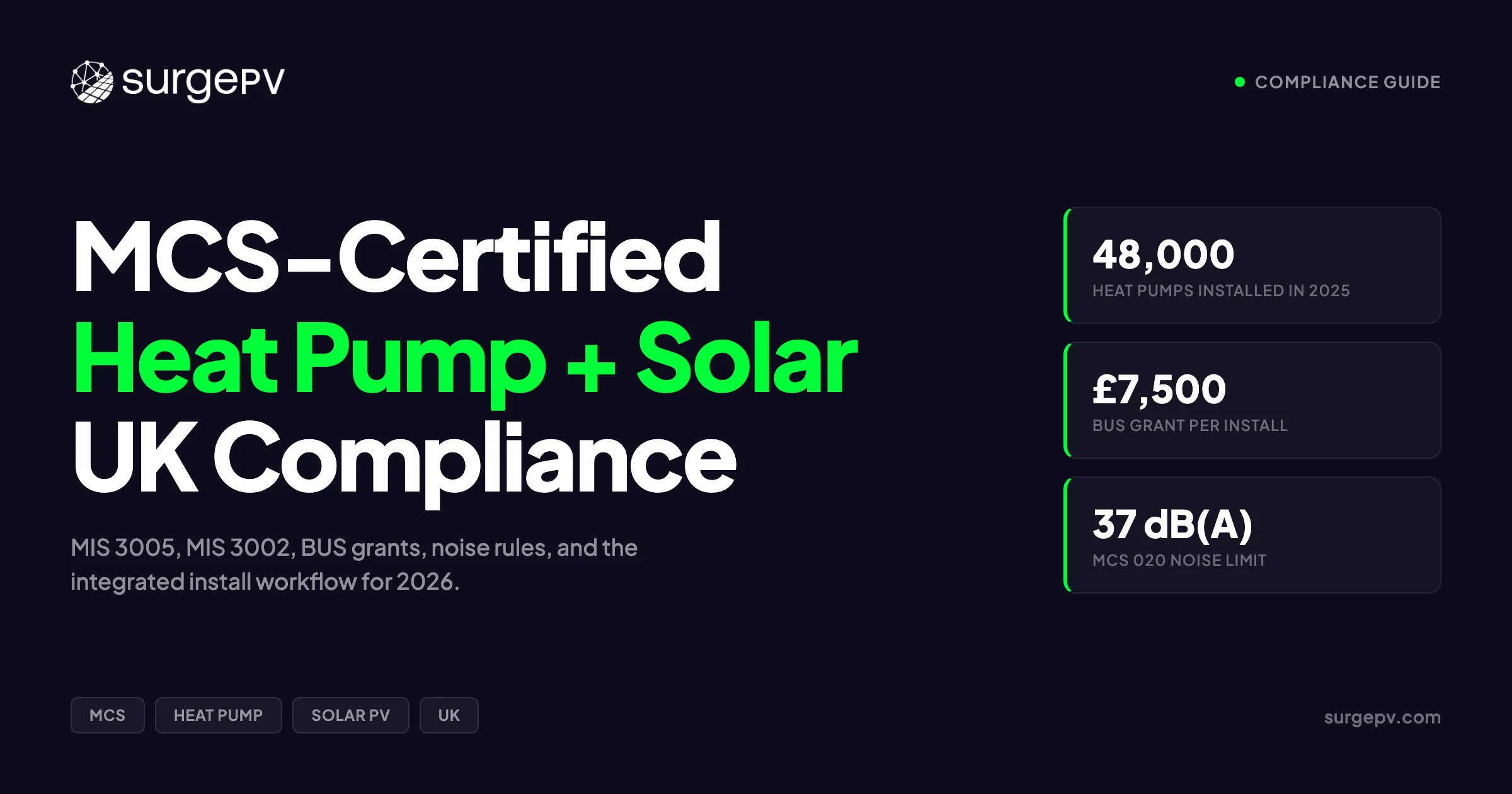
The UK installed 48,000 MCS-certified heat pumps in 2025 — a 47% increase on the previous year. Solar PV installations hit 267,032 in the same period. An increasing share of those projects are not standalone heat pumps or standalone solar arrays. They are integrated systems: rooftop PV feeding a heat pump via a home battery or direct self-consumption, commissioned under MCS standards and funded through the Boiler Upgrade Scheme. For UK-specific information, see Battery Solar System Design UK. For the latest details on UK, see Heritage Building Solar Case Study. For United Kingdom-specific compliance details, see United Kingdom comparisons/mcs-vs-non-mcs.
For installers, this integration creates a compliance problem that most guides do not address cleanly. The heat pump standard (MIS 3005) and the solar PV standard (MIS 3002) are written as standalone documents. The BUS grant application treats the heat pump as the primary technology. But the homeowner experiences one system. Getting the commissioning order wrong, the meter configuration wrong, or the MCS certificate sequence wrong can delay grant payment by weeks or invalidate it entirely.
This guide covers the full compliance workflow for MCS-certified heat pump plus solar installations in the UK in 2026. It explains the standards, the grant rules, the noise requirements, the heat loss calculations, and the real-world commissioning sequence that gets installers paid on time. For UK-specific information, see MCS Certification for Solar Installers in the UK.
Quick Answer
MCS-certified heat pump and solar installations in the UK require compliance with MIS 3005 (heat pumps), MIS 3002 (solar PV), and MCS 020(a) (noise). The £7,500 Boiler Upgrade Scheme grant covers heat pumps paired with existing or new solar PV. Installers must complete BS EN 12831-1:2017 heat loss calculations, provide MCS 020(a) noise assessments, and commission the heat pump before the solar PV to ensure clean meter readings for grant claims.
In this guide:
- What MCS certification covers for combined heat pump and solar systems
- The standards: MIS 3005, MIS 3002, MIS 3001, and MCS 020
- Boiler Upgrade Scheme rules, eligibility, and application steps
- Heat loss calculations under BS EN 12831-1:2017
- Permitted Development Rights and planning constraints
- The integrated PV+HP commissioning workflow
- Common BUS rejection reasons and how to avoid them
- A real installer’s audit checklist (Sarah, Birmingham)
- 2026 schedule changes and what they mean for your business
What MCS Certification Covers for Heat Pump + Solar
MCS is the Microgeneration Certification Scheme. It is an independent, government-backed quality assurance programme for small-scale renewable energy in the UK. The scheme covers solar PV, solar thermal, heat pumps, battery storage, wind, and biomass. For installers working across multiple technologies, MCS operates through a set of interconnected standards that must all be satisfied for a certified installation. See Adding Battery Storage Services for detailed guidance.
The three standards that matter for a combined heat pump and solar project are:
- MIS 3005 — Heat pump systems: design, installation, commissioning, and handover
- MIS 3002 — Solar PV systems: design, installation, commissioning, and handover
- MCS 020(a) — Noise assessment for heat pump installations under permitted development
Two additional standards provide the product and consumer framework:
- MCS 001 — Product certification: every panel, inverter, battery, and heat pump must appear on the MCS Product Directory
- MCS 003 — Consumer code: minimum requirements for contracts, cooling-off periods, energy assessments, and complaint handling
Certification is held by the installation company as a legal entity, not by individual operatives. Your named staff must hold relevant qualifications, but the certificate belongs to the business. Staff changes must be notified to your certification body before the operative leaves.
Key Takeaway
A combined heat pump and solar project triggers two installation standards (MIS 3005 and MIS 3002) plus the noise standard (MCS 020). The product standard (MCS 001) and consumer code (MCS 003) apply to both technologies. One missing standard means the entire project is non-compliant.
The 2025-2026 Scheme Redevelopment
MCS underwent a major redevelopment in 2025. The old scheme structure was replaced with a new framework that separates design and installation standards for heat pumps:
- MIS 3005-D:2025 — Design standard for heat pump systems (Version 2.0, issued 05/12/2025)
- MIS 3005-I:2025 — Installation standard for heat pump systems (Version 1.0)
For solar PV, MIS 3002 was updated to Version 6.0 in March 2026. The key change is tighter documentation requirements around system design rationale, particularly for battery storage integration.
Compliance with the new standards is mandatory for all MCS contractors certified under MCS: 2025. If your certification body has not yet guided you through the transition, contact them immediately — the old standards are being phased out.
MIS 3005: The Heat Pump Standard
MIS 3005 is the Microgeneration Installation Standard for heat pump systems. It covers both air-source heat pumps (ASHPs) and ground-source heat pumps (GSHPs), as well as water-source and hybrid configurations. The standard applies to systems with a total design heat load not exceeding 70 kWth, provided no single heat pump exceeds 45 kWth output.
The standard is now split into two documents under the redeveloped scheme:
MIS 3005-D: Design Requirements
The design standard requires:
- A heat loss calculation following BS EN 12831-1:2017
- A system performance calculation showing Seasonal Coefficient of Performance (SCOP)
- Emitter sizing (radiators or underfloor heating) matched to the heat pump’s flow temperature
- A domestic hot water (DHW) assessment if the heat pump provides hot water
- A noise assessment following MCS 020(a)
- Documentation of design assumptions, including building fabric, ventilation rates, and design temperatures
MIS 3005-I: Installation Requirements
The installation standard requires:
- Installation by qualified operatives following manufacturer instructions
- Refrigerant handling by F-Gas certified personnel
- Electrical work by Part P competent persons
- Pressure testing and leak checking
- System commissioning including performance verification
- Customer handover documentation including operation manual and maintenance schedule
- MCS certificate generation within 10 working days of commissioning
Pro Tip
The 10-day certificate deadline is real. Ofgem’s BUS system checks the MCS certificate date against the installation completion date. Certificates issued more than 10 days after commissioning can trigger grant payment delays or rejection. Set a calendar reminder for day 7.
SCOP Requirements for BUS Eligibility
The Boiler Upgrade Scheme requires a minimum SCOP of 2.8 for air-source heat pumps and 3.2 for ground-source heat pumps. SCOP — Seasonal Coefficient of Performance — is the ratio of annual heat output to annual electricity input, measured under standardised European test conditions (EN 14825). Also see: European Solar Incentives. For Europe-specific compliance details, see Europe solar compliance.
Most modern ASHPs achieve SCOP 3.0–4.0. GSHPs typically reach 4.5–6.0. The minimum thresholds are not demanding for quality equipment, but installers must document the SCOP figure from the manufacturer’s MCS-compliant test data, not from datasheets or marketing materials.
MIS 3002: The Solar PV Standard
MIS 3002 is the Microgeneration Installation Standard for solar PV systems. Version 6.0, issued in March 2026, updates the previous version with tighter requirements for battery storage integration and design rationale documentation.
Key Requirements
- System design — Array size, orientation, tilt, shading analysis, and expected annual yield
- Component selection — All panels, inverters, and batteries must be MCS 001 certified
- Electrical design — DC cabling, AC cabling, earthing, protection, and isolation
- Structural assessment — Roof loading, mounting system compatibility, and wind loading
- Commissioning — Performance verification, metering, and handover documentation
- MCS certificate — Generated within 10 working days of commissioning Shadow analysis software identifies shading issues before installation.
Battery Storage Integration
Version 6.0 adds specific requirements for battery storage:
- The battery must be MCS 001 certified and listed on the MCS Product Directory
- The installer must document the battery’s intended operating mode (self-consumption, backup, or time-of-use arbitrage)
- The system design must show how the battery interacts with the inverter and the grid connection
- Safety documentation must cover shutdown procedures, fire suppression compatibility, and emergency isolation
For a combined heat pump and solar plus battery system, the battery sizing rationale should reference the heat pump’s load profile. A battery sized purely for solar self-consumption may be undersized for evening heat pump demand. See Solar Battery Sizing Guide for detailed guidance.
MIS 3001: Solar Thermal (When Applicable)
MIS 3001 covers solar thermal (hot water) systems. While most combined heat pump and solar projects use solar PV (MIS 3002), some installers pair a heat pump with solar thermal panels to pre-heat domestic hot water. This is less common since solar PV plus an immersion heater or diverter often delivers better economics, but it remains a valid configuration.
If your project includes solar thermal, the standard requires:
- Collector sizing based on hot water demand and solar fraction targets
- Cylinder compatibility and Legionella prevention measures
- Freeze protection and overheating protection
- Pump and controller commissioning
Solar thermal installations do not qualify for the Smart Export Guarantee, so the financial case is weaker than solar PV in most scenarios. The primary advantage is higher efficiency for water heating direct from thermal energy, bypassing electrical conversion losses.
MCS 020: The Noise Standard
MCS 020(a) is the noise assessment standard for heat pump installations under permitted development rights in England. It is not optional. From 28 May 2026, MCS 020 becomes the only permitted certification scheme for noise calculations — equivalent approaches are no longer accepted.
The Calculation Method
The MCS 020(a) calculation uses the manufacturer’s sound power level (LWA) at the design operating point, then applies corrections for:
- Reflective surfaces — Any solid surface within 1 metre of the unit, extending at least 1 metre beyond the unit edge in two or more directions
- Barriers — Physical obstructions between the unit and the assessment position
- Tonal or impulsive characteristics — A 5 dB penalty if the noise has clearly tonal qualities
The assessment position is 1 metre perpendicular to the centre of the closest habitable room window of a neighbouring noise-sensitive property. The calculated noise level must not exceed 37 dB(A).
Reflective Surface Penalties
This is where most installers make mistakes. The penalty depends on how many reflective surfaces are present:
| Installation Type | Reflective Surfaces | Typical Penalty |
|---|---|---|
| Wall-mounted, open wall | 1 | +3 dB |
| Corner installation | 2 | +6 dB |
| Enclosed bin store | 3+ | +9 dB or more |
A heat pump that passes the noise limit on an open wall may fail in a corner or bin store. The calculation must be done for the actual installation location, not a generic position.
What Most Guides Miss
The 37 dB(A) limit in MCS 020(a) uses a different calculation method than the old 42 dB(A) limit. The lower number does not mean stricter requirements — the methodology changed from sound pressure to sound power. An installer who simply compares 37 dB(A) to 42 dB(A) and assumes the new standard is tighter will overspecify equipment and quote unnecessarily expensive units.
Documentation Requirements
The installer must provide the homeowner with:
- The MCS 020(a) calculation sheet
- The manufacturer’s sound power level data
- A site plan showing the unit location, reflective surfaces, and assessment positions
- The design operating point used for the calculation
Keep copies of all documentation for at least two years. Planning authorities and MCS auditors can request evidence of compliance.
The Boiler Upgrade Scheme: Rules and Eligibility
The Boiler Upgrade Scheme (BUS) is the UK government’s flagship grant programme for heat pump installations. In April 2026, the scheme was overhauled with significant changes that affect every installer.
Grant Amounts (2026)
| Technology | Grant |
|---|---|
| Air-source heat pump (air-to-water) | £7,500 |
| Ground-source heat pump | £7,500 |
| Air-to-air heat pump (new, residential only) | £2,500 |
| Heat battery (new) | £2,500 |
| Biomass boiler | £5,000 |
Key Changes Effective April 2026
- Scheme extended to 2030 — Was due to close in 2028, now runs to 2030
- EPC requirement removed — No longer mandatory to have a valid Energy Performance Certificate
- Upfront discount mandated — Installer must deduct £7,500 from the quote before installation
- Air-to-air heat pumps added — Residential properties only, £2,500 grant
- Heat batteries added — £2,500 grant for thermal storage
- Budget increased — £400 million allocated for 2026-27
Eligibility Criteria
| Requirement | Detail |
|---|---|
| Location | England or Wales only |
| Property | Owner-occupier or private landlord |
| Existing heating | Must replace fossil fuel (gas, oil, LPG) or direct electric |
| Excluded | Social housing, new-builds (except self/custom builds), existing heat pumps |
| System capacity | Up to 45 kWth per unit (70 kWth total for multi-unit systems) |
| Installer | Must be MCS-certified |
| Income test | None — not means-tested |
Solar PV Pairing
Heat pumps integrated with solar PV are fully eligible under BUS. The solar PV does not need to be new. Existing panels can be paired with a new heat pump. The grant applies to the heat pump only — you cannot claim BUS for the solar installation itself.
However, the solar PV may be eligible under separate schemes:
- Smart Export Guarantee (SEG) — Pays for exported solar electricity
- ECO4/ECO5 — Energy Company Obligation may cover solar PV in some cases
- Local authority grants — Some councils offer additional solar incentives
SurgePV Analysis
The removal of the EPC requirement in April 2026 is a significant change. Previously, many installers lost sales because the property’s EPC rating did not meet the minimum threshold or the EPC had expired. The new rules open the scheme to older properties with poor insulation — exactly the buildings that need heat pumps most. Installers should update their sales scripts to reflect this change.
For a direct comparison, see Arka 360 vs SurgePV.
How PV/Battery Pairing Affects BUS Eligibility
The presence of solar PV or a battery does not affect BUS eligibility for the heat pump. However, it does affect the financial case and the metering requirements:
- The heat pump must have its own MID-compliant electricity sub-meter for grant claim purposes
- The solar generation meter must be separate from the heat pump consumption meter
- If a battery is present, the metering must distinguish between solar generation, battery charge/discharge, and heat pump consumption
Some installers try to use a single meter for everything. This is a mistake. Ofgem’s BUS validation system checks meter serial numbers against the MCS certificate. A single meter cannot provide the separate consumption data required for both SEG and BUS claims.
Permitted Development Rights and Planning Constraints
Most heat pump and solar PV installations in England fall under permitted development rights and do not require planning permission. But the rules have specific limits and conditions.
Heat Pump Permitted Development (England)
| Feature | Limit |
|---|---|
| Unit volume (house) | Up to 1.5 cubic metres |
| Unit volume (flat) | Up to 0.6 cubic metres |
| Number of units (detached house) | Up to 2 units |
| Number of units (other properties) | 1 unit |
| Boundary distance | No minimum (1m rule removed May 2025) |
| Roof mounting | Flat roof only, minimum 1m from edge |
| Front elevation | Must not face highway |
Solar PV Permitted Development (England)
| Feature | Limit |
|---|---|
| Standalone panels | No more than 4 metres high, at least 5m from boundary |
| Roof panels | Must not protrude more than 200mm above roof plane |
| Wall panels | Must not protrude more than 200mm from wall |
| Total capacity | No specific limit under permitted development |
| Listed buildings | Require listed building consent |
| Conservation areas | Front-wall panels require planning permission |
Combined Systems
When installing both a heat pump and solar PV on the same property, each technology is assessed separately for permitted development. The heat pump must comply with heat pump rules. The solar PV must comply with solar PV rules. One does not affect the other.
However, the combined visual impact may be a consideration in conservation areas or for listed buildings. Some local planning authorities take a stricter view of multiple renewable technologies on a single property, even when each individually complies with permitted development.
Pro Tip
Always check the local planning authority’s website before starting work in conservation areas or near listed buildings. Some councils have supplementary planning documents that impose additional restrictions beyond the national permitted development rules. A five-minute check can save a three-week planning delay.
MCS 020 and Planning Permission
If a heat pump installation cannot meet MCS 020(a) noise limits under permitted development, the homeowner has two options:
- Modify the design — Move the unit, add acoustic screening, or select a quieter model
- Apply for planning permission — Submit a full planning application with acoustic assessment
Option 2 adds 8–12 weeks to the project timeline and costs £400–£600 in planning fees. Most installers and homeowners prefer option 1.
EPC Requirements: What Changed in 2026
The Energy Performance Certificate (EPC) requirement was removed from the Boiler Upgrade Scheme in April 2026. This is one of the most significant changes for installers.
Before April 2026
- Property needed a valid EPC with no outstanding recommendations for loft or cavity wall insulation
- Many older properties failed this test
- Installers spent significant time helping homeowners obtain EPCs and complete insulation work
- Some sales fell through entirely due to EPC barriers
After April 2026
- No EPC required
- No insulation prerequisites
- The scheme is open to all eligible properties regardless of energy efficiency rating
- Installers can focus on the heat pump installation rather than EPC administration
The Tradeoff Nobody Talks About
Removing the EPC requirement increases sales volume but may reduce system performance. A heat pump in a poorly insulated home will have a lower real-world SCOP than the same unit in a well-insulated home. The homeowner’s running costs will be higher, and satisfaction may be lower. The installer who sizes the heat pump based on the actual building fabric — not just the grant-eligible minimum — builds better long-term reputation.
While EPCs are no longer required for BUS, they remain relevant for other purposes:
- Property sales and lettings — EPCs are still mandatory
- Mortgage lender requirements — Some green mortgage products require minimum EPC ratings
- ECO4/ECO5 — The Energy Company Obligation still uses EPC data for targeting
- Installer best practice — A pre-installation EPC provides useful baseline data for heat loss calculations
Who Can Install: MCS Umbrella Schemes
MCS certification is held by the installation company, not individual operatives. But the pathway to certification varies depending on the company’s existing qualifications and structure.
Direct MCS Certification
A company can apply directly to an MCS certification body for assessment. The process requires:
- At least one named operative with relevant qualifications
- Documented quality management procedures
- Public liability insurance (minimum £2 million)
- Registration with a competent person scheme for Part P electrical work
- Successful site assessment by the certification body
Umbrella Schemes
Umbrella schemes allow smaller companies or individual installers to operate under the MCS certification of a larger organisation. The umbrella holder maintains the MCS certificate and takes responsibility for compliance. The sub-contractor performs the installation work under the umbrella’s quality management system.
Common umbrella scheme providers include:
- NICEIC — National Inspection Council for Electrical Installation Contracting
- BPEC — British Plumbing Employers Council
- EAL — Excellence, Achievement and Learning
- LCL Awards — Specialist qualifications for renewables
Qualification Requirements
For solar PV:
- City & Guilds 2399 (Solar PV)
- BPEC Solar PV
- EAL Level 3 in Installing and Testing Solar PV Systems
- NICEIC Solar PV
For heat pumps:
- BPEC Heat Pump Installation
- LCL Awards Level 3 in Heat Pump Installation
- Logic Certification Heat Pump
- Equivalent qualifications recognised by MCS
For both technologies:
- Part P electrical competency
- F-Gas certification (for heat pump refrigerant handling)
- Public liability insurance
Key Takeaway
An installer qualified for solar PV is not automatically qualified for heat pumps, and vice versa. The qualification requirements are separate. A company wanting to offer combined heat pump and solar installations needs operatives with both sets of qualifications, or must sub-contract one technology to a partner company.
Heat Loss Calculations: The BS EN 12831-1:2017 Requirement
MIS 3005 mandates heat loss calculations following BS EN 12831-1:2017. This is not a suggestion. It is a compliance requirement, and certification bodies check it during audits.
Why It Matters
An accurate heat loss calculation determines:
- The correct heat pump size — oversized units cycle inefficiently; undersized units cannot maintain temperature
- The correct emitter sizing — radiators or underfloor heating must deliver enough output at the heat pump’s flow temperature
- The customer’s expected running costs — inaccurate calculations lead to unrealistic expectations
- The BUS grant validity — an incorrectly sized system may fail MCS audit
The Calculation Components
The BS EN 12831-1:2017 calculation has two levels:
Room-level calculation (for emitter sizing):
- Transmission heat loss through walls, floors, roofs, and windows
- Ventilation heat loss at peak infiltration rates
- No diversity factor applied
Zone-level calculation (for heat pump sizing):
- Same transmission and ventilation components
- Diversity factor of 0.5 applied to ventilation losses for multi-room zones
- Accounts for air transfer between rooms
- Gives a lower total building load than simply summing room losses
Design Temperatures
Internal design temperatures follow CIBSE Guide A:
| Room Type | Design Temperature |
|---|---|
| Living room | 21°C |
| Kitchen | 18°C |
| Bedroom | 18°C |
| Bathroom | 22°C |
| Hall/landing | 18°C |
External design temperatures are based on hourly dry-bulb temperatures equal to or exceeded for 99% of hours in a year. For most of England, this is -3°C to -5°C. Scotland and northern England use lower figures.
The UK National Annex Problem
The UK National Annex to BS EN 12831-1:2017 is limited. It does not provide sufficient detail for infiltration rates, wind exposure factors, or ground temperatures. Most installers use the CIBSE Domestic Heating Design Guide as a de facto National Annex, specifically Table 3.8 for air change rates.
This is an industry workaround, not a formal standard. MCS accepts it because the alternative — incomplete calculations — is worse. But installers should document their assumptions clearly, including which reference tables they used and why.
In Simple Terms
The heat loss calculation works out how much heat escapes from the building on the coldest day of the year. You calculate this room by room to size the radiators, then apply a diversity factor to size the heat pump. The diversity factor recognises that not every room loses peak heat at the same time — the kitchen might be warm from cooking while the living room is cold. Without the diversity factor, you would oversize the heat pump by 30-50%.
Software Tools
Several software tools support BS EN 12831-1:2017 calculations:
| Tool | Cost | Notes |
|---|---|---|
| MCS online calculator | Free | Updated for MIS 3005-D, basic functionality |
| Heat Engineer Software | Subscription | Updated June 2025, comprehensive |
| Heatpunk | Subscription | Supports both 2003 and 2017 methods |
| h2x | Subscription | Commercial option with strong BS EN 12831 focus |
| GreenPro Installer Toolkit | Subscription | Automated compliance reporting |
The MCS online calculator is sufficient for most residential projects. Commercial tools add features like 3D building modelling, automatic Part L compliance checking, and integration with manufacturer databases.
What a Heat Pump + Solar Survey Looks Like
A combined heat pump and solar survey is more complex than either technology alone. The survey must collect data for both systems and assess how they interact.
Building Fabric Assessment
- Wall construction and insulation level (U-value if known)
- Roof insulation depth and type
- Floor construction and insulation
- Window type, age, and glazing (single, double, triple)
- Draughts, ventilation strategy (trickle vents, mechanical ventilation)
- Age of building and any extensions
Heat Demand Assessment
- Current heating system type, age, and fuel
- Current annual heating cost
- Number of occupants and hot water usage pattern
- Preferred heating schedule
- Existing emitter type (radiators, underfloor heating, or both)
- Room-by-room temperature preferences Also see: Us Residential Solar Market Trends 2026.
Electrical Assessment
- Existing supply capacity (single-phase or three-phase)
- Main fuse rating
- Consumer unit condition and spare ways
- Existing solar PV system (if any) — size, inverter capacity, generation meter
- Existing battery (if any) — capacity, inverter, control strategy
- Existing EV charger (if any) — capacity and load management
Roof Assessment (for Solar)
- Roof orientation, pitch, and available area
- Shading from trees, chimneys, neighbouring buildings
- Roof condition and remaining lifespan
- Structural loading capacity
- Access for installation and maintenance
Heat Pump Location Assessment
- Available ground-level space for outdoor unit
- Distance to nearest neighbour’s habitable room window
- Reflective surfaces within 1 metre
- Noise-sensitive receptors (bedrooms, home offices, neighbouring properties)
- Access for refrigerant pipework to indoor unit
- Drainage for condensate
Integration Assessment
- How will the solar PV interact with the heat pump?
- Is the heat pump SG Ready?
- Is a battery planned? What capacity?
- What is the homeowner’s priority — lowest running cost, lowest carbon, or lowest upfront cost?
- What tariff is the homeowner on? Time-of-use tariffs change the economics significantly.
Pro Tip
Ask about the electricity tariff early. A homeowner on Octopus Agile or a similar time-of-use tariff has different optimal system sizing than a homeowner on a standard variable tariff. The tariff affects battery sizing, heat pump scheduling, and whether SG Ready control is worth the premium.
The Integrated PV + Heat Pump Install Workflow
Installing a combined heat pump and solar system requires careful sequencing. The commissioning order matters for MCS compliance, grant claims, and metering accuracy.
Pre-Installation
- Complete the design — Heat loss calculation, system sizing, component selection
- Submit BUS voucher application — Installer applies to Ofgem before work starts
- Receive voucher — Typically issued within 5 working days
- Order equipment — Allow 2–4 weeks for heat pump delivery; solar components usually faster
- Notify DNO — G98 (up to 16 A per phase) or G99 (above 16 A) notification for solar PV
Installation Sequence
Day 1–2: Electrical preparation
- Install heat pump sub-meter (MID-compliant, separate from solar generation meter)
- Install solar generation meter
- Upgrade consumer unit if necessary
- Run cable routes for both systems
Day 2–4: Heat pump installation
- Install outdoor unit
- Install indoor unit (cylinder, hydrobox, or integrated unit)
- Connect refrigerant pipework
- Pressure test and leak check
- Wire controls and thermostats
Day 3–5: Solar PV installation
- Install mounting system
- Install panels
- Install inverter
- Connect DC and AC cabling
- Install battery if applicable
Day 5–6: Commissioning
Commission the heat pump first.
The MCS heat pump certificate requires a MID-compliant electricity sub-meter reading to verify the heat pump’s electrical consumption for grant claim purposes. If solar PV is commissioned first, the generation meter records export that may complicate the heat pump consumption baseline.
- Heat pump commissioning — Run performance tests, record meter readings, set controls
- Solar PV commissioning — Test inverter, verify generation, record meter readings
- Battery commissioning (if applicable) — Test charge/discharge cycles, verify control logic
- Integration testing — Verify SG Ready signals, test load management, confirm self-consumption
Post-Installation
- Generate MCS certificates — Heat pump certificate within 10 days; solar PV certificate within 10 days
- Submit BUS grant claim — Using the voucher code and MCS certificate numbers
- Register for SEG — If the homeowner wants export payments
- Handover documentation — Operation manuals, maintenance schedules, warranty information
- Customer training — Show the homeowner how to use the controls, read the meters, and monitor performance
Key Takeaway
The commissioning order is heat pump first, then solar PV. The heat pump sub-meter must record clean consumption data without solar generation interference. Document each commissioning stage separately. Generate MCS certificates within 10 days. Submit the BUS claim promptly.
MID-Compliant Electricity Sub-Meter
The BUS grant claim requires a MID-compliant electricity sub-meter dedicated to the heat pump. MID stands for Measuring Instruments Directive — the EU/UK standard for meters used for billing purposes.
Key requirements:
- The meter must be MID-certified (look for the MID mark or M-number)
- It must measure the heat pump’s electrical consumption only, not the whole house
- It must be installed before commissioning
- The serial number must be recorded on the MCS certificate
- The initial reading must be recorded at commissioning
Common MID-compliant meters for heat pumps include:
- Kamstrup Omnipower
- Elster A1140
- Siemens PAC3100
- Schneider Electric iEM3000 series
Some heat pumps have built-in MID-compliant meters. Check the manufacturer’s documentation. If the built-in meter is MID-certified, you may not need a separate sub-meter — but verify this with your certification body before assuming.
BUS Application Steps for Installers
The BUS application process is straightforward but has specific steps that must be followed in order.
Step 1: Pre-Installation Survey
- Confirm property eligibility (location, ownership, existing heating)
- Complete heat loss calculation
- Select heat pump model and confirm SCOP meets minimum threshold
- Provide quote with £7,500 discount already applied
- Obtain customer signature on BUS terms and conditions
Step 2: Voucher Application
- Log in to the Ofgem BUS installer portal
- Enter property details, customer details, and system specification
- Upload quote and customer consent form
- Submit voucher application
Step 3: Voucher Issuance
- Ofgem issues voucher within 5 working days (typically faster)
- Voucher is valid for 3 months (6 months for ground-source heat pumps)
- Installer must complete installation within the voucher validity period
Step 4: Installation
- Install heat pump following MIS 3005
- Install MID-compliant sub-meter
- Commission system and record meter readings
- Generate MCS certificate within 10 days
Step 5: Grant Claim
- Log in to Ofgem BUS installer portal
- Enter MCS certificate number
- Enter MID meter serial number and commissioning reading
- Upload any supporting documentation
- Submit grant claim
Step 6: Payment
- Ofgem validates the claim (typically 2–4 weeks)
- Payment of £7,500 made to the installer’s nominated bank account
- Installer has already received the net amount from the customer, so the grant payment balances the books
Pro Tip
The upfront discount model means you must trust the grant will be paid. Most established installers with clean MCS records receive payment within 2–3 weeks. Newer installers or those with previous compliance issues may face longer validation. Build a cash flow buffer of at least one month’s grant claims to avoid working capital strain.
Common BUS Rejection Reasons
Ofgem publishes data on BUS grant rejections. The most common reasons are preventable with good process discipline.
| Rejection Reason | Prevention |
|---|---|
| Installer not MCS-certified at application | Verify certification status before quoting |
| Missing or incorrect MID meter serial number | Double-check the serial number against the physical meter |
| Property not replacing fossil fuel or direct electric heating | Confirm existing heating type during survey |
| Existing heat pump already present | Check property history and previous installations |
| Social housing or new-build property | Verify property type before quoting |
| Voucher expired before installation | Set calendar reminders at 2 months and 2.5 months |
| SCOP below minimum threshold (2.8 ASHP, 3.2 GSHP) | Use manufacturer’s MCS-compliant test data |
| Incorrect property address | Verify address against Land Registry or council tax records |
| Customer not owner-occupier or private landlord | Verify ownership status |
| Installation in Scotland or Northern Ireland | BUS is England and Wales only |
What Most Installers Get Wrong
The most expensive mistake is not the rejection itself — it is the time and materials already invested in an installation that cannot be claimed. A £7,500 rejection on a project with £2,000 margin wipes out the profit and then some. The five-minute eligibility checklist at survey stage is the highest-ROI process in your business.
Schedule Changes for 2026 and Beyond
The UK heat pump and solar policy landscape is shifting rapidly. Installers need to track these changes to advise customers accurately.
Confirmed Changes
| Date | Change | Impact |
|---|---|---|
| April 2026 | BUS overhaul: EPC removed, upfront discount, scheme extended to 2030 | More sales, simpler process |
| April 2026 | Air-to-air heat pumps and heat batteries added to BUS | New product opportunities |
| May 2026 | MCS 020 becomes sole permitted noise certification | Stricter documentation, no equivalent alternatives |
| 2026-27 | £400 million BUS budget — largest annual allocation | More voucher availability |
| Ongoing | MIS 3005-D and MIS 3005-I phased implementation | Certification body transition required |
Anticipated Changes
- ECO5 — Expected to launch in 2026 with 50% mandatory solar PV pairing with heat pumps (up from 10% in ECO4)
- Zero VAT extension — The 0% VAT rate on energy-saving materials is currently scheduled to continue
- Building Regulations Part L updates — Tighter efficiency standards for new builds may increase heat pump specification requirements
- Smart meter mandate — All homes are expected to have smart meters by 2027, enabling better time-of-use tariffs
Design Heat Pump + Solar Systems in One Workflow
SurgePV’s solar design platform lets you model PV array output, heat pump load profiles, and battery storage together — so you can size the integrated system correctly from day one.
Explore Solar Design ToolsNo commitment required · 20 minutes · Live project walkthrough
Real-World Case: Sarah’s Birmingham MCS-Accredited Install
Sarah runs a three-person installation company in Birmingham. She added heat pump certification to her existing solar PV MCS accreditation in 2024. In March 2026, she completed a combined heat pump and solar installation for a semi-detached house in Solihull. Here is what her audit checklist looks like before she submits any BUS claim.
The Project
| Detail | Value |
|---|---|
| Property | 3-bedroom semi-detached, built 1985 |
| Existing heating | Gas combi boiler, 15 years old |
| Heat pump | 8 kW air-source, SCOP 3.4 |
| Solar PV | 6.5 kWp, south-facing, 10° pitch |
| Battery | 10 kWh lithium-ion |
| Total project value | £18,500 (after £7,500 BUS discount) |
Sarah’s Pre-Submission Audit Checklist
MIS 3005 compliance:
- Heat loss calculation completed using BS EN 12831-1:2017
- Room-by-room emitter sizing documented
- SCOP from manufacturer’s MCS test data (not datasheet marketing figure)
- MCS 020(a) noise calculation completed and below 37 dB(A)
- Site plan with unit location and assessment positions
- Design operating point documented
- F-Gas handling by certified operative
- Pressure test and leak check records
- Commissioning readings recorded
- MCS certificate generated within 10 days
MIS 3002 compliance:
- All panels and inverter on MCS Product Directory
- Shading analysis completed
- Structural assessment documented
- Electrical design including earthing and protection
- DNO notification submitted (G98, under 16 A per phase)
- Generation meter installed and reading recorded
- MCS certificate generated within 10 days
BUS grant:
- Voucher applied for before work started
- Voucher still valid at installation completion
- Property eligibility confirmed (owner-occupier, replacing gas boiler)
- MID-compliant sub-meter installed with serial number recorded
- Meter commissioning reading recorded
- MCS certificate number entered correctly
- Customer consent form signed and uploaded
Integration:
- Heat pump commissioned before solar PV
- SG Ready control tested and functional
- Battery charge/discharge cycles verified
- Self-consumption rate measured and documented
- Customer trained on controls and monitoring
What Sarah Learned
“The first combined project I did, I commissioned the solar PV first because the roof team finished before the heat pump team. The heat pump sub-meter reading was contaminated by solar generation flowing through the same distribution board. Ofgem queried the meter data and delayed payment by three weeks. Now I always commission the heat pump first, even if it means the solar team waits half a day.”
“The other thing I learned is to document everything. The MCS auditor asked for my MCS 020(a) calculation six months after installation. I had it because I save a PDF of every noise assessment. An installer I know lost his certification because he could not produce noise calculations for three audited projects.”
Real-World Example
Sarah’s project achieved 78% self-consumption in the first quarter of operation — the solar PV covers most of the heat pump’s daytime demand, the battery covers evening demand, and grid import is limited to overnight and winter peaks. The homeowner’s electricity bill increased by £40/month (heat pump consumption) but the gas bill dropped by £95/month. Net saving: £55/month, or £660/year, before SEG earnings.
The Smart Export Guarantee and Combined Systems
The Smart Export Guarantee (SEG) pays homeowners for exported solar electricity. With a heat pump increasing daytime demand, the export profile changes significantly.
Typical Export Profile
| Scenario | Annual Export | SEG Earnings (at 15p/kWh) |
|---|---|---|
| Solar PV only (6.5 kWp) | 1,800 kWh | £270 |
| Solar PV + heat pump (no battery) | 900 kWh | £135 |
| Solar PV + heat pump + battery | 400 kWh | £60 |
The heat pump increases self-consumption by using solar electricity that would otherwise be exported. This is financially optimal because retail electricity (30–40p/kWh) is worth more than SEG payments (13–25p/kWh).
SEG Tariff Comparison (2026)
| Supplier | SEG Rate | Notes |
|---|---|---|
| Octopus Energy | 15p/kWh | Agile Outgoing varies with wholesale prices |
| British Gas | 6.4p/kWh | Fixed rate |
| E.ON Next | 16.5p/kWh | Fixed rate, E.ON customers only |
| ScottishPower | 12p/kWh | Fixed rate |
| OVO Energy | 20p/kWh | Fixed rate, OVO customers only |
The best SEG tariffs are typically 2–3× the worst. Homeowners with combined heat pump and solar systems should shop around for SEG tariffs, as the higher self-consumption means export volumes are lower and the rate per kWh matters more.
SurgePV Analysis
The economics of combined heat pump and solar systems are sensitive to tariff structure. A homeowner on a time-of-use tariff like Octopus Agile can achieve lower running costs than a homeowner on a standard variable tariff, even with identical equipment. Installers who understand tariff optimisation and can advise customers accordingly add genuine value beyond the hardware installation.
Sizing the Combined System: A Practical Framework
Sizing a combined heat pump and solar system requires matching three variables: heat demand, solar generation, and storage capacity.
Step 1: Calculate Heat Pump Electricity Demand
Divide the building’s annual heat demand (kWh) by the heat pump’s SCOP:
Heat pump electricity demand = Annual heat demand / SCOPFor a typical UK semi-detached house:
- Annual heat demand: 12,000 kWh
- SCOP: 3.4
- Electricity demand: 12,000 / 3.4 = 3,529 kWh/year
Step 2: Add Baseload Consumption
Add the home’s non-heating electricity consumption:
- Typical UK household: 2,500–3,500 kWh/year
- With EV charger: add 2,000–4,000 kWh/year
- Total for our example: 3,529 + 3,000 = 6,529 kWh/year
Step 3: Size the Solar PV Array
Divide total electricity demand by the site’s specific yield:
PV array size = Total electricity demand / Specific yieldFor Birmingham (specific yield ~900 kWh/kWp/year):
- PV array size: 6,529 / 900 = 7.3 kWp
- Round up to nearest practical size: 7.5–8 kWp
Step 4: Size the Battery
Battery sizing depends on the load profile mismatch. The heat pump’s peak demand is in winter evenings. The solar PV’s peak generation is in summer midday. A battery bridges this gap.
For a heat pump with 3,529 kWh/year demand:
- Average daily heat pump consumption: 3,529 / 365 = 9.7 kWh/day
- Evening demand (17:00–22:00): roughly 60% of daily total = 5.8 kWh
- Battery size to cover evening demand: 5.8 kWh / 0.9 (depth of discharge) = 6.4 kWh
- Practical battery size: 8–10 kWh
Key Takeaway
A combined heat pump and solar system typically needs a PV array 20–30% larger than a solar-only system to achieve the same self-consumption rate, because the heat pump adds significant electricity demand. The battery should be sized for evening heat pump coverage, not just general household load. An 8 kWp array with a 10 kWh battery is a common configuration for a 3-bedroom UK home with a heat pump.
Tools & Further Reading
Continue exploring related SurgePV resources:
Frequently Asked Questions
What is MCS certification for heat pump and solar installations in the UK?
MCS is the Microgeneration Certification Scheme — a government-backed quality assurance programme that certifies installers of small-scale renewable energy systems. For heat pump and solar installations, it covers product standards (MCS 001), installation standards (MIS 3005 for heat pumps, MIS 3002 for solar PV), and consumer protection (MCS 003). Customers need MCS-certified installations to access grants like the Boiler Upgrade Scheme and the Smart Export Guarantee.
Can I claim the Boiler Upgrade Scheme grant for a heat pump paired with solar panels?
Yes. Heat pumps integrated with solar PV systems are fully eligible under the Boiler Upgrade Scheme (BUS). The solar PV does not need to be new — existing panels can be paired with a new heat pump. The £7,500 grant applies to the heat pump only, not the solar installation. You cannot claim BUS and another public grant for the same installation.
What is the MCS 020 noise standard for heat pumps?
MCS 020(a) is the noise assessment standard for heat pump installations under permitted development. It requires a documented sound calculation using the manufacturer’s sound power level at the design operating point, corrected for reflective surfaces, barriers, and tonal characteristics. The assessment position is 1 metre perpendicular to the centre of the closest habitable room window of a neighbouring property, compared against a 37 dB(A) limit. From 28 May 2026, MCS 020 becomes the only permitted certification scheme for this calculation.
What qualifications do I need to install MCS-certified heat pumps and solar in the UK?
For solar PV, at least one operative needs a recognised qualification such as City & Guilds 2399, BPEC Solar PV, or EAL Level 3 in Installing and Testing Solar PV Systems. For heat pumps, qualifications include BPEC Heat Pump, LCL Awards Level 3 in Heat Pump Installation, or equivalent. Your company must hold public liability insurance (minimum £2 million), documented quality management procedures, and registration with a competent person scheme for Part P electrical work. Certification is held by the company, not individual operatives.
What is the heat loss calculation requirement under MIS 3005?
MIS 3005 mandates heat loss calculations following BS EN 12831-1:2017. The calculation must be room-by-room for emitter sizing, and zone-level with a diversity factor of 0.5 for heat pump sizing. Design temperatures follow CIBSE Guide A. The UK National Annex is limited, so most installers use the CIBSE Domestic Heating Design Guide as a de facto annex for air change rates. The calculation prevents both undersized emitters and oversized heat pumps.
Do I need planning permission to install a heat pump with solar panels in the UK?
Most heat pump installations in England fall under permitted development rights and do not require planning permission, provided they comply with MCS 020(a) noise limits and size rules (up to 1.5 cubic metres on houses, up to two units on detached houses). The 1-metre boundary rule was removed in May 2025. Solar PV also generally falls under permitted development. Listed buildings, conservation areas, and flats have additional restrictions. Always check with the local planning authority if unsure.
What changed in the Boiler Upgrade Scheme in April 2026?
The April 2026 overhaul extended the scheme to 2030, removed the EPC requirement, mandated upfront £7,500 discount on quotes, added air-to-air heat pumps (£2,500 grant) and heat batteries (£2,500 grant), and allocated £400 million for 2026-27. The installer must be MCS-certified and must apply for the voucher from Ofgem before work starts.
What is the commissioning order when installing both solar PV and a heat pump?
Commission the heat pump first. The MCS heat pump certificate requires a MID-compliant electricity sub-meter reading to verify the heat pump’s electrical consumption for grant claim purposes. If solar PV is commissioned first, the generation meter records export that may complicate the heat pump consumption baseline. After heat pump commissioning, commission the solar PV and battery if present. Document each stage separately in the MCS portal.
What are the most common reasons for BUS grant rejection?
The most common rejection reasons are: installer not MCS-certified at the time of application, missing or incorrect MID-compliant meter serial numbers, property not replacing a fossil fuel or direct electric heating system, existing heat pump already present, social housing or new-build properties, voucher expiry before installation completion, and incorrect SCOP documentation below the minimum 2.8 threshold.
How does the Smart Export Guarantee interact with a heat pump + solar system?
The Smart Export Guarantee (SEG) pays homeowners for exported solar electricity at rates from 13p to 25p per kWh. With a heat pump increasing daytime electricity demand, self-consumption rises and export falls — which is financially optimal because retail electricity (30-40p/kWh) is worth more than SEG payments. A typical UK home with 8 kWp solar and a heat pump sees SEG earnings drop from £250-300/year to £100-150/year, but the overall bill savings increase by £400-600/year due to higher self-consumption.
Where this fits
This article is part of SurgePV's Solar Incentives & Policy hub, which works through the topic from first principles to the decisions a project team actually has to make.

