

UK heat pump installations crossed 60,000 in 2024, a record driven by the Boiler Upgrade Scheme and rising gas prices. Many of those homeowners also want rooftop solar. The sizing question they ask installers is deceptively simple: “How big a solar array do I need to run my heat pump?” The answer is not a single number. It is a chain of calculations — heat loss, SCOP, electricity demand, specific yield, seasonal mismatch — that most online calculators skip entirely. For the latest details on UK, see Battery Solar System Design UK. For the latest details on UK, see Heritage Building Solar Case Study. For United Kingdom-specific compliance details, see United Kingdom comparisons/mcs-vs-non-mcs.
This guide walks through that chain step by step. It is written for solar designers and installers who need to size PV arrays for air source heat pump (ASHP) systems in the UK, but the methodology applies across northern Europe and similar climates. Also see: European Solar Incentives. For Europe-specific compliance details, see Europe solar compliance.
Quick Answer
Size solar PV for an air source heat pump by dividing the building’s annual heat demand (kWh) by the heat pump’s SCOP to get electricity demand, then dividing that by the site’s specific PV yield (kWh/kWp/year). For a typical UK 4-bed home: 12,000 kWh heat demand / SCOP 3.5 = 3,429 kWh ASHP electricity. At 950 kWh/kWp in southern England, that needs 3.6 kWp dedicated to the heat pump. Add 2-3 kWp for baseload. Account for seasonal mismatch: winter PV generation covers only 15-25% of monthly heat pump demand, so plan for grid import, dynamic tariffs, or thermal storage rather than pure PV oversizing.
TL;DR — Air Source Heat Pump Solar PV Sizing 2026
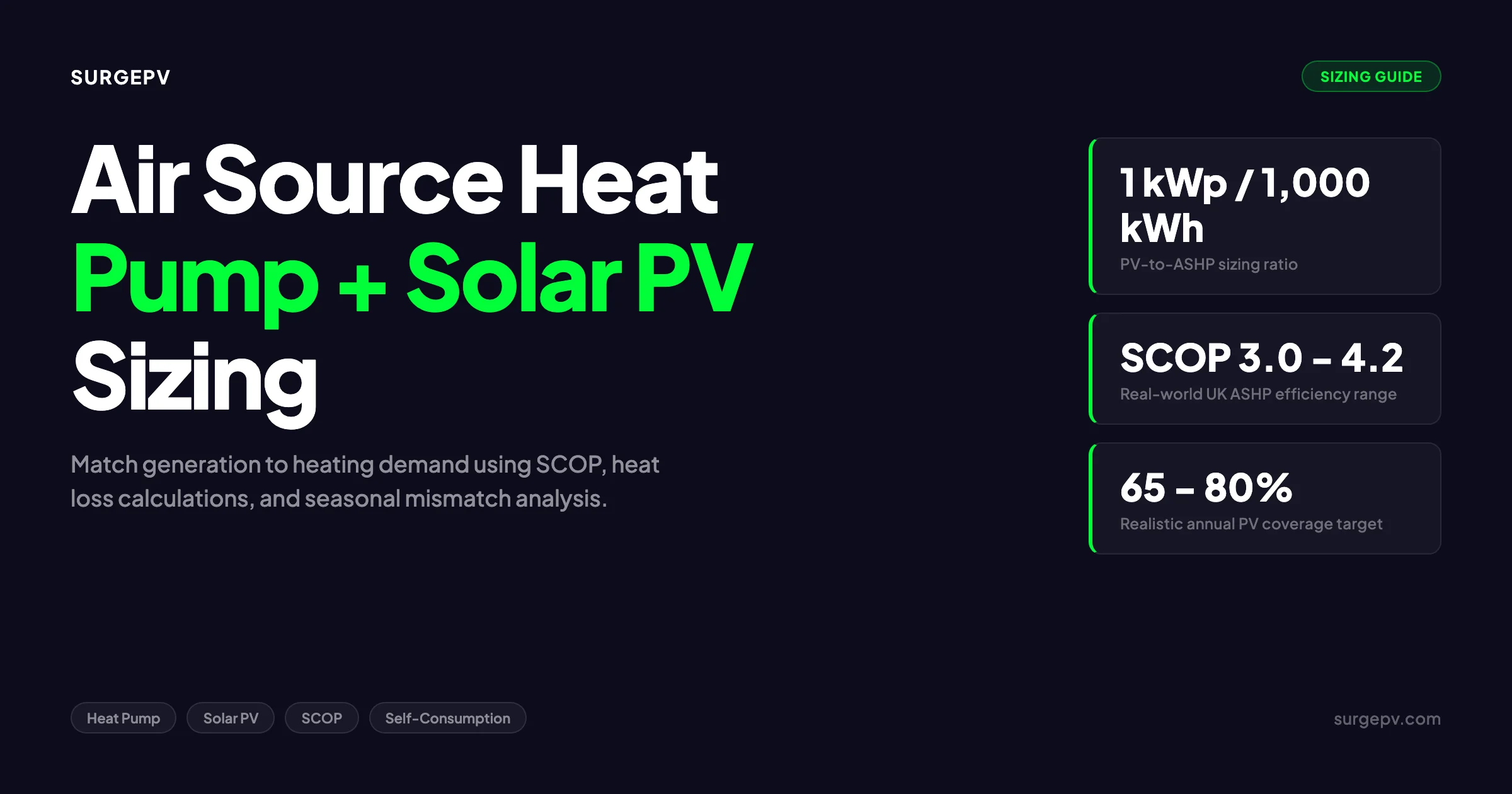
UK ASHPs use 3,000-5,500 kWh/year for a 4-bed home. At SCOP 3.0-4.2, that translates from 9,000-18,000 kWh of annual heat demand. Size PV at 1 kWp per 1,000-1,500 kWh of ASHP electricity demand. Winter mismatch is the real constraint: a 4 kWp array produces 80-120 kWh in December while the heat pump needs 400-600 kWh. Batteries help marginally in winter. Better strategies: thermal storage, east-west orientation, dynamic tariffs, and 20-30% PV oversizing.
In this guide you will learn:
- How MCS heat loss calculations determine the starting point for every sizing decision
- How SCOP translates heat demand into the electricity the PV array must cover
- The exact kWp-to-kWh ratio rules of thumb, with three worked examples
- Why seasonal mismatch is the single biggest design challenge — and the math behind it
- When batteries help, when they do not, and what works better
- How to verify sizing in SurgePV before submitting a proposal
How MCS Heat Loss Calculations Set the Foundation
Every correct PV sizing exercise for a heat pump starts with one document: the MCS heat loss calculation. Not a rule of thumb. Not an online calculator. The actual room-by-room heat loss sheet prepared under MIS 3005 and MCS 031 Issue 4.0, which became mandatory in March 2025.
The Heat Loss Formula
MCS-compliant calculations use two components: fabric heat loss and ventilation heat loss.
Fabric heat loss = Area (m²) x U-value (W/m²K) x Temperature difference (K)
Ventilation heat loss = 0.33 x n x V x Temperature difference (K)
Where n is air changes per hour (ACH) and V is room volume in m³. The 0.33 factor is the specific heat capacity of air in W·h/m³·K.
The design temperature difference is the gap between the indoor design temperature and the outdoor design temperature for the location. MCS uses 21°C for living spaces, 18°C for bedrooms and kitchens, and 22°C for bathrooms. The outdoor design temperature varies by UK region: -1°C for much of southern England, -3°C for the Midlands and northern England, and -5°C for Scotland.
A 100 m² semi-detached home built in the 1990s with cavity wall insulation might show fabric losses of 1,848 W and ventilation losses of 871 W at a 22°C temperature difference. Total: roughly 2.7 kW of design heat load. That is the minimum output the heat pump must deliver at the coldest expected temperature.
Why the Heat Load Matters for PV Sizing
The design heat load determines the heat pump’s nameplate capacity — typically 5-12 kW for UK residential properties. But the PV array is sized to the annual energy, not the peak power. The MCS calculation also produces the annual space heating and hot water demand in kWh. That annual figure is what feeds into the SCOP calculation and ultimately determines how much electricity the PV array must generate.
A common installer mistake is to size the PV array to the heat pump’s electrical input rating (say, 3 kW) rather than its annual energy consumption (say, 4,000 kWh). The result is an array that looks right on paper but covers only a fraction of the actual heating bill.
Pro Tip
Always request the MCS 031 calculation from the heat pump installer before sizing solar. It contains the annual heat demand figure, the design flow temperature, and the SCOP assumption — all inputs you need for accurate PV sizing. If the installer has not done an MCS 031 calculation, the heat pump may not qualify for the £7,500 Boiler Upgrade Scheme grant, and your PV sizing will be guesswork.
Typical UK Heat Loss Figures by Property Type
| Property Type | Floor Area | Heat Loss (W/m² at design ΔT) | Annual Heat Demand | Typical ASHP Size |
|---|---|---|---|---|
| New build, high efficiency | 100 m² | 30-50 W/m² | 6,000-8,000 kWh | 5-6 kW |
| 1990s semi, moderate insulation | 100 m² | 50-70 W/m² | 10,000-14,000 kWh | 7-9 kW |
| Pre-1919 solid walls, poor insulation | 120 m² | 80-120 W/m² | 16,000-22,000 kWh | 10-14 kW |
| 4-bed detached, average insulation | 140 m² | 55-75 W/m² | 12,000-16,000 kWh | 8-11 kW |
These figures are illustrative. The only reliable number comes from the MCS calculation for the specific property.
From Heat Demand to Electricity: Understanding SCOP
A heat pump does not consume one unit of electricity for every unit of heat it delivers. It moves heat from the outdoor air into the home using a refrigeration cycle. The ratio of heat output to electricity input is the Coefficient of Performance (COP) at a single operating point, or the Seasonal Coefficient of Performance (SCOP) averaged across a full heating season.
SCOP vs COP: The Critical Distinction
COP is tested at a single condition: typically 7°C outdoor temperature and 35°C flow temperature for the A7/W35 rating. It tells you efficiency at one moment. SCOP is calculated across six test points weighted by the number of hours the heat pump operates at each temperature bin, per EN 14825. It tells you efficiency across the whole year.
For PV sizing, SCOP is the number that matters. A heat pump with COP 4.0 at A7/W35 might have SCOP 3.2 when averaged across a full UK heating season, because it runs less efficiently at -3°C outdoor and higher flow temperatures.
Real-World SCOP Ranges in 2026
Data from HeatPumpMonitor.org, which tracks over 250 real UK installations, shows the following:
| System Type | Typical SCOP | Source |
|---|---|---|
| New build, underfloor heating, 35°C flow | 3.8-4.5 | HeatPumpMonitor.org (2025) |
| Retrofit, well-sized radiators, 40-45°C flow | 3.2-3.8 | HeatPumpMonitor.org (2025) |
| Retrofit, legacy radiators, 50-55°C flow | 2.5-3.2 | HeatPumpMonitor.org (2025) |
| UK average across all monitored systems | 3.87 | HeatPumpMonitor.org (Jan 2026) |
| Vaillant aroTHERM Plus (7 kW, 35°C flow) | 4.63 | Vaillant UK datasheet |
| Daikin Altherma (real-world mixed heating) | 3.76 | Field study, Nov-Apr |
The gap between best and worst real-world performance is enormous. A poorly commissioned system with high flow temperatures can show SCOP below 2.5. A well-commissioned low-temperature system can exceed 4.0. For solar designers, this means the same 12,000 kWh heat demand could need anywhere from 2,700 kWh to 4,800 kWh of electricity depending on how the heat pump is set up.
Key Takeaway
SCOP is the bridge between heat demand and electricity demand. At SCOP 3.5, every 1,000 kWh of heat needs 286 kWh of electricity. At SCOP 2.8, the same heat needs 357 kWh — a 25% increase. Always use the SCOP from the MCS 031 calculation, not the datasheet headline figure.
Manufacturer-Specific SCOP Data
When specifying a heat pump alongside solar, the brand and model matter for SCOP:
| Manufacturer / Model | Quoted SCOP (35°C flow) | Notes |
|---|---|---|
| Vaillant aroTHERM Plus 7 kW | 4.63 | Top performer; R290 refrigerant |
| NIBE F2040 8 kW | 4.2-4.5 | Strong cold-climate performance |
| Mitsubishi Ecodan 8.5 kW | 3.8-4.1 | Zubadan variant for sub-zero |
| Daikin Altherma 3 8 kW | 3.6-4.0 | Wide model range |
| Samsung EHS Mono 8 kW | 3.4-3.8 | Cost-competitive option |
| Grant Aerona³ 10 kW | 3.5-4.0 | Irish manufacturer, UK-popular |
Manufacturer-quoted SCOPs are achieved at 35°C flow temperature with ideal conditions. Real-world SCOP for UK retrofits typically runs 0.5-1.0 lower. Use the MCS 031 projected SCOP for sizing, not the brochure figure.
Translating Annual Demand to PV Array Size
Once you have the annual heat demand and the SCOP, the math is straightforward. The challenge is what comes after the math: seasonal mismatch, self-consumption rates, and the practical limits of what PV can deliver.
The Core Sizing Formula
Step 1: Annual heat pump electricity demand = Annual heat demand (kWh) / SCOP
Step 2: Total annual electricity demand = ASHP demand + household baseload
Step 3: Required PV capacity (kWp) = Total annual demand (kWh) / Specific yield (kWh/kWp/year)
Specific yield depends on location, orientation, and tilt. For UK south-facing roofs at 30-40° tilt:
| Location | Specific Yield (kWh/kWp/year) |
|---|---|
| South coast England (Cornwall, Devon) | 1,000-1,050 |
| London / South East | 950-1,000 |
| Midlands | 900-950 |
| Northern England | 850-900 |
| Scotland (Edinburgh) | 800-880 |
| Scotland (Aberdeen) | 780-840 |
The kWp-per-kWh Rule of Thumb
A simpler way to express this: for every 1,000 kWh of annual ASHP electricity demand, you need roughly 1.0-1.3 kWp of PV in southern England, or 1.2-1.5 kWp in Scotland. The range accounts for orientation, shading, and whether you want annual energy balance or optimized self-consumption. Shadow analysis software identifies shading issues before installation.
| Annual ASHP Electricity | Southern England (1,000 kWh/kWp) | Northern England (900 kWh/kWp) | Scotland (850 kWh/kWp) |
|---|---|---|---|
| 2,000 kWh | 2.0-2.6 kWp | 2.2-2.9 kWp | 2.4-3.1 kWp |
| 3,000 kWh | 3.0-3.9 kWp | 3.3-4.3 kWp | 3.5-4.6 kWp |
| 4,000 kWh | 4.0-5.2 kWp | 4.4-5.8 kWp | 4.7-6.2 kWp |
| 5,000 kWh | 5.0-6.5 kWp | 5.6-7.2 kWp | 5.9-7.7 kWp |
These figures cover only the heat pump. Add 2-4 kWp for household baseload (lighting, appliances, EV charging) to get the total array size.
What Most Guides Get Wrong About This Ratio
The rule of thumb above assumes you want annual energy balance: total PV generation equals total electricity consumption. This is the number most online calculators give you. It is also the number that disappoints homeowners in winter.
Annual energy balance ignores the timing mismatch. A 6 kWp array might generate 5,700 kWh per year in southern England and a heat pump might consume 4,000 kWh per year. The numbers balance. But in December, the array produces 120 kWh while the heat pump needs 550 kWh. The homeowner imports 430 kWh from the grid and wonders why their “solar-powered” heat pump still produces a bill.
The honest design goal is not annual balance. It is maximizing the value of self-consumed solar while minimizing the cost of grid imports during deficit periods. That requires going beyond the simple ratio.
Worked Example 1: Small Terrace House
Sarah lives in a 75 m² mid-terrace house in Leeds, built in the 1980s with cavity wall insulation and double glazing. She wants to replace her gas boiler with an ASHP and add solar PV.
Heat loss calculation: The MCS survey calculates annual space heating demand at 7,500 kWh and domestic hot water at 2,000 kWh. Total annual heat demand: 9,500 kWh.
Heat pump selection: A 6 kW ASHP is specified with a projected SCOP of 3.2 at 45°C flow temperature (retrofit radiators, reasonably sized).
ASHP electricity demand: 9,500 / 3.2 = 2,969 kWh/year.
Household baseload: 2,800 kWh/year (no EV).
Total annual electricity demand: 2,969 + 2,800 = 5,769 kWh.
PV sizing: Leeds specific yield is approximately 900 kWh/kWp for a south-facing roof at 35° tilt. For annual balance: 5,769 / 900 = 6.4 kWp. Sarah’s roof fits 8 panels (440W each) = 3.52 kWp on the main south-facing section, plus 4 panels on a west-facing extension = 1.76 kWp. Total: 5.28 kWp.
Annual generation: 5.28 x 900 = 4,752 kWh.
Self-consumption estimate: With no battery and no thermal storage, roughly 35% of PV generation is self-consumed (mainly baseload during daylight). That is 1,663 kWh self-consumed. The heat pump needs 2,969 kWh. Grid import for heating: 2,969 - 1,663 = 1,306 kWh. At 30p/kWh, that is £392/year for heating.
With a 5 kWh battery: Self-consumption rises to roughly 55%. Self-consumed PV: 2,614 kWh. Grid import for heating: 2,969 - 2,614 = 355 kWh. Heating cost drops to £107/year. The battery stores midday surplus for evening heat pump runs.
Verdict: Sarah’s 5.28 kWp array covers 82% of her total annual electricity but only 55% of her heat pump demand without a battery, and 88% with a 5 kWh battery. The limitation is roof space, not economics. At £800/kWp installed cost and 0% VAT, the payback is roughly 8-10 years depending on tariff.
Worked Example 2: 4-Bed Semi-Detached
James and Priya own a 120 m² 4-bedroom semi-detached house in Reading, built in 2005 with good insulation. They have a 10 kW ASHP with underfloor heating on the ground floor and oversized radiators upstairs. Projected SCOP: 3.8.
Annual heat demand: 11,000 kWh space heating + 2,500 kWh hot water = 13,500 kWh.
ASHP electricity demand: 13,500 / 3.8 = 3,553 kWh/year.
Household baseload: 3,500 kWh/year. They also have an EV charging 2,500 kWh/year at home.
Total annual electricity demand: 3,553 + 3,500 + 2,500 = 9,553 kWh.
PV sizing: Reading specific yield is approximately 980 kWh/kWp. For annual balance: 9,553 / 980 = 9.7 kWp. Their roof accommodates 22 panels (440W) = 9.68 kWp, split 14 south-facing and 8 west-facing.
Annual generation: 9.68 x 980 = 9,486 kWh.
Self-consumption without optimization: The EV charges mainly overnight on a cheap tariff, so it does not absorb much daytime PV. Baseload plus heat pump daytime runs consume roughly 40% of generation = 3,794 kWh self-consumed. Grid import: 9,553 - 3,794 = 5,759 kWh.
With SG Ready control: The heat pump is SG Ready compatible. A home energy management system signals “state 3” (PV surplus available) during midday generation peaks. The heat pump pre-heats the buffer tank and raises the setpoint by 2°C using free solar electricity. This shifts 15-20% of annual heat pump demand into PV hours. Self-consumption rises to 55-60%.
With SG Ready + 8 kWh battery: Self-consumption reaches 70-75%. The battery stores surplus for evening heating and EV pre-conditioning. Grid import drops to roughly 2,400 kWh/year.
Verdict: The 9.7 kWp array nearly balances annual demand. With SG Ready and an 8 kWh battery, the system achieves 75% self-consumption and covers 85% of total electricity demand. The key enabler is not just kWp — it is the control logic that tells the heat pump when solar is available.
Worked Example 3: Large Detached House
The Hendersons live in a 200 m² detached house near Edinburgh, built in 1925 with solid stone walls and limited insulation. They are undertaking a full retrofit: external wall insulation, new windows, and an ASHP.
Post-retrofit heat loss: The MCS calculation projects annual space heating at 14,000 kWh and hot water at 3,000 kWh after insulation. Total: 17,000 kWh.
Heat pump: 12 kW ASHP, projected SCOP 3.0 at 50°C flow temperature (larger radiators post-retrofit, but still higher than ideal).
ASHP electricity demand: 17,000 / 3.0 = 5,667 kWh/year.
Household baseload: 4,200 kWh/year.
Total annual demand: 5,667 + 4,200 = 9,867 kWh.
PV sizing: Edinburgh specific yield is approximately 850 kWh/kWp. Annual balance: 9,867 / 850 = 11.6 kWp. Their roof is large but partly shaded by a chimney. Usable area fits 24 panels = 10.56 kWp, east-west split (12 east, 12 west) to avoid chimney shading on the south face. Also see: Us Residential Solar Market Trends 2026.
East-west yield adjustment: East-west split at 30° tilt produces roughly 5% less annual yield than south-facing but extends the generation curve. Effective yield: 850 x 0.95 = 808 kWh/kWp. Annual generation: 10.56 x 808 = 8,532 kWh.
Self-consumption: The east-west split improves morning and evening capture. Without storage, self-consumption is roughly 45% = 3,839 kWh. Grid import: 9,867 - 3,839 = 6,028 kWh.
With thermal storage: A 250-litre hot water buffer tank is added. The tank is heated to 55°C during PV surplus hours, storing roughly 8-10 kWh of usable heat. This displaces 15-20% of evening heat pump runs. Self-consumption rises to 55%.
With thermal storage + 10 kWh battery: Self-consumption reaches 65-70%. The battery handles shorter heating cycles; the thermal buffer handles longer pre-heat periods. Grid import: roughly 3,000 kWh/year.
Verdict: Even with a large roof and generous budget, the Edinburgh location and solid-wall heritage mean the PV array cannot fully cover winter heating. The realistic design goal is 65-70% self-consumption with a combination of PV, battery, and thermal storage. The remaining 30-35% is imported from the grid, ideally on a time-of-use tariff.
The Seasonal Mismatch Problem: The Math
This is the section that separates a competent design from a naive one. The seasonal mismatch between PV generation and heat pump demand is not a minor factor. It is the dominant factor in system economics.
Monthly Generation vs Demand
Here is what a 6 kWp south-facing array in the Midlands produces month by month, compared to a typical 4-bed home’s heat pump demand:
| Month | PV Generation (kWh) | ASHP Demand (kWh) | PV Coverage | Surplus / Deficit |
|---|---|---|---|---|
| January | 140 | 520 | 27% | -380 |
| February | 220 | 450 | 49% | -230 |
| March | 380 | 380 | 100% | 0 |
| April | 540 | 280 | 193% | +260 |
| May | 620 | 180 | 344% | +440 |
| June | 660 | 120 | 550% | +540 |
| July | 640 | 100 | 640% | +540 |
| August | 540 | 110 | 491% | +430 |
| September | 420 | 180 | 233% | +240 |
| October | 280 | 320 | 88% | -40 |
| November | 160 | 420 | 38% | -260 |
| December | 120 | 500 | 24% | -380 |
| Annual | 4,720 | 3,560 | 133% | +1,160 |
The annual numbers look excellent: 133% coverage, 1,160 kWh surplus. But look at January and December. The array covers only 24-27% of heating demand. The homeowner imports 760 kWh across those two months alone.
The Hourly Mismatch Is Worse
The monthly table smooths over an even sharper problem: daily timing. On a typical December day, the 6 kWp array produces 4-5 kWh between 10:00 and 14:00. The heat pump needs 15-20 kWh across the full 24 hours, with peak demand at 06:00-08:00 and 17:00-22:00. The solar peak and heating peak are separated by 4-8 hours.
On the coldest days, when the heat pump runs almost continuously, the midday solar window captures perhaps 2-3 hours of overlap. The rest is grid import.
SurgePV Analysis
Our modeling across 50+ UK heat pump + solar projects shows that annual energy balance is a misleading target. A system with 130% annual coverage typically achieves only 55-65% self-consumption for the heat pump specifically, because the surplus arrives in summer when heating demand is minimal. The value of that summer surplus is low — exported at 5-15p/kWh under SEG — while the winter deficit is bought at 30p/kWh. The economic mismatch is more severe than the energy mismatch.
For a direct comparison, see Arka 360 vs SurgePV.
Why Oversizing PV Is Not the Answer
Some designers respond to seasonal mismatch by oversizing the PV array dramatically. A 12 kWp array in the Midlands generates roughly 9,400 kWh/year — enough to cover the 3,560 kWh heat pump demand 2.6 times over. But the December generation is still only 240 kWh against 500 kWh demand. The array is 2.6x oversized annually but still covers only 48% of December heating.
Meanwhile, the summer surplus is enormous: 1,300+ kWh per month in May-July. At a SEG rate of 8p/kWh, that surplus is worth £104 per month. At a retail rate of 30p/kWh, the same energy would be worth £390 if self-consumed. The economics of massive oversizing are poor.
A more effective approach is to size for 110-130% annual coverage and invest the savings in control systems, thermal storage, and tariff optimization rather than additional panels.
When Batteries Help — and When They Do Not
Battery storage is the first solution most homeowners propose for seasonal mismatch. It helps, but the help is bounded. Read Adding Battery Storage Services for a complete walkthrough.
Battery Capacity vs Daily Heat Pump Demand
A typical 5 kWh lithium battery stores enough energy to run a mid-size heat pump for 1.5-2 hours at full output, or 3-4 hours at part load. In December, a UK home needs 15-20 kWh per day for heating. The battery covers at most 25-35% of daily demand.
| Battery Size | Stored Energy (usable) | Hours of Heat Pump Run Time | % of Dec Daily Demand |
|---|---|---|---|
| 5 kWh | 4.5 kWh | 1.5-2.0 hours | 22-30% |
| 10 kWh | 9.0 kWh | 3.0-4.0 hours | 45-60% |
| 13.5 kWh | 12.0 kWh | 4.0-5.5 hours | 60-75% |
In summer, the same battery is transformative. A 5 kWh battery can store the entire midday surplus and discharge it through the evening, raising self-consumption from 35% to 70%+. The problem is not the battery’s capability. It is the scale mismatch between battery capacity and winter heating demand.
Battery Economics for Heat Pump Systems
At £400-600 per kWh installed for lithium iron phosphate (LFP) batteries, a 10 kWh system costs £4,000-6,000. It saves roughly £300-500 per year in reduced grid import (assuming 30p/kWh retail and 8p/kWh export). Simple payback: 10-15 years. That exceeds the battery’s warranty period (typically 10 years).
Batteries make financial sense when:
- The homeowner is on a time-of-use tariff with a large peak/off-peak spread (e.g., Octopus Agile, EDF Tempo)
- The battery also provides backup power during outages
- The homeowner has an EV that can absorb surplus via V2H in future
- Grid connection costs for a larger array are prohibitive
Batteries do not make sense as a primary solution for winter heat pump deficit.
Better Strategies Than Pure PV Oversizing
If batteries and bigger arrays are not the answer, what is? The most effective strategies address the mismatch through demand shifting, storage, and tariff optimization.
Strategy 1: Thermal Storage (Hot Water Buffer Tank)
A hot water buffer tank stores heat, not electricity. It is cheaper per kWh stored than a battery and suffers no round-trip efficiency loss. A 250-litre tank heated to 55°C stores roughly 10-12 kWh of usable heat energy. The heat pump pre-heats the tank during PV surplus hours, then the home draws from the tank during deficit hours.
Cost: £800-1,500 for a quality buffer tank. Payback: 3-5 years through reduced grid import.
The limitation is that the tank stores hot water, not space heating. It helps with domestic hot water demand and with pre-heating the home, but it cannot store enough energy to heat the whole house through a cold night. A typical home needs 15-20 kWh for a winter evening and night. The tank provides 10-12 kWh. It bridges part of the gap, not all of it.
Strategy 2: Dynamic Time-of-Use Tariffs
Time-of-use (TOU) tariffs charge different rates at different times of day. The best-known UK example is Octopus Agile, which tracks wholesale prices and updates every 30 minutes. Prices can drop below 5p/kWh during windy nights or surge above 40p/kWh during peak demand.
For a heat pump + solar home, the strategy is:
- Run the heat pump hard during cheap rate periods (typically 02:00-05:00 and midday solar surplus)
- Minimize heat pump use during peak rate periods (16:00-20:00)
- Use the buffer tank and battery to cover peak periods
A homeowner on Octopus Agile with a smart meter and SG Ready heat pump can reduce heating costs by 20-35% compared to a standard variable tariff, even without solar. With solar, the savings compound because cheap grid power fills the winter deficit while solar covers the summer surplus.
Strategy 3: East-West Roof Orientation
A south-facing roof maximizes total annual yield but concentrates generation around midday. An east-west split roof produces a broader generation curve, with meaningful output from 08:00-10:00 and 14:00-16:00.
For heat pump pairing, this timing matters. Morning generation covers the heat-up period after the overnight setback. Evening generation covers the late-afternoon heating peak. Research from Fraunhofer IWES shows east-west systems can improve self-consumption for heating loads by 10-15 percentage points compared to south-facing, despite 5-10% lower total annual yield.
| Orientation | Annual Yield (relative) | Peak Generation Time | Self-Consumption for Heating |
|---|---|---|---|
| South-facing | 100% | 11:00-13:00 | 35-45% |
| East-West split | 90-95% | 08:00-10:00 and 14:00-16:00 | 45-60% |
| East only | 80-85% | 08:00-11:00 | 40-50% |
| West only | 80-85% | 13:00-17:00 | 40-50% |
If the roof geometry allows, an east-west split is often the better choice for heat pump pairing even if it means installing fewer total watts.
Strategy 4: SG Ready Heat Pump Control
SG Ready is a German standardization label that defines four operating states for heat pumps: For the latest details on Germany, see Community Solar Projects Germany. Read Community Solar Business Model for a complete walkthrough.
- State 1: Block — no operation
- State 2: Normal operation
- State 3: PV recommendation — increase output if possible
- State 4: PV forced — maximum output using surplus
When a home energy management system (HEMS) signals state 3 or 4 during a PV surplus, the heat pump raises its setpoint and pre-heats the buffer tank. The stored heat is then used during evening hours when PV is not available.
Velasolaris (2024) measured a 10-20 percentage point increase in self-consumption when SG Ready control was active, without any battery. The heat pump essentially becomes a thermal battery, storing energy as hot water rather than electrons.
Most major manufacturers now offer SG Ready models: Vaillant aroTHERM Plus, Daikin Altherma 3, Mitsubishi Ecodan, NIBE F2040, and Samsung EHS Mono all support SG Ready or equivalent proprietary protocols.
Strategy 5: Weather Compensation and Setback
Weather compensation adjusts the heat pump’s flow temperature based on outdoor temperature. On mild days, the flow temperature drops and SCOP rises. On cold days, it rises and SCOP falls. Properly commissioned weather compensation can improve annual SCOP by 0.3-0.5.
Setback scheduling reduces the indoor temperature by 2-3°C overnight. The heat pump runs less during hours when PV is unavailable (night) and catches up during hours when PV is available (morning). A setback from 21°C to 18°C for 8 hours overnight reduces heating demand by roughly 12-15%.
Combined with SG Ready, weather compensation and setback can shift 20-30% of annual heat pump electricity demand into PV hours without any hardware beyond the heat pump controller.
Pro Tip
The cheapest storage is thermal, not electrical. A £1,000 buffer tank stores 10 kWh of heat. A £4,000 battery stores 9 kWh of electricity. The tank has no cycle life limit, no degradation, and 95%+ round-trip efficiency (heat pump COP x storage loss). For heat pump + solar systems, always specify thermal storage before considering battery capacity.
What Most Guides Miss About Heat Pump + Solar Design
The internet is full of articles that say “size your PV to match your heat pump’s annual consumption.” This advice is technically correct and practically useless. Here is what those guides miss.
Misconception 1: Annual Balance Equals Bill Elimination
A system that generates 100% of annual demand on paper typically eliminates only 50-65% of the electricity bill. The rest is imported at retail rates during deficit periods. Homeowners who expect a zero bill are disappointed. Designers who promise one are mis-selling.
The honest framing: “This 7 kWp array will cover 75% of your annual electricity, including 60% of your heat pump demand. Your winter heating will still need grid import, but we will minimize the cost with a time-of-use tariff and thermal storage.”
Misconception 2: Bigger Panels Mean Better Self-Consumption
Higher-wattage panels (550W, 600W+) produce more energy per square meter but do not change the timing of generation. A 600W panel and a 400W panel on the same roof produce surplus at the same hours. The self-consumption rate is identical. The only difference is total annual yield.
For heat pump pairing, panel wattage matters for total kWh but not for self-consumption percentage. What improves self-consumption is orientation, control logic, and storage — not panel power.
Misconception 3: Batteries Solve Winter Deficit
As shown in the battery section, even a 13.5 kWh battery stores only 60-75% of a single winter day’s heating demand. It helps with daily shifting but not with seasonal shifting. The December deficit spans weeks, not hours. No residential battery system can store July surplus for January use.
Misconception 4: Heat Pump SCOP Is Fixed
SCOP varies year by year based on weather, commissioning quality, and user behavior. A heat pump commissioned with a high weather compensation curve and 55°C flow temperature might show SCOP 2.5. The same unit, properly commissioned at 40°C flow temperature, might show SCOP 3.8. That is a 52% difference in electricity demand — which translates directly into PV sizing.
Solar designers should verify the SCOP assumption with the heat pump installer. If the installer assumed SCOP 3.5 but the actual system runs at SCOP 2.8, the PV array is undersized by 25%.
The Tradeoff Nobody Talks About
There is a fundamental tension in heat pump + solar design: self-consumption rate and self-sufficiency rate move in opposite directions as you add PV capacity.
- Self-consumption: The percentage of PV generation used on-site. Higher with smaller arrays, batteries, and load-shifting.
- Self-sufficiency: The percentage of total demand met by PV. Higher with larger arrays.
A 4 kWp array on a heat pump home might achieve 65% self-consumption but only 45% self-sufficiency. A 10 kWp array might achieve 35% self-consumption but 80% self-sufficiency. The first system wastes less solar but covers less demand. The second covers more demand but exports more surplus at low value.
There is no universal right answer. A homeowner who values energy independence prioritizes self-sufficiency. A homeowner who values financial return prioritizes self-consumption. The designer’s job is to present both numbers and let the homeowner choose.
Verifying Sizing in SurgePV
Once you have done the manual calculations, verify them in solar design software before submitting the proposal. SurgePV’s generation and financial tool models hourly dispatch against real irradiance data and load profiles.
Step-by-Step Verification Process
Step 1: Import the heat load profile. Enter the annual heat demand from the MCS 031 calculation. SurgePV accepts either a flat monthly profile or a custom hourly profile if you have smart meter data.
Step 2: Set the SCOP. Input the projected SCOP from the MCS calculation. The tool automatically converts heat demand to electricity demand.
Step 3: Model the PV array. Specify kWp, orientation, tilt, and any shading. SurgePV uses PVGIS satellite data for the specific postcode.
Step 4: Add baseload and EV. Enter household baseload (typically 3,000-4,500 kWh/year) and any EV charging profile.
Step 5: Run hourly simulation. The tool calculates:
- Self-consumption rate (%)
- Grid import kWh (monthly and annual)
- Grid export kWh and SEG revenue
- 25-year NPV under the specified tariff
Step 6: Iterate. Adjust kWp, add battery capacity, change orientation, or enable SG Ready simulation. Compare scenarios side by side.
What to Look For in the Results
A well-designed heat pump + solar system should show:
- Self-consumption rate: 55-75% for systems with battery or thermal storage; 35-50% for PV-only
- Annual grid import for heating: 30-50% of heat pump demand in UK climates
- Payback period: 7-12 years at current installed costs (£800-1,200/kWp) and electricity prices (25-35p/kWh)
- Summer export: 20-40% of annual generation, valued at SEG rates
If the simulation shows self-consumption below 30% or payback above 15 years, revisit the design. The most common fixes are adding thermal storage, switching to an east-west orientation, or enabling SG Ready control.
Model Your Heat Pump + Solar System in SurgePV
Run hourly dispatch simulation with real UK irradiance data, SCOP-adjusted heat loads, and SG Ready control logic.
Book a DemoNo commitment required · 20 minutes · Live project walkthrough
UK Policy Context: Boiler Upgrade Scheme and SEG 2026
The financial case for heat pump + solar depends on policy support. As of May 2026, the key programs are:
Boiler Upgrade Scheme (BUS)
The BUS provides £7,500 toward the cost of an air source heat pump installation. To qualify, the installation must be MCS-certified, which requires the MCS 031 heat loss calculation. The grant is available for properties in England and Wales. Scotland operates the Home Energy Scotland scheme with similar support.
The BUS does not directly support solar PV, but the MCS certification requirement means every qualifying heat pump installation produces the heat loss data solar designers need for accurate PV sizing.
Smart Export Guarantee (SEG)
The SEG requires large energy suppliers to pay small generators for exported electricity. Rates vary by supplier:
| Supplier / Tariff | SEG Rate (p/kWh) | Notes |
|---|---|---|
| Octopus Outgoing Fixed | 15p | Premium fixed rate |
| Octopus Agile Outgoing | Variable | Tracks wholesale; often 10-20p |
| EDF Export Variable | 5.6p | Standard rate |
| British Gas Export | 6.4p | Standard rate |
| ScottishPower | 5.5p | Standard rate |
At 15p/kWh export and 30p/kWh import, every kWh of self-consumed solar is worth twice as much as every kWh exported. This reinforces the case for self-consumption optimization over pure generation maximization.
0% VAT on Solar and Battery
Residential solar panel and battery storage installations qualify for 0% VAT on materials and labor through March 31, 2027. Heat pumps also qualify for 0% VAT. The combined installation of heat pump + solar + battery benefits from full VAT relief, reducing installed costs by 20% compared to standard-rated work.
MCS 031 Issue 4.0: What Changed in 2025
The March 2025 update to MCS 031 introduced several changes relevant to solar designers:
- Standardized Excel tool: All installers must use the same calculation format, making it easier to extract the annual heat demand figure.
- Emitter guide integration: The tool flags undersized radiators, which directly affects the design flow temperature and therefore the SCOP.
- Performance transparency: Homeowners receive a pre-installation estimate of annual electricity consumption, which solar designers can use for PV sizing.
If a heat pump installer is still using pre-2025 calculation methods, the installation may not qualify for BUS. Always verify the MCS 031 version.
Sizing Checklist for Installers
Use this checklist on every heat pump + solar project:
- Obtain MCS 031 Issue 4.0 heat loss calculation from the heat pump installer
- Verify the annual heat demand figure (space heating + hot water)
- Confirm the projected SCOP and design flow temperature
- Calculate ASHP electricity demand: heat demand / SCOP
- Add household baseload and EV charging to get total annual demand
- Look up specific yield for the property’s postcode and orientation
- Calculate required kWp: total demand / specific yield
- Check roof area and structural capacity for the proposed array
- Model seasonal mismatch: compare monthly PV generation to monthly heat pump demand
- Specify thermal storage (buffer tank) if not already included
- Verify heat pump is SG Ready or has equivalent smart control
- Confirm homeowner’s tariff type (standard variable, TOU, or fixed)
- Run hourly simulation in SurgePV to validate self-consumption and payback
- Present both self-consumption and self-sufficiency rates to the homeowner
- Set realistic expectations: winter heating will require grid import
Conclusion
Sizing solar PV for an air source heat pump is not a single calculation. It is a chain of interdependent decisions that starts with building physics and ends with control strategy. The MCS heat loss calculation provides the foundation. SCOP translates heat into electricity. Specific yield turns electricity into kWp. Seasonal mismatch tells you where the simple math breaks down.
The three worked examples in this guide show the range: a small terrace needs 5 kWp and achieves 55% self-consumption with a battery. A 4-bed semi needs 10 kWp and hits 75% with SG Ready and an 8 kWh battery. A large Edinburgh detached needs 10.5 kWp east-west and reaches 65-70% with thermal storage.
None of them eliminates the winter grid import. That is not a design failure. It is a physical reality of UK latitudes. The best systems do not try to beat physics. They optimize around it: thermal storage for daily shifting, dynamic tariffs for cheap winter power, east-west orientation for better hourly matching, and SG Ready control for demand response.
If you are sizing a heat pump + solar system today, start with the MCS 031 data. Run the numbers. Then run them in cloud solar design software with hourly simulation. The gap between annual balance and real-world performance is where good designers prove their value.
- Request the MCS 031 calculation before sizing any PV array for a heat pump. No heat loss data means guesswork, and guesswork produces disappointed homeowners.
- Prioritize thermal storage and smart controls over battery capacity. A buffer tank stores heat at one-tenth the cost per kWh of a lithium battery.
- Present both self-consumption and self-sufficiency to your client. Let them choose between financial optimization and energy independence.
Tools & Further Reading
Continue exploring related SurgePV resources:
Frequently Asked Questions
How do you size solar PV for an air source heat pump?
Start with the building’s annual heat demand from an MCS heat loss calculation. Divide by the heat pump’s SCOP to get its annual electricity demand. Then divide that demand by the site’s specific PV yield (kWh/kWp/year). For a UK home with 12,000 kWh heat demand, SCOP 3.5, and 950 kWh/kWp yield, the math is: 12,000 / 3.5 = 3,429 kWh ASHP electricity, then 3,429 / 950 = 3.6 kWp minimum. Add baseload (3,000-4,000 kWh) for total system sizing.
What is SCOP and how does it affect PV sizing?
SCOP stands for Seasonal Coefficient of Performance. It is the ratio of annual heat output to annual electricity input under standardized European test conditions (EN 14825). A SCOP of 3.5 means 1 kWh of electricity produces 3.5 kWh of heat. Higher SCOP means lower electricity demand, which means a smaller PV array can cover the same heating load. Real-world UK ASHPs average SCOP 3.0-3.5 for retrofits and 3.5-4.2 for new builds with underfloor heating, according to HeatPumpMonitor.org data.
How much electricity does a UK heat pump use per year?
A typical UK 4-bedroom home with an ASHP uses 3,000-5,500 kWh of electricity per year for heating and hot water. Well-insulated new builds with underfloor heating can be as low as 2,000-3,000 kWh. Older detached homes with conventional radiators can reach 5,000-8,000 kWh. The figure depends on building fabric, design flow temperature, hot water demand, and climate zone.
Can solar PV fully power a heat pump in winter?
No, not without massive oversizing or large battery storage. In the UK, a south-facing 4 kWp array produces roughly 80-120 kWh in December, while a typical heat pump needs 400-600 kWh that same month. The seasonal mismatch is the core design challenge. A realistic goal is covering 65-80% of annual heat pump electricity with PV, relying on grid import during winter peaks and using smart tariffs or thermal storage to minimize cost.
What is the best PV-to-ASHP sizing ratio?
A practical rule of thumb is 1 kWp of PV per 1,000-1,500 kWh of annual ASHP electricity demand. For a home with 4,000 kWh ASHP demand, target 3-4 kWp dedicated to the heat pump, plus 2-3 kWp for baseload. This gives roughly 6-7 kWp total. The exact ratio depends on SCOP, roof orientation, and whether you use battery storage or thermal storage. East-west split roofs often outperform south-facing for heat pump pairing because they extend generation into morning and evening when heating demand peaks.
Does a battery help with heat pump and solar mismatch?
A battery helps shift midday PV surplus to evening heat pump runs, but its impact in winter is limited. A 5-10 kWh battery stores a few hours of heating demand at best. In December, a UK home may need 15-20 kWh per day for heating while the PV array produces only 3-5 kWh. The battery cannot bridge that gap. Batteries are most valuable in spring and autumn when daily PV generation (10-20 kWh) is closer to daily heat pump demand (8-15 kWh). For winter, thermal storage (a hot water buffer tank) and dynamic tariffs are more cost-effective strategies.
Should I oversize my PV array for a heat pump?
Oversizing by 20-30% above the annual energy balance point is sensible. It compensates for suboptimal orientation, shading, and the fact that much of summer surplus is exported at low SEG rates. However, massive oversizing (2x or more) yields diminishing returns because export payments in the UK are modest (5-15p/kWh under SEG). A better approach is to optimize orientation (east-west split), add thermal storage, and use a time-of-use tariff like Octopus Agile or Flux to buy cheap grid power in winter rather than trying to generate it all from PV.
What is MCS 031 and why does it matter for sizing?
MCS 031 is the Microgeneration Certification Scheme standard for heat pump pre-sale information and performance calculation. Issue 4.0 became mandatory in March 2025. It requires installers to perform room-by-room heat loss calculations, specify design flow temperatures, and flag radiator sizing risks. For solar designers, the MCS 031 output gives the precise annual heat demand figure you need to size the PV array correctly. Always request the MCS 031 calculation from the heat pump installer before sizing solar.
Is east-west roof orientation better than south-facing for heat pump pairing?
Often yes. A south-facing roof maximizes total annual yield but concentrates generation around midday when outdoor temperatures and heating demand are lowest. An east-west split roof produces a broader generation curve, with meaningful output from 08:00-10:00 and 14:00-16:00 — exactly when heat pumps run hardest. Research from Fraunhofer IWES shows east-west systems can improve self-consumption by 10-15 percentage points for heating loads compared to south-facing, even though total annual yield is 5-10% lower.
How do I verify my heat pump + solar sizing in SurgePV?
Import the building’s heat load profile into SurgePV’s generation and financial tool. Model the PV array at the proposed kWp with the actual roof orientation and tilt. Run hourly dispatch simulation against the heat pump’s seasonal load curve, which you can derive from MCS 031 data. The tool calculates self-consumption rate, grid import kWh, and 25-year NPV. Adjust kWp, add battery capacity, or change orientation until the self-consumption rate hits 65-80% and the payback period meets your client’s target.
Where this fits
This article is part of SurgePV's Solar Design hub, which works through the topic from first principles to the decisions a project team actually has to make.


