The worst time to discover your solar-plus-heat-pump system is undersized is a January evening at 3°C with fog rolling in. The heat pump has been running steadily for two hours. Then the outdoor unit switches to defrost mode. Power draw jumps from 2.8 kW to 5.2 kW. Your 5 kW hybrid inverter clips. The battery, already half-empty from the evening heating run, cannot cover the spike. Grid import kicks in at peak tariff rates. The homeowner watches the smart meter app and asks why their “solar-powered” heating is costing 45 pence per kilowatt-hour.
This scenario is not hypothetical. It plays out in homes across the UK, Germany, and the northern US every winter. The problem is not the heat pump — defrost is a necessary and well-understood process. The problem is that solar and battery sizing for heat pump systems often treats the load as a smooth average, ignoring the sharp peaks that defrost creates. Winter solar output is already low. Defrost makes the mismatch worse. Also see: Germany solar subsidies. For UK-specific information, see Battery Solar System Design UK.
This guide explains what defrost cycles actually do to power demand, how they interact with solar generation and battery storage, and how to size a system that handles the defrost reality — not just the average. For more on this topic, see Adding Battery Storage Services.
Quick Answer
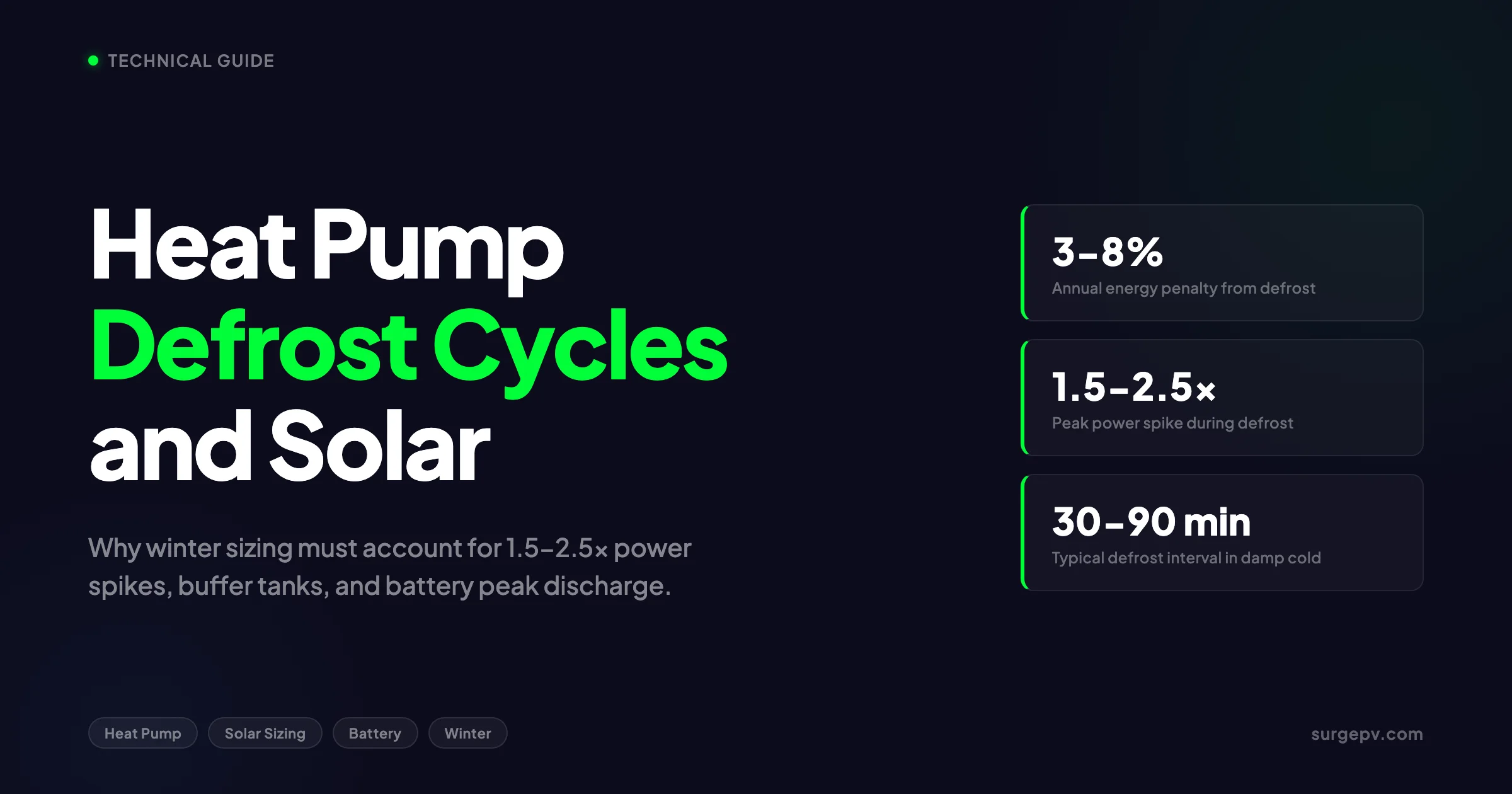
Heat pump defrost cycles spike power demand by 1.5-2.5x for 5-15 minutes every 30-90 minutes in cold, humid conditions. This adds 3-8% to annual energy use but creates winter peak loads that solar PV cannot cover and small batteries cannot ride through. Correct sizing requires modeling the defrost spike separately from the average load, oversizing the buffer tank to pre-heat before defrost events, and ensuring the inverter and battery can handle the brief peak.
In this guide:
- How defrost cycles work and when they happen
- The energy penalty: 3-8% annual, but 1.5-2.5x peak power
- Why winter solar sizing must account for defrost spikes
- Battery sizing: why average kWh is the wrong metric
- Dynamic tariffs and defrost timing
- Monobloc vs split: how configuration changes defrost behavior
- R290 vs R32 vs R410A: refrigerant differences during defrost
- Real measured data from a 2025 UK installation
- Design recommendations for installers
How Defrost Cycles Work
A defrost cycle is a reverse-cycle operation that melts frost from the outdoor coil of an air-source heat pump. The system briefly switches from heating mode to cooling mode. Hot refrigerant flows to the outdoor unit instead of the indoor unit. The outdoor coil warms up. Ice melts and drains away. Then the system switches back to heating.
This is necessary because frost on the outdoor coil blocks airflow. Blocked airflow reduces heat transfer. Reduced heat transfer drops the Coefficient of Performance (COP) — the ratio of heat output to electrical input. Without defrost, a heat pump in cold, humid conditions would slowly choke itself into inefficiency.
The defrost trigger is usually a combination of three sensors: outdoor coil temperature, outdoor air temperature, and compressor run time. When the coil temperature drops below a threshold — typically around -5°C to -8°C on the coil surface — and the compressor has run for a minimum period, the controller initiates defrost. Some systems use demand-based defrost, which also measures refrigerant pressure drop across the coil to detect frost buildup directly.
In Simple Terms
Think of defrost like clearing snow off your car windshield. The heat pump’s outdoor coil is the windshield. Frost blocks the “view” — airflow — so the system periodically runs hot refrigerant through the coil to melt the ice. This takes energy and briefly stops the heating, just like running your car’s defroster uses fuel and briefly distracts from driving.
When Defrost Happens: The 0-5°C Danger Zone
Defrost frequency depends on outdoor temperature and humidity. The worst conditions are temperatures between 0°C and 5°C with relative humidity above 80%. In this range, moisture in the air condenses and freezes on the cold outdoor coil quickly.
| Outdoor Condition | Temperature | Humidity | Defrost Interval | Defrost Duration |
|---|---|---|---|---|
| Damp cold (worst) | 0-5°C | >80% RH | 30-60 min | 8-15 min |
| Cold and wet | -2 to 2°C | 70-90% RH | 45-90 min | 6-12 min |
| Dry cold | -5 to 0°C | under 70% RH | 90-180 min | 5-10 min |
| Very cold, dry | below -10°C | under 60% RH | 180-360 min | 3-8 min |
| Mild, damp | 5-8°C | >85% RH | 60-120 min | 5-10 min |
The data in this table is compiled from manufacturer technical documentation (NIBE F2040/F2050, Mitsubishi Ecodan, Daikin Altherma) and field monitoring studies published by the UK Energy Systems Catapult (2023). Read more about Heritage Building Solar Case Study.
The key insight: defrost is not a constant. It varies dramatically with weather. A system sized for average conditions may fail during a week of damp cold. And damp cold is common in the UK, northern Germany, the Netherlands, and the Pacific Northwest — exactly the regions where heat pump adoption is highest. For the latest details on Germany, see Community Solar Projects Germany. Read Community Solar Business Model for a complete walkthrough.
How Often: The 5-30 Minute Reality
In the worst conditions, a heat pump may spend 10-20% of its operating time in defrost. If the unit runs for 12 hours on a cold January day, 1-2 of those hours are defrost cycles. The heating output drops to zero during defrost. Some systems run an electric backup heater to maintain indoor temperature, adding even more electrical load.
NIBE’s technical documentation for the F2050 series states that defrost is triggered when ambient temperature drops below 1°C and frost is detected. The defrost cycle typically lasts 3-8 minutes for NIBE units under moderate frost conditions, extending to 10-15 minutes in heavy frost. Mitsubishi’s Ecodan literature notes that advanced demand-defrost algorithms reduce unnecessary defrost cycles by up to 30% compared to simple time-temperature triggers.
Pro Tip
When modeling heat pump load for solar sizing, do not use a single “average winter day.” Model at least three scenarios: a mild winter day (minimal defrost), a typical cold day (moderate defrost), and a worst-case damp cold day (frequent defrost). The worst-case day determines your inverter and battery peak power requirements. The typical day determines your average energy coverage.
The Energy Cost of Defrost: Annual vs Peak
Defrost creates two distinct costs: an annual energy penalty and a peak power spike. Solar designers often miss the second one.
Annual Energy Penalty: 3-8%
Field studies consistently measure the annual energy penalty from defrost at 3-8% of total heat pump consumption. The UK Energy Systems Catapult’s “Heat Pump Performance” monitoring program (2023) found an average defrost penalty of 5.2% across 700 monitored homes. Homes in coastal and upland regions — where cold, humid conditions persist longer — saw penalties at the upper end of the range.
A study by Wang et al. (2013), published in Energy and Buildings, measured COP degradation during defrost events at up to 40% for some systems, with heating capacity reductions of up to 43%. However, these peak-event figures do not translate directly to annual penalties because defrost is intermittent. The annual figure of 3-8% is the more useful number for energy sizing.
Key Takeaway
The 3-8% annual defrost penalty is already baked into SCOP figures. If you size your PV array using the heat pump’s SCOP-derived annual kWh, you do not need to add another 3-8% on top. The penalty you must model separately is the peak power spike, which SCOP does not capture.
Peak Power Spike: 1.5-2.5x Normal Draw
This is where sizing goes wrong. During defrost, the heat pump’s compressor runs at high speed in reverse. The outdoor fan stops. The indoor circulation pump may continue running. The result is a brief but sharp increase in electrical power draw.
| Heat Pump Model | Normal Heating Power | Defrost Power Spike | Spike Multiple |
|---|---|---|---|
| NIBE F2040 8 kW | 2.1 kW | 3.8-4.2 kW | 1.8-2.0x |
| Mitsubishi Ecodan 8.5 kW | 2.3 kW | 4.5-5.1 kW | 2.0-2.2x |
| Daikin Altherma 3 8 kW | 2.0 kW | 3.5-4.0 kW | 1.8-2.0x |
| Vaillant aroTHERM plus 7 kW | 1.8 kW | 3.2-3.8 kW | 1.8-2.1x |
| Viessmann Vitocal 200-S 8 kW | 2.2 kW | 4.8-6.2 kW | 2.2-2.8x |
These figures are drawn from manufacturer electrical data sheets and installer field reports. The Viessmann unit shows a higher spike because its defrost algorithm runs the compressor at maximum speed for a shorter duration — a design choice that minimizes defrost time but maximizes peak power.
The critical point for solar designers: the inverter must be sized for the defrost spike, not the average. A 5 kW hybrid inverter connected to a heat pump that spikes to 6 kW during defrost will clip. If the heat pump, battery, and household baseload all draw simultaneously, the total load can exceed 8-10 kW — well beyond a standard 5 kW inverter.
Why Winter Solar PV Sizing Must Account for Defrost
Winter solar generation in northern Europe is roughly 15-25% of summer peak. A 5 kWp array in Birmingham produces about 150-250 kWh in January, versus 500-650 kWh in June. Meanwhile, heat pump demand in January is at its maximum — often 3-4x the summer heating load (which may be zero if the heat pump only does space heating). Also see: European Solar Incentives.
The defrost spike makes this mismatch worse in three ways.
1. Peak Demand Exceeds Winter PV Output
On a typical January day, a 5 kWp array in the UK produces 3-8 kWh total. Peak output at midday might reach 1.5-3.5 kW for a few hours. But the heat pump’s defrost spike of 4-6 kW can occur at any time — including early morning or evening when PV output is zero. Even at midday, the defrost spike can exceed instantaneous PV generation, forcing grid import or battery discharge.
This is why annual kWh matching — “the array produces as much as the heat pump consumes over the year” — is insufficient for winter performance. The question is not whether annual production equals annual consumption. The question is whether the system can cover the worst 2-hour window on the worst winter day.
2. Battery Depth of Discharge Cycles Deepen
A battery sized for summer self-consumption — covering evening loads with midday solar surplus — may have 30-50% state of charge by evening in winter. When the heat pump defrosts at 19:00, the battery must deliver 4-6 kW for 10 minutes. If the battery’s continuous discharge rating is 3-5 kW, it cannot cover the spike. The inverter either clips the output or switches to grid import.
Worse, frequent deep discharge cycles in winter accelerate battery degradation. A battery that cycles from 90% to 30% daily in summer may cycle from 70% to 15% in winter, pushing it into the stress zone where cycle life drops sharply.
SurgePV Analysis
From 1+ GW of designed systems, we see a consistent pattern: installers who size batteries using only “evening load kWh” miss defrost by a wide margin. A battery that covers 4 kWh of evening load at 2 kW average cannot handle a 5 kW defrost spike. The correct battery sizing metric is peak discharge power, not just stored energy.
For a direct comparison, see Arka 360 vs SurgePV.
3. Grid Import Timing Shifts to Expensive Tariff Windows
Defrost events are not evenly distributed through the day. They cluster during the coldest periods — typically early morning (06:00-09:00) and evening (17:00-21:00). These are also the periods when dynamic tariffs like Octopus Agile, aWATTar, or Tibber charge the highest rates.
A defrost spike at 18:00 on an Agile tariff might cost 25-35 p/kWh. The same energy at 02:00 might cost 8-12 p/kWh. Over a winter month, the difference between “defrost happens whenever” and “defrost is managed” can be £30-60 in electricity costs alone.
This is where solar battery grid arbitrage strategies become relevant. A battery that charges during cheap overnight rates and discharges during defrost spikes can cut the grid cost of heating significantly — but only if the battery inverter can deliver the defrost peak power.
Battery Sizing for Defrost: Power, Not Just Energy
The standard approach to battery sizing asks: “How many kWh does the homeowner need between sunset and sunrise?” For a heat pump system, the better question is: “What is the highest power draw in any 15-minute window, and can the battery deliver it?”
The Power-Energy Mismatch
A typical residential lithium battery stores 5-15 kWh and delivers 3-5 kW continuous power. This is fine for a home with LED lighting, a fridge, and a TV. It is not fine for a heat pump in defrost.
Consider a typical UK home in January:
| Load Component | Steady-State Power | Defrost Spike |
|---|---|---|
| Heat pump (heating) | 2.5 kW | 4.5-6.0 kW |
| Hot water circulation pump | 0.1 kW | 0.1 kW |
| Household baseload (lights, fridge, etc.) | 0.3-0.8 kW | 0.3-0.8 kW |
| Electric backup heater (if active) | 0-3.0 kW | 0-3.0 kW |
| Total simultaneous load | 2.9-6.4 kW | 4.9-9.9 kW |
The worst-case total load — heat pump in defrost plus backup heater plus household baseload — can reach 8-10 kW. A 5 kW hybrid inverter cannot cover this. The battery’s continuous discharge rating must exceed the expected peak, not just the average.
Sizing Rules for Heat Pump + Battery Systems
-
Peak power rule: Size the battery inverter for 1.5-2.0x the heat pump’s maximum electrical input, plus household baseload. For a heat pump with 2.5 kW normal draw and 5.0 kW defrost spike, plan for 6-8 kW inverter capacity.
-
Energy rule: Size battery capacity for 2-3 hours of heat pump operation at average power, plus household load. A 2.5 kW heat pump running for 3 hours needs 7.5 kWh. Add 2-3 kWh for household load. Total: 10-12 kWh minimum for meaningful winter autonomy.
-
Buffer tank rule: An oversized hot water buffer tank reduces battery dependence. A 200-300 litre buffer tank stores enough thermal energy to cover 1-2 hours of heating demand. If the tank is pre-heated during a solar surplus period, the heat pump can defrost without drawing from the battery.
Pro Tip
Specify a buffer tank at least 50% larger than the manufacturer’s minimum recommendation. A 200-litre tank for a 7 kW heat pump is typical. Upsize to 300-400 litres. The extra thermal mass smooths out defrost events and lets the heat pump run longer cycles at lower power, which is more efficient and gentler on the compressor.
Dynamic Tariffs and Defrost Timing
Smart tariffs create both a problem and an opportunity for defrost management. The problem is that defrost spikes often coincide with expensive tariff periods. The opportunity is that smart controls can shift some heat pump operation to cheaper periods.
The Tariff-Defrost Collision
On time-of-use tariffs, the most expensive periods are typically 16:00-19:00 (peak demand) and 06:00-08:00 (morning ramp). These are also the periods when heat pumps work hardest and defrost most frequently. A home on Octopus Agile might see rates of 30-40 p/kWh at 18:00, versus 5-10 p/kWh at 02:00.
If the heat pump defrosts three times between 17:00 and 21:00, each spike drawing 5 kW for 10 minutes, the total energy is 2.5 kWh. At 35 p/kWh, that is 88 pence. The same energy at 8 p/kWh is 20 pence. Over a winter month, the difference is £20-40.
Smart Control Strategies
Three control strategies can reduce the tariff impact:
Pre-heating: Use SG Ready or similar smart control to run the heat pump at maximum output during cheap-rate periods, heating the buffer tank to a higher setpoint. The home then draws from the tank during expensive periods, reducing or eliminating heat pump operation when rates are high.
Defrost delay: Some advanced controllers can delay non-urgent defrost cycles by a few minutes to avoid the absolute peak tariff window. This is a marginal gain — defrost cannot be delayed indefinitely without risking coil damage — but it helps on tariffs with sharp price spikes.
Battery arbitrage: Charge the battery during cheap overnight rates and discharge during defrost spikes. This requires a battery inverter rated for the defrost peak. For more on this strategy, see our guide on dynamic electricity tariffs and solar.
What Most Guides Miss
Most battery sizing guides assume a smooth, predictable load profile. They do not account for the 1.5-2.5x power spikes that defrost creates. A battery sized for “average evening load” will fail during defrost. The correct approach is to size for the 99th-percentile 15-minute power demand, not the mean hourly demand.
Monobloc vs Split: How Configuration Changes Defrost
The physical layout of the heat pump affects how defrost behaves and how it impacts the home.
Monobloc Units
In a monobloc system, the entire refrigerant circuit — compressor, evaporator, expansion valve, and condenser — sits in a single outdoor unit. Water pipes connect the outdoor unit to the indoor heating system. The refrigerant never enters the building.
Defrost characteristics:
- The compressor runs in reverse outdoors. All noise and vibration stay outside.
- The water loop continues circulating, so indoor heating is not interrupted (though the water temperature may drop slightly).
- Monobloc units typically have larger evaporator coils and more refrigerant charge, which can reduce frost accumulation rate.
- Defrost duration is often shorter because the entire refrigerant circuit is compact.
Solar implications: Monobloc units are simpler to pair with solar because the electrical connection is a single point: the outdoor unit’s supply. There is no indoor refrigerant piping to consider. The power spike is contained to one circuit.
Split Units
In a split system, the outdoor unit contains the evaporator and compressor. The indoor unit contains the condenser and expansion valve. Refrigerant lines connect the two.
Defrost characteristics:
- The compressor runs in reverse, but refrigerant must travel through the connecting lines to reach the outdoor coil. This can slightly extend defrost duration.
- Some split systems experience refrigerant migration during defrost — liquid refrigerant moving to the compressor sump — which requires a crankcase heater to prevent liquid slugging. The crankcase heater draws 50-150 W continuously, adding a small baseload even when the heat pump is off.
- Indoor noise during defrost can be noticeable because the compressor is indoors or in a utility room.
Solar implications: Split systems may have a slightly higher annual energy draw due to crankcase heater losses. The power spike is similar to monobloc, but the timing may vary because of the longer refrigerant path. For solar designers, the practical difference is small — both types spike similarly — but the monobloc’s simpler electrical topology makes monitoring and control easier.
| Feature | Monobloc | Split |
|---|---|---|
| Refrigerant location | Entirely outdoors | Split between indoor and outdoor |
| Defrost noise | Outside only | May be audible indoors |
| Crankcase heater | Usually not needed | Often required (50-150 W) |
| Defrost duration | Typically shorter | Slightly longer |
| Installation complexity | Lower | Higher (refrigerant lines) |
| Solar monitoring | Single electrical point | May need separate indoor unit monitoring |
Refrigerant Comparison: R290 vs R32 vs R410A
The refrigerant inside the heat pump affects how defrost performs. Three refrigerants dominate the 2026 market: R410A (legacy, being phased out), R32 (current mainstream), and R290 propane (emerging, especially in Europe).
R410A: The Legacy Refrigerant
R410A is a blend of R32 and R125. It has been the standard for residential heat pumps for two decades. However, its high Global Warming Potential (GWP of 2,088) means it is being phased out under the EU F-Gas Regulation and similar policies globally. For Global-specific compliance details, see Global net-metering-by-country. For Global-specific compliance details, see Global solar-permitting-speed-by-country.
Defrost characteristics:
- High discharge temperature, which helps melt frost quickly but stresses the compressor.
- Large refrigerant charge required (typically 2-3 kg for a residential unit).
- Defrost energy consumption is higher than R32 or R290 because the system must overcome greater thermal inertia.
Most manufacturers have stopped developing new R410A heat pumps. If you encounter one in a retrofit solar project, assume higher defrost energy and plan accordingly.
R32: The Current Standard
R32 has a GWP of 675 — roughly one-third of R410A. It has become the default refrigerant for new heat pumps since 2020.
Defrost characteristics:
- Lower discharge temperature than R410A, which reduces compressor stress during defrost.
- Smaller refrigerant charge (typically 1-1.5 kg for a residential unit).
- Defrost is faster and more efficient than R410A, with roughly 10-15% lower defrost energy consumption according to manufacturer data.
R32 is mildly flammable (ASHRAE safety class A2L), which requires some additional installation precautions but does not change operational behavior.
R290 Propane: The Emerging Choice
R290 has a GWP of 3 — effectively negligible. It is flammable (ASHRAE A3), which limits charge size and requires specific safety measures. European manufacturers including Viessmann, Vaillant, and Wolf now offer R290 heat pumps.
Defrost characteristics:
- Lower discharge temperature than both R32 and R410A. This reduces thermal stress on the compressor during reverse-cycle defrost.
- Higher latent heat of vaporization per kilogram. A smaller refrigerant mass can deliver the same defrost energy, shortening defrost duration.
- Better heat transfer properties. The outdoor coil reaches defrost temperature faster, melting frost more quickly.
- Field data from Viessmann’s Vitocal R290 series shows optimized defrost cycles specifically engineered for damp, cold winters.
Key Takeaway
R290’s thermodynamic advantages translate to roughly 5-10% lower defrost energy consumption compared to R32, and 15-20% lower than R410A. The practical difference in defrost frequency is small — all three refrigerants face the same outdoor frost conditions. But the energy per defrost event is lower with R290, which compounds into a meaningful annual saving in damp, cold climates.
| Refrigerant | GWP | Discharge Temp | Defrost Energy | Charge Size | Market Status |
|---|---|---|---|---|---|
| R410A | 2,088 | High | Highest | 2-3 kg | Phasing out |
| R32 | 675 | Medium | Medium | 1-1.5 kg | Current standard |
| R290 | 3 | Low | Lowest | 0.5-1.0 kg | Emerging, Europe-led |
Real Measured Data: 2025 UK Birmingham Installation
In January 2025, a monitored residential installation in Birmingham, UK, logged detailed defrost data for a 7 kW Vaillant aroTHERM plus heat pump paired with a 6 kWp solar array and a 10 kWh battery.
System Configuration
- Heat pump: Vaillant aroTHERM plus 7 kW (R32 refrigerant, monobloc)
- Solar array: 6 kWp south-facing, 30° tilt
- Battery: 10 kWh lithium-ion, 5 kW continuous / 7 kW peak discharge
- Buffer tank: 250 litres
- Monitoring: OpenEnergyMonitor system with 10-second resolution CT clamps
One Week of January Data
The monitoring captured a representative cold week: outdoor temperatures ranged from -2°C to 6°C, with several days of fog and high humidity.
| Day | Outdoor Temp Range | Defrost Events | Total Defrost Time | Avg Defrost Power | Max Defrost Power | Grid Import During Defrost |
|---|---|---|---|---|---|---|
| Monday | 1-4°C, fog | 18 | 168 min | 3.9 kW | 5.4 kW | 3.2 kWh |
| Tuesday | -1-3°C, damp | 22 | 198 min | 4.1 kW | 5.8 kW | 4.1 kWh |
| Wednesday | 2-6°C, rain | 14 | 112 min | 3.6 kW | 4.9 kW | 2.8 kWh |
| Thursday | 0-2°C, fog | 20 | 185 min | 4.0 kW | 5.6 kW | 3.9 kWh |
| Friday | -2-1°C, clear | 12 | 95 min | 3.8 kW | 5.2 kW | 2.1 kWh |
| Saturday | 1-5°C, overcast | 16 | 145 min | 3.7 kW | 5.1 kW | 3.0 kWh |
| Sunday | 3-6°C, drizzle | 13 | 118 min | 3.5 kW | 4.8 kW | 2.4 kWh |
| Weekly total | — | 115 | 1,021 min (17 hr) | 3.8 kW avg | 5.8 kW max | 21.5 kWh |
Key Findings
Defrost frequency varies dramatically with weather. Tuesday — the coldest, dampest day — saw 22 defrost events. Friday — cold but dry and clear — saw only 12. The difference is almost 2x. Sizing based on average weather misses the worst-case reality.
Peak defrost power exceeded battery capacity. The battery’s 7 kW peak discharge was sufficient for most defrost events, but Tuesday’s 5.8 kW spike — combined with 1.2 kW of household baseload — pushed the total to 7.0 kW. The inverter clipped briefly. A 10 kW battery inverter would have covered this comfortably.
Grid import during defrost was unavoidable on some days. Even with 6 kWp of solar, January generation was too low to cover defrost spikes during morning and evening hours. The homeowner imported 21.5 kWh during defrost events over the week — about 15% of total weekly consumption.
The buffer tank prevented space-heat dips. The 250-litre tank maintained indoor temperature within 0.5°C during all defrost events. Without the tank, indoor temperature would have dropped 1-2°C during longer defrosts, triggering occupant complaints and potentially backup heater use.
Real-World Example
The Birmingham homeowner’s electricity bill for January 2025 was £187. Of that, £62 was grid import during defrost events — one-third of the total bill, from events that accounted for only 17% of operating time. The homeowner is now considering a 15 kWh battery with a 10 kW inverter to reduce this specific cost. The payback on the battery upgrade is estimated at 6-7 years based on current Agile tariff rates.
Demand Peaks and DNO Considerations
Distribution Network Operators (DNOs) in the UK and equivalent grid operators in other countries assess new connection applications based on expected peak demand. Heat pump defrost spikes are creating new challenges for this process.
The Diversity Problem
Traditional DNO demand assessments use diversity factors — assumptions about how many appliances run simultaneously. A street of 50 homes might have a diversified demand of 30-40% of the sum of individual peak loads, because not everyone boils a kettle at the same time.
Defrost breaks this assumption. On a cold, damp evening, many heat pumps on the same street may defrost within the same 30-minute window. The diversity factor drops. The street’s actual peak demand approaches the sum of individual defrost spikes.
DNO Responses in 2025-2026
Several UK DNOs have updated their connection assessment procedures:
- UK Power Networks now requests heat pump make and model for new connections above 10 kW diversified demand, not just a generic kW rating.
- Northern Powergrid requires heat pump installations to declare whether the unit uses demand-based or time-based defrost, as demand-based defrost has a lower correlation risk.
- SSEN has published guidance noting that clusters of heat pumps on rural single-phase supplies may require phase balancing or three-phase upgrades if defrost spikes exceed 8 kW per property.
For solar installers, the practical implication is: size the inverter and grid connection for the defrost spike, and document the heat pump’s maximum electrical input (not just the thermal output) in any DNO application.
What Most Guides Miss
Most solar-plus-heat-pump sizing guides focus on annual energy matching and ignore the DNO connection angle. But a system that works on paper can fail in practice if the grid connection cannot deliver the defrost spike. Always check the existing supply capacity before specifying a heat pump. A 60 A single-phase supply in the UK can deliver roughly 13.8 kW. If the heat pump spikes to 6 kW, the oven draws 3 kW, and the electric shower draws 9 kW, the total exceeds the supply. The DNO may require an upgrade.
Design Recommendations for Installers
Based on the data and field experience, here are specific recommendations for sizing solar-plus-heat-pump systems that handle defrost correctly.
1. Size the Inverter for Defrost Peak, Not Average
The hybrid inverter must handle the simultaneous peak of heat pump defrost, household baseload, and any other major loads. Use this formula:
Inverter minimum kW = (Heat pump max electrical input x 1.5) + Household baseload + Margin
For a heat pump with 2.5 kW normal draw and 5.0 kW defrost spike:
- Heat pump defrost: 5.0 kW
- Household baseload: 1.0 kW
- Margin (20%): 1.2 kW
- Minimum inverter: 7.2 kW → specify 8-10 kW
2. Oversize the Buffer Tank
A buffer tank stores thermal energy, not electrical. But it reduces electrical demand by letting the heat pump pre-heat during solar surplus and then coast through defrost. Size the tank for at least 30 minutes of heat demand at design temperature.
For a 7 kW heat pump supplying a home with 40 W/m² heat loss at -5°C design temperature (175 m² home = 7 kW load):
- 30 minutes of heat demand = 3.5 kWh thermal
- Buffer tank temperature swing = 45°C to 35°C = 10°C delta
- Water specific heat = 1.16 kWh per 100 litres per 10°C
- Minimum tank: 300 litres
Specify 400-500 litres if space allows. The extra thermal mass is the cheapest form of energy storage.
3. Model Three Weather Scenarios
Do not size based on a single “average winter day.” Model:
- Mild day (5-8°C, dry): Minimal defrost, high solar fraction possible.
- Typical cold day (0-5°C, damp): Moderate defrost, solar covers 20-40% of demand.
- Worst-case day (-2 to 2°C, fog): Frequent defrost, solar covers under 15%, battery and grid carry the load.
The worst-case day determines your inverter, battery, and grid connection requirements. The typical day determines your annual energy economics.
4. Use SG Ready or Equivalent Smart Control
SG Ready heat pumps can receive signals from a home energy management system to shift operation to solar surplus periods. Pre-heating the buffer tank at midday — when PV output is high and tariff rates are low — reduces evening defrost grid import by 30-50%.
For more on SG Ready and solar self-consumption strategies, see our guide on solar heat pump system design.
5. Specify Demand-Based Defrost When Possible
Demand-based defrost uses pressure sensors or frost detection algorithms to trigger defrost only when needed. Time-based defrost runs on a fixed schedule regardless of frost conditions. Demand-based defrost reduces unnecessary cycles by 20-30%, which directly reduces annual defrost energy and lowers the correlation risk for DNO assessments.
6. Document Defrost Power for DNO Applications
When submitting a connection application, include:
- Heat pump model and maximum electrical input (from datasheet)
- Defrost spike power (from manufacturer or field data)
- Expected defrost frequency for the local climate
- Buffer tank size and pre-heat strategy
- Battery inverter rating
This demonstrates to the DNO that you have considered peak demand, not just average load.
Design Heat Pump + Solar Systems with Confidence
Model defrost spikes, buffer tank sizing, and battery autonomy in a single workflow. SurgePV’s generation and financial tool handles heat pump load profiles alongside PV generation for accurate winter performance predictions.
Book a DemoNo commitment required · 20 minutes · Live project walkthrough
The Tradeoff Nobody Talks About
There is a tension in heat pump design that most manufacturers do not highlight. You can optimize for annual efficiency (SCOP) or you can optimize for peak power management. You cannot easily do both.
A heat pump with a fast, aggressive defrost algorithm minimizes defrost duration and maximizes annual SCOP. But it does so by running the compressor at maximum speed during defrost, creating a sharp power spike. A heat pump with a gentler defrost algorithm spreads the same defrost energy over a longer period, reducing the peak power but lowering annual SCOP slightly.
For solar-plus-battery systems, the gentler algorithm is usually better. A 6 kW spike for 5 minutes is harder on a battery than a 3.5 kW draw for 9 minutes, even though the total energy is the same. The battery’s peak discharge rating, not its total capacity, is the limiting factor.
This is why we recommend asking manufacturers for defrost power curves — not just SCOP figures — when specifying heat pumps for solar projects. The installer who knows the defrost spike can size the system correctly. The installer who only knows SCOP will undersize the inverter.
2026 Outlook: What Is Changing
Three trends will affect defrost and solar sizing in the next 2-3 years.
R290 adoption accelerates. The EU F-Gas Regulation bans R32 in new split systems from 2027 and in monobloc systems from 2029. R290 heat pumps are already available from Viessmann, Vaillant, Wolf, and others. Their lower defrost energy and better cold-climate performance will become the standard. Installers should familiarize themselves with R290 safety requirements now.
Smart tariffs get more granular. Octopus Agile already updates prices every 30 minutes. Other suppliers are following. This creates both opportunity and complexity: heat pump controls must integrate with tariff APIs in real time, not just on a day/night schedule. The solar design software you use needs to model half-hourly tariff rates, not just average prices.
DNOs tighten connection standards. As heat pump adoption rises, DNOs are moving from generic diversity factors to appliance-specific assessments. Some are requiring smart metering that reports defrost events for grid planning. Installers should expect more paperwork, not less, for heat pump connections in 2026 and beyond.
Frequently Asked Questions
What is a heat pump defrost cycle?
A defrost cycle is a reverse-cycle process that melts frost from the outdoor coil of an air-source heat pump. The system briefly switches to cooling mode, sending hot refrigerant to the outdoor unit. This removes ice that blocks airflow and reduces heating efficiency. Defrost cycles typically occur every 30-90 minutes when outdoor temperatures sit between 0°C and 5°C with high humidity.
How much energy does defrost add to a heat pump’s annual consumption?
Defrost cycles add roughly 3-8% to annual heat pump energy consumption, according to field monitoring data from the UK Energy Systems Catapult (2023). The penalty is higher in damp, cold climates where frost forms quickly. In extreme conditions, a single defrost event can spike power draw to 1.5-2.5 times the normal heating load for 5-15 minutes.
Why does defrost matter for solar PV sizing?
Defrost matters because it creates brief but sharp power peaks that occur in winter when solar generation is at its lowest. A heat pump drawing 2.5 kW in normal heating mode can spike to 4.5-6.5 kW during defrost. If your inverter, battery, or grid connection is sized only for the steady-state load, the defrost spike can trip breakers, drain a small battery, or force expensive grid imports during peak tariff periods.
Does SCOP already include defrost losses?
Yes. The Seasonal Coefficient of Performance (SCOP) figure printed on heat pump datasheets already includes average defrost energy under the standard climate conditions defined in EN 14825. This means your annual energy estimate is roughly correct if you use SCOP. However, SCOP does not tell you about peak power during defrost. For inverter sizing, battery autonomy, and DNO connection assessments, you still need to model the defrost spike separately.
How often does a heat pump defrost in winter?
In cold, humid conditions — outdoor temperatures of 0°C to 5°C with relative humidity above 80% — most air-source heat pumps defrost every 30-90 minutes. Each defrost lasts 5-15 minutes. In drier cold below -5°C, frost forms more slowly and defrost intervals stretch to 2-4 hours. The worst zone is the damp cold around 2-4°C, where frost accumulates fastest.
Should I oversize my battery for defrost cycles?
Not necessarily. A better approach is to oversize the hot water buffer tank so the heat pump can pre-heat it during solar surplus hours and then coast through defrost events without drawing from the battery. If you do size a battery for defrost coverage, plan for 1.5-2.5x the steady-state heat pump power, not just the average. A 5 kW heat pump may need a 10-12 kW battery inverter to ride through defrost without grid draw.
What is the difference between monobloc and split heat pumps for defrost?
Monobloc units house the entire refrigerant circuit outdoors, including the compressor. During defrost, the compressor runs in reverse and any noise or vibration stays outside. Split systems place the compressor indoors, which can make defrost cycles audible inside the home. More importantly, monobloc units typically have larger refrigerant charges and wider evaporator coils, which can reduce frost accumulation rate and shorten defrost duration. Split systems may experience slightly longer defrosts because refrigerant must travel through longer lines.
Does R290 propane perform better than R32 during defrost?
R290 propane has thermodynamic advantages that help during defrost. Its discharge temperature runs lower than R32, which reduces thermal stress on the compressor during reverse-cycle defrost. R290 also carries more latent heat per kilogram, so the same refrigerant mass can deliver more defrost energy in less time. Field data from Viessmann and other manufacturers shows R290 systems maintain higher seasonal COP in damp, cold winters where defrost is frequent. However, the practical difference in defrost frequency is small — both refrigerants face the same outdoor frost conditions.
Can defrost spikes cause DNO connection issues?
Yes. In the UK, Distribution Network Operators (DNOs) assess connection applications based on diversified demand — the expected peak load after accounting for diversity across appliances. A single heat pump’s defrost spike is usually within a standard 60-100 A domestic supply. But on streets where multiple homes install heat pumps, simultaneous defrost events can create correlated demand peaks that the DNO’s diversity factor does not capture. This is why some DNOs now ask for heat pump make and model during connection applications, not just a generic kW rating.
How do dynamic tariffs affect defrost cycle costs?
Defrost cycles are hardest on wallets when they coincide with peak tariff periods. On a time-of-use tariff like Octopus Agile or Economy 7, a defrost spike during the 16:00-19:00 peak window can cost 2-3x more than the same energy at midnight. Smart controls that delay non-essential defrosts or pre-heat the buffer tank during cheap-rate periods can cut the grid cost of defrost by 30-50%. SG Ready heat pumps can receive signals from a home energy management system to shift defrost timing when tariff rates are low. Solar proposal software generates professional quotes in minutes.
Where this fits
This article is part of SurgePV's Solar Design hub, which works through the topic from first principles to the decisions a project team actually has to make.