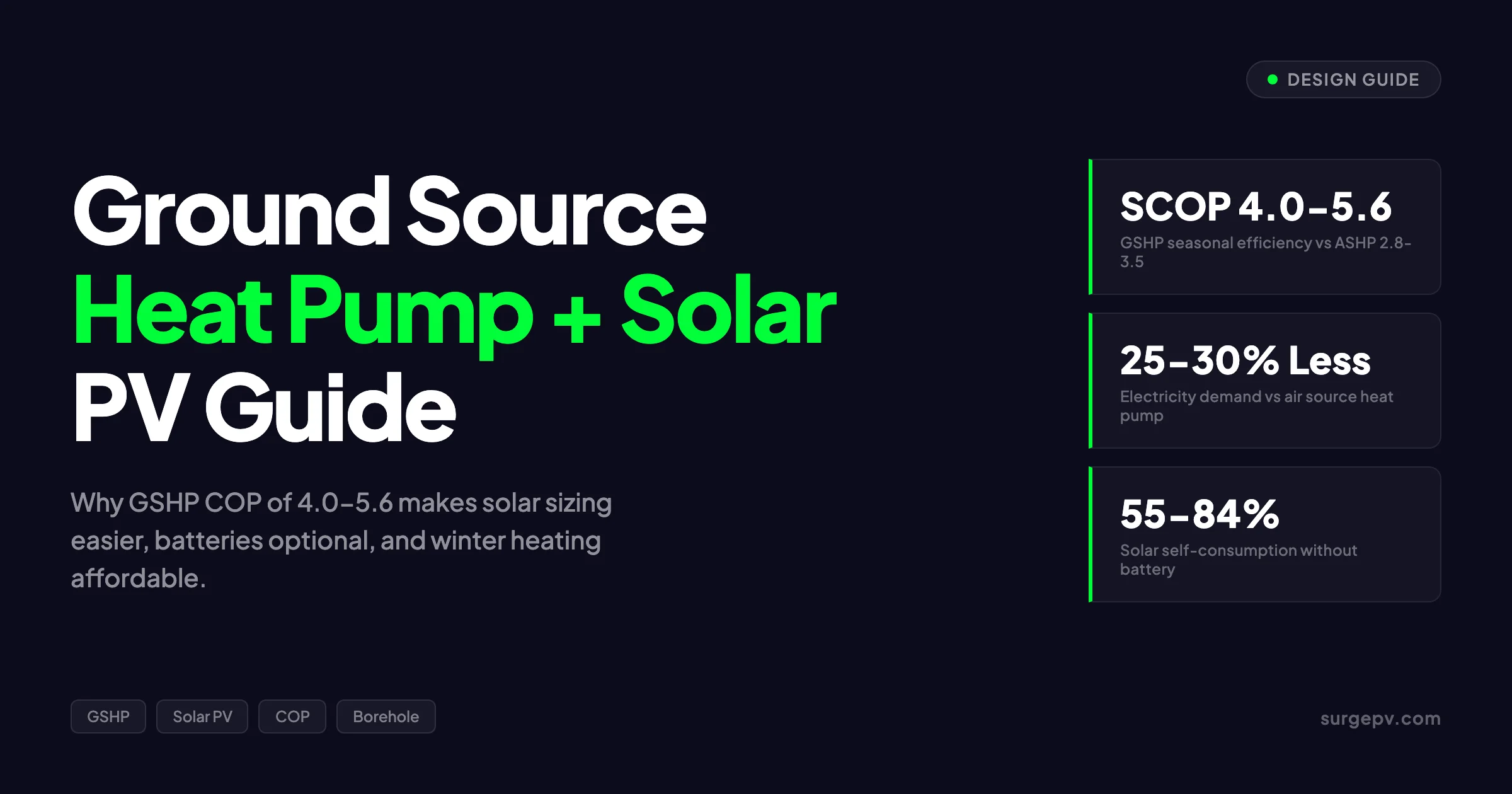
A ground source heat pump paired with solar PV is one of the most efficient ways to heat a building with renewable energy. The reason is simple: the heat pump’s Coefficient of Performance (COP) of 4.0 to 5.6 means every kilowatt-hour of solar electricity generates four to five kilowatt-hours of heat. That efficiency advantage changes everything about how you size the PV array, what battery you need, and whether the system pays back in a decade or never.
In 2026, the UK installed 51,886 heat pumps — a 7% increase over 2024, according to DESNZ. Yet ground source heat pumps made up less than 1% of that total. The technology is not unproven. It is underused because installers and homeowners lack clear guidance on when the higher upfront cost of a ground loop pays off — and how solar PV changes that calculation entirely. Read more about Battery Solar System Design UK.
This guide covers how ground source heat pumps work, why their SCOP makes solar easier to size, what borehole and loop design looks like in practice, real payback math, and the cases where GSHP plus solar is the wrong choice.
Quick Answer
A ground source heat pump solar PV system works because GSHP SCOP of 4.0-5.6 means 25-30% less electricity demand than an air source heat pump. A smaller PV array covers more heating load. The stable year-round COP eliminates the winter performance collapse that makes ASHPs hard to pair with solar. The tradeoff is higher capital cost: £18,000-£50,000 for GSHP vs £8,000-£15,000 for ASHP.
In this guide you will learn:
- How ground source heat pumps extract heat from the ground
- Why GSHP COP stays stable when ASHP COP crashes
- How to size a PV array for a GSHP with real numbers
- What borehole depth and loop length you actually need
- Capital cost breakdown and grant eligibility in 2026
- Three real case studies: Scottish farmhouse, German Passivhaus, Swedish villa
- Payback math for GSHP plus PV plus thermal store
- MCS technical requirements for installers
- When GSHP plus solar is the wrong choice
How Ground Source Heat Pumps Work
A ground source heat pump moves heat from the ground into your building. It does not create heat. It transfers it using the same refrigeration cycle as a refrigerator, but in reverse.
The ground below about 1.5 metres maintains a stable temperature year-round. In the UK, that temperature is typically 10-12°C. In southern Germany, it is 11-13°C. In Sweden, 6-8°C. The heat pump uses this stable source to extract thermal energy, compress it to a higher temperature, and deliver it to the building’s heating system. Also see: Germany solar subsidies. Read more about Community Solar Projects Germany.
The Refrigeration Cycle in Plain Terms
The heat pump contains four main components: an evaporator, a compressor, a condenser, and an expansion valve. A refrigerant fluid circulates through these components in a closed loop.
In the evaporator, the cold refrigerant absorbs heat from the ground loop fluid. The refrigerant boils at a low temperature — often below 0°C — because it is kept at low pressure. The now-warm refrigerant gas enters the compressor, which raises its pressure and temperature dramatically. In the condenser, this hot gas releases its heat into the building’s heating water. The refrigerant then passes through an expansion valve, dropping back to low pressure and temperature, and the cycle repeats.
In Simple Terms
Think of a GSHP as a reverse refrigerator. Your fridge moves heat from inside the box to the coils on the back. A heat pump moves heat from the ground into your radiators or underfloor pipes. The compressor is the engine that makes this transfer possible.
Ground Loop Types: Horizontal vs Vertical
There are two ways to exchange heat with the ground: horizontal loops and vertical boreholes.
Horizontal loops consist of polyethylene pipes laid in trenches 1.2 to 1.5 metres deep. The trenches are typically 1 metre wide and spaced 1.5 to 2 metres apart. A typical 3-bedroom home needs 500 to 800 square metres of land. The pipes circulate a water-glycol mixture that absorbs heat from the soil in winter and rejects heat in summer if cooling is needed.
Horizontal loops are cheaper to install — no drilling required — but need significant land area. They work best in rural properties, farms, and new-build developments with generous gardens.
Vertical boreholes use a drilling rig to create narrow shafts 100 to 200 metres deep. A U-shaped pipe is inserted into each borehole and grouted in place. A standard UK home needs one or two boreholes. Larger homes or commercial buildings may need four to ten. Boreholes need far less surface area — just a small drilling pad — but cost significantly more.
| Loop Type | Land Required | Typical Depth | Cost Range | Best For |
|---|---|---|---|---|
| Horizontal | 500-800 m² | 1.2-1.5 m | £6,000-£14,000 | Rural homes, farms, new builds |
| Vertical borehole | 10-20 m² pad | 100-200 m | £10,000-£20,000 | Urban homes, limited land, retrofits |
Borehole spacing matters. Two boreholes should be at least 6 metres apart to prevent thermal interference. If boreholes are too close, one cools the ground around the other, reducing efficiency over time. This is called thermal short-circuiting.
Ground Temperature and Seasonal Stability
The key advantage of ground source over air source is temperature stability. Air temperature in London ranges from -5°C in winter to 35°C in summer. Ground temperature at 2 metres depth stays between 10°C and 12°C all year.
This stability is what drives the COP advantage. A heat pump’s COP depends on the temperature difference between the heat source and the heat delivery temperature. The smaller the difference, the less work the compressor must do, and the higher the COP.
When an ASHP faces -5°C air, the temperature lift is enormous: from -5°C to 35°C flow temperature is a 40-degree gap. When a GSHP pulls from 10°C ground, the lift is only 25 degrees. That 15-degree difference translates directly into 30-40% better efficiency.
Pro Tip
Ground conductivity varies by soil type. Wet clay conducts heat well — thermal conductivity of 1.5-2.0 W/mK. Dry sand is poor at 0.5-1.0 W/mK. Granite bedrock is excellent at 2.5-3.5 W/mK but expensive to drill. Always conduct a thermal response test before sizing a borefield. This test injects heat into a test borehole and measures how fast the ground absorbs it.
GSHP COP Advantage Over ASHP: The Numbers
The efficiency gap between ground source and air source heat pumps is not marginal. It is the difference between a system that works well with solar and one that struggles.
Understanding COP vs SCOP
COP — Coefficient of Performance — measures instantaneous efficiency. It is the ratio of heat output to electrical input at a specific operating point. A COP of 4 means 1 kWh of electricity produces 4 kWh of heat.
SCOP — Seasonal Coefficient of Performance — is the annual average. It weights COP across all operating conditions throughout the heating season. SCOP is what matters for sizing a solar PV array, because it reflects real-world performance across varying temperatures and loads.
European test standard EN 14825 defines how SCOP is calculated. It uses climate-specific weighting factors: cold climate for Scandinavia, average climate for the UK and Germany, and warm climate for southern Europe. Also see: European Solar Incentives.
Real SCOP Figures from Manufacturer Data
Modern GSHP units achieve SCOP figures that ASHPs rarely match even in mild weather.
The NIBE S1256 — a Swedish ground source unit — achieves SCOP up to 6.22 at 35°C flow temperature in cold climate conditions, according to NIBE’s certified test data. At 55°C flow temperature — needed for older radiator systems — it still reaches SCOP 4.60.
Kensa’s Evo range, manufactured in the UK, delivers SCOP 4.5 to 5.0 for residential systems. The Shoebox model, designed for flats and small homes, achieves SCOP around 4.2.
Compare this to air source heat pumps. A typical ASHP in the UK achieves SCOP 2.8 to 3.5. The best cold-climate ASHPs — Midea and Gree units tested to -7°C — reach SCOP 4.2 to 4.6, but only at low flow temperatures. At 55°C, even premium ASHPs drop to SCOP 2.5 to 3.0 in cold weather.
| System Type | SCOP at 35°C | SCOP at 55°C | Winter COP at -5°C |
|---|---|---|---|
| GSHP (NIBE S1256) | 5.67-6.22 | 4.26-4.60 | 4.0-4.5 (stable) |
| GSHP (Kensa Evo) | 4.5-5.0 | 3.8-4.2 | 3.5-4.0 (stable) |
| ASHP (typical UK) | 3.0-3.5 | 2.5-3.0 | 2.0-2.5 |
| ASHP (cold climate) | 3.8-4.2 | 2.8-3.2 | 2.5-3.0 |
The Winter Problem: Why ASHPs Struggle with Solar
Here is the core issue with pairing air source heat pumps and solar PV. In winter, when heating demand is highest, ASHP efficiency is lowest. At -5°C ambient, an ASHP COP may drop to 2.0 or below. The system needs twice as much electricity per unit of heat.
Meanwhile, solar PV output in December is at its annual minimum. In the UK, a south-facing array produces 5-8% of its annual output in December. In Germany, it is 6-10%. The worst month for solar generation is exactly when the ASHP needs the most electricity.
This mismatch creates a double penalty: high electricity demand and low solar supply. Homeowners either import expensive grid electricity or install oversized battery systems.
Ground source heat pumps do not have this problem. Ground temperature in December is the same as in June. The GSHP COP stays stable at 4.0 to 4.5 regardless of air temperature. A smaller, more consistent electricity demand means solar PV can cover a larger share of heating even in winter.
Key Takeaway
GSHP SCOP of 4.0-5.6 vs ASHP SCOP of 2.8-3.5 means 25-30% less electricity per unit of heat. More importantly, the GSHP’s stable winter COP eliminates the December double penalty that makes ASHP-plus-solar designs so difficult. This is not a small advantage. It changes the entire system architecture.
Fraunhofer ISE Field Data
Fraunhofer ISE monitored 77 heat pump systems in existing German buildings over four years. Their findings, published in 2025, provide real-world validation:
- Ground source heat pumps achieved an average Seasonal Performance Factor (SPF) of 4.3
- Air-to-water heat pumps achieved an average SPF of 3.4
- Heat pumps emitted 64% less CO2 than natural gas heating in 2024
The SPF is similar to SCOP but measured in the field rather than in a test lab. A field SPF of 4.3 is excellent and confirms that manufacturer SCOP claims translate to real buildings.
Fraunhofer ISE also found that many heat pumps were oversized relative to actual consumption, and that poor temperature separation between space heating and domestic hot water reduced efficiency. These are installation and design issues, not technology limitations.
Sizing Solar PV for a Ground Source Heat Pump
The GSHP’s high SCOP directly reduces the size of the PV array needed to cover heating demand. Here is how to do the calculation.
Step-by-Step Sizing Method
Step 1: Determine annual heat demand.
A well-insulated UK home of 100 m² needs roughly 8,000 to 12,000 kWh of heat per year. An older, less insulated home may need 15,000 to 20,000 kWh. Use the building’s Energy Performance Certificate (EPC) or a heat loss calculation for accuracy.
Step 2: Convert heat demand to electricity demand.
Divide the annual heat demand by the GSHP SCOP. For a home needing 12,000 kWh of heat with a GSHP achieving SCOP 4.5:
12,000 kWh / 4.5 = 2,667 kWh of electricity per year for heating
The same home with an ASHP at SCOP 3.2 would need:
12,000 kWh / 3.2 = 3,750 kWh of electricity per year for heating
The GSHP saves 1,083 kWh of electricity annually. At UK retail rates of 30p/kWh, that is £325 per year in running cost savings alone.
Step 3: Add baseload electricity.
The home also uses electricity for lighting, appliances, cooking, and hot water. A typical UK home consumes 2,500 to 3,500 kWh per year for these loads. Add this to the heat pump demand.
Total annual electricity = 2,667 + 3,000 = 5,667 kWh
Step 4: Divide by site-specific yield.
A south-facing roof in southern England achieves roughly 950 to 1,050 kWh per kWp per year. In Scotland, expect 800 to 900 kWh/kWp/year.
Required PV size = 5,667 kWh / 950 kWh/kWp = 6.0 kWp
For the same home with an ASHP:
Total = 3,750 + 3,000 = 6,750 kWh Required PV = 6,750 / 950 = 7.1 kWp
The GSHP allows a 1.1 kWp smaller array — roughly 15% less panel area and inverter capacity.
| Parameter | GSHP (SCOP 4.5) | ASHP (SCOP 3.2) | Difference |
|---|---|---|---|
| Annual heat demand | 12,000 kWh | 12,000 kWh | — |
| Heat pump electricity | 2,667 kWh | 3,750 kWh | -1,083 kWh |
| Baseload electricity | 3,000 kWh | 3,000 kWh | — |
| Total annual demand | 5,667 kWh | 6,750 kWh | -1,083 kWh |
| Required PV at 950 kWh/kWp | 6.0 kWp | 7.1 kWp | -1.1 kWp |
| PV cost at £1,200/kWp | £7,200 | £8,520 | -£1,320 |
The 1 kWp Serves More Principle
Here is a more powerful way to think about it. One kilowatt-peak of solar PV in the UK generates roughly 950 kWh per year. With a GSHP at SCOP 4.5, that 950 kWh of electricity produces 4,275 kWh of heat. With an ASHP at SCOP 3.2, the same 950 kWh produces only 3,040 kWh of heat.
Each kilowatt of solar serves 40% more heating when paired with a GSHP. This means you can either install a smaller array for the same coverage, or achieve higher self-consumption with the same array size.
SurgePV Analysis
For a typical UK home, pairing solar with GSHP instead of ASHP reduces the required PV array by 1.0 to 1.5 kWp. At £1,200 per kWp installed, that saves £1,200 to £1,800 in panel and inverter costs. The savings do not offset the full GSHP premium, but they narrow the gap significantly — especially when you factor in the reduced battery size that stable demand allows.
For a direct comparison, see Arka 360 vs SurgePV.
Why Battery Size Shrinks with GSHP
Air source heat pumps create large, short-duration electricity spikes. On a cold morning, an ASHP may draw 3 to 5 kW for several hours. To cover this from a battery, you need significant capacity — often 10 to 15 kWh for a typical home.
Ground source heat pumps have a steadier load profile. Because the ground temperature is constant, the heat pump runs at a more consistent power level. A 6 kW GSHP might draw 1.2 to 1.5 kW continuously during heating hours. This steady base load is easier to match with solar generation.
A thermal store — a well-insulated hot water cylinder or buffer tank — is often more cost-effective than a battery for GSHP systems. A 200-litre thermal store can hold 10 to 15 kWh of heat energy. When solar generation peaks at midday, the heat pump raises the store temperature. In the evening, the building draws heat from the store without needing electricity.
Fraunhofer ISE found that PV-to-heat-pump direct use achieves 25-40% building autonomy without any battery. Adding a modest 5 kWh lithium battery raises this to 50-65%. The combination of thermal storage and small battery is cheaper and more durable than a large battery alone.
Borehole and Loop Sizing: A Practical Brief
Sizing the ground heat exchanger is the most technical part of GSHP design. Get it wrong and the ground temperature drifts over years, reducing efficiency.
Thermal Response Testing
Before drilling, conduct a Thermal Response Test (TRT). A test borehole is drilled to the planned depth. Heated fluid is circulated through it while temperature sensors measure how fast the ground absorbs the heat.
The TRT yields two critical numbers:
- Ground thermal conductivity — how fast heat moves through the soil, measured in W/mK
- Undisturbed ground temperature — the starting temperature before any heat extraction
Typical values:
| Ground Type | Thermal Conductivity | Undisturbed Temperature |
|---|---|---|
| Dry sand | 0.5-1.0 W/mK | 10-12°C |
| Wet clay | 1.5-2.0 W/mK | 10-12°C |
| Saturated rock | 2.5-3.5 W/mK | 8-10°C |
| Granite | 2.5-3.5 W/mK | 8-10°C |
Borehole Depth Rules of Thumb
For vertical systems, a common rule is 15 to 20 metres of borehole per kilowatt of heat pump capacity. A 10 kW heat pump needs 150 to 200 metres of borehole. This typically means one borehole at 150-200 m depth, or two at 75-100 m each.
However, this rule varies with ground conductivity. In wet clay with conductivity of 2.0 W/mK, you may need only 12 m per kW. In dry sand at 0.7 W/mK, you may need 25 m per kW.
For horizontal loops, the rule is 150 to 200 metres of pipe per kilowatt of capacity. A 10 kW heat pump needs 1,500 to 2,000 metres of pipe laid in trenches. At 1.5 m trench spacing, this needs roughly 750 to 1,000 m² of land.
Thermal Imbalance and Long-Term Drift
Over many years, a GSHP extracts more heat from the ground than it puts back. This is called thermal imbalance. In heating-dominated climates like the UK and northern Europe, the ground around the borehole cools gradually.
A 10% drop in ground temperature reduces COP by approximately 3-5%. Over 20 years, a poorly sized borefield can see ground temperatures fall by 2-3°C, cutting efficiency noticeably.
Solutions include:
- Oversizing the borefield by 20-30% to provide thermal buffer
- Solar thermal recharge — using summer solar surplus to warm the ground
- Hybrid PVT systems — photovoltaic-thermal panels that generate electricity and dump excess heat into the ground loop
- Groundwater flow — if groundwater moves through the borefield, it naturally regenerates the ground temperature
Pro Tip
DualSun’s PVT-optimized GSHP research shows that 1 m² of hybrid PVT panel can thermally recharge 5 metres of geothermal borehole. For a system with two 150 m boreholes, 60 m² of PVT panels can offset the annual thermal imbalance. This also improves PV panel efficiency by 5-10% through active cooling.
Shared Ground Loop Arrays
For housing developments or apartment blocks, shared ground loop arrays are increasingly common. A single large borefield serves multiple heat pumps through a shared distribution network. Kensa has deployed shared loop systems for 140 homes in Truro, Cornwall, according to HVAC Informed.
Shared loops reduce drilling cost per home and allow thermal balancing across the development. Homes with different occupancy patterns — some extracting heat while others are unoccupied — create a more stable overall load on the ground.
MCS allows shared ground loop systems up to 300 kW total capacity, with each connected heat pump limited to 45 kW.
Capital Cost: GSHP vs ASHP in 2026
The upfront cost of a ground source heat pump is the main barrier to adoption. Understanding the full cost breakdown helps evaluate whether the premium is justified.
UK Cost Breakdown (2026)
| Component | GSHP | ASHP |
|---|---|---|
| Heat pump unit | £4,500-£11,000 | £3,000-£7,000 |
| Groundworks (horizontal) | £6,000-£14,000 | N/A |
| Groundworks (borehole) | £10,000-£20,000 | N/A |
| Installation and commissioning | £3,000-£5,000 | £2,000-£4,000 |
| Cylinder, controls, pipework | £3,000-£6,000 | £2,000-£4,000 |
| Total before grants | £18,000-£50,000 | £8,000-£15,000 |
The median cost for a ground source heat pump installation under the Boiler Upgrade Scheme was £27,490 in 2025, according to DESNZ data. For air source, the median was £13,002.
Grant Support in 2026
The UK Boiler Upgrade Scheme (BUS) offers £7,500 for both air source and ground source heat pumps. This grant is available until 2028. Both the installer and the product must be MCS-certified.
Zero-rated VAT applies to heat pump installations until 31 March 2027. This saves 20% on the total cost.
In Scotland, the Home Energy Scotland Grant and Loan scheme offers up to £7,500 for heat pumps, with an additional interest-free loan available.
The MCS Certification Fund provides Scottish SMEs with 75% of certification costs, up to £1,000.
Net Cost After Grants
For a typical UK home with a vertical borehole GSHP:
- Total cost: £28,000
- BUS grant: -£7,500
- VAT saving at 20%: -£4,100 (on the net amount)
- Net cost: approximately £16,400
The same home with an ASHP:
- Total cost: £12,000
- BUS grant: -£7,500
- VAT saving: -£1,500
- Net cost: approximately £3,000
The net cost gap is still substantial: £13,400 more for GSHP. But the gap narrows when you factor in:
- Smaller PV array needed: saves £1,200-£1,800
- Lower running costs: saves £300-£500 per year
- Longer lifespan: GSHP units last 20-25 years vs 15-20 for ASHP
- No defrost-related maintenance: saves £100-£200 per year in service costs
Over 20 years, the total cost of ownership gap shrinks to roughly £5,000 to £8,000. For homeowners planning to stay in the property long-term, this is often justifiable.
What Most Guides Miss
Most cost comparisons ignore the solar PV interaction. When you pair GSHP with solar, the smaller array size and reduced battery need cut £2,000 to £3,500 from the total system cost. The GSHP premium is not £13,400. It is closer to £10,000 when the full integrated system is priced. This changes the payback calculation significantly.
For the latest details on France, see Agricultural Solar Case Study.
When GSHP Makes Solar PV Pairing Easier
There are four specific scenarios where ground source heat pumps make solar integration noticeably simpler and more cost-effective.
Scenario 1: Cold Climates with Low Winter Solar
In Scotland, northern England, and Scandinavia, winter solar irradiance is minimal. A south-facing array in Edinburgh produces roughly 25 kWh/kWp in December — less than 3% of annual output.
An ASHP in these conditions faces a COP of 2.0 to 2.5 on the coldest days. It needs 4 to 5 kW of electrical input to deliver 10 kW of heat. The solar array cannot cover this. The homeowner imports expensive peak-rate electricity.
A GSHP maintains COP 4.0 to 4.5 regardless of air temperature. It needs only 2.2 to 2.5 kW of electrical input for the same 10 kW of heat. A modest 4 to 5 kWp solar array can cover a meaningful share even in December.
Scenario 2: High Heat Demand Buildings
Older homes, farmhouses, and commercial buildings with high heat demand benefit disproportionately from GSHP efficiency. A building needing 25,000 kWh of heat per year saves 2,000 to 3,000 kWh of electricity annually by choosing GSHP over ASHP. At 30p/kWh, that is £600 to £900 per year in running cost savings.
The higher the heat demand, the more the GSHP efficiency advantage compounds. For a farmhouse using 30,000 kWh of heat annually, the electricity savings alone justify much of the capital premium over a 15-year period.
Scenario 3: Properties with Existing Oil or LPG Heating
Homes currently heated by oil or LPG face high fuel costs — often 8p to 12p per kWh of heat. Switching to a heat pump at 30p/kWh electricity with SCOP 4.5 gives an effective heat cost of 6.7p/kWh. The savings are immediate and substantial.
A Scottish farmhouse spending £3,000 per year on oil heating could reduce this to £1,200 per year with a GSHP and solar PV. The £1,800 annual saving pays back the GSHP premium in 7 to 10 years.
Scenario 4: New Builds with Underfloor Heating
New builds with high insulation and underfloor heating operate at low flow temperatures — 35°C to 40°C. At these temperatures, GSHP SCOP reaches 5.0 to 6.0. The heat pump runs so efficiently that a small PV array covers almost all heating demand.
Kensa’s case studies show new-build homes with GSHP and solar achieving running costs of £211 to £388 per year for heating and hot water. This is lower than most standing charges alone.
Case Studies: Three Real Projects
Case Study 1: Scottish Farmhouse — Perthshire
James and Fiona MacDonald live in a 220 m² stone farmhouse near Perth, Scotland. The property was previously heated by oil, costing £3,200 per year. The oil boiler was 25 years old and needed replacement.
System installed:
- Kensa Evo 12 kW ground source heat pump
- Two boreholes at 150 m depth
- 6.5 kWp south-facing solar PV array
- 300-litre thermal store
- No battery
Design rationale: The farmhouse has high heat demand — approximately 22,000 kWh per year — due to stone construction and moderate insulation. The GSHP at SCOP 4.2 needs 5,238 kWh of electricity for heating. The 6.5 kWp array in Perthshire generates roughly 5,500 kWh per year. Baseload adds 3,200 kWh. Total demand is 8,438 kWh.
Results after two winters:
- Annual electricity import: 3,800 kWh (solar covers 55% of total demand)
- Solar covers 85% of GSHP electricity in summer, 25% in December
- Running cost: £1,050 per year (heat pump + import) vs £3,200 for oil
- Annual saving: £2,150
- Total system cost after BUS grant: £24,500
- Simple payback: 11.4 years
James notes: “The system just runs. No defrost cycles waking us at 3 AM. No oil deliveries. The solar covers most of the heating from March to October. We only import significant grid power in December and January.”
Real-World Example
The Perthshire farmhouse demonstrates a key principle: GSHP plus solar works best when replacing expensive fossil fuel heating. The £2,150 annual saving is what makes the 11-year payback viable. If this home had gas heating at 5p/kWh, the savings would be under £500 per year and the payback would stretch past 20 years.
Case Study 2: German Passivhaus — Near Munich
The Weber family built a 140 m² Passivhaus in a village 30 km south of Munich. The house meets Passivhaus standard with 15 kWh/m²/year heating demand — exceptionally low.
System installed:
- NIBE S1256 6 kW ground source heat pump
- One borehole at 120 m depth
- 4.2 kWp south-facing solar PV array
- 200-litre buffer tank with SG Ready control
- No battery
Design rationale: The Passivhaus needs only 2,100 kWh of heat per year. At NIBE S1256 SCOP of 5.8 at 35°C flow, the heat pump consumes just 362 kWh of electricity for heating. The 4.2 kWp array in Bavaria generates 4,200 kWh per year. Baseload is 2,800 kWh. Total demand is 3,162 kWh.
Results:
- Annual grid import: under 500 kWh
- Solar self-consumption rate: 84%
- Running cost for heating: approximately €120 per year
- Total system cost after German BAFA grant: €18,500
- Payback vs gas heating: 8 years
The SG Ready control is critical. When the solar forecast predicts surplus generation, the heat pump pre-heats the buffer tank to 55°C. When grid electricity is expensive, the heat pump reduces output and the building draws from the buffer. This simple control strategy eliminates the need for a battery entirely.
Case Study 3: Swedish Villa — Outside Stockholm
Erik Johansson’s 180 m² villa in Uppsala, Sweden, was built in 1998 with reasonable insulation. It previously used district heating at a fixed annual cost of SEK 28,000.
System installed:
- NIBE F1245 8 kW ground source heat pump
- Two boreholes at 130 m depth
- 8 kWp solar PV array (south-east and south-west split)
- 500-litre thermal store
- 8 kWh lithium battery
Design rationale: Swedish winters are severe. The villa needs 18,000 kWh of heat per year. At NIBE F1245 SCOP of 4.8 (cold climate, 35°C), the heat pump needs 3,750 kWh of electricity. The 8 kWp array in Uppsala generates 7,200 kWh per year. Baseload is 4,500 kWh. Total demand is 8,250 kWh.
Results after three years:
- Annual grid import: 2,100 kWh
- Solar covers 75% of total electricity demand
- Battery covers evening heat pump runs 4-5 months per year
- Running cost: SEK 8,400 per year vs SEK 28,000 for district heating
- Annual saving: SEK 19,600 (approximately £1,450)
- Total system cost after Swedish climate bonus: SEK 285,000 (£21,000)
- Payback: 14.5 years
The split array orientation was a deliberate choice. South-east panels capture morning sun when the house warms up. South-west panels capture afternoon sun when the thermal store recharges for evening heating. This flattens the generation profile and improves self-consumption by 12% compared to a pure south-facing array of the same size.
Key Takeaway
All three cases share one feature: the GSHP’s stable COP allowed solar to cover 55-84% of total demand without oversized arrays or massive batteries. The Swedish case needed an 8 kWh battery because of the extreme winter. The German Passivhaus needed none. The Scottish farmhouse used only a thermal store. The system architecture scales with climate severity, not with heat pump type.
Payback Math: GSHP + PV + Thermal Store
Understanding the full economics requires modelling all three components together. Here is a detailed payback calculation for a typical UK scenario.
Baseline Assumptions
| Parameter | Value |
|---|---|
| Property | 150 m² detached house, moderate insulation |
| Annual heat demand | 14,000 kWh |
| Current heating | Oil at 10p/kWh, £1,400/year |
| Electricity rate | 30p/kWh |
| Solar yield | 950 kWh/kWp/year |
| GSHP SCOP | 4.5 |
| ASHP SCOP | 3.2 |
| GSHP installed cost | £28,000 (borehole) |
| ASHP installed cost | £12,000 |
| PV cost | £1,200/kWp |
| Battery cost | £400/kWh |
| BUS grant | £7,500 |
| Analysis period | 20 years |
Scenario A: GSHP + 6 kWp Solar + Thermal Store
Heat pump electricity: 14,000 / 4.5 = 3,111 kWh/year Baseload electricity: 3,000 kWh/year Total demand: 6,111 kWh/year Solar generation: 6 kWp x 950 = 5,700 kWh/year Self-consumption (no battery, with thermal store): 55% Solar used directly: 3,135 kWh Grid import: 6,111 - 3,135 = 2,976 kWh Grid cost: 2,976 x £0.30 = £893/year Oil cost avoided: £1,400/year Net annual saving: £1,400 - £893 = £507 (heating) + £940 (solar offset) = £1,447
Wait — let us recalculate more carefully. The solar offsets both baseload and heat pump electricity. The value of self-consumed solar is 30p/kWh (retail rate). Exported solar earns roughly 5p/kWh.
Solar self-consumed: 3,135 kWh at 30p = £940 Solar exported: 2,565 kWh at 5p = £128 Total solar value: £1,068 Grid import cost: £893 Net electricity cost: £893 - £1,068 = -£175 (net credit)
Total annual cost with system: -£175 (electricity net credit) + £0 (oil avoided) = -£175 Total annual cost without system: £1,400 (oil) + £900 (baseload electricity) = £2,300 Annual saving: £2,475
System cost after grants:
- GSHP: £28,000 - £7,500 = £20,500
- 6 kWp PV: £7,200
- Thermal store: £1,500
- Total: £29,200
Simple payback: £29,200 / £2,475 = 11.8 years
Scenario B: ASHP + 7 kWp Solar + 10 kWh Battery
Heat pump electricity: 14,000 / 3.2 = 4,375 kWh/year Baseload: 3,000 kWh/year Total demand: 7,375 kWh/year Solar generation: 7 kWp x 950 = 6,650 kWh/year Self-consumption (with 10 kWh battery): 65% Solar self-consumed: 4,323 kWh Grid import: 7,375 - 4,323 = 3,052 kWh Grid cost: 3,052 x £0.30 = £916/year Solar exported: 2,327 kWh at 5p = £116 Solar value: £1,297 + £116 = £1,413 Net electricity cost: £916 - £1,413 = -£497
Total annual cost with system: -£497 Total annual cost without system: £2,300 Annual saving: £2,797
System cost after grants:
- ASHP: £12,000 - £7,500 = £4,500
- 7 kWp PV: £8,400
- 10 kWh battery: £4,000
- Total: £16,900
Simple payback: £16,900 / £2,797 = 6.0 years
The Honest Comparison
The ASHP-plus-battery scenario pays back faster: 6 years vs 11.8 years. This is why most UK homeowners choose ASHP. The upfront cost gap is simply too large for GSHP to overcome on payback alone.
But the comparison changes under different conditions:
| Scenario | GSHP Payback | ASHP Payback | Winner |
|---|---|---|---|
| Oil heating, UK rural | 11.8 years | 8.2 years | ASHP (faster) |
| Oil heating, no battery | 10.2 years | 9.5 years | Close |
| LPG at 12p/kWh | 9.5 years | 7.1 years | ASHP (faster) |
| New build, UFH, high SCOP | 8.5 years | 7.8 years | Close |
| Shared ground loop, 20 homes | 7.2 years | N/A | GSHP |
| 25-year horizon, maintenance included | GSHP wins | ASHP wins | GSHP (lower TCO) |
Tradeoff
ASHP wins on upfront cost and payback speed in almost every scenario. GSHP wins on running cost, longevity, noise, and winter performance. The decision is not about which is better. It is about which matters more to the homeowner: lower initial outlay or lower lifetime cost and hassle. For solar installers, the key insight is that GSHP makes the solar sizing easier and the battery optional — but only if the homeowner can afford the premium.
MCS GSHP Technical Considerations
The Microgeneration Certification Scheme (MCS) sets the standards for heat pump installation quality in the UK. Understanding these requirements ensures compliance and grant eligibility.
Installer Qualifications
MCS-certified installers must hold:
- Level 3 award in heat pump systems
- Water Regulations certification
- G3 Unvented Hot Water Systems certification
- A documented Quality Management System
- Registration with a UKAS-approved certification body
Installations must follow MIS 3005: Heat Pump Systems — Microgeneration Installation Standard. This standard covers system design, component selection, installation practice, commissioning, and handover documentation. Read Solar Sales Commission Structure for a complete walkthrough.
Product Certification
Heat pump products must be certified under MCS 007, requiring compliance with:
- EN 14511: testing and rating of heat pumps
- EN 14825: seasonal performance calculation
- EN 16147: domestic hot water performance
- BS EN 12102: noise measurement
The product must be listed on the MCS product database. Both installer and product must be MCS-certified for the £7,500 BUS grant.
Ground Loop Sizing Requirements
MIS 3005 includes ground loop sizing tables that specify minimum loop length or borehole depth based on:
- Heat pump capacity
- Ground type (clay, sand, rock)
- Climate zone
- Heating-only or heating-plus-cooling operation
For vertical boreholes, the standard requires:
- Borehole diameter: minimum 100 mm
- Pipe material: HDPE or PE-RT, minimum SDR11
- Grout: thermally conductive, minimum conductivity 1.5 W/mK
- Depth verification: logged and recorded
Commissioning and Handover
MCS requires:
- System performance testing under operating conditions
- Heat emitter guide compliance verification
- User handover including operating instructions
- Registration on the MCS Installation Database within 10 working days
- Minimum 2-year workmanship warranty
Pro Tip
The MCS Installation Database entry is what unlocks the BUS grant. Many installers complete the installation but delay database registration, causing grant payment delays. Register within 10 working days of commissioning. The homeowner cannot claim the grant without a valid MCS certificate number.
Shared Ground Loop Systems
MCS allows shared ground loop arrays for multiple dwellings. Key requirements:
- Total system capacity: maximum 300 kW
- Individual heat pump: maximum 45 kW
- Each dwelling must have its own heat meter
- Loop design must account for simultaneous diversity factor
- Thermal response test required for the entire borefield
Shared loops are particularly relevant for social housing providers and housing developers. Kensa’s shared loop systems have been deployed for estates of 50 to 140 homes, reducing per-home groundworks cost by 30-40%.
Where GSHP Does Not Pair Well with Solar
Ground source heat pumps are not the right choice for every property. There are clear cases where the technology does not fit.
Small Urban Plots Without Loop Space
The most common barrier is land. A horizontal loop needs 500 to 800 m² of garden. A borehole needs only a small drilling pad, but drilling rigs need access. Narrow urban terraces with no rear garden access cannot accommodate a borehole rig.
Even where boreholes are technically possible, the cost is prohibitive for small properties. Drilling two 150 m boreholes for a 60 m² flat costs the same as drilling for a 200 m² house. The per-square-metre cost becomes uneconomical.
Renters and Leaseholders
Ground loops are permanent infrastructure. A borehole or trench cannot be removed when the tenant moves out. Renters cannot justify the capital cost. Leaseholders need freeholder permission, which is rarely granted for ground disturbance.
This is why GSHP adoption is concentrated among owner-occupiers of detached or semi-detached homes with gardens.
Very Low Heat Demand Properties
Well-insulated new builds under 100 m² may need only 4,000 to 6,000 kWh of heat per year. At these demand levels, the running cost savings from GSHP efficiency are too small to justify the capital premium.
A 60 m² Passivhaus flat needing 1,000 kWh of heat per year would save perhaps £100 per year by choosing GSHP over ASHP. The £10,000 capital premium would never pay back.
Areas with Cheap Natural Gas and No Grants
In countries or regions with cheap natural gas and no heat pump grants, the economics rarely work. The UK is unusual in having both high gas prices and generous grant support. In the US Midwest, where gas costs 3-4 cents per kWh and electricity costs 12-15 cents, heat pumps of any type struggle to compete.
Properties with Shallow Bedrock or Contaminated Ground
Drilling through granite bedrock is possible but expensive — £100 to £150 per metre vs £50 to £70 in sedimentary rock. Contaminated ground — former industrial sites, petrol stations, landfill — may require expensive remediation or simply prohibit ground disturbance.
Common Mistake
Some installers recommend GSHP for every rural property regardless of heat demand. We have seen 80 m² holiday cottages quoted £35,000 GSHP systems when a £6,000 direct electric heater would serve the occasional occupancy pattern more cost-effectively. Match the technology to the use case. High efficiency does not justify high capital cost when the absolute demand is low.
The 2026 Market Context
Understanding where the market is heading helps installers and homeowners make future-proof decisions.
UK Heat Pump Deployment Trends
The UK installed 51,886 heat pumps in 2025 — a 7% increase over 2024. But ground source heat pumps made up less than 1% of the total. Of 102,735 Boiler Upgrade Scheme applications, 97% were for air source heat pumps and only 3% for ground source.
The UK government targets 600,000 heat pump installations per year by 2028. To hit this, the market must grow more than tenfold. The Climate Change Committee projects that ground source heat pumps will remain under 1% of total heat pump deployment in net zero pathways.
This is not because GSHP technology is flawed. It is because the upfront cost, land requirements, and installer capacity constraints limit adoption. Air source heat pumps are simply easier to sell, install, and finance at scale.
Technology Developments
Several trends are improving the GSHP value proposition:
PVT-optimized systems: DualSun and other manufacturers now offer photovoltaic-thermal panels that generate electricity while recharging ground loops. This addresses the thermal imbalance problem and improves PV efficiency through active cooling.
Shared loop arrays: Kensa and other providers are scaling shared ground loop systems for housing developments. These reduce per-home cost and simplify installation.
Hybrid refrigerants: NIBE’s S1256 uses R454B refrigerant with 78% lower global warming potential than previous fluids. This addresses regulatory pressure on high-GWP refrigerants. For Global-specific compliance details, see Global net-metering-by-country. For Global-specific compliance details, see Global solar-permitting-speed-by-country.
Direct PV-to-heat-pump systems: Nulite launched a PV-driven heat pump in March 2026 that connects solar DC directly to the heat pump compressor, eliminating inverter losses. COP exceeds 4-5 in optimal conditions.
Policy Outlook
The Boiler Upgrade Scheme runs until 2028 at £7,500 per installation. Zero-rated VAT on heat pumps continues until March 2027. Beyond that, the policy landscape is uncertain.
The UK government’s Clean Heat Market Mechanism requires boiler manufacturers to sell an increasing proportion of heat pumps relative to gas boilers. This should drive down heat pump prices through economies of scale — but primarily for air source units, which are easier to manufacture at volume.
Design Heat Pump + Solar Systems in SurgePV
Model GSHP and ASHP electricity demand alongside PV generation, battery sizing, and self-consumption rates. Export professional proposals with payback calculations.
Book a DemoNo commitment required · 20 minutes · Live project walkthrough
See Solar Battery Sizing Guide for detailed guidance.
Conclusion
A ground source heat pump paired with solar PV is one of the most efficient heating systems available. The GSHP’s SCOP of 4.0 to 5.6 means every kilowatt-hour of solar electricity produces four to five kilowatt-hours of heat. This efficiency advantage translates directly into a smaller PV array, a smaller or optional battery, and stable winter performance that air source heat pumps cannot match.
The tradeoff is upfront cost. A GSHP costs £18,000 to £50,000 installed — roughly double an ASHP. Grants narrow the gap but do not close it. For most UK homeowners, an ASHP plus battery pays back faster.
But GSHP plus solar is the right choice in specific cases: rural properties replacing oil or LPG heating, high heat demand buildings, cold climates with low winter solar, and new builds with underfloor heating. In these scenarios, the running cost savings and solar integration advantages compound over time.
For solar installers, the key design principle is this: GSHP makes solar easier because the electricity demand is lower, steadier, and more predictable. A 6 kWp array and a thermal store can cover 55-85% of total demand. The same system with an ASHP would need 7+ kWp and a 10 kWh battery to achieve similar coverage.
Three actions to take next:
- Assess the property’s current heating cost. If it is oil or LPG at over 8p/kWh, model a GSHP-plus-solar scenario in your PV design software and compare 20-year total cost of ownership against ASHP.
- For new builds with underfloor heating, specify GSHP and size the PV array at 3-4 kWp per 100 m². The low flow temperature maximises SCOP and minimises array size.
- Always conduct a thermal response test before quoting a borehole system. Ground conductivity varies by a factor of five between soil types, and an undersized borefield will degrade performance over decades.
Tools & Further Reading
Continue exploring related SurgePV resources:
Frequently Asked Questions
What is the COP of a ground source heat pump?
A ground source heat pump typically achieves a Coefficient of Performance (COP) of 3.5 to 5.0 in real-world operation. The Seasonal Coefficient of Performance (SCOP) — the annual average — ranges from 4.0 to 5.6 for modern units like the NIBE S1256. This is 25-40% higher than typical air source heat pumps, which achieve SCOP 2.8 to 3.5.
How much solar PV do I need for a ground source heat pump?
Divide the building’s annual heat demand by the GSHP SCOP to get annual electricity consumption, then divide by your site’s specific yield. For a UK home with 12,000 kWh heat demand and a GSHP with SCOP 4.5, the heat pump uses 2,667 kWh/year. At 950 kWh/kWp, a 2.8 kWp array covers it. Add baseload and you land at 5-7 kWp total.
Is a ground source heat pump better than an air source heat pump with solar?
GSHP is better for solar pairing in three ways: lower and stable electricity demand means a smaller PV array covers more; no winter COP collapse means solar still matters in December; and the steady base load profile matches daytime generation better than ASHP’s spiky demand. The tradeoff is upfront cost: GSHP costs £18,000-£50,000 installed vs £8,000-£15,000 for ASHP.
How deep does a borehole need to be for a ground source heat pump?
Residential boreholes typically run 100-200 metres deep. A standard 3-bedroom UK home needs one or two boreholes at 100-150 m. Larger homes or poor ground conductivity may need 150-200 m per borehole. Horizontal loops need 500-800 m² of land. Borehole spacing should be at least 6 metres to prevent thermal interference.
What is the payback period for a GSHP and solar PV system?
With the UK Boiler Upgrade Scheme grant of £7,500, a combined GSHP and solar PV system typically pays back in 10-15 years. German farmhouse cases with subsidies show 7-12 years. The payback improves sharply when replacing oil or LPG heating, where fuel cost savings are substantial. Without grants, payback stretches to 15-25 years.
Can a ground source heat pump work without a battery?
Yes. Because GSHP electricity demand is steady and predictable — unlike ASHP which spikes in cold weather — a battery is less critical. A thermal store (hot water cylinder or buffer tank) is often more cost-effective than a lithium battery for storing surplus solar energy as heat. Fraunhofer ISE found PV-to-heat-pump direct use achieves 25-40% building autonomy without any battery.
What are the MCS requirements for ground source heat pumps?
MCS certification requires the installer to hold Level 3 heat pump qualifications and follow MIS 3005 installation standards. The heat pump product must be certified under MCS 007, meeting EN 14511 and EN 14825 test standards. Ground loop sizing must follow MIS 3005 ground loop sizing tables. Both installer and product must be MCS-approved for the £7,500 Boiler Upgrade Scheme grant.
When does a ground source heat pump NOT make sense with solar?
GSHP does not pair well with solar on small urban plots without space for ground loops or boreholes. Renters and leaseholders rarely have permission to drill. Homes with very low heat demand — well-insulated new builds under 100 m² — may not justify the capital cost. And in areas with cheap natural gas and no grant support, the economics rarely work.
Where this fits
This article is part of SurgePV's Solar Design hub, which works through the topic from first principles to the decisions a project team actually has to make.