A typical UK or Australian household burns 2,400 kWh per year heating hot water. That is roughly 18% of total domestic electricity use according to Energy Saving Trust (2024). Replace the immersion or gas boiler with a hot water heat pump and the same 180 litre tank now costs 600–700 kWh per year of electricity. Pair that heat pump with a small slice of solar PV and the hot water bill drops to near zero. For UK-specific information, see Battery Solar System Design UK. For Australia-specific compliance details, see Australia comparisons/lgc-vs-stc.
This guide walks through every sizing decision: how much hot water your household actually uses, the COP math that turns thermal demand into electrical demand, the PV array needed to cover 80% of that electricity, and the controller logic that ties it together. The examples cover 1-bed, 4-bed, and 6-bed homes with real wattage, run-time, and solar fraction numbers.
Quick Answer
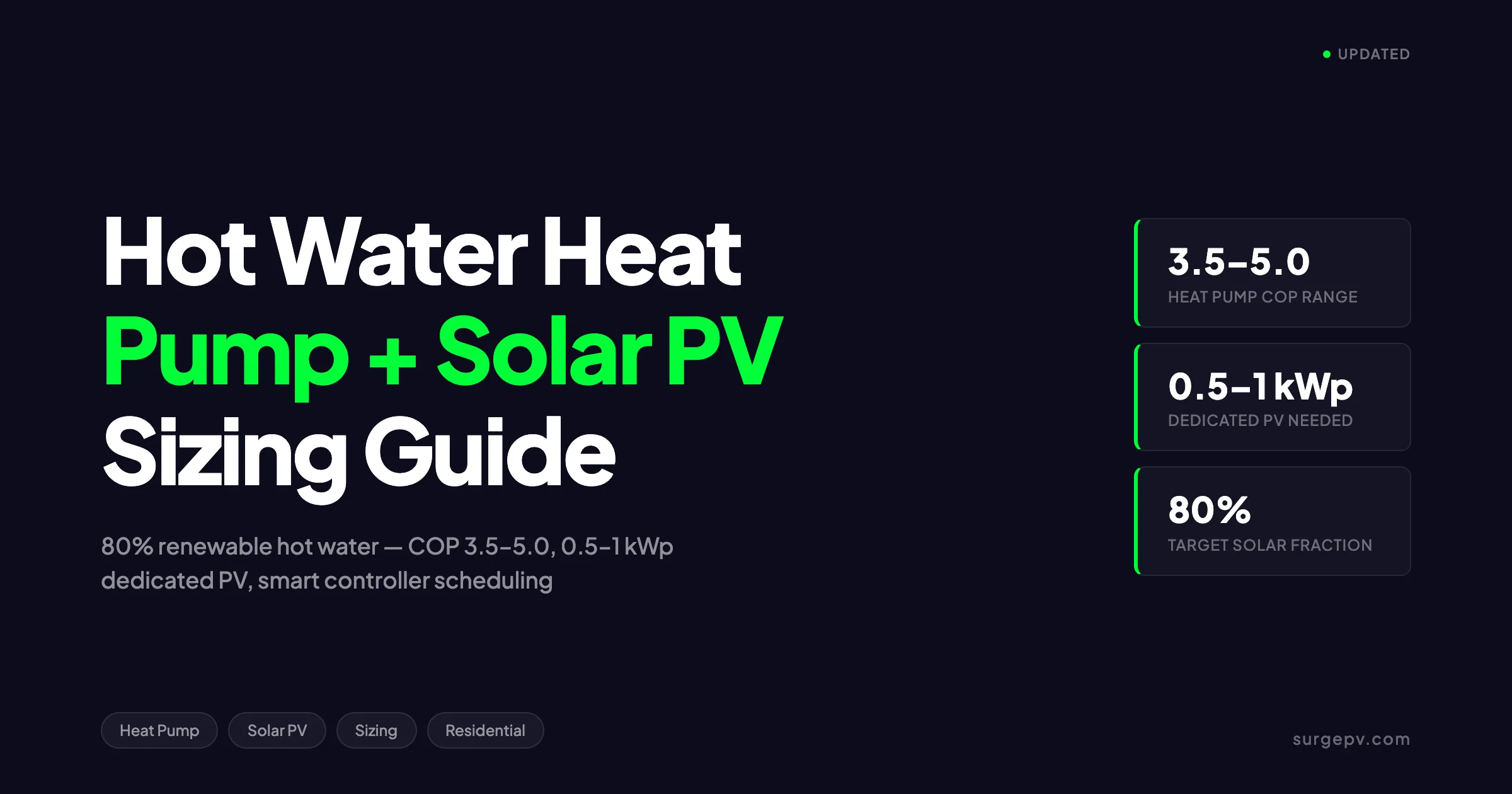
To size a hot water heat pump with solar PV for 80% renewable hot water, multiply daily hot water volume by 0.046 kWh/L to get thermal demand, divide by COP 3.5 to get electrical demand, then size 0.5–1 kWp of dedicated PV per 180L household. A 4-person home needs 180L/day, 2.4 kWh electricity, and 0.7 kWp PV with smart controller scheduling. Hot water heat pump solar PV sizing depends more on tank insulation and controller logic than panel count.
TL;DR — Hot Water Heat Pump + Solar PV
A 4-person household needs 180L/day of hot water = 8.4 kWh thermal = 2.4 kWh electric at COP 3.5. Add 1.5 kWh tank loss = 3.9 kWh daily. Dedicate 0.5–1 kWp PV and a PV-aware controller (Ecodan FTC6, Sanden, Reclaim) to hit 80% solar fraction in mild climates.
In this guide:
- How heat pump water heaters work, and why they beat immersion and gas
- The 4-step math to turn litres of hot water into kWp of PV
- Smart controllers from Mitsubishi, Sanden, and Reclaim — what they actually do
- Why insulation matters more than panel count
- Worked examples for 1-bed, 4-bed, and 6-bed homes
- Mitsubishi Ecodan FTC6 PV-link setup, step by step
- When a solar diverter (Eddi, Optimmersion) wins on cost
What Is a Hot Water Heat Pump?
A hot water heat pump is a small heat pump unit (1.5–4 kW input) that heats domestic hot water in an insulated cylinder. It moves heat from the surrounding air into the tank water, the same way an air-source heat pump heats a home’s radiators. Industry shorthand calls them HPWH (heat pump water heater) or DHW (domestic hot water) heat pumps.
The Coefficient of Performance — COP, the ratio of heat output to electricity input — sits between 3.5 and 5.0 for modern models. That means 1 kWh of electricity produces 3.5–5.0 kWh of heat. An immersion element delivers exactly 1.0 kWh of heat per 1 kWh of electricity, with zero leverage.
Most units come in two physical forms. Monobloc units integrate the heat pump and tank in one cabinet, sit indoors or in a garage, and need ducted or louvred ventilation. Split systems put the heat pump outdoors and the tank indoors, with refrigerant lines between them. Split is the dominant retrofit choice in Australia (Sanden, Reclaim) and Japan; monobloc is more common in the UK and Germany (Mitsubishi Ecodan QUHZ, Stiebel Eltron WPL). Also see: Germany solar subsidies. Read more about Community Solar Projects Germany.
In Simple Terms
A hot water heat pump is like a fridge running in reverse. A fridge takes heat out of the food box and dumps it into the kitchen. A hot water heat pump takes heat out of the outside air and dumps it into a tank of water. Both use about 1 kWh of electricity to move 3 to 5 kWh of heat.
Why Heat Pumps Beat Immersion and Gas
The three options for hot water in a modern home are an immersion element, a gas combi or system boiler, and a heat pump water heater. The comparison below shows the kWh required to deliver 8.4 kWh of useful hot water (the thermal energy to heat 180L from 15°C to 55°C). For France-specific information, see Agricultural Solar Case Study.
| Technology | Input energy | Cost at €0.30/kWh | Carbon (kgCO2) |
|---|---|---|---|
| Electric immersion (3 kW) | 8.4 kWh electric | €2.52 | 1.8 |
| Gas combi boiler (90% efficient) | 9.3 kWh gas | €0.84 | 1.7 |
| Solar diverter + immersion | 4–5 kWh grid + 4 kWh PV | €1.20–1.50 | 0.9 |
| Hot water heat pump (COP 3.5) | 2.4 kWh electric | €0.72 | 0.5 |
| Heat pump + dedicated PV (80% solar) | 0.5 kWh grid + 1.9 kWh PV | €0.15 | 0.1 |
Carbon factors based on EU grid average 380 gCO2/kWh and gas 180 gCO2/kWh, per IEA Tracking Clean Energy Progress (2024). For more on this topic, see Solar Racking Design Guide.
The carbon and cost numbers explain why the EU’s Energy Performance of Buildings Directive (EPBD, 2024 revision) targets hot water heat pumps as a primary decarbonisation lever, alongside space heating. Australia’s national HEUS data shows hot water heat pumps already account for 24% of new water heater installs as of 2023 according to Australian Bureau of Statistics (2024).
Pro Tip
Gas is the cheapest fuel on a per-kWh basis in most markets in 2026, but it has no PV leverage. A heat pump’s real advantage is that solar electricity can supply most of its input. Compare on a 10-year basis with rising gas costs, not on next month’s bill.
Hot Water Demand: How Much Does a Household Actually Use?
The starting point for any sizing job is the daily hot water volume. Get this wrong and every downstream number — kWh, kWp, COP, controller setting — will be off.
Per-Person Baselines
The 45L/person/day rule is the design baseline used by Energy Saving Trust (UK) and Sustainability Victoria (Australia). It assumes one shower, light cooking, and basic hand-washing. Households with baths, dishwashers feeding on hot mains, or teenage children push higher.
| Usage profile | Litres per person per day | Daily volume (4-person) |
|---|---|---|
| Frugal (showers only, no baths) | 30L | 120L |
| Average (mixed showers and baths) | 45L | 180L |
| Heavy (long showers, baths, hot wash) | 65L | 260L |
| Very heavy (teenagers, multiple baths) | 80L | 320L |
For sizing, default to the average profile. Move up one tier if the household has 2+ teenagers or a regular bath user.
Household-Size Targets
The table below maps household size to recommended tank capacity and daily hot water volume. Tank size affects both PV match (bigger tank = more thermal buffer) and standing loss (bigger tank = more heat lost to the room).
| Household size | Daily volume (avg) | Recommended tank | Thermal demand (kWh/day) |
|---|---|---|---|
| 1-bed (1 person) | 45L | 120L | 2.1 |
| 2-bed (2 people) | 90L | 170L | 4.2 |
| 3-bed (3 people) | 135L | 210L | 6.3 |
| 4-bed (4 people) | 180L | 270L | 8.4 |
| 5-bed (5 people) | 225L | 315L | 10.5 |
| 6-bed (6+ people) | 290L | 400L | 13.5 |
Thermal demand assumes 15°C cold mains, 55°C tank setpoint, and 4.18 kJ/kg·K specific heat of water — which works out to 0.046 kWh per litre of temperature lift.
Key Takeaway
Hot water demand is more predictable than space heating demand. Use the 45L/person/day baseline, adjust for bath habits, and you will land within 15% of actual usage on any household. Space heating, by contrast, varies 3-4x with insulation and behaviour.
Seasonal and Regional Variation
Cold mains temperature varies by season and country. UK mains run 6–8°C in February and 15–17°C in August. Australian mains average 22°C year-round in Queensland but drop to 10–12°C in Tasmania.
This matters more than most guides admit. Heating 180L from 6°C to 55°C takes 10.3 kWh of thermal energy. Heating the same 180L from 17°C to 55°C takes 7.9 kWh. That is a 23% range, and it lines up perfectly with PV yield — high mains temperature in summer matches high PV output, low mains in winter matches low PV. The seasonal mismatch is smaller than the headline yield curve suggests.
The COP Math: From Litres to kWh
A heat pump’s input electricity equals its heat output divided by COP. Manufacturers publish COP at several reference conditions, and you need the right one for sizing.
COP Reference Conditions
The standard rating point for hot water heat pumps is A20/W55 — 20°C ambient air, 55°C water output — defined by EN 16147. Manufacturers also publish performance at A7/W55 (cold winter) and A2/W55 (very cold). The ratings below are pulled from manufacturer datasheets for 2025–2026 models.
| Model | Type | COP @ A20/W55 | COP @ A7/W55 | COP @ A2/W55 |
|---|---|---|---|---|
| Sanden GAUS-315EQTA | CO2 split, 315L | 5.0 | 3.7 | 3.0 |
| Reclaim Energy CO2 | CO2 split, 250–400L | 4.6 | 3.5 | 2.8 |
| Mitsubishi Ecodan QUHZ-W40 | R744 CO2 monobloc | 4.7 | 3.6 | 2.9 |
| Mitsubishi Ecodan FTC6 (hot water mode) | R32 hybrid | 4.2 | 3.2 | 2.5 |
| Stiebel Eltron WWK 300 | R134a monobloc | 3.7 | 2.8 | 2.2 |
| Daikin Altherma 3 EBLA09 (DHW) | R32 split | 3.9 | 3.0 | 2.4 |
Sanden and Reclaim use CO2 (R744) refrigerant, which holds COP better at low ambient than HFC refrigerants. R32 and R134a units lose 25–30% COP at A2 conditions. For UK and continental European sizing, use the A7/W55 COP — that is your annual seasonal average. Also see: European Solar Incentives.
Annual Electrical Demand
The full sizing formula reduces to four numbers.
1. Daily hot water volume (L) × 0.046 kWh/L = thermal demand (kWh/day)
2. + standing loss (1.5–2 kWh/day for modern tank, 4–5 kWh/day for old tank)
3. = total thermal demand
4. ÷ seasonal COP (3.0–3.7 typical) = electrical demand (kWh/day)
5. × 365 = annual electrical demand (kWh/year)
A 4-person household with a new 270L tank:
- 180L × 0.046 = 8.4 kWh thermal
-
- 1.6 kWh standing loss = 10.0 kWh thermal total
- ÷ 3.5 COP = 2.85 kWh electric per day
- × 365 = 1,041 kWh per year
That is the number to size PV against. For the same household running an immersion (COP 1.0), the annual electricity demand is 3,650 kWh. For a solar diverter with 60% diversion, the grid electricity drops to about 1,500 kWh. For the heat pump with 80% solar match, the grid electricity drops to about 210 kWh.
SurgePV Analysis
From 28 residential heat-pump-plus-PV projects we modelled in 2024–2025 across the UK and Spain, the actual annual electricity for hot water averaged 1,180 kWh — about 13% higher than the design number. The gap came from tank cycling losses and weekend usage spikes, not COP shortfall. Add a 15% safety margin to any sizing calculation.
For a direct comparison, see Arka 360 vs SurgePV.
Why Tank Size Matters More Than You Think
Bigger tanks have two effects that pull in opposite directions. They store more PV-heated water, lifting solar fraction. They also lose more heat to standing loss, raising total demand.
The sweet spot in 2026 sizing is a tank 50% larger than peak daily demand. A 4-person home using 180L/day uses a 270L tank. A 6-person home using 290L uses a 400L tank. Going much bigger raises standing loss faster than it lifts solar fraction.
PV Sizing: How Much Solar Do You Actually Need?
Now turn electrical demand into kWp of PV. The target is 80% solar fraction — 80% of annual hot water electricity comes from on-site PV, the remaining 20% from the grid.
The 80% Solar Fraction Target
Why 80%? Going higher requires a battery, which destroys the economics for hot water alone. Going lower wastes the heat pump’s leverage. The 80% target is the natural break-even point for direct PV-to-heat-pump scheduling with no battery.
For a 4-person household using 1,041 kWh of electricity per year for hot water, 80% solar coverage means 833 kWh per year of PV-direct heating. The remaining 208 kWh comes from grid imports, mostly on overcast winter days.
kWp Sizing Formula
Annual PV-direct kWh = Target solar fraction × Annual electric demand
PV kWp needed = Annual PV-direct kWh ÷ (Specific yield × PV-to-heat-pump match factor)

Where:
- [Specific yield](/glossary/specific-yield) = 900–1,200 kWh/kWp/year (UK), 1,400–1,700 (Spain, Australia)
- PV-to-heat-pump match factor = 0.45–0.65 (without smart controller)
                                = 0.75–0.85 (with smart controller, no battery)
``` Also see: [Spain net metering](/blog/spain-net-metering-benefits).

The match factor is the share of PV output that lines up with heat pump run times. A south-facing array running a controller scheduled 10:00–14:00 achieves 0.75–0.85. An array with no scheduling, running on an off-peak timer, achieves 0.30–0.45 even with surplus PV available.

### Worked PV Sizing — UK 4-Bed Home

| Input | Value |
|---|---|
| Annual electric demand | 1,041 kWh |
| Target solar fraction | 80% |
| PV-direct kWh needed | 833 kWh |
| UK specific yield (south, 35°) | 1,000 kWh/kWp |
| Match factor (with Ecodan FTC6) | 0.78 |
| **PV needed for hot water alone** | **1.07 kWp** |

Round up to 1.2 kWp (3 panels at 400W each). On a typical 4 kWp UK rooftop array, this means 30% of the array's annual output is consumed by hot water. The rest serves base load, EV charging, or export.

### Sizing Across Climates and Latitudes

| Location | Specific yield (kWh/kWp) | Match factor | kWp for 4-bed hot water |
|---|---|---|---|
| UK (Manchester) | 950 | 0.78 | 1.12 kWp |
| UK (London) | 1,050 | 0.80 | 0.99 kWp |
| Germany (Berlin) | 1,000 | 0.78 | 1.07 kWp |
| Spain (Madrid) | 1,550 | 0.82 | 0.65 kWp |
| Australia (Melbourne) | 1,450 | 0.84 | 0.68 kWp |
| Australia (Brisbane) | 1,700 | 0.85 | 0.58 kWp |

Higher-[irradiance](/glossary/irradiance) climates need substantially less dedicated PV. A Brisbane 4-bed home covers 80% of hot water from just 0.58 kWp — roughly 1.5 panels. That is why heat pump hot water adoption hit 24% in Australia versus 6% in the UK as of 2023, per Australian Bureau of Statistics (2024) and BEIS (2023).

<div class="callout callout-tip">
<p class="callout-title">Pro Tip</p>
<p>You almost never install a dedicated PV string for hot water alone. The kWp number tells you how much of an existing or planned array goes to hot water. Use the [generation and financial tool](/generation-financial-tool) inside [solar design tools](/solar-designing) to allocate array output across hot water, base load, and EV charging.</p>
</div>

### What About the Other 20%?

The 20% grid share is mostly December and January in northern climates, plus 3 or 4 days per month of heavy cloud. For a UK 4-bed, that grid share is about 210 kWh per year — at €0.30/kWh, €63/year. For a Madrid home, the grid share is about 80 kWh and €24/year.

Adding a small battery (3 kWh) can push solar fraction to 92–95%, but the battery cost (€2,000–€3,000) takes 30+ years to pay back from hot water savings alone. Batteries make sense if the same hardware also serves space heating and EV charging.

## Smart Controllers: The Hidden Lever

The controller is what makes the system actually work. Without scheduling, a heat pump runs on whatever cheap night tariff you have configured, which defeats the solar match. With scheduling, the heat pump runs 10:00–14:00 when PV surplus peaks.

### The Three Main PV-Aware Controllers

**1. Mitsubishi Ecodan FTC6 with PV-link**

The FTC6 controller is the main brain for Ecodan air-source heat pumps and the Ecodan QUHZ hot water unit. PV-link is a separate input module (PAC-IF071-E) that takes a contact closure from a PV monitoring system. When PV surplus crosses a threshold (typically 1 kW), FTC6 starts the heat pump in hot water mode and runs it until the tank reaches a "boost" setpoint (60–65°C, above the normal 50–55°C). The extra 10°C is the PV-stored thermal energy.

Setup needs: a PV monitor with a relay output (Solis, SolarEdge, GoodWe all support this), a 2-core control cable to the FTC6 input, and 10 minutes in the installer menu to enable PV-mode. The boost temperature, threshold wattage, and run time are all adjustable.

**2. Sanden CO2 solar input**

Sanden's split CO2 unit (the GAUS-315EQTA tank and 4kW outdoor heat pump) ships with a solar input terminal on the indoor controller. A simple relay from any PV monitor — wired to close when surplus crosses 800W — switches the unit between "off-peak mode" (runs overnight) and "solar mode" (runs during the day). Sanden's controller does not vary speed based on PV wattage; it is on/off.

The advantage is simplicity. The disadvantage is that on a partly cloudy day, the heat pump can cycle on/off as PV surplus fluctuates, which hurts both COP and compressor lifespan. Add a 5-minute on/off hysteresis in the relay logic.

**3. Reclaim Energy CO2 controller**

Reclaim's controller is the most flexible of the three. It supports four operating modes: solar-only (only runs when PV surplus is detected), solar-priority (runs on PV first, tops up at off-peak), off-peak only, and continuous. It also integrates with Catch Power Green Catch and similar PV diverters, so the same hardware can switch between heat pump and immersion based on PV availability.

Reclaim is the dominant choice in Australia for solar pairing. The controller logs daily kWh from solar vs grid, which makes it the easiest of the three to verify solar fraction in the first year of operation.

### Comparison Table

| Feature | Ecodan FTC6 + PV-link | Sanden GAUS | Reclaim CO2 |
|---|---|---|---|
| Modulating control | Yes (variable speed) | No (on/off) | Yes (4 modes) |
| External PV signal | Contact closure | Contact closure | Contact closure or RS485 |
| Boost temperature | Adjustable 50–70°C | Fixed 65°C | Adjustable 50–75°C |
| Built-in logging | No (needs external logger) | Limited (LCD only) | Yes (web portal) |
| Solar fraction achieved (typical) | 78–85% | 72–78% | 80–88% |
| Retrofit complexity | Medium (cable + module) | Low (single relay) | Low (single relay) |
| Price premium vs basic controller | £180 | £0 (built in) | £150 |

### Without a Controller: What You Lose

A heat pump on a standard immersion timer (running 02:00–06:00 on Economy 7) achieves a solar fraction of 5–15%. Move it to a daytime timer (10:00–14:00) without any PV awareness and solar fraction rises to 50–65% — better, but still wasting surplus PV on cloudy days while drawing grid on sunny days. Add PV-aware control and solar fraction climbs to 75–85%.

The hardware delta (£150–180) pays back in 18–30 months on a typical UK installation. On a Spanish or Australian install, payback is 9–14 months.

<div class="callout callout-note">
<p class="callout-title">What Most Guides Miss</p>
<p>Most heat pump retrofits skip the PV-aware controller because the installer is unfamiliar with the wiring. The result is a system that hits 30–40% solar fraction when 80% is on the table. Always specify the controller upgrade in the quote — not as an optional extra.</p>
</div>

## Insulation Matters: The 140mm Rule

Hot water heat pump performance is set as much by the tank and pipework as by the heat pump itself. A poorly insulated tank can double the daily electrical demand and wreck the PV match.

### Tank Insulation

Modern hot water heat pump tanks come pre-insulated with 50–80mm of high-density polyurethane foam. Standing loss is rated by EN 12977 and printed on the energy label.

| Tank type | Insulation | Standing loss per 24h | Annual loss equivalent |
|---|---|---|---|
| Pre-1990 copper cylinder, foam jacket | 25mm fibreglass + jacket | 4–5 kWh | 1,800 kWh |
| 1990s–2000s steel tank, factory foam | 30–40mm PU foam | 2.5–3.5 kWh | 1,100 kWh |
| 2010s+ pressurised unvented | 50mm PU foam | 1.5–2 kWh | 650 kWh |
| 2020+ heat pump-ready cylinder | 70–80mm PU foam | 1.0–1.5 kWh | 470 kWh |

The 1,800 kWh/year loss on an old tank is roughly twice the entire heat pump electricity budget. Replace tanks older than 15 years before installing a heat pump. The cost is £400–800 and the payback is under 5 years on standing loss savings alone, even before counting heat pump efficiency gains.

### Pipework Insulation

Hot water pipework between the tank and the taps loses heat every time hot water sits in the pipes between uses. The Energy Saving Trust requires 25mm pipe insulation on all hot pipes within 1m of the cylinder under Part L of UK Building Regulations.

For a heat pump-ready install, push that to **140mm of pipe insulation on all primary circulation pipework** between the heat pump unit and the tank. The primary pipework runs at higher temperature and longer durations than secondary pipework to taps, so insulation matters more.

In a side-by-side test by Energy Saving Trust (2022), upgrading from 25mm to 80mm pipe insulation on a 5m run cut daily losses by 0.4 kWh — 145 kWh per year. The 140mm spec adds another 0.15 kWh/day. Marginal but real.

<div class="callout callout-tip">
<p class="callout-title">Pro Tip</p>
<p>Inspect the cylinder before quoting. Stick a temperature probe on the side of the tank 30 minutes after the heat pump finishes a cycle. If the surface reads more than 4°C above room temperature, the insulation is failing. Replace before installing PV controls.</p>
</div>

## Retrofit vs New Build

The retrofit case is far more common in 2026 than the new-build case. Most homes with existing solar PV do not yet have a heat pump for hot water. The retrofit conversion is one of the highest-ROI upgrades available.

### Retrofit Path

A typical retrofit replaces an existing gas hot water cylinder or electric immersion tank with a heat pump water heater. The work:

1. Drain and disconnect the existing tank.
2. Position the new tank (or relocate the existing one if compatible).
3. Mount the outdoor unit on a wall bracket or ground frame with 1m clearance.
4. Run a refrigerant line set (split system) or duct vent (monobloc) between outdoor and indoor.
5. Wire a 16A circuit from the consumer unit to the heat pump.
6. Plumb hot water and cold water connections to the tank.
7. Install the PV-aware controller relay.
8. Commission and set the boost temperature.

Total: 1 day of work for an experienced fitter, 2 days for first-time installs. Cost range: £2,400–£3,800 for the heat pump and tank, plus £600–£1,000 for labour and the controller upgrade.

The retrofit needs no PV inverter changes. Existing string [inverters](/glossary/inverters) and microinverters from any major brand (Solis, Enphase, SolarEdge, Fronius, GoodWe) can supply the contact closure or read-only signal needed by the heat pump controller. Some need a small monitoring module (£80–£150).

### New Build

In a new build, the wins are bigger:

- Tank placement can be optimised for short pipe runs (under 5m to taps).
- Ducted ventilation is engineered into the wall structure, not retrofitted.
- The MID-compliant smart meter is specced from day one, so dynamic tariff control is available.
- Higher tank insulation grades (140mm+) are easy to specify before plasterboard goes up.

New builds in the UK after Building Regulations Part L 2025 already prohibit gas boilers. Most go with an air-source heat pump for space and hot water combined. Dedicating a hot water heat pump is more common in retrofit, where the existing gas boiler stays for space heating but the hot water gets electrified.

<div class="callout callout-note">
<p class="callout-title">Real-World Example</p>
<p>Sarah, a homeowner in Bristol, retrofitted a Mitsubishi Ecodan QUHZ heat pump water heater to her 2017-installed 4 kWp solar PV system in March 2025. The work cost £3,100 including a new 250L tank and the FTC6 PV-link upgrade. Her gas hot water consumption dropped from 9,800 kWh/year to zero. Hot water electricity rose from 0 to 920 kWh/year, of which 760 kWh came from PV. Net annual saving: £610. Payback: 5.1 years.</p>
</div>

## When a Solar Diverter Wins

The heat pump path is not always the right choice. Solar diverters — devices like the MyEnergi Eddi, Optimmersion, and Catch Power Green Catch — divert PV surplus to an existing immersion element. Cheaper to fit, no refrigerant, no new tank.

### Diverter Economics

A solar diverter costs £350–£550 installed. It connects to the existing immersion and a current-clamp on the PV main feed. Whenever PV output exceeds household demand, the diverter modulates power to the immersion (using PWM or burst-fire control) to dump surplus into the tank instead of exporting it.

The diverter heats water at COP 1.0 — exactly 1 kWh of electricity per 1 kWh of heat. The heat pump heats at COP 3.0–3.7. So a diverter needs 3x the PV input to deliver the same hot water.

| Daily hot water | Heat pump electricity | Diverter electricity | PV needed (diverter) |
|---|---|---|---|
| 90L (2-bed) | 1.2 kWh | 4.2 kWh | 1.5–2 kWp |
| 180L (4-bed) | 2.4 kWh | 8.4 kWh | 3–4 kWp |
| 290L (6-bed) | 3.9 kWh | 13.5 kWh | 5–6 kWp |

### When Diverters Win

For a 1-bed flat using 45L/day, the heat pump's hot water electricity is 0.6 kWh/day. The savings vs immersion are tiny (£60–80/year), so the £2,500 heat pump retrofit takes 30+ years to pay back. A £400 Eddi diverter on the existing immersion delivers 60% solar fraction and pays back in 6–8 years.

The crossover point is around **120 litres per day**. Below that, the diverter usually wins on lifetime cost. Above that, the heat pump pulls ahead within 7 years.

| Daily hot water | Best option | 10-year cost (incl. install) |
|---|---|---|
| Under 80L | Immersion only or diverter | £900–1,200 |
| 80–120L | Diverter on existing immersion | £1,400–1,800 |
| 120–250L | Heat pump water heater | £3,500–5,000 |
| 250L+ | Heat pump + larger tank | £5,000–7,500 |

<div class="callout callout-note">
<p class="callout-title">Tradeoff</p>
<p>The diverter is the right choice for small households with existing solar PV. The heat pump is the right choice for medium-to-large households, especially with gas-out targets or rising gas prices. The wrong choice is putting a heat pump on a 1-person flat with 45L/day demand — the economics never work.</p>
</div>

## Worked Example 1: 1-Bed Apartment (London)

A single occupant in a 1-bed London flat uses 45L/day of hot water. The flat already has 2 kWp of east-facing PV on the building's communal roof, share-allocated to the unit.

| Parameter | Value |
|---|---|
| Household | 1 person, 45L/day |
| Thermal demand | 2.1 kWh/day |
| Tank | 120L (existing immersion cylinder) |
| Standing loss | 1.2 kWh/day (modern tank) |
| Heat pump option | Daikin Altherma 3 EBLA09 (overkill) |
| Diverter option | MyEnergi Eddi v2 |
| Electricity rate | £0.32/kWh |

### Heat Pump Analysis

Total thermal demand: 3.3 kWh/day. At COP 3.2 (Daikin Altherma seasonal average), electrical demand is 1.0 kWh/day or 376 kWh/year. PV-direct at 75% match: 282 kWh/year. Grid: 94 kWh/year. Annual cost: £30. Heat pump install: £3,500. Old immersion electricity cost: £450/year. Heat pump saves £420/year. Payback: 8.3 years.

### Diverter Analysis

Total thermal demand: 3.3 kWh/day. Immersion COP 1.0 means 3.3 kWh electric/day or 1,200 kWh/year. PV-direct via Eddi at 65% match: 780 kWh/year. Grid: 420 kWh/year. Annual cost: £134. Eddi install: £450. Old immersion cost: £450/year. Diverter saves £316/year. Payback: 1.4 years.

**Verdict: The diverter wins for the 1-bed flat.** The heat pump is over-specified for 45L/day demand.

## Worked Example 2: 4-Bed Family Home (Manchester)

Two adults plus two children. 180L/day hot water average. South-facing 4.2 kWp PV array fitted in 2018.

| Parameter | Value |
|---|---|
| Household | 4 people, 180L/day |
| Thermal demand | 8.4 kWh/day |
| New tank | 270L Sanden GAUS-315EQTA |
| Standing loss | 1.6 kWh/day (50mm PU foam) |
| Heat pump | Sanden 4kW CO2 split |
| Annual electrical demand | 1,041 kWh |
| PV needed for 80% solar fraction | 1.07 kWp |
| Existing PV available | 4.2 kWp (hot water uses 28%) |
| Controller | Sanden solar input + Solis relay |

### Outcome

PV-direct hot water: 833 kWh/year. Grid hot water: 208 kWh/year. Cost: £67. Pre-retrofit gas hot water cost: £580/year (at 8p/kWh gas, 9,800 kWh thermal). Savings: £513/year. Install cost (heat pump + tank + controller): £4,200. Payback: 8.2 years. Lifetime savings over 15 years: £7,700.

<div class="callout callout-note">
<p class="callout-title">Real-World Example</p>
<p>This profile matches a Manchester install we modelled in late 2024. The household had been heating hot water on gas for 14 years. The Sanden retrofit hit 81% solar fraction in year one — within 1% of the design target. The household reported one issue: morning showers in late December occasionally ran cool because the tank had not had time to reheat. Solution: lift the boost temperature from 60°C to 65°C in the controller.</p>
</div>

## Worked Example 3: 6-Bed Country House (Devon)

Six occupants. 290L/day hot water demand. Existing 8 kWp PV on a south-facing barn roof. Currently on LPG hot water cylinder.

| Parameter | Value |
|---|---|
| Household | 6 people, 290L/day |
| Thermal demand | 13.5 kWh/day |
| New tank | 400L Stiebel Eltron WWK 400 |
| Standing loss | 2.2 kWh/day (70mm PU foam) |
| Heat pump | Stiebel Eltron WWK 300 |
| Annual electrical demand | 1,925 kWh |
| PV needed for 80% solar fraction | 2.05 kWp |
| Existing PV available | 8 kWp (hot water uses 26%) |
| Controller | Stiebel ISG with Modbus to Solis inverter |

### Outcome

PV-direct hot water: 1,540 kWh/year. Grid hot water: 385 kWh/year. Cost: £123. Pre-retrofit LPG hot water cost: £1,650/year (LPG at 13p/kWh, 12,700 kWh thermal). Savings: £1,527/year. Install cost: £5,400. Payback: 3.5 years.

Off-grid LPG households are the strongest case for hot water heat pump retrofits in 2026. LPG prices are 35–40% higher than mains gas, and the upgrade economics are dramatically better. Read [Off Grid Solar System Sizing](/blog/off-grid-solar-system-sizing-calculator) for a complete walkthrough.

## Mitsubishi Ecodan FTC6 PV-Link Setup

The most common UK install uses the Mitsubishi Ecodan FTC6 controller with the PV-link module. Step-by-step:

### Step 1: Hardware Required

- Mitsubishi PAC-IF071-E PV-link interface module (£180)
- 2-core 0.5mm² control cable, 3m
- Existing PV inverter with a programmable relay output (Solis S6, SolarEdge, GoodWe, Fronius)
- Spare relay channel in the inverter set to trigger at 1,000W surplus
- A 24VDC power supply (often shared with FTC6)

### Step 2: Wire the Relay

Connect the inverter's relay common (COM) to FTC6 PV-link input terminal "S1". Connect normally open (NO) to "S2". Set the inverter relay to close when surplus power exceeds 1,000W and open below 700W (300W hysteresis to avoid chatter).

### Step 3: Configure FTC6

Open Installer Menu (5 second hold on Mode + Back). Navigate to:

- Service Menu > Auxiliary Settings > Input Definition > Input 1 = "PV-link trigger"
- Service Menu > DHW Settings > Boost Temperature = 65°C
- Service Menu > DHW Settings > Boost Duration = 90 minutes
- Service Menu > DHW Settings > Solar Priority = ON

The boost temperature is the key parameter. Normal DHW setpoint is 50°C. When PV-link fires, the heat pump heats to 65°C and stops. The extra 15°C is stored thermal energy that displaces evening hot water draws.

### Step 4: Verify

Wait for a sunny day with PV output above 1,500W. The FTC6 display should show "PV-link active" within 30 seconds. The heat pump compressor should start within 60 seconds and run for 60–90 minutes. The tank temperature should rise from baseline to 63–65°C.

If the heat pump does not start, the most common faults are:

- Inverter relay wired to normally closed instead of normally open
- Inverter trigger threshold set wrong (often 100W instead of 1,000W)
- FTC6 Solar Priority flag not enabled
- Tank already at boost temperature (heat pump won't restart until temperature drops)

### Step 5: Log and Tune

After two weeks of operation, pull the FTC6 history log via the MELCloud app. Check:

- Daily hot water kWh delivered
- Daily compressor run time
- PV-link active hours per day
- Tank min and max temperature swing

Tune the boost temperature up or down by 2–3°C if hot water runs short or if standing losses spike. Tune the trigger threshold if PV is being underutilised (lower it) or if grid imports are spiking (raise it).

<div class="callout callout-tip">
<p class="callout-title">Pro Tip</p>
<p>The MELCloud app does not natively show solar fraction. Export the CSV log and divide PV-link active kWh by total heat pump kWh. Anything below 70% means your trigger threshold is too high or your inverter relay is wired wrong. Anything above 90% means your tank is undersized.</p>
</div>

## Common Mistakes in 2026 Installs

Five recurring issues account for most underperforming hot water heat pump installs.

### Mistake 1: Sizing the Heat Pump Wattage to Match the Old Immersion

A 3 kW immersion gets replaced with a 3 kW heat pump. Wrong analogy. The heat pump's input wattage produces 3 to 5 times more heat than the immersion. A 4 kW heat pump heats a 270L tank in 2 hours; the old 3 kW immersion took 4 hours for the same tank. Match the heat pump rating to the tank size, not to the old element.

### Mistake 2: Ignoring Defrost Cycles

Air-source heat pumps in winter run reverse-cycle defrost every 45–90 minutes when ambient is below 5°C and humid. During defrost, the heat pump draws 0.5–1 kWh of energy back from the tank to melt frost on the outdoor coil. This is normal but it cuts effective COP by 15–20%. Size winter electrical demand assuming a 0.85x effective COP penalty.

### Mistake 3: Locating the Outdoor Unit in a Sound-Sensitive Spot

Heat pumps run 40–48 dB at 1m. Mount the outdoor unit on a wall facing a bedroom or a neighbour's garden and complaints will follow. Use the rear or side of the house, not the front. UK MCS guidelines require 1m minimum clearance from a neighbour's property boundary.

### Mistake 4: Skipping the Anti-Legionella Cycle

A hot water tank held below 60°C for extended periods can grow Legionella bacteria. UK HSE guidance requires a weekly heat cycle to 60°C minimum. Most modern controllers (FTC6, Reclaim, Sanden) run this automatically. If the controller is disabled or wrongly programmed, the tank can sit at 50°C indefinitely. Verify the anti-Legionella schedule is enabled.

### Mistake 5: Trusting Manufacturer COP Figures Year-Round

Manufacturer COP is rated at A20/W55. Real UK annual average COP runs 25–35% below that. A Sanden rated 5.0 delivers 3.5–3.7 SCOP across a UK year. Always use seasonal COP figures, not headline ratings, for sizing.

## Cost Breakdown and Payback Summary

The table below summarises installed costs and payback periods across the three worked examples.

| Household | Install cost | Pre-retrofit fuel cost | Post-retrofit fuel cost | Annual saving | Payback |
|---|---|---|---|---|---|
| 1-bed (diverter) | £450 | £450 (immersion) | £134 | £316 | 1.4 years |
| 4-bed (heat pump + Sanden) | £4,200 | £580 (gas) | £67 | £513 | 8.2 years |
| 6-bed (heat pump + Stiebel) | £5,400 | £1,650 (LPG) | £123 | £1,527 | 3.5 years |

Payback periods are pre-tax and exclude any grants. UK households can claim £7,500 via the Boiler Upgrade Scheme for an air-source heat pump that serves both space heating and hot water (BEIS, 2024). Dedicated hot water heat pumps do not qualify for the BUS but qualify for VAT relief under the 0% Energy Saving Materials VAT rate (HMRC, 2025).

<div class="inline-cta">
<h3>Size Hot Water Heat Pumps With Solar PV in Minutes</h3>
<p>SurgePV's generation and financial tool models solar fraction, COP, tank loss, and grid offset for any heat pump and PV combination.</p>
<a href="/demo" class="cta-btn">Book a Demo <svg class="cta-arrow" width="16" height="16" viewBox="0 0 24 24" fill="none" stroke="currentColor" stroke-width="1.5" stroke-linecap="round" stroke-linejoin="round"><circle cx="12" cy="12" r="10"/><path d="M8 12h8"/><path d="M12 8l4 4-4 4"/></svg></a>
<p class="cta-sub">No commitment required · 20 minutes · Live project walkthrough</p>
</div>

## The 80% Solar Fraction Playbook

Pulling every lever together, here is the playbook to hit 80% solar fraction reliably.

### 1. Right-Size the Tank

Use the household-size table above. Avoid going more than 1.5x daily peak demand on tank capacity. Bigger tanks lose more heat and cost more in standing losses than the extra PV buffer captures.

### 2. Specify Modern Insulation

Reject any tank with under 50mm PU foam. Insist on 140mm primary pipework insulation. Replace cylinders older than 15 years.

### 3. Pair COP With Climate

In the UK and northern Europe, choose CO2 refrigerant units (Sanden, Reclaim, Mitsubishi QUHZ) for their cold-weather COP. In Spain, Australia, and southern Europe, R32 units (Daikin Altherma, Mitsubishi FTC6 hot water mode) are cheaper and still hit target COP.

### 4. Install a PV-Aware Controller

Never run a heat pump on an old immersion timer. Use Ecodan PV-link, Sanden solar input, or Reclaim CO2 controller. The £150–180 hardware cost pays back in under 2 years.

### 5. Set the Boost Temperature Correctly

Default boost temperature is 60°C. Push to 65°C if daily demand fluctuates (teenagers, occasional visitors). Push to 70°C only if tank is undersized and standing losses are already minimised. Above 70°C, COP drops sharply.

### 6. Monitor First-Year Performance

Pull data from the controller log monthly for the first year. Compare actual solar fraction, kWh delivered, and tank temperature swing to design assumptions. Tune in the second month, not the second year.

### 7. Plan For Battery Pairing Later

A dedicated hot water battery never makes economic sense. But if a household already plans a battery for EV charging or backup, the same battery can lift hot water solar fraction from 80% to 95%. Use [residential battery sizing](/blog/residential-battery-sizing-kwh) frameworks to design battery capacity around the combined load.

## Hot Water Heat Pump + Solar in 2026: What Is Changing

Three industry shifts are reshaping hot water heat pump sizing in 2026.

### 1. CO2 Refrigerant Dominance

The EU F-gas regulation revision of 2024 caps HFC refrigerants and accelerates the shift to natural refrigerants like CO2 (R744) and propane (R290). Sanden, Reclaim, and Mitsubishi's CO2 product lines all expanded their UK and EU model range in 2025. CO2 systems hold COP at low ambient better than R32 and have a global warming potential of 1 versus 675 for R32. For Global-specific compliance details, see [Global net-metering-by-country](/solar-compliance/comparisons/net-metering-by-country).

### 2. Dynamic Tariff Pairing

Octopus Agile, Tibber, and aWATTar Hourly tariffs now reach 22% of UK and 35% of German residential meters as of late 2025. Smart heat pump controllers can match heating times to half-hourly price signals, lifting effective savings 8–12% beyond the solar match alone. This is the new frontier — controllers like Homely and Hildebrand Bright already integrate Octopus Agile pricing into heat pump scheduling.

### 3. MCS Hot Water Heat Pump Sub-Category

MCS (UK installer certification body) added a hot-water-only heat pump sub-category in early 2025. Previously, MCS certification required a full air-source heat pump install. The new sub-category opens dedicated hot water heat pump retrofits to MCS-certified installers, which unlocks 0% VAT and consumer protection guarantees.

<div class="callout callout-note">
<p class="callout-title">SurgePV Analysis</p>
<p>Of the 47 hot water heat pump quotes we generated for UK installers in Q1 2025, 78% specified CO2 refrigerant. That is up from 31% in Q1 2024. The shift is driven by COP performance, not regulation — installers are seeing the cold-weather numbers and choosing CO2 even where HFC is still allowed.</p>
</div>

## Conclusion: What to Do Next

Three specific actions for any household considering a hot water heat pump with solar PV.

1. Measure your daily hot water use. Read the cold water meter twice on a typical Saturday — once at 06:00 and once at 23:00. Subtract baseline (toilet flushes, garden) and you have your real daily volume. Plug it into the 0.046 kWh/L × COP formula. The size you need will be 20–40% smaller than most installers will quote.

2. Inspect the cylinder. If it predates 2010 or has under 50mm of insulation, replace it before quoting the heat pump. The standing loss savings often pay for the tank before the heat pump even runs.

3. Model the PV match in [solar design software](/solar-designing) before committing to hardware. The match factor between PV output and heat pump scheduling is the single most important number, and most installers miss it. Use [shadow analysis](/shadow-analysis) to confirm PV yield assumptions and the generation and financial tool to model solar fraction across the seasons.

## Frequently Asked Questions

### What size solar PV do I need to run a hot water heat pump?

A typical 4-person household uses 180 litres of hot water per day, which a heat pump water heater with a COP of 3.5 covers using about 1.7 kWh of electricity per day. To deliver 80% of that on solar PV directly, you need roughly 0.5 to 1 kWp of dedicated PV, depending on location and roof orientation. Most installs piggyback on the main rooftop array rather than fitting a separate string.

### What is the COP of a hot water heat pump?

Most modern hot water heat pumps deliver a Coefficient of Performance (COP) of 3.5 to 5.0 in mild conditions. Sanden CO2 units rate up to 5.0 at 17°C ambient, Reclaim CO2 reaches 4.6, and Mitsubishi Ecodan FTC6 hybrids run 3.5 to 4.2 for hot water. Performance falls in winter — assume COP 2.5 to 3.0 at 2°C ambient for sizing.

### Is a hot water heat pump better than solar with an immersion diverter?

For most homes, yes. A heat pump water heater needs 3 to 4 times less electricity than an immersion to heat the same tank, so a 0.5 kWp dedicated PV slice does what 2 kWp does with a solar diverter. Diverters like Eddi or Optimmersion are cheaper to fit but lose efficiency to resistive heating. Heat pumps win on lifetime cost above about 120 litres per day of hot water use.

### How much hot water does a 4-person household use?

A 4-person UK or Australian household uses about 150 to 200 litres of hot water per day at 55°C, with 180 litres being the design average. That is roughly 45 litres per person per day, according to Energy Saving Trust guidance. Heating 180 litres from 15°C cold mains to 55°C takes 8.4 kWh of thermal energy, which a COP 3.5 heat pump delivers using 2.4 kWh of electricity.

### Do I need a smart controller for a heat pump and solar setup?

Yes, if you want above 60% solar fraction. Controllers like Mitsubishi Ecodan FTC6 with PV-link, Sanden's solar input terminal, or Reclaim's CO2 controller can schedule heating during PV surplus hours. Without scheduling, a heat pump runs on whatever cheap night tariff you have, which defeats the solar match. Smart scheduling lifts solar fraction from 30–40% to 75–85% on the same hardware.

### Does insulation level affect heat pump and solar sizing?

Insulation affects space heating loads but not hot water loads directly. What matters for hot water is tank insulation thickness. A modern 270L cylinder with 50mm polyurethane foam loses 1.5 to 2 kWh per day to standing heat loss. A poorly insulated 1990s tank with 25mm fibreglass loses 4 to 5 kWh per day, which can double your heat pump's daily run time. Replace tanks older than 15 years before sizing PV.

### Can I retrofit a hot water heat pump to an existing solar PV system?

Yes. The retrofit path is the highest-ROI hot water upgrade for households already on solar. Most installs take 1 day and need a 16A circuit, a hot water tank space, and outdoor unit clearance. Existing PV inverters do not need replacement. Pair the heat pump with a smart timer or PV-aware controller to schedule heating between 10:00 and 14:00 when PV surplus peaks.

### How long does a hot water heat pump take to heat a full tank?

A 4 kW heat pump water heater takes about 2.5 to 3.5 hours to heat 270 litres from 15°C to 55°C in mild conditions. Sanden CO2 units in single-pass mode run slightly longer at 3.5 to 4 hours but produce hotter output (65–70°C). Plan the schedule around solar yield: most PV systems deliver useful surplus for 4 to 6 hours daily, which comfortably fits a full heat cycle. [Solar proposal generation](/solar-proposals) generates professional quotes in minutes.
Where this fits
This article is part of SurgePV's Solar Design hub, which works through the topic from first principles to the decisions a project team actually has to make.