

Stadiums sit on some of the largest underused roofs in any city. A modern NFL venue covers 8-12 acres of footprint, surrounds itself with 60-100 acres of surface parking, and pulls multi-megawatt loads on game day. That combination, expensive demand charges, broadcast visibility, and corporate ESG pressure, makes stadiums one of the best-kept secrets in commercial photovoltaics.
This guide covers stadium solar panel design 2026 in detail. It walks through where panels actually fit on a stadium footprint, how event-day load profiles change the sizing math, why canopy engineering is harder than warehouse rooftops, and what real case studies from Mercedes-Benz Stadium, Levi’s Stadium, FedEx Field, and Lincoln Financial Field reveal. The post is built for commercial solar designers, sustainability officers, and venue owners weighing a new array.
Quick Answer — Stadium Solar Panel Design 2026
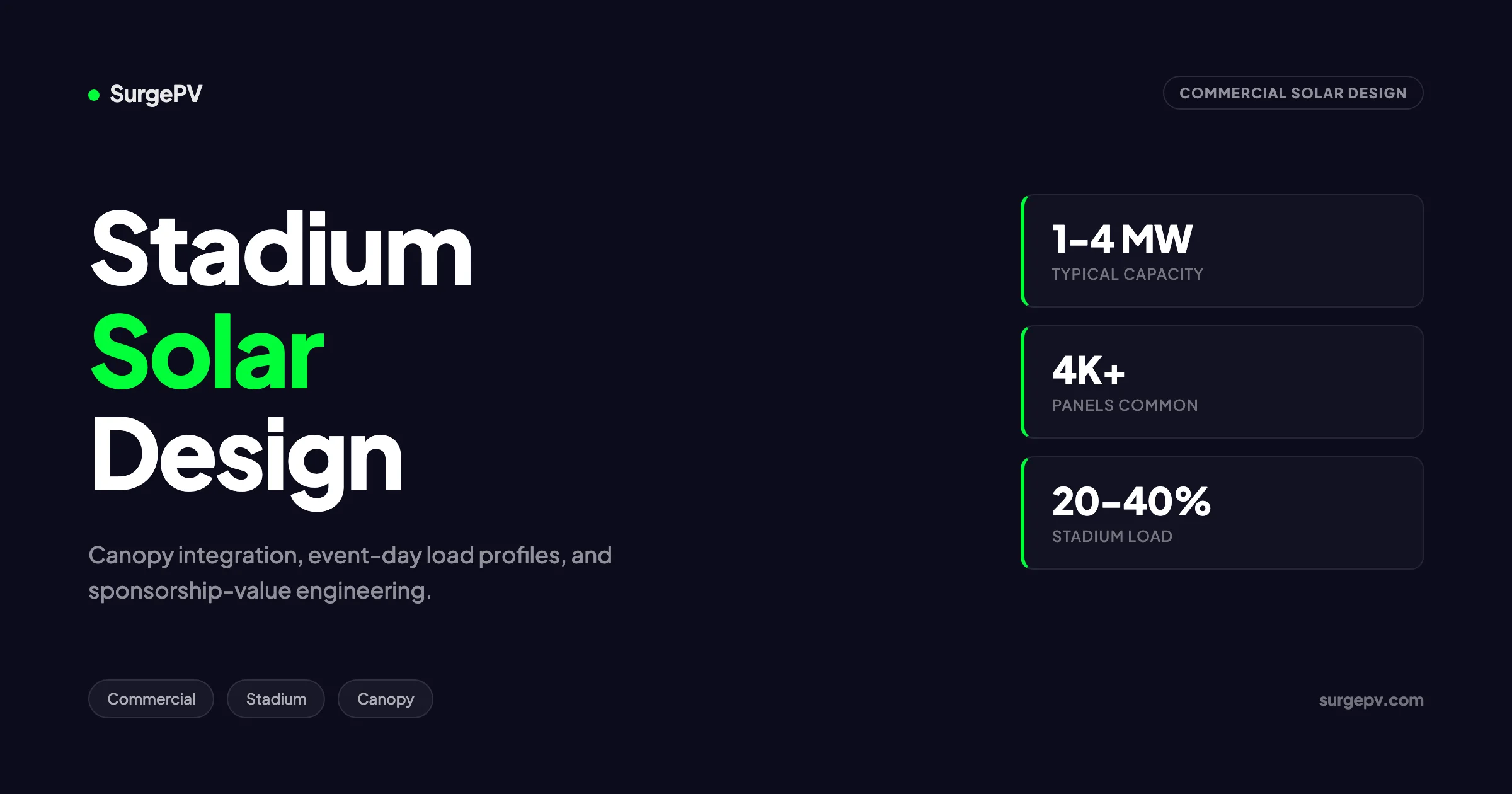
Stadium solar panel design 2026 typically delivers 500 kW to 4 MW of PV across roofs, suite-tower canopies, and parking carports. Systems cover 20-40 percent of event-day load, achieve LEED points, and frequently recover 30-100 percent of cost through naming-rights sponsorships. Real examples: Mercedes-Benz Stadium 4,000 panels (1.6 MW), Levi’s Stadium 375 kW, FedEx Field 2 MW, Lincoln Financial Field 3 MW.
See Commercial Solar Carport Design Guide for detailed guidance.
In this guide:
- Why stadium real estate is dramatically underused for PV
- Stadium load profile: event-day spike vs off-day base load
- Where panels fit: roof, canopy, parking, surrounds, training facility
- Stadium canopy engineering for wind, snow, and field shading
- Battery sizing for event-day demand charges and broadcast backup
- Real case studies: Mercedes-Benz, Levi’s, FedEx, Lincoln Financial
- Sponsorship and marketing value of visible solar
- NCAA, NFL, and MLB sustainability mandates
- Financial modeling: donor naming versus pure ROI
- Common design mistakes to avoid
Stadium Solar Panel Design 2026: Direct Answer
A stadium solar panel design that performs well in 2026 follows three rules. First, place panels where they do not shade the playing field at any kickoff time across the season. Second, size the array to a fraction of off-day base load, not event-day peak. Third, pair the PV with a battery that targets the demand-charge window, not the energy charge. Skip these and the financial model breaks.
| Stadium Zone | Typical Capacity | Cost Per Watt | Best Use Case |
|---|---|---|---|
| Upper roof or bowl canopy | 200 kW - 1.5 MW | $1.30-$2.20 | Existing covered stadium with structural margin |
| Suite-tower roof | 50-300 kW | $1.40-$2.40 | Clean flat roof on attached office tower |
| Surface parking carport | 500 kW - 3 MW | $2.00-$3.00 | Largest area available, doubles as shaded fan parking |
| Pedestrian bridge | 25-150 kW | $2.50-$3.50 | High-visibility branding for sponsors |
| Training facility roof | 100-500 kW | $1.30-$2.20 | Off-stadium load match, cleaner roof access |
The biggest leverage for a project sits in parking carports. They unlock the largest contiguous area, do not require structural retrofit of the main bowl, and let the venue owner monetize panels through fan-facing branding. A typical NFL parking lot can host 2-3 MW of carport solar before the geometry runs out.
Latest Updates: Stadium Solar 2026
The stadium PV market accelerated through 2024 and 2025. ESG reporting requirements from leagues, falling module prices, and stricter demand charges combined to push more venues toward megawatt-scale installations.
Stadium Solar Industry Status — May 2026
| Trend | Status | Notes |
|---|---|---|
| NFL Sustainability Initiative | Active | League tracks renewable share at each venue |
| NCAA Green Sports framework | Active | Athletic departments report PV capacity yearly |
| MLB Green Glove program | Active | Recognizes top-performing sustainable ballparks |
| Federal Investment Tax Credit | Active | 30 percent base for commercial PV through 2032 |
| Direct Pay for tax-exempt owners | Active | Public universities and municipal venues qualify |
| Sponsorship-funded stadium arrays | Growing | Constellation, NRG, Bank of America active |
| Parking carport projects | Accelerating | Largest single growth segment for sports venues |
Key Changes Since 2024
Direct Pay unlocks public university and municipal stadiums. The Inflation Reduction Act provisions for elective payment, often called Direct Pay, now let tax-exempt entities monetize the federal Investment Tax Credit as a direct refund. Public school stadiums, city-owned ballparks, and state university athletic facilities can now access incentives that previously required a tax-equity partner.
Sponsorship-funded canopies became the default deal structure. Through 2025, the share of new stadium PV projects financed via a corporate sponsorship envelope rose. The branded array gives the sponsor broadcast visibility on every aerial shot. The venue owner gets PV capacity with little upfront cost.
Parking carports overtook roof retrofits. Roof retrofits of legacy stadiums are constrained by structural margin and reflectivity rules. Parking carports avoid both problems and create a sponsor-friendly customer touchpoint. Most new stadium PV projects in 2024-2025 used carports as the primary array.
Key Takeaway — 2026 Stadium PV Priority
The fastest path to a viable stadium PV project in 2026 is a parking carport canopy paired with a 1-2 MWh battery. The carport unlocks the largest area without roof retrofit. The battery covers demand-charge windows on event days. Together they produce a financeable project with clear sponsor branding zones.
Why Stadiums Are Untapped Solar Real Estate
A modern professional stadium combines four asset classes into one site: a covered or partially covered roof, a large flat surface above suite towers, acres of surface parking, and adjacent training or office space. Each zone has different rules, but together they offer more PV-ready area than most logistics warehouses.
Take the typical NFL venue. Mercedes-Benz Stadium in Atlanta sits on a 1.3 million square foot footprint with 8,000 surrounding parking spaces. Levi’s Stadium has a 1.85 million square foot building shell. FedEx Field covers 91 acres including parking. The University of Phoenix Stadium parking lot alone could host more than 5 MW of carport PV at standard spacing.
Compare those numbers against a typical big-box warehouse at 200,000 to 400,000 square feet. The stadium site is 5-10 times larger and routinely sits in metro areas with high commercial tariffs. That is exactly the customer profile that makes commercial PV economic.
Site Characteristics That Favor Stadium Solar
- High demand charges. Stadium utility tariffs typically include demand charges above $15/kW per month. A 2 MW PV plus 2 MWh battery system can shave 1-1.5 MW off the monthly peak.
- Long off-day periods. NFL stadiums host 10 home games per regular season. The other 350 days produce daytime base load from offices, kitchens, and ice plants where solar matches perfectly.
- Federal and state incentives stack. ITC, MACRS depreciation, and state utility incentives commonly cover 35-50 percent of installed cost.
- Visible branding zones. Aerial broadcasts repeatedly show the roof and parking footprint. That is high-value sponsor real estate.
- Existing utility scrutiny. Stadiums already have submetering, demand monitoring, and energy management systems in place. PV integration is operationally simpler than at sites with no measurement infrastructure.
The constraint is not real estate or economics. It is design competence. Most stadiums were built before solar canopies were a routine retrofit, and most solar design firms have never run a project with a Sunday afternoon event-day load curve. Closing that gap is what this guide covers, and it is why solar design software built for commercial scale matters.
Stadium Load Profile: Event-Day vs Off-Day
Stadium PV sizing breaks if you treat the venue as a single building with one load curve. There are two distinct profiles, and the financial model depends on getting both right.
Off-Day Load (350+ days per year)
Most days at a stadium are not game days. The building still runs offices, kitchens, ice plants, ticket operations, security, IT, and turf irrigation. Off-day base load typically runs 200-800 kW for an NFL venue and 100-400 kW for an MLS or MLB site. This load is daytime-weighted, which makes it ideal for solar.
A 2 MW PV array at a typical NFL stadium produces 2-3 GWh annually. Off-day consumption absorbs the majority of that production at full retail rates. The export math rarely matters because the array is sized to a fraction of base load.
Event-Day Load (Game Day Spike)
Event days look completely different. Concourse lighting, scoreboards, broadcast equipment, kitchen ramp-up, HVAC for 60,000+ fans, and parking lot lighting push total demand to 4-10 MW for an NFL stadium. The peak is event-window-specific and often after sunset for primetime games.
| Stadium Type | Off-Day Base Load | Event-Day Peak | Event-Day Average |
|---|---|---|---|
| NFL (60,000+ capacity) | 400-800 kW | 6-10 MW | 4-6 MW |
| MLB (40,000+ capacity) | 300-600 kW | 4-7 MW | 3-5 MW |
| MLS / NHL (20,000+ capacity) | 200-400 kW | 2-4 MW | 1.5-3 MW |
| College (50,000+ capacity) | 200-500 kW | 4-8 MW | 3-5 MW |
Solar cannot meaningfully serve a night-game peak. The sun is down. What solar can do is cover the daytime ramp-up before kickoff, which on Sunday afternoon NFL games often coincides with peak demand-charge billing windows. Designers should run hourly simulations against historical event schedules, not flat annual production estimates.
Pro Tip — Event-Day Modeling
Pull two years of hourly meter data and overlay the home schedule. Mark each event window with its actual demand reading. Your PV plus battery system should target the demand-charge interval, not just kWh production. A 1 MW array that shaves 800 kW off the monthly peak is worth more than a 2 MW array that exports surplus at wholesale rates.
Solar Locations: Roof, Canopy, Parking, Field Surrounds
Stadium PV has four primary placement zones. Each has a different cost structure, design constraint, and visibility profile. The best projects use multiple zones.
Zone 1: Main Roof or Upper Bowl Canopy
Stadiums with full or partial roofs offer the most direct PV mount. The challenge is structural margin. Most domed or covered stadiums were not designed with solar dead load in mind. Add wind uplift and the engineering review can rule out a roof retrofit.
When the structure permits, roof PV produces the cleanest economics. Cost per watt is lowest at $1.30-$2.20. The array is high above field level so shading is irrelevant. Mercedes-Benz Stadium uses this zone in combination with peripheral arrays.
Zone 2: Suite-Tower or Concourse Roof
Many stadiums have attached buildings: suite towers, premium club levels, team office buildings, and broadcast booths. These structures have flat roofs and clear sun exposure. They are often the cleanest install path because they are built to standard commercial roof specs.
Levi’s Stadium placed 1,186 panels across its three suite-tower roofs. The roofs were designed for solar from day one, which is the easier path. Retrofit projects work where the existing structural calculations have margin for a 4-6 psf PV dead load.
Zone 3: Surface Parking Carport
Parking carports are the single largest growth zone for stadium PV in 2024-2026. A typical NFL parking lot covers 60-100 acres. Carport canopy spacing typically delivers 100-150 kW of PV per acre. That puts 6-15 MW theoretical capacity in the parking lot of one large venue.
Carports require steel structural cost, foundation work, and conduit runs to the substation. Cost per watt runs $2.00-$3.00. The offsetting benefits are massive: shaded fan parking, EV charger integration, naming-rights branding, and no impact on the stadium building structure.
A well-designed carport project includes Level 2 EV charging at 5-10 percent of stalls. Fans pay for charging during the event, which adds a revenue stream. For more context on this combined design, see the solar carport design guide.
Zone 4: Pedestrian Bridge, Training Facility, Ancillary
Smaller arrays at pedestrian bridges, ticket booth canopies, video board structures, and training facility roofs add 50-300 kW each. These are visibility-driven installs. Levi’s Stadium has a panel-clad pedestrian bridge that doubles as a Tesla sponsorship surface. The bridge generates only modest energy but every fan walks past it.
Training facility roofs deserve more attention than they typically get. Practice facilities often run year-round with steady daytime load. They are also less visible, which keeps roof access simple and avoids broadcast lighting conflicts.
Key Takeaway — Zone Selection
A typical stadium PV project combines two or three zones. The first MW comes from suite-tower or training-facility roofs because they are the simplest install. The next 1-3 MW comes from parking carports for area and branding. Main bowl roof PV is reserved for cases where structural margin already exists or a new stadium is being designed.
Stadium Canopy Solar Engineering 2026
Stadium canopy engineering is the most technically demanding part of a project. The structures are larger, taller, and more exposed than warehouse or rooftop systems. Three constraints dominate: wind, snow, and field shading.
Wind Load on Stadium Canopies
Stadium parking carports often sit in unobstructed terrain with high exposure factors. Coastal venues like Levi’s Stadium and Hard Rock Stadium also see hurricane-zone wind ratings. The ASCE 7-22 standard governs structural design.
Designers should pull the site-specific wind speed map and check the exposure category (B, C, or D). Most stadium parking lots are Category C or D. Uplift loads on a carport array can exceed 30-50 psf at the corner panels, which drives heavier steel and deeper foundations.
A common shortcut is to use the warehouse rooftop standard. That fails for stadium parking lots. Pre-engineered carport designs must be re-rated for the site, often requiring custom column spacing or X-bracing on the perimeter rows.
Snow Load in Cold-Climate Stadiums
Northern stadiums like Lambeau Field, Soldier Field, and Lincoln Financial Field face ground snow loads of 25-40 psf or higher. Carports must be engineered for the unbalanced snow scenario where wind drifts pile snow on the leeward side.
Roof PV faces a different problem. Snow on tilted modules slides off, but only if the surrounding structure does not capture it. Designers should plan for snow shed zones, gutter integration, and stand-off heights that allow 6-12 inches of accumulated drift without compromising production.
Field Shading Analysis
This is the constraint that wrecks otherwise-good designs. Stadium playing surfaces, particularly natural grass fields, are sensitive to shade. The NFL and MLB both publish turf condition requirements that include daily direct sunlight thresholds.
A stadium PV canopy that shades the field for more than 1-2 hours per day during the playing season is a non-starter. Designers need to run a full shadow analysis at solar noon for every game day across the season. Mercedes-Benz Stadium positioned panels around the perimeter and over parking specifically because internal canopies would have shaded the natural grass.
SurgePV’s shadow analysis software handles stadium-scale geometry where most residential tools fail. The same engine drives field-shade prediction, glare-onto-broadcast analysis, and panel-position optimization in one model. For deeper background on the underlying methods, see the automated shading analysis glossary entry. For a direct comparison, see Arka 360 vs SurgePV.
Glare and Broadcast Conflicts
Glare onto the field, broadcast cameras, and surrounding flight paths is the second technical hurdle. Most US airports require glare modeling under the SGHAT tool developed by Sandia National Laboratories.
For stadiums near airports (FedEx Field, JFK; SoFi Stadium, LAX), glare modeling must include flight path approach angles. Stadium broadcast booths typically sit at specific azimuths, and reflective panel orientations can wash out cameras during late afternoon games.
The mitigation is panel tilt and orientation, anti-reflective coatings, and selective placement away from broadcast sightlines. None of this is optional. It must be modeled during design, not discovered after install.
Event-Day Demand Spikes & Battery Storage Strategy
Solar alone cannot move a stadium PV project from green to financially compelling. The math turns positive when battery storage covers the demand-charge spike on event days. This is the single biggest financial lever in stadium PV design. See Adding Battery Storage Services for detailed guidance.
Demand-Charge Economics
Most stadium utility tariffs include a demand charge of $15-$30 per kW per month based on the highest 15-minute interval during the billing period. Event days routinely set the monthly peak. A single Sunday afternoon NFL game can drive a $50,000 monthly demand charge.
A 2 MW PV array might shave 1 MW off the peak during daylight games but contribute nothing for night games. A 2 MWh battery, sized to discharge across the 2-hour demand window, can shave the same 1 MW regardless of sun position.
| Stadium Configuration | Annual Demand Charge | Demand Charge After PV | After PV + Battery |
|---|---|---|---|
| Baseline (no PV) | $400K-$700K | n/a | n/a |
| 2 MW PV only | $400K-$700K | $300K-$550K | n/a |
| 2 MW PV + 2 MWh battery | $400K-$700K | $300K-$550K | $200K-$400K |
| 2 MW PV + 4 MWh battery | $400K-$700K | $300K-$550K | $150K-$300K |
The battery savings compound over 10-15 events per season. A 4 MWh system targeting peak shaving typically delivers a 4-7 year incremental payback on the battery alone, on top of the PV economics. For deeper guidance on commercial-scale battery design, see the commercial battery storage sizing post and the peak demand reduction guide.
Critical-Load Backup for Broadcast and Safety
Beyond demand-charge savings, stadium batteries serve a second function: critical-load backup. Broadcast booths, IT racks, emergency lighting, and security systems all need 30-60 minutes of bridge power during a utility outage.
A 1-2 MWh battery sized for critical loads pays back through risk mitigation rather than energy savings. Insurance carriers increasingly require this kind of resilience as part of large-venue policies. The same battery can run peak-shaving on event days and backup-power-readiness in standby mode.
Battery Chemistry for Stadium Sites
LFP (lithium iron phosphate) is the standard chemistry for stadium battery installations. Cycle life of 6,000-10,000 deep cycles matches a 15-20 year service life with limited degradation. Thermal stability also reduces fire-protection requirements compared to NMC alternatives. For chemistry background, see the LFP battery glossary entry.
A typical 2 MWh stadium battery uses LFP cells in 20-foot containerized enclosures placed adjacent to the main electrical room or in a fenced equipment yard. Liquid cooling is standard at this scale to maintain warranty performance through summer load cycles.
Design Stadium-Scale PV with the Right Software
SurgePV handles the canopy geometry, multi-zone shading, event-day load profiles, and battery sizing math that residential tools never had to solve.
Book a DemoNo commitment required · 20 minutes · Live stadium project walkthrough
Stadium Solar Case Studies
Real installations reveal what works. The following five projects span NFL, MLB, MLS, and university venues. Each used a different combination of zones, sponsors, and battery strategy.
Mercedes-Benz Stadium, Atlanta — 4,000 Panels, 1.6 MW
Mercedes-Benz Stadium opened in 2017 with one of the largest stadium PV arrays in professional sports. The system uses 4,000 panels delivering 1.6 MW of capacity. Panels are mounted across the stadium roof perimeter and the surrounding parking, with PV canopies covering pedestrian walkways.
According to Mercedes-Benz Stadium operator AMB Sports and Entertainment, the array generates approximately 1.6 MWh per home game equivalent. Constellation Energy sponsored the array and is the named energy partner for the venue. The stadium achieved LEED Platinum certification, partly on the strength of its renewable production.
Key design choices:
- Panels positioned around the bowl perimeter, never over the natural grass field
- Parking canopies provide shaded fan parking and the bulk of capacity
- Pedestrian walkway PV adds visible branding without structural complexity
- LEED Platinum scoring leveraged the array as Renewable Energy Production credit
Levi’s Stadium, Santa Clara — 1,186 Panels, 375 kW
Levi’s Stadium, home of the San Francisco 49ers, opened in 2014 with PV designed in from day one. The system covers three suite-tower rooftops with 1,186 panels totaling 375 kW. A panel-clad pedestrian bridge adds branding capacity and small additional production.
NRG Energy sponsored the original installation and the bridge naming rights. The stadium reached LEED Gold certification at opening, the first NFL stadium to do so. Levi’s also pioneered the use of upcycled and recycled construction materials around the PV system.
Levi’s geographic advantage is high solar irradiance and a long playing season including 49ers regular and post-season home dates. The 375 kW array offsets approximately 20-25 percent of the stadium’s annual electricity consumption. Most of that production occurs on non-event days, which is the highest-value generation window.
FedEx Field, Maryland — 8,000 Panels, 2 MW
FedEx Field, the previous home of the Washington Commanders, hosted an 8,000-panel rooftop and parking carport installation totaling roughly 2 MW. The project was developed by NRG Energy and commissioned in stages between 2011 and 2013, making it one of the earliest large-stadium PV systems.
The array covered approximately 800,000 square feet of stadium roof and adjacent parking canopy. Parking carport sections doubled as fan shading and Level 2 EV charging hosts. The stadium transition to a new venue site means the FedEx array status is in transition, but the design template continues to influence new builds.
Lincoln Financial Field, Philadelphia — 11,000 Panels, 3 MW
Lincoln Financial Field, home of the Philadelphia Eagles, holds the largest stadium PV array in the NFL at approximately 3 MW. The system includes 11,000 panels and 14 wind turbines, making it a hybrid renewable installation. NRG Energy partnered on the original project.
The PV system spans the upper bowl exterior, suite-tower roofs, and adjacent parking canopies. Total renewable capacity covers approximately 30 percent of stadium annual consumption. The Eagles publish annual sustainability reports highlighting the array as a centerpiece of their LEED Gold operations.
Petco Park, San Diego — 716 kW Solar Plus Storage
Petco Park, home of the San Diego Padres, completed a 716 kW solar plus 1.4 MWh battery project in 2023. The system covers parking canopies and the eastern facade. Sycamore Energy was the developer.
The Petco Park system was an early example of an MLB stadium combining solar with significant battery capacity for demand-charge management. The battery covers the early-evening demand window for night games, which is the highest demand-charge interval for the venue.
Real-World Example — Mercedes-Benz Stadium Design Decisions
Mercedes-Benz Stadium’s design team ran shadow analysis across every home game in the Atlanta Falcons and Atlanta United schedules. The result placed every panel around the bowl perimeter or over parking. Zero panels overhang the natural grass field. That single design rule allowed the 4,000-panel system to coexist with high-quality turf for football, soccer, and concert events.
Sponsorship & Marketing Value of Visible Solar
The financial model of a stadium PV project often depends on a corporate sponsor covering 30-100 percent of capital cost. The sponsor gets broadcast visibility, ESG storytelling, and named branding on the array itself. This is unique to stadium projects and changes the underwriting math compared to a typical commercial PV install.
Major Sponsorship Examples
- NRG Energy at NRG Stadium (Houston) — naming-rights deal that includes the 180 kW stadium PV array
- Constellation Energy at Mercedes-Benz Stadium (Atlanta) — sponsorship covering the 4,000-panel array
- Bank of America at Bank of America Stadium (Charlotte) — energy partnership extending to renewable assets
- Toyota at multiple MLB venues — branded panel sections with broadcast visibility
- Schneider Electric at multiple sites — energy management plus PV sponsorship
How the Sponsorship Math Works
A sponsor pays an annual fee that covers the PV system lease, sometimes with naming rights on the array or a stadium asset (entrance gate, lounge, charging station). The stadium owner avoids upfront capital cost. The sponsor reports the array as ESG investment and uses it in marketing.
A 2 MW installation costing $4M can be packaged into a 10-year sponsorship at $500K-$800K annually. The sponsor effectively pays a small premium over a straight PPA in exchange for branding rights. The stadium gets a renewable energy asset with no capital outlay and contributes to its sustainability disclosure.
This structure works because stadium PV has high media exposure. A typical NFL Sunday afternoon broadcast shows aerial shots of the stadium roof and parking 5-10 times per game. With 17 regular-season games plus playoffs, that is 100+ broadcast moments featuring the sponsor’s branded array.
Designing for Visibility
Sponsorship value is highest when panels are visible from broadcast cameras and aerial shots. Designers should:
- Identify the primary blimp and aerial camera angles
- Cluster sponsor-branded panels in those sight lines
- Use module color or framing that contrasts with the surrounding roof
- Include large-format sponsor logos on the array structure
- Avoid hiding panels behind upper-bowl rim structures
The actual energy production from a sponsor-visibility zone may be similar to other roof areas. The branding value is what drives the financial premium. For more on the broader commercial solar sales cycle that includes these stakeholder layers, see our deeper guide.
NCAA & Professional League Sustainability Mandates
League and conference-level sustainability frameworks now push stadium owners toward renewable investments. These frameworks influence what gets approved at the board level.
NFL Sustainability
The NFL Green initiative tracks renewable energy production at each venue and publishes annual league-wide sustainability data. While the league does not mandate specific PV capacity, teams that lag the league average face increasing pressure from sponsors, fans, and ownership groups. Several teams have publicly committed to net-zero operations by 2030 or 2035.
NCAA Athletic Programs
Major NCAA programs publish sustainability reports as part of broader university disclosures. Pac-12 and Big Ten schools have been early movers on stadium PV. The University of California Davis Aggie Stadium achieved net-zero electrical operations through a combination of rooftop PV and adjacent parking carports.
MLB Green Glove Award
Major League Baseball’s Green Glove award recognizes ballparks for waste diversion, energy efficiency, and renewable adoption. The San Francisco Giants, Cleveland Guardians, and Seattle Mariners have been multi-year winners with significant PV components. The award provides league-level visibility that supports sponsorship deals and city-level political support.
NHL and NBA
Indoor arenas face different design constraints. Most NHL and NBA venues lean toward parking carport PV rather than roof installs because indoor arenas are typically dome-roof structures unsuited for retrofit. Detroit’s Little Caesars Arena has explored adjacent parking and ancillary building PV.
LEED and Living Building Certification
LEED v4 and LEED Zero certifications continue to be the de facto sustainability metric for stadium projects. Renewable energy production credits scale with array size as a percentage of building consumption. A 2 MW array at a typical NFL stadium contributes meaningfully to LEED Gold or Platinum scoring.
The Living Building Challenge is more aggressive and rare in stadium contexts. Most professional sports venues pursue LEED rather than Living Building due to operational complexity.
Financial Modeling: Donor Naming vs Pure ROI
Stadium PV projects use two distinct financial models. The first is pure ROI, sized as a traditional commercial PV economic case. The second is donor or sponsor naming, where capital comes from outside the operational budget. Understanding both is critical to closing a project.
Pure ROI Model
A pure ROI stadium project pencils like any other commercial PV plus storage system. The owner pays capital cost, claims the ITC and depreciation, and tracks payback through energy and demand savings.
| Stadium System | Capital Cost | Annual Energy Savings | Annual Demand Savings | Payback Years |
|---|---|---|---|---|
| 1 MW PV (rooftop) | $1.5M-$2M | $80K-$130K | $30K-$80K | 9-13 |
| 2 MW PV + 1 MWh battery | $3.5M-$4.5M | $160K-$260K | $80K-$150K | 8-11 |
| 3 MW PV (carport) + 2 MWh battery | $6M-$8M | $250K-$400K | $150K-$300K | 9-12 |
After federal ITC (30 percent base, with potential adders for energy-community siting and domestic content), MACRS depreciation, and state incentives, effective payback typically lands at 6-9 years. Twenty-five-year LCOE for stadium PV runs $0.05-$0.08 per kWh, well below the $0.12-$0.18 per kWh retail rate the stadium would otherwise pay.
The economics work, but the underwriting requires patient capital. Most for-profit stadium owners want a 5-year payback or better, which is achievable only with sponsorship offset or a very high demand-charge tariff.
Donor and Sponsor Naming Model
The donor model unlocks projects that pure ROI cannot close. Capital comes from a corporate sponsor, donor program, or sustainability bond issuance. The stadium operator does not carry the project on its capital budget.
For university stadiums, donor capital is common. Athletic department gifts can be earmarked for the PV system in exchange for donor recognition at the array. The financial model becomes a 25-year operating savings story without an upfront capital hurdle.
For professional stadiums, sponsorship covers most large-scale projects. The sponsor pays an annual fee (sometimes called a “renewable energy partnership”) that funds the PPA or lease. The venue gets the asset with no capital. The sponsor gets named branding and ESG disclosure value.
Hybrid Models
The most common 2024-2026 deal structure is a hybrid. The PV system is owned by a third-party financier. A corporate sponsor covers 40-60 percent of the PPA payment in exchange for branding. The stadium owner pays a reduced PPA for the remaining electricity. All parties claim a portion of the ITC and depreciation through the third-party owner.
For more on commercial-scale financial modeling, see the commercial solar ROI calculator and generation and financial tool for stadium-specific models. The solar proposal generation approach lets designers package these complex multi-party deals into a single client-facing document.
Common Stadium Solar Design Mistakes
The cost of getting stadium PV design wrong is high. Field damage, broadcast interference, structural failure, and sponsor disputes all surface from preventable mistakes. The following are the most common errors observed across the case studies above.
Mistake 1: Ignoring Field Shading
The single most damaging mistake is placing PV canopies that shade the playing field during games. Natural grass needs 4-6 hours of direct sun per day for healthy growth. A canopy that shades 30 percent of the field for 2 hours per day will kill the turf within weeks. Always run a full year-round shadow analysis before fixing panel positions. Use solar shadow analysis software at stadium scale, not a residential roof model.
Mistake 2: Undersizing for Event-Day Demand
Designers who size for off-day base load only and skip the event-day demand profile produce systems that miss the largest financial lever. Demand charges on event days drive the monthly utility bill. A battery sized to shave the peak is often more valuable than additional PV. Run the hourly demand model with actual home schedules, not just annual kWh production estimates.
Mistake 3: Sponsorship-Last Design
A common sequencing error is to finalize the array layout, then approach sponsors. The sponsor-visibility zones matter to the deal value, so they must be in the design from the start. Project teams should bring the marketing and sponsorship office into the design review as early as the structural engineer.
Mistake 4: Glare and Broadcast Conflicts
Late-discovery glare onto broadcast cameras has caused multiple retrofit projects. Glare modeling must include each broadcast camera position, the late-afternoon sun angle, and the panel tilt. Anti-reflective coatings and adjusted tilt resolve most issues, but only if they are designed in.
Mistake 5: Carport Spacing Errors
Stadium parking lots have specific aisle widths, ADA requirements, and fire-truck access lanes. Pre-engineered carport designs that work for a shopping mall may fail at a stadium. Carport spans, column placement, and headroom clearance must match stadium parking codes. Always work with a structural engineer familiar with solar carport design at large-venue scale.
Mistake 6: Skipping Structural Margin Review on Roof Retrofits
Many stadiums lack roof structural margin for a PV retrofit. Designers who skip the structural engineering review and propose a roof system that the structure cannot carry produce projects that never get permitted. Run the structural review before any sales presentation involving roof PV.
Mistake 7: Underestimating Construction Window Constraints
Stadium PV construction must work around home schedules, off-season maintenance windows, and major events. A six-month installation schedule may stretch to eighteen months because of access limitations. Include realistic schedule constraints in the project plan and the financial model.
Mistake 8: Not Modeling Net Metering Tariff Specifics
Stadium tariffs vary by utility. Some allow net metering at retail rates. Others credit exports at avoided-cost or wholesale rates. The difference can swing the 25-year financial model by 30 percent. Confirm the tariff schedule with the local utility before finalizing the production model.
Stadium Solar Design Tools and Software
The right software stack for stadium PV design must handle three things most residential tools cannot. First, large-format geometry across multiple buildings, parking lots, and ancillary structures. Second, complex shading from upper-bowl architecture and adjacent buildings. Third, stadium-specific load profiles with event-day spikes.
SurgePV is the solar software built for these problems. The platform handles multi-zone projects, integrated shadow analysis, event-day load modeling, and the financial modeling layer that ties everything to a defensible proposal. The generation and financial tool supports the hybrid sponsorship deal structures common in stadium projects.
For commercial designers moving from residential to stadium projects, the learning curve is in three areas: structural coordination with stadium architects, event-day demand modeling, and sponsor visibility analysis. The software handles the technical layer. The deal closure depends on the designer building relationships with sustainability officers and corporate sponsorship teams.
Stadium projects also benefit from a stronger solar proposal platform layer because the audience includes ownership, sponsors, sustainability officers, and league offices. A single client-ready proposal that summarizes engineering, financial, and sponsorship layers cuts the sales cycle from months to weeks.
Pro Tip — Software Selection for Stadium Projects
Evaluate solar design software at stadium scale by asking three questions. Can it import the stadium 3D model from architect CAD files? Can it run shadow analysis at hourly resolution across the playing season? Can it model event-day load profiles distinct from off-day base load? If the answer to any is no, the tool will force manual workarounds that compound errors.
ROI Examples: Three Stadium PV Projects
The following three examples cover NFL, MLS, and university stadium types. Numbers are illustrative based on industry-typical pricing and tariffs.
Example 1: NFL Stadium, 2 MW PV + 2 MWh Battery
A 65,000-seat NFL stadium in a mid-Atlantic state hosts 10 regular-season home games plus playoffs. Off-day base load is 600 kW. Event-day peak is 8 MW. Tariff is $0.10 per kWh energy with a $20 per kW per month demand charge.
| Line Item | Value |
|---|---|
| PV capacity | 2 MW (parking carport + suite tower roof) |
| Battery capacity | 2 MWh / 1 MW LFP |
| Installed cost | $4.8M |
| Federal ITC (30%) | -$1.44M |
| MACRS depreciation NPV | -$0.9M |
| Net cost | $2.46M |
| Annual energy savings | $220K |
| Annual demand savings | $130K |
| Annual O&M | -$30K |
| Net annual savings | $320K |
| Simple payback (post-incentive) | 7.7 years |
| 25-year NPV (6% discount) | $4.1M |
Example 2: MLS Stadium, 800 kW PV (No Battery)
A 25,000-seat MLS stadium in California hosts 17 home matches plus playoff potential. Off-day base load is 250 kW. Tariff is $0.16 per kWh energy with modest demand charges ($8/kW).
| Line Item | Value |
|---|---|
| PV capacity | 800 kW (parking carport) |
| Installed cost | $2.0M |
| Federal ITC (30%) | -$0.6M |
| State and local incentives | -$0.15M |
| MACRS depreciation NPV | -$0.36M |
| Net cost | $0.89M |
| Annual energy savings | $130K |
| Annual demand savings | $15K |
| Annual O&M | -$12K |
| Net annual savings | $133K |
| Simple payback (post-incentive) | 6.7 years |
| 25-year NPV (6% discount) | $1.7M |
Example 3: University Stadium with Donor Funding
A 50,000-seat Division I college stadium pursues a 1.5 MW PV plus 1 MWh battery system funded entirely by an alumni sustainability gift. The athletic department contributes only the engineering coordination time.
| Line Item | Value |
|---|---|
| PV capacity | 1.5 MW (mixed roof + carport) |
| Battery capacity | 1 MWh LFP |
| Installed cost | $3.4M |
| Donor contribution | $3.4M (100% capital) |
| Net cost to athletic department | $0 |
| Annual energy savings | $190K |
| Annual demand savings | $70K |
| Annual O&M | -$22K |
| Net annual operating benefit | $238K |
| 25-year operating benefit | $5.9M |
The donor model converts the project from a 7-9 year ROI conversation to a zero-capital operating win. Donor recognition at the array entrance and naming of a sustainability program covers the donor’s return on the gift. This structure is increasingly common at major public university stadiums where donors want named recognition without an endowment tie.
For more on stadium-scale commercial PV economics, see the commercial solar market outlook and the commercial solar self-consumption guides.
Conclusion: Three Action Items for Stadium Solar in 2026
Stadium PV design is one of the most underdeveloped commercial solar segments in 2026, and the economics favor early movers. Three steps will move a stadium project from idea to construction.
- Run the event-day demand model first. Pull two years of hourly meter data, overlay the actual home schedule, and identify the demand-charge windows that drive the monthly bill. Size the battery to those windows. The PV sizing follows.
- Engage the sustainability and sponsorship offices in parallel. Stadium PV projects close when the financial model includes sponsor capital. Bring marketing, sponsorship, and sustainability teams into the design review during the layout phase, not after.
- Use solar design platform built for commercial scale. Stadium geometry, multi-zone shading, and event-day load profiles break residential design tools. Pick software that handles the complexity from project setup through a defensible proposal.
Frequently Asked Questions
How many solar panels does a typical NFL stadium need?
A typical NFL stadium installs between 1,000 and 8,000 solar panels depending on roof area, canopy structures, and parking deck coverage. Mercedes-Benz Stadium in Atlanta runs 4,000 panels for 1.6 MW of capacity. FedEx Field in Maryland reached 8,000 panels at roughly 2 MW. Smaller MLS or college sites land between 500 and 1,500 panels. The right count for stadium solar panel design depends on event-day base load, parking footprint, and structural span of the canopy.
What is the typical solar capacity for a stadium in 2026?
Stadium solar capacity in 2026 typically ranges from 500 kW to 4 MW. Levi’s Stadium in Santa Clara holds 375 kW across three suite-tower canopies plus pedestrian bridge PV. Mercedes-Benz Stadium reaches 1.6 MW. FedEx Field is around 2 MW. The Lincoln Financial Field installation in Philadelphia is 3 MW with 11,000 panels. Larger sites with adjacent surface parking can push 4 MW once carport canopies are included.
Can stadium solar cover event-day peak demand?
Stadium solar usually covers 20-40 percent of event-day total demand and a much higher share of daytime non-event load. A typical NFL stadium pulls 4-10 MW during a televised game, while a 2 MW PV array delivers under 2 MW even at noon. Night events get zero solar contribution. Pairing PV with a 2-4 MWh battery covers concourse lighting, scoreboards, and HVAC ramp-up for short critical windows.
Where do solar panels fit on a stadium?
Solar panels on a stadium fit in four main zones: the main roof or upper bowl canopy, suite-tower roofs, surface parking lot carports, and pedestrian bridge or training facility roofs. Field-surround canopies that overhang seating offer the largest single area but raise shading concerns over the playing surface. Parking carports are the most common choice because they avoid roof structural retrofits and create shaded fan parking.
Does stadium solar interfere with the playing field?
Well-designed stadium solar does not interfere with the playing field. Designers run a full shadow analysis to confirm panel canopies cast zero shade on the turf during play hours. Reflective glare onto players or broadcast cameras is also modeled. Mercedes-Benz Stadium positioned its photovoltaic canopy around the perimeter and over the parking lots specifically to avoid grass impacts.
How much does stadium solar installation cost?
Stadium solar installation cost typically ranges from $1.50 to $3.00 per watt for ground-mount and carport systems and $1.30 to $2.20 per watt for clean rooftop installs. A 2 MW stadium project lands between $2.6M and $6M before incentives. Carport canopies sit at the high end due to structural steel costs. The federal Investment Tax Credit and depreciation deliver a 35-50 percent reduction for the stadium owner or third-party developer.
What battery size pairs with stadium solar?
Stadium solar typically pairs with a 1-4 MWh battery. The sizing target is covering the highest 2-3 hours of demand-charge exposure on event days or providing 30-60 minutes of critical-load backup for broadcast booths, IT, and emergency lighting. A 2 MW PV plus 4 MWh battery is a common stadium ratio for sites with high tariff demand charges.
Do stadium solar sponsorships pay back the system?
Stadium solar sponsorships often cover 30-100 percent of the installation cost. NRG Energy sponsored the original NRG Stadium PV in Houston. Constellation Energy backed the Mercedes-Benz Stadium array in Atlanta. Bank of America and Toyota have funded panels at multiple MLB and NFL venues. The sponsorship value comes from broadcast visibility, ESG storytelling, and naming rights on the array itself. For United States-specific compliance details, see United States arizona/phoenix. For United States-specific compliance details, see United States california/los-angeles.
What is the LEED benefit of stadium solar?
Stadium solar contributes points toward LEED v4 Energy and Atmosphere credit categories, particularly Renewable Energy Production and Optimize Energy Performance. Mercedes-Benz Stadium achieved LEED Platinum partly due to its 4,000-panel array. Levi’s Stadium reached LEED Gold with its 1,186-panel system. The points correlate with array size as a percentage of building energy consumption.
What is the best solar design software for stadium projects?
The best solar design platform for stadium projects handles large-format canopies, complex shading from upper-bowl architecture, and stadium-specific load profiles. SurgePV is built for these commercial-scale designs with integrated shadow analysis, financial modeling, and proposal generation. It supports tilt and azimuth optimization across multiple stadium zones from a single project file.
Where this fits
This article is part of SurgePV's Solar Design hub, which works through the topic from first principles to the decisions a project team actually has to make.