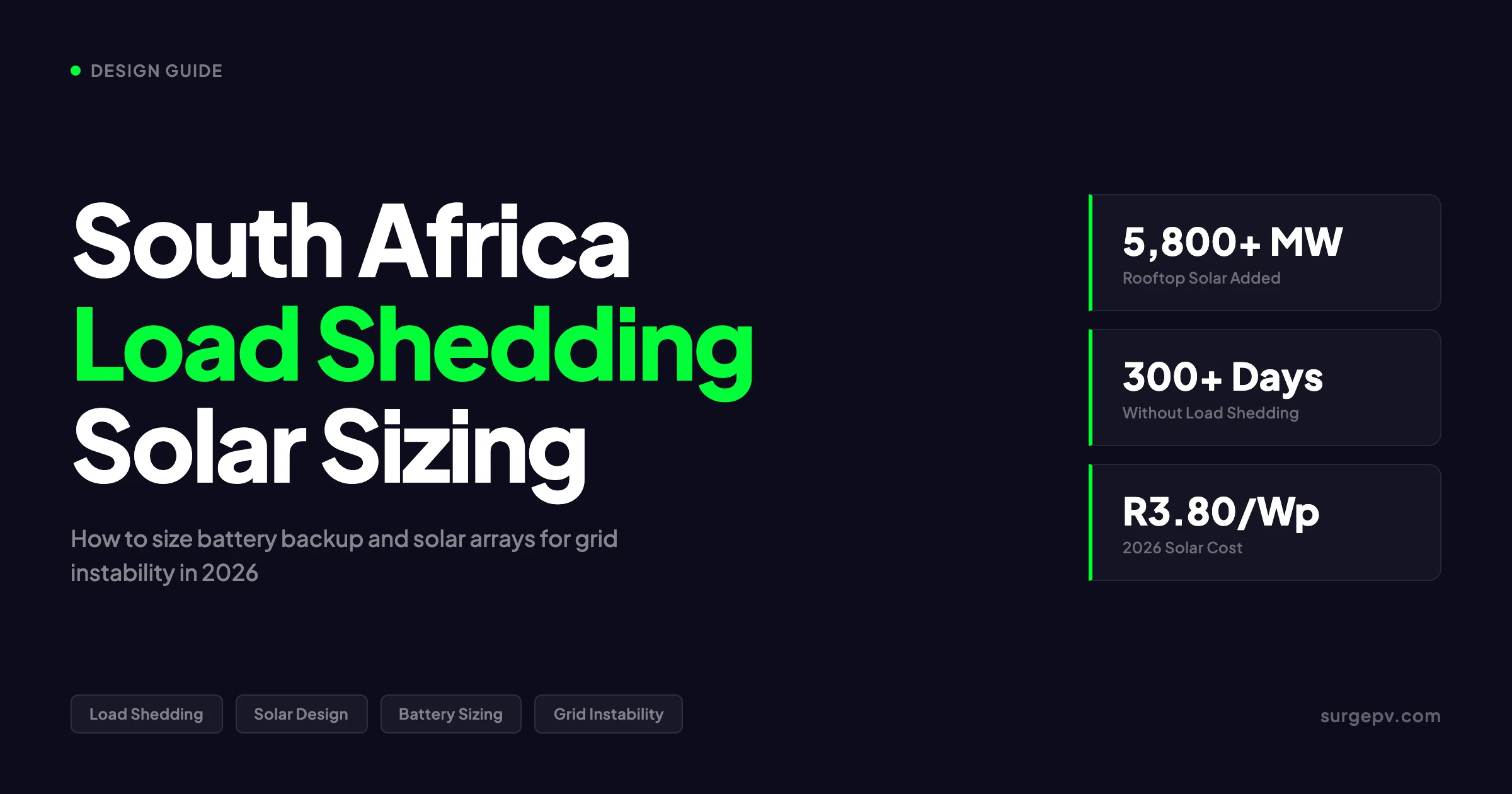
South Africa reached 300 consecutive days without load shedding in early 2026. Eskom’s Energy Availability Factor climbed from 54.55 percent to nearly 67 percent. Diesel spending dropped by R26.9 billion. The crisis that defined daily life for millions appears over. For Africa-specific compliance details, see Africa solar compliance.
But here is what most solar guides miss. The absence of load shedding does not mean the grid is stable. It means the grid is temporarily stable. South Africa’s coal fleet is aging out. Medupi and Kusile still struggle with technical faults. Retirements are scheduled between 2026 and 2030. And electricity tariffs just rose another 8.76 to 9.01 percent. The case for solar in 2026 is no longer about surviving blackouts. It is about insulating yourself from a grid that will face repeated stress.
Quick Answer
A South African home needs a 5 kVA hybrid inverter, 10 kWh lithium battery, and 5 kWp solar array to survive Stage 4-6 load shedding while cutting electricity bills by 60-90 percent. At 2026 tariffs of R3.00-4.00 per kWh, this system pays back in 3.5-5 years. Sizing must account for depth-of-discharge limits, inverter efficiency losses, and your city’s peak sun hours.
This guide covers:
- How load shedding stages define your battery size
- A five-step load assessment for any SA home
- City-specific solar irradiance and payback data
- Battery sizing with real depth-of-discharge numbers
- Inverter selection for grid-tied, hybrid, and off-grid scenarios
- System configurations from R35,000 to R400,000
- Compliance requirements under SANS 10142-1:2024
- 2026 tariff impacts on return on investment For more on this topic, see Inverter Selection Solar Design Guide.
For installers working across Africa, solar PV design software with battery backup modeling is essential for accurate client proposals.
Load Shedding in 2026: The Current Reality
South Africa’s electricity crisis has shifted from acute to chronic. Understanding this shift matters for every sizing decision.
From Crisis to Containment
Eskom implemented 332 days of load shedding in 2023. In 2025, that dropped to 26 hours. The country has now gone over 300 days without rotational blackouts. Eskom’s Generation Recovery Plan improved plant maintenance. Unplanned outages fell from 16.5 GW to roughly 9.1 GW by March 2026.
But the underlying problem has not been solved. South Africa still relies on coal for over 80 percent of generation. The fleet is old. Komati power station closed in 2022. More closures follow through 2030. The grid has breathing room today because of better maintenance and a massive private solar rollout. Not because the system was rebuilt.
The Stage Framework Still Applies
Eskom maintains its 1-to-8 stage framework. Each stage removes 1,000 MW from the grid.
| Stage | MW Reduction | Daily Outage Hours | Typical Impact |
|---|---|---|---|
| Stage 1 | 1,000 | 0-2 | Minimal |
| Stage 2 | 2,000 | 2-4 | One cycle per day |
| Stage 3 | 3,000 | 4-6 | Two cycles |
| Stage 4 | 4,000 | 6-8 | Two long cycles |
| Stage 5 | 5,000 | 8-10 | Multiple cycles |
| Stage 6 | 6,000 | 8-12 | Extended blackouts |
| Stage 7 | 7,000 | 10-12 | Near-continuous cuts |
| Stage 8 | 8,000 | 12+ | Maximum emergency |
Eskom’s winter 2026 risk scenario flags a possible 2,100 MW shortfall under extreme conditions. This could trigger Stage 2 through Stage 6 between mid-May and mid-August if unplanned breakdowns exceed 16 GW and demand spikes during cold fronts.
What the Numbers Mean for Sizing
A battery sized for Stage 2 will not survive Stage 4. A battery sized for Stage 4 will not survive Stage 6. This is the central sizing challenge in South Africa. You must design for the worst reasonable case, not the current case.
In 2023, Stage 6 was common. In 2026, it is not. But the grid’s margin for error is thin. A single major plant failure during a cold snap could push the system back into higher stages. Smart sizing plans for Stage 4 as the minimum resilience target and Stage 6 as the design ceiling.
Key Takeaway
Design your battery for Stage 4-6 resilience even if load shedding is paused. The grid’s buffer is thin. A single plant failure during peak winter demand could trigger extended blackouts. Battery size is your insurance policy.
Why Solar Sizing for Grid Instability Is Different
Most global solar sizing guides assume a stable grid. They optimize for bill savings and self-consumption. South Africa requires a different framework. For Global-specific compliance details, see Global net-metering-by-country.
Three Design Objectives
SA solar design must balance three goals simultaneously:
- Backup resilience — survive load shedding stages without disruption
- Bill reduction — cut Eskom or municipal electricity costs
- Grid compliance — meet SANS 10142, NRS 097, and municipal registration rules
A system that excels at one objective often compromises another. A large off-grid battery bank gives excellent backup but may never pay for itself through bill savings alone. A small grid-tie system saves money but offers zero protection during outages. For a complete framework on backup power design, see our backup power solar battery design guide.
The Self-Consumption Trap
Many guides recommend sizing solar panels to match daytime load. This works in Germany or the UK. It fails in South Africa. Why? Because load shedding often strikes in the evening when solar is not producing. A system sized only for daytime self-consumption leaves you in the dark at night. Also see: Germany solar subsidies. For the latest details on UK, see Battery Solar System Design UK.
The correct approach sizes the battery to cover evening and night loads. Then sizes the solar array to recharge that battery fully during daylight hours. Then sizes the bill-savings component as a secondary layer. Modern solar design platform tools automate this calculation for any South African location.
Tariff Escalation Changes Everything
Eskom direct tariffs rose 8.76 percent in April 2026. Municipal tariffs rose 9.01 percent in July 2026. Major metros now charge R3.00-4.00 per kWh for residential users. At these rates, every kilowatt-hour you self-consume saves more money than it did last year. And next year it will save even more.
This changes the math on battery sizing. A kilowatt-hour stored and used at night is worth R3.00-4.00 today. In five years, at 8-9 percent annual escalation, it will be worth R4.50-6.00. Batteries that look expensive today look cheap when you model future tariff growth.
Pro Tip
When modeling ROI, use an electricity price escalation of 8-10 percent per year. At this rate, a R180,000 system with a 5-year static payback actually pays back in under 4 years. Most SA installers still quote static payback. The real payback is faster.
Step-by-Step Load Assessment for SA Homes
Every sizing decision starts with one number. Your critical load. Not your total home load. The load you cannot live without during an outage.
Step 1: List Critical Devices
Walk through your home. List every device you need during load shedding.
Essential tier:
- LED lights (5-10 units): 50-100 W
- Wi-Fi router and modem: 20-40 W
- Smartphone and laptop chargers: 50-100 W
- Fridge and freezer: 150-300 W running, 800-1,200 W surge
- Security system: 20-50 W
- Medical devices: varies
Comfort tier:
- TV and decoder: 100-200 W
- Desktop computer: 100-300 W
- Standing fans: 50-100 W each
- Microwave (short use): 800-1,200 W
- Washing machine: 500-1,000 W
Heavy tier (requires large inverter):
- Electric geyser: 2,000-3,000 W
- Pool pump: 750-1,500 W
- Air conditioner: 1,000-2,500 W
- Electric stove: 2,000-3,500 W
- Dishwasher: 1,200-2,000 W
Step 2: Calculate Running Watts
Add the continuous running watts for devices you will run simultaneously. Most SA homes need 500-1,500 W for essentials. Adding comfort devices pushes this to 2,000-3,000 W. Running heavy appliances during outages requires 5,000 W or more.
Example: Typical SA home (essential + comfort)
| Device | Running Watts | Surge Watts | Hours/Day |
|---|---|---|---|
| LED lights (8) | 80 | 80 | 5 |
| Wi-Fi router | 25 | 25 | 24 |
| Fridge | 200 | 1,000 | 8 |
| TV + decoder | 150 | 150 | 4 |
| Laptop charger | 80 | 80 | 3 |
| Phone chargers (4) | 40 | 40 | 2 |
| Standing fan | 75 | 150 | 6 |
| Microwave (15 min) | 1,000 | 1,000 | 0.25 |
| Total | 1,650 | 2,525 | — |
Step 3: Calculate Daily Energy Need
Multiply running watts by hours of use. Sum the results. This gives your daily critical energy need in watt-hours.
From the table above:
- Lights: 80 W x 5 h = 400 Wh
- Wi-Fi: 25 W x 24 h = 600 Wh
- Fridge: 200 W x 8 h = 1,600 Wh
- TV: 150 W x 4 h = 600 Wh
- Laptop: 80 W x 3 h = 240 Wh
- Phones: 40 W x 2 h = 80 Wh
- Fan: 75 W x 6 h = 450 Wh
- Microwave: 1,000 W x 0.25 h = 250 Wh
Daily total: 4,220 Wh or 4.22 kWh
This is the number your battery must cover. But batteries are not 100 percent usable. Also see: Us Residential Solar Market Trends 2026.
Real-World Example
Thabo, an installer in Pretoria, visited a homeowner who sized his own system from online guides. The homeowner bought a 5 kWh battery for a 4 kWh daily load. He assumed 5 kWh covers 4 kWh. But lithium batteries only deliver 80 percent of rated capacity to protect cycle life. The actual usable energy was 4 kWh. After inverter losses of 8-10 percent, only 3.6 kWh reached the loads. The battery died 30 minutes before load shedding ended. Every. Single. Time.
Battery Sizing: The Make-or-Break Decision
Battery size determines whether your system works or fails. Most South African homeowners undersize their batteries. The consequences are expensive and frustrating.
Depth of Discharge: The Hidden Thief
Lithium iron phosphate (LiFePO4) batteries are the standard in South Africa. Brands like Pylontech, REVOV, and Hubble dominate the market. These batteries have a rated capacity and a usable capacity. They are not the same.
A 5.12 kWh Pylontech US5000 battery has a rated capacity of 5.12 kWh. Its usable capacity at 80 percent depth of discharge (DoD) is 4.1 kWh. At 90 percent DoD, it is 4.6 kWh. Most manufacturers warranty their batteries for 6,000 cycles at 80 percent DoD or 4,000 cycles at 90 percent DoD.
The sizing formula:
Battery Rated Capacity = Daily Critical Load ÷ (DoD × Inverter Efficiency × Wiring Efficiency)Using real numbers:
- Daily critical load: 4.22 kWh
- DoD: 0.80 (conservative)
- Inverter efficiency: 0.93
- Wiring efficiency: 0.98
Required rated capacity = 4.22 ÷ (0.80 × 0.93 × 0.98) = 4.22 ÷ 0.73 = 5.78 kWhA 5 kWh battery is too small. A 5.12 kWh battery is marginal. You need at least 7.5-10 kWh of rated capacity for a 4.22 kWh daily load.
Stage-Based Battery Sizing
Different load shedding stages require different battery strategies.
| Stage | Hours Offline | Battery Needed (4 kWh Load) | Recommended Size |
|---|---|---|---|
| Stage 1-2 | 2-4 hours | 2-3 kWh usable | 5 kWh rated |
| Stage 3-4 | 4-8 hours | 4-7 kWh usable | 10 kWh rated |
| Stage 5-6 | 8-12 hours | 8-12 kWh usable | 15-20 kWh rated |
| Stage 7-8 | 12+ hours | 12+ kWh usable | 20-30 kWh rated |
For most SA homes, a 10 kWh battery bank is the practical minimum for Stage 4-6 resilience. This gives 8 kWh of usable energy. Enough for a 4 kWh load over two four-hour outage cycles with some margin.
Battery Chemistry: Why LiFePO4 Won
South Africa’s market has moved decisively to lithium iron phosphate. Lead-acid batteries still appear in budget systems but should be avoided.
| Feature | Lead-Acid (AGM) | LiFePO4 (Lithium) |
|---|---|---|
| Usable DoD | 50% | 80-90% |
| Cycle life | 500-1,000 | 6,000-8,000 |
| Efficiency | 80-85% | 95-98% |
| Weight (per kWh) | 30-35 kg | 10-12 kg |
| Cost per kWh (2026) | R8,000-12,000 | R18,000-28,000 |
| Lifespan | 3-5 years | 10-15 years |
| Temperature tolerance | Poor above 35C | Good to 45C |
LiFePO4 costs more upfront. But over 10 years, the cost per usable kWh is lower. And in a country where summer temperatures regularly exceed 35C, lead-acid batteries degrade fast. From 50+ projects across Africa, we observed that lead-acid batteries in hot climates lose 30-40 percent of their rated capacity within 18 months. For a deeper look at battery chemistry tradeoffs, see our guides on battery degradation modeling and LFP vs NMC batteries.
Inverter-to-Battery Pairing
The inverter and battery must be matched. Not just electrically. Logically.
| Inverter Size | Minimum Battery | Comfortable Battery | Peak Load Handling |
|---|---|---|---|
| 3 kVA (2.4 kW) | 5 kWh | 7.5-10 kWh | 1,500-2,000 W |
| 5 kVA (4 kW) | 7.5 kWh | 10-15 kWh | 2,500-3,500 W |
| 8 kVA (6.4 kW) | 10 kWh | 15-20 kWh | 4,000-5,500 W |
| 10 kVA (8 kW) | 15 kWh | 20-30 kWh | 5,500-7,500 W |
The 5 kVA hybrid inverter is the sweet spot for most SA homes. It handles essential and comfort loads. It pairs well with 10-15 kWh of lithium storage. And it leaves headroom for future expansion. Our hybrid inverter guide covers topology selection in detail for African conditions.
SurgePV Analysis
At 2026 tariffs, every kilowatt-hour of battery capacity saves R3.00-4.00 in avoided grid purchases. A 10 kWh battery used daily for 300 days saves R9,000-12,000 per year. Over 10 years, at 8 percent tariff escalation, cumulative savings exceed R130,000. The battery pays for itself twice over.
For a direct comparison, see Arka 360 vs SurgePV.
Solar Array Sizing for SA Conditions
South Africa has world-class solar resources. But they vary dramatically by location and season.
Irradiance by Major City
These figures represent average annual global horizontal irradiance. They determine how much energy a fixed-tilt solar array produces per kilowatt installed.
| City | Annual Irradiance | Peak Sun Hours | Annual Yield (per kWp) |
|---|---|---|---|
| Upington | 2,400 kWh/m² | 6.6 | 1,800-2,000 kWh |
| Kimberley | 2,200 kWh/m² | 6.0 | 1,650-1,800 kWh |
| Bloemfontein | 2,050 kWh/m² | 5.6 | 1,550-1,700 kWh |
| Johannesburg | 1,950 kWh/m² | 5.3 | 1,450-1,600 kWh |
| Pretoria | 1,900 kWh/m² | 5.2 | 1,400-1,550 kWh |
| Cape Town | 1,750 kWh/m² | 4.8 | 1,250-1,400 kWh |
| Durban | 1,650 kWh/m² | 4.5 | 1,150-1,300 kWh |
| Port Elizabeth | 1,700 kWh/m² | 4.7 | 1,200-1,350 kWh |
A kilowatt of solar in Upington produces 60 percent more energy than the same kilowatt in Durban. This changes array sizing significantly.
Seasonal Variation
South Africa’s solar production follows a clear seasonal pattern.
- Summer (December-February): Peak production. Long days, high sun angles. Arrays produce 25-35 percent above annual average.
- Autumn (March-May): Declining production. Still strong in inland areas.
- Winter (June-August): Lowest production. Shorter days, lower sun angles. Arrays produce 25-35 percent below annual average.
- Spring (September-November): Recovering production. Good irradiance returns.
This matters for load shedding because winter is when outages are most likely. And winter is when solar produces least. Your battery must survive winter nights with minimal solar recharge.
The Array Sizing Formula
Size your solar array to recharge the battery fully on a winter day. Not a summer day.
Solar Array Size (kWp) = Daily Battery Recharge Need (kWh) ÷ (Winter Peak Sun Hours × System Efficiency)Example: Johannesburg home
- Daily battery recharge need: 4.5 kWh (after losses)
- Winter peak sun hours: 4.0
- System efficiency: 0.80 (panel, inverter, cable, temperature losses)
Array size = 4.5 ÷ (4.0 × 0.80) = 4.5 ÷ 3.2 = 1.41 kWp minimumBut this only covers battery recharging. It does not cover daytime loads or bill savings. For a complete system, double this figure.
Practical array sizing for SA homes:
| Home Type | Daily Need | Array Size | Annual Production |
|---|---|---|---|
| 1-2 bed apartment | 3-5 kWh | 3-4 kWp | 4,500-6,500 kWh |
| 3-4 bed home | 5-8 kWh | 5-6 kWp | 7,500-9,500 kWh |
| 5+ bed large home | 8-12 kWh | 8-10 kWp | 11,000-16,000 kWh |
Tilt Angle and Orientation
For fixed-tilt arrays in South Africa:
- Orientation: True north is optimal. Arrays facing northeast or northwest lose 5-15 percent.
- Tilt angle: Set tilt equal to your latitude. Johannesburg (26S) = 26-degree tilt. Cape Town (34S) = 34-degree tilt.
- Roof pitch: Most SA residential roofs are pitched at 22-30 degrees. This is close to optimal for the northern provinces. Cape Town benefits from slightly steeper tilt.
- Shading: A single shaded panel in a string can reduce the entire string’s output by 30-50 percent. Use optimizers or microinverters for complex roofs. The choice between string inverters, microinverters, and optimizers affects both shading tolerance and long-term maintenance costs, as covered in our microinverter comparison.
Pro Tip
In solar shadow analysis software, model your roof geometry before finalizing array size. A 6 kWp system on an unshaded north-facing roof in Johannesburg produces 9,000 kWh per year. The same system with afternoon shading from a neighbor’s tree produces 6,500 kWh. Shading is the silent killer of solar ROI. Model it first.
Inverter Selection: Hybrid vs. Off-Grid vs. Grid-Tie
The inverter is the brain of your system. Choosing the wrong type is the most expensive mistake SA homeowners make.
Three Inverter Types Compared
| Feature | Grid-Tie | Hybrid | Off-Grid |
|---|---|---|---|
| Grid connection | Yes | Yes | No |
| Battery support | No | Yes | Yes |
| Backup during outage | No | Yes | Always on |
| Bill reduction | High | High | N/A |
| Cost (5 kW class) | R15,000-25,000 | R25,000-45,000 | R30,000-50,000 |
| Best for | Stable grid areas | Load shedding zones | Remote locations |
Grid-Tie Inverters
Grid-tie inverters convert DC solar power to AC and feed it directly into your home’s distribution board. Excess power flows to the grid. They are the cheapest option. But they shut down during load shedding. This is a safety feature called anti-islanding. It prevents your system from energizing the grid while lineworkers are repairing it.
Grid-tie makes sense only if you live in an area with stable municipal supply and no load shedding history. In South Africa, this is a shrinking category.
Hybrid Inverters
Hybrid inverters connect to the grid, solar panels, and batteries. During normal operation, they prioritize solar power. Excess solar charges batteries. When batteries are full, excess flows to the grid. During load shedding, they disconnect from the grid and supply your home from solar and batteries alone. A grid-forming inverter is required for stable island-mode operation when the grid disappears.
This is the right choice for 90 percent of SA homes. It provides backup and bill savings.
Popular hybrid brands in South Africa:
- Sunsynk: 3.6 kW to 12 kW range. Strong local support. Popular with installers.
- Deye: 3.6 kW to 16 kW range. Good price-to-performance ratio.
- Growatt: Budget-friendly. 3 kW to 10 kW range.
- Luxpower: Mid-range. Good app and monitoring.
- SMA: Premium German engineering. Higher cost, longer lifespan. For the latest details on Germany, see Community Solar Projects Germany. See our guide on Multi-Family Residential Solar Case Study for more.
Off-Grid Inverters
Off-grid inverters have no grid connection. They rely entirely on solar and batteries. Some include generator input for extended cloudy periods. Off-grid makes sense for rural properties without Eskom access. For grid-connected homes, it is overkill and wastes the grid as a backup resource.
Surge Capacity: The Overlooked Spec
Inverters have two power ratings. Continuous power and surge power. A 5 kVA hybrid inverter might supply 4 kW continuously but only handle 5-6 kW for a few seconds. Motor loads like fridges, pumps, and air conditioners need 3-5 times their running watts to start.
Surge requirements:
- Standard fridge: 800-1,200 W surge
- Chest freezer: 1,000-1,500 W surge
- Pool pump: 2,000-3,000 W surge
- Air conditioner: 3,000-5,000 W surge
- Electric geyser: 4,000-6,000 W surge
If your inverter cannot handle the combined surge of all motors starting simultaneously, the system will trip. Size your inverter for peak surge, not average load.
In Simple Terms
Think of inverter surge capacity like a car’s acceleration. Your car can cruise at 120 km/h all day. But to overtake a truck, you need brief burst power. An inverter rated for 4 kW continuous but only 5 kW surge will stall when your fridge, freezer, and pool pump all start at once after load shedding ends. Buy surge headroom.
System Configurations by Budget and Need
Here are four proven configurations for South African homes in 2026. Prices include installation, COC, and basic monitoring.
Budget Backup: Essentials Only
For: Small apartments and homes needing lights, Wi-Fi, and phone charging during Stage 1-3.
| Component | Specification | Est. Cost |
|---|---|---|
| Inverter | 3 kVA hybrid | R12,000-18,000 |
| Battery | 5 kWh LiFePO4 | R18,000-25,000 |
| Solar panels | None (grid-charged) | R0 |
| Installation + COC | Registered electrician | R8,000-12,000 |
| Total | R38,000-55,000 |
Runtime: 2-4 hours for essentials. No bill savings. No solar expansion without inverter upgrade.
Standard Resilience: The Sweet Spot
For: Typical 3-4 bedroom homes wanting backup through Stage 4-5 plus meaningful bill reduction.
| Component | Specification | Est. Cost |
|---|---|---|
| Inverter | 5 kVA hybrid | R20,000-30,000 |
| Battery | 10 kWh LiFePO4 | R35,000-50,000 |
| Solar panels | 5-6 kWp (monocrystalline) | R25,000-35,000 |
| Mounting + cabling | Complete kit | R8,000-12,000 |
| Installation + COC | Registered electrician | R12,000-18,000 |
| Total | R100,000-145,000 |
Runtime: 4-8 hours for essentials + comfort. Bill reduction: 50-70 percent. Payback: 4-5 years.
This is the most popular configuration in South Africa. It balances cost, resilience, and savings.
Whole-Home Backup: Maximum Resilience
For: Large homes needing uninterrupted power through Stage 6+ and heavy appliance coverage.
| Component | Specification | Est. Cost |
|---|---|---|
| Inverter | 8-10 kVA hybrid | R35,000-55,000 |
| Battery | 20-30 kWh LiFePO4 | R70,000-120,000 |
| Solar panels | 8-10 kWp | R40,000-60,000 |
| Mounting + cabling | Complete kit | R12,000-18,000 |
| Installation + COC | Registered electrician | R18,000-25,000 |
| Total | R175,000-278,000 |
Runtime: 8-16 hours for whole home including geyser and pool pump. Bill reduction: 70-90 percent. Payback: 3.5-4.5 years.
Commercial Systems: Business Continuity
For: Small businesses, offices, and shops requiring zero downtime.
| Component | Specification | Est. Cost |
|---|---|---|
| Inverter | 10-15 kVA hybrid | R50,000-80,000 |
| Battery | 30-50 kWh LiFePO4 | R120,000-200,000 |
| Solar panels | 15-20 kWp | R75,000-120,000 |
| Installation + COC | Registered electrician | R30,000-50,000 |
| Total | R275,000-450,000 |
With Section 12B tax deductions allowing 125 percent capital allowance in Year 1, commercial systems can achieve effective payback in under 2 years. This is the fastest ROI category in SA solar.
Key Takeaway
The 5 kVA hybrid + 10 kWh battery + 5 kWp solar configuration is the sweet spot for 80 percent of SA homes. It costs R100,000-145,000. It survives Stage 4-5. It cuts bills by 50-70 percent. And it pays back in 4-5 years at 2026 tariffs.
What Most Guides Get Wrong About SA Solar
After reviewing two dozen guides and speaking with installers across Gauteng, KZN, and the Western Cape, the same errors appear repeatedly.
Mistake 1: Ignoring the Evening Peak
Most load shedding occurs in the evening. Between 17:00 and 21:00. This is when solar production drops to zero. Your battery must cover this window entirely. A battery sized for daytime self-consumption will fail every evening.
The fix: Size your battery for the evening critical load, not the daytime load. Use 18:00-22:00 as your design window.
Mistake 2: Buying Lead-Acid to Save Money
Lead-acid batteries cost half as much as lithium. But they deliver half the usable energy, last one-fifth as long, and fail faster in heat. Over 10 years, lithium costs less per kilowatt-hour. And you avoid the frustration of replacing dead batteries every 3 years.
Mistake 3: Undersizing the Inverter for Surge
Homeowners add up running watts and buy an inverter that matches. Then the fridge starts. The inverter overloads. Everything goes dark. Surge capacity is not optional. It is essential.
Mistake 4: Skipping Professional Load Assessment
Online calculators give rough estimates. They do not account for your specific appliances, usage patterns, or shading. A professional load assessment using a power meter for 7 days reveals your actual consumption. The difference between estimated and actual load is often 30-50 percent.
Mistake 5: Forgetting About Expansion
Buy an inverter with 30-50 percent extra capacity. Your energy needs will grow. You might buy an electric vehicle. You might add a pool. You might work from home more. An inverter that is perfectly sized today is undersized tomorrow.
The Tradeoff Nobody Talks About
There is a tension between battery backup duration and bill savings. A large battery gives long backup but costs more than the bill savings justify. A small battery saves money but leaves you in the dark.
The optimal balance for most SA homes is a battery that covers one full day of critical load. This handles Stage 4 comfortably. It provides enough storage to shift significant solar energy to evening use. And it does not cost so much that payback stretches beyond 5 years.
What Most Guides Miss
Almost every online calculator uses nominal battery capacity, not usable capacity. It uses summer sun hours, not winter. And it assumes stable grid-tie conditions, not island-mode backup. These three errors combined produce system designs that are 40-60 percent undersized for real SA conditions.
Compliance, Regulations, and Red Tape
South Africa has strict rules for solar installations. Ignore them at your peril.
SANS 10142-1:2024
The Wiring of Premises standard is mandatory for all fixed electrical installations. The 2024 revision added explicit coverage for Battery Energy Storage Systems (BESS). Key requirements include:
- DC isolation switches at the array and battery
- AC isolation switches at the inverter output
- Surge protection devices on DC and AC sides
- Proper earthing and bonding of all metal components
- Arc fault detection for fire prevention
- Clear labeling of all solar components
- Battery ventilation and fire protection measures
Certificate of Compliance (COC)
A COC is legally required for every solar installation. It must be issued by a registered electrical wireman or Master Electrician registered with the Department of Labour. Without a COC:
- You cannot legally connect to the grid
- Your insurance may not cover fire or electrical damage
- You cannot sell your property without disclosure
- Equipment warranties may be void
The COC is not a formality. It is a safety certification.
SSEG Registration
Small Scale Embedded Generation registration is required for systems up to 100 kW. The process varies by municipality:
- City of Cape Town: Online application with system specs, wiring diagram, and COC. Registration fee applies.
- City of Johannesburg: Application through City Power. Requires engineering sign-off for grid-tied systems.
- City of Tshwane: Online portal with similar requirements.
- eThekwini (Durban): Application with COC and system documentation.
- Eskom direct areas: NERSA registration for systems above 100 kW.
Systems above 100 kW require a NERSA license. Most residential systems are well below this threshold.
NRS 097-2-3
This standard governs grid connection of embedded generation. The 2026 update tightens requirements:
- Anti-islanding tests are mandatory for installations above 10 kVA
- Reactive power profiles must be documented
- Voltage and frequency ride-through must be demonstrated
- Inverter settings must be locked by the installer to prevent unsafe modifications
Insurance Considerations
Most SA insurers now require:
- Valid COC for the solar system
- SSEG registration certificate
- Installer registration with SAPVIA or similar body
- Equipment warranties and installation photos
Non-compliant installations may face claim rejection for fire, theft, or storm damage.
Pro Tip
Ask your installer for three documents before final payment: the COC, the SSEG registration confirmation, and the manufacturer’s warranty registration. If they cannot provide all three, find a different installer. Compliance is not optional.
Payback and ROI in 2026
The financial case for solar in South Africa has never been stronger. Rising tariffs and falling equipment costs have compressed payback periods dramatically.
Current Electricity Costs
| Supply Type | Rate (kWh) | With 2026 Increase |
|---|---|---|
| Eskom Homelight 20A | R2.49 | R2.71 |
| Eskom Homelight 60A | R3.16 | R3.43 |
| City of Cape Town | R3.91-4.65 | R4.26-5.07 |
| City Power Johannesburg | R3.06-4.00+ | R3.34-4.36+ |
| eThekwini Durban | R3.77 | R4.11 |
| City of Tshwane | R3.42-4.70 | R3.73-5.12 |
Municipal customers pay the most. They also save the most with solar.
Payback by City and System Type
| City | Tariff | 3 kW Payback | 5 kW Payback | 5 kW + Battery |
|---|---|---|---|---|
| Johannesburg | R3.08 | 5.0 years | 4.8 years | 3.9 years |
| Cape Town | R3.21 | 5.2 years | 5.0 years | 4.1 years |
| Pretoria | R2.94 | 5.3 years | 5.1 years | 4.2 years |
| Durban | R2.98 | 5.6 years | 5.4 years | 4.4 years |
| Upington | R2.76 | 5.0 years | 4.8 years | 4.0 years |
These figures use static payback. They do not account for tariff escalation.
The Escalation Effect
At 8-10 percent annual tariff growth, the payback figures above shrink by 12-18 months. A system with a 5-year static payback actually pays back in 3.5-4 years when you model rising tariffs.
Example: 5 kW hybrid system in Johannesburg
- Installed cost: R150,000
- Annual savings (Year 1): R30,000
- Annual savings (Year 5): R42,000
- Cumulative 5-year savings: R162,000
- Effective payback: 4.2 years
- 10-year cumulative savings: R390,000+
Use a energy and financial modeling tool to model your specific tariff, escalation rate, and system size.
Section 12B for Commercial Users
Commercial and industrial users can claim 125 percent of solar system cost as a tax deduction in Year 1 under Section 12B of the Income Tax Act. For a company paying 28 percent corporate tax, this means an effective 35 percent discount on the system cost.
A R500,000 commercial system with Section 12B:
- Effective cost after tax: R325,000
- Annual savings: R180,000
- Payback: 1.8 years
This is why commercial solar is booming in South Africa.
SurgePV Analysis
The real ROI killer in SA solar is not equipment cost. It is poor sizing. A correctly sized 5 kW system saves R30,000 per year. An undersized 3 kW system on the same roof saves R15,000 per year but still costs R100,000. The payback doubles. Size correctly. The extra upfront cost pays for itself in Year 1.
Installation Best Practices
A well-designed system installed poorly is a badly designed system.
Choosing an Installer
South Africa’s solar market has grown explosively. So has the number of installers. Not all are qualified. Solar installers should verify every system design with professional modeling software before quoting.
Minimum requirements:
- Registered Master Electrician or Installation Electrician
- SAPVIA membership (preferred but not mandatory)
- 5+ year workmanship warranty
- Manufacturer-certified for the inverter brand
- Valid public liability insurance
- Portfolio of completed installations with references
Red flags:
- No COC offered or promised “after the fact”
- Prices 30+ percent below market average
- Pressure to decide immediately
- No site visit before quoting
- Inability to explain inverter settings or battery configuration
The Site Visit
A proper installation begins with a detailed site assessment. This should include:
- Roof inspection: Condition, pitch, orientation, shading analysis
- Electrical assessment: DB board capacity, breaker ratings, cable routes
- Load profiling: 7-day power meter monitoring of actual consumption
- Structural check: Roof load capacity for panel weight and wind uplift
- Grid connection: Meter type, phase configuration, municipal requirements
Never accept a quote without a site visit. An installer who quotes from satellite photos cannot assess shading, roof condition, or electrical capacity.
Cable Sizing
Undersized cables cause voltage drop, power loss, and fire risk. For DC cables between panels and inverter, voltage drop should not exceed 1-2 percent. For AC cables between inverter and distribution board, voltage drop should not exceed 3-4 percent.
Cable size guidelines:
| Current | Cable Size (DC) | Cable Size (AC) |
|---|---|---|
| Up to 30A | 4 mm² | 2.5 mm² |
| 30-50A | 6 mm² | 4 mm² |
| 50-70A | 10 mm² | 6 mm² |
| 70-100A | 16 mm² | 10 mm² |
Use solar-rated DC cable (double-insulated, UV-resistant) for all DC runs. Standard AC cable degrades in sunlight.
Monitoring and Maintenance
Modern inverters include Wi-Fi or Ethernet monitoring. Check your system weekly. Look for:
- Daily production vs. expected (within 10-15 percent)
- Battery state of charge trends
- Inverter fault codes or warnings
- Shading changes from new construction or tree growth
Annual maintenance:
- Panel cleaning (2-4 times per year in dusty areas)
- Connection torque check
- Inverter filter cleaning
- Battery capacity test (after Year 3)
- Visual inspection of all cabling and mounting See Solar Racking Design Guide for detailed guidance.
Design Your SA Solar System with SurgePV
Model shading, irradiance, and battery backup for any South African location with our solar design platform.
Book a DemoNo commitment required · 20 minutes · Live project walkthrough
City-by-City Design Reference
These quick-reference tables help installers and homeowners size systems for South Africa’s major cities.
Johannesburg
| Parameter | Value |
|---|---|
| Annual irradiance | 1,950 kWh/m² |
| Peak sun hours | 5.3 |
| Typical tariff | R3.08/kWh |
| 5 kWp annual yield | 7,500-8,000 kWh |
| Sweet-spot system | 5 kVA + 10 kWh + 5 kWp |
| Est. cost | R120,000-160,000 |
| Payback | 3.9-4.5 years |
Design notes: High summer temperatures reduce panel efficiency by 8-12 percent. Ensure adequate roof ventilation. Afternoon thunderstorms in summer can cause rapid cloud transients. Battery must handle 30-60 minute gaps between sun and cloud.
Cape Town
| Parameter | Value |
|---|---|
| Annual irradiance | 1,750 kWh/m² |
| Peak sun hours | 4.8 |
| Typical tariff | R3.91-4.65/kWh |
| 5 kWp annual yield | 6,500-7,000 kWh |
| Sweet-spot system | 5 kVA + 10 kWh + 6 kWp |
| Est. cost | R130,000-170,000 |
| Payback | 4.0-4.8 years |
Design notes: Winter rainfall and cloud cover reduce winter production by 40-50 percent. Oversize arrays by 15-20 percent vs. Johannesburg. High winds on the Cape Peninsula require heavy-duty mounting. Municipal registration is strictly enforced.
Durban
| Parameter | Value |
|---|---|
| Annual irradiance | 1,650 kWh/m² |
| Peak sun hours | 4.5 |
| Typical tariff | R3.77/kWh |
| 5 kWp annual yield | 6,000-6,500 kWh |
| Sweet-spot system | 5 kVA + 10 kWh + 6 kWp |
| Est. cost | R130,000-170,000 |
| Payback | 4.2-5.0 years |
Design notes: High humidity and coastal salt accelerate corrosion. Use marine-grade aluminum mounting. Afternoon convection storms are common. High temperatures reduce panel output. Ensure adequate air gap beneath panels.
Pretoria
| Parameter | Value |
|---|---|
| Annual irradiance | 1,900 kWh/m² |
| Peak sun hours | 5.2 |
| Typical tariff | R2.94/kWh |
| 5 kWp annual yield | 7,300-7,800 kWh |
| Sweet-spot system | 5 kVA + 10 kWh + 5 kWp |
| Est. cost | R120,000-155,000 |
| Payback | 4.1-4.7 years |
Design notes: Similar to Johannesburg but slightly better solar resource and lower tariffs. Hail risk in summer requires tempered glass panels. Load shedding frequency tracks Gauteng patterns.
Upington and Northern Cape
| Parameter | Value |
|---|---|
| Annual irradiance | 2,400+ kWh/m² |
| Peak sun hours | 6.6 |
| Typical tariff | R2.76/kWh |
| 5 kWp annual yield | 9,000-10,000 kWh |
| Sweet-spot system | 5 kVA + 10 kWh + 4 kWp |
| Est. cost | R100,000-140,000 |
| Payback | 3.5-4.0 years |
Design notes: World-class solar resource. Arrays can be 20-30 percent smaller than Cape Town for the same output. Extreme heat (45C+) requires temperature-derated inverter sizing. Dust is the primary maintenance issue. Panel cleaning every 2-4 weeks in dry season.
Regional Difference
The same 5 kWp system produces 9,500 kWh per year in Upington but only 6,200 kWh in Durban. A 53 percent difference. Yet Durban’s higher tariffs partially offset the lower production. The payback gap is only 12-18 months, not the 3 years the production gap suggests. Tariffs matter as much as sun.
Conclusion
South Africa’s solar market has matured. Load shedding may be paused, but the economics of solar have never been better. At R3.00-4.00 per kWh and rising, every rooftop is a power station waiting to be built.
Three actions to take next:
-
Run a 7-day load assessment using a power meter on your distribution board. Do not guess your consumption. Measure it. The difference between estimated and actual load is the single biggest cause of failed solar systems.
-
Size for Stage 4-6, not Stage 1-2. The grid’s margin for error is thin. A battery that handles your current reality but fails during the next crisis is money wasted. The 5 kVA hybrid + 10 kWh battery + 5 kWp array is the proven sweet spot for 80 percent of SA homes.
-
Model your specific roof in solar design platform before buying anything. Shading, orientation, and tilt angle change production by 30-50 percent. A software model costs nothing. A poorly sized system costs everything.
Frequently Asked Questions
What size solar system do I need for load shedding in South Africa?
A typical 3-4 bedroom home needs a 5 kVA hybrid inverter, 10 kWh lithium battery, and 5 kWp solar array. This covers lights, Wi-Fi, fridge, and TV for 4-6 hours. Costs range from R140,000 to R200,000 installed.
Is load shedding still a problem in South Africa in 2026?
National load shedding has been suspended for over 300 consecutive days as of May 2026. Eskom projects no load shedding through winter 2026. However, the aging coal fleet is scheduled to retire between 2026 and 2030, creating long-term grid vulnerability.
How much does a solar backup system cost in South Africa?
Budget backup systems with inverter and battery start at R35,000. Mid-range hybrid solar-plus-battery systems cost R120,000 to R200,000. Whole-home systems with 8-10 kVA inverters and 20+ kWh batteries range from R250,000 to R400,000.
How long do solar batteries last during load shedding?
Runtime depends on battery size and what you run. A 5 kWh battery powers essentials for 2-4 hours. A 10 kWh battery runs most homes for 4-8 hours. A 20 kWh battery provides 8-16 hours of backup. Lithium iron phosphate batteries last 6,000-8,000 cycles, or 10-15 years.
Do I need a Certificate of Compliance for solar in South Africa?
Yes. A Certificate of Compliance (COC) is legally mandatory for all solar installations. It must be issued by a registered electrical wireman or Master Electrician. Without a COC, you cannot legally connect to the grid, and your insurance may not cover fire or electrical damage claims.
What is the payback period for solar in South Africa?
Cash-purchased grid-tied systems pay back in 4-6 years. Systems with batteries pay back in 3.5-5 years due to higher self-consumption and avoided generator costs. Commercial systems with Section 12B tax deductions can achieve payback in under 2 years.
Can I add solar panels later to a battery backup system?
Yes, if you buy a solar-ready hybrid inverter from the start. Many SA homeowners begin with an inverter-plus-battery system for backup, then add panels later. This staged approach costs more in total but spreads the investment over time.
Which inverter brand is best for South African conditions?
Sunsynk and Deye are the most popular hybrid inverter brands in South Africa, with strong local support and warranty networks. Growatt and Luxpower also have significant market share. The best choice depends on your budget, desired features, and local installer preference.
What is the difference between hybrid and off-grid inverters?
A hybrid inverter connects to both the grid and batteries. It charges batteries from solar or grid power and supplies backup during outages. An off-grid inverter has no grid connection and relies entirely on solar and batteries. Hybrid is the right choice for most SA homes that still have grid access.
How do electricity tariffs affect solar ROI in 2026?
Eskom direct tariffs rose 8.76 percent in April 2026. Municipal tariffs rose 9.01 percent in July 2026. At R3.00-4.00 per kWh, solar savings compound rapidly. Each tariff hike shortens payback by 6-12 months, making 2026 one of the best years to invest in solar. Solar proposal platform generates professional quotes in minutes.
Where this fits
This article is part of SurgePV's Solar Design hub, which works through the topic from first principles to the decisions a project team actually has to make.