

Answer
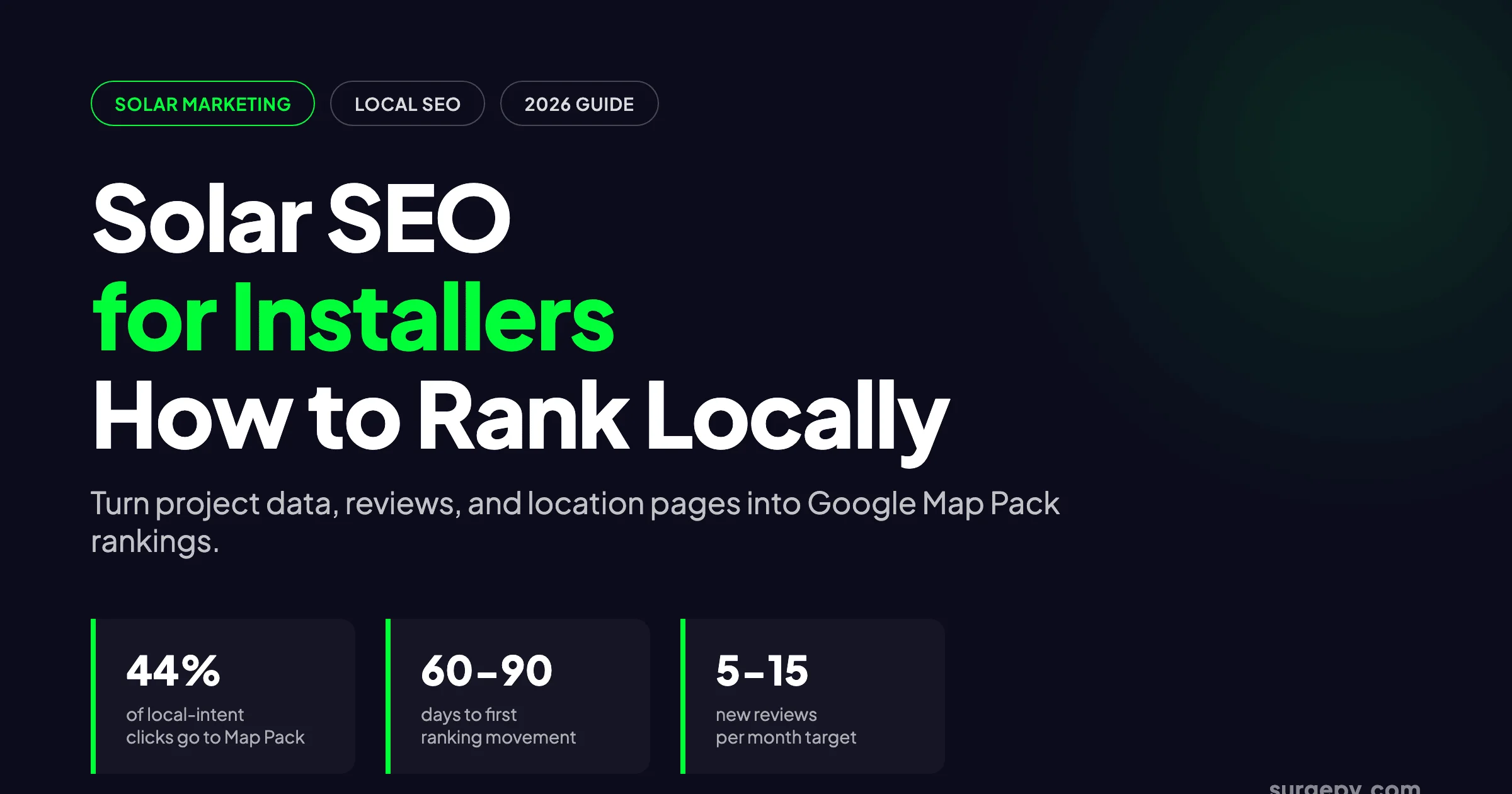
Solar SEO for installers means optimizing your business to rank in local search results like 'solar installer near me.' Core levers are a complete Google Business Profile, location-specific pages built from real project data, consistent NAP citations, review velocity, and locally relevant content. Most installers see measurable ranking gains in 60-90 days.
A residential solar installer in Denver spent $14,000 on Google Ads in March 2026. They generated 23 leads and closed 3 systems. Their cost per acquired customer was $4,667. A competitor 8 miles away spent $0 on ads that month. They generated 31 leads from local search and closed 7 systems. The difference was not product, pricing, or crew quality. It was local SEO.
Solar leads from organic search close at 22-30%, compared with 12-18% for paid search, according to SolarVis solar lead generation research. Local search leads are even warmer because the searcher has already narrowed intent to their own area.
Solar SEO for installers means optimizing your business to rank in local search results like “solar installer near me.” Core levers are a complete Google Business Profile, location-specific pages built from real project data, consistent NAP citations, review velocity, and locally relevant content. Most installers see measurable ranking gains in 60-90 days.
Solar is a local business. A homeowner in Austin will not hire an installer in Boston. Yet most solar companies still treat SEO like a national content game. They publish generic blog posts and wonder why they never show up for the searches that actually produce revenue. This guide reverses that approach. It treats local ranking as an operational system, not a marketing afterthought.
Local search behavior is immediate. Roughly 76% of people who search for something nearby visit a related business within 24 hours, according to BrightLocal’s local consumer research. About 28% of those searches result in a purchase. For solar installers, that means ranking locally is not about branding. It is about revenue this month.
Quick Answer: Solar SEO for Installers
Solar SEO for installers ranks your business in local search by optimizing your Google Business Profile, building unique location pages from real project data, keeping NAP citations consistent, generating reviews at scale, and publishing locally relevant content. The Google Map Pack captures 44% of clicks on local intent queries. Most installers can reach top 3 positions in 9-12 months with sustained effort.
In this guide you will learn:
- Why most solar SEO advice fails local installers
- How the 2026 local search funnel works for solar buyers
- How to turn every completed project into a ranking asset
- The exact structure for location pages that rank
- A daily and weekly Google Business Profile routine
- A review generation system that produces 5-15 reviews per month
- Technical SEO checks that take under 2 hours
- The one mistake that wastes 90% of solar SEO budgets
- A 90-day implementation calendar
Why Most Solar SEO Advice Fails Local Installers
Generic SEO advice tells you to “publish great content” and “build backlinks.” That is not wrong. It is just incomplete for solar installers. A local installer does not need to outrank Forbes or EnergySage on national solar keywords. They need to outrank the other 8-15 installers competing for “solar installer near me” in their city.
The search result that matters most is the Google Map Pack. It appears above organic results and captures roughly 44% of clicks on local-intent queries, according to Backlinko’s local SEO analysis. Position 1 in the Map Pack gets about 17-35% of those clicks. Position 4 gets roughly 6%. The drop-off is severe.
Most solar SEO guides miss three realities:
Reality 1: Your website supports your profile, not the other way around. A perfect website with a weak Google Business Profile will not crack the Map Pack. The profile is the front door.
Reality 2: Solar buyers research for weeks, then search locally for days. They read about panels, incentives, and financing. When they are ready to buy, they search “solar installer near me.” Your content must match both phases.
Reality 3: Your project data is your content moat. Every site survey, shade analysis, and installed system contains unique local information that national sites cannot replicate. Use it.
This guide focuses on the operational levers that move local rankings: project documentation, review timing, citation consistency, and location page depth.
How the 2026 Local Search Funnel Works for Solar Buyers
A typical solar buyer moves through three search stages before contacting an installer. Understanding this funnel prevents you from optimizing for the wrong keywords.
Stage 1: Education
The homeowner searches broad informational queries:
- “How do solar panels work?”
- “Are solar panels worth it in 2026?”
- “Solar tax credit after 2025”
At this stage they are not ready to buy. They are building trust and vocabulary. Content here should answer questions plainly and link to deeper resources. See content marketing for solar companies for a full strategy.
Stage 2: Local Consideration
The homeowner adds location intent:
- “Solar panel cost in Denver”
- “Best solar installer in Denver”
- “Denver solar incentives 2026”
This is where your location pages and local blog content earn visibility. The searcher is comparing options and narrowing geography.
Stage 3: Local Purchase Intent
The homeowner searches with immediate intent:
- “solar installer near me”
- “solar company Denver”
- “get solar quote [zip code]”
The Map Pack dominates here. Your Google Business Profile, reviews, and local citations determine whether you appear.
Key Takeaway
Solar SEO must cover all three stages, but the highest revenue impact comes from Stage 3. A complete Google Business Profile and strong reviews convert local searchers into calls faster than any blog post.
Step 1: Turn Every Project into a Local Content Asset
Every installation your team completes contains content that no national website can reproduce. The key is capturing it before the crew leaves the site.
Capture These 5 Data Points on Every Job
- Address and neighborhood — city and neighborhood only; never publish full street addresses without written consent
- System size and equipment — panel model, inverter, battery if applicable
- Roof type and challenge — tile, composite, flat, shading issues, structural workarounds
- Utility and rate structure — local utility name, net metering or buyback details
- Outcome — estimated annual production, projected savings, customer quote
This data feeds three SEO assets:
- Location pages with real project examples
- Google Business Profile posts with project photos
- Blog case studies that rank for neighborhood and equipment queries
A solar design platform makes this easy. SurgePV’s solar design software stores every project with system specs, equipment, and production estimates. That data can be exported directly into location page content and GBP posts.
Project Post Template
Use this format for a GBP post after each completed install:
Completed an 8.4 kW system in [Neighborhood], [City]. The home had a tile roof with south-facing exposure. We used [Panel Brand] panels and [Inverter Brand] inverters. Estimated first-year production: 12,400 kWh. The homeowner’s utility is [Utility Name].
This post signals local relevance, recent activity, and project expertise. It also gives prospects a reason to click.
Step 2: Build Location Pages from Real Site Data
Location pages are the bridge between your service area and local search. A weak location page lists the city name 20 times and adds a contact form. A strong location page answers the specific questions a homeowner in that city has.
Required Sections for Every Location Page
Opening (75-100 words) Mention years serving the city, number of local installations, and a specific local detail. Example: “We have installed 340 systems in the Denver metro since 2019, including 60+ in Highlands Ranch.”
Local incentives and utility details (250-400 words) Cover federal incentives, state programs, and local utility net metering. Use specific program names and dollar ranges.
Climate and system sizing (200-300 words) Explain local irradiance, average electricity use, and recommended system sizes. Mention roof types common in the area.
Local installation considerations (200-300 words) Cover permitting authority, typical permit timeline, HOA rules, and common roof or electrical challenges.
Real project examples (150-250 words) List 3-5 projects in that city or neighborhood. Include system size, equipment, and a brief challenge or outcome.
Customer testimonials (100-200 words) Use real quotes from local customers with first names and neighborhoods.
FAQ section (300-400 words) Answer 4-6 city-specific questions.
Target length: 1,500-2,000 words per page.
Location Page Mistakes to Avoid
- Do not duplicate 70% or more of the content across cities
- Do not publish a page for every zip code if you have no projects there
- Do not use stock photos and label them as local installs
- Do not stuff the city name unnaturally
Use shadow analysis and production data from your design tool to make each page technically credible. A page showing real shade modeling and production estimates for that city outranks generic competitors.
Step 3: Make Google Business Profile a Daily Habit
Your Google Business Profile is the single highest-impact local SEO asset. Most installers set it up once and ignore it. The top 3 Map Pack businesses treat it like a social media profile.
Weekly GBP Checklist
- Post 2-3 times per week. Rotate project highlights, customer testimonials, incentive updates, and seasonal tips.
- Add 5-10 photos per week. Real installation photos outperform stock images by a wide margin.
- Answer Q&A within 24 hours. Seed 8-12 common questions yourself if none exist yet.
- Respond to all new reviews within 48 hours.
- Update hours and service areas if anything changes.
Monthly GBP Checklist
- Review insights for calls, direction requests, and website clicks
- Add any new services or products
- Refresh the business description if needed
- Check that the primary category is still “Solar Energy Equipment Supplier” or “Solar Energy Contractor”
Profile Completeness Targets
| Element | Minimum | Competitive |
|---|---|---|
| Photos | 20 | 80+ |
| Reviews | 50 | 250+ |
| Monthly review velocity | 3-5 | 10-20 |
| Posts per month | 4 | 12+ |
| Services listed | 5 | 10+ |
| Products listed | 3 | 8+ |
Businesses with a complete Google Business Profile receive roughly 2.7x more reputation views and more visit intent actions, according to BrightLocal’s Google Business Profile research. For competitive markets, completeness is the price of entry.
Step 4: Capture Reviews at the Peak Moment
Reviews are the most controllable ranking signal for solar installers. A systematic review process beats sporadic asks every time.
The Best Time to Ask
The peak moment is 14-21 days after permission to operate (PTO), when the first lower electric bill arrives. The customer has proof the system works. Excitement is high. Response rates at this moment are typically 25-40%.
Other good moments:
- Install day, when the system is energized
- One-year production milestone
- Annual maintenance visit
The worst time is 90 days after install, when the customer has moved on.
The Review Request Formula
Every request should be:
- Personal — from the project manager, not a generic email
- Specific — mention system size, completion date, or savings
- Easy — include a direct Google review link
- Brief — under 100 words
Example:
Hi [Name], this is [Project Manager] from [Company]. Your 8.4 kW system has been running for three weeks now. Your first electric bill should reflect solar savings. Would you share a quick Google review about your experience? [Direct link]. Thanks for choosing us.
Response Templates
Reply to every review. Use these templates:
5-star: “Thank you, [Name]. We’re glad your [system size] system is performing as expected. The [specific detail] is exactly what we aim for. Please reach out anytime.”
3-4 star: “Thank you for the feedback, [Name]. We hear your concern about [issue]. [Manager] will reach out today to address it. Our goal is 5-star service every time.”
1-2 star: “[Name], we take this seriously and apologize. I’d like to learn more and resolve this. Please contact me directly at [phone/email]. — [Owner/GM Name]”
Responding to reviews also improves conversion rate. Semrush local SEO data suggests that for every 25% of reviews a business responds to, Google Business Profile conversion rate improves by roughly 4%.
Step 5: Stack Technical SEO on Top of Design Operations
Technical SEO is not a separate project. It is a set of checks that should be built into your website and design workflow.
Technical Checklist for Solar Installers
Mobile speed. Over 60% of local searches happen on mobile. Test your site with Google’s PageSpeed Insights. Aim for a mobile score above 70. Compress images and minimize unnecessary scripts.
NAP consistency. Your Name, Address, and Phone must be identical across your website, GBP, Yelp, BBB, Angi, and every other directory. Inconsistent NAP confuses search engines and hurts rankings.
Schema markup. Add LocalBusiness, Service, and FAQ schema. SolarEnergyContractor is a recognized schema type. Validate markup with Google’s Rich Results Test.
Internal linking. Link from every blog post and location page to your main service pages. Use descriptive anchor text like “solar panel installation” or “residential solar design.”
Click-to-call and forms. Make phone numbers tappable on mobile. Keep quote forms short: name, phone, email, address, average monthly bill.
Index management. Make sure location pages are in your XML sitemap. Remove thin or duplicate pages that could dilute authority.
Integrate Design Data Into Your Site
Use your generation and financial tool to embed real production estimates and savings calculations on location pages. Interactive calculators increase time on page, which correlates with better rankings. They also convert visitors into leads.
For proposal workflows, solar proposal software keeps your sales materials consistent with the data on your website. When a prospect moves from your location page to a proposal, the numbers should match.
The One Mistake That Wastes 90% of Solar SEO Budgets
The mistake is treating SEO as a campaign instead of a system. Installers hire an agency, pay for 90 days of setup, and expect rankings to compound forever. They do not.
Local SEO decays without maintenance. A Google Business Profile with no new posts for 90 days looks inactive. A location page with outdated incentive information loses freshness signals. A competitor that keeps publishing will pass you. Google’s local algorithm weighs more than 100 factors, but the top controllable ones cluster around relevance, distance, and prominence, according to BrightLocal’s local ranking factors guide.
The installers who win treat local SEO as a recurring operational task. They have:
- A weekly GBP posting calendar
- A review request workflow triggered at PTO+14
- A quarterly content refresh schedule
- A monthly citation audit
- A dashboard tracking calls, clicks, and rankings
The cost of inconsistency is higher than the cost of doing nothing. Google penalizes stop-start signals more than it rewards one-time effort.
What Most Guides Miss
The installers who dominate local search are not always the biggest. They are the most consistent. A small installer publishing one GBP post and requesting two reviews per week will outrank a larger competitor that does everything in bursts.
Measuring Solar SEO Success
You cannot optimize what you do not measure. Solar installers need a simple dashboard that connects local search activity to revenue.
Track These Metrics Weekly
Google Business Profile insights. Monitor calls, direction requests, website clicks, and message requests. These are your leading indicators. A 30% increase in GBP calls usually predicts a similar increase in booked consultations two to four weeks later.
Organic traffic by location page. Use Google Analytics 4 to see which city pages drive the most visits. Double down on the winners. Refresh the losers with new project data.
Keyword rankings. Track “solar installer near me,” “solar installer [city],” and “solar panel cost [city].” Use a rank tracking tool that reports Map Pack and organic positions separately.
Review velocity and rating. Target 5-15 new reviews per month in mid-size markets. Watch your average rating. A drop from 4.9 to 4.6 can visibly reduce call volume.
Cost per lead by channel. Compare local SEO leads against paid search, third-party leads, and referrals. Organic local leads typically cost $25-60 each, according to SolarVis lead generation benchmarks. Paid search often runs $90-220 per qualified lead.
Consultation-to-close rate by source. Local SEO leads usually close at 22-30%. Compare that to bought leads at 4-9%. The quality difference justifies the slower ramp time.
Build a Simple Monthly Report
| Metric | Last Month | This Month | Change |
|---|---|---|---|
| GBP calls | |||
| Organic sessions | |||
| New reviews | |||
| Average rating | |||
| Top 3 keywords | |||
| Leads attributed to organic |
Review this report monthly. Adjust your GBP posting frequency, review requests, or content production based on what moves the numbers.
90-Day Solar SEO Implementation Calendar
Use this calendar to sequence your work without overwhelming your team.
Days 1-30: Foundation
- Claim and verify Google Business Profile
- Complete every available field
- Add 20-30 photos
- Set up NAP consistency across top 10 directories
- Install Google Search Console and Google Analytics
- Build or improve your top 3 location pages
- Launch review request workflow at PTO+14
Days 31-60: Content and Citations
- Publish 4-6 GBP posts with project highlights
- Build citations on 20-30 solar and local directories
- Publish 2 locally focused blog posts
- Add schema markup to homepage and location pages
- Reach out to 10 local partners for backlink opportunities
Days 61-90: Scale and Optimize
- Add 5-10 more location pages
- Increase GBP posting to 3x per week
- Refresh top location pages with new project data
- Audit and fix any NAP inconsistencies
- Set up rank tracking for primary local keywords
- Launch one local partnership for backlinks
Expected Outcomes
| Metric | Baseline | 90 Days |
|---|---|---|
| GBP completeness | 40-60% | 90%+ |
| Total reviews | Varies | +15-30 |
| Citations | 10-25 | 40-60 |
| Location pages | 1-3 | 8-12 |
| Organic local calls | Baseline | 30-80% increase |
| Cost per lead | Varies | 30-50% lower than paid |
The biggest gains in the first 90 days usually come from GBP completeness and review velocity. Content and backlinks compound over months 6-12.
Frequently Asked Questions
What is solar SEO for installers?
Solar SEO for installers is the practice of optimizing a solar installation business to appear in local search results. It combines Google Business Profile optimization, location-specific website pages, citation consistency, review generation, and locally relevant content to rank for queries like “solar installer near me.”
How long does solar SEO take to produce leads?
Most installers see Google Business Profile and Map Pack movement within 60-90 days. Consistent local SEO typically produces a steady lead flow within 4-9 months. Competitive metros like Los Angeles or Phoenix may require 9-18 months to reach top 3 rankings.
What is the most important local ranking factor for solar installers?
Proximity to the searcher is the strongest factor and cannot be changed. The most controllable factors are Google Business Profile completeness, review quantity and velocity, and NAP citation consistency. Together these account for roughly 60% of local ranking performance.
How many Google reviews does a solar installer need?
A minimum of 50 reviews is needed to compete in most markets. Top 3 Map Pack positions in major metros typically require 100-500 reviews. Review velocity matters more than total count: aim for 5-15 new reviews per month in mid-size markets.
Do location pages really help solar installers rank?
Yes, when they contain unique, locally specific content. Templated pages with only the city name swapped trigger Google’s duplicate content detection and get demoted. Strong location pages include local utility details, real project examples, and city-specific incentives.
Can solar installers do SEO themselves or should they hire an agency?
A small installer can handle the foundation in-house with 5-10 hours per week. Agencies become valuable for citation building, content production, and technical SEO at scale. Most installers benefit from hybrid execution: internal team owns reviews and GBP, agency handles content and citations.
How much does solar SEO cost?
DIY solar SEO costs $100-$400 per month in tools. Agency retainers range from $1,200-$3,500 per month. Most installers reach top 3 Map Pack positions with a $1,500-$2,500 monthly investment over 9-12 months.
What is the biggest mistake solar installers make with SEO?
Treating SEO as a one-time setup. Local rankings require ongoing activity: weekly GBP posts, steady review requests, citation monitoring, and quarterly content updates. Installers who stop after 90 days typically lose their gains within 6 months.
Three Steps to Start This Week
-
Audit your Google Business Profile completeness. Fill every field. Add 20+ real project photos. Verify your primary category is “Solar Energy Equipment Supplier” or “Solar Energy Contractor.” This alone can move you 2-4 positions.
-
Set up a review request workflow. Trigger an email or text at PTO+14 from the project manager with a direct Google review link. Aim for 5+ new reviews per month within 90 days.
-
Build one strong location page for your highest-volume city. Use real project data from your solar design software, include local utility and incentive details, and target 1,500+ words of unique content. Replicate the format for other cities.
Related SurgePV Resources
Continue learning with these related guides for solar installers:
- Solar SEO Strategy for Local Installers
- Local SEO for Solar Installers
- Content Marketing for Solar Companies
- Marketing for Solar Business
- Solar Review Management
For more solar business and marketing content, explore the full SurgePV blog or browse the SurgePV glossary for definitions of solar industry terms.
Solar Software Tools to Support This Work
Effective solar installer operations depend on integrated software. SurgePV’s solar design platform helps installers handle the upstream work that feeds every decision in this guide:
- Solar design software for system layouts, panel placement, and BOM generation
- Shadow analysis for site-specific irradiance and obstruction modeling
- Energy and financial modeling tool for production forecasts and project ROI
- Solar proposal software for branded, customer-facing proposals
- Clara AI for automated design assistance and Q&A
Browse the full SurgePV platform to see how installers worldwide use the tools to design smarter, sell faster, and streamline every solar project.
Where this fits
This article is part of SurgePV's Solar Sales & Proposals hub, which works through the topic from first principles to the decisions a project team actually has to make.


