

A solar installer in Tucson generates 70% of new leads from Google Maps in 2025. A nearly identical installer 90 miles away in Phoenix generates 12%. Same product, same pricing, same crew quality, same review count. The difference: the Tucson installer’s website ranks #1 in the Google Map Pack for “solar installer near me.” The Phoenix installer ranks position 8 — invisible to most searchers.
Local SEO for solar installers is not a marketing channel. It is THE marketing channel for installers serving a defined geographic area. The map pack returns three businesses. Position 1 receives 35% of clicks. Position 4 receives 6%. Positions 5-10 split the remaining 20% across six businesses. The math is brutal for anyone not in the top 3.
Quick Answer: Solar SEO Strategy for Local Installers
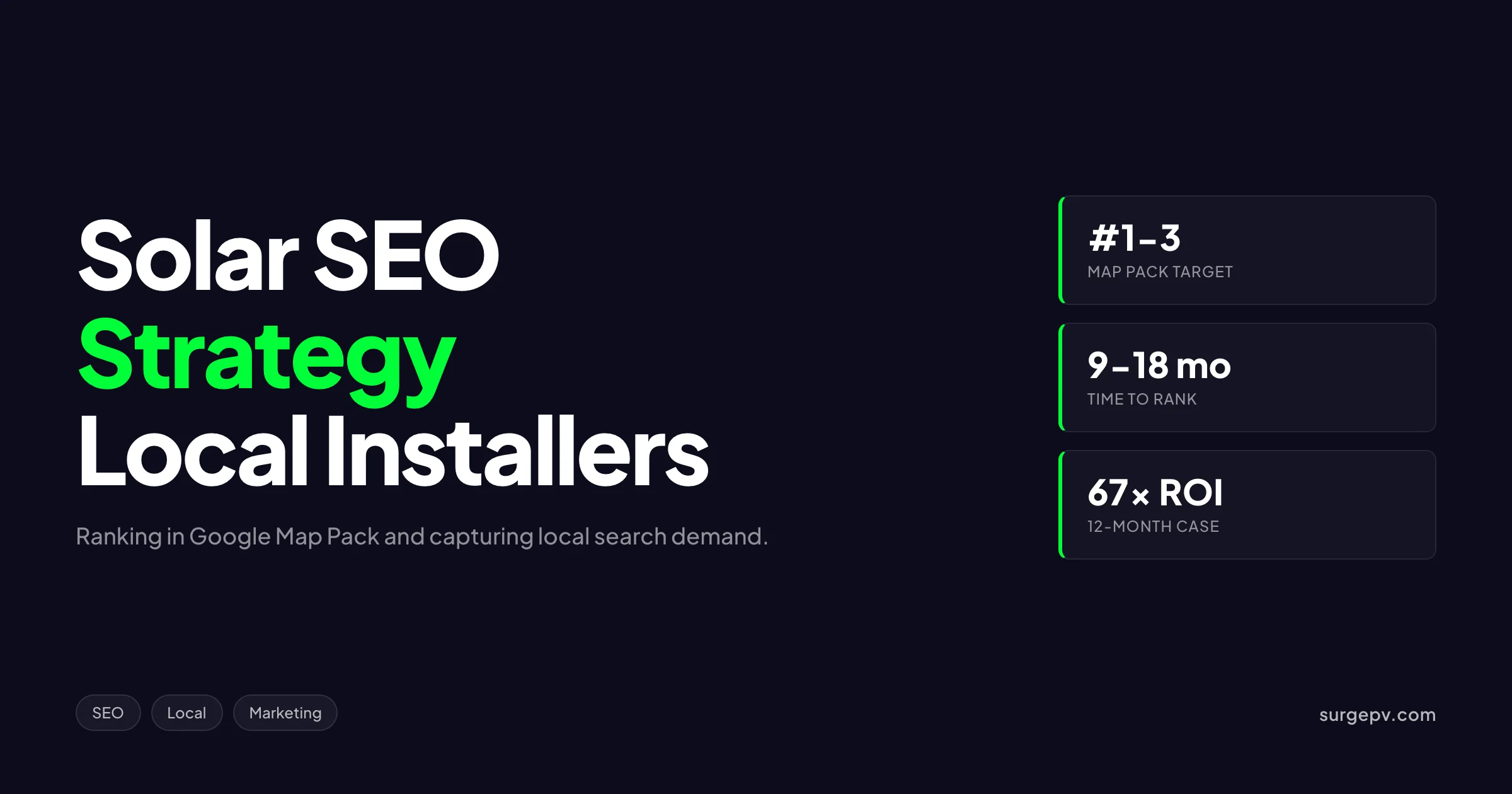
Solar SEO strategy for local installers centers on Google Business Profile optimization, location-specific landing pages, NAP citation consistency, review velocity, and locally-relevant content. The Map Pack is the prize — position 1 captures 35% of clicks for “solar installer near me” queries. Most installers can reach top 3 within 6-9 months with sustained effort.
In this guide:
- How local solar search actually works in 2026
- The 9 ranking factors for Google Map Pack
- Google Business Profile optimization checklist
- Building location-specific landing pages that don’t get demoted
- NAP citation consistency across solar-specific directories
- Review generation system that scales
- Content strategy: blog topics that rank locally
- What most installers get wrong about local SEO
- Eight common questions about solar SEO
How Local Solar Search Works in 2026
A homeowner in Mesa, Arizona types “solar installer near me” into Google. Within 200 milliseconds, Google’s local algorithm runs three parallel ranking processes.
First, the Map Pack: 3 local businesses shown above all other results, each with rating, review count, address, and phone number. The Map Pack receives roughly 44% of all clicks on local intent queries.
Second, the organic results: 10 traditional blue-link results below the Map Pack. Service pages, blog content, and directory listings (Yelp, BBB, Angi) compete here.
Third, AI Overviews: Google’s generative answers that increasingly displace traditional results for informational queries. For local commercial queries like “solar installer near me,” AI Overviews appear less frequently but cite the same map pack businesses when they do appear.
What Changed in 2025
Two major shifts reshaped local solar search:
-
Map Pack diversity: Google now penalizes “spammy” market dominance where one business has 10+ map pins clustered in one metro. Multi-location strategies that worked in 2022-2023 broke in 2024. Single-location installers can now outrank franchise installers in many markets.
-
AI Overview integration: When AI Overviews appear for solar queries, they pull from map pack businesses with high topical authority. Installers with strong blog content covering local solar topics get cited disproportionately.
The implication: thin, generic websites lose. Deep, locally-relevant websites with consistent business signals win.
The Three-Layer Local Search Reality
For a solar installer to win local search, three layers must work together:
Layer 1: Google Business Profile (GBP) — Your business listing. The single most important ranking factor for map pack.
Layer 2: Website (Main Domain) — Your installer.com homepage and location pages. Determines organic ranking and supports GBP through schema markup and consistent NAP.
Layer 3: Off-site Citations — Yelp, BBB, Angi, and 200+ other directories. Confirms business legitimacy to Google.
Most installers focus on layer 1 (GBP) and ignore layers 2 and 3. Top-ranking installers integrate all three.
The 9 Ranking Factors for Solar Map Pack
Google’s local search algorithm weighs roughly 100 factors. Nine of them dominate solar installer rankings.
1. Proximity to Searcher (Cannot Be Optimized)
Google ranks businesses closest to the searcher’s actual location higher. Solar installers cannot beat this factor through SEO. What they can do: open additional physical locations in high-volume service areas.
A primary office in Phoenix with a satellite office in Mesa, Glendale, and Chandler allows the installer to compete in four separate proximity zones. The satellite offices need to be real — not virtual offices. Google detects and demotes fake addresses.
2. Google Business Profile Completeness
Every field on GBP affects ranking. Complete profiles outperform partial profiles. Key fields:
- Primary business category (must be “Solar Energy Equipment Supplier” or “Solar Energy Contractor”)
- Secondary categories (add Electrical Contractor, Energy Equipment & Solutions)
- Business hours
- Service areas (specific cities/zips, not entire states)
- Service list (each service typed out)
- Photos (minimum 50 for established installers)
- Products (panel models, inverter brands, battery types)
- Posts (recent updates within 30 days)
A complete profile takes 6-10 hours to set up properly. Most installers fill in 40% of fields and wonder why rankings stall.
3. Review Quantity and Velocity
Total review count matters. Review velocity (new reviews per month) matters more for trajectory. New reviews signal an active, growing business.
Target velocities by market competition:
| Market Tier | Min Total Reviews | Monthly Velocity Target |
|---|---|---|
| Small market (under 100K population) | 50 | 3-5 |
| Mid market (100K-1M) | 100 | 5-15 |
| Major metro (1M+) | 250-500 | 15-40 |
Phoenix-area installers in the top 3 map pack typically maintain 400-1,500 Google reviews with 20-50 new reviews per month.
4. Review Sentiment and Recency
Average rating must be 4.5+ to compete. Recent reviews (last 30 days) carry more weight than old reviews. A 4.9-star installer with 100 reviews from last 12 months will often outrank a 4.6-star installer with 500 reviews from 2018-2022.
Negative review management matters. Every negative review needs a professional, detailed response. Unanswered negatives signal to Google that the business is inattentive.
5. NAP Citation Consistency
Name, Address, Phone — identical across every directory. Google checks 50+ data sources to confirm business legitimacy. Inconsistent NAP triggers demotion.
Common inconsistencies:
- “Sun Solar LLC” on website, “Sun Solar” on Yelp, “Sun Solar Energy” on BBB
- Suite 100 on website, no suite on GBP, Ste 100 on Angi
- Phone number ending in 9999 on website, 9998 on legacy directories
Run a quarterly citation audit using BrightLocal, Whitespark, or Moz Local. Fix every inconsistency.
6. Website Authority (Backlinks + Content Depth)
Map pack rankings increasingly correlate with traditional organic SEO signals. A website with 200 referring domains and 1,000 pages of solar content will outrank a website with 20 referring domains and 50 pages — even if GBP metrics are similar.
Backlink targets for solar installers:
- Local Chamber of Commerce
- BBB accreditation page
- Local news outlets (project announcements)
- Solar industry directories (EnergySage, SolarReviews)
- Partner pages (electricians, roofers, real estate agents)
- Community organization pages (Rotary, Lions Club)
7. Location Page Quality
Every city or zip you serve needs a dedicated location page on your website. Each page needs unique content covering local factors:
- Local utility rates and rate structures
- City/state solar incentives specific to the location
- Average system sizes for that climate zone
- Local permit process and AHJ details
- Specific installation examples from that city
- Local testimonials and reviews
A location page under 800 words gets demoted. A location page that duplicates 70% of content from sister pages gets demoted. Build each location page individually with local insight.
8. Behavioral Signals (Click-Through Rate)
Google tracks how searchers interact with map pack results. Businesses that get clicked, called, and direction-requested at higher rates rank better.
Optimization levers:
- Photos that show actual work, not stock images
- Posts with current information, not generic content
- Hours that accurately reflect availability (no missed Saturday calls)
- Phone number on profile, not just website
- Direct call button accuracy (calls actually answered)
9. Schema Markup on Website
LocalBusiness schema, Service schema, and Review schema markup on your website helps Google understand and trust your business information. Properly marked-up sites get richer SERP features and slightly better rankings.
Use JSON-LD format. Validate with Google’s Rich Results Test. Common solar-specific schema:
{
  "@context": "https://schema.org",
  "@type": "SolarEnergyContractor",
  "name": "Your Solar Installer",
  "address": { ... },
  "telephone": "+1-555-555-5555",
  "serviceArea": { ... },
  "areaServed": ["Phoenix", "Mesa", "Tempe"]
}
Google Business Profile Optimization Checklist
Use this checklist to bring any solar installer GBP to competitive shape.
Core Profile Setup
- Verify business by mail (postcard verification — required)
- Set primary category: “Solar Energy Equipment Supplier”
- Add 3-5 secondary categories (Solar Energy Contractor, Electrical Contractor, Energy Equipment & Solutions, Solar Hot Water System Supplier)
- Business hours (open all days you actually accept calls)
- Service area (specific cities, not “metro region”)
- Phone number (local number, not toll-free)
- Website URL with UTM tracking
- Description (750 character limit, mention services + service areas)
Photos (50+ required for competitive markets)
- Logo (square, 250x250 minimum)
- Cover photo (1080x608)
- Exterior building photos
- Interior office photos
- Team photos
- At least 20 project completion photos (rooftop installs)
- At least 10 ground mount or commercial photos (if applicable)
- Equipment/inventory photos
- Vehicle photos (vans with logo)
Services List
Add each service as separate entry:
- Solar Panel Installation
- Solar System Design
- Solar Maintenance
- Solar Repair
- Battery Storage Installation
- EV Charger Installation
- Solar Consultation
- Commercial Solar
- Solar Pool Heating (if applicable) Read Adding Battery Storage Services for a complete walkthrough. Read Solar Panel Installation Guide for a complete walkthrough.
Products
For each major product line:
- Solar panel models (REC, LG, Q Cells, etc.)
- Inverter brands (Enphase, SolarEdge, Tesla)
- Battery options (Tesla Powerwall, Enphase IQ Battery)
- EV chargers offered
Posts (3-5 per month minimum)
Rotate between:
- Completed project highlights (with photos)
- Customer testimonials
- Solar incentive updates
- Service announcements
- Community involvement
- Seasonal tips (winterizing systems, summer prep)
Q&A Section
- Seed 8-12 common questions yourself
- Answer questions within 24 hours
- Monitor for new questions weekly
Booking and Messaging
- Enable booking integration if using calendar tool
- Enable messaging with auto-reply
- Set messaging response time expectation
Building Location Pages That Don’t Get Demoted
The biggest local SEO mistake solar installers make is templated location pages. Google’s Helpful Content Update specifically targets this pattern.
Anatomy of a Strong Solar Location Page
A location page for “Solar Installer Mesa AZ” should include:
Header (50-75 words):
- City-specific opening
- Specific local context (Mesa’s solar adoption rate, average system size)
- Trust signal (years serving Mesa, project count)
Local incentives section (250-400 words):
- Federal incentives (post-2025 reality for residential)
- Arizona state credits and rebates
- Mesa-specific utility rebates (SRP vs APS programs)
- Net metering details for Mesa utilities
- Specific dollar amounts and program names
System sizing for Mesa climate (200-300 words):
- Mesa’s irradiance and production factor
- Average home electricity use in Mesa
- Recommended system sizes by home size
- Roof factors specific to Mesa (tile roofs prevalent)
Local installation considerations (200-300 words):
- Mesa permit process and timeline
- City of Mesa building department details
- HOA considerations for Mesa subdivisions
- Local utility interconnection requirements
Project examples (3-5 examples, 50 words each):
- Real Mesa addresses (street and city, not full address)
- System size, equipment used
- Notable challenges and solutions
Customer testimonials (3-5, 75 words each):
- Mesa-specific customers
- Specific project details
- Real names (with permission) or first names
FAQ section (4-6 questions):
- Mesa-specific questions
- Local utility-specific questions
Total target: 1,200-1,800 words per location page
Location Page Mistakes to Avoid
- Don’t duplicate paragraphs between cities
- Don’t use city name 50+ times (keyword stuffing trigger)
- Don’t fabricate testimonials
- Don’t show stock photos as project examples
- Don’t link 30 location pages from footer (creates link dilution)
- Don’t build location pages for cities you don’t actually serve
Pro Tip
Use cloud solar design software and your CRM to pull real project data for each location page. A Mesa page showing actual Mesa installations with system sizes, equipment, and completion dates outranks every templated competitor.
NAP Citation Strategy: 50+ Directories That Matter
NAP citations across directories signal business legitimacy. Building these citations takes 3-6 months of consistent work.
Tier 1 Citations (Critical — Build First)
These directly affect map pack ranking:
- Google Business Profile (✓ obvious)
- Apple Maps Connect
- Bing Places
- Facebook Business
- Yelp
- Yellow Pages
- Better Business Bureau (BBB)
- Angi (formerly Angie’s List)
- HomeAdvisor
- Thumbtack
- Houzz
- Foursquare
- Manta
- Hotfrog
- Citysearch
Tier 2 Citations (Solar Industry Specific)
These build topical authority:
- EnergySage
- SolarReviews
- ConsumerAffairs
- Solar Estimate
- PickMySolar (now part of SunStream)
- The Solar Nerd
- SolarStartup
- CleanEnergyAuthority
- NABCEP Directory
- SEIA Member Directory
Tier 3 Citations (Regional Solar Directories)
State-level solar directories vary by location. Examples:
- California: California Solar Energy Industries Association (CALSEIA)
- Texas: Texas Solar Energy Society
- Arizona: Arizona Solar Energy Industries Association
Tier 4 Citations (General Local Directories)
Mid-tier directories worth claiming:
- Local.com
- eLocal
- Superpages
- ChamberofCommerce.com
- AllBusiness.com
- Brownbook
- Insider Pages
- Cylex
- Tupalo
- Chip In
- Where to?
- Choogle
- WhitePages
- EnHancedLocal
- Local Database
Citation Management Tools
Manual citation building takes 60-90 hours. Tools accelerate the process:
- Moz Local — $14-33/month per location
- BrightLocal — $39-99/month
- Yext — $199-999/month (overkill for most installers)
- Whitespark — $11-99/month
- Synup — $29-99/month per location
Most installers benefit from BrightLocal at the entry tier or Moz Local for set-and-forget management.
Review Generation: The System That Scales
Reviews are the single highest-leverage SEO activity for solar installers. A systematic review process beats sporadic asks every time.
When to Ask for Reviews
The single best moment: 14-21 days after PTO, when the customer’s first electric bill arrives showing savings.
The second best moment: install day, when the system is energized and the customer is excited.
The worst moment: 90 days after install when the customer has moved on.
How to Ask
The ask must be:
- Personal (from the project manager, not a generic email)
- Specific (mention the system size or completion date)
- Easy (direct link to Google review page)
- Brief (under 100 words total)
Example email:
Subject: How was your install with [Company]?
Hi [Name],
It’s [Project Manager] from [Company]. Your 8.4 kW system has been generating for about three weeks now. Your first electric bill should be reflecting solar savings.
Could you share a quick review of your experience? Your honest feedback helps other Mesa homeowners decide if solar is right for them.
[Direct Google review link]
Thanks for choosing [Company].
Review Response Templates
Every review needs a response within 48 hours.
5-star response (template):
Thank you for the kind words, [Name]! We’re thrilled your [system size] system is performing as expected. The [specific detail from review] is exactly what we aim for. Welcome to the [Company] family — please reach out anytime.
3-4 star response (template):
Thank you for the feedback, [Name]. We appreciate you taking the time. We hear your concern about [specific issue]. [Manager Name] will reach out today to address this directly. Our goal is 5-star service every time.
1-2 star response (template):
[Name], we take this feedback seriously and apologize for not meeting expectations. I’d like to learn more and resolve this. Please contact me directly at [phone/email]. — [Owner/GM Name]
Review Velocity Calculation
For a target of 5 new reviews per month, with a typical 15-25% review request → review completion rate:
- Send 20-30 review requests per month
- Time the request at 14-21 days post-PTO
- Follow up once at day 7 if no response
A 10-system-per-month installer can sustainably generate 2-3 reviews per month with this system. A 50-system-per-month installer generates 10-15 per month.
Content Strategy: Local Blog Topics That Rank
Solar installers should publish 2-4 blog posts per month covering locally-relevant topics. The goal: rank for informational queries that lead to commercial intent.
High-Value Local Solar Topics
For each service area, create blog content covering:
- “[City] Solar Incentives 2026” — state and local rebates, net metering
- “Average Solar Installation Cost in [City]” — local pricing data
- “Best Solar Panels for [City] Climate” — heat tolerance, dust factors
- “[City] Solar Permit Process: Step by Step” — local AHJ details
- “Solar Panel Installation [City]: What to Expect” — local workflow
- “Net Metering in [State]” — utility rate structures, payback
- “Solar ROI Calculator for [City] Homes” — local utility rates
- “Solar vs Grid Power Cost in [City]” — comparative analysis
- “Top 5 Solar Mistakes [City] Homeowners Make” — local issues
- “Solar Battery Storage in [City]” — power outage frequency, storm risks
Content Structure for Local Ranking
Every local content piece needs:
- Primary keyword in title and H1
- City name in first 100 words
- 1,500-3,000 word minimum
- Real local data (utility rates, permit fees, incentive amounts)
- 2-3 internal links to service pages
- Author bio with credentials
- Updated within last 12 months
Content Refresh Cadence
Update each piece quarterly:
- Refresh statistics with current data
- Update incentive amounts if changed
- Add 1-2 new sections
- Update meta tags and schema
- Resubmit to Search Console
Google’s freshness signal favors recently updated content for local queries.
What Most Solar Installers Get Wrong About Local SEO
Mistake 1: Treating Local SEO as a One-Time Project
Most installers hire an agency, do 90 days of setup, then expect rankings to compound. Local SEO requires ongoing work — posts, reviews, citations, content. Set-and-forget approaches lose ground every month.
Mistake 2: Buying Reviews
Fake reviews are detectable and trigger Google penalties. Two unnatural patterns flag review fraud:
- Burst velocity (50 reviews in one week from new accounts)
- Generic language (no specific project details)
Penalties range from review removal to full GBP suspension. Recovery takes 60-180 days.
Mistake 3: Spam Service Area Targeting
Setting service area to “entire state” or “metro region” actually hurts ranking. Google demotes overly broad service area claims. List specific cities and zip codes you actually serve.
Mistake 4: Duplicate Location Pages
10 location pages with 80% identical content trigger Google’s duplicate content detection. The pages either rank for nothing or pull each other down. Build location pages individually with unique local content.
Mistake 5: Ignoring Bing and Apple Maps
Bing has 6.5% search market share. Apple Maps has 27% mobile search share for iPhone users. Solar installers who optimize only for Google miss a third of their potential local traffic.
Mistake 6: Neglecting GBP Posts
Posts decay after 7 days. Without consistent posting, GBP looks inactive to Google. 1-2 posts per month is minimum; 4-5 posts per month is competitive.
What Most Guides Miss
Local SEO for solar installers compounds with year of effort. The installer who invests $2,000/month consistently for 24 months will outrank an installer who spends $10,000/month for 6 months. Map pack rankings reward consistency, not bursts.
Real-World Example: A Local SEO Turnaround
A solar installer in Sacramento with $4M annual revenue was ranking position 8-12 in the map pack for “solar installer near me” in 2024. Lead flow had stalled. The owner suspected pricing or product issues.
The diagnostic:
- GBP completeness: 65% (30+ fields empty)
- Total reviews: 87 (4.7-star average)
- Review velocity: 1-2 per month
- Citations: 22 (inconsistent NAP across 15)
- Location pages: 3 (covering 12 service cities)
- Posts: 2 in last 6 months
The 6-month plan:
- Complete GBP to 95%+ (Month 1)
- Implement review request system at PTO+14 (Month 1)
- Fix NAP across 50 citations (Months 1-3)
- Build location pages for 8 cities (Months 2-4)
- Publish 3 blog posts per month (Months 1-6)
- Post on GBP 4x per month (Months 1-6)
Six months later:
- Map pack position improved from 8-12 to 2-4 for primary keyword
- Reviews grew from 87 to 158 (avg 12/month new)
- Citations: 67 with consistent NAP
- Organic traffic up 240%
- Lead volume up 180%
Total cost: $1,800/month for 6 months ($10,800). Lead value generated: roughly $400,000 in additional contracted revenue. Return on SEO investment: 36x in year one.
Get Local SEO Right With Real Data
Use solar design software project data to fuel your local content — real installations with system sizes, equipment, and outcomes that prove local expertise. Every location page should reference real installations.
Book a DemoNo commitment required · 20 minutes · Live project walkthrough
Frequently Asked Questions
What is solar SEO strategy?
Solar SEO strategy is the set of on-page, off-page, and technical optimizations that help solar installer websites rank in local search results. It focuses on the Google Map Pack, Google Business Profile, location-specific landing pages, and trust signals like reviews and citations.
How long does solar SEO take to work?
Solar SEO typically takes 4 to 9 months to drive consistent leads. Map Pack ranking can happen in 60 to 90 days for less competitive markets. Highly competitive metros like Phoenix and San Diego require 9 to 18 months of consistent effort to crack the top 3.
What is the most important factor for solar map pack ranking?
Proximity to the searcher’s location is the single biggest factor. The next two: Google Business Profile completeness (categories, photos, posts, services) and review velocity (new reviews per month). Solar installers with 100+ reviews and 4+ posts per month dominate most local markets.
How many reviews does a solar installer need to rank in the map pack?
Minimum 50 Google reviews to compete for any local solar keyword. Top 3 map pack positions typically require 100 to 500 reviews depending on market competitiveness. Review velocity (new reviews per month) matters more than total count for new rankings.
What are NAP citations and why do they matter for solar SEO?
NAP stands for Name, Address, Phone — the basic business information that must be identical across every directory citation. Inconsistent NAP across Yelp, BBB, Angi, and other directories signals unreliability to Google and reduces local ranking authority.
How many location pages should a solar installer build?
Build one location page per city or service area where you actively install. Most solar installers benefit from 10 to 50 location pages covering primary metros and surrounding suburbs. Each page needs 800-1500 words of unique, location-specific content — not duplicated templates.
Does Google Business Profile posting frequency affect rankings?
Yes. Active posting (3-5 posts per month) signals an active business to Google’s local algorithm. Posts about completed projects, customer testimonials, seasonal incentives, and community events all contribute to map pack ranking. Inactive profiles lose ground to active competitors.
What is the biggest mistake solar installers make with local SEO?
Building generic city landing pages with duplicated templates. Google demotes thin location pages that lack unique content. A page titled “Solar Installation Mesa AZ” must include actual Mesa-specific information — utility info, incentive details, local project examples — not a templated copy of the Phoenix page with city name swapped.
Three Steps to Start This Week
-
Complete every field on your Google Business Profile. This alone will move you 2-4 positions in most markets. Spend 6 hours on it once. Reap returns for years.
-
Set up a review request workflow. PTO + 14 days, personalized email from project manager, direct Google review link. Aim for 5+ new reviews per month within 90 days.
-
Build one strong location page for your highest-volume city. Use real customer data from solar design platform, include local utility info, embed Google Map, target 1,500+ words of unique content. Build the template, then replicate to other cities.
Related SurgePV Resources
Continue learning with these related guides for solar installers and EPCs:
- Local SEO for Solar Installers
- Content Marketing for Solar Companies
- Google Ads for Solar Installers
- Solar Review Management
- Video Marketing for Solar Installers
For more solar business and marketing content, explore the full SurgePV blog or browse the SurgePV glossary for definitions of solar industry terms. For a direct comparison, see Arka 360 vs SurgePV.
Solar Software Tools to Support This Work
Effective solar installer operations depend on integrated software. SurgePV’s cloud solar design tool helps installers handle the upstream work that feeds every decision in this guide:
- Solar design software for system layouts, panel placement, and BOM generation
- PV shade analysis for site-specific irradiance and obstruction modeling
- Solar financial modeling for production forecasts and project ROI
- Solar proposal generation for branded, customer-facing proposals
- Clara AI for automated design assistance and Q&A
Browse the full SurgePV platform to see how installers worldwide use the tools to design smarter, sell faster, and streamline every solar project.
Where this fits
This article is part of SurgePV's Solar Sales & Proposals hub, which works through the topic from first principles to the decisions a project team actually has to make.


