

Quick Answer
Solar review management targets Google Business Profile (primary), Yelp, SolarReviews, and EnergySage. Best practices: request reviews within 7 days of project completion, respond to all reviews within 24 hours, and maintain 4.5+ star average. Companies with 50+ reviews get more organic leads.
A residential solar installer in Sacramento and a competitor 8 miles away both finished 2024 with $5.8M annual revenue. They installed identical equipment at nearly identical prices. They had been founded within 18 months of each other. By every measurable business metric, they were peers.
Solar review management targets Google Business Profile (primary), Yelp, SolarReviews, and EnergySage. Best practices: request reviews within 7 days of project completion, respond to all reviews within 24 hours, and maintain 4.5+ star average. Companies with 50+ reviews get more organic leads.
By March 2026, one had grown to $11.2M annual revenue. The other had stalled at $5.4M.
The difference was 422 Google reviews vs 47.
The growing installer averaged 12-18 new Google reviews per month. They responded to every review within 24 hours. They had a 4.9 star average across 422 reviews. They ranked position 1 in Google’s local map pack for “solar installer near me” in their service area. Their inbound lead volume from organic search was 8x their competitor’s.
Quick Answer: Solar Review Management
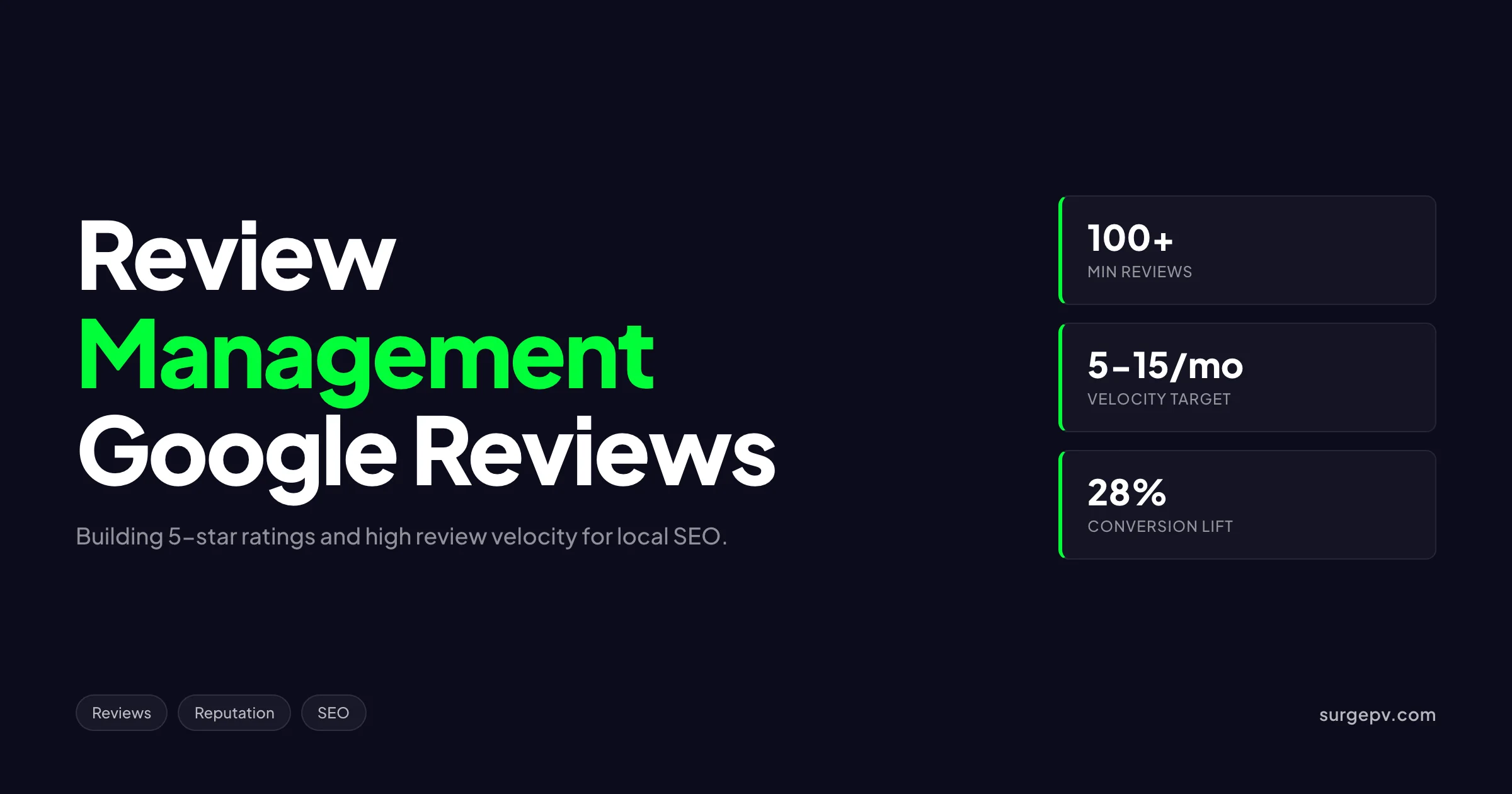
Solar installers need 100+ Google reviews with consistent monthly velocity (8-15 new reviews per month) to dominate local map pack rankings. Request reviews 14-21 days after PTO. Respond to every review within 48 hours. Solar installers with 250+ reviews close 28% more leads than those with under 100 reviews.
In this guide:
- Why Google reviews matter more than other reviews for solar
- The 4 review platforms solar installers should manage
- Systematic review request workflow (PTO + 14 days)
- Response templates for 5-star, 3-star, and 1-star reviews
- How to handle fake or unfair reviews
- Building review velocity that compounds
- Common mistakes in solar review management
- Eight common questions
Why Google Reviews Matter More Than Other Reviews for Solar
A homeowner researching solar typically searches “solar installer near me” or “best solar company [city].” Google’s response: the map pack (3 businesses) above all other results. Map pack ranking depends on:
- Proximity to searcher (uncontrollable by installer)
- Google Business Profile completeness
- Review quantity, velocity, and sentiment (largest controllable factor)
- Citation consistency
- Website authority
Reviews influence two of the top three factors. They are the single largest controllable signal for local solar SEO.
Reviews also drive conversion directly. A homeowner clicking on your map pack listing sees:
- Star rating (immediate trust signal)
- Review count (volume signal)
- Recent review text (specific trust signals)
A 4.9-star installer with 287 reviews gets 4-7x more clicks from map pack than a 4.6-star installer with 42 reviews.
The 3-Factor Review Trust Algorithm
Most homeowners apply a quick 3-factor mental algorithm when reading solar reviews:
Factor 1: Volume Under 50 reviews = “Small business, may be risky” 50-100 reviews = “Established” 100-500 reviews = “Trusted local” 500+ reviews = “Major presence”
Factor 2: Recency Latest review under 30 days old = “Active business” Latest review 30-90 days old = “Acceptable” Latest review 90+ days old = “Stagnant or out of business”
Factor 3: Response pattern Owner responds to all reviews = “Cares about customers” Owner responds to negatives only = “Defensive” No owner responses = “Inattentive”
Solar installers who optimize for all three factors consistently win local search.
The 4 Review Platforms Solar Installers Should Manage
Reviews exist across many platforms. Four matter most for solar installers.
Platform 1: Google Business Profile (Top Priority)
Google reviews drive 60-70% of local solar search visibility. Single most important platform.
Optimization tactics:
- Verify and complete Google Business Profile
- Respond to 100% of reviews within 48 hours
- Drive 5-15 new reviews per month
- Maintain 4.6+ star average
- Include keyword “solar” in some review responses for SEO
Time investment: 30-60 minutes per week for active management.
Platform 2: Yelp
Yelp matters less than it used to but still influences trust. Particularly important in California, New York, Texas, and Florida.
Optimization tactics:
- Claim and complete Yelp profile
- Respond to negative reviews (Yelp limits aggressive response promotion)
- Drive 10-20 reviews over time
- Maintain 4-star+ rating
Caution: Yelp’s algorithm filters out reviews from inactive accounts. Roughly 40-50% of solar reviews end up in “not currently recommended” status. Don’t drive review volume to Yelp at the expense of Google.
Platform 3: Solar Industry Sites (EnergySage, SolarReviews, ConsumerAffairs)
Solar-specific sites attract high-intent solar shoppers. Lower review volume but higher conversion rate.
Optimization tactics:
- Claim profiles on all three sites
- Drive 20-50 reviews over 12-18 months
- Respond to negative reviews professionally
- Maintain 4.5+ star average
ROI: Solar shoppers researching installers on these sites convert at 25-35% of visit rate vs 3-8% for general Google searches.
Platform 4: Better Business Bureau (BBB)
BBB matters for trust signals and older demographics. Lower review volume but high credibility.
Optimization tactics:
- Apply for BBB accreditation
- Maintain A or A+ rating
- Respond to all BBB complaints within 7 days
- Drive 5-15 BBB reviews
Time investment: Quarterly check-ins. Lower volume than Google.
Systematic Review Request Workflow
The single largest variable in review volume is whether requests are made systematically or sporadically. Most installers ask sporadically.
The PTO + 14 Days Trigger
The single best moment to request a solar review: 14-21 days after Permission to Operate (PTO), when the customer’s first electric bill arrives showing solar savings.
Why this timing works:
- System is operational and proven
- Customer has experienced real cost savings
- Excitement is still high (less than 30 days post-install)
- Specific data points to mention in review (first bill amount, kWh produced)
The Review Request System
Trigger: PTO date entered into CRM Wait: 14 days Action: Automated email from project manager (not generic “info@” address)
Email template:
Subject: How is your solar system performing, [First Name]?
Hi [First Name],
[Project Manager Name] here from [Company]. Your [system size] kW system passed PTO on [date], and your first electric bill should be reflecting solar savings by now.
If you’ve had a good experience, I’d really appreciate a quick Google review. It helps other [city] homeowners decide if solar is right for them.
[Direct Google review link]
If anything isn’t going as expected, please reply to this email and I’ll personally make sure we resolve it.
Thanks for choosing [Company]!
[Project Manager Name] [Phone]
Follow-Up Cadence
Day 0: Initial email (above) Day 7: Follow-up if no review submitted
Follow-up email template:
Subject: Quick favor, [First Name]?
Hi [First Name],
Just following up on my note from last week. Your [system size] system should be a couple weeks into producing power now.
If you have 60 seconds, would you share your experience on Google?
[Direct link]
Thanks so much.
[Project Manager Name]
Day 14: Stop. Move to long-term nurture. Don’t pester.
Conversion Rate Expectations
A well-designed review request system with PTO+14 timing and personal email achieves:
- Email open rate: 55-75%
- Click-through to review page: 12-25%
- Completed review submission: 8-18%
For a 10-install/month installer, this generates 1-2 reviews per month organically.
For 5+ reviews per month, add:
- Phone follow-up for top customers (90 day post-install)
- Text message reminder (day 21 if no review yet)
- In-person ask during service appointments
What Doesn’t Work
- “Please leave us a review” with no link
- Generic email from “info@” account
- Requests made at install day (too early to mention savings)
- Requests made 90+ days post-install (excitement faded)
- Requests sent to multiple addresses without personalization
Response Templates for Every Review Type
Every review deserves a response. Templates ensure consistency.
5-Star Reviews
5-star reviews are praise. Response should:
- Thank the customer personally
- Reinforce a specific detail from their review
- Add a forward-looking element (future service or referral invitation)
- Stay under 60 words
Template:
Thank you for the kind words, [First Name]! We’re thrilled your [system size] kW system is performing as expected. [Specific detail from review — “the dust storm cleanup,” “the quick permit work”] is exactly what we strive for on every install. If anything comes up in the future, just call us. Welcome to the [Company] family.
4-Star Reviews
4-star reviews are positive with a small concern. Response should:
- Thank for the review
- Address the concern directly without defensiveness
- Offer a specific path to make it right
- Stay under 75 words
Template:
Thanks for the feedback, [First Name]. We’re glad the system is delivering savings. I hear your point about [specific concern from review] — that’s not what we aim for. [Manager Name] will reach out today to address this directly. Our goal is 5-star service on every install, and we appreciate you giving us the chance to improve.
3-Star Reviews
3-star reviews indicate real disappointment. Response should:
- Take immediate ownership
- Provide direct contact for resolution
- Avoid public arguing
- Move detailed discussion offline
Template:
[First Name], thank you for taking the time to share this feedback. I’m sorry your experience didn’t meet expectations. I’d like to talk with you directly about [specific concern]. Please contact me at [phone] or [email] — I’ll personally make this right. [Owner Name]
2-Star and 1-Star Reviews
Low-star reviews can damage business if mishandled. Response should:
- Apologize sincerely without defensiveness
- Take public ownership
- Offer specific contact for resolution
- NOT argue facts publicly
Template:
[First Name], we’re sincerely sorry this experience didn’t reflect our standards. I personally want to learn what went wrong and make this right. Please reach me directly at [phone] today. — [Owner Name], [Company]
If the review contains factual errors, address them briefly:
[First Name], we appreciate your feedback and apologize this experience didn’t meet expectations. To clarify, [specific factual correction — only if necessary]. I’d like to discuss this further. Please reach me at [phone] or [email].
Never argue extensively in public responses. Move conversations offline.
How to Handle Fake or Unfair Reviews
Fake reviews damage business and can be removed through Google’s process.
What Google Will Remove
- Reviews from competitors or non-customers
- Reviews containing hate speech or profanity
- Off-topic reviews
- Reviews from accounts created to leave one review
- Reviews containing personal information (phone numbers, addresses)
- Reviews from before customer engaged with business
What Google Will NOT Remove
- Honest negative reviews from actual customers
- Reviews disagreeing with your version of events
- 1-star reviews without text
- Reviews from years ago
The Removal Process
- Flag the review through Google Business Profile (right-click → Flag as inappropriate)
- Select reason for removal
- Submit
- Wait 5-7 business days for Google review
- If not removed, submit additional information via Google support
Success rate: Approximately 25-40% of flagged reviews get removed. Best results come from clear policy violations.
When Removal Isn’t Possible
Bury negative reviews with high volume of positive recent reviews. A single 1-star review fades when:
- 8-12 new 5-star reviews accumulate
- The 1-star review is pushed off the first page
- New reviews show recent positive experiences
This typically takes 60-120 days of consistent review velocity.
Pro Tip
Save evidence of poor service experiences before they happen. Photos, project notes, customer communications. If a difficult customer later leaves an unfair review, you have documentation. Some installers maintain “difficult customer” files specifically for this purpose.
Building Review Velocity That Compounds
Total review count matters, but momentum matters more. Google rewards consistent monthly review velocity over historical volume.
Velocity Benchmarks by Market
Small market (under 100K population):
- Target velocity: 3-5 new reviews per month
- Total review goal: 75-150 in 18 months
- Time investment: 1-2 hours per week
Mid-market (100K-1M):
- Target velocity: 5-15 new reviews per month
- Total review goal: 150-350 in 18 months
- Time investment: 2-4 hours per week
Major metro (1M+):
- Target velocity: 15-40 new reviews per month
- Total review goal: 350-700 in 18 months
- Time investment: 5-10 hours per week
Scaling Review Generation
For installers needing 15+ reviews per month, build a structured system:
Step 1: Dedicated team member A part-time customer success role handles all review requests, responses, and tracking. 10-20 hours per week. Cost: $1,500-$3,000/month. See Solar Racking Design Guide for detailed guidance.
Step 2: Multi-touch request process
- Email at PTO + 14
- Phone call at PTO + 30 (if no review yet)
- SMS at PTO + 45 (if still no review)
- In-person ask at first service appointment
Step 3: CRM automation Tag every customer with PTO date. Automated triggers for each request touchpoint. Dashboard showing pending and completed requests.
Step 4: Response templates Pre-written templates that customer success team adapts for each response. Maintains consistency.
Step 5: Internal review of all responses Manager review of responses before posting. Maintains brand voice and prevents off-brand language.
Common Mistakes in Solar Review Management
Mistake 1: Asking Inconsistently
Some installs get review requests, others don’t. Build a systematic trigger so EVERY install gets a request. Inconsistency cuts volume by 60-80%.
Mistake 2: Generic Requests
“Please leave a review” without context, link, or personalization. Personal requests from project manager with direct link convert 5-10x better than generic asks.
Mistake 3: Asking Too Early or Too Late
Day-of-install requests fail because customer hasn’t seen savings yet. 90-day-post requests fail because excitement has faded. PTO + 14 is the sweet spot.
Mistake 4: Not Responding to Reviews
Reviews without owner responses signal inattentive business. Every review gets a response within 48 hours.
Mistake 5: Defensive Responses to Negatives
Arguing publicly with negative reviewers damages prospects’ trust. Take ownership, move offline, resolve privately.
Mistake 6: Buying Reviews
Paid reviews violate Google policy and FTC regulations. Detection penalties include review removal, GBP suspension, and FTC enforcement.
Mistake 7: Ignoring Industry-Specific Platforms
EnergySage, SolarReviews, and ConsumerAffairs attract high-intent solar shoppers. Reviews there compound trust beyond Google.
What Most Guides Miss
Solar review management is not about getting more 5-star reviews. It’s about building a complete trust system: volume, velocity, responses, and platform diversity. A 4.7-star installer with 250 reviews and active response patterns outperforms a 5.0-star installer with 30 reviews. Authenticity at scale beats perfection at small scale.
Real-World Example: 6 Months to 200+ Reviews
A solar installer in Charlotte, NC entered 2025 with 38 Google reviews and ranked position 7-9 in the local map pack. The owner committed to systematic review management.
The 6-month plan:
- Hired part-time customer success specialist ($2,200/month)
- Built CRM automation for PTO + 14 day trigger
- Implemented response template library
- Multi-touch follow-up (email, phone, SMS)
- Set monthly review velocity target of 12-15
Results after 6 months:
- 224 total Google reviews (up from 38)
- 4.83 star average
- Average response time: 11 hours
- Map pack position: 1-3 for primary keyword
- Organic lead volume: up 340%
Cost: $13,200 ($2,200 × 6 months) Attributed revenue increase: $890,000
ROI: 67x
The improvement came from system, not effort. The same installer had asked for reviews informally for years with no momentum. Building a system created compounding volume.
Combine Real Project Data With Reviews
When customers leave reviews, the most specific details (system size, savings amount, payback period) come from solar design platform project records. Make these accessible to customer success team for richer review responses.
Book a DemoNo commitment required · 20 minutes · Live project walkthrough
Frequently Asked Questions
How many Google reviews does a solar installer need?
Solar installers need a minimum of 50 Google reviews to compete in local search. Top-performing residential installers maintain 100-500+ reviews. Review velocity (new reviews per month) matters as much as total count — Google rewards active review patterns over stagnant ones.
What is the best way to get more solar customer reviews?
Request reviews 14-21 days after PTO via personalized email from project manager with direct Google review link. Follow up once at day 7 if no response. Avoid generic ‘leave us a review’ requests. Time the request when customer’s first electric bill arrives showing savings.
Should solar installers respond to negative reviews?
Yes. Every negative review needs a professional response within 48 hours. Acknowledge the concern, take responsibility where appropriate, and offer a specific path to resolution. Public response to negatives demonstrates accountability to all prospects reading reviews.
Is it legal to offer incentives for solar reviews?
Offering monetary incentives in exchange for reviews violates Google’s review policies and FTC guidelines. You can ask for reviews, make the process easy, and thank customers. You cannot pay for reviews, offer discounts in exchange for reviews, or write fake reviews. Violations result in review removal and possible business profile suspension.
What review platforms matter most for solar installers?
Google Business Profile reviews carry the most SEO weight and influence local map pack ranking. Secondary platforms: Yelp, BBB, EnergySage, SolarReviews, and ConsumerAffairs. Industry-specific platforms like EnergySage and SolarReviews influence solar-specific search intent.
How fast should solar installers respond to reviews?
Respond to positive reviews within 24-48 hours. Respond to negative reviews within 24 hours. Faster responses signal active business management. Reviews left unanswered for weeks signal inattentive service to prospects researching the installer.
Can solar installers remove fake or unfair Google reviews?
Google removes reviews that violate policies (fake reviews, off-topic content, conflicts of interest, hate speech). Submit a removal request through Google Business Profile. Reviews you simply disagree with are harder to remove. The fastest path: respond professionally and bury bad reviews with high volume of positive recent reviews.
What is the biggest mistake solar installers make with reviews?
The biggest mistake is asking for reviews inconsistently. Some installs get review requests, others don’t. The fix: build a systematic review request workflow tied to PTO completion. Every install gets a request at the same trigger point. Consistency drives volume; inconsistency wastes the opportunity.
Three Steps to Take This Week
-
Audit your last 50 installs. How many resulted in Google reviews? If under 30%, you have a request system problem, not a customer satisfaction problem.
-
Set up PTO + 14 trigger in your CRM. Build the email template. Test with the next 10 installs. Measure conversion to review submission.
-
Respond to every existing Google review. Use the templates in this guide. Posts a clear signal to Google that the business is actively managed. Backfill responses on the last 12 months of reviews in one focused 2-hour session.
Use PV design software to pull project-specific data (system size, projected savings, ROI) that makes review request emails more personal and compelling.
Related SurgePV Resources
Continue learning with these related guides for solar installers and EPCs:
- Solar Customer Testimonial Strategy
- Local SEO for Solar Installers
- Handling Customer Complaints After Solar Installation
- Content Marketing for Solar Companies
- Solar Community Events Marketing
For more solar business and marketing content, explore the full SurgePV blog or browse the SurgePV glossary for definitions of solar industry terms. For a direct comparison, see Arka 360 vs SurgePV.
Solar Software Tools to Support This Work
Effective solar installer operations depend on integrated software. SurgePV’s solar design platform helps installers handle the upstream work that feeds every decision in this guide: Read Solar Operations and Maintenance for a complete walkthrough.
- Solar design software for system layouts, panel placement, and BOM generation
- PV shade analysis for site-specific irradiance and obstruction modeling
- Solar yield and financial analysis for production forecasts and project ROI
- Solar proposal generation for branded, customer-facing proposals
- Clara AI for automated design assistance and Q&A
Browse the full SurgePV platform to see how installers worldwide use the tools to design smarter, sell faster, and streamline every solar project.
Where this fits
This article is part of SurgePV's Solar Sales & Proposals hub, which works through the topic from first principles to the decisions a project team actually has to make.


