

Quick Answer
Local SEO for solar installers focuses on Google Business Profile optimization (photos, services, Q&A), review generation (target: 50+ 4.5-star reviews), and local citation consistency. Top local ranking factors: proximity, relevance, and review quantity/quality. Solar companies in the Local 3-Pack see 3–5x more calls.
In 2024, two solar installers in Tampa, FL had nearly identical businesses: 12 years in operation, 35 employees, $7M annual revenue, similar customer satisfaction. By the end of 2025, one had grown to $14M revenue. The other stalled at $7.2M.
Local SEO for solar installers focuses on Google Business Profile optimization (photos, services, Q&A), review generation (target: 50+ 4.5-star reviews), and local citation consistency. Top local ranking factors: proximity, relevance, and review quantity/quality. Solar companies in the Local 3-Pack see 3–5x more calls.
Local SEO for solar installers focuses on Google Business Profile optimization (photos, services, Q&A), review generation (target: 50+ 4.5-star reviews), and local citation consistency. Top local ranking factors: proximity, relevance, and review quantity/quality. Solar companies in the Local 3-Pack see 3–5x more calls.
The difference: 78% of the growing installer’s new leads came from local organic search. They had built and maintained the local SEO advantage over 3+ years. The static installer relied on paid ads at $1,800 cost per acquired customer.
Local SEO is the difference between paying for every customer and earning them. The investment is real — 9-18 months of consistent work. The return compounds for years.
Quick Answer: Local SEO for Solar Installers
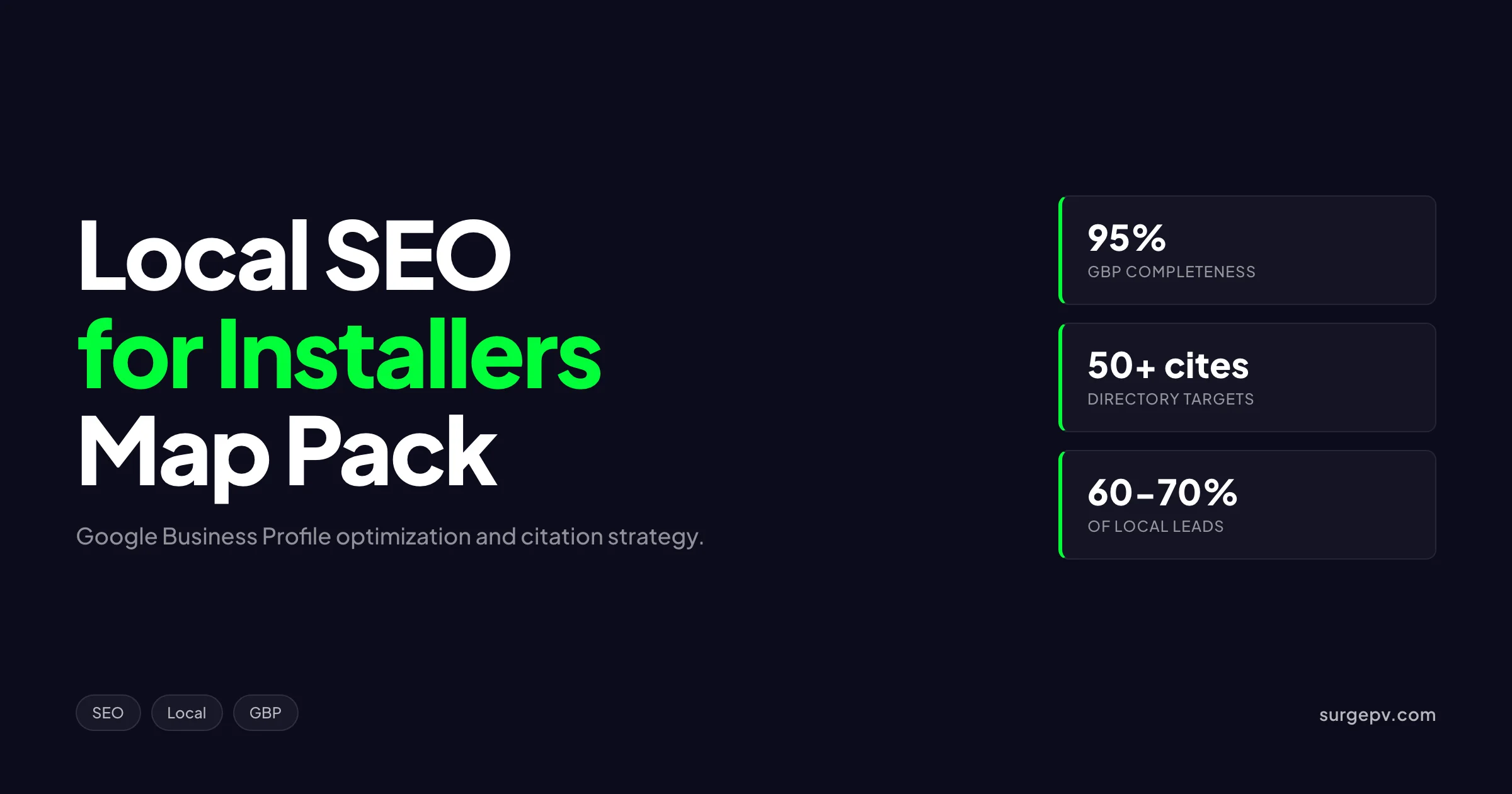
Local SEO drives 60-70% of inbound solar leads through Google Map Pack rankings. Core components: complete Google Business Profile (50+ photos, all fields, weekly posts), 100+ reviews with 5-15/month velocity, NAP citations across 50+ directories, location-specific landing pages, and local content. Most installers achieve top 3 ranking in 9-12 months with $1,500-$2,500/month investment.
See Solar Lead Generation Strategies for detailed guidance.
In this guide:
- How local SEO actually works for solar installers in 2026
- The Google Business Profile optimization checklist
- NAP citation building strategy across 50+ directories
- Building location pages that rank for individual cities
- Local content strategy that generates leads
- Schema markup that boosts solar rankings
- Multi-location SEO for installers serving large geographies
- Common local SEO mistakes
- Eight common questions
How Local SEO Works for Solar Installers in 2026
When a homeowner types “solar installer near me” in Google, three results determine 80% of clicks: the Map Pack (3 businesses with star ratings and addresses) at the top of the page. Position 1 receives 35% of clicks. Position 4 receives 6%.
Getting into the Map Pack requires Google to trust your business as legitimate, local, and relevant. Google evaluates three primary factors:
1. Relevance: Does your business match the searcher’s intent? Solar installers must clearly signal “solar installation” through Google Business Profile categories, website content, and external signals.
2. Distance: How close is the business to the searcher? Proximity is uncontrollable, but multi-location strategies create more proximity opportunities.
3. Prominence: Is the business well-known and trusted? Reviews, citations, backlinks, and content depth all contribute to prominence.
The Local SEO Stack
Local SEO operates across three integrated layers:
| Layer | Components | Primary Tools |
|---|---|---|
| Google Business Profile | Profile completeness, posts, photos, Q&A | GBP dashboard |
| Website | Location pages, schema, content depth | WordPress, custom CMS |
| Off-site signals | Citations, reviews, backlinks | BrightLocal, Moz Local |
Each layer reinforces the others. Strong GBP without strong website performance plateaus. Strong website without GBP optimization never breaks through. The three must work together.
Google Business Profile Optimization Checklist
A complete, optimized GBP is the foundation of every local SEO strategy. Most solar installers fill in 30-50% of available fields and wonder why rankings stall.
Account-Level Settings
- Verified by mail (postcard verification)
- Email associated with admin account is monitored daily
- Multiple managers added for redundancy
- Backup phone number on file with Google
Business Information
- Business name matches exact legal name (no keyword stuffing)
- Phone number is local (not toll-free)
- Address is exact (suite numbers, etc.)
- Business hours include all real hours of operation
- Service areas list specific cities and zip codes
- Special hours marked for holidays
- Year founded entered
Category Selection (Critical)
- Primary category: “Solar Energy Equipment Supplier” or “Solar Energy Contractor”
- Secondary 1: “Electrical Contractor”
- Secondary 2: “Energy Equipment & Solutions”
- Secondary 3: “Solar Hot Water System Supplier” (if applicable)
- Secondary 4: “Battery Storage Equipment Supplier” (if applicable)
Wrong primary category is the #1 reason installers don’t show up. Some installers select “Electrical Contractor” as primary, which dilutes solar visibility.
Photos (50+ required)
- Logo (square, 1080x1080)
- Cover photo (1080x608, modern install or team photo)
- 5+ exterior building photos
- 5+ interior office photos
- 5+ team and equipment photos
- 20+ project completion photos (varied home styles)
- 10+ commercial project photos (if applicable)
- Equipment and inventory photos
- Vehicle photos (branded vans)
Geotag photos using EXIF data tools. Geotagged photos signal authentic local presence to Google.
Services List
Each service entered separately with description:
- Solar Panel Installation
- Solar System Design
- Solar Maintenance & Repair
- Battery Storage Installation
- EV Charger Installation
- Solar Consultation
- Commercial Solar
- Solar Hot Water (if applicable)
- Off-grid Solar (if applicable)
Include pricing range where comfortable (some installers prefer to omit; both approaches work).
Products
- Major panel brands offered (REC, Q Cells, Jinko, etc.)
- Major inverter brands (Enphase, SolarEdge, Tesla)
- Battery options (Tesla Powerwall, Enphase IQ Battery)
- EV chargers if offered
Posts (3-5 per month minimum)
- Schedule recurring posts
- Mix completed projects, customer testimonials, incentive updates, seasonal content
- Use high-quality images with each post
- Include call-to-action button on each post
Q&A Section
- Seed 8-12 common questions yourself
- Answer all attendee questions within 24 hours
- Monitor weekly for new questions
Messaging and Booking
- Enable messaging
- Set up auto-reply with response time expectation
- Enable booking integration if using scheduling tool
- Test booking flow monthly
NAP Citation Strategy Across 50+ Directories
NAP citations across directories signal business legitimacy to Google. Building these citations is foundational local SEO work.
Tier 1: Critical Citations (Build First)
Required for any local SEO foundation:
- Google Business Profile (✓)
- Bing Places for Business
- Apple Maps Connect
- Facebook Business
- Yelp Business Listing
- Better Business Bureau (BBB)
- Angi (formerly Angie’s List)
- HomeAdvisor
- Thumbtack
- Yellow Pages
- Manta
- Foursquare for Business
- Houzz Pro
- Citysearch
- Local.com
Tier 2: Solar Industry Directories
Solar-specific citations build topical relevance:
- EnergySage Installer Directory
- SolarReviews
- ConsumerAffairs (Solar category)
- Solar Estimate (Pickmysolar legacy)
- The Solar Nerd
- CleanEnergyAuthority
- SolarTribune
- NABCEP Find a Professional
- SEIA Member Directory
- SunStream (Solar Network)
Tier 3: Regional Solar Directories
Vary by state. Examples:
- California Solar & Storage Association
- Texas Solar Energy Society
- Arizona Solar Energy Industries Association
- Massachusetts Solar Energy Industries Association
- Solar United Neighbors local chapters
Tier 4: General Local Directories
Build over 6-12 months:
- ChamberofCommerce.com
- eLocal
- Superpages
- EnHancedLocal
- Tupalo
- Cylex
- Brownbook
- WhitePages
- n49.com
- Cylex
- ChipIn
- Yelp (already covered)
- AllBusiness.com
- Insider Pages
- MerchantCircle
- Hotfrog
- Synup Local
- Citysquares
- ShowMeLocal
- EZlocal
Citation Consistency Rules
- Business name: Identical exact match across all citations
- Address: Same format (including suite/unit) across all
- Phone: Same number, same format (e.g., (555) 555-1234)
- Website URL: Same root domain with or without www (be consistent)
- Hours: Same operating hours across all directories
Inconsistencies trigger Google’s distrust. Quarterly citation audit using BrightLocal or Moz Local catches drift.
Citation Tools
| Tool | Monthly Cost | Best For |
|---|---|---|
| BrightLocal | $39-$99 | Small-mid installers |
| Moz Local | $14-$33 per location | Multi-location |
| Whitespark | $11-$99 | Local SEO specialists |
| Yext | $199-$999 | Enterprise multi-location |
| Synup | $29-$99 per location | Mid-market |
For most solar installers, BrightLocal at the entry tier handles citation management for $39-$59/month.
Building Location Pages That Rank for Individual Cities
Each city you serve needs a dedicated location page. Templated pages don’t rank; custom local content does.
Anatomy of a Strong Location Page
For a page targeting “Solar Installer Phoenix AZ”:
URL structure: /solar-installer-phoenix-az/ or /phoenix-solar-installation/
Title tag (under 60 chars): “Solar Installer in Phoenix, AZ | [Company Name]”
Meta description (under 155 chars): “Phoenix’s trusted solar installer. [X] years serving Maricopa County. [Y] systems installed. NABCEP certified. Get a free Phoenix solar quote.”
H1: “Solar Installer Phoenix, AZ”
Page content structure:
-
Opening (75-100 words)
- Phoenix-specific context (1.4M residents, average roof type, sun exposure)
- Your local presence (years, projects)
- Trust signal (certifications, BBB rating)
-
Phoenix Solar Incentives (300-400 words)
- APS and SRP rate structures
- Net metering / Buyback program details
- Arizona state credits and rebates
- Local utility-specific programs
-
Phoenix Climate and Solar (250-350 words)
- Phoenix irradiance (one of best in US)
- Tile roof considerations
- Summer heat impact on production
- Recommended system sizes by home size
-
Phoenix Permit Process (200-300 words)
- City of Phoenix Development Services
- Typical permit timeline
- HOA considerations
- Inspection requirements
-
Recent Phoenix Projects (150-250 words)
- 3-5 real Phoenix installations (street + city only for privacy)
- System sizes, equipment, completion dates
- Notable details
-
Phoenix Customer Testimonials (150-200 words)
- 3-4 real Phoenix customers
- First names, neighborhoods, system specifics
-
Phoenix-Specific FAQ (300-400 words)
- “How much does solar cost in Phoenix?”
- “Will solar work with my Phoenix tile roof?”
- “What’s Phoenix’s net metering policy?”
- 4-6 location-specific questions
-
Contact CTA (footer)
- Phone number with local area code
- Phoenix office address (if applicable)
- Form for Phoenix-specific quote
Total target: 1,500-2,200 words per location page
Location Page Best Practices
- Use city name 8-15 times naturally (not keyword stuffed)
- Embed Google Map showing your service area
- Include schema markup (LocalBusiness, PostalAddress)
- Link to relevant blog content about Phoenix solar
- Show photos of actual Phoenix installations
- Update quarterly with current data
Location Page Mistakes to Avoid
- Duplicating 70%+ content between cities
- Adding 30+ location pages (link dilution)
- Targeting cities you don’t actually serve
- Including stock photos as “Phoenix installs”
- Forgetting to update outdated information
Local Content Strategy That Generates Leads
Strong local content builds topical authority that supports map pack ranking.
Local Content Pillars
Pillar 1: City-specific guides (5-10 pages) “Solar in [City] 2026: Complete Guide”
- Costs, incentives, permits, considerations
- Updated quarterly
- 2,000-3,500 words
Pillar 2: Utility comparison pages (2-5 pages) “[City Utility A] vs [City Utility B] for Solar”
- Rate structures, net metering, demand charges
- Side-by-side comparison
- 1,500-2,500 words See our guide on Agricultural Solar Case Study for more. Read more about Floating Solar Farms France.
Pillar 3: Project case studies (10-20 pages) “[Neighborhood] Solar Installation: [System Size] Case Study”
- Specific project deep dives
- Photos, system specs, financial outcomes
- 800-1,500 words each
Pillar 4: Local FAQ pages (3-8 pages) “Solar in [City]: Common Questions Answered”
- Specific local concerns
- Schema marked-up for AI Overview citation
- 1,200-2,000 words
Blog Content Cadence
For competitive markets, target 4-8 blog posts per month covering:
- Local incentive updates
- Customer story features
- Local industry events
- Seasonal solar topics
- Local utility news
- Climate-specific solar considerations
Content Distribution
Each blog post should be:
- Published on website with proper schema
- Posted to GBP as a Google Business post
- Shared on Facebook, LinkedIn, Twitter
- Emailed to customer/prospect list
- Linked from related location pages
Schema Markup That Boosts Solar Rankings
Structured data helps Google understand your business. Proper schema markup increases SERP feature appearance and click-through rate.
LocalBusiness Schema (Required)
{
  "@context": "https://schema.org",
  "@type": "SolarEnergyContractor",
  "name": "Your Solar Company",
  "image": "https://yoursite.com/logo.png",
  "telephone": "+1-555-555-5555",
  "email": "info@yourcompany.com",
  "address": {
    "@type": "PostalAddress",
    "streetAddress": "123 Main St",
    "addressLocality": "Phoenix",
    "addressRegion": "AZ",
    "postalCode": "85001",
    "addressCountry": "US"
  },
  "geo": {
    "@type": "GeoCoordinates",
    "latitude": 33.4484,
    "longitude": -112.0740
  },
  "openingHours": "Mo-Fr 08:00-17:00",
  "priceRange": "$$$$",
  "aggregateRating": {
    "@type": "AggregateRating",
    "ratingValue": "4.9",
    "reviewCount": "287"
  }
}
Service Schema
For each service:
{
  "@context": "https://schema.org",
  "@type": "Service",
  "serviceType": "Solar Panel Installation",
  "provider": {
    "@type": "SolarEnergyContractor",
    "name": "Your Solar Company"
  },
  "areaServed": ["Phoenix", "Scottsdale", "Mesa", "Tempe"]
}
Review Schema
Mark up customer testimonials with Review schema. Aggregate ratings appear in search results with star displays.
FAQ Schema
FAQ pages and FAQ sections within posts qualify for FAQ rich results. Drives 15-25% higher click-through rate.
Validate all schema with Google’s Rich Results Test before publishing.
Multi-Location SEO for Large Geography
Installers serving multi-city or multi-state markets need careful multi-location SEO strategy.
When to Add Real Locations
A new GBP location requires:
- Physical address (not PO Box)
- Staffed during business hours
- Local phone number
- Real signage at the location
Don’t fake locations. Google detects and suspends fake locations. Recovery takes 3-6 months and costs revenue.
Multi-Location Account Structure
Google Business Profile supports multi-location management. Set up:
- Main agency account with multiple locations under management
- Consistent NAP across all locations
- Unique posts per location (don’t copy posts across all)
- Unique photos per location
- Location-specific service areas
Geographic Targeting Tactics
For cities where you don’t have a physical location but serve regularly:
- Build location landing pages on website
- Generate citations in directories that allow service-only listings
- Partner with local businesses for cross-referrals
- Run local advertising in target city
- Build local backlinks (Chamber of Commerce, etc.)
Cannot use Google Business Profile for cities without physical location.
Pro Tip
Track each location’s organic lead volume separately in your CRM. If a location generates fewer than 5 organic leads per month after 12 months, the local SEO investment isn’t paying back. Either invest more aggressively or close the location.
Common Local SEO Mistakes Solar Installers Make
Mistake 1: Treating Local SEO as Set-and-Forget
GBP, citations, reviews, posts — all require ongoing maintenance. Set-and-forget installers lose rankings within 6 months.
Mistake 2: Buying Citations in Bulk
Mass citation services often submit inconsistent or low-quality citations. Better to build slowly with quality sources.
Mistake 3: Spam Service Area Settings
Setting service area to “all of Texas” hurts ranking. List specific cities you actually serve.
Mistake 4: Duplicate Location Pages
10 location pages with 80% identical content trigger duplicate content demotion. Build each page individually.
Mistake 5: Ignoring Mobile Experience
Most local searches happen on mobile. Slow, non-mobile-friendly websites lose map pack ranking.
Mistake 6: Not Tracking Anything
Without tracking, you can’t optimize. Set up Google Search Console, Google Analytics, Call Tracking, and CRM source tagging from day 1. See Solar Racking Design Guide for detailed guidance.
What Most Guides Miss
Local SEO for solar specifically benefits from showing actual project work. Generic plumbing local SEO advice doesn’t account for the visual nature of solar installations. Photo-heavy GBP profiles, project case studies, and visual customer testimonials drive solar local SEO better than they drive any other trade.
Real-World Example: 12-Month Local SEO Transformation
A solar installer in Raleigh, NC entered 2025 with these metrics:
- GBP completeness: 55%
- Total reviews: 67 (4.6 stars)
- Citations: 23 (inconsistent NAP)
- Location pages: 2
- Map pack position: 8-12
12-month investment: $2,200/month for local SEO ($26,400 total)
What was done:
- Complete GBP to 95% with 80+ photos
- Implement PTO+14 review request system
- Build citations to 67 (consistent NAP)
- Build 9 city-specific location pages
- Publish 4 blog posts per month
- Schema markup site-wide
- Respond to 100% of reviews within 48 hours
Results after 12 months:
- GBP completeness: 95%
- Total reviews: 218 (4.9 stars, 12+ per month velocity)
- Citations: 67 (consistent across all)
- Location pages: 9 with unique content
- Map pack position: 1-3 for primary keyword
- Organic leads: 387 (up 290% from prior year)
- Attributed revenue: $1.78M
- Cost per organic lead: $68
Total ROI: 67x on the $26,400 investment.
Use Real Project Data for Local Content
Solar design platform tracks every project with system specs, location, and outcomes. Use this data to build authentic location pages, customer testimonials, and case studies that outperform competitors using generic templates.
Book a DemoNo commitment required · 20 minutes · Live project walkthrough
Frequently Asked Questions
What is local SEO for solar installers?
Local SEO for solar installers is the practice of optimizing a business to rank in geographic search results. It covers Google Business Profile optimization, NAP citation consistency, location-specific landing pages, review generation, and locally-relevant content. The goal: ranking in Google’s Map Pack for queries like ‘solar installer near me.’
How long does local SEO take for solar installers?
Local SEO results begin appearing in 60-90 days. Map Pack ranking typically improves 2-4 positions in 3-6 months for installers in moderately competitive markets. Reaching top 3 in highly competitive metros (Phoenix, Los Angeles, Houston) requires 9-18 months of consistent work.
What is the most important local SEO factor for solar?
Google Business Profile completeness is the most controllable factor. Combined with review velocity (5+ new reviews per month) and NAP citation consistency, these three account for roughly 60% of local ranking performance for solar installers.
How much does local SEO cost for a solar installer?
DIY local SEO costs $100-$400/month in tools (BrightLocal, Moz Local, scheduling tools). Agency services cost $1,200-$3,500/month. Most solar installers achieve top 3 map pack ranking spending $1,500-$2,500/month for 9-12 months — total investment of $15K-$30K for permanent local search dominance.
Do solar installers need separate Google Business Profiles for multiple locations?
Yes, with caveats. Each physical location with staff and phone service deserves a separate GBP. Virtual offices or PO boxes do NOT qualify and trigger suspension. Multi-location installers typically maintain 3-15 verified locations with shared management.
What is Google’s E-E-A-T and how does it apply to solar?
E-E-A-T stands for Experience, Expertise, Authoritativeness, Trustworthiness. Solar installers signal E-E-A-T through NABCEP certifications, licensed contractor information, project portfolios, customer testimonials, author bios on content, and detailed business information. Google rewards businesses demonstrating real expertise.
Does paid advertising help or hurt local SEO for solar?
Paid ads (Google Ads, Local Service Ads) operate separately from organic SEO. They don’t directly help or hurt rankings. However, increased traffic from paid ads can boost behavioral signals (clicks, dwell time, calls) that indirectly support local SEO. Most solar installers use both channels in parallel.
What is the biggest local SEO mistake solar installers make?
The biggest mistake is treating local SEO as a one-time setup project. Local SEO requires ongoing work: posts, reviews, citations, content updates, response management. Installers who hire an agency for 90 days then stop lose rankings within 6 months. Sustained effort matters more than initial setup quality.
Three Steps to Start This Month
-
Audit your Google Business Profile completeness. Aim for 95%+ across all fields. Add missing photos, services, products, and posts. Single biggest leverage point in local SEO.
-
Run a NAP citation audit. Use BrightLocal’s free tool to check NAP consistency across 15-25 directories. Fix every inconsistency within 30 days.
-
Build your first location page properly. Pick your highest-volume city. Build 1,800+ words of unique, locally-relevant content. Use it as the template for additional location pages. Pull real installation data from PV design software to make the content credible.
Related SurgePV Resources
Continue learning with these related guides for solar installers and EPCs:
- Solar SEO Strategy for Local Installers
- Solar Review Management
- Content Marketing for Solar Companies
- Google Ads for Solar Installers
- Neighborhood Solar Marketing
For more solar business and marketing content, explore the full SurgePV blog or browse the SurgePV glossary for definitions of solar industry terms. For a direct comparison, see Arka 360 vs SurgePV.
Solar Software Tools to Support This Work
Effective solar installer operations depend on integrated software. SurgePV’s solar design software helps installers handle the upstream work that feeds every decision in this guide:
- Solar design software for system layouts, panel placement, and BOM generation
- Shadow analysis for site-specific irradiance and obstruction modeling
- Solar financial modeling for production forecasts and project ROI
- Solar proposal generation for branded, customer-facing proposals
- Clara AI for automated design assistance and Q&A
Browse the full SurgePV platform to see how installers worldwide use the tools to design smarter, sell faster, and streamline every solar project.
Where this fits
This article is part of SurgePV's Solar Sales & Proposals hub, which works through the topic from first principles to the decisions a project team actually has to make.


