

Back to Blog
solar policy 28 min read

Solar Incentives New York 2026: NY-Sun and Tax Credits

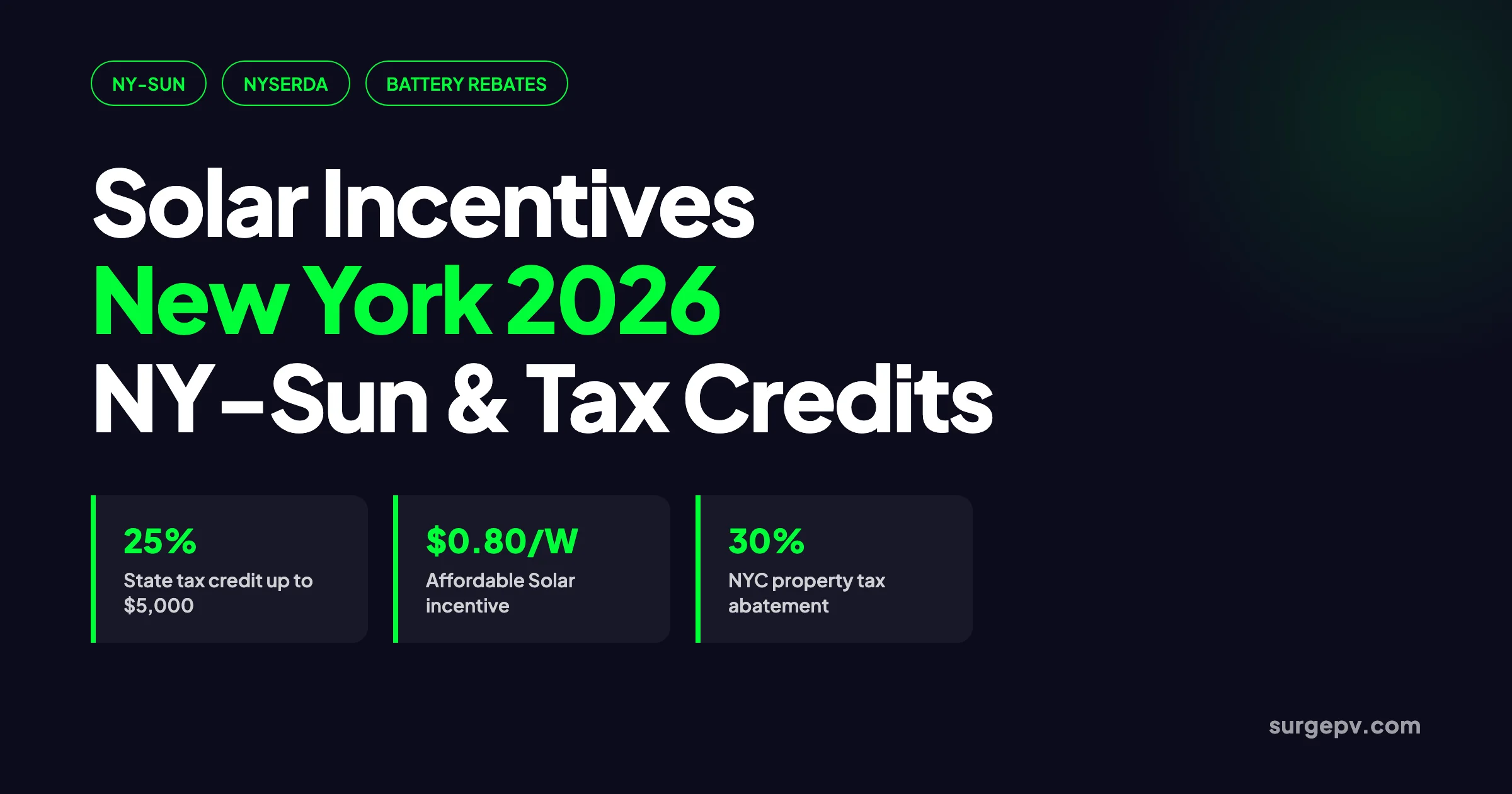
New York solar incentives in 2026: NY-Sun Affordable Solar at $0.80/W, the $5,000 state tax credit, battery storage rebates, property tax exemptions, and net metering rules.

Akash Hirpara

Written by

Akash Hirpara

Co-Founder · SurgePV

Rainer Neumann

Edited by

Rainer Neumann

Content Head · SurgePV

Published ·Updated

Quick Answer

In 2026, New York solar incentives are led by the state Solar Energy System Equipment Credit (25% up to $5,000) and the NY-Sun Affordable Solar Residential Incentive ($0.80/W for income-qualified households). Standard NY-Sun residential rebate blocks have closed for most New Yorkers. Battery rebates from NYSERDA range from $200/kWh to $250/kWh, property tax exemptions last 15 years under RPTL Section 487, and NYC offers a 30% SEGS property tax abatement. The federal Section 25D residential credit expired December 31, 2025.

New York lost the federal residential solar tax credit on January 1, 2026, the same day as every other state. What makes New York different is that its own incentive stack is strong enough to keep many projects attractive anyway. The state solar tax credit survived. NY-Sun did not disappear, though its standard rebate blocks are now closed to most households. Battery rebates, property tax exemptions, and a generous New York City abatement remain in place.

Installers who used to start every pitch with “30% federal plus state” now have to explain two harder ideas. First, most New Yorkers no longer get a NY-Sun per-watt rebate unless they qualify as low- to moderate-income. Second, the best projects in 2026 usually combine the state tax credit with storage, favorable net metering, and a property tax exemption. A generic quote with outdated assumptions will underperform and may lose the deal.

This guide covers every New York solar incentive that matters in 2026. It explains the NY-Sun program after the standard blocks closed, the state tax credit, and battery storage incentives. It also covers net metering and VDER rules, property and sales tax exemptions, and the NYC property tax abatement. For federal policy context, see our post on solar tax credit 2026. For state-by-state comparisons, see solar tax credits 2026 country and state guide. SurgePV’s generation and financial tool lets installers model these programs for every New York project.

Quick Answer

In 2026, New York solar incentives are led by the state Solar Energy System Equipment Credit (25% up to $5,000) and the NY-Sun Affordable Solar Residential Incentive ($0.80/W for income-qualified households). Standard NY-Sun residential rebate blocks have closed for most New Yorkers. Battery rebates from NYSERDA range from $200/kWh to $250/kWh, property tax exemptions last 15 years under RPTL Section 487, and NYC offers a 30% SEGS property tax abatement. The federal Section 25D residential credit expired December 31, 2025.

In this guide:

  • How New York solar incentives changed in 2026.
  • The New York state solar tax credit and how to claim it.
  • NY-Sun Megawatt Block status and the Affordable Solar Residential Incentive.
  • Battery storage rebates and the BYOB requirement.
  • Net metering, VDER, and how exports are compensated.
  • Property tax, sales tax, and NYC-specific benefits.
  • Commercial and community solar program notes.
  • How to stack incentives and the most common installer mistake.

How New York Solar Incentives Changed in 2026

New York entered 2026 with the same federal policy shock as every other state. Its state program had already trimmed its broad residential rebate. Three changes drive every proposal now.

The Federal Residential Credit Ended

The Residential Clean Energy Credit under Internal Revenue Code Section 25D allowed homeowners to claim 30% of qualified solar costs on their federal tax return. It expired on December 31, 2025, after the One Big Beautiful Bill Act terminated the credit rather than phasing it down. Homeowner-owned solar, battery, and solar water heating systems placed in service on or after January 1, 2026, no longer qualify.

Commercial projects and third-party-owned residential systems still have a path. Section 48E, the Clean Electricity Investment Tax Credit, offers a 30% credit. Projects qualify if construction begins by July 4, 2026, or if systems are placed in service by December 31, 2027. That is why lease and PPA providers can still advertise lower monthly payments in 2026: they own the system and claim the credit. For a deeper look at which products still qualify, see our tax credits for solar products guide.

NY-Sun Standard Residential Blocks Closed

NYSERDA’s NY-Sun Megawatt Block program provided upfront per-watt rebates to residential customers across the state for more than a decade. In 2026, the standard residential blocks are exhausted in the two largest regions. The Con Edison residential block closed to new applications on May 29, 2025. The Upstate residential Block 14 was fully subscribed and closed in December 2025, according to the NYSERDA Upstate Dashboard. It covered NYSEG, RG&E, and National Grid territories.

The only remaining residential NY-Sun pathway for new applicants in those regions is the income-qualified Affordable Solar Residential Incentive at $0.80/W. Long Island has its own block history and is generally fully subscribed for standard residential applicants as well.

The State Tax Credit Became the Headline Incentive

New York’s Solar Energy System Equipment Credit did not expire. It remains one of the largest state-level solar tax credits in the country at 25% of qualified costs, capped at $5,000. Because the federal credit is gone, this state credit is now the first line item most New York homeowners see on a proposal.

Incentive2025 Status2026 StatusWho Qualifies
Federal Section 25D residential credit30% for homeowner-owned systems0% for new homeowner-owned systemsNo one for 2026 installs
Federal Section 48E commercial credit30% + bonuses30% + bonuses through 2027Commercial, lease, and PPA owners
NY-Sun standard residential rebate (Con Edison)OpenClosed May 29, 2025No new standard applicants
NY-Sun standard residential rebate (Upstate)OpenClosed December 2025No new standard applicants
NY-Sun Affordable Solar Residential Incentive$0.80/W$0.80/WHouseholds at or below 80% AMI
NY state solar tax credit (IT-255)25% up to $5,00025% up to $5,000Principal residences in New York State
NYSERDA residential battery rebate$200–$250/kWh$200–$250/kWhGrid-connected residential storage
RPTL Section 487 property tax exemption15 years15 yearsProperties in participating municipalities
NYC SEGS property tax abatement7.5%/year × 4 years7.5%/year × 4 yearsEligible NYC properties
State sales tax exemptionActiveActiveResidential solar equipment

Sources: New York State Department of Taxation and Finance; NYSERDA Con Edison Dashboard; NYSERDA Upstate Dashboard.

New York State Solar Tax Credit (Form IT-255)

The New York Solar Energy System Equipment Credit is a personal income tax credit for solar equipment installed at a principal residence in New York State. It is not refundable, but unused amounts carry forward for up to five years.

Credit Amount and Cap

The credit equals 25% of qualified solar energy system equipment expenditures, capped at $5,000. Qualified expenditures include solar panels, inverters, racking, wiring, and installation labor directly tied to the system. The credit is claimed on Form IT-255.

A $20,000 system receives the full $5,000 credit. A $16,000 system receives $4,000. The credit applies to the net cost after NYSERDA rebates but before the federal credit. That ordering matters only for systems placed in service before the 2026 expiration.

Eligibility and Ownership Structures

According to the New York State Department of Taxation and Finance, you can claim the credit if you:

  • Purchased solar energy system equipment.
  • Entered into a written agreement to lease solar energy system equipment.
  • Entered into a written agreement of at least ten years to purchase power generated by solar equipment you do not own.

The system must use solar radiation to produce energy for heating, cooling, hot water, or electricity for residential use. It must also be installed and used at your principal residence in New York State.

This last point is important for leases and power purchase agreements. A homeowner who does not own the panels can still claim the state tax credit if the lease or PPA meets the length and form requirements. That makes third-party ownership unusually attractive in New York compared with states where only system owners can claim credits.

Carryforward Rules

If the credit exceeds the taxpayer’s New York State tax liability in the year of installation, the excess carries forward for up to five years. A homeowner who installs a $25,000 system and receives the full $5,000 credit can use $1,000 per year over five years if annual liability is limited. Installers should avoid quoting the full credit as an immediate cash benefit unless the customer confirms sufficient tax liability.

NY-Sun Megawatt Block and Affordable Solar in 2026

NY-Sun is NYSERDA’s flagship solar incentive program. In 2026, it is no longer a universal per-watt rebate. It is a targeted program for income-qualified households, multifamily affordable housing, canopy projects, and commercial or community solar.

Standard Residential Blocks Are Closed

The Megawatt Block program divided the state into regions and funded rebates in declining blocks. Once a block was fully subscribed, the rebate closed to new applications. As of mid-2026:

  • Con Edison region: The standard residential block closed on May 29, 2025.
  • Upstate region: Residential Block 14, covering NYSEG, RG&E, and National Grid territories, closed in December 2025 after it was fully subscribed.
  • Long Island region: Standard residential incentives have been fully subscribed for years and remain closed to most new applicants.

An installer who quotes a $0.15–$0.20/W standard NY-Sun rebate to a middle-income homeowner in Brooklyn or Albany in 2026 is using outdated information. The project will not receive it.

Affordable Solar Residential Incentive: $0.80/W

The Affordable Solar Residential Incentive is the active residential pathway for new applicants in the Con Edison and Upstate regions. It pays a total incentive of $0.80/W of nameplate capacity, applied directly by a participating NY-Sun contractor at the point of sale.

For a 7 kW system, the rebate is $5,600. For a 10 kW system, it is $8,000. The rebate is substantial enough to change project economics. A household that qualifies can see payback periods shorten by several years.

Who Qualifies

Eligibility is based on household income relative to county-specific area median income (AMI). The threshold is generally at or below 80% AMI. For a family of four, that is roughly $64,000 per year in many Upstate counties as of 2026, though the exact figure varies by county.

Applicants must complete a NYSERDA Income Eligibility Application before the contractor can reserve funds. Systems must be 25 kW or less. The home must be a primary residence. Only participating NY-Sun contractors can apply for the incentive on the customer’s behalf.

Commercial, Industrial, and Community Solar Blocks

Non-residential and large commercial projects continue to receive NY-Sun incentives through the Solar Energy Equity Framework (SEEF) and other commercial blocks. These programs include adders for prevailing wage, beneficial siting, community solar, and low-income subscribers. Community solar projects may also qualify for the Inclusive Community Solar Adder (ICSA), which pays additional incentives for projects that allocate capacity to eligible residential subscribers.

A 7.1 MW community solar project in Skaneateles Falls, New York, was approved in April 2026 for NY-Sun incentives. The project may receive up to $1.1 million through the base program. It may also receive an additional $1.6 million through the Inclusive Community Solar Adder, according to PowerBank.

RegionStandard Residential BlockAffordable Solar Residential IncentiveTypical Battery Incentive
Con EdisonClosed May 29, 2025$0.80/W (≤80% AMI)$250/kWh
Upstate (NYSEG, RG&E, National Grid)Closed December 2025$0.80/W (≤80% AMI)$200/kWh
Long IslandFully subscribed for yearsLimited availabilityCheck PSEG-LI programs

Sources: NYSERDA NY-Sun Dashboards and Incentives; PowerBank NY-Sun project announcement.

Battery Storage Incentives in New York

New York treats battery storage as a separate incentive category from solar PV. The state has one of the more active residential battery rebate programs in the country, though it now comes with a demand-response participation requirement.

NYSERDA Residential Energy Storage Incentive

NYSERDA’s Residential Energy Storage Incentive provides upfront cash rebates for qualifying home battery systems installed through an approved contractor. The rebate level depends on the utility territory:

  • Upstate utilities such as National Grid, NYSEG, Central Hudson, and Orange & Rockland: $200 per kWh of usable capacity.
  • Con Edison territory including New York City, Westchester, and Rockland County: $250 per kWh of usable capacity.

The incentive applies to systems up to 25 kWh of storage capacity per household. A 13.5 kWh battery like a Tesla Powerwall would receive $2,700 upstate or $3,375 in the Con Edison region.

Bring Your Own Battery Requirement

Effective April 1, 2026, customers must enroll in their utility’s Bring Your Own Battery (BYOB) demand response program to receive the NYSERDA storage incentive. BYOB allows the utility to briefly discharge the battery during peak grid events. Customers can typically opt out or override a dispatch event, but enrollment is mandatory for the rebate.

A transition exception runs through June 1, 2026. If the battery manufacturer’s original equipment manufacturer is not yet enrolled in BYOB, the customer can still receive the incentive without enrollment during that window.

Sales Tax Exemption for Storage

New York exempts residential energy storage systems from state and local sales tax. This exemption is separate from the solar equipment sales tax exemption and applies to batteries installed in connection with a residence. The combined effect of the rebate and sales tax exemption can reduce the net cost of a battery by 30% or more.

For installers sizing storage correctly, battery storage design software helps match capacity to backup needs and self-consumption goals.

Net Metering, VDER, and Bill Credits

New York’s export compensation rules are more favorable than California’s NEM 3.0, but they are not uniform. The rules depend on system size, utility territory, and whether the project is rooftop residential, commercial, or community solar.

Phase One Net Metering for Residential Rooftop

Many residential rooftop systems in New York continue to operate under Phase One Net Metering. This allows customers to receive bill credits for excess generation at the full retail rate, effectively a 1:1 exchange during the billing period. Excess credits can roll over to future bills. This is one reason solar-only projects still work in New York in 2026, even without the federal tax credit.

Value of Distributed Energy Resources (VDER)

Larger systems, non-residential projects, and community solar typically fall under the Value of Distributed Energy Resources (VDER) framework, sometimes called the Value Stack. VDER compensates exports based on several value components: energy, capacity, environmental value, demand reduction value, and locational system relief value. The result is a time-varying export credit that can be higher or lower than the retail rate depending on when and where energy is exported.

VDER is more complex than net metering. A proposal that treats VDER exports as a flat retail credit can overstate savings. Accurate modeling requires hourly production profiles, load profiles, and the specific value stack components for the utility territory.

Utility Territory Matters

  • Con Edison: NYC and Westchester. Phase One Net Metering applies to eligible residential rooftop systems; larger and non-residential projects use VDER.
  • National Grid: Upstate. Similar split between Phase One Net Metering for eligible residential and VDER for larger projects.
  • NYSEG and RG&E: Upstate. Same general framework.
  • PSEG-LI: Long Island. Operates under Long Island Power Authority rules with NY-Sun adders; net metering has been fully subscribed for new applicants in many categories.

Installers should ask a different first question on every New York project. Instead of “what is the incentive?”, ask “what utility territory is the project in?” The answer changes the rebate and battery incentive. It also changes export compensation and sales tax treatment.

Our net metering savings calculator and the net metering glossary explain the mechanics in more detail.

Property Tax, Sales Tax, and Other New York Solar Perks

New York offers several non-rebate incentives that reduce the lifetime cost of solar. These are easy to overlook because they do not show up as line-item rebates on a contract. Over 15 years, they can be worth thousands of dollars.

Real Property Tax Law Section 487 Exemption

RPTL Section 487 provides a 15-year property tax exemption for the added value of a qualifying solar energy system. That means the assessed value of the home does not increase because of the solar installation, even though the market value may rise.

The exemption is not automatic in every municipality. Local governments can opt out of Section 487. Homeowners should confirm with their local assessor that the exemption applies. The exemption generally requires filing Form RP-487 with the assessor’s office.

For a typical home where solar adds tens of thousands of dollars in value, the 15-year exemption can save several thousand dollars in property taxes. For commercial and agricultural properties with large arrays, the savings are much larger.

State and Local Sales Tax Exemption

New York Tax Law §1115(ee) exempts solar energy system equipment and installation labor from state sales tax. Many counties and New York City also exempt the local portion of sales tax. The combined savings often total 7–8% of the gross system cost.

The exemption applies to residential solar equipment and, separately, to residential energy storage systems. Contractors should make sure invoices clearly separate qualifying solar and storage equipment from ineligible structural work, such as roofing or tree removal.

NYC Solar Electric Generating System Tax Abatement

New York City offers the Solar Electric Generating System (SEGS) Tax Abatement, a property tax benefit separate from the state RPTL Section 487 exemption. The abatement equals 7.5% of eligible system costs per year for four years, totaling 30% of net system cost.

The benefit is capped at $62,500 per year and $250,000 total per property. Applications must be filed by a registered architect or professional engineer with the New York City Department of Buildings. The program is active through January 1, 2035. In fiscal year 2026, the city expects more than 4,000 new benefits totaling over $20 million, according to a May 2026 NYC mayoral announcement.

The NYC abatement is one of the strongest local solar incentives in the country. A $50,000 solar system in Manhattan can receive $15,000 in property tax abatements on top of the state tax credit and any applicable NY-Sun incentives.

IncentiveTypeValueKey Detail
RPTL Section 487Property tax exemption100% of added assessed value for 15 yearsMunicipal opt-out possible
NY sales tax exemptionSales tax exemptionState + many local taxes waivedApplies to equipment and labor
NYC SEGS abatementProperty tax abatement30% over 4 yearsRequires RA or PE filing
NYC property tax capAnnual limit$62,500/year, $250,000 totalPer property

Sources: NYC Mayor’s Office solar tax abatement announcement; DSIRE New York incentives database.

Commercial, Industrial, and Community Solar Incentives

This guide focuses on residential incentives because that is what most homeowners search for. But New York also has meaningful programs for commercial, industrial, and community solar projects in 2026.

Commercial and Industrial NY-Sun

Nonresidential projects up to 200 kW and larger commercial and industrial projects continue to receive NY-Sun incentives through commercial Megawatt Blocks and the Solar Energy Equity Framework. Projects 1 MW AC and larger must meet prevailing wage or project labor agreement requirements to receive the full incentive adder. The Prevailing Wage Adder for Con Edison nonresidential projects of 1 MW AC or more is $0.20/W DC.

Federal Section 48E for Commercial Projects

Commercial and industrial projects in New York can still claim the 30% federal Section 48E credit if construction begins by July 4, 2026, or the system is placed in service by December 31, 2027. Bonus adders for domestic content, energy communities, and low-income projects can increase the credit. This federal pathway is why many C&I projects in New York are still moving forward despite the loss of the residential credit.

Community Solar and the Inclusive Community Solar Adder

Community solar allows subscribers who cannot install panels on their own roof to receive bill credits from a shared solar array. NY-Sun supports community solar through the Inclusive Community Solar Adder (ICSA). It pays additional incentives for projects that allocate at least 50% of capacity to eligible residential subscribers.

ICSA payments are made in three installments: 50% at project completion, 25% at the first anniversary, and 25% at the second anniversary. The adder rates vary by project type and whether the project received MW Block or Community Adder support.

Who Benefits Most from New York Solar Incentives in 2026

The value of New York’s 2026 incentive stack depends heavily on income, location, and utility territory. Three profiles illustrate the difference.

Low- to Moderate-Income Homeowner in Con Edison or Upstate Territory

A household at or below 80% AMI in Brooklyn, Albany, or Buffalo receives the strongest stack. The Affordable Solar Residential Incentive cuts $0.80/W off the system cost. The state tax credit adds up to $5,000. A battery rebate adds $2,700–$3,375. Property and sales tax exemptions reduce lifetime and upfront costs. This customer can still achieve a 6–9 year payback in 2026, even without the federal credit.

Middle-Income Homeowner Outside NYC

A household that earns too much for Affordable Solar but still qualifies for the state tax credit has a thinner stack. There is no NY-Sun per-watt rebate. The state tax credit provides up to $5,000. Property and sales tax exemptions help. Battery rebates are available if the customer enrolls in BYOB. The project works because New York electricity rates are high and Phase One Net Metering still offers 1:1 credits for many rooftop systems. Payback periods are typically 8–12 years.

NYC Building Owner

A building owner in New York City has the most generous local incentive. The SEGS abatement can cover 30% of system cost up to $250,000. Combined with the state tax credit and sales tax exemption, a $100,000 commercial or residential building system can see net incentives of $35,000–$55,000. The key constraint is filing paperwork correctly through a registered architect or professional engineer.

How to Stack Incentives and Apply

Stacking New York incentives correctly is more important than finding more incentives. The order of operations matters because some incentives reduce the cost basis for others.

Step 1: Confirm Utility Territory and Eligibility

Check the customer’s electric bill to confirm the utility. Then confirm whether Phase One Net Metering or VDER applies. This determines export compensation and whether storage is financially essential.

Step 2: Screen for Income-Qualified Programs

Ask early about household income relative to county AMI. If the household is at or below 80% AMI, file the NYSERDA Income Eligibility Application before signing the contract. The $0.80/W Affordable Solar rebate must be reserved by a participating NY-Sun contractor.

Step 3: Choose Ownership Structure

A cash purchase or loan lets the homeowner claim the state tax credit directly. A lease or PPA may allow the financier to claim Section 48E and pass savings through as lower monthly payments. The state tax credit can still be claimed on qualifying leases and PPAs of ten years or more. For a full comparison, see our solar financing options guide.

Step 4: Add Storage If It Fits the Use Case

Battery storage makes sense when the customer faces high time-of-use rates, frequent outages, or a VDER export value that is low compared with retail import rates. Apply the NYSERDA storage rebate and enroll in BYOB before installation.

Step 5: File Property Tax and Sales Tax Paperwork

For RPTL Section 487, file Form RP-487 with the local assessor. For NYC SEGS, file through a registered architect or professional engineer with the NYC Department of Buildings. Make sure invoices separate qualifying solar and storage equipment from ineligible costs.

Step 6: Keep Documentation

Keep itemized invoices, interconnection agreements, proof of placed-in-service date, NYSERDA approval letters, and tax forms. Incentives are increasingly audited. Missing paperwork can delay or cancel a rebate or tax credit.

What a Stacked Incentive Looks Like

Consider a 7 kW solar system with a 13.5 kWh battery for a low-income homeowner in Syracuse served by National Grid. The gross cost might be $28,000 before incentives.

  • NY-Sun Affordable Solar rebate: 7,000 W × $0.80/W = $5,600.
  • NYSERDA battery rebate: 13.5 kWh × $200/kWh = $2,700.
  • New York state tax credit: 25% of remaining cost, capped at $5,000.
  • Sales tax exemption: roughly $2,000 in combined state and local taxes.

The net cost drops substantially. The exact payback depends on usage, rate plan, and export compensation, but the project remains attractive even without the federal credit.

The Biggest Mistake New York Installers Make in 2026

The most common error is quoting NY-Sun standard residential rebates that no longer exist. A proposal that assumes a $0.20/W rebate for a middle-income customer in Rochester or Queens will understate the net cost. It will also create a bad surprise when the contract is signed.

Verify Block Status Before Every Quote

NYSERDA publishes real-time dashboards for each region. Check them before every proposal. If the standard residential block is closed, remove the rebate from the model and explain why. If the customer qualifies for Affordable Solar, start the income eligibility process early.

Model the Right Export Compensation

Do not assume 1:1 net metering for every project. Confirm whether the system qualifies for Phase One Net Metering or VDER. For VDER projects, use hourly value stack modeling rather than a flat export rate. SurgePV’s solar design software and generation and financial tool let installers model net metering, VDER, and storage dispatch for New York projects. When it is time to present, solar proposal software keeps the incentive stack transparent.

Do Not Forget the Property Tax Deadline

RPTL Section 487 is active, but local opt-outs matter. NYC SEGS requires a registered design professional. Missing either step can cost the customer thousands of dollars over the life of the system.

Model New York Incentives Accurately in Every Proposal

NY-Sun blocks, VDER rates, and storage rebates change the math on every project. SurgePV’s financial modeling applies the right state, local, and utility incentives so your customer sees real net cost and payback.

Explore Financial Modeling

No commitment required · 20 minutes · Live project walkthrough

Conclusion

New York solar incentives in 2026 are still strong, but they are no longer automatic. The federal residential credit is gone. NY-Sun standard residential blocks are closed in the largest regions. The projects that win combine the state tax credit with targeted NY-Sun Affordable Solar rebates. They also add battery storage incentives, property tax protections, and correct export compensation modeling.

  • Confirm the utility territory and whether Phase One Net Metering or VDER applies.
  • Screen every customer for Affordable Solar eligibility before quoting.
  • File property tax exemption and NYC SEGS paperwork correctly and on time.

For installers looking to model these moving parts accurately, SurgePV combines solar design, shading analysis, and incentive-aware financial modeling in one platform. For a broader view of state programs, see our state solar incentives US guide.

Frequently Asked Questions

What solar incentives are available in New York in 2026?

New York incentives in 2026 include the state Solar Energy System Equipment Credit (25% up to $5,000), the NY-Sun Affordable Solar Residential Incentive ($0.80/W for income-qualified households), NYSERDA residential battery storage rebates ($200–$250/kWh), the 15-year RPTL Section 487 property tax exemption, the NYC SEGS property tax abatement (30% over four years), and state/local sales tax exemptions. The federal Section 25D residential credit expired for homeowner-owned systems installed after December 31, 2025.

How much is the New York state solar tax credit?

New York offers a personal income tax credit equal to 25% of qualified solar energy system equipment expenditures, capped at $5,000. The credit is claimed on Form IT-255. Unused credit can be carried forward for up to five years. The system must be installed and used at the taxpayer’s principal residence in New York State.

Is NY-Sun still available in 2026?

NY-Sun still operates, but the standard residential Megawatt Block rebates have closed in the Con Edison region (May 29, 2025) and the Upstate region (Block 14 fully subscribed December 2025). The Affordable Solar Residential Incentive remains active at $0.80/W for households at or below 80% of area median income, applied at the point of sale by a participating NY-Sun contractor.

Who qualifies for the NY-Sun Affordable Solar Residential Incentive?

Households with income at or below 80% of area median income (AMI) for their county qualify. Applicants must complete a NYSERDA Income Eligibility Application, and the system must be installed by a participating NY-Sun contractor. Systems are limited to 25 kW or less. The incentive is $0.80/W of nameplate capacity in both the Con Edison and Upstate regions.

Does New York have a battery storage incentive?

Yes. NYSERDA’s Residential Energy Storage Incentive provides $200 per kWh of usable battery capacity in Upstate utility territories and $250 per kWh in the Con Edison territory, capped at 25 kWh per household. Effective April 1, 2026, enrollment in the utility’s Bring Your Own Battery (BYOB) demand response program is required. A transition exception runs through June 1, 2026.

Will solar panels increase my property taxes in New York?

Not usually. Real Property Tax Law Section 487 exempts the added value of a qualifying solar energy system from property taxes for 15 years. However, municipalities may opt out of the exemption. Homeowners should confirm with their local assessor. In New York City, the SEGS property tax abatement provides a separate 30% benefit over four years.

Is net metering still available in New York?

Traditional net metering with 1:1 bill credits remains available for many residential rooftop systems under the Public Service Commission’s Phase One Net Metering rules. Larger systems, non-residential projects, and community solar typically fall under the Value of Distributed Energy Resources (VDER) framework, which uses a value stack to compensate exports. The compensation structure depends on utility territory, system size, and project type.

Can I still claim the federal solar tax credit in New York in 2026?

The federal Residential Clean Energy Credit under Section 25D expired for homeowner-owned systems placed in service after December 31, 2025. Commercial projects and third-party-owned residential systems such as leases and power purchase agreements may still qualify for a 30% credit under Section 48E if construction begins by July 4, 2026, or systems are placed in service by December 31, 2027.

What is the NYC solar property tax abatement?

New York City’s Solar Electric Generating System (SEGS) Tax Abatement reduces property taxes for eligible building owners who install solar. The benefit equals 7.5% of eligible system costs per year for four years, totaling 30%, with an annual cap of $62,500 and a total cap of $250,000 per property. Applications must be filed by a registered architect or professional engineer.

How do I apply for New York solar incentives?

Homeowners do not apply directly for NY-Sun rebates; the participating installer applies through NYSERDA and deducts the rebate from the contract price. The state tax credit is claimed on New York Form IT-255 when filing the state income tax return. Battery incentives are handled by the installer at the time of installation. Property tax exemptions require filing Form RP-487 with the local assessor. NYC SEGS requires DOB filing by a registered design professional.

About the Contributors

Author
Akash Hirpara
Akash Hirpara

Co-Founder · SurgePV

Akash Hirpara is Co-Founder of SurgePV and at Heaven Green Energy Limited, managing finances for a company with 1+ GW in delivered solar projects. With 12+ years in renewable energy finance and strategic planning, he has structured $100M+ in solar project financing and improved EBITDA margins from 12% to 18%.

Editor
Rainer Neumann
Rainer Neumann

Content Head · SurgePV

Rainer Neumann is Content Head at SurgePV and a solar PV engineer with 10+ years of experience designing commercial and utility-scale systems across Europe and MENA. He has delivered 500+ installations, tested 15+ solar design software platforms firsthand, and specialises in shading analysis, string sizing, and international electrical code compliance.

Get Solar Design Tips in Your Inbox

Join 2,000+ solar professionals. One email per week - no spam.

No spam · Unsubscribe anytime

Book Free Demo