

Quick Answer
Choose battery-storage design software by the decisions it must support: load and operating modes, power and energy sizing, equipment compatibility, safety, electrical studies, degradation, controls, financial scenarios, documentation, integrations, and auditability. Validate outputs against qualified engineering and current authority requirements; software does not replace project-specific professional responsibility or approvals.
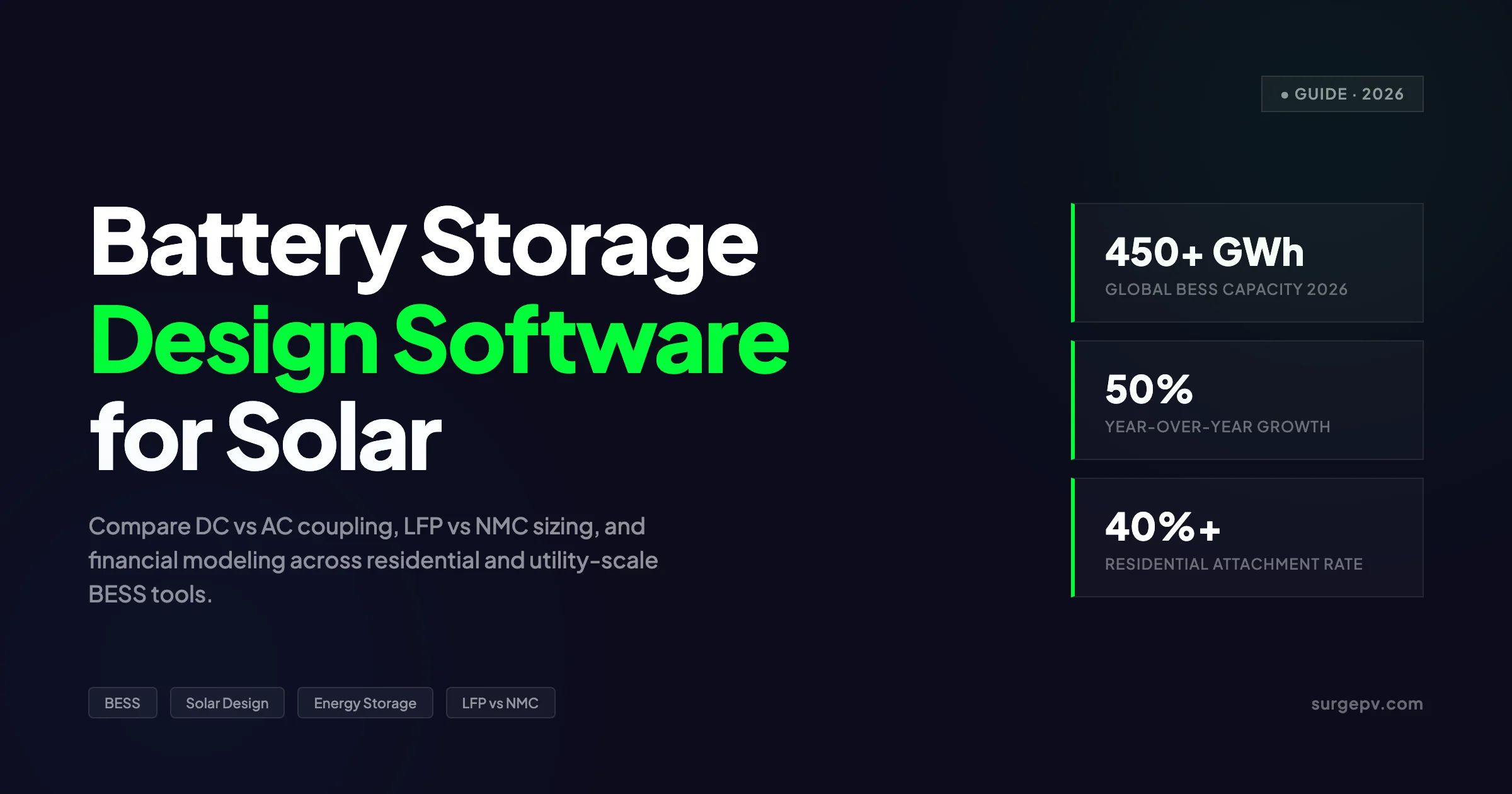
Battery storage is no longer an upsell. In markets where over 40% of new residential solar installations now include batteries, storage design is core to the installer workflow. The global battery energy storage system (BESS) market exceeded 315 GWh of installed capacity in 2025, growing roughly 50% year-over-year. In the United States alone, 57 GWh of stationary storage was added in 2025, with residential and commercial behind-the-meter systems representing 8 GWh and 12 GW respectively.
For solar installers and EPCs, the challenge is not whether to offer battery storage. It is how to design, size, and model battery systems accurately within the same workflow used for PV design. Standalone battery tools exist, but the most efficient teams use cloud solar design software with integrated storage modeling — one platform for panel layout, inverter selection, battery sizing, and financial proposals.
This guide covers battery storage design software in 2026: what the tools actually do, how they model DC versus AC coupling, which chemistries they support, and where each tool fits by project scale. It also covers the financial modeling features that determine whether a battery proposal closes the deal or loses to a competitor.
Battery storage design software lets solar installers size batteries, model charge-discharge cycles, calculate payback with time-of-use arbitrage, and generate customer-facing proposals — all within the solar design workflow.
TL;DR — Battery Storage Design Software 2026
The leading battery-capable design tools are Aurora Solar (sales + NEM 3.0 dispatch), Solargraf (speed + Enphase integration), PV*SOL (deep engineering simulation), and OpenSolar (free full-featured). For utility-scale BESS, RatedPower and PVsyst handle AC-coupled layouts and bankable yield. Key differentiators: charge-discharge granularity, manufacturer library breadth, rate-aware dispatch modeling, and whether storage is bundled or an add-on. LFP dominates residential with 6,000-10,000 cycle life. DC-coupled systems achieve 95-98% round-trip efficiency versus 90-94% for AC-coupled.
In this guide:
- Latest 2026 BESS market data and residential attachment trends
- Battery storage design software comparison table by use case
- What battery design software actually models: chemistry, coupling, dispatch
- DC-coupled vs AC-coupled design: efficiency, cost, and software support
- Residential battery design tools: Aurora, Solargraf, OpenSolar, PV*SOL
- Utility-scale and commercial BESS platforms: RatedPower, PVsyst, BESS Designer
- Financial modeling: time-of-use arbitrage, payback, and proposal integration
- Key safety standards and compliance checks in design workflows
- How to choose the right tool for your project scale and team size
Latest Updates: Battery Storage Design 2026
Battery storage design has shifted from a specialist add-on to a standard feature in solar software. Here is the current status of the market and technology as of June 2026.
2026 Battery Storage Market at a Glance
| Metric | 2025 Actual | 2026 Forecast |
|---|---|---|
| Global BESS installed capacity | 315+ GWh | 450+ GWh |
| Global BESS revenue | $76.7 billion | $89.9 billion |
| U.S. BESS additions | 57 GWh / 28 GW | 70 GWh / 35 GW |
| U.S. residential BTM | 8 GWh / 12 GW | 7.3 GWh / 14.8 GW |
| European residential market | 9.8 GWh (declined) | Rebound expected |
| Residential battery CAGR | 18.97% | Sustained through 2031 |
The European residential battery market contracted in 2025 as emergency subsidies ended and electricity prices normalized. A rebound is expected in 2026 as self-consumption economics improve and time-of-use tariffs expand. In the United States, the residential segment continues growing driven by NEM 3.0 export rate structures that make battery self-consumption economically essential in California and other major markets.
Technology Shifts Affecting Design Software
Three technology shifts are changing what design software must model in 2026:
-
LFP chemistry dominance. Lithium Iron Phosphate now commands the majority of residential and commercial installations due to 6,000-10,000 cycle life, superior thermal stability, and declining cost per kWh. Design tools must default to LFP parameters rather than NMC.
-
Larger cell formats. The shift to 1,175 Ah LFP prismatic cells is reducing system costs 10-20% in 2026. This changes rack-level energy density and thermal management requirements that design software must account for in commercial layouts.
-
Virtual Power Plant (VPP) aggregation. Software increasingly needs to model grid services revenue — frequency regulation, demand response, wholesale arbitrage — in addition to self-consumption savings. This requires integration with utility tariff APIs and aggregator platforms.
Battery Storage Design Software: What It Actually Does
Battery storage design software performs four core functions that extend beyond basic PV design:
1. Battery sizing based on load profiles. The software takes hourly or 15-minute consumption data and calculates the battery capacity needed to achieve a target self-consumption rate, backup duration, or arbitrage savings level. Sizing must account for depth of discharge limits, round-trip efficiency, and temperature-dependent performance.
2. Charge-discharge cycle modeling. Using hourly PV production and load profiles, the software simulates when the battery charges from excess solar, when it discharges to meet load or arbitrage against time-of-use rates, and when it remains idle. This requires realistic dispatch strategies: self-consumption maximization, peak shaving, grid export limitation, or economic optimization.
3. Financial modeling with storage. The software calculates payback period, net present value, and internal rate of return including both solar production savings and battery-mediated time-of-use arbitrage. This is where tools diverge most — some model only flat rates, while others integrate complex utility tariff structures with seasonal and tiered pricing.
4. Proposal generation with storage visuals. The software generates customer-facing proposals showing battery specifications, projected charge-discharge cycles, savings breakdowns, and payback timelines. Proposals may include 3D renderings of battery placement, one-line diagrams showing AC or DC coupling topology, and manufacturer datasheets.
Pro Tip — Load Profile Accuracy Determines Sizing Accuracy
The most common battery sizing error is using annual average consumption rather than hourly load profiles. A home that uses 30 kWh per day but concentrates 60% of that consumption in a 4-hour evening window needs a different battery size than one with flat consumption. Always import smart meter data or use interval data when available. Design software that accepts Green Button data, CSV imports, or direct utility API connections produces more accurate sizing.
DC-Coupled vs AC-Coupled Battery Design
The coupling topology is the first decision in any battery storage design, and it fundamentally changes what the software must model.
DC-Coupled Systems
In a DC-coupled system, the battery connects to the DC bus between the PV array and the hybrid inverter. The battery and solar share a single inverter.
| Parameter | DC-Coupled Value |
|---|---|
| Round-trip efficiency | 95-98% |
| Inverter count | 1 (hybrid) |
| Retrofit compatibility | Poor — requires hybrid inverter |
| Battery inverter sizing | Tied to PV array sizing |
| Software modeling | Single inverter, DC bus voltage limits |
Advantages: Higher efficiency, lower hardware cost, simpler single-inverter warranty.
Disadvantages: Battery charge rate limited by hybrid inverter capacity. Cannot charge from grid unless hybrid inverter supports grid-to-battery. Less flexible for retrofits.
AC-Coupled Systems
In an AC-coupled system, the battery has its own dedicated battery inverter and connects to the AC side of the installation, typically at the main distribution panel.
| Parameter | AC-Coupled Value |
|---|---|
| Round-trip efficiency | 90-94% |
| Inverter count | 2+ (solar + battery) |
| Retrofit compatibility | Excellent — add battery to existing solar |
| Battery inverter sizing | Independent of PV array |
| Software modeling | Separate AC buses, grid charge capable |
Advantages: Retrofit-friendly, independent battery inverter sizing, can charge from grid during low-rate periods, redundant inverter architecture.
Disadvantages: Lower round-trip efficiency, higher hardware cost, more complex wiring and commissioning.
Software Support by Topology
Most battery-capable design tools model both topologies, but with different levels of detail:
- Aurora Solar models AC and DC coupling with utility rate-aware dispatch. Its NEM 3.0-specific battery dispatch logic is a market differentiator for California installers.
- PV*SOL offers the deepest DC-coupled modeling with detailed charge-discharge curves, temperature effects, and battery aging simulations.
- PVsyst handles both configurations in its advanced simulation module, with bankable hourly timestep modeling for utility-scale projects.
- OpenSolar supports basic AC and DC coupling for proposal generation but lacks deep charge-discharge granularity.
For residential retrofits, AC coupling is the dominant topology in 2026 because most existing solar installations use string inverters that cannot be replaced without significant cost. For new installations, DC coupling is gaining share due to higher efficiency and lower balance-of-system cost.
Battery Chemistry & Sizing in Design Software
Design software must apply different parameters for each battery chemistry. Here is how the major chemistries compare and what software should model.
Lithium Iron Phosphate (LFP)
LFP is the default chemistry for residential and most commercial battery storage in 2026.
| Parameter | LFP Typical Value |
|---|---|
| Cycle life | 6,000-10,000 cycles |
| Depth of discharge (DoD) | 90-100% |
| Round-trip efficiency | 92-96% |
| Operating temperature | -10°C to 50°C |
| Degradation rate | 2-3% per year |
| Cost per kWh (system) | €500-700 / $550-800 |
LFP’s thermal stability means design software can model less conservative cooling requirements than NMC. The 90-100% DoD allows usable capacity to closely match nominal capacity — a 10 kWh LFP battery provides 9-10 kWh of usable energy.
Nickel Manganese Cobalt (NMC)
NMC is used where space and weight are constrained.
| Parameter | NMC Typical Value |
|---|---|
| Cycle life | 3,000-5,000 cycles |
| Depth of discharge (DoD) | 80-90% |
| Round-trip efficiency | 94-97% |
| Operating temperature | 0°C to 45°C |
| Degradation rate | 3-4% per year |
| Cost per kWh (system) | €600-800 / $650-900 |
Design software must apply the lower DoD limit: a 10 kWh NMC battery typically provides only 8-9 kWh of usable energy. The narrower temperature range also affects outdoor installation modeling.
Battery Sizing Formula
Design software applies variations of this formula:
Battery Capacity (kWh) = (Daily Critical Load kWh × Days of Autonomy) ÷ (DoD × Round-Trip Efficiency)For grid-tied self-consumption (no backup requirement):
Battery Capacity (kWh) ≈ Daily Consumption kWh × (1 - Self-Consumption Rate without Battery) × Safety FactorA typical safety factor is 1.1-1.2 to account for winter production shortfalls and degradation over time.
Sizing Example: German Residential Home
| Input | Value |
|---|---|
| Annual consumption | 4,000 kWh |
| Daily consumption | 10.9 kWh |
| Existing solar self-consumption | 35% |
| Target self-consumption with battery | 70% |
| Daily solar surplus to store | 3.8 kWh |
| DoD (LFP) | 95% |
| Efficiency | 94% |
| Required battery capacity | ~4.3 kWh usable → 5 kWh nominal |
In practice, a 5-8 kWh battery is typically proposed for this profile, with the exact size depending on time-of-use tariff structure and whether backup power is required.
Residential Battery Design Software Comparison
Aurora Solar
Aurora Solar includes full battery storage modeling in its cloud-based design platform. At an estimated $2,640-6,000+ per user per year, it targets high-volume residential sales teams.
Battery capabilities:
- Storage modeling with real utility rate structures
- NEM 3.0-aware battery dispatch simulation
- 25+ battery manufacturer library
- AC and DC coupling support
- Customer-facing proposals with battery savings breakdown
Strengths: Lender-grade proposal output, AI roof modeling, accurate shading analysis. The NEM 3.0 dispatch logic is specifically valuable for California installers.
Limitations: Battery modeling is bundled with the full Aurora subscription — there is no standalone storage option. Conservative yield estimates may understate battery savings in some scenarios.
Solargraf (Enphase)
Solargraf, now part of Enphase, targets speed-focused residential installers at approximately $2,799 per year.
Battery capabilities:
- Battery storage design across 25+ manufacturers
- Integrated Enphase IQ battery and microinverter ecosystem
- NEM 3.0 support with 3-minute proposal generation
- In-house permit stamps
Strengths: Fastest proposal generation in the market. Strong Enphase ecosystem integration. Multi-manufacturer battery library reduces lock-in.
Limitations: Shading accuracy reportedly 10-20% off compared to Aurora and HelioScope in some installations. Battery dispatch modeling is less granular than engineering-grade tools.
OpenSolar
OpenSolar offers free battery and hybrid system design, making it the best entry-level option.
Battery capabilities:
- Storage and hybrid system design
- Financial analysis with incentives
- AC and DC coupling support
- Multi-device tablet-friendly interface
Strengths: Free with no design caps. Now includes CRM integration. Good for startups and small teams testing battery offerings.
Limitations: Less granular charge-discharge modeling. Financial analysis is basic compared to paid tools. Monetizes through hardware and financing partnerships.
PV*SOL
PV*SOL is the engineer’s choice for deep battery simulation at €585-845 per year.
Battery capabilities:
- Detailed battery charge-discharge modeling
- Complex shading with storage impact
- Hybrid system design
- Temperature-dependent performance curves
- Desktop-only (Windows)
Strengths: Most accurate battery simulation for technical validation. Deep component library. Trusted by European engineering firms.
Limitations: Desktop only — no cloud collaboration. No proposal generation — requires export to separate tools. Steep learning curve.
| Software | Best For | Battery Library | Dispatch Modeling | Proposal Gen | Price |
|---|---|---|---|---|---|
| Aurora Solar | High-volume residential sales | 25+ manufacturers | Rate-aware, NEM 3.0 | Yes | $2,640-6,000+/yr |
| Solargraf | Fast Enphase-centric installers | 25+ manufacturers | Basic TOU | Yes | ~$2,799/yr |
| OpenSolar | Budget-conscious teams | Core manufacturers | Basic | Yes | Free |
| PV*SOL | Engineering validation | Extensive | Deep charge-discharge | No | €585-845/yr |
Commercial & Utility-Scale BESS Design Software
RatedPower (Enverus)
RatedPower targets utility-scale and large commercial solar-plus-storage developers. Pricing is enterprise-tier and contact-based.
Battery capabilities:
- AC-coupled BESS integration
- Automated battery container layout alongside PV arrays
- CAPEX estimation and LCOE modeling
- Batch layout optimization for hybrid projects
- Exports to AutoCAD and PVsyst
Strengths: Reduces engineering workflow time 30-50%. Strong for feasibility and prospecting. Handles MW-scale layouts with precision.
Limitations: Primarily commercial and utility-scale — not suited for residential. Limited proposal generation capabilities.
PVsyst
PVsyst is the gold standard for bankable yield simulations including battery storage.
Battery capabilities:
- Storage integration in advanced simulation module
- Battery aging and degradation modeling
- Microgrid, off-grid, and grid-tied with self-consumption
- DC and AC coupling support
- Hourly timestep modeling
Strengths: Investor-grade simulation accuracy. Trusted by independent engineers and lenders. Handles complex multi-configuration projects.
Limitations: No proposal generation. Windows desktop only. 4-6 week learning curve. Primarily used for final bankable reports, not daily design workflows.
BESS Designer (baess.app)
BESS Designer is a specialized tool for battery energy storage system design from 10 kWh residential to 100+ MWh utility-scale.
Battery capabilities:
- AI-powered capacity calculations
- DC-coupled, AC-coupled, and hybrid configurations
- Time-of-use optimization for peak shaving and load shifting
- One-click professional reports and BOQ generation
- Safety compliance checks (IEC 62619, UL 1973)
Strengths: Purpose-built for BESS rather than solar-with-battery. Covers the full scale range. Strong financial analysis with ROI and payback.
Limitations: Less integrated with PV design workflows. Newer tool with smaller user base than established platforms.
| Software | Best For | Scale | Coupling | Key Output |
|---|---|---|---|---|
| RatedPower | Utility/C&I feasibility | 100 kW-500 MW+ | AC-coupled | Layout, CAPEX, LCOE |
| PVsyst | Bankable yield reports | Any | AC/DC | Hourly simulation, aging |
| BESS Designer | BESS-specific sizing | 10 kWh-100+ MWh | AC/DC/Hybrid | Reports, BOQ, compliance |
Financial Modeling: The Critical Differentiator
Battery financial modeling is where design software either wins or loses the sale. The difference between basic and advanced tools comes down to three capabilities.
1. Rate-Aware Dispatch Modeling
Basic tools model battery dispatch against a flat electricity rate. Advanced tools import actual utility tariff structures with:
- Time-of-use periods (peak, shoulder, off-peak)
- Seasonal rate variations
- Tiered pricing thresholds
- Export compensation rates and net metering rules
- Demand charges for commercial customers
Example impact: In California under NEM 3.0, a battery that shifts solar exports from midday (compensated at ~$0.05/kWh) to evening discharge (avoiding $0.35-0.45/kWh peak rates) can improve project economics by 30-50% versus a flat-rate model. Software without rate-aware dispatch significantly understates battery value in these markets.
2. Degradation-Aware Payback Calculations
Batteries degrade 2-4% per year. A 10 kWh battery is a 7-8 kWh battery after 10 years. Software that models linear degradation produces more accurate 10-15 year savings projections than tools using static capacity assumptions.
| Year | LFP Capacity (10 kWh nominal, 2.5% degradation) |
|---|---|
| 1 | 9.75 kWh |
| 5 | 8.8 kWh |
| 10 | 7.8 kWh |
| 15 | 6.9 kWh |
3. Incentive and Tax Credit Integration
For U.S. installers, the Inflation Reduction Act provides a 30% Investment Tax Credit for standalone battery storage through 2032. Design software must model this correctly — particularly for retrofits where the battery is added to an existing solar system.
In Europe, incentives vary by country:
- Germany: KfW 442 battery grants (up to €2,500 per system)
- Italy: Ecobonus 50% tax deduction for battery-plus-solar
- France: Zero VAT on solar-plus-battery installations
- UK: No direct battery subsidy, but EPC improvements may qualify for grants
Pro Tip — Model Battery-Only Scenarios Separately
When retrofitting a battery to existing solar, always run two scenarios in your design software: (1) existing solar only, and (2) existing solar plus battery. The incremental savings from the battery are what justify the investment. Showing total project savings including solar production the customer already enjoys overstates the battery’s value and creates post-installation disappointment.
For teams generating bankable battery-plus-solar financial models, the solar financial tool at SurgePV automates LCOE, IRR, and NPV calculations with country-specific tariff and battery degradation data.
Key Safety Standards for Battery Storage Design
Design software should flag or prevent configurations that violate safety standards. The critical standards by region are:
| Standard | Region | Scope |
|---|---|---|
| IEC 62619 | International | Lithium cell safety for industrial applications |
| UL 1973 | North America | Safety for stationary battery systems |
| IEC 62485 | International | Safety requirements for battery installations |
| NFPA 855 | North America | Fire protection for energy storage systems |
| EN 50548 | Europe | Junction box standard (applies to battery connections) |
| VDE-AR-E 2510 | Germany | Battery system safety and installation |
| AS/NZS 5139 | Australia/New Zealand | Battery safety for solar-connected systems |
Software Safety Checks
Leading design tools include or should include:
- Thermal management verification: Ensuring battery operating temperatures stay within manufacturer specifications for the installation location and enclosure type.
- Shutdown device placement: Verifying that rapid shutdown devices and disconnect switches are placed within required distances per NEC or local codes.
- Ventilation calculations: For indoor installations, calculating required airflow to prevent thermal runaway gas accumulation.
- Clearance verification: Ensuring minimum separation distances between battery enclosures, inverters, and combustible materials.
- Arc fault detection: Modeling AFCI requirements for DC-coupled systems.
Design Battery Storage with SurgePV
Model DC and AC-coupled batteries, LFP and NMC chemistries, and time-of-use dispatch in the same workflow as your PV design. Generate customer proposals with integrated battery savings, payback, and ROI.
Book a DemoNo commitment required · 20 minutes · Live project walkthrough
How to Choose Battery Storage Design Software
The right tool depends on your project scale, team size, and technical requirements.
For Residential Solar Installers (1-50 systems/month)
Priority: Proposal speed and sales conversion.
Recommendation: Aurora Solar if you need lender-grade bankability and accurate shading. Solargraf if you prioritize speed and work in the Enphase ecosystem. OpenSolar if budget is constrained and you need a free full-featured option.
Key features to verify:
- Battery manufacturer library includes your preferred brands
- Dispatch modeling supports your local utility rate structure
- Proposal output includes battery-specific savings breakdown
- Mobile or tablet support for field sales
For Commercial EPCs (50 kW-5 MW)
Priority: Engineering accuracy and compliance documentation.
Recommendation: PV*SOL for deep charge-discharge simulation and European compliance. HelioScope for commercial PV layout (note: HelioScope lacks native battery design — pair with a separate battery sizing tool). SurgePV for integrated commercial design with battery modeling and automated SLD generation.
Key features to verify:
- AC and DC coupling support for retrofit scenarios
- Demand charge modeling for commercial tariffs
- Three-phase system support
- Export to permitting documentation
For Utility-Scale Developers (5 MW+)
Priority: Bankable yield, CAPEX accuracy, and grid interconnection documentation.
Recommendation: RatedPower for feasibility, layout optimization, and CAPEX modeling. PVsyst for final bankable yield simulations with battery aging. Pair with BESS Designer for detailed battery-specific engineering.
Key features to verify:
- AC-coupled BESS layout with container placement
- LCOE modeling with degradation
- Grid interconnection study support
- Batch optimization for multiple scenarios
Battery Storage Design Software: Final Comparison
| Tool | Scale | Coupling | Chemistry Depth | Dispatch | Price | Best For |
|---|---|---|---|---|---|---|
| Aurora Solar | Residential | AC/DC | Good | Rate-aware, NEM 3.0 | $$$ | Sales teams, high volume |
| Solargraf | Residential | AC/DC | Good | Basic TOU | $$ | Speed, Enphase ecosystem |
| OpenSolar | Residential | AC/DC | Basic | Basic | Free | Startups, budget teams |
| PV*SOL | Residential/C&I | AC/DC | Excellent | Deep engineering | $$ | European engineers |
| PVsyst | All scales | AC/DC | Excellent | Hourly, aging | $$ | Bankable reports |
| RatedPower | C&I/Utility | AC-coupled | Good | Basic | $$$$ | Feasibility, layout |
| BESS Designer | All scales | AC/DC/Hybrid | Good | TOU optimized | $$ | BESS-specific design |
How to Buy Battery Storage Design Services
Define the use case, required power and energy duration, operating modes, critical loads, existing PV and service, utility constraints, site conditions, fire and emergency requirements, control interfaces, degradation assumptions, and project stage. Deliverables may include sizing and dispatch models, architecture, SLDs, equipment schedules, protection and grounding, layouts and clearances, thermal and ventilation inputs, communications, sequence of operations, calculations, permit documents, and commissioning requirements.
Require discipline interfaces between electrical, structural, fire, controls, civil, utility, vendor, and commissioning teams. QA should test energy balance, peak power, state-of-charge limits, efficiency, degradation and augmentation assumptions, fault and protection coordination, equipment compatibility, operating sequences, and consistency across models and drawings.
Heaven Designs describes its broader work as hybrid/BESS-ready, but no dedicated public BESS design service was found during this review. Buyers must confirm current capability, responsible specialists, applicable jurisdictions, vendor boundaries, safety engineering, deliverables, and professional coverage. Design does not replace manufacturer approval, fire-authority review, utility acceptance, hazard analysis, installation supervision, or commissioning.
Disclosure: SurgePV is promoting Heaven Designs through a commercial relationship. Apply the same specialist-qualification, interface, safety, model, and commissioning checks to every provider.
Visit the Heaven Designs service catalogue and homepage, then request a directly relevant BESS sample before treating the service as available.
Conclusion
Battery storage design is now a core competency for solar installers, not a specialist add-on. The software you choose determines whether you can accurately size batteries, model real utility rate structures, and generate proposals that close deals.
For most residential installers, Aurora Solar or Solargraf provide the best balance of speed and accuracy. For engineering-first teams, PV*SOL and PVsyst offer the simulation depth that bankable projects require. For utility-scale developers, RatedPower and BESS Designer handle the scale and complexity that residential tools cannot.
Three actions to take this week:
- Audit your current software’s battery capabilities. If it only models flat-rate savings or lacks your preferred battery manufacturers, it is understating project value.
- Import real load profiles into your next 10 battery designs. Annual average consumption produces sizing errors of 20-40%.
- Model degradation explicitly. A battery proposal that assumes static capacity for 10 years sets customer expectations that reality will not meet.
Battery storage will attach to over half of new residential solar installations in major markets by 2027. The installers who master battery design software now will capture that growth. Those who delay will lose deals to competitors who can show accurate, compelling battery economics.
For battery design integrated with your full PV workflow — sizing, shading, financial modeling, and proposals — PV design software that handles storage natively eliminates the friction of switching between tools. Use SurgePV’s solar design platform with built-in battery modeling and PV shade analysis to optimize panel and battery placement together.
Frequently Asked Questions
What is the best battery storage design software for residential solar?
For residential solar-plus-storage design, Aurora Solar leads for sales-focused teams with its NEM 3.0-aware dispatch modeling and utility rate integration. Solargraf is fastest for Enphase-centric installers. PV*SOL offers the deepest engineering simulation for charge-discharge cycles. OpenSolar is the best free option with full hybrid system design. The right choice depends on whether you prioritize proposal speed, simulation depth, or cost.
What is the difference between DC-coupled and AC-coupled battery design?
DC-coupled batteries connect directly to the PV array DC bus before the inverter, sharing a single inverter and achieving 95-98% round-trip efficiency. AC-coupled batteries have their own dedicated inverter, connect to the AC side of the system, and achieve 90-94% round-trip efficiency. DC coupling is more efficient and cheaper but limits battery inverter sizing flexibility. AC coupling works better for retrofits and allows independent battery inverter specification. Design software must model each topology differently.
How do you size a battery for a solar system in design software?
Battery sizing starts with the load profile: daily consumption in kWh, peak demand in kW, and critical loads for backup. Design software calculates required battery capacity using the formula: Battery kWh = (Daily kWh × Days of Autonomy) ÷ (DoD × Efficiency). For grid-tied self-consumption, size for 1-1.5× daily consumption. For backup, target 8-24 hours of critical load coverage. Software should model time-of-use dispatch, seasonal variation, and degradation over 10-15 years.
What battery chemistries do design tools support?
Most solar battery design software supports Lithium Iron Phosphate (LFP) and Nickel Manganese Cobalt (NMC) as the primary chemistries. LFP dominates residential due to 6,000-10,000 cycle life, thermal stability, and lower cost per kWh. NMC offers higher energy density for space-constrained installs. Some tools also model lead-acid for off-grid and flow batteries for utility-scale. The software should apply different depth-of-discharge limits, efficiency curves, and degradation rates per chemistry.
Can PVsyst model battery storage?
Yes, PVsyst includes battery storage modeling in its advanced simulation module. It supports DC-coupled and AC-coupled configurations, models battery aging and degradation, and can simulate off-grid, grid-tied with self-consumption, and microgrid scenarios. PVsyst’s battery model uses hourly timestep data and applies temperature-dependent efficiency curves. However, it lacks proposal generation and is primarily used for bankable yield reports rather than sales workflows.
What is the typical cost of battery storage design software?
Residential-focused battery design tools range from free (OpenSolar) to $159-300 per user per month (Aurora Solar, Solargraf). Engineering-grade tools like PV*SOL cost €585-845 per year, while PVsyst runs approximately €756 per year. Utility-scale BESS design platforms like RatedPower use enterprise pricing. Most tools that include battery modeling bundle it with their solar design subscription rather than charging separately for storage features.
How does battery dispatch modeling work in solar design software?
Battery dispatch modeling simulates when the battery charges from solar surplus and discharges to meet load or arbitrage against time-of-use rates. Software uses hourly load and production profiles to apply dispatch strategies: self-consumption maximization, time-of-use arbitrage, peak shaving, or grid export limitation. Advanced tools model grid tariff structures, seasonal rate changes, and feed-in tariff rules to calculate actual savings. The accuracy of dispatch modeling directly affects payback period and ROI calculations shown to customers.
What are the key safety standards for battery storage design?
Battery storage design must comply with IEC 62619 for lithium cell safety, UL 1973 for stationary battery safety, IEC 62485 for battery installation, and NFPA 855 for fire protection. In Europe, EN 50548 applies to junction boxes, and VDE-AR-E 2510 covers battery system safety. Design software should flag when configurations exceed safety thresholds, verify shutdown device placement, and ensure adequate ventilation and thermal management clearances per manufacturer specifications.
Where this fits
This article is part of SurgePV's Solar Design hub, which works through the topic from first principles to the decisions a project team actually has to make.


