

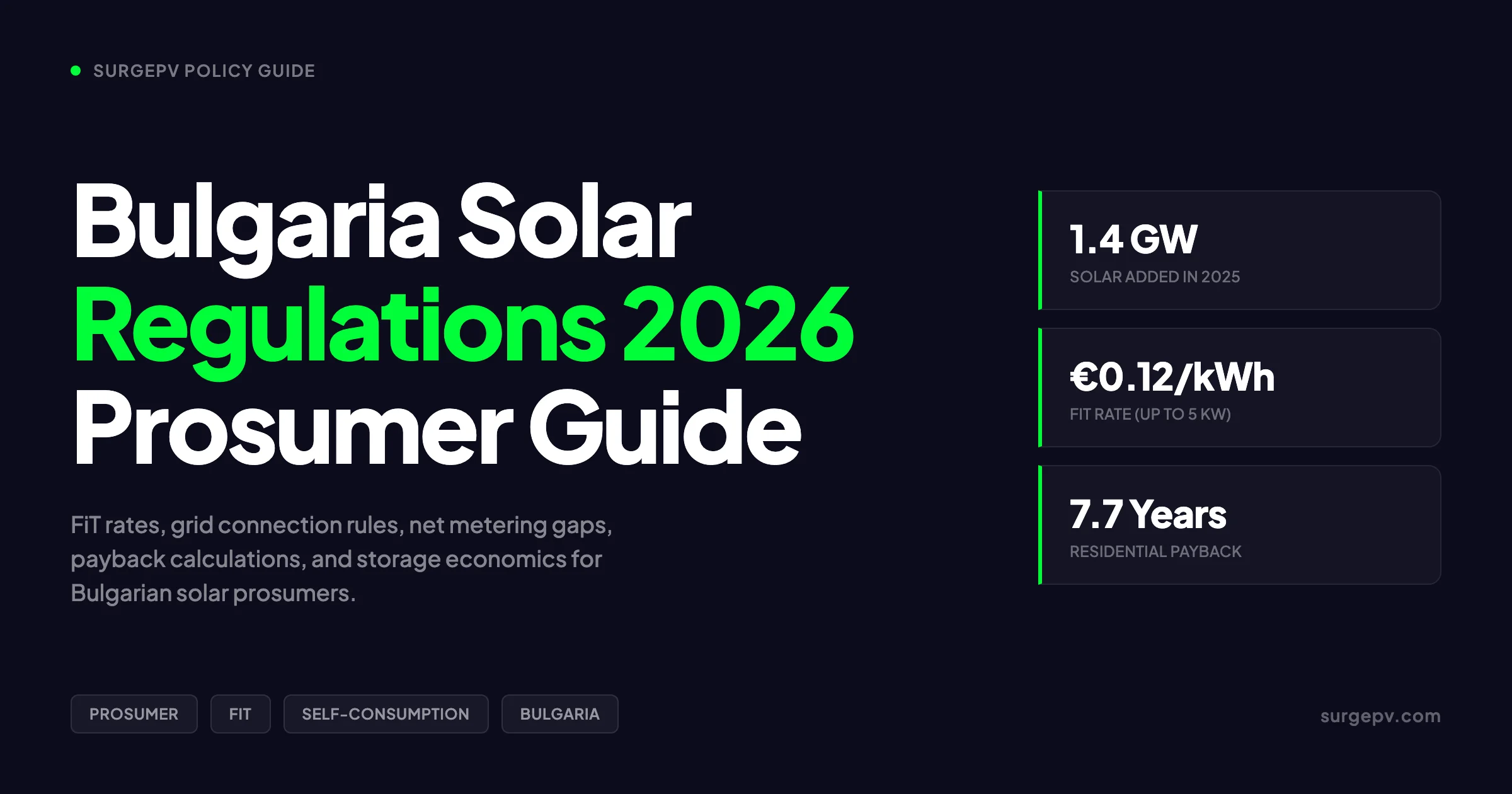
Bulgaria installed 1,416 MW of solar capacity in 2025. That pushed cumulative capacity to just under 6 GW. Bulgaria entered the EU top-ten solar markets for the first time. Roughly 90 percent of new capacity came from ground-mounted utility plants. The residential and commercial segments that most readers care about are growing too. But they grow inside a regulatory framework that is incomplete, unevenly enforced, and in some areas still missing.
This guide explains exactly how Bulgaria’s solar regulations work for prosumers in 2026. We cover the feed-in tariff and premium contracts. We explain who qualifies as a prosumer. We walk through the grid connection process. We show real payback numbers. And we name the single biggest gap that most overseas guides never mention. For context on how Bulgaria compares to its neighbors, see our guide to European solar incentives. Also see: European Solar Tax Credits.
In this guide you will learn:
- How Bulgaria’s two-tier support system splits small and large projects
- The exact FiT rates and contract terms for rooftop solar
- Who counts as a prosumer and what rights you get
- Grid connection thresholds and permit rules by system size
- Why net metering does not exist in Bulgaria despite EU mandates
- Real payback numbers for residential and commercial systems
- How battery storage changes the economics
- What the 2026 EU compliance pressure means for future rules
Quick Answer
Bulgaria operates a two-tier solar support system. Rooftop systems under 30 kW can access a fixed feed-in tariff of roughly €0.10–0.12 per kWh for 20 years. Larger projects must sell on the merchant market with a premium top-up. Prosumers have simplified grid access for systems under 20 kW, but true net metering does not yet exist. The country is under EU court pressure to fully transpose RED II and introduce virtual net metering by late 2026.
Bulgaria’s Solar Market in 2026
Bulgaria’s solar sector has tripled in size since 2022. The country added over 1 GW per year for three consecutive years. By the end of 2025, cumulative capacity reached 5,984 MW, according to pv magazine citing ENTSO-E data.
The composition of that growth matters. Utility-scale, ground-mounted plants delivered roughly 90 percent of new capacity in 2025. Commercial and industrial self-consumption projects gained momentum. The residential segment stayed underdeveloped. Regulatory complexity and historically regulated electricity prices held homeowners back.
Industry estimates point to 2.5 GW of projects already under construction or at advanced development stages for 2026. If even two-thirds of that pipeline commissions on time, Bulgaria will add another record year.
Why Utility-Scale Dominates
Bulgaria has flat, sunny land in the south and east. Land costs are low by EU standards. Project finance from local and international banks has improved. Solar is now commercially viable without direct subsidies at utility scale.
The result is a market structure that looks more like Greece or Spain than Germany or the Netherlands. Large developers drive volume. Rooftop prosumers are a minority. For installers evaluating projects across the continent, solar PV design software can model Bulgarian irradiance, shading, and yield with the same accuracy as Western European sites. Also see: Germany solar subsidies. Also see: Spain net metering.
Key Takeaway
Bulgaria is a utility-scale solar market that is only now waking up to rooftop and C&I self-consumption. The regulatory framework favors large projects. Small prosumers face more paperwork, longer waits, and fewer financial safeguards.
The Storage Surge
A parallel trend is reshaping the market. Battery energy storage capacity in Bulgaria surged from roughly 200 MWh in 2024 to nearly 2,500 MWh by the end of 2025. Bulgaria ranked third in the EU for newly installed battery storage capacity that year, according to the European Solar Association. For more on this topic, see Adding Battery Storage Services.
The 315 MW / 760 MWh Tenevo hybrid project commissioned Phase 1 in 2025. Phase 2 is scheduled for early 2026. A standalone 496 MWh battery facility adjacent to a 107 MW solar park became one of the EU’s largest standalone BESS installations.
This storage build-out is not accidental. Grid constraints in southern Bulgaria cause curtailment during peak solar hours. Negative pricing events have increased. Developers are pairing solar with storage to hedge capture-price risk and improve grid flexibility. For project developers, solar shadow analysis software helps identify shading risks and optimize panel orientation before construction begins.
The Two-Tier Support System: FiT vs Premium Contracts
Bulgaria does not offer a single, universal support scheme for solar. Instead, it runs two parallel mechanisms split by project size.
Feed-In Tariff for Small Systems
Systems below 4 MW can access a fixed feed-in tariff. In practice, the FiT scheme is most relevant for rooftop installations up to 30 kW.
The Energy and Water Regulatory Commission (EWRC) sets preferential prices annually. Current rates for the regulatory period are:
| System Size | Preferential Price | Approximate Euro Equivalent |
|---|---|---|
| Up to 5 kW | BGN 0.235 / kWh | ~€0.12 / kWh |
| 5 kW to 30 kW | BGN 0.196 / kWh | ~€0.10 / kWh |
These prices exclude VAT. Contracts run for 20 years. The National Electricity Company (NEK) or the designated buyer purchases the output at the guaranteed price.
The FiT is a genuine guaranteed price. If your rooftop system is registered under this scheme, you know exactly what each exported kilowatt-hour earns. That predictability is rare in Bulgaria’s otherwise market-driven framework. For a broader comparison of how feed-in tariffs work across Europe, see our guide to Italy’s feed-in tariffs. Also see: solar panel ROI in Italy.
Premium Contracts for Large Systems
Projects of 4 MW and above must sell electricity on the free market. They receive a premium top-up from the Electricity System Security Fund (ESSF). The premium bridges the gap between the market price and a reference price set by the EWRC.
For the July 2024 to June 2025 period, the EWRC set the reference price for solar at BGN 141.49 per MWh. That is approximately €72 per MWh or €0.072 per kWh, according to CMS law firm.
The premium equals the difference between the reference price and the realized market price. If market prices fall below the reference, the producer gets a top-up. If market prices rise above the reference, the producer pays back the difference.
This mechanism creates an asymmetric risk. When solar penetration rises and capture prices fall, the premium shrinks. The reference price itself has dropped sharply. It fell from BGN 250.27 per MWh in 2023–2024 to BGN 141.49 per MWh in 2024–2025. That is a 43 percent reduction in one year.
Key Takeaway
Small rooftop systems get a fixed FiT of roughly €0.10–0.12 per kWh for 20 years. Large projects sell on the merchant market with a shrinking premium top-up. The reference price dropped 43 percent between 2024 and 2025, squeezing returns for utility-scale developers.
The Shift to Merchant Projects
Since July 2021, all renewable energy producers with capacity of 0.5 MW or more must sell on the free market. The era of guaranteed purchase by NEK is over for any project larger than a large residential rooftop.
The practical result is a market increasingly driven by corporate power purchase agreements (PPAs) and merchant revenue. Direct subsidy dependence is fading. Spain and Portugal followed a similar path. Bulgaria moved faster. The original FiT boom of 2010–2012 created a budget deficit. Policymakers are still wary of repeating that mistake. See our guide on Hotel Solar + EV Charging Case Study for more.
Who Qualifies as a Prosumer in Bulgaria
Bulgarian law does not use the word “prosumer” in a single, clean definition. Instead, two overlapping legal categories describe people who both produce and consume electricity.
Self-Consumers of Renewable Energy
The Renewable Energy Sources Act defines self-consumers as end users who generate electricity from renewable sources. They have the right to produce, consume, store, and sell excess electricity. They retain all consumer protections.
Network operators cannot impose discriminatory grid access conditions on self-consumers. The legal intent is clear: if you put panels on your roof, the grid operator must treat you fairly.
Active Customers
The Energy Act defines active customers more broadly. An active customer generates, stores, consumes, and sells electricity. They can participate in aggregation, flexibility, and demand-response schemes. Energy production must not be their primary commercial activity.
Active customers with energy storage systems benefit from two important exemptions:
- Simplified grid access procedures
- No additional grid fees for electricity that passes through storage
This matters because storage is where Bulgarian prosumer economics get interesting. Without storage, a typical household self-consumes 30 to 40 percent of its solar output. With a 5 to 10 kWh battery, that rate climbs to 60 to 80 percent. The storage exemption removes a fee layer that would otherwise erode those gains.
What You Cannot Do Yet
Here is where the gap shows. Bulgaria has transposed the EU Renewable Energy Directive (RED II) on paper. But several critical prosumer rights are still missing in practice. To understand how net metering works in countries where it is fully operational, see our glossary definition.
- Virtual net metering does not exist. You cannot allocate solar generation from one meter to another.
- Energy communities have no operational framework. The 2023 legal transposition created definitions but no registration procedure or operational rules.
- Collective self-consumption is not possible. Apartment buildings cannot share a single rooftop installation.
These gaps are not minor footnotes. They are the reason Bulgaria’s residential solar market lags behind Romania, Greece, and even Serbia in per-capita rooftop deployment.
Pro Tip
Size your system for self-consumption, not maximum production. A 5 kWp rooftop array in Sofia produces roughly 6,500 kWh per year. A typical household consumes 3,500 to 5,000 kWh annually. Without a battery, 40 to 60 percent of that production gets exported at low FiT or market rates. A 5 kWh battery raises self-consumption to 70 to 80 percent and shortens payback by 1 to 2 years.
Grid Connection Rules by System Size
The administrative burden of connecting solar to the Bulgarian grid depends heavily on system size. Three thresholds create very different experiences.
Up to 20 kW: Notification Only
For single-family homes and villas, rooftop solar up to 20 kW does not require a construction permit. The owner submits a notification to the local distribution system operator (DSO). The DSO amends the existing electricity supply contract. The system must not exceed the building’s allocated grid connection capacity.
This is the simplest pathway. It is also the one that applies to most Bulgarian homeowners. A 5 to 10 kWp residential system fits comfortably under this threshold.
The tacit consent principle applies. If authorities do not respond within one month, the permit is deemed granted.
20 kW to 50 kW: Silent Consent
Systems in this range still qualify for simplified procedures but face a slightly higher bar. The silent consent rule applies: if the municipal architect does not object within one month, the construction permit is granted. Total installed power must not exceed the grid connection capacity allocated to the building.
This tier catches small commercial installations, agricultural buildings, and larger residential complexes. The silent consent rule is genuinely useful. It prevents municipal bureaucracies from stalling projects indefinitely.
Above 50 kW or Selling Surplus: Full Process
Any system above 50 kW, or any system that intends to sell electricity to the grid, must go through the full administrative process. This includes:
- Design visa from the municipality
- Grid connection feasibility study from the DSO
- Engineering and technical approvals
- Construction permit
- Construction and installation
- Preliminary grid connection contract (valid 2 years)
- 72-hour testing and commissioning
- Final grid connection contract
- Electricity purchase or supply contract
For installations above 20 MW, an operating license from the EWRC is mandatory. Projects above 10 MW must connect to the transmission grid managed by the Electricity System Operator (ESO). Projects up to 10 MW connect to the distribution grid.
Real-World Example
A family in Plovdiv installed a 6.5 kWp rooftop system in mid-2024. Because the system was under 20 kW and on a single-family home, they skipped the construction permit. Notification to the DSO took 3 weeks. Grid connection amendment took another 4 weeks. Total time from signed contract to first kilowatt-hour: 11 weeks. The family now covers roughly 85 percent of their annual electricity from solar with a 5 kWh battery.
Grid Connection Timelines
The DSO must provide a grid connection permit within 2 years of the request. For installations up to 150 kW, the limit is 1 year. In practice, timelines vary:
- Western Bulgaria (CEZ territory): 3 to 6 months for small systems
- Southern Bulgaria (EVN territory): 4 to 8 months; longer in congested areas
- Northern Bulgaria (Energo-Pro territory): 6 to 12 months; grid capacity is the tightest
The April 2024 Grid Connection Ordinance improved some rules. Investors may now initiate grid connection procedures based on land rights rather than a full design visa. Final grid connection agreements no longer have a strict 3-year cap.
Metering Requirements
All prosumers must install bidirectional meters. These meters record electricity imported from the grid and exported to the grid separately. The DSO installs and maintains the meter under EWRC rules.
This sounds standard. But here is the catch. The DSOs have been slow to roll out smart digital meters. Many prosumers still operate with older mechanical meters that require manual reading. This creates billing delays and disputes. It also blocks virtual net metering, which depends on real-time digital metering.
Net Metering: The Gap Nobody Talks About
Most international guides to Bulgarian solar casually mention that net metering exists. It does not. This is the single most important fact for any prospective Bulgarian prosumer to understand.
What Is Missing
Bulgaria has no operational net metering mechanism as of May 2026. When a prosumer exports surplus electricity to the grid, that electricity is not credited against future consumption. It is either:
- Sold under the small-scale FiT at roughly €0.10–0.12 per kWh, or
- Sold at market prices through a bilateral contract
There is no billing period offset. There is no one-to-one kilowatt-hour credit. If you export 100 kWh in June and import 100 kWh in December, you pay full retail price for the December import. The June export earns you the FiT or market rate, which is lower than the retail rate you pay.
This asymmetry is why self-consumption rate dominates Bulgarian solar economics. Every kilowatt-hour you consume immediately saves you the full retail price of roughly €0.12. Every kilowatt-hour you export earns you roughly €0.10 or less. The difference is your lost value. For a deeper look at how self-consumption optimization works in practice, see our guide to commercial solar self-consumption optimization.
The Draft Law
A draft Law on Energy from Renewable Sources includes provisions for virtual net metering. The proposal would allow prosumers to credit self-generated energy against consumption at multiple points. Systems up to 10.8 kW would only need to notify the DSO. Applications for systems up to 20 kW would be processed within one month.
The draft has been under discussion in the National Assembly for months. It has not been enacted. Even if it passes in 2026, implementation will take additional time. DSOs need digital metering infrastructure. Billing systems need updates. Tariff structures need redesign.
What Most Guides Miss
Bulgaria installed 1.4 GW of solar in 2025 without functional net metering. The growth came from utility-scale plants and C&I self-consumption projects where the economics work without export credits. Residential rooftop growth remains constrained precisely because the missing net metering mechanism makes small systems less attractive than in neighboring countries.
Why This Matters in Practice
Consider two identical 5 kWp systems. One is in Bulgaria. One is in Greece, where net metering operates.
- Bulgaria: 35% self-consumption, 65% exported at €0.10/kWh, retail price €0.12/kWh
- Greece: 35% self-consumption, 65% net-metered at 1:1 offset, retail price €0.18/kWh
The Greek system saves €0.18 on every self-consumed and every net-metered kilowatt-hour. The Bulgarian system saves €0.12 on self-consumed kilowatt-hours but only earns €0.10 on exports. The Greek homeowner sees a payback of 5 to 6 years. The Bulgarian homeowner sees 7 to 9 years.
This is not a theoretical gap. It is the primary reason Bulgarian residential solar lags. Italy shows how a well-developed prosumer framework drives adoption. Net metering and generous incentives created one of Europe’s most active residential markets there. See our analysis of solar panel ROI in Italy. For Italy-specific information, see Commercial Rooftop Solar Case Study Italy.
Model Your Bulgarian Solar Project
Calculate exact payback, self-consumption rates, and storage sizing for Bulgarian irradiance and tariffs.
Try the Financial ToolFree · Instant results · Based on real Bulgarian DSO tariffs
EU Compliance Pressure
In January 2026, the Court of Justice of the European Union condemned Bulgaria for incomplete transposition of the RED II directive. The court imposed a €1.5 million penalty plus potential daily fines until compliance is achieved.
The ruling specifically targets Bulgaria’s failure to implement full prosumer rights, including net metering and energy community frameworks. This creates genuine pressure for legislative action in 2026. But court judgments do not install meters or rewrite billing software overnight.
What It Costs and What You Save
Solar economics in Bulgaria are shaped by three variables: installed cost, electricity price, and self-consumption rate.
System Costs
Bulgarian solar installation costs are competitive by EU standards but vary by segment:
| Segment | Cost per kWp | Typical System Size | Total Cost Range |
|---|---|---|---|
| Residential rooftop | €900–1,400 | 3–10 kWp | €2,700–14,000 |
| Commercial rooftop | €700–1,100 | 30–500 kWp | €21,000–550,000 |
| Ground-mounted utility | €500–800 | 1+ MW | €500,000+ |
These figures exclude VAT. They include modules, inverters, mounting, cabling, installation labor, and grid connection. They exclude battery storage, which adds €400–900 per kWh of usable capacity. Also see: Us Residential Solar Market Trends 2026.
Electricity Prices
Bulgaria has among the lowest residential electricity prices in the EU. For a broader look at how electricity prices shape solar economics across the continent, see our analysis of solar energy policies in Europe. The EWRC approved a 2.56 percent average increase for household consumers starting July 1, 2025.
Regional variations exist:
| DSO Region | Approximate Residential Price |
|---|---|
| Elektrohold (West / Sofia) | ~€0.118 / kWh |
| EVN (South) | ~€0.123 / kWh |
| Energo-Pro (North) | ~€0.121 / kWh |
Commercial and industrial consumers typically pay €0.14–0.18 per kWh after grid tariffs, regulated cost recovery, and system charges. This price differential explains why C&I self-consumption is Bulgaria’s fastest-growing solar segment. A factory paying €0.16 per kWh saves more per kilowatt-hour than a household paying €0.12.
Solar Resource
Bulgaria receives 1,100 to 1,600 kWh per square meter per year of global horizontal irradiance. Southern regions like Plovdiv and Haskovo sit at the high end. Northern regions like Ruse and Veliko Tarnovo sit at the low end. Sofia, at roughly 550 meters altitude, receives around 1,250 kWh/m²/year. For Global-specific compliance details, see Global net-metering-by-country. For Global-specific compliance details, see Global solar-permitting-speed-by-country.
A 1 kWp system in southern Bulgaria produces roughly 1,350 to 1,500 kWh per year. The same system in northern Bulgaria produces 1,100 to 1,250 kWh per year.
Payback Calculation
Here is an original payback analysis for a typical Bulgarian residential system:
Assumptions:
- 5 kWp rooftop system in Sofia
- Installed cost: €1,100/kWp = €5,500 total
- Annual production: 6,250 kWh (1,250 kWh/kWp)
- Self-consumption rate: 70% (with 5 kWh battery)
- Retail electricity price: €0.12/kWh
- FiT for exported surplus: €0.10/kWh
- Annual degradation: 0.5%
Annual savings:
- Self-consumed: 4,375 kWh × €0.12 = €525
- Exported: 1,875 kWh × €0.10 = €188
- Total first-year value: €713
Simple payback: €5,500 ÷ €713 = 7.7 years
Without the battery, self-consumption drops to roughly 40%. Annual value falls to roughly €520. Payback extends to 10.6 years. The battery adds roughly €2,000 to system cost but shortens payback by nearly 3 years.
SurgePV Analysis
At Bulgarian electricity prices, the battery is the difference between a viable and a marginal residential investment. Without storage, the payback exceeds 10 years for most households. With storage, it drops below 8 years. Bulgaria’s residential solar market will not scale meaningfully until one of two things happens. Battery costs must fall below €300 per kWh. Or net metering must be introduced.
For a direct comparison, see Arka 360 vs SurgePV.
Commercial Payback
A 100 kWp C&I rooftop system in Plovdiv:
- Installed cost: €900/kWp = €90,000
- Annual production: 140,000 kWh (1,400 kWh/kWp)
- Self-consumption rate: 85% (factory operates daytime)
- Retail electricity price: €0.16/kWh
- Surplus export: €0.08/kWh (market price, no FiT above 30 kW)
Annual savings:
- Self-consumed: 119,000 kWh × €0.16 = €19,040
- Exported: 21,000 kWh × €0.08 = €1,680
- Total first-year value: €20,720
Simple payback: €90,000 ÷ €20,720 = 4.3 years
This is why Bulgarian factories, warehouses, and cold storage facilities are adding rooftop solar at record rates. The economics are straightforward. The regulatory path is clearer for commercial entities than for homeowners. For commercial solar project teams, a generation and financial tool can model these payback scenarios with exact local tariffs and production estimates.
Solar-Plus-Storage: The Real Game Changer
Battery storage is not an accessory in Bulgaria. It is becoming a core component of any serious prosumer system.
Why Storage Matters
Without storage, a typical Bulgarian household self-consumes 30 to 40 percent of its solar output. The rest gets exported at rates below retail. With a 5 to 10 kWh battery, self-consumption climbs to 60 to 80 percent.
The math is simple. Every kilowatt-hour stored and consumed later saves the full retail price. Every kilowatt-hour exported earns less. Storage captures value that would otherwise leak into the grid.
Regulatory Support
Bulgaria’s 2024 amendments to the Energy Act recognized battery energy storage systems as independent market participants. This sounds technical. It has practical benefits:
- Active customers with storage get simplified grid access
- No additional grid fees for electricity that passes through storage
- Storage systems can participate in balancing and ancillary services markets
The National Recovery and Resilience Plan is funding significant storage deployment. An estimated 15 GWh of battery capacity is expected by mid-2026. Some 10,000+ MWh is currently under construction.
The Cost Bottleneck
One factor works against storage growth. Bulgaria introduced eco-taxes and recycling fees for solar panels and batteries in 2025. These fees are reportedly 5 to 10 times higher than in comparable EU countries, according to APSTE.
Desislava Mateva of the Association for Production, Storage and Trading of Electricity warned: “Unless addressed, this issue risks becoming a major bottleneck for new PV and BESS procurement.”
This creates a paradox. The regulatory framework encourages storage. The tax framework punishes it. Resolution requires Ministry of Ecology action to align Bulgarian recycling fees with EU norms.
C&I Storage Economics
For commercial users, the storage case is even stronger. A factory with a 200 kWp system and a 100 kWh battery can use solar proposal tools to present the financial case to stakeholders with exact IRR and payback projections:
- Shift solar generation to evening peak hours
- Reduce peak demand charges
- Provide backup power during grid outages
- Participate in demand-response programs
At current Bulgarian industrial tariffs, peak shaving alone can justify 30 to 50 percent of battery cost. Solar generation covers the rest.
Pro Tip
Size your battery to cover evening consumption, not daytime overproduction. A typical Bulgarian household uses 2 to 4 kWh between 6 PM and 11 PM. A 5 kWh battery with 90 percent usable depth of discharge covers this with margin. Oversizing to 10 kWh adds cost without proportional value unless you have specific load patterns like electric vehicle charging.
Energy Communities: Why Bulgaria Is Behind
The EU Renewable Energy Directive requires member states to enable renewable energy communities (RECs) and citizen energy communities (CECs). Bulgaria transposed these definitions into law in 2023. The transposition was cosmetic.
What Exists on Paper
Bulgarian law defines RECs and CECs. It grants them legal personality. It says they should have access to support schemes. It promises non-discriminatory treatment.
What Is Missing in Practice
No dedicated registration procedure exists for energy communities. There are no operational rules for market participation. There is no framework for local energy sharing or microgrids. Members must typically register as individual producers and hold separate DSO contracts.
This means an apartment building in Sofia cannot install a shared rooftop system and split the benefits among units. A village cannot create a local energy cooperative. An industrial park cannot build a private microgrid.
These are not exotic use cases. They are standard practice in Germany, Denmark, and the Netherlands. Bulgaria’s failure to enable them is a direct consequence of incomplete RED II transposition. See our guide on Community Solar Projects Germany for more. For more on this topic, see Community Solar Business Model.
The EU Court Ruling
The January 2026 Court of Justice ruling put a price tag on this failure. Bulgaria faces a €1.5 million lump-sum penalty plus ongoing daily fines. The ruling specifically names missing prosumer rights, energy community frameworks, and net metering as violations.
This creates a legislative deadline. Bulgaria must pass comprehensive amendments to the Energy Act and RES Act in 2026. The draft law under discussion includes some of these provisions. Whether it passes, and whether it works in practice, remains to be seen.
Tradeoff
Individual prosumer systems work today but lock households into isolated optimization. Energy communities would allow shared resources, lower per-capita costs, and collective bargaining power. The tradeoff is immediate savings versus long-term resilience. Bulgaria currently forces households to choose the isolated path because the collective path does not legally exist.
2026 Reforms and the EU Compliance Pressure
Bulgaria’s energy sector is undergoing its most significant transformation in a decade. Three forces are driving change.
Market Liberalization
Full liberalization of household electricity prices was scheduled for July 1, 2025. Parliament voted to postpone it indefinitely. Most households remain on regulated tariffs. This delays the price signal that would drive residential solar adoption.
The regulated price regime is unsustainable. It requires state subsidies to keep prices artificially low. Those subsidies drain the state budget and distort investment signals. Every year of delay pushes back the residential solar market by another year.
Desislava Mateva of APSTE put it directly: “Full liberalization would stimulate demand-side participation and unlock the residential solar and storage market.”
Fast-Track Permitting
A 2025 amendment introduced a fast-track procedure for renewable projects in priority areas. The target is 12 months from application to final permit. This applies to both wind and solar projects plus related grid infrastructure.
For small-scale prosumer systems, the impact is indirect. Fast-track permitting mainly benefits utility-scale developers. But streamlined municipal support units and shorter appeal deadlines create a template that could eventually simplify residential procedures too.
RESTORE 2 and Grant Programs
The RESTORE 2 Energy Program offers direct subsidies for renewable energy projects. The firm deadline is July 31, 2026, for commissioned projects. This targets businesses and public entities deploying PV and storage.
A late-2025 grant program targets micro, small, and medium enterprises in coal regions. The program funds PV and storage deployment with EU co-financing. Applications closed in March 2026.
These programs matter because they bridge the gap between commercial viability and actual deployment. A C&I project with a 4-year payback becomes a 2.5-year payback with a 30 percent grant. That changes investment decisions.
Grid Infrastructure
Grid constraints are the hidden ceiling on Bulgarian solar growth. Southern Bulgaria faces transmission bottlenecks. Northern Bulgaria has limited interconnection capacity. The CARMEN 11 project with Romania will add cross-border capacity but is not yet operational.
The EWRC raised grid access prices for RES producers from BGN 4.86 to BGN 6.15 for the 2024–2025 period. The justification was securing additional grid capacity. In practice, higher fees without faster connections frustrate developers.
Key Takeaway
2026 is a transition year for Bulgarian solar policy. The EU court ruling creates mandatory reform pressure. The RESTORE 2 deadline creates a deployment rush. Grid constraints create a physical ceiling. Prosumers who act in 2026 may benefit from simpler procedures and available grants. Those who wait may face a more crowded queue and higher competition for grid capacity.
Common Mistakes Bulgarian Prosumers Make
After reviewing the regulatory framework, here are the most common errors we see in the Bulgarian market.
Oversizing Without Storage
Many homeowners install the largest system their roof can hold. Then they export 60 to 70 percent of production at FiT rates below retail. Without a battery, oversizing is financially self-defeating. Size for your consumption profile, not your roof area.
Ignoring the Grid Connection Queue
Some prosumers buy equipment before securing grid connection approval. The DSO queue in congested regions can stretch to 12 months. Equipment prices fall during the wait. Warranty clocks start ticking. Always secure grid connection terms before purchasing.
Misunderstanding the FiT Cap
The small-scale FiT only applies to systems up to 30 kW. Many C&I prosumers design 35 to 50 kWp systems expecting FiT coverage for the entire output. Only the first 30 kW qualifies. The remainder sells at market rates. This can destroy projected returns.
Underestimating Eco-Taxes
Bulgaria’s recycling fees for solar panels and batteries are 5 to 10 times higher than in comparable EU countries. A battery system that costs €5,000 in Germany may carry an additional €800 to €1,500 in Bulgarian eco-taxes. Budget for this or source equipment from suppliers who have prepaid recycling obligations.
Skipping the Balancing Group Contract
Prosumers who sell surplus must sign a contract with a balancing group coordinator. Without this contract, the DSO may refuse to register exports. Some installers skip this step. The system works for self-consumption but cannot earn export revenue. For solar installers working in Bulgaria, documenting this contract in the handover package protects both the installer and the client from future disputes.
Not Accounting for Seasonal Production Curves
Bulgarian solar production is heavily seasonal. A 5 kWp system in Sofia generates roughly 750 kWh in July but only 180 kWh in December. That is a 4:1 ratio between peak and trough months. Prosumers who size batteries based on summer production find themselves importing heavily in winter. Size storage for the winter deficit, not the summer surplus.
Further Reading
For installers working across multiple European markets, understanding regional regulatory differences is essential. See our guides to solar energy policies in Europe, solar panel ROI in Italy, and European solar incentives for comparative context. Our net metering and feed-in tariff glossary entries define the key mechanisms discussed in this guide.
Conclusion
Bulgaria’s solar market is at an inflection point. The country has proven it can deploy utility-scale solar at speed. The missing piece is a prosumer framework that matches EU standards.
For project teams preparing technical documentation, solar design software with multi-country template libraries can speed up the proposal and permitting process across Balkan markets. Three actions will have the biggest impact for anyone considering solar in Bulgaria in 2026:
- Size for self-consumption first. Without net metering, every exported kilowatt-hour loses value. A right-sized system with a battery pays back faster than an oversized system without one.
- Secure grid connection terms before you buy. Queue times vary by region and DSO. Southern Bulgaria faces the longest delays. Get the DSO letter in hand before ordering equipment.
- Apply for grants before the July 2026 deadline. RESTORE 2 and related programs can cut system cost by 15 to 30 percent. After the deadline, Bulgarian prosumers will rely on pure self-consumption economics without subsidy support.
The regulatory gaps are real. But the solar resource is excellent, system costs are competitive, and the EU compliance pressure means the framework will improve. Prosumers who enter the market in 2026 position themselves ahead of the wave. For solar companies evaluating new markets, solar software that supports multi-country regulatory databases and tariff structures simplifies the expansion decision.
Frequently Asked Questions
Does Bulgaria have net metering for solar prosumers?
No. Bulgaria does not have an operational net metering mechanism as of May 2026. Prosumers can sell surplus electricity to the grid at market prices or under the small-scale feed-in tariff. But there is no one-to-one billing offset. A draft law proposing virtual net metering is under discussion in the National Assembly but has not been enacted.
What is the feed-in tariff for rooftop solar in Bulgaria?
For systems up to 5 kW, the preferential price is approximately €0.12 per kWh. For systems between 5 kW and 30 kW, the rate is approximately €0.10 per kWh. These prices are set by the Energy and Water Regulatory Commission and reviewed annually. Contracts run for 20 years.
What size solar system can I install without a construction permit in Bulgaria?
Residential solar systems up to 20 kW on single-family homes or villas do not require a construction permit. Owners submit a notification to the distribution system operator and sign an amendment to their electricity supply contract. Systems between 20 kW and 50 kW fall under a silent consent rule.
How long does grid connection take in Bulgaria?
The distribution system operator must issue a grid connection permit within two years of the request. For installations up to 150 kW, the deadline is one year. In practice, connection timelines vary by region. Southern Bulgaria faces longer delays due to grid congestion.
What is the payback period for residential solar in Bulgaria?
A typical 5 kWp residential system in Bulgaria pays back in 6 to 9 years. The exact period depends on self-consumption rate, electricity tariff, grant availability, and system cost. At €1,100 per kWp installed cost and €0.12 per kWh retail price, a household with 70 percent self-consumption breaks even in roughly 7.5 years.
Can I add battery storage to my solar system in Bulgaria?
Yes. Bulgaria’s 2024 amendments recognized battery energy storage as an independent market participant. Active customers with storage benefit from simplified grid access and are exempt from additional grid fees for stored electricity. The National Recovery and Resilience Plan funds significant storage deployment.
Are there grants for solar in Bulgaria?
Yes. The RESTORE 2 Energy Program offers subsidies with a firm deadline of July 31, 2026 for commissioned projects. The National Recovery and Resilience Plan covers 15 to 30 percent of residential installation costs. A late-2025 grant program targets SMEs in coal regions for PV and storage deployment.
What is the difference between an active customer and a self-consumer in Bulgaria?
A self-consumer generates renewable electricity primarily for own use under the RES Act. An active customer is defined in the Energy Act and can generate, store, consume, and sell electricity while participating in aggregation and demand-response schemes. Active customers must not have energy production as their primary commercial activity.
Where this fits
This article is part of SurgePV's Solar Incentives & Policy hub, which works through the topic from first principles to the decisions a project team actually has to make.

