

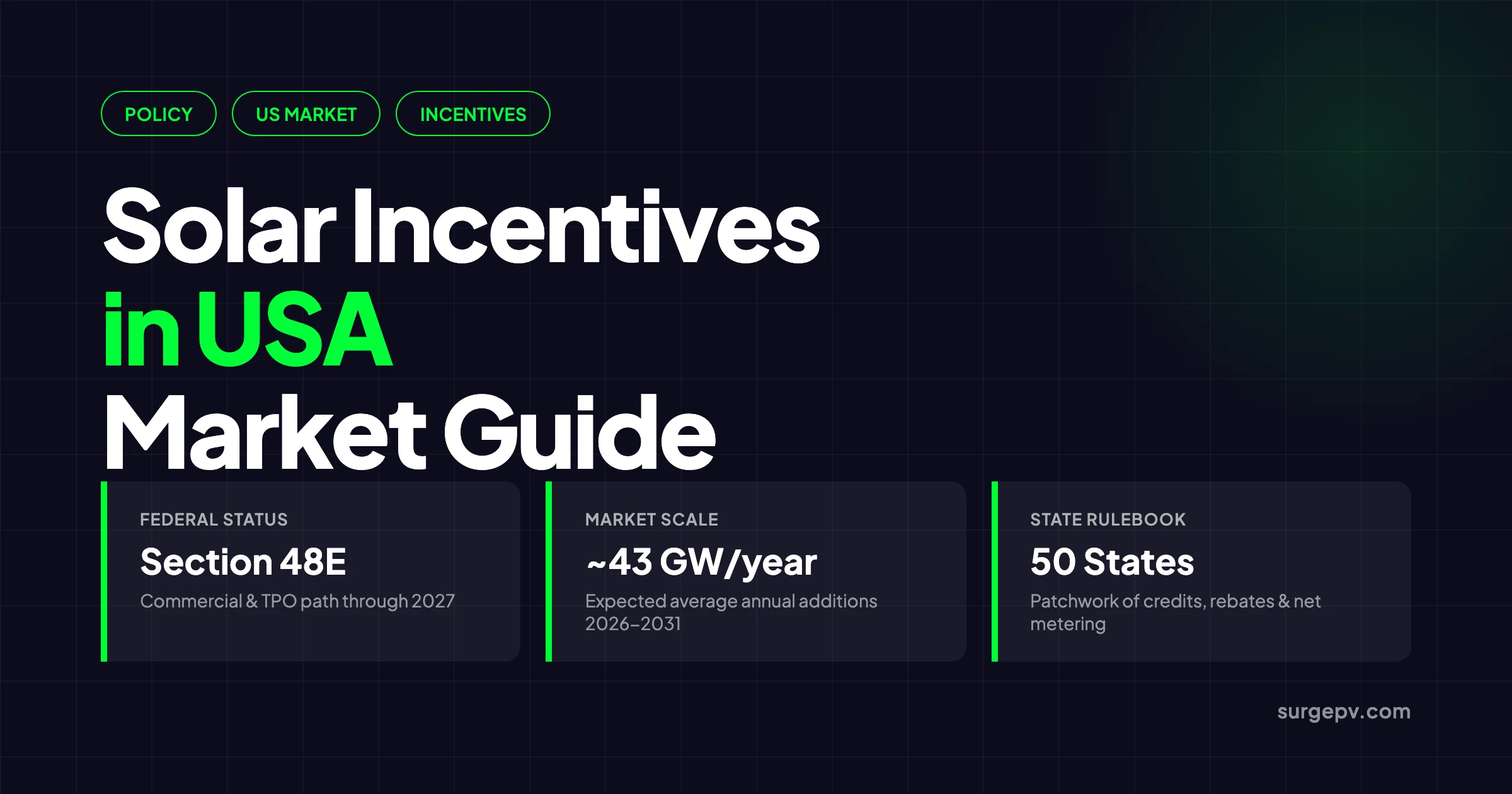
The United States is the world’s second-largest solar market, yet it has no national solar subsidy in 2026. The 30% federal residential Investment Tax Credit that anchored residential solar economics for more than a decade expired on December 31, 2025. What remains is a patchwork of 50 state rulebooks, utility tariffs, and local programs that can change payback by five years or more on the same system.
For installers, EPCs, financiers, and property owners, the opportunity now lies in modeling the full stack accurately. A homeowner in New Jersey can still combine 15 years of SREC-II income with full retail net metering. A homeowner in California must pair solar with storage under NEM 3.0. A rancher in Texas can use USDA REAP to cut project cost in half. A building owner in New York City can claim a 30% property tax abatement on top of the state tax credit. None of these stacks work the same way.
This guide is a market-focused incentive manual, not a cost or installation tutorial. It covers the federal policy foundation, the four layers of state incentives, the net metering divide, the strongest state profiles, and the common errors that cost homeowners and businesses thousands of dollars. State-specific guides for California, Texas, Florida, New York, and New Jersey are linked in the conclusion.
If you are sizing systems or writing proposals for U.S. clients, a cloud solar design platform with built-in state incentives and utility tariffs can save hours on every project. Model payback, net metering, and stacked incentives automatically, then generate solar proposals in minutes. Check pricing or book a demo to see how SurgePV handles U.S. projects.
Quick Answer
In 2026, U.S. solar incentives are a state-driven patchwork. The federal residential Section 25D credit expired for homeowner-owned systems, but Section 48E still supports commercial and third-party-owned projects through 2027. State tax credits, rebates, SREC markets, net metering rules, and property tax exemptions now determine project economics.
In this guide:
- Latest 2026 status of federal and state solar incentives in the United States
- Why the U.S. market shifted from a federal credit to a state-by-state stack
- Section 48E deadlines, bonus adders, and who can still claim a federal credit
- The four layers of state incentives: tax credits, performance payments, net metering, and exemptions
- Net metering vs. net billing: which states still offer full retail credits
- State incentive profiles for New Jersey, New York, Massachusetts, Illinois, California, Texas, Florida, Arizona, Colorado, and Minnesota
- Commercial, agricultural, and utility-scale incentives beyond the residential stack
- Three real-world stacking examples with payback impact
- Common mistakes and how to avoid them
Latest Updates: U.S. Solar Incentives 2026
The U.S. solar policy environment changed fundamentally in early 2026. The federal residential credit disappeared, several state rebate blocks closed, and net metering rules continued their slow shift from retail credits toward avoided-cost compensation.
U.S. Solar Incentive Status — June 2026
| Incentive | Type | Status | Key Terms |
|---|---|---|---|
| Federal Section 25D residential credit | Tax credit | Expired | No new homeowner-owned systems after Dec 31, 2025 |
| Federal Section 48E commercial credit | Tax credit | Active through 2027 | 30% if construction begins by July 4, 2026, or placed in service by Dec 31, 2027 |
| Section 48E domestic content bonus | Bonus adder | Active | +10% for meeting U.S. manufacturing thresholds |
| Section 48E energy community bonus | Bonus adder | Active | +10% for projects in qualifying census tracts |
| Section 48E low-income bonus | Bonus adder | Active | Up to +20% for qualified low-income residential or economic benefit projects |
| USDA REAP grants | Grant | Active | Up to 50% of eligible rural/agricultural solar costs |
| State income tax credits | Tax credit | Active in 8 states | AZ, HI, IA, MA, NM, NY, SC, UT |
| State SREC/PBI markets | Performance payment | Active in NJ, MA, MD, IL, MN, DC | Rates vary by program and registration date |
| Net metering | Export credit | Varies by state | Full retail in NY, NJ, MA, IL, FL, CO, MN; net billing in CA, AZ, NV |
| Property tax exemptions | Tax exemption | Active in 36 states | Varies from 100% exclusion to limited abatement |
Key Changes Since 2025
January 2026 — Section 25D expiration: The Residential Clean Energy Credit under Internal Revenue Code Section 25D expired for homeowner-owned solar, battery, and solar water heating systems placed in service on or after January 1, 2026. The credit had been 30% since 2022.
March 2026 — New Jersey SREC-II rate step-down: The SuSI Administratively Determined Incentive residential rate dropped from $85 per MWh to $76.50 per MWh for systems registered on or after March 6, 2026. Systems registered before that date locked in the higher rate for 15 years.
April 2026 — New York BYOB requirement: NYSERDA’s residential battery storage rebate began requiring enrollment in a Bring Your Own Battery demand response program, with a transition exception through June 1, 2026.
Ongoing — Net metering transitions: California, Arizona, Nevada, Hawaii, and several other states continued shifting from full retail net metering toward avoided-cost or net billing tariffs. The trend makes self-consumption and storage more valuable than exports in those markets.
Key Takeaway
2026 is the first full year of a post-residential-ITC United States. The most reliable incentives are now state tax credits, SREC and performance payments, and property tax exemptions. Commercial and third-party-owned projects still have a federal pathway, but the deadline pressure is real.
Why the U.S. Incentive Stack Matters in 2026
The U.S. added 7.8 gigawatts direct current (GWdc) of solar capacity in the first quarter of 2026, a 27% decline from Q1 2025 and a 42% decline from Q4 2025, according to the U.S. Solar Market Insight Q2 2026 report from SEIA and Wood Mackenzie (2026). Solar and storage together accounted for 91% of all new electricity-generating capacity added in the quarter.
The residential segment installed 1,179 MWdc in Q1 2026, up 6% year-over-year because of overflow from the 2025 federal credit rush, but SEIA and Wood Mackenzie expect a 21% contraction for the full year. The utility-scale segment led with 5.9 GWdc. Over the next five years, the industry expects average annual additions of roughly 43 GWdc, supported by more than 200 GWdc of safe-harbored capacity, according to SEIA and Wood Mackenzie (2026).
What the Slowdown Means for Incentives
Without the 30% federal credit, every dollar of state and local incentive becomes more important. On a typical 8.5 kW residential system, the difference between a state with a strong incentive stack and one with none can exceed $12,000 in effective project cost, according to NREL analysis (2025). That gap directly affects close rates and project viability.
For installers, this means proposals must show gross cost, every applicable incentive, the net metering or net billing value, and realistic payback. A generic quote that assumes a federal credit or a flat export rate will underperform in 2026. That is where a solar design platform with U.S. state and utility templates becomes a competitive tool.
Model U.S. Incentives Accurately in Every Proposal
Section 48E deadlines, state tax credits, net metering rules, and SREC markets change the math on every project. SurgePV’s financial modeling applies the right federal, state, and utility incentives so your customer sees real net cost and payback.
Explore Financial ModelingNo commitment required · 20 minutes · Live project walkthrough
The Federal Foundation: Section 48E and What Replaced the ITC
Every U.S. solar incentive conversation in 2026 starts with the same question: is there still a federal tax credit? The answer depends on who owns the system.
Section 25D Is Gone for Homeowner-Owned Systems
The Residential Clean Energy Credit under Internal Revenue Code Section 25D allowed homeowners to claim 30% of qualified solar, battery, and solar water heating costs on their federal tax return. It expired on December 31, 2025, for systems placed in service after that date. A homeowner who signed a contract in 2025 but did not complete installation until 2026 cannot claim the credit.
The credit was non-refundable, meaning it could reduce federal tax liability to zero, and unused amounts could carry forward. For many households, the credit was the single largest line item on a solar proposal. Its removal shifts the entire sales conversation to state programs.
Section 48E Is the New Federal Workhorse
Section 48E, the Clean Electricity Investment Tax Credit, offers a 30% credit for eligible clean electricity projects. Projects qualify if construction begins by July 4, 2026, or if systems are placed in service by December 31, 2027. This is why lease and PPA providers can still advertise lower monthly payments in 2026: they own the system and claim the credit.
Projects over 1 MW AC must meet prevailing wage and apprenticeship requirements to receive the full 30% rate. Otherwise the base rate is 6%.
Bonus adders can push the total credit higher:
| Bonus | Adder | Requirement |
|---|---|---|
| Domestic content | +10% | Steel, iron, and manufactured products meet U.S. manufacturing thresholds |
| Energy community | +10% | Project located in a qualifying census tract tied to fossil fuel employment or brownfield sites |
| Low-income residential | +10% | Qualified low-income residential building project |
| Low-income economic benefit | +20% | Project provides at least 50% of financial benefits to low-income households |
The maximum credit for a qualifying low-income community solar project can reach 70% when all adders stack.
USDA REAP for Rural and Agricultural Solar
The USDA Rural Energy for America Program (REAP) provides grants and guaranteed loans to rural small businesses and agricultural producers. For renewable energy systems including solar:
- Grants can cover up to 50% of eligible project costs.
- Guaranteed loans can cover up to 75% of eligible costs.
- Combined grant and loan financing can cover up to 75% of eligible costs.
REAP is one of the most important federal incentives for agricultural solar, rural commercial projects, and small-town installers. A farm installing a 100 kW array can combine REAP with a Section 48E credit and state incentives, often reducing net cost by half or more.
Federal Solar for All and Low-Income Programs
The Environmental Protection Agency’s Solar for All program, funded by the Inflation Reduction Act’s Greenhouse Gas Reduction Fund, allocated $7 billion to states, territories, tribes, and municipalities to expand low-income solar access. Some state programs launched in 2025, but several faced funding uncertainty or pause notices in 2025 and 2026. Installers should verify current program status with each state energy office before quoting no-cost or heavily subsidized low-income installations.
The Four Layers of State Solar Incentives
State solar incentives fall into four categories. Most strong stacks combine at least three of them. The Database of State Incentives for Renewables and Efficiency (DSIRE) maintains the most comprehensive public record of every state, utility, and local program.
Layer 1: State Income Tax Credits
Eight states offer direct solar income tax credits in 2026:
| State | Credit | Cap | Carryforward |
|---|---|---|---|
| Arizona | 25% of cost | $1,000 | 5 years |
| Hawaii | 35% of cost | $5,000 | Until exhausted |
| Iowa | 15% of cost | $5,000 | 10 years for residential |
| Massachusetts | 15% of cost | $1,000 | 3 years |
| New Mexico | Up to 10% of cost | $6,500 refundable | 5 years |
| New York | 25% of cost | $5,000 | 5 years |
| South Carolina | 25% of cost | $3,500 | 10 years |
| Utah | 25% of cost with declining cap | Variable | 4 years |
New York’s credit is the largest in dollar terms and one of the most flexible, because it can also apply to qualifying leases and power purchase agreements of ten years or more. Hawaii’s 35% credit has a high cap but limited tax liability among many residents, so the effective take-up depends on household income.
Layer 2: Rebates and Performance Payments
Rebates and performance-based incentives (PBIs) are the most variable layer. They include upfront per-watt rebates, production payments per megawatt-hour, and renewable energy credit (REC) markets.
Key programs in 2026:
- New Jersey SuSI ADI: Fixed SREC-II payments of roughly $76.50/MWh for 15 years for residential net-metered systems registered after March 5, 2026.
- Massachusetts SMART: Payments of $0.13-$0.16/kWh for every kWh generated for 10 years.
- Illinois Shines: REC payments based on projected 15-year generation, typically $10,000-$12,000 on an 8.5 kW system.
- New York NY-Sun: Standard residential rebate blocks are closed in most regions, but the Affordable Solar Residential Incentive pays $0.80/W for income-qualified households.
- Minnesota Solar*Rewards: Xcel Energy pays $0.29/kWh on expected annual production, capped at $5,000/year for 10 years.
- Colorado CORE: Upfront rebate of 25% of project cost, capped at $2,500.
SREC markets in Maryland, Ohio, Pennsylvania, Virginia, and Washington D.C. trade at market prices rather than fixed rates. Prices fluctuate with supply, demand, and state renewable portfolio standards.
Layer 3: Net Metering and Net Billing
Net metering determines how much exported solar is worth. It is often the single largest driver of project economics. In 2026, states split into three groups:
- Full retail net metering: Exported kWh earn credits equal to the retail rate. New York, New Jersey, Massachusetts, Illinois, Colorado, Minnesota, and Florida still offer strong retail-rate regimes for many residential systems.
- Reduced net metering / net billing: Exported kWh earn partial credits based on avoided cost or wholesale prices. California’s NEM 3.0 averages $0.05-$0.08/kWh. Arizona’s Resource Comparison Proxy pays roughly 50% of retail. Nevada and Hawaii also use reduced export credits.
- Voluntary buyback: Texas has no statewide net metering law. Retail electric providers in ERCOT territory set their own buyback rates, ranging from full retail to wholesale.
The shift from net metering to net billing makes self-consumption and battery storage more valuable. A kilowatt-hour consumed on site is worth the full retail rate. A kilowatt-hour exported under net billing may be worth one-fifth as much.
Layer 4: Property and Sales Tax Exemptions
Property and sales tax exemptions are the quiet workhorses of solar incentives. They do not appear as line-item rebates, but they reduce upfront cost and lifetime ownership cost.
- Property tax exemptions: Thirty-six states exempt some or all of the added value of a solar system from property tax assessments. Florida’s exemption runs through 2037. New York’s RPTL Section 487 lasts 15 years. Texas’s exemption is permanent but requires filing Form 50-123.
- Sales tax exemptions: Most states exempt solar equipment from sales tax. Florida waives the 6% state sales tax. New York exempts state and local sales tax on equipment and labor. California exempts sales tax on equipment.
On a $25,000 system, a 6% sales tax exemption saves $1,500 at the point of sale. A property tax exemption on a $25,000 system in a 2% tax jurisdiction saves $500 per year, or $12,500 over 25 years.
Net Metering vs. Net Billing: The New National Divide
The most important single variable in U.S. solar economics is no longer the federal tax credit. It is the export tariff.
How Full Retail Net Metering Works
Under full retail net metering, every kilowatt-hour exported to the grid earns a credit equal to the retail rate. A kWh exported at noon in April is worth the same as a kWh imported at 8 PM in August. Credits roll over month to month, and annual true-ups may pay out surplus credits at a lower avoided-cost rate.
This structure makes solar-only systems financially strong. A properly sized system can offset 90-100% of annual usage without a battery. It also removes the hourly timing risk from production.
How Net Billing Works
Under net billing, exports are credited at an avoided-cost or wholesale-based rate. The rate varies by hour, season, and location. California’s NEM 3.0 uses the Avoided Cost Calculator, which publishes 576 possible rate combinations across months, hours, and day types.
The result is that midday exports in spring are worth very little, while evening exports in summer are worth more. A solar-only system that exports heavily at midday earns far less than a solar-plus-storage system that stores midday production and discharges during peak hours.
State-by-State Export Compensation Snapshot
| State | Regime | Typical Export Value | Notes |
|---|---|---|---|
| California | Net billing (NEM 3.0) | $0.05-$0.08/kWh average | Battery effectively required for strong ROI |
| Florida | Full retail net metering | Full retail rate | IOUs only; municipal utilities vary |
| New York | Phase One net metering / VDER | Near-retail for many rooftop systems | Larger and non-residential use value stack |
| New Jersey | Full retail net metering | Full retail rate | Annual true-up at wholesale |
| Massachusetts | Full retail net metering | Full retail rate | High retail rates amplify savings |
| Illinois | Full retail net metering | Full retail rate | Strong REC market on top |
| Arizona | Net billing (RCP) | ~50% of retail | Design for self-consumption |
| Texas | Voluntary buyback | Varies by REP | No statewide mandate |
| Colorado | Full retail net metering | Full retail rate | Utility rebates stack on top |
| Minnesota | Full retail net metering | Full retail rate | Solar*Rewards adds production income |
For a deeper explanation of billing mechanics, see our net metering glossary.
State Incentive Profiles: Where the Money Is in 2026
The following profiles highlight the strongest or most representative state stacks. For full details on each state, see the linked state-specific guides.
New Jersey: The Strongest Residential Stack
New Jersey pairs full retail net metering with the SuSI ADI SREC-II program. Systems registered on or after March 6, 2026, lock in roughly $76.50 per MWh for 15 years. An 8 kW system producing 10 MWh per year earns about $765 annually in SREC-II income, or $11,475 over 15 years. The state also offers a 6.625% sales tax exemption and a property tax exemption. Payback periods often fall in the 7-10 year range. See our New Jersey solar incentives guide for the full breakdown.
New York: Deep Credits and Strong Local Programs
New York offers a 25% state income tax credit capped at $5,000, a 15-year property tax exemption, and state and local sales tax exemptions. NY-Sun standard residential rebate blocks are closed in most regions, but the Affordable Solar Residential Incentive pays $0.80/W for income-qualified households. NYSERDA battery rebates are $200-$250/kWh. New York City’s SEGS property tax abatement adds 30% over four years for eligible building owners. See our New York solar incentives guide for details.
Massachusetts: SMART Income Drives Economics
Massachusetts combines full retail net metering at roughly $0.30/kWh with the SMART program, which pays $0.13-$0.16/kWh for every kWh generated for 10 years. The state also offers a 15% income tax credit capped at $1,000 and 20-year property tax exemptions. Payback periods typically fall in the 7-9 year range.
Illinois: The Midwest’s Solar Leader
Illinois Shines provides REC payments based on projected 15-year generation, typically $10,000-$12,000 on an 8.5 kW system. The program pays at project completion, which helps installers offer zero-down financing. Full retail net metering and a property tax freeze add further value. Illinois also has one of the country’s largest community solar markets.
California: Storage-First Strategy Required
California is the largest U.S. solar market and the most operationally complex. NEM 3.0 export credits average $0.05-$0.08/kWh, roughly 75% lower than NEM 2.0. Solar-only payback periods stretch to 9-13 years, while solar-plus-storage systems that shift midday production to evening peak hours retain stronger economics. State incentives include SGIP RSSE waitlist, DAC-SASH, SOMAH, and a property tax exclusion through December 31, 2026. See our California solar incentives guide for the full picture.
Texas: No Statewide Stack, Strong Local Programs
Texas has no state income tax, no statewide solar rebate, and no mandatory net metering. What it has is a deregulated electricity market, a 100% property tax exemption under Tax Code §11.27, and strong municipal utility programs. Austin Energy offers a $2,500 residential solar rebate plus Value of Solar credits around 9.91 cents/kWh. CPS Energy offers commercial rebates at $0.60/W AC. Retail electric providers in ERCOT territory offer voluntary solar buyback plans with widely varying rates. See our Texas solar incentives guide for details.
Florida: Net Metering and Tax Exemptions
Florida offers mandatory full retail net metering for the four investor-owned utilities, a 100% property tax exemption through 2037, and a 6% state sales tax exemption. Local rebates exist in Boynton Beach, Dunedin, Orlando, Jacksonville, and Lakeland. Unlike California, Florida does not have time-of-use export rates, so batteries are optional for financial performance. See our Florida solar incentives guide for the full breakdown.
Arizona: High Sun, Modest Incentives
Arizona offers a 25% state income tax credit capped at $1,000 and a 100% property tax exemption. The limitation is net metering: APS and SRP use a Resource Comparison Proxy rate roughly equal to 50% of retail. System design should prioritize self-consumption. High solar irradiance makes up for weaker export credits.
Colorado: Clean Slate With Growing Opportunity
Colorado offers the CORE upfront rebate of 25% of project cost up to $2,500, Xcel Energy rebates of $0.05-$0.10/W, full retail net metering, and property and sales tax exemptions. The Denver metro has strong solar awareness, while suburban and rural markets remain less saturated.
Minnesota: Stable Returns Through Solar*Rewards
Minnesota’s residential market centers on Xcel Energy’s Solar*Rewards program, which pays $0.29/kWh on expected annual production, capped at $5,000/year for 10 years. Full retail net metering and property and sales tax exemptions add further value. The program applies only to Xcel customers.
Commercial, Agricultural, and Utility-Scale Incentives
Residential homeowners who buy systems outright lost the federal credit in 2026. Commercial, industrial, agricultural, and utility-scale projects still have a federal pathway, plus many of the same state exemptions.
Section 48E for Commercial and Third-Party-Owned Systems
Section 48E is the main federal driver for non-residential solar in 2026. Lease and PPA providers use it to offer lower monthly payments to homeowners. Commercial and industrial owners use it directly. The construction deadline of July 4, 2026, and the placed-in-service deadline of December 31, 2027, create urgency for projects currently in development.
Projects over 1 MW AC must meet prevailing wage and apprenticeship requirements to receive the full 30% rate. Smaller projects and those placed in service by the deadline avoid this complexity.
Agricultural Solar: REAP Plus State Incentives
Agricultural solar in the United States often combines multiple federal and state layers:
- USDA REAP grant up to 50% of eligible cost.
- USDA REAP loan guarantee up to 75% of eligible cost.
- Section 48E credit if the project is owned by a taxable entity or third-party owner.
- State property tax exemption.
- State sales tax exemption.
A 100 kW solar array on a dairy farm can see net costs reduced by 50-70% through this stack. The key is structuring ownership correctly and applying for REAP before construction begins.
Utility-Scale Solar
Utility-scale solar dominated U.S. additions in Q1 2026 with 5.9 GWdc installed. The segment relies on Section 48E, power purchase agreements, and state renewable portfolio standards. More than 200 GWdc of safe-harbored capacity supports expected buildout through 2030, according to SEIA and Wood Mackenzie (2026). The main challenges are interconnection queue delays, permitting bottlenecks, and trade policy uncertainty.
Community Solar
Community solar allows subscribers who cannot install panels on their own roof to receive bill credits from a shared array. Active markets include Illinois, New York, New Jersey, Maryland, Minnesota, Colorado, and Massachusetts. Subscriber savings typically range from 10-20% below retail value. Community solar projects often rely on Section 48E and state incentives such as NY-Sun’s Inclusive Community Solar Adder.
How to Stack Incentives: Three Real-World Scenarios
The following examples are illustrative, based on typical 2026 costs and incentive rates. Actual figures depend on the state, utility, installer quote, and electricity tariff.
Scenario 1 — 8 kW Residential, New Jersey
| Item | Amount |
|---|---|
| Gross installed cost | $24,000 |
| Sales tax exemption (6.625%) | -$1,590 |
| Net cost | $22,410 |
| SREC-II income (10 MWh/yr × $76.50 × 15 yrs) | -$11,475 |
| Property tax exemption (20 yrs, 2.3% rate) | -$5,750 |
| Effective net investment | $5,185 |
| Annual net metering savings | ~$1,800 |
| Payback | 3-4 years |
This example shows why New Jersey remains the strongest residential solar market in the United States post-ITC.
Scenario 2 — 7 kW Solar + 13.5 kWh Battery, New York (Income-Qualified)
| Item | Amount |
|---|---|
| Gross installed cost | $32,000 |
| NY-Sun Affordable Solar rebate (7,000 W × $0.80/W) | -$5,600 |
| NYSERDA battery rebate (13.5 kWh × $250/kWh) | -$3,375 |
| Sales tax exemption (~7%) | -$2,240 |
| Net cost | $20,785 |
| New York state tax credit (25%, capped) | -$5,000 |
| Effective net investment | $15,785 |
| Annual bill offset + export credits | ~$2,200 |
| Payback | 7-8 years |
Without the Affordable Solar rebate, the same project would cost roughly $5,600 more. This is why income screening is now as important as system design.
Scenario 3 — 100 kW Agricultural Solar, Rural Texas
| Item | Amount |
|---|---|
| Gross installed cost | $175,000 |
| USDA REAP grant (50%) | -$87,500 |
| Section 48E credit (30% of remaining) | -$26,250 |
| Texas property tax exemption | -$26,250 (25 yr NPV at 2% rate) |
| Effective net cost | $35,000 |
| Annual avoided electricity cost | $14,000 |
| Payback | 2.5 years |
This example assumes the project is owned by a taxable farm entity that can use the Section 48E credit directly or through a third-party owner.
Common Mistakes and Misconceptions
Even experienced installers lose money on U.S. projects by mishandling the incentive sequence. Here are the most common errors.
Quoting the Expired Federal Residential Credit
The single most expensive mistake is promising a 30% federal tax credit for a homeowner-owned system installed in 2026. The Residential Clean Energy Credit under Section 25D expired on December 31, 2025. Commercial, lease, and PPA structures may still access Section 48E, but cash and loan customers cannot.
Applying One State’s Rules to Another
A proposal built for New Jersey cannot be copied to a customer in Arizona without changing the export credit, tax credit, and program assumptions. State rules vary by income limits, utility territory, system size caps, and application deadlines. Always verify the specific state and utility before quoting.
Oversizing for Export Under Net Billing
Under net billing, every oversized kilowatt-hour wastes capital. A system sized for 75-85% self-consumption ratio usually outperforms a larger system with high export. This is especially true in California, Arizona, and Nevada.
Missing the Property Tax Exemption Filing
Many states require a filing to claim the property tax exemption. Texas requires Form 50-123. New York requires Form RP-487. Homeowners who do not file may pay higher taxes for years. Installers can add value by providing the exemption packet at handover.
Ignoring the Section 48E Deadline
Commercial and third-party-owned projects face hard deadlines. Construction must begin by July 4, 2026, or the system must be placed in service by December 31, 2027. Projects that miss these deadlines lose the federal credit, which can change project returns dramatically.
Underestimating Processing Time
State rebate approvals can take 4-10 weeks. Interconnection approvals range from 2-20 weeks depending on the utility. SREC registration and GATS enrollment add time. A homeowner who schedules installation before approvals are complete can face cash-flow problems.
Conclusion
U.S. solar incentives in 2026 are a state-driven patchwork, not a single national program. The federal residential tax credit is gone, but Section 48E, USDA REAP, and a wide range of state programs still make solar attractive for the right customer in the right location. The competitive edge belongs to installers who can model the full stack accurately, verify utility tariffs, and apply before deadlines.
For solar professionals, the job is no longer just installation quality. It is the ability to model state incentives, net metering or net billing rules, and storage dispatch in one workflow. Tools like Clara AI and SurgePV’s energy and financial modeling tool can automate that process for U.S. projects.
Three actions to take now:
- Verify every layer before quoting — federal ownership structure, state tax credits, rebates, SREC markets, net metering tariff, and property/sales tax exemptions.
- Confirm utility territory and export tariff first — this single check changes the entire financial model.
- Apply before installing — many rebates, grants, and pre-approval programs void eligibility if installation begins first.
For state-specific details, see the guides linked in each profile section above, plus our top 10 state solar incentives ranking.
Frequently Asked Questions
What solar incentives are available in the USA in 2026?
In 2026, U.S. solar incentives are dominated by state and local programs. The federal residential Section 25D tax credit expired for homeowner-owned systems placed in service after December 31, 2025. Commercial and third-party-owned residential systems may still qualify for a 30% credit under Section 48E. State incentives include income tax credits in Arizona, Hawaii, Iowa, Massachusetts, New Mexico, New York, South Carolina, and Utah; performance payments such as New Jersey SuSI, Massachusetts SMART, and Minnesota Solar*Rewards; upfront rebates in New York, Illinois, Colorado, and California; and property or sales tax exemptions in most states.
Is the federal solar tax credit still available in the United States in 2026?
The 30% federal Residential Clean Energy Credit under Internal Revenue Code Section 25D expired for homeowner-owned systems placed in service after December 31, 2025. Commercial, industrial, agricultural, and third-party-owned residential systems such as leases and power purchase agreements may still qualify for a 30% credit under Section 48E if construction begins by July 4, 2026, or the system is placed in service by December 31, 2027.
Which U.S. states have the strongest solar incentives in 2026?
New Jersey, New York, Massachusetts, Illinois, Maryland, and Hawaii offer the strongest residential stacks. New Jersey’s SuSI ADI program pays roughly $76.50 per MWh for 15 years. New York offers a 25% state tax credit up to $5,000 plus NY-Sun Affordable Solar rebates. Massachusetts SMART pays $0.13-$0.16 per kWh for 10 years. Illinois Shines provides roughly $10,000-$12,000 in REC value over 15 years. Maryland pairs SREC income with a 30% battery tax credit. Hawaii offers a 35% state tax credit up to $5,000.
What is the difference between net metering and net billing?
Net metering credits exported solar kilowatt-hours at the full retail rate, usually with monthly rollover. Net billing credits exports at an avoided-cost or wholesale-based rate that is often 50-90% lower than retail. In 2026, full retail net metering survives in states such as New York, New Jersey, Massachusetts, Illinois, Colorado, Minnesota, and Florida, while California, Arizona, Nevada, and several other states have moved toward net billing or reduced export credits.
Can homeowners still claim a state solar tax credit in 2026?
Yes. Eight states offer direct solar income tax credits in 2026: Arizona (25% up to $1,000), Hawaii (35% up to $5,000), Iowa (15% up to $5,000), Massachusetts (15% up to $1,000), New Mexico (up to $6,500), New York (25% up to $5,000), South Carolina (25% up to $3,500), and Utah (up to 25% with a declining cap). Each credit has its own carryforward rules and ownership requirements.
What is Section 48E and who qualifies?
Section 48E is the Clean Electricity Investment Tax Credit. It offers a 30% federal tax credit for eligible clean electricity projects, including commercial, industrial, utility-scale, and third-party-owned residential solar. To qualify for the full credit, projects must begin construction by July 4, 2026, or be placed in service by December 31, 2027. Projects over 1 MW AC must meet prevailing wage and apprenticeship requirements to receive the full 30% base rate; otherwise the base rate is 6%. Bonus adders can increase the credit by up to 40 percentage points.
Do solar panels increase property taxes in the United States?
In most states, no. Thirty-six states have some form of property tax exemption or exclusion for solar energy systems, meaning the added value of the system is not included in the property tax assessment. Notable exceptions or partial treatments exist in some jurisdictions, so homeowners should confirm the specific rule with their local assessor. Commercial properties should verify whether the exemption applies at 100% or a lower abatement percentage.
What is the USDA REAP program for solar?
The USDA Rural Energy for America Program (REAP) provides grants and guaranteed loans to rural small businesses and agricultural producers for renewable energy systems, including solar. Grants can cover up to 50% of eligible project costs, with maximum grant amounts varying by project type. Loans can cover up to 75% of eligible costs. The program is a major federal incentive for agricultural and rural commercial solar.
Are solar batteries incentivized in the United States in 2026?
Battery incentives are mostly state- or utility-driven. California’s SGIP RSSE waitlist, Maryland’s 30% energy storage tax credit up to $5,000, New York’s NYSERDA storage rebate of $200-$250/kWh, and Florida local utility battery rebates are among the active programs. Standalone batteries no longer qualify for the expired federal residential Section 25D credit, but batteries paired with commercial or third-party-owned systems may be included in a Section 48E claim.
What is the biggest mistake installers make with U.S. solar incentives in 2026?
The most expensive mistake is quoting the expired 30% federal residential tax credit for a homeowner-owned system or applying one state’s incentive rules to a customer in another state. In 2026, installers must verify the customer’s utility territory, state program status, net metering tariff, and ownership structure before modeling savings. A proposal built on outdated assumptions can overstate savings by thousands of dollars.
Where this fits
This article is part of SurgePV's Solar Incentives & Policy hub, which works through the topic from first principles to the decisions a project team actually has to make.

