

Quick Answer
In 2026, California solar incentives are narrower and targeted. New PG&E, SCE, and SDG&E customers fall under NEM 3.0 export credits averaging $0.05–$0.08/kWh. The federal Section 25D credit expired for homeowner-owned systems, but Section 48E remains for commercial and third-party-owned projects. State incentives include SGIP RSSE, DAC-SASH, SOMAH, and a property tax exclusion through 2026.
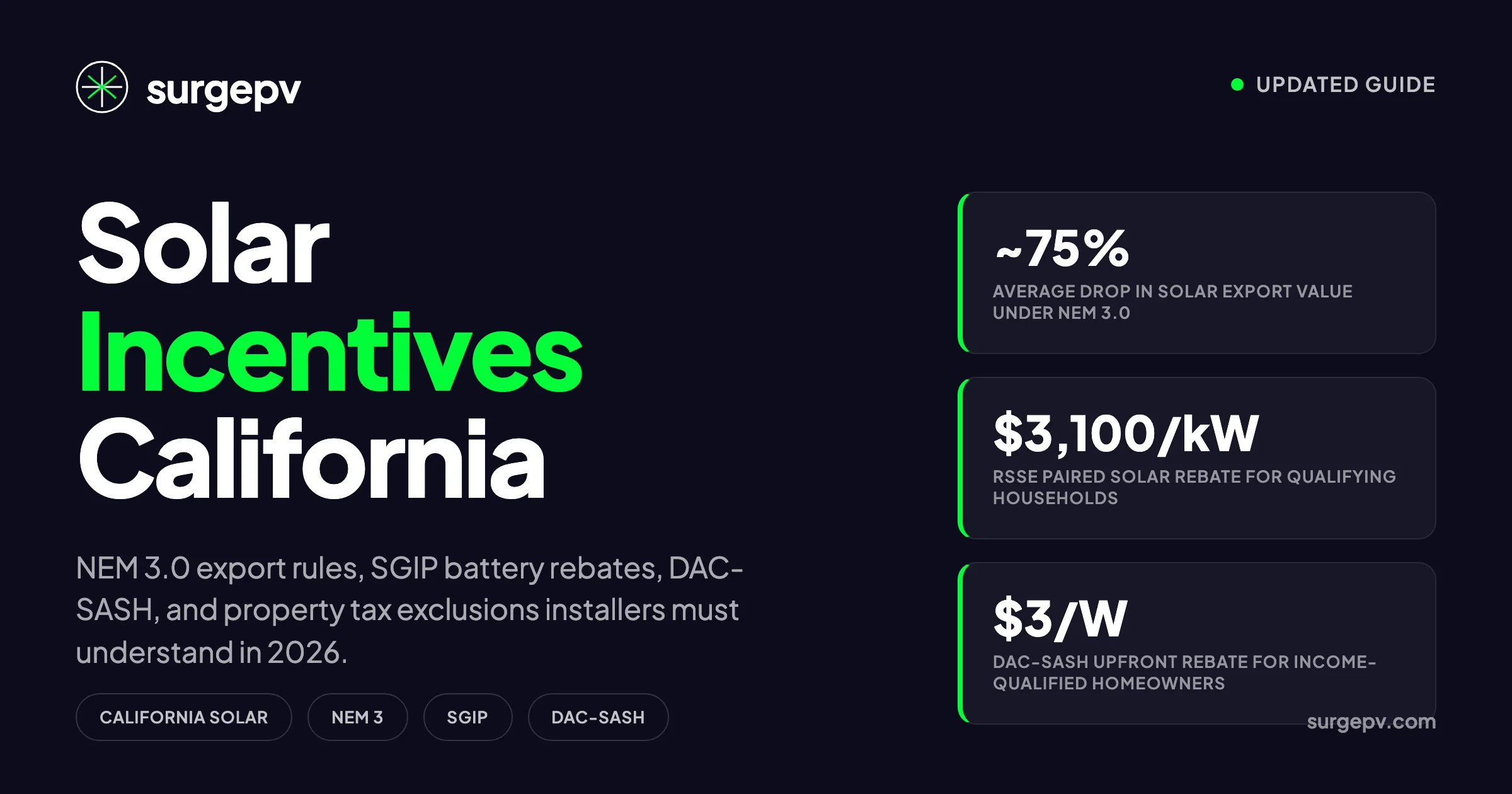
California reshaped its rooftop solar market three years ago. NEM 3.0, the state’s current net billing tariff, cut the value of solar exports by roughly 75% for customers of Pacific Gas and Electric (PG&E), Southern California Edison (SCE), and San Diego Gas & Electric (SDG&E). Then, on January 1, 2026, the federal Residential Clean Energy Credit under Section 25D expired for homeowner-owned systems. Those two changes turned the California incentive stack from a broad, automatic benefit into a narrow, eligibility-driven menu.
Installers who used to lead every sales call with “30% federal tax credit plus net metering” now have to explain why a project still works without either. The answer depends on the utility territory, the customer’s income, whether a battery is included, and how fast the paperwork can be filed. For example, a low-income household in a disadvantaged community can still combine DAC-SASH and the SGIP RSSE waitlist to cover most or all of a solar-plus-battery system. A high-income homeowner in the same ZIP code may have only the NEM 3.0 tariff and a property tax exclusion.
This guide covers every California solar incentive that matters in 2026. It explains NEM 3.0 export rates, the surviving SGIP pathways, income-qualified programs, the property tax exclusion deadline, and how to stack incentives without overpromising. For the federal policy context, see our post on tax credits for solar products. For market-level context, see US residential solar market trends 2026. SurgePV’s solar design software helps installers model these rules for every California project.
Quick Answer
In 2026, California solar incentives are narrower and targeted. New PG&E, SCE, and SDG&E customers fall under NEM 3.0 export credits averaging $0.05–$0.08/kWh. The federal Section 25D credit expired for homeowner-owned systems, but Section 48E remains for commercial and third-party-owned projects. State incentives include SGIP RSSE, DAC-SASH, SOMAH, and a property tax exclusion through 2026.
In this guide:
- How the federal and California incentive stacks changed in 2026.
- How NEM 3.0 export rates work and why time-of-use matters.
- Which SGIP battery rebates are still open and who qualifies.
- DAC-SASH, SOMAH, and other income-qualified programs.
- The California property tax exclusion deadline and what happens after 2026.
- The biggest mistake installers make when modeling NEM 3.0 savings.
- How to stack incentives and apply for each program.
How California Solar Incentives Changed in 2026
California solar incentives did not disappear in 2026. They became more conditional. Three shifts drive every proposal now.
The Federal Residential Credit Is Gone
The Residential Clean Energy Credit under Internal Revenue Code Section 25D allowed homeowners to claim 30% of qualified solar costs on their federal tax return. It expired on December 31, 2025, after the One Big Beautiful Bill Act terminated the credit rather than phasing it down. Homeowner-owned solar, battery, and solar water heating systems placed in service on or after January 1, 2026, no longer qualify.
Commercial projects and third-party-owned residential systems still have a path. Section 48E, the Clean Electricity Investment Tax Credit, offers a 30% credit for projects that begin construction by July 4, 2026, or are placed in service by December 31, 2027. That is why lease and PPA providers can still advertise lower monthly payments in 2026: they own the system and claim the credit.
NEM 3.0 Is the Law for New IOU Customers
The California Public Utilities Commission (CPUC) adopted NEM 3.0, officially the Net Billing Tariff, in December 2022. It took effect on April 15, 2023, for new interconnection applications filed with PG&E, SCE, and SDG&E. The tariff replaced full retail-rate credits with avoided-cost export rates that average $0.05–$0.08/kWh, according to CPUC Decision 22-12-056. That is roughly one-fourth to one-sixth of the retail rates that NEM 2.0 customers receive.
NEM 3.0 remains in effect while legal challenges work through the courts. The California Supreme Court sent the case back to the Court of Appeal for reconsideration in August 2025, and a ruling is expected in 2026. Until then, every new IOU interconnection is on NEM 3.0.
State Rebates Became Equity-Focused
California’s two largest remaining rebate programs are now aimed at low-income households and disadvantaged communities. The Self-Generation Incentive Program (SGIP) General Market, Equity, and Equity Resiliency budgets closed to new applicants on December 31, 2025. The only active residential SGIP pathway is the Residential Solar and Storage Equity (RSSE) budget created under Assembly Bill 209, which is fully reserved and operating on a waitlist.
The Disadvantaged Communities – Single-family Affordable Solar Homes (DAC-SASH) program remains active through 2030. The Solar on Multifamily Affordable Housing (SOMAH) program continues for deed-restricted affordable rental properties. Both are administered by nonprofits and require income verification.
| Incentive | 2025 Status | 2026 Status | Who Qualifies |
|---|---|---|---|
| Federal Section 25D residential credit | 30% for homeowner-owned systems | 0% for new homeowner-owned systems | No one for 2026 installs |
| Federal Section 48E commercial credit | 30% + bonuses | 30% + bonuses through 2027 | Commercial, lease, and PPA owners |
| NEM 2.0 retail-rate net metering | Closed to new applicants | Grandfathered systems only until April 15, 2026 PTO deadline | Systems with applications filed before April 15, 2023 |
| NEM 3.0 net billing | Active | Active for all new IOU applications | PG&E, SCE, SDG&E customers |
| SGIP General Market / Equity / Equity Resiliency | Open with waitlists in some territories | Closed December 31, 2025 | No new applicants |
| SGIP RSSE (AB 209) | Active | Waitlist only | Income-qualified IOU customers |
| DAC-SASH | Active | Active through 2030 | Low-income homeowners in disadvantaged communities |
| Active Solar Energy System property tax exclusion | Active | Active for systems completed by December 31, 2026 | All California solar owners |
What the New Incentive Stack Looks Like on a Real Bill
Numbers make the policy shift concrete. Take a 7 kW solar system on a Fresno home served by PG&E. Under NEM 2.0, that system might export 4,000 kWh per year at an average retail credit of $0.32/kWh, producing roughly $1,280 in annual export credits. Under NEM 3.0, the same export profile earns an average of $0.06/kWh, or about $240 per year. The $1,040 annual difference stretches the simple payback from roughly 7 years to 11 years for a solar-only system.
Add a 13.5 kWh battery and the picture changes. The battery stores midday solar and discharges during the 4 PM to 9 PM peak window, replacing grid imports at $0.40–$0.50/kWh. Instead of exporting at $0.06/kWh, the homeowner effectively earns the retail peak rate on stored energy. The battery also reduces reliance on the grid during PSPS events. The combined system payback falls back into the 8–10 year range, even without the federal tax credit.
This is why a California installer’s job in 2026 is not to sell the most panels. It is to design the right mix of solar, storage, and self-consumption for each utility territory and rate plan. Tools like battery storage design software help size storage correctly from the start.
NEM 3.0 / Net Billing Tariff: What New Solar Customers Actually Earn
NEM 3.0 is not a rebate or tax credit. It is the billing rule that determines how much a solar customer gets paid for exports. Because it shapes every other incentive, it is the first thing to model.
How NEM 3.0 Export Compensation Works
Under NEM 2.0, every kilowatt-hour sent to the grid earned a credit equal to the full retail rate at that hour, typically $0.28–$0.35/kWh after non-bypassable charges. Under NEM 3.0, exports are paid at the Avoided Cost Calculator (ACC) rate. The ACC publishes hourly values for each utility territory based on wholesale energy, capacity, and transmission values. The result is an average export credit of $0.05–$0.08/kWh for a typical solar-only system.
The ACC rate is highest on summer evenings, when grid demand peaks and wholesale prices spike. It is lowest in spring midday, when solar generation is abundant statewide and demand is moderate. A kilowatt-hour exported at noon in April might be worth $0.02–$0.05. The same kilowatt-hour exported at 7 PM in August might be worth $0.30–$0.60, or more during extreme heat events.
Mandatory Time-of-Use Rates
NEM 3.0 requires customers to enroll in a time-of-use (TOU) rate plan. The peak window for most plans is 4 PM to 9 PM daily, with summer peak rates reaching $0.40–$0.55/kWh. Off-peak overnight rates can fall below $0.12/kWh. The wide spread between midday export value and evening import cost is intentional: it rewards customers who store solar and discharge it during peak hours.
The ACC Plus Adder Steps Down Through 2028
PG&E and SCE residential customers who enrolled early in NEM 3.0 receive a temporary ACC Plus adder on top of the base ACC rate. The adder is locked for nine years from enrollment but declines 20% each year. By 2026, the adder for new enrollments is roughly 40% lower than it was at launch. SDG&E customers and commercial projects do not receive the adder.
NEM 2.0 Grandfathering Rules
Customers who submitted a complete interconnection application before April 15, 2023, are grandfathered on NEM 2.0 for 20 years from their Permission to Operate (PTO) date. There is a hard deadline: any grandfathered system that has not received PTO by April 15, 2026, falls to NEM 3.0. Adding a battery to an existing NEM 2.0 system does not affect grandfathered status.
The Municipal Utility Exception
NEM 3.0 applies only to the three investor-owned utilities. Los Angeles Department of Water and Power (LADWP) and Sacramento Municipal Utility District (SMUD) operate under their own net metering rules, which remain more favorable to solar-only systems. A homeowner in Burbank, Glendale, or Pasadena may also be served by a municipal utility with different terms. Always confirm the utility before modeling incentives.
| Feature | NEM 2.0 (grandfathered) | NEM 3.0 (new IOU systems) |
|---|---|---|
| Export credit basis | Full retail TOU rate | Avoided Cost Calculator |
| Typical export rate | $0.28–$0.35/kWh | $0.05–$0.08/kWh average |
| Peak export window | Same as retail peak | Summer evenings, 4–9 PM |
| Battery requirement | Optional | Effectively required for strong ROI |
| Annual true-up | Net surplus compensation over $100 | Surplus credits expire |
| Rate plan | TOU required | TOU required |
| Grandfather period | 20 years from PTO | None |
Sources: Baker Botts analysis of CPUC Decision 22-12-056; EnergySage NEM 3.0 legal update; California Solar & Storage Association.
Commercial, Agricultural, and Third-Party Solar Incentives
Residential homeowners who buy systems outright lost the federal credit in 2026. Commercial, industrial, agricultural, and third-party-owned projects still have a federal pathway, plus the same California property tax exclusion deadline.
Section 48E for Commercial and Lease/PPA Systems
Section 48E, the Clean Electricity Investment Tax Credit, offers a 30% credit for eligible clean electricity projects. Projects that begin construction by July 4, 2026, or are placed in service by December 31, 2027, can qualify. Projects over 1 MW AC must meet prevailing wage and apprenticeship requirements to receive the full 30% rate. Otherwise the base rate is 6%.
Bonus adders can push the total credit higher:
- Domestic content bonus: adds 10% for projects that meet U.S. manufacturing thresholds for steel, iron, and manufactured products.
- Energy community bonus: adds up to 10% for projects located in census tracts tied to fossil fuel employment or brownfield sites.
- Low-income bonus: adds up to 20% for certain qualified low-income residential buildings or economic benefit projects.
For lease and PPA providers, the credit is the reason they can still offer attractive monthly payments in 2026. The savings are indirect, but they are real. Homeowners who do not have enough tax liability to use a credit anyway may find a lease or PPA more attractive than a cash purchase in this environment.
Commercial Property Tax Exclusion Deadline
The active solar energy system property tax exclusion matters more for commercial and agricultural projects than for most homes. A 500 kW ground-mount array on a farm or warehouse can add hundreds of thousands of dollars in assessed value. Without the exclusion, the owner pays property tax on that added value every year. With the exclusion locked in before January 1, 2027, those taxes are avoided until the property sells.
Large C&I and ag projects often take 12–18 months from contract to Permission to Operate. That means a project that starts design in mid-2026 may miss the exclusion window. Contractors should flag this deadline in every commercial proposal.
NEM 3.0 for Commercial Customers
NEM 3.0 applies to commercial and agricultural customers of PG&E, SCE, and SDG&E as well. The same ACC-based export rates and TOU rate requirements apply. Commercial projects over 1 MW AC face additional complexity around hourly netting and export compensation. Accurate modeling is essential, because the dollar amounts are larger and the mistakes are more expensive.
California Battery Incentives: SGIP in 2026
The Self-Generation Incentive Program is California’s primary battery rebate. In 2026, it is no longer a broad market tool. It is a targeted resiliency and equity program.
Which SGIP Budgets Are Closed
Three SGIP budgets that dominated the market for years closed to new applications on December 31, 2025:
- General Market Residential: paid roughly $150–$200/kWh for any IOU residential customer.
- Equity: paid roughly $850/kWh for income-qualified households enrolled in CARE or FERA.
- Equity Resiliency: paid up to $1,000/kWh for customers in high fire-threat districts, on Medical Baseline, or in other high-need categories.
A middle-income homeowner who does not meet equity criteria cannot count on SGIP in 2026. Any installer who still lists the General Market rebate as a guaranteed line item in a standard proposal is using outdated assumptions.
The RSSE Waitlist Under AB 209
The Residential Solar and Storage Equity budget is the only active SGIP pathway for new residential applicants in 2026. It was created by Assembly Bill 209 and is funded with $280 million in state dollars, separate from ratepayer collections. As of early 2026, the budget is fully reserved, but new applications are accepted on a waitlist and funded when earlier reservations cancel or fail.
RSSE incentive levels are high enough to cover most or all of a small solar-plus-battery system:
- $3,100 per kW of paired solar capacity.
- $1,100 per kWh of battery storage capacity.
A typical 7 kW solar system paired with a 10 kWh battery could qualify for up to $21,700 for the solar and $11,000 for the battery, or $32,700 total. The rebate is reserved by an SGIP-registered installer on the customer’s behalf.
RSSE Eligibility Requirements
Qualifying households must meet all of the following:
- Income at or below 80% of Area Median Income, or enrollment in CARE, FERA, or ESA utility assistance programs.
- Residential electric service from PG&E, SCE, SDG&E, SoCalGas, or LADWP.
- Installation by an SGIP-registered contractor.
- Enrollment in a qualified Demand Response program within one year of reserving funds.
- System sized to actual electricity usage; batteries over 15 kWh for single-family homes require justification.
How to Apply
Homeowners cannot apply for SGIP directly. The installer submits the Incentive Claim Form through the utility’s SGIP portal. The rebate is usually applied as a reduction in the final invoice after the system passes inspection and receives Permission to Operate. Waitlist timing is uncertain, so installers should not promise a specific payment date.
The official budget tracker is at selfgenca.com.
Income-Qualified Solar Programs: DAC-SASH and SOMAH
California’s largest remaining solar rebates are reserved for low-income households and affordable housing. These programs often deliver more value than the expired federal credit ever did for qualifying customers.
DAC-SASH: Up to $3/W for Disadvantaged Communities
The Disadvantaged Communities – Single-family Affordable Solar Homes (DAC-SASH) program provides an upfront rebate of up to $3 per watt of installed solar capacity. A 5 kW system can receive up to $15,000, which frequently covers 80–100% of installation costs for qualifying households. The program is funded at $8.5 million per year and remains active through 2030.
DAC-SASH is administered by GRID Alternatives, a nonprofit that also provides workforce training. To qualify, a homeowner must:
- Receive electric service from PG&E, SCE, or SDG&E.
- Own and occupy a single-family home as a primary residence.
- Live in a Disadvantaged Community as defined by the CalEnviroScreen 4.0 map.
- Have household income within CARE or FERA limits.
Applications are submitted through GRID Alternatives. The rebate covers equipment and installation, but roof repairs, electrical panel upgrades, and permitting fees may still require out-of-pocket payment.
SOMAH: Solar on Multifamily Affordable Housing
The Solar on Multifamily Affordable Housing (SOMAH) program provides incentives for solar and paired storage at deed-restricted affordable rental properties. Unlike single-family rebates, SOMAH is structured so that a meaningful share of savings flows directly to tenants.
Incentive levels as of 2026 include:
- Up to $3.50 per AC watt for solar generation that serves tenant loads.
- Up to $1.19 per AC watt for solar generation that serves common areas.
The program is available to properties served by PG&E, SCE, SDG&E, or SoCalGas. Funding collections continue through June 30, 2026, and incentives are projected to remain available through 2032 or until funds are exhausted. Property owners apply through calsomah.org.
DAC-GT and CARE/FERA Bill Discounts
The Disadvantaged Communities Green Tariff (DAC-GT) is not a solar rebate, but it is relevant to the same households. It provides a 20% discount on electricity bills and 100% renewable energy to income-qualified customers in disadvantaged communities, with no rooftop solar required. It is a useful option for renters or homeowners whose roofs are unsuitable.
CARE and FERA are utility bill discount programs that reduce monthly electric rates by 18–35%. Enrollment in CARE or FERA is also the simplest way to prove eligibility for SGIP RSSE and DAC-SASH.
Property Tax, Sales Tax, and Other California Solar Perks
California does not offer a statewide income tax credit for solar, but it does offer a property tax exclusion that is now approaching a hard deadline.
Active Solar Energy System Property Tax Exclusion
California Revenue and Taxation Code Section 73 excludes active solar energy systems from property tax reassessment. That means adding solar does not increase the property’s assessed value or annual property tax bill. The exclusion has been extended many times since 1985, but it is currently scheduled to sunset on January 1, 2027.
According to guidance from the California State Board of Equalization, any active solar energy system completed before January 1, 2027, qualifies for the exclusion. Systems completed after that date may be assessed at market value and added to the tax roll. Systems that qualified before the sunset remain excluded until the property changes ownership.
For residential customers, the annual savings are modest, often a few hundred dollars per year. For commercial and agricultural properties with large arrays, the exclusion can be worth tens of thousands of dollars annually. That makes the 2026 deadline a real factor for C&I and ag project timelines.
No Statewide Sales Tax Exemption
California does not have a blanket sales tax exemption for residential solar equipment. Some local jurisdictions or manufacturers may offer limited exemptions for specific components, but most homeowners pay sales tax on the full system cost. Installers should not assume a sales tax exemption when quoting.
PACE Financing
Property Assessed Clean Energy (PACE) financing allows homeowners to finance solar and batteries with no money down and repay the cost through a property tax assessment over 10–20 years. PACE is active statewide, but it creates a lien on the property. That lien can complicate refinancing or home sales. Customers should review all terms before signing.
Local Utility Rebates
Several municipal utilities and community choice aggregators offer small additional rebates. These programs change frequently, so installers should verify the current budget before quoting.
- SMUD My Energy Optimizer Partner+: Sacramento Municipal Utility District customers can receive up to $5,400 per Tesla Powerwall, capped at $10,000 per household, plus ongoing virtual power plant payments for allowing SMUD to dispatch the battery during grid events.
- Alameda Municipal Power: Income-qualified homeowners with household income below roughly $106,000 can receive a one-time $500 rebate for a new solar system on a home built before 2020.
- Silicon Valley Clean Energy: Has offered battery rebates and electrification incentives for customers in its service territory, subject to annual budget cycles.
- Peninsula Clean Energy: Runs targeted incentives for battery storage and heat pump water heaters for customers in San Mateo County.
- Sonoma Clean Power: Offers the EverGreen program and has run electrification rebates for storage and EV charging in the past.
Community choice aggregators generally do not change net metering rules for customers in IOU territory, but they can change the generation rate portion of the bill. That matters because NEM 3.0 credits are based on avoided cost, not the full CCA generation rate. Always model the customer’s actual bundled or CCA rate schedule.
These local programs are worth checking, but they are not large enough to replace NEM 2.0 or the federal credit.
Who Benefits Most from California Solar Incentives in 2026?
The value of California’s 2026 incentive stack depends almost entirely on customer profile. Two households on the same street can see wildly different out-of-pocket costs.
High-Income Homeowner in IOU Territory
A household that earns too much for CARE or FERA and does not live in a designated disadvantaged community has the thinnest incentive stack. The federal residential credit is gone. SGIP General Market is closed. The household can still benefit from NEM 3.0 bill savings, but only if the system is paired with a battery and sized for self-consumption. The property tax exclusion helps, though the annual dollar impact on a modest home is small.
For this customer, solar in 2026 is a rate-arbitrage play. The project works because California retail electricity is expensive, not because subsidies are generous. The installer must show real payback based on hourly TOU rates and battery dispatch.
Low-Income Homeowner in a Disadvantaged Community
The same 7 kW system with a 10 kWh battery can look completely different. If the household qualifies for DAC-SASH and the SGIP RSSE waitlist, the upfront incentives can cover most or all of the project. DAC-SASH pays up to $15,000 on a 5 kW system. RSSE pays up to $11,000 on a 10 kWh battery. Even if the RSSE reservation is waitlisted, the DAC-SASH portion alone can reduce out-of-pocket cost to a few thousand dollars.
This is the sharpest divide in California solar policy today. The state has shifted subsidies toward equity, leaving middle- and upper-income buyers with little direct help. Installers who build a strong intake process for income-qualified programs will serve more customers and close more deals.
The Biggest Mistake California Installers Make Under NEM 3.0
The most common error is designing a system the same way installers designed under NEM 2.0. An oversized south-facing array that exports 40% of its annual production made sense when exports earned retail rates. Under NEM 3.0, that same design exports at $0.05/kWh and imports at $0.45/kWh. The homeowner loses money on every exported kilowatt-hour.
Design for Self-Consumption, Not Annual Offset
Under NEM 3.0, the goal is to consume solar on site during the hours it is produced or shift it to peak hours with a battery. That means:
- Size the battery to cover the 4 PM to 9 PM peak window, not the full daily load.
- Add west-facing panels or mix orientations to push production later in the day.
- Avoid oversized arrays that produce large midday surpluses.
- Model the customer’s actual TOU rate plan, because PG&E, SCE, and SDG&E structures differ significantly.
Model the Tariff, Not the Marketing Claim
Generic assumptions like “exports are worth 8 cents” miss the hourly variation that drives real savings. The ACC has 576 possible rate combinations across months, hours, and day types. A proposal that uses a flat export rate can overstate savings by 20–40%.
Installers should use design software that imports ACC tables and simulates battery dispatch. SurgePV’s generation and financial tool models NEM 3.0 rates, TOU plans, and SGIP incentives for California projects. For shading and production accuracy, pair it with shadow analysis. When it is time to present the numbers, solar proposal software keeps the incentive stack clear and defensible.
Model California Incentives Accurately in Every Proposal
NEM 3.0, SGIP waitlists, and the property tax deadline change the math on every project. SurgePV’s financial modeling applies the right rates, rebates, and ownership structures so your customer sees real payback.
Explore Financial ModelingNo commitment required · 20 minutes · Live project walkthrough
California Solar Incentives by Utility Territory
Not every California customer faces the same rules. The utility territory is the single largest variable.
| Utility | Net Metering Regime | SGIP Eligibility | Notes |
|---|---|---|---|
| PG&E | NEM 3.0 net billing | Yes, RSSE waitlist only | Large service territory, high rates, strong battery economics |
| SCE | NEM 3.0 net billing | Yes, RSSE waitlist only | High summer peak rates favor west-facing and storage |
| SDG&E | NEM 3.0 net billing | Yes, RSSE waitlist only | Highest retail rates in the state; storage payback is strong |
| LADWP | Own net metering rules | No SGIP | More favorable solar-only economics than IOUs |
| SMUD | Own net metering rules | No SGIP | Battery rebates available through local programs |
| Other municipal utilities | Varies by city | Usually no SGIP | Check local rules; some still offer full retail net metering |
A customer in San Jose served by PG&E faces a completely different financial picture from a customer in Sacramento served by SMUD. The same system size and equipment can produce a 7-year payback in one territory and a 14-year payback in another.
How to Stack Incentives and Apply
Stacking incentives correctly is more important than finding more incentives. A customer who qualifies for DAC-SASH and RSSE can reduce out-of-pocket costs to near zero. A customer who does not qualify needs a battery and realistic export assumptions to make the project work.
Step 1: Confirm the Utility and Tariff
Check the customer’s electric bill to confirm the utility. Then confirm whether the customer is on NEM 3.0 or a grandfathered NEM 2.0 tariff. This determines whether storage is essential or optional.
Step 2: Screen for Income-Qualified Programs
Ask early about CARE, FERA, or ESA enrollment and household income relative to the Area Median Income. Use the CalEnviroScreen map to check whether the address falls in a disadvantaged community. These two checks unlock DAC-SASH and RSSE.
Step 3: Choose the Ownership Structure
If the customer buys the system outright or with a loan, there is no federal residential credit in 2026. If the customer leases or enters a PPA, the financier may claim Section 48E and pass part of the savings through as lower monthly payments. For a deeper breakdown, see our solar financing options guide.
Step 4: Apply for Rebates Before Installation Where Required
DAC-SASH and SOMAH require pre-approval. SGIP RSSE is reserved by the installer during the sales process. Missing a deadline can move a customer from a funded reservation to the waitlist.
Step 5: Complete the System Before the Property Tax Deadline
For systems completed after December 31, 2026, the active solar energy system property tax exclusion may no longer apply. Residential projects should be designed, permitted, and installed with that deadline in mind. Large commercial projects that take 12–18 months should start immediately.
Step 6: Document Everything
Keep itemized invoices, interconnection agreements, proof of placed-in-service date, manufacturer certifications, and program approval letters. Incentives are increasingly audited, and missing paperwork can delay or cancel a rebate.
What a Stacked Incentive Looks Like
Consider a 5 kW solar system with a 10 kWh battery installed for a CARE-enrolled homeowner in a disadvantaged community served by SCE. The gross cost might be $28,000 before incentives.
- DAC-SASH rebate: 5,000 W × $3/W = $15,000.
- SGIP RSSE battery rebate: 10 kWh × $1,100/kWh = $11,000.
- Net out-of-pocket cost: approximately $2,000, plus any roof repairs or electrical upgrades.
Without those equity programs, the same homeowner would pay the full $28,000. The battery would still improve NEM 3.0 economics, but the payback period would be much longer. This example shows why intake screening is now as important as system design.
Conclusion
California solar incentives in 2026 are no longer automatic. The federal residential credit is gone, NEM 3.0 has reset export values, and the largest remaining rebates are reserved for low-income and disadvantaged communities. Installers who adapt their designs, proposals, and customer conversations will still find strong projects. Those who reuse 2023 sales scripts will overpromise and underdeliver.
- Confirm the utility territory and tariff before quoting any savings.
- Screen every customer for DAC-SASH, SGIP RSSE, and CARE/FERA eligibility.
- Complete systems before the December 31, 2026, property tax exclusion deadline.
For installers looking to model these moving parts accurately, SurgePV combines solar design, shading analysis, and incentive-aware financial modeling in one platform.
Frequently Asked Questions
What solar incentives are available in California in 2026?
California incentives in 2026 include NEM 3.0 net billing for PG&E, SCE, and SDG&E customers; the SGIP RSSE waitlist for income-qualified battery and paired-solar rebates; DAC-SASH up to $3/W for low-income homeowners in disadvantaged communities; SOMAH for multifamily affordable housing; a property tax exclusion through December 31, 2026; and federal Section 48E credits for commercial or third-party-owned systems through 2027.
How does NEM 3.0 affect solar savings in California?
NEM 3.0 replaced retail-rate credits with avoided-cost export rates that average $0.05–$0.08/kWh, roughly 75% lower than NEM 2.0. Solar-only payback periods stretched to 9–13 years, while solar-plus-storage systems that shift midday production to evening peak hours retain stronger economics.
Is the federal solar tax credit still available in California in 2026?
The federal residential credit under Section 25D expired for homeowner-owned systems installed after December 31, 2025. Commercial projects and third-party-owned residential systems such as leases and PPAs may still qualify for a 30% credit under Section 48E if construction begins by July 4, 2026, or systems are placed in service by December 31, 2027.
Is SGIP still available in California in 2026?
The General Market, Equity, and Equity Resiliency SGIP budgets closed to new applicants on December 31, 2025. The only active residential pathway is the income-qualified RSSE budget created under AB 209, which is fully reserved and accepting waitlist applications through SGIP-registered installers.
What is DAC-SASH and who qualifies?
DAC-SASH is the Disadvantaged Communities – Single-family Affordable Solar Homes program. It offers up to $3/W in upfront rebates for income-qualified homeowners who own and occupy a single-family home in a disadvantaged community, receive electric service from PG&E, SCE, or SDG&E, and meet CARE or FERA income limits. GRID Alternatives administers the program.
Does California have a state solar tax credit?
No. California has never offered a statewide income tax credit for residential solar. The state relies on rebates, net billing, and property tax exclusions instead. Homeowners often confuse the expired federal Section 25D credit with a state credit.
Will solar increase my property taxes in California?
Active solar energy systems installed before January 1, 2027, are excluded from property tax reassessment under California Revenue and Taxation Code Section 73. Systems completed after the sunset date may be assessed at market value and added to the property tax roll.
Do I need a battery with solar under NEM 3.0?
A battery is not legally required, but it is financially essential for most new IOU customers. NEM 3.0 pays very little for midday exports while evening retail rates remain high. A battery stores excess solar and discharges during peak hours, replacing grid imports worth $0.30–$0.55/kWh.
