

Answer
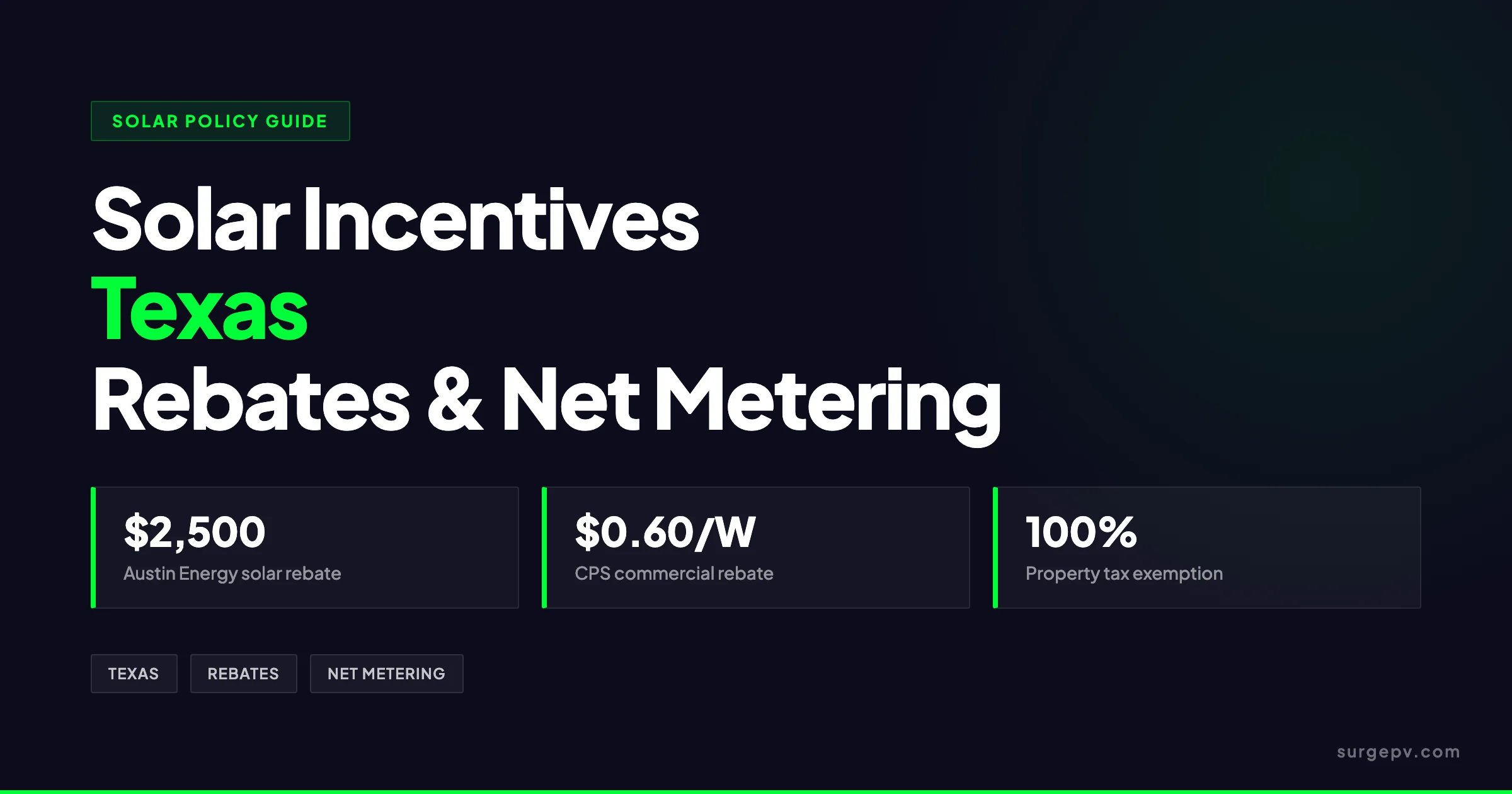
Texas has no statewide solar rebate or mandatory net metering, but homeowners can stack the federal Residential Clean Energy Credit, the 100% property tax exemption under Tax Code §11.27, and utility-specific rebates or solar buyback plans from Austin Energy, CPS Energy, and retail electric providers.
Texas is the second-largest solar market in the United States, with more than 53,000 MWdc of installed solar capacity as of mid-2026, according to SEIA. The state added the most solar of any state in 2025, driven by utility-scale projects and a growing residential pipeline. Yet for homeowners, the incentive picture is unusually fragmented. Texas has no state income tax, no statewide solar rebate, and no mandatory net metering law. What it does have is a deregulated electricity market, strong property tax protection, and a handful of municipal utilities that still write rebate checks.
Texas solar incentives in 2026 rest on three pillars: the federal Residential Clean Energy Credit where eligible, the 100% property tax exemption under Tax Code §11.27, and utility-specific rebates or solar buyback programs. In Austin, San Antonio, and parts of North Texas, the stack can be generous. In Houston, Dallas-Fort Worth, and the rest of ERCOT territory, the value of your system depends heavily on which retail electric provider you choose.
This guide explains every active incentive, how net metering works in practice, which utilities offer real rebates, and how to stack the programs without leaving money on the table. For installers and EPCs, understanding these details is the difference between a proposal that closes and one that gets shelved.
Quick Answer
Texas has no statewide solar rebate or mandatory net metering, but homeowners can stack the federal Residential Clean Energy Credit when available, the 100% property tax exemption under Tax Code §11.27, and utility-specific rebates or solar buyback plans from Austin Energy, CPS Energy, and retail electric providers serving ERCOT.
TL;DR — Texas Solar Incentives 2026
Active programs: federal Residential Clean Energy Credit for eligible systems, Texas Tax Code §11.27 property tax exemption, Austin Energy $2,500 solar rebate plus battery pilot, CPS Energy commercial solar rebates at $0.60/W AC, and voluntary solar buyback plans from retail electric providers. Residential CPS rebates are subject to annual funding. No state income tax credit. No mandatory net metering. File Form 50-123 for the property tax exemption.
In this guide:
- Texas solar market snapshot and why incentives look different here
- Federal solar tax credit: current status and how to claim it
- Texas property tax exemption: Form 50-123 explained
- Utility rebates by region: Austin, San Antonio, Dallas-Fort Worth, El Paso
- Solar buyback plans and how they replace net metering
- Battery incentives and virtual power plant programs
- How to stack incentives in the right order
- Real 2026 payback examples for Houston, Austin, and Dallas
- Common misconceptions and mistakes
Texas Solar Market Snapshot: Why Incentives Look Different
Texas installed roughly 15 GWdc of solar in 2025, the most of any U.S. state, according to SEIA. Total installed capacity now exceeds 53,000 MWdc, enough to power more than 6.5 million homes. The state ranks second nationally in cumulative solar capacity and first in projected growth over the next five years.
That growth is driven largely by utility-scale projects serving corporate offtakers and data center load. Residential solar is smaller but expanding, especially in Austin, San Antonio, Houston, and Dallas-Fort Worth. The reason incentives feel confusing is structural. Texas does not have a single state regulator setting uniform solar rules. Instead, three different market structures operate side by side:
- Deregulated ERCOT territory: About 90% of Texas load. Homeowners choose a Retail Electric Provider (REP). The REP decides whether to offer a solar buyback plan and at what rate.
- Municipally owned utilities (MOUs): Austin Energy, CPS Energy in San Antonio, Garland Power & Light, and others. These utilities set their own rebate and crediting rules.
- Electric cooperatives: Rural areas served by member-owned co-ops. Policies vary by co-op.
This patchwork means the same 8 kW system can have very different economics in Austin, Houston, or a rural co-op territory. The good news is that some of the best programs are available in the state’s largest metros.
Federal Solar Tax Credit: Current Status in 2026
The federal Residential Clean Energy Credit under Internal Revenue Code §25D historically allowed homeowners to deduct 30% of qualified solar electric property, solar water heating, small wind, geothermal heat pump, fuel cell, and battery storage costs from federal income tax. The credit applied to the full installed cost, including equipment, labor, wiring, and permits. Current rules are maintained by the IRS Residential Clean Energy Credit page.
As of mid-2026, the credit’s availability for new residential solar installations is uncertain. Several industry sources report that the residential credit expired for systems placed in service after December 31, 2025, under federal legislation. The IRS has not prominently confirmed a 2026 extension on its public-facing guidance. Homeowners should verify current eligibility with a tax professional or the latest IRS guidance before signing a contract based on the credit.
Systems placed in service in 2025 can still be claimed on the 2025 tax return using IRS Form 5695. The credit is non-refundable, meaning it can reduce federal tax liability to zero, and unused amounts carry forward to future tax years.
For leased systems and power purchase agreements, the installer or financing company may still be able to claim a commercial credit under Section 48E and pass part of the savings through as lower monthly payments. That structure does not require the homeowner to have tax liability.
Installers should be careful. Promising a 30% federal credit for a 2026 installation without verifying current law is a consumer-protection risk. The safer approach is to model both scenarios: with and without the federal credit.
Texas Property Tax Exemption: The One Incentive Every Homeowner Gets
Texas has some of the highest property tax rates in the country. Without an exemption, a $25,000 solar system could raise the annual tax bill by $350 to $625, depending on the county. Over 25 years, that is $8,750 to $15,625 in extra taxes.
Texas Tax Code §11.27 eliminates that cost. The added value of a solar or wind-powered energy device is 100% exempt from property taxation. The home itself can still appreciate for other reasons, but the solar equipment value is excluded. The exemption is administered through the Texas Comptroller Form 50-123.
How to claim the exemption
Homeowners must file Form 50-123, “Exemption Application for Solar or Wind-Powered Energy Devices,” with the county appraisal district. The filing window is typically January 1 through April 30 of the year following installation. It is a one-time filing; the exemption stays with the property for the life of the system.
Required documentation usually includes:
- A completed Form 50-123
- Proof of installation, such as the final invoice or interconnection approval
- A description of the system and its capacity
Installers can add real value by giving the homeowner a completed exemption packet at handover. Many homeowners never file and unknowingly pay higher taxes for years.
Utility Rebates: Where Texas Actually Writes Checks
Texas does not have a statewide rebate program, but several municipal utilities and one investor-owned utility offer direct incentives. These are the most important programs for residential customers in 2026.
Austin Energy
Austin Energy has run one of the longest-running residential solar rebate programs in the country. In 2026, the program offers a $2,500 flat rebate for qualifying residential systems, listed on the utility’s residential rebates page.
Key requirements:
- The system must be at least 3 kW
- The homeowner must complete Austin Energy’s solar education course
- Installation must be performed by an Austin Energy-approved contractor
- Pre-approval is required before installation begins
Austin Energy also operates the Value of Solar (VoS) program. Instead of traditional net metering, the utility pays a fixed credit for every kilowatt-hour the system produces, regardless of whether it is used on-site or exported. The VoS rate is recalculated annually and was approximately 9.91 cents per kWh in recent filings. Credits roll over indefinitely and can offset future bills.
For batteries, Austin Energy’s Power Partner Battery pilot offers:
- $500 upfront rebate for each battery that receives Permission to Operate after February 18, 2025
- Annual performance payments based on battery size, backup reserve level, and event hours
- Participation limited to approved battery models from Tesla, FranklinWH, SolarEdge, and Enphase
The battery must be third-party-owned by the homeowner; leased batteries do not qualify.
CPS Energy (San Antonio)
CPS Energy’s residential solar rebate program has offered upfront incentives in the past, but current levels depend on annual budgets. Homeowners should check the current status before quoting a project, because funds can be exhausted before year-end.
For commercial systems under 100 kW AC, CPS Energy currently offers $0.60 per AC watt for the first 25 kW and $0.40 per AC watt for capacity above 25 kW, with caps and local-module premiums. This is the most clearly active solar rebate path in San Antonio as of 2026.
CPS Energy also runs a Home Battery Rebate pilot offering up to $2,500 for home batteries enrolled in grid services. The program is budget-limited and may have equipment and installer requirements.
CPS Energy compensates exported solar at avoided-cost or market rates rather than full retail net metering. Homeowners should model savings assuming most solar is consumed on-site.
Oncor (Dallas-Fort Worth and North Texas)
Oncor is a transmission and distribution utility, not a retail electric provider. It does not sell electricity directly to homeowners. Oncor’s Take a Load Off Texas program focuses on commercial and low-income residential energy efficiency. Some solar-plus-storage rebates have appeared in past program cycles, but standard Oncor territory homeowners typically rely on federal incentives and their chosen REP’s buyback plan.
Homeowners in Oncor territory should focus on selecting the best solar buyback REP rather than waiting for a utility rebate.
El Paso Electric
El Paso Electric offers a Grid-Tied Solar Program with rebates up to $0.40 per watt for qualifying residential solar. Program caps and availability vary by year. Exported energy is credited at avoided-cost rates, with unused credits paid out by check once they exceed $50.
Other municipal programs
Several smaller utilities offer incentives that can stack with other programs:
| Utility / City | Incentive | Approximate Value | Notes |
|---|---|---|---|
| Austin Energy | Residential solar rebate | $2,500 flat | Requires approved contractor and solar education course |
| CPS Energy | Commercial solar rebate | $0.60/W AC first 25 kW | Active for small business, schools, nonprofits |
| El Paso Electric | Grid-tied solar rebate | Up to $0.40/W | Caps vary by year |
| AEP Texas SMART Source | Solar rebate | Up to $3,000 | Available in AEP Texas Central and North territories |
| City of San Marcos | Solar PV rebate | $1/W, cap $2,500 | Cannot exceed 50% of system cost |
| Sunset Valley | Solar PV rebate | $1/W, cap $3,000 | Must also qualify for Austin Energy rebate |
| Denton Municipal Electric | GreenSense rebate | $0.40-$1.50/W, cap $30,000 | Residential and commercial |
Installers should verify current program details directly with each utility before quoting, because rebate levels and funding windows change frequently.
Solar Buyback Plans: Texas’s Net Metering Substitute
Net metering is not mandated in Texas. In ERCOT’s deregulated market, homeowners must shop for a REP that offers a solar buyback plan. The quality of these plans varies enormously, and the wrong plan can cut solar savings by 30% or more.
Types of buyback compensation
- Full retail rate: The best option. Exported kWh are credited at the same rate you pay for imported kWh. This is functionally equivalent to 1:1 net metering.
- Blended or time-of-use rate: Credits vary by hour, often tied to wholesale market prices.
- Wholesale or avoided-cost rate: Credits are based on ERCOT real-time prices, which can be very low outside peak hours.
- Fixed export rate: A set cents-per-kWh value that does not change with market prices.
Retail electric providers with solar buyback plans
Several REPs actively market solar buyback plans in 2026:
| Retail Electric Provider | Plan Name | Typical Compensation |
|---|---|---|
| Green Mountain Energy | Renewable Rewards | Full retail rate credit |
| Reliant | Solar Payback Plus | Buyback credit structure |
| TXU | Solar Buyback Saver | Avoided-cost or fixed export rate |
| Octopus Energy | Octo 12 | Time-of-use export rates |
| Chariot Energy | Solar Buyback | Retail or near-retail credits |
| Direct Energy | Direct Solar Unlimited | Buyback plan |
| Gexa Energy | Solar Export | Export credits |
| Shell Energy | Solar Buyback | Export credits |
| Rhythm | Texas SB Select | Buyback plan |
| Ambit Energy | Total Solar Buyback | Export credits |
Homeowners should read the fine print carefully. Important questions to ask:
- Is the buyback rate guaranteed for the contract term?
- Is there a monthly cap on exported kWh?
- Do credits roll over, or reset monthly?
- Are there demand charges or base fees that reduce savings?
- What happens if the REP discontinues the plan?
For installers, the REP choice should be part of every proposal. A system sized for one buyback rate may be oversized or undersized for another.
Regulated utility territories
In regulated areas, the utility sets the rules. Austin Energy uses Value of Solar credits. CPS Energy uses avoided-cost export credits. El Paso Electric and Entergy Texas offer specific interconnection schedules. CoServ credits exports at wholesale rates with indefinite rollover. Homeowners in regulated territories cannot shop for a better plan, so the utility’s rules determine project economics.
Battery Incentives and Virtual Power Plants
Batteries are becoming a larger part of the Texas solar conversation for two reasons: power outages and weak buyback rates. If your REP pays only wholesale rates for exports, storing excess solar for evening use is often more valuable than selling it.
Texas has no statewide battery rebate, but several programs exist:
- Austin Energy Power Partner Battery: $500 upfront plus annual performance payments
- CPS Energy Home Battery Rebate: Up to $2,500 for enrolled batteries
- Tesla Electric Virtual Power Plant: Powerwall owners in parts of Oncor and CenterPoint territory can receive bill credits for allowing Tesla to dispatch stored energy
- Oncor Residential Solar Program: Historically offered solar-plus-storage incentives; check current cycle
Virtual power plant programs will grow in importance. ERCOT’s grid faces tight reserve margins, and aggregators are willing to pay homeowners for access to stored energy during peak events. A battery that earns $300 to $800 per year in grid services can materially improve payback.
For more on battery sizing and selection, see which solar battery is the best and the battery storage glossary.
How to Stack Texas Solar Incentives in the Right Order
The order in which you claim incentives matters. The correct sequence is:
- Confirm federal credit eligibility. If the Residential Clean Energy Credit is available for your installation year, it applies to the net cost after upfront rebates.
- Apply for utility rebates before installation. Austin Energy, CPS Energy, and most municipal programs require pre-approval. Retroactive applications are usually void.
- Subtract upfront rebates before calculating the federal credit. The tax credit basis is generally the amount paid after rebates.
- File Form 50-123 after installation. Submit the property tax exemption application in the year following installation.
- Select a solar-friendly REP in deregulated territory. Do this after interconnection is approved and you know your actual export profile.
Example: 8 kW system in Austin Energy territory
| Line item | Value |
|---|---|
| Gross system cost | $22,000 |
| Austin Energy solar rebate | -$2,500 |
| Net cost | $19,500 |
| Federal credit at 30% (if eligible) | -$5,850 |
| Effective cost | $13,650 |
| Annual bill offset + VoS credits | ~$2,000-$2,400 |
| Estimated simple payback | 6-8 years |
Example: 8 kW system in Houston (Oncor territory, no utility rebate)
| Line item | Value |
|---|---|
| Gross system cost | $22,000 |
| Federal credit at 30% (if eligible) | -$6,600 |
| Effective cost | $15,400 |
| Annual bill offset with strong buyback plan | ~$1,600-$1,900 |
| Estimated simple payback | 8-10 years |
Without the federal credit, both examples shift payback out by 2 to 4 years. This is why 2026 proposals should always show a no-federal-credit scenario. For more on financing structures, see the solar financing options guide.
2026 Payback Scenarios by City
Payback depends on system cost, electricity rate, solar production, rebates, and buyback plan. Here are realistic ranges for an 8 kW residential system installed in 2026.
| City / Utility | Gross Cost | Utility Rebate | Effective Cost After Incentives | Annual Savings | Simple Payback |
|---|---|---|---|---|---|
| Austin (Austin Energy) | $22,000 | $2,500 | $13,650-$19,500 | $2,000-$2,500 | 6-9 years |
| San Antonio (CPS Energy) | $22,000 | Variable | $15,400-$22,000 | $1,800-$2,200 | 8-11 years |
| Dallas-Fort Worth (Oncor + REP) | $22,000 | $0 | $15,400-$22,000 | $1,500-$2,000 | 8-12 years |
| Houston (CenterPoint + REP) | $22,000 | $0 | $15,400-$22,000 | $1,400-$1,900 | 9-13 years |
| El Paso (El Paso Electric) | $22,000 | Up to $3,200 | $12,340-$22,000 | $1,600-$2,000 | 7-11 years |
These ranges assume a federal credit is either partially or fully available. If the federal credit is not available, add $6,000 to $7,000 to the effective cost and roughly 2 to 4 years to payback.
Common Misconceptions About Texas Solar Incentives
Misinformation costs homeowners money. Here are the most common myths we hear from installers and customers.
Myth 1: Texas has a state solar tax credit. False. Texas has no state income tax, so a state tax credit is impossible. The property tax exemption is the only statewide tax benefit.
Myth 2: Texas has mandatory net metering. False. Net metering is not required by state law. In ERCOT territory, buyback plans are voluntary and vary by REP.
Myth 3: All solar buyback plans are the same. False. Rates range from full retail to wholesale. Some plans cap exports or reset credits monthly. The plan you choose can change payback by several years.
Myth 4: The property tax exemption is automatic. False. Homeowners must file Form 50-123 with the county appraisal district.
Myth 5: Solar rebates apply after installation without pre-approval. False. Austin Energy, CPS Energy, and most municipal programs require pre-approval. Installing first and applying later usually means losing the rebate.
What Installers and EPCs Should Model in 2026
A competitive Texas solar proposal in 2026 should include:
- Two federal credit scenarios: with and without the 30% credit
- The correct utility rebate based on the customer’s service territory
- A property tax exemption savings estimate over 25 years
- At least two REP buyback comparisons in deregulated territory
- A battery option with utility-specific VPP or rebate values
- A clear note that incentive programs change and the customer should verify current eligibility
SurgePV’s solar design platform and solar proposals tool let installers model stacked incentives, utility-specific buyback rates, and battery value by territory. For complex financial modeling, the PV generation and financial modeling can run NPV and payback across multiple scenarios.
Conclusion: Three Actions to Take This Week
Texas solar incentives in 2026 reward homeowners who do their homework and installers who quote accurately. The situation is fragmented, but the money is real for those who stack programs correctly.
- Verify your service territory and available programs. Austin Energy, CPS Energy, and ERCOT deregulated areas have completely different rules.
- Get pre-approval before installation. Utility rebates are not retroactive.
- File Form 50-123 after installation. The property tax exemption is the one incentive every Texas solar owner should claim.
For installers looking to streamline proposal accuracy across Texas markets, book a SurgePV demo to see how territory-specific incentives and buyback rates can be built into every quote.
Frequently Asked Questions
What solar incentives are available in Texas in 2026? Texas homeowners can access the federal Residential Clean Energy Credit when available, the 100% property tax exemption for solar under Texas Tax Code §11.27, and utility-specific rebates or solar buyback programs. Austin Energy offers a $2,500 residential solar rebate plus battery incentives. CPS Energy offers commercial solar rebates at $0.60 per AC watt for the first 25 kW; residential rebates are subject to annual funding and should be verified directly. Many retail electric providers offer voluntary solar buyback plans. Texas has no state income tax credit and no mandatory statewide net metering.
Does Texas have net metering for solar? Texas does not have a mandatory statewide net metering law. In the deregulated ERCOT market, which covers about 90% of the state, homeowners must choose a retail electric provider that offers a solar buyback plan. Some municipally owned utilities like Austin Energy and CPS Energy offer their own crediting mechanisms. Compensation varies from full retail rate to wholesale or avoided-cost rates.
Is there a state solar tax credit in Texas? No. Texas does not levy a state income tax, so there is no state solar tax credit. The main tax benefit is the 100% property tax exemption for renewable energy systems, which prevents the added value of a solar installation from increasing your property tax bill. Homeowners must file Form 50-123 with their county appraisal district.
How does the federal solar tax credit work in Texas? The federal Residential Clean Energy Credit under Internal Revenue Code §25D historically allowed homeowners to claim 30% of qualified solar and battery costs. As of mid-2026, eligibility for new residential solar installations placed in service is uncertain due to federal legislative changes. Homeowners should verify current IRS guidance before relying on the credit. Systems placed in service in 2025 may still qualify on the 2025 tax return using IRS Form 5695.
What is the Austin Energy solar rebate in 2026? Austin Energy offers a $2,500 flat rebate for qualifying residential solar systems, provided the homeowner completes a solar education course and uses an approved contractor. The utility also pays Value of Solar bill credits, currently around 9.91 cents per kWh for solar production. A separate Power Partner Battery pilot offers a $500 upfront battery rebate plus annual performance payments.
What is the CPS Energy solar rebate in 2026? CPS Energy in San Antonio has historically offered residential solar rebates, but current availability and amounts are subject to annual program budgets and change frequently. The utility actively offers commercial solar rebates at $0.60 per AC watt for the first 25 kW. Homeowners should verify current residential rebate status directly with CPS Energy. CPS Energy also runs a Home Battery Rebate pilot that offers up to $2,500 for batteries enrolled in grid services.
Do solar panels increase property taxes in Texas? No. Under Texas Tax Code §11.27, the added value of a solar or wind-powered energy device is 100% exempt from property taxation. The exemption is not automatic. Homeowners must file Form 50-123 with their county appraisal district, typically between January 1 and April 30 of the year following installation.
What is a solar buyback plan in Texas? A solar buyback plan is a retail electricity contract that credits homeowners for surplus solar energy exported to the grid. Unlike true net metering, buyback rates and rules vary by provider. Some plans credit at full retail rate, others at wholesale or avoided-cost rates, and some cap monthly export credits. Popular providers include Green Mountain Energy, Reliant, TXU, Octopus Energy, and Chariot Energy.
Are solar batteries incentivized in Texas? There is no statewide battery incentive, but several utility programs exist. Austin Energy’s Power Partner Battery pilot offers $500 upfront plus performance payments. CPS Energy has a Home Battery Rebate pilot up to $2,500. Some retail electric providers and virtual power plant programs, including Tesla Electric, also pay battery owners for grid services. The federal battery storage credit should be verified against current IRS guidance.
What is the payback period for solar in Texas? A typical residential solar system in Texas pays back in 7 to 12 years, depending on system cost, electricity rate, utility rebates, buyback plan, and whether a battery is included. In Austin Energy territory with the $2,500 rebate and favorable Value of Solar credits, payback can fall near 7 to 9 years. In areas with weak buyback rates and no utility rebate, payback may stretch to 10 to 14 years.
Where this fits
This article is part of SurgePV's Solar Incentives & Policy hub, which works through the topic from first principles to the decisions a project team actually has to make.

