

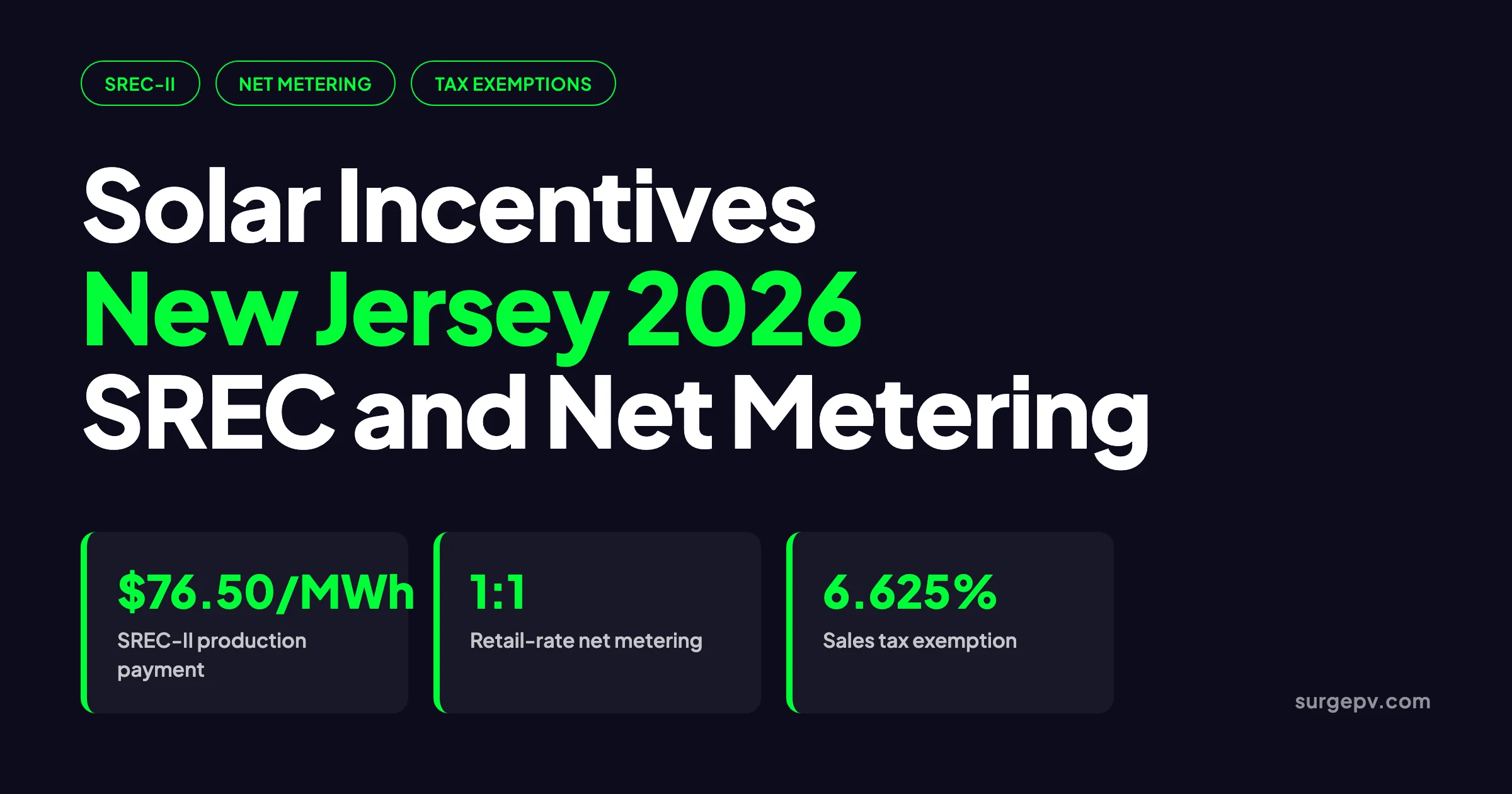
Solar incentives New Jersey homeowners can use in 2026 no longer include the 30% federal residential tax credit. The change hit every state equally. New Jersey is one of the few places where the remaining state stack is strong enough to keep residential solar attractive. The SuSI SREC-II program still pays homeowners for every megawatt-hour their panels produce. Net metering still credits excess power at the full retail rate. Two permanent tax exemptions remove thousands of dollars from the lifetime cost.
Installers now face a harder pitch. They cannot lead with a federal credit that no longer exists for homeowner-owned systems. They must instead explain SREC-II registration, net metering true-up rules, and why system sizing matters more than ever. A proposal that repeats 2024 assumptions will understate the real economics and may lose the sale.
This guide covers solar incentives New Jersey homeowners can still use in 2026. It explains the SuSI SREC-II program, net metering, sales and property tax exemptions, and community solar. It also shows how to stack these incentives and the mistakes that cost homeowners money. For federal context, see our post on solar tax credit 2026. For installers modeling these variables, SurgePV combines solar design with incentive-aware financial analysis.
Quick Answer
In 2026, New Jersey solar incentives are led by the SuSI Administratively Determined Incentive (ADI) SREC-II program, which pays a fixed rate per MWh of solar production for 15 years. Retail-rate net metering credits excess generation at the full retail rate, while sales and property tax exemptions remove thousands from lifetime system cost. The federal Section 25D residential tax credit expired December 31, 2025.
In this guide:
- How New Jersey solar incentives changed in 2026.
- How the SuSI SREC-II program works and what it pays.
- Net metering rules and why annual true-up matters.
- Sales tax and property tax exemptions.
- Community solar and battery storage options.
- How to stack incentives and apply correctly.
- The most common installer mistakes and how to avoid them.
Solar Incentives New Jersey: How the Stack Changed in 2026
Three shifts drive every New Jersey solar proposal in 2026. The federal residential credit is gone. The SREC-II rate dropped for late registrations. Net metering remains generous but requires careful sizing.
The Federal Residential Credit Ended
The Residential Clean Energy Credit under Section 25D let homeowners claim 30% of qualified solar costs on their federal return. It expired on December 31, 2025, for property placed in service after that date, according to the IRS. Homeowner-owned solar and battery systems installed in 2026 no longer qualify.
Commercial projects and third-party-owned residential systems still have a path. Section 48E, the Clean Electricity Investment Tax Credit, offers a 30% credit. Projects qualify if construction begins by July 4, 2026, or if systems are placed in service by December 31, 2027. That is why some lease and PPA providers can still advertise lower monthly payments in 2026.
SREC-II Rates Dropped for New Registrations
New Jersey replaced its original volatile SREC market with the Successor Solar Incentive (SuSI) program in 2021. SuSI’s Administratively Determined Incentive (ADI) track sets fixed SREC-II prices rather than letting them float. Systems registered before March 6, 2026, locked in $85 per MWh for 15 years. Systems registered on or after March 6, 2026, receive $76.50 per MWh for the same 15-year term, according to industry reporting on the NJBPU rate adjustment.
The rate is fixed at registration and cannot be reduced later for that system. Waiting has a real cost. A homeowner who delayed from February to March 2026 gave up $8.50 per MWh for 15 years.
Net Metering Is Still Generous but Not Unlimited
New Jersey remains one of the stronger net metering states in 2026. Major utilities credit excess solar exports at the full retail rate. Credits roll over month to month. The catch is the annual true-up. Any credits left after 12 months are paid out at the lower wholesale rate. That makes oversizing a poor strategy.
| Incentive | 2025 Status | 2026 Status | Who Qualifies |
|---|---|---|---|
| Federal Section 25D residential credit | 30% for homeowner-owned systems | 0% for new homeowner-owned systems | No one for 2026 installs |
| Federal Section 48E commercial credit | 30% + bonuses | 30% + bonuses through 2027 | Commercial, lease, and PPA owners |
| SuSI ADI SREC-II residential rate | $85/MWh for registered systems | $76.50/MWh for systems registered on/after March 6, 2026 | Net-metered residential systems |
| Net metering | Retail-rate credits | Retail-rate credits with annual true-up | Customer-generators of eligible utilities |
| Solar sales tax exemption | 6.625% waived | 6.625% waived | Purchasers of qualifying solar equipment |
| Property tax exemption | Active | Active | Certified renewable energy systems |
Sources: IRS Residential Clean Energy Credit; New Jersey Clean Energy Program Renewable Energy.
How the SuSI SREC-II Program Works
SREC-II stands for Solar Renewable Energy Certificate II. It is the production-based incentive that replaced New Jersey’s original SREC market. The program lives inside the Successor Solar Incentive (SuSI) framework. The New Jersey Board of Public Utilities administers it through the New Jersey Clean Energy Program.
One Certificate per MWh
For every 1,000 kilowatt-hours (1 megawatt-hour) of electricity a qualifying solar system produces, it earns one SREC-II. A typical 8 kW residential system in New Jersey produces roughly 9,500 to 10,500 kWh per year. That equals 9.5 to 10.5 SREC-IIs annually.
Production is tracked through the PJM Generation Attribute Tracking System (GATS). The SREC-II administrator, InClime, processes payments quarterly based on recorded generation.
Fixed Payments for 15 Years
The ADI track pays a fixed price per SREC-II rather than a market price. Residential net-metered systems registered before March 6, 2026, lock in $85 per MWh. Systems registered on or after that date lock in $76.50 per MWh. The rate stays fixed for the system’s 15-year qualification life.
For an 8 kW system producing 10 MWh per year, the annual SREC-II income is roughly $765 at the post-March 2026 rate. Over 15 years, that totals about $11,475. At the older $85 rate, the same system would have earned $12,750.
Who Qualifies
Most residential rooftop systems up to 5 MW AC that are net-metered qualify for the ADI track. Key requirements include:
- The system must be installed by a participating contractor and registered before construction begins.
- The homeowner must obtain a New Jersey Certification Number after installation.
- The system must be connected to the grid and producing energy.
- A GATS account must be opened to track certificates.
- The homeowner must register with the SREC-II administrator to receive payments.
Do-it-yourself installations generally do not qualify for SREC-II. That single decision can erase $10,000 or more in lifetime income.
Commercial and Competitive Tracks
SuSI also includes a Competitive Solar Incentive (CSI) track for larger commercial and utility-scale projects over 5 MW. Those projects bid for capacity and receive different pricing. This guide focuses on residential net-metered systems, which fall under ADI.
| System Size | Typical Annual Production | SREC-IIs per Year | Annual Income at $76.50/MWh | 15-Year Income |
|---|---|---|---|---|
| 6 kW | 7,200 kWh | 7.2 | $551 | $8,265 |
| 8 kW | 9,600 kWh | 9.6 | $734 | $11,010 |
| 10 kW | 12,000 kWh | 12.0 | $918 | $13,770 |
| 12 kW | 14,400 kWh | 14.4 | $1,102 | $16,530 |
These production figures assume roughly 1,200 kWh per kW of installed capacity per year in New Jersey. Actual output varies by roof orientation, shading, and equipment.
Sources: New Jersey Clean Energy Program Renewable Energy; Solar Info Path NJ SREC-II 2026 analysis.
Net Metering in New Jersey
Net metering is the second half of New Jersey’s solar value proposition. It works alongside SREC-II. One reduces the electric bill. The other pays for production.
Full Retail Rate Credits
New Jersey utilities credit exported solar electricity at the full retail rate. If a homeowner pays 18 cents per kWh for power from the grid, the utility credits 18 cents per kWh for excess solar sent back. This 1:1 exchange is one reason solar economics remain strong in New Jersey even without the federal credit.
The major investor-owned utilities offering net metering are PSE&G, Jersey Central Power & Light (JCP&L), Atlantic City Electric, and Rockland Electric. Each has its own interconnection process, but the compensation framework is similar.
Monthly Rollover and Annual True-Up
Credits roll over month to month within a 12-month annualized billing period. A home that overproduces in July can use those credits in January. At the end of the annual true-up month, any remaining surplus credits are paid out at the utility’s avoided wholesale cost. That rate is typically much lower than the retail rate.
This is the detail many homeowners miss. A system sized to produce 130% of annual usage will generate surplus credits. The homeowner receives only wholesale value for that surplus. Sizing closer to 100% of annual usage captures more value.
Why Sizing Matters More Than Ever
Without the federal tax credit, every dollar of bill savings and SREC-II income matters more. A properly sized system maximizes retail-rate offset and minimizes wholesale true-up losses. The goal is to cover annual usage, not to build a power plant.
For installers, accurate load modeling is essential. SurgePV’s PV generation and financial modeling lets installers pair hourly production estimates with utility rate structures and net metering rules. Our net metering savings calculator and net metering glossary explain the mechanics further.
Sales Tax and Property Tax Exemptions
New Jersey offers two permanent tax exemptions that reduce both upfront and lifetime solar costs. They are easy to overlook because they do not appear as line-item rebates.
Solar Sales Tax Exemption
New Jersey exempts qualifying solar energy equipment from the state’s 6.625% sales and use tax. The exemption applies to solar panels, inverters, racking, wiring, and installation labor directly tied to the system. Battery storage equipment paired with solar also qualifies.
On a $25,000 system, the exemption saves roughly $1,656. On a $35,000 system with battery storage, the savings approach $2,320. The installer applies the exemption at the point of sale. No separate application is required, though the purchaser may need to provide an exemption certificate.
Renewable Energy Property Tax Exemption
New Jersey law exempts the added value of a certified renewable energy system from local property tax assessments. The system can increase the home’s market value, but the assessed value used for tax purposes does not rise. This matters in a state where effective property tax rates are among the highest in the country.
For a $25,000 solar system in a municipality with a 2.3% effective tax rate, the exemption saves roughly $575 per year. Over 20 years, that is $11,500 in avoided taxes. Homeowners should confirm the local filing process with their tax assessor.
| Incentive | Type | Value | Key Detail |
|---|---|---|---|
| Sales tax exemption | Upfront cost reduction | 6.625% of equipment and labor | Applied at purchase |
| Property tax exemption | Lifetime cost reduction | 100% of added assessed value exempt | Requires local certification |
| SREC-II | Production payment | $76.50/MWh for 15 years | Rate locks at registration |
| Net metering | Bill credit | Full retail rate | Annual true-up at wholesale |
Sources: New Jersey Clean Energy Program Renewable Energy; EcoWatch New Jersey solar incentives guide.
Battery Storage and Community Solar
Not every homeowner can install rooftop solar. New Jersey offers alternatives and emerging storage options.
Garden State Energy Storage Program
The Garden State Energy Storage Program (GSEP) was approved by the NJBPU in June 2025. It is designed to incentivize residential battery storage paired with solar. Eligibility, incentive levels, and enrollment procedures are still taking shape in 2026. Homeowners considering storage should confirm current GSEP rules with their installer or the NJ Clean Energy Program before relying on the benefit in a financial model.
Battery storage also qualifies for the state’s sales tax exemption when installed as part of a solar energy system. That alone can reduce the net cost of a battery by several hundred dollars.
Community Solar for Renters and Shaded Homes
New Jersey’s Community Solar Energy Program lets subscribers receive bill credits from a shared solar array. Renters, condo owners, and homeowners with shaded roofs can participate without installing panels.
Subscribers typically receive a guaranteed discount on bill credits, often 10% to 20% below the retail value. Before enrolling, subscribers should ask about the contract term, cancellation policy, exit fees, and whether billing is consolidated through the utility.
Community solar subscribers do not own the system and do not receive SREC-II income directly. The project owner captures the production incentives and passes a portion through as bill-credit discounts.
How to Stack New Jersey Solar Incentives
Stacking incentives correctly is more important than finding more incentives. The order of operations and documentation determine the actual return.
Step 1: Confirm Eligibility and Utility Territory
Start with the electric bill. Confirm the utility and the rate schedule. Net metering rules are similar across the four major utilities, but interconnection timelines and specific tariffs vary. Check whether the roof has enough unshaded space to offset close to 100% of annual usage.
Step 2: Register Before Construction Begins
The ADI SREC-II registration must be completed before construction starts. The installer typically handles this through the NJ Clean Energy Program online portal. Missing this step can disqualify the system from SREC-II income.
Step 3: Choose the Ownership Structure
A cash purchase or loan lets the homeowner claim any available tax benefits directly and receive SREC-II payments. A lease or PPA may offer lower upfront cost, but the third-party owner usually receives the SREC-II income and any tax credits. Ask how the SREC-II value is reflected in the monthly rate. For a full comparison, see our solar financing options guide.
Step 4: Size the System to Annual Usage
Model expected production against the last 12 months of electric bills. Aim to offset close to 100% of annual usage. Oversizing creates surplus credits that true up at wholesale value. Undersizing leaves money on the table.
Step 5: Complete Post-Construction Paperwork
After installation and utility permission to operate, submit the post-construction packet to obtain a NJ Certification Number. Open a PJM GATS account and register with the SREC-II administrator. These steps trigger quarterly payments.
Step 6: File for Property Tax Exemption
Apply for the renewable energy system property tax exemption with the local assessor. Requirements vary by municipality. Keep copies of the application and approval.
What a Stacked Incentive Looks Like
Consider an 8 kW solar system with a gross cost of $24,000 before incentives.
- Sales tax exemption: $24,000 × 6.625% = $1,590 saved upfront.
- SREC-II income: 10 MWh per year × $76.50/MWh × 15 years = $11,475.
- Net metering savings: roughly $1,700 per year in avoided retail purchases, depending on usage and rate.
- Property tax exemption: roughly $500 per year, or $10,000 over 20 years, depending on local rate.
The total value depends on utility rates, system production, and how long the homeowner stays in the home. But the stack is strong enough to deliver payback periods in the 7- to 10-year range for many projects.
The Biggest Mistakes New Jersey Homeowners Make in 2026
Three errors cost homeowners more than any other in 2026.
Assuming the Federal Tax Credit Still Applies
Some installers still mention the 30% federal credit in broad terms. For homeowner-owned systems placed in service after December 31, 2025, it does not apply. Homeowners should verify in writing whether any tax benefit applies to their specific ownership structure.
Oversizing the System
A larger system is not always better. Excess generation above annual usage true up at wholesale rates. The most economical design matches production to consumption over 12 months, with a small buffer for future electrification if planned.
Missing the SREC-II Registration Window
Registration must happen before construction begins. A homeowner who waits until after installation to ask about SREC-II may lose the income stream entirely. The installer should include registration in the contract scope, and the homeowner should receive confirmation.
Model New Jersey Incentives Accurately in Every Proposal
SREC-II rates, net metering true-ups, and tax exemptions change the math on every project. SurgePV’s financial modeling applies the right state and utility incentives so your customer sees real net cost and payback.
Explore Financial ModelingNo commitment required · 20 minutes · Live project walkthrough
Conclusion
New Jersey solar incentives in 2026 are still strong, but they are no longer automatic. The federal residential tax credit is gone. SREC-II rates are lower for late registrations. Net metering rewards precise sizing.
- Register the system for SREC-II before construction begins.
- Size the system close to annual usage to maximize retail-rate net metering.
- Keep all paperwork, from interconnection approval to tax exemption filings.
For installers looking to model these moving parts accurately, SurgePV combines solar design, shading analysis, and incentive-aware financial modeling in one platform. For a broader view of state programs, see our state solar incentives US guide.
Frequently Asked Questions
What solar incentives are available in New Jersey in 2026?
New Jersey incentives in 2026 include the SuSI ADI SREC-II production incentive, retail-rate net metering, and a 6.625% sales tax exemption. They also include a renewable energy system property tax exemption and community solar subscriptions. The federal Section 25D residential tax credit expired for homeowner-owned systems placed in service after December 31, 2025.
How much is the New Jersey SREC-II incentive in 2026?
The residential SREC-II rate through the SuSI ADI program was reduced to $76.50 per MWh for systems registered on or after March 6, 2026. Systems registered before that date lock in the prior $85 per MWh rate for their full 15-year qualification life. Rates are subject to periodic NJBPU review.
How does net metering work in New Jersey?
Net metering in New Jersey credits excess solar generation at the full retail electricity rate. Credits roll over month to month within an annualized billing period. At the annual true-up, any remaining surplus credits are compensated at the avoided wholesale cost of power rather than the retail rate.
Does New Jersey have a solar tax credit?
New Jersey does not offer a state-level solar tax credit. The state incentive is the SREC-II production payment through the SuSI program. Homeowners also benefit from the sales tax exemption on solar equipment and the property tax exemption on the added value of a renewable energy system.
Is the federal solar tax credit still available in New Jersey in 2026?
The federal Residential Clean Energy Credit under Section 25D expired for homeowner-owned systems placed in service after December 31, 2025. Commercial projects and third-party-owned residential systems may still qualify for a 30% credit under Section 48E. Construction must begin by July 4, 2026, or the system must be placed in service by December 31, 2027.
Will solar panels increase my property taxes in New Jersey?
No. New Jersey law exempts certified renewable energy systems from local property tax assessments. The added value of a solar installation is not included in the property’s assessed value, so the tax bill does not rise. Homeowners should confirm the local filing process with their tax assessor.
Do solar leases and PPAs qualify for SREC-II in New Jersey?
The system itself can qualify for SREC-II, but the third-party owner typically receives the payments in a lease or PPA. Homeowners should ask who owns the SREC-II income and how the value is reflected in the monthly payment or bill-credit discount.
Can renters get solar savings in New Jersey?
Yes. Renters and homeowners without suitable roofs can subscribe to community solar projects. Subscribers receive bill credits without installing panels, though the discount rate, contract term, exit fees, and billing method vary by project.
What paperwork should I keep for New Jersey solar incentives?
Keep the contract, itemized invoices, equipment specifications, interconnection approval, permission to operate, NJ Certification Number, GATS account records, SREC-II registration confirmation, and any tax exemption documentation. Missing paperwork can delay or void incentive payments.
How do I apply for New Jersey solar incentives?
Homeowners do not apply directly for SREC-II payments. The installer registers the system through the NJ Clean Energy Program ADI portal before construction begins. After installation, submit the post-construction packet. This secures a NJ Certification Number, opens a PJM GATS account, and registers you with the SREC-II administrator for quarterly payments. Sales tax exemption is applied at purchase, and the property tax exemption requires local assessor filing.
Where this fits
This article is part of SurgePV's Solar Incentives & Policy hub, which works through the topic from first principles to the decisions a project team actually has to make.
