

Answer
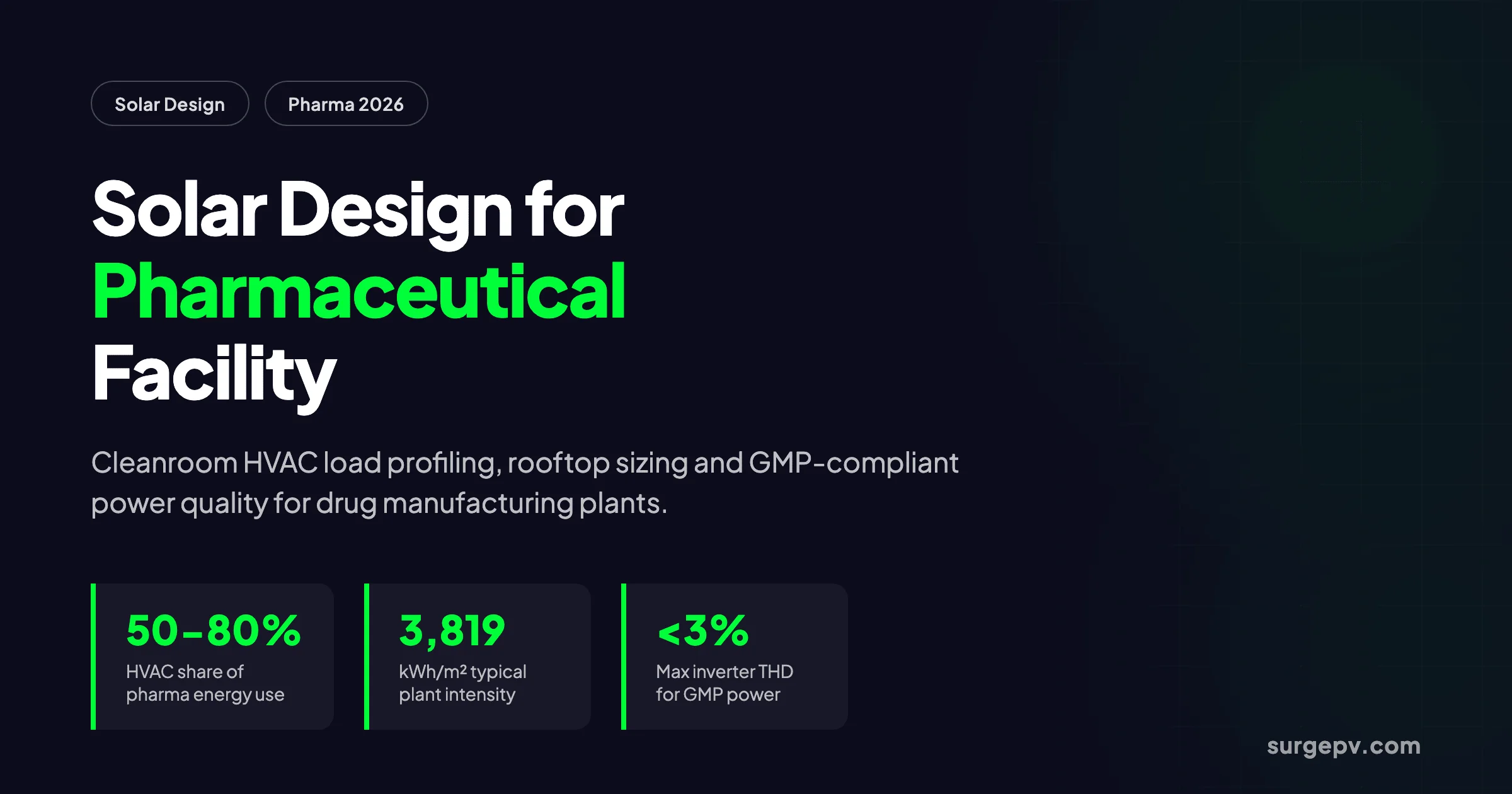
Solar design for pharmaceutical facilities starts with the cleanroom HVAC load curve, not the roof area. A typical pharma plant uses 1,200 to 3,800 kWh per square metre per year, with HVAC accounting for 50 to 80 percent of consumption. Size the array for high self-consumption, specify low-THD inverters, and keep critical GMP loads on the existing essential electrical system with proper change control.
A pharmaceutical manufacturing plant can use more electricity per square metre than a data centre, a hospital, or an automotive factory. Like factory solar system design and hospital solar system design, pharmaceutical solar must be sized around a critical process load rather than a generic commercial template. The average pharmaceutical plant has an energy use intensity of roughly 1,210 kBtu per square foot per year, or about 3,819 kWh per square metre, according to EPA ENERGY STAR pharmaceutical benchmarking data. HVAC systems alone can consume 50 to 80 percent of that total, because cleanrooms demand continuous filtered, conditioned and pressurised air. That makes solar design for pharmaceutical facility a distinct discipline: the array must be sized to a 24/7 process load, not to a standard commercial rooftop template, and it must never destabilise a validated manufacturing environment.
The goal is not simply to cover annual consumption. It is to match a continuous cleanroom baseload, manage demand charges, preserve GMP compliance, and fit the array onto a roof that may sit directly above Grade A production space. This guide walks through the full 2026 design workflow for oral solid dose, sterile injectable, biologics and API facilities. We cover load profiling, sizing, mounting options, power quality, storage integration, resilience, finance and the mistakes that waste budget or trigger audit findings.
If you are designing pharmaceutical solar at scale, use a cloud solar design platform that imports interval data, runs shading analysis software and exports permit-ready plans. SurgePV provides this through its generation and financial tool, which models HVAC-specific tariffs, demand charges and cash-flow structures in one place.
Quick Answer
Solar design for pharmaceutical facilities starts with the cleanroom HVAC load curve, not the roof area. A typical pharma plant uses 1,200 to 3,800 kWh per square metre per year, with HVAC accounting for 50 to 80 percent of consumption. Size the array for high self-consumption, specify low-THD inverters, and keep critical GMP loads on the existing essential electrical system with proper change control.
In this guide:
- Why pharmaceutical solar design is a distinct discipline
- How to profile cleanroom HVAC and process load
- Rooftop, carport and ground-mount tradeoffs for pharma
- Power quality, harmonic limits and GMP compliance
- Battery storage sizing for peak shaving and resilience
- Financial models and incentives for 2026
- Common design mistakes and how to avoid them
- Worked example for a 50,000 sq ft oral solid dose facility
- FAQ with 10 pharmaceutical solar questions
Why Pharmaceutical Solar Design Is Different
A pharmaceutical facility is not a standard factory with extra air conditioning. It is a validated environment where temperature, humidity, pressure differential and particle count must stay inside tight bands around the clock. HVAC systems run continuously to protect product quality, and any electrical change that could introduce harmonics, voltage sags or downtime must pass GMP change control.
Three structural differences matter most:
- HVAC dominates energy use. Cleanroom HVAC can account for 50 to 80 percent of site energy, according to Cleanroom Technology (2026). A typical ISO 7 pharmaceutical cleanroom in Australia consumes 1,500 to 2,500 kWh per square metre per year, with HVAC responsible for 60 to 70 percent of that total, according to Trotek Controlled Environments (2026).
- Air-change rates drive load shape. ISO 5/Grade A spaces need 300 to 600 air changes per hour. ISO 7/Grade B spaces need around 60. ISO 8/Grade C spaces need around 30. That fan and chiller load creates a flat daytime baseload that aligns well with solar output, but also a night baseload that solar cannot cover.
- Power quality is a GMP issue. Variable-frequency drives on cleanroom air handlers and chillers are sensitive to harmonic distortion. Inverters with high total harmonic distortion can interfere with lab instruments, HVAC controls and process equipment, creating a validation risk.
| Factor | Standard Factory | Pharmaceutical Facility |
|---|---|---|
| Annual electricity intensity | ~150 to 400 kWh/m² | ~1,200 to 3,800 kWh/m² |
| HVAC share of site energy | 15 to 35% | 50 to 80% |
| Air change rates | 2 to 10 ACH | 30 to 600 ACH |
| Uptime requirement | Business critical | GMP and batch-critical |
| Electrical change control | Standard project | GMP change-control register |
| Roof structural concern | Standard live load | Cleanroom membrane and air-tightness |
The table explains why a proposal built on generic commercial assumptions will underperform or create compliance risk. Pharmaceutical solar design must treat the cleanroom HVAC system as the customer, not the roof.
Cleanroom HVAC and Process Load Profile
The first step in any pharmaceutical solar design is to understand where the kilowatt-hours go. The load profile sets the array size, the battery duration, the inverter rating and the financial case.
HVAC dominates consumption
HVAC is the largest single load in a pharmaceutical facility. It supplies filtered, conditioned air to cleanrooms, maintains pressure cascades, removes process heat, and controls humidity. In the U.S. pharmaceutical industry as a whole, HVAC accounts for roughly 65 percent of energy use, according to the EPA ENERGY STAR guide. Individual sites range from 50 to 80 percent depending on process intensity and climate.
The load is not perfectly constant. It rises with ambient temperature, during batch start-up, when autoclaves or sterilisers add heat, and when production shifts change. Summer peaks can be 30 to 50 percent above winter baseload in hot climates. That seasonal shape happens to align well with solar output, which also peaks in summer.
Process equipment adds daytime peaks
Manufacturing equipment such as granulators, tablet presses, coaters and packaging lines typically run two or three shifts. Water purification systems, compressed air plants and effluent treatment pumps often run 24 hours. The result is a high daytime baseload with process-specific peaks. Cleanrooms themselves stay online around the clock, so the night load never drops to zero.
Demand charges and time-of-use rates
Many pharmaceutical facilities pay demand charges based on the highest 15- or 30-minute power draw in each billing period. These charges can run $10 to $25 per kW per month in the United States. Because HVAC load peaks on hot summer afternoons, solar generation often coincides with the facility’s highest draw. That coincidence is valuable. It means solar can reduce both energy charges and demand charges if the array is sized and dispatched correctly.
The generation and financial tool models time-of-use rates and demand charges hour by hour, so you can see whether solar alone delivers the expected savings or whether a battery is needed to shave the evening peak.
Sizing the Solar Array for a Pharmaceutical Facility
The correct sizing sequence for pharmaceutical solar is: measure load, model production, maximise self-consumption, then pick the kWp number. Residential rules of thumb will mislead you.
Step 1: Collect interval data and building information
Request 12 to 24 months of 15-minute or 30-minute interval data from the utility. Monthly bills hide the daily peaks and the seasonal shape. You also need:
- Gross floor area and clear ceiling height
- Cleanroom grades and air-change rates
- Year of construction and roof age
- HVAC system type, chiller capacity and age
- Demand charge structure and time-of-use windows
- Plans for expansion, additional production lines or electrification
Step 2: Separate HVAC baseload from process peaks
Build a load curve by month and by hour. An oral solid dose facility in the southern United States might show an HVAC baseload of 400 kW in January and peaks of 700 kW in July. A sterile fill-finish suite might see larger daily swings as autoclaves and isolators cycle. The summer peak drives the inverter and interconnection sizing, while the annual kWh drives the array size.
Step 3: Choose a target offset based on self-consumption
Pharmaceutical facilities typically achieve self-consumption ratios of 60 to 85 percent without storage because the cleanroom baseload runs through the day. Adding storage can push that above 90 percent. Because exported solar is usually worth far less than on-site consumption, the economic optimum is often an array that covers 30 to 60 percent of annual load, not 100 percent.
Run three sizing scenarios:
| Scenario | Sizing target | Best for |
|---|---|---|
| High self-consumption | Production = 30 to 50% of annual load | Strong net metering or net billing with low export value |
| Maximum roof use | Production = 60 to 80% of annual load | Favourable feed-in tariff or large daytime baseload |
| Export-limited | Production = on-site minimum daytime load | Strict interconnection or net metering caps |
Step 4: Convert target kWh to DC capacity
Divide the target annual kilowatt-hours by the local capacity factor. Capacity factor depends on location, tilt, azimuth and losses. A fixed-tilt rooftop in the southern United States might achieve 20 to 25 percent. A rooftop in the northern United States or Europe might achieve 12 to 18 percent.
For example, a facility targeting 1,000,000 kWh/year of solar generation at a 20 percent capacity factor needs:
- Required DC energy = 1,000,000 kWh/year ÷ 0.20 = 5,000,000 kWh/year of DC nameplate
- Required DC capacity = 5,000,000 kWh/year ÷ 8,760 hours = 571 kWp
Round to a practical module layout. A 600 kWdc system would produce roughly 1,050,000 kWh/year at that capacity factor.
Step 5: Add storage if the peak matters
If the facility pays high demand charges or faces time-of-use rates with steep evening peaks, add a battery energy storage system. The battery captures midday solar surplus and discharges during the peak window. For pharmaceutical facilities, a 2 to 4 hour battery sized at 25 to 50 percent of peak facility demand is a common starting point.
Use solar design software with interval-data import to test these scenarios automatically. Manual spreadsheets struggle to capture the hourly value of self-consumption, export and demand-charge savings at the same time.
Mounting Options: Rooftop, Carport, Ground-Mount
Most pharmaceutical facilities have three real-estate options. Each has a different cost, risk profile and operational payoff.
Rooftop solar
Rooftop is usually the lowest-cost option and the most common for pharmaceutical plants. Large flat roofs, minimal obstructions and electrical rooms close to the array reduce balance-of-system costs. A modern pharmaceutical roof can often support 500 to 800 kW per 50,000 square feet of usable roof area, depending on structural reserve capacity.
Pros:
- Lowest installed cost per watt
- No new land use
- Fastest interconnection path
- Production aligns with daytime HVAC load
Cons:
- Limited by roof age and structural capacity
- Fire setbacks consume 15 to 25 percent of gross roof area
- HVAC equipment, exhaust stacks and parapets create exclusions
- Re-roofing later requires panel removal and reinstallation
Over GMP cleanroom roofs, use non-penetrating ballasted mounting to preserve membrane integrity and air-tightness. Penetration-based mounts can void roof warranties and compromise the cleanroom envelope. Before committing to rooftop, get a structural letter. If the roof has fewer than 15 years of remaining life, bundle the solar with a re-roof or move to carport.
Solar carports
Carports cost more per watt than rooftop, but they solve several pharmaceutical problems at once. They provide shaded parking for staff and visitors, protect temperature-sensitive deliveries, avoid roof warranty conflicts and create a natural home for EV charging.
Pros:
- Use parking-lot real estate the facility already owns
- Provide shade for temperature-sensitive vehicles
- Easy to pair with EV charging stubs
- No roof structural limits
Cons:
- Higher cost per watt due to steel structure
- Foundation and civil work
- May require stormwater review
- Shorter experience base for some installers
A 200-space parking lot can host 500 kW to 1.5 MW depending on bay spacing and column layout. For facilities where the roof is old or small, carports often carry the project.
Ground-mount solar
Ground-mount works for pharmaceutical campuses with spare land, often near detention basins or unused acreage. It offers the lowest cost per watt and the easiest operations and maintenance access, but it competes with land use and requires fencing.
Pros:
- Largest potential capacity per site
- Optimal tilt and azimuth
- Simple O&M access
- Can use bifacial modules and tracking
Cons:
- Land opportunity cost
- Longer permitting and environmental review
- Fencing, landscaping and security
- Higher civil and interconnection cost
A ground-mount array typically requires 4 to 6 acres per MWdc, depending on module efficiency and row spacing. A 5 MWp array needs roughly 20 to 30 acres.
| Mounting option | Typical size | Cost trend | Best for |
|---|---|---|---|
| Rooftop | 200 kW to 2 MW | Lowest | Strong roof, limited land |
| Carport | 500 kW to 1.5 MW | Higher | Old roof, visible sustainability, EV charging |
| Ground-mount | 1 MW to 10 MW+ | Low per watt | Campus with spare land |
Use shading analysis to check parapets, HVAC equipment and neighbouring buildings before finalising the rooftop layout. A small shadow on a string of modules can disproportionately reduce production if the stringing design is not planned around it.
For complex commercial projects that need detailed engineering support, permit packages or PE-stamped electrical drawings, engineering consultancies such as Heaven Designs provide solar design services, detailed engineering and PE-stamped permit design for EPCs that need extra capacity.
Power Quality, Backup and GMP Compliance
Solar design for pharmaceutical facilities is not only about kilowatt-hours. It is also about how the array integrates with the HVAC plant, the electrical distribution and the validated state of the facility.
Specify low total harmonic distortion
Cleanroom air handlers, chillers and quality-control instruments are sensitive to harmonic distortion. Inverters with high total harmonic distortion can cause VFD trips, inaccurate readings on analytical equipment and premature bearing currents in motors. Specify inverters certified to IEEE 1547 with total harmonic distortion below 3 percent at nominal output. Conduct a pre- and post-commissioning power-quality study and append the report to the GMP electrical validation file.
Do not treat the battery as a full backup generator
A 4-hour battery cannot carry a Grade A suite through a multi-day outage. It is an energy-shifting and grid-support asset. Most pharmaceutical facilities still need diesel or natural-gas generators for extended outages and GMP-mandated redundancy. The battery reduces generator runtime and fuel consumption during short outages and provides smooth transition.
Coordinate with HVAC and building management systems
Solar inverters must be coordinated with the facility’s transfer switches, static switches and generator synchronisation. A grid-tied array without a microgrid controller will shut down during a utility outage to protect line workers. If the facility needs solar to operate off-grid, add a microgrid controller and design the system for islanding. For most facilities, the simpler path is to keep solar on the normal power system and leave the essential electrical system unchanged.
Document every change in the GMP register
Any electrical change at a GMP facility must be recorded in the change-control register. The solar project must produce updated single-line diagrams, updated emergency power load studies where applicable, commissioning reports, factory acceptance test and site acceptance test records, and staff training records. Auditors will not approve the solar system, but they will expect the facility to demonstrate that the change did not compromise validated state.
Plan for electrification loads
Pharmaceutical facilities are adding electric vehicles, heat pumps and additional production capacity. These loads increase electricity use and can shift the peak. Design the service entrance, transformer and solar inverter capacity with headroom for future electrification. Upgrading an 11 kV service after construction is far more expensive than sizing it correctly the first time.
Battery Storage and Peak Shaving
Battery storage has become a standard companion to pharmaceutical solar. It solves three problems that solar alone cannot: time-shifting, demand-charge reduction and short-duration resilience.
Time-shift surplus into evening peaks
A pharmaceutical facility consumes power after sunset. A battery captures the midday solar surplus and discharges from 5 PM to 9 PM, when the facility is still fully loaded but solar output has fallen. A 4-hour battery sized at 25 to 50 percent of peak load covers daily time-shifting for most grid-tied designs.
Reduce demand charges
Many facilities see a demand peak in late afternoon as solar fades but HVAC load remains high. A battery discharged during that window can reduce the monthly peak demand charge. At $15/kW/month, shaving 300 kW for 12 months saves $54,000 per year.
Bridge short outages
The battery can keep critical HVAC controls and selected production equipment online during brief grid outages. It does not replace a diesel generator for a multi-day failure, but it can ride through the seconds to minutes needed for a generator to start or avoid a brief outage altogether.
Sizing rule of thumb
A grid-tied pharmaceutical solar-plus-storage system typically uses a 2 to 4 hour battery sized at 25 to 50 percent of peak facility demand. A 1 MW peak facility might pair 600 kWdc of solar with a 250 kW / 1,000 kWh battery. The exact ratio depends on the local tariff structure, export limits and whether the operator values resilience or bill savings more highly.
Battery prices have fallen below $90 per kWh at the cell level in 2026, but the full installed cost including inverters, enclosures and integration still runs $300 to $500 per kWh. The business case usually depends on a stack of value streams: energy arbitrage, demand-charge reduction, backup energy displacement and carbon claims.
Financial Model and Incentives for 2026
Pharmaceutical solar projects have strong economics in 2026 because the load is large, continuous and expensive. The financial model depends on ownership structure, incentives and local utility rates.
Installed costs
Commercial rooftop solar in 2026 typically costs $1.40 to $1.80 per watt DC before incentives, according to GreenLancer (2026). Pharmaceutical projects can land toward the middle or upper end of that range because of structural reviews, membrane warranty coordination, low-THD inverter specification and GMP documentation. For a deeper sector cost breakdown, see our guide on solar installation cost breakdown. For commercial solar buyers evaluating ownership models, our commercial solar overview covers the same decision framework.
Ownership versus third-party finance
Direct ownership captures the full value of energy savings, incentives and depreciation. A taxable owner can use the 30 percent federal ITC, bonus credits and MACRS 5-year depreciation. A third-party power purchase agreement or lease offers zero upfront cost and predictable operating expenses, but passes some value to the financier.
Federal and state incentives
Here is the current incentive status for pharmaceutical solar projects placed in service in 2026.
| Incentive | Status | 2026 detail |
|---|---|---|
| Section 48E ITC | Active | 30% base credit for clean electricity property |
| Direct-pay election | Active | Tax-exempt entities can elect cash payment |
| Domestic content adder | Active | +10% if 40% of project cost meets domestic content thresholds |
| Energy community adder | Active | +10% in eligible census tracts |
| MACRS depreciation | Active if taxable owner | 40% bonus depreciation in 2026 |
| USDA REAP | Active for rural facilities | Grants and loan guarantees for rural manufacturing |
| State and utility rebates | Vary by state | Check DSIRE for current programs |
The most important federal incentive is the 30 percent ITC under Section 48E. For rural pharmaceutical facilities, USDA REAP can cover up to 50 percent of eligible project costs in grant form, with the remainder available through loan guarantees.
International context: India example
In India’s Baddi-Barotiwala-Nalagarh pharmaceutical cluster, a 1 MWp rooftop solar plant costs roughly ₹3.5 to 4 crore installed and generates 14.5 to 15.8 lakh kWh per year, according to Heaven Green Energy’s Baddi pharma solar guide (2026). With 40 percent accelerated depreciation, payback falls to roughly 4 to 4.5 years. The high self-consumption driven by 24/7 cleanroom HVAC makes behind-the-meter solar particularly attractive in that cluster.
Payback and long-term savings
A typical solar system for a pharmaceutical facility has a simple payback of 5 to 7 years due to energy cost savings. With utility rates rising and module prices low, well-designed projects often show internal rates of return above 15 percent over 25 years.
Use a solar proposal tool to compare ownership, PPA and lease structures side by side, with incentives, demand-charge savings and rate escalation built in.
Common Pharmaceutical Solar Design Mistakes
Pharmaceutical solar projects fail or underperform for predictable reasons. Here are the most common design mistakes and how to avoid them.
1. Sizing by roof area instead of verified HVAC load
A large roof can fit a big array, but a big array that exports most of its production at avoided-cost rates loses money. Start with interval data and target high self-consumption.
2. Ignoring demand charges and time-of-use rates
Annual kWh offset is the wrong metric if the facility pays steep demand charges. Model the hourly bill, including peak windows, to size the array and battery correctly.
3. Using inverters with high harmonic distortion
Inverters with total harmonic distortion above 3 percent can interfere with cleanroom VFDs, lab instruments and process controls. Specify IEEE 1547-certified inverters with low THD and validate with a power-quality study.
4. Treating the battery as a backup replacement
A battery improves economics and resilience, but it does not replace a generator for long-duration outages. Size backup power separately.
5. Skipping structural and membrane review
Pharmaceutical roofs often sit above validated cleanrooms. Adding ballasted solar without a structural review can overload the building. A leaky membrane raises the HVAC load and can compromise cleanroom classification.
6. Forgetting GMP change control
The electrical change must be documented in the facility’s change-control register. Without updated single-line diagrams, FAT/SAT records and staff training, the project creates audit risk even if it performs well technically.
7. Poor interconnection and export assumptions
Export limits, net metering caps and utility study timelines can derail a project. Submit a pre-application early and model the export value realistically.
Worked Example: 50,000 sq ft Oral Solid Dose Facility
Here is a practical sizing exercise for a 50,000 square foot oral solid dose facility in the southern United States. The numbers are illustrative but realistic.
Inputs:
- Annual electricity use: 3,000,000 kWh
- Peak demand: 1,200 kW
- HVAC baseload: 450 kW
- Local electricity rate: $0.12/kWh
- Demand charge: $15/kW/month
- Capacity factor for fixed-tilt rooftop: 22%
Sizing target:
The design targets 35 percent annual offset to keep self-consumption high. Target solar generation = 3,000,000 × 0.35 = 1,050,000 kWh/year.
Required DC capacity = 1,050,000 ÷ (8,760 × 0.22) = 545 kWp.
Round to a practical layout: 550 kWdc.
Cost before incentives:
- 550 kW at $1.70/W = $935,000
- 30% federal ITC = $280,500
- Net cost = $654,500
Savings:
- First-year solar generation: 550 kW × 8,760 × 0.22 = 1,060,000 kWh
- Avoided energy cost: 1,060,000 × $0.12 = $127,200
- Demand-charge savings with 250 kW / 1,000 kWh battery: 250 kW × $15 × 12 = $45,000
- Total first-year savings: roughly $172,200
- Simple payback: $654,500 ÷ $172,200 = 3.8 years
This is an aggressive but achievable case. If net metering pays only avoided-cost rates for exports, reduce the array size or increase the battery to lift self-consumption.
Design Pharmaceutical Solar in SurgePV
Model cleanroom HVAC baseloads, demand charges, solar-plus-storage dispatch and bankable proposals in one cloud platform.
Book a DemoNo commitment required · 20 minutes · Live project walkthrough
Next Steps for Your Pharmaceutical Solar Project
Pharmaceutical solar in 2026 is a mature play with clear design rules, strong incentives and a load profile that naturally fits PV. The projects that succeed treat the facility as a 24/7 validated process load. They size the array for self-consumption, protect power quality, and coordinate every electrical change through GMP change control.
Three actions will move you forward today:
-
Pull 12 to 24 months of interval data and benchmark the facility against typical pharmaceutical energy intensity. Identify whether the roof, carport or ground-mount path has the most buildable area.
-
Run a tariff-first design in solar design software. Model production hour by hour, then test three sizing scenarios against demand charges, export rules and cleanroom baseload before finalising the kWp number.
-
Compare ownership, PPA and lease structures using a solar proposal tool that handles Section 48E credits, bonus credits, depreciation and pharmaceutical cash flow. If you want a hands-on walkthrough, book a SurgePV demo.
Frequently Asked Questions
What is solar design for pharmaceutical facility?
Solar design for pharmaceutical facility is the process of sizing, laying out and integrating a photovoltaic system to offset a drug manufacturing plant’s electricity use. It starts with the cleanroom HVAC load curve, models solar generation against validated process loads, and selects mounting, inverter and backup options that do not compromise GMP compliance.
How much electricity does a pharmaceutical facility use?
A typical pharmaceutical plant has an energy use intensity of roughly 1,210 kBtu per square foot per year, or about 3,819 kWh per square metre, according to EPA ENERGY STAR benchmarking data. HVAC alone accounts for 50 to 80 percent of site energy use, and up to 65 percent across the industry as a whole.
How do you size a solar array for a pharmaceutical facility?
Collect 12 to 24 months of interval meter data, separate the cleanroom HVAC baseload from process peaks, and target a solar offset that keeps most generation on-site. Divide the target annual kilowatt-hours by the local capacity factor to get DC kilowatts. A 3 million kWh-per-year facility targeting 35 percent offset at a 20 percent capacity factor needs about 685 kWdc of solar.
Which mounting option is best for pharmaceutical solar?
Rooftop is usually best when the roof has adequate structural capacity and remaining life. Carports work when the roof is old or small and the site needs shaded parking. Ground-mount is the choice for large campuses with spare land. Over GMP cleanroom roofs, use non-penetrating ballasted mounting to preserve membrane integrity and air-tightness.
Should pharmaceutical solar include battery storage?
Yes, when the facility pays high demand charges or values resilience for critical GMP loads. A battery energy storage system captures midday solar surplus and discharges during evening peaks or brief outages. It reduces demand charges and improves self-consumption, but it does not replace the on-site generator required for long-duration backup.
Can solar power run a pharmaceutical facility during a grid outage?
Solar alone cannot guarantee continuous cleanroom operation through a long outage because generation stops at night and during bad weather. A solar-plus-storage system with a properly sized inverter and battery can ride through brief outages, but most facilities still keep diesel or natural-gas generators for extended outages and GMP-mandated redundancy.
What incentives are available for pharmaceutical solar in 2026?
Federal incentives in the United States include the 30 percent Investment Tax Credit under Section 48E, domestic content and energy community bonus credits, and MACRS depreciation for taxable owners. Rural facilities may qualify for USDA REAP grants and loan guarantees. In India, pharma plants can use 40 percent accelerated depreciation. State and utility rebates vary, so check the DSIRE database for current programs.
How much does commercial solar cost for a pharmaceutical facility in 2026?
Commercial rooftop solar in 2026 typically costs $1.40 to $1.80 per watt DC before incentives. Pharmaceutical projects can land toward the middle or upper end of that range because of structural reviews, membrane warranty coordination, low-THD inverter specification and GMP documentation. A 700 kW system at $1.70/W costs roughly $1,190,000 before the 30 percent federal ITC.
What are the most common pharmaceutical solar design mistakes?
The most common mistakes are sizing by available roof area instead of verified cleanroom load, ignoring demand charges and time-of-use rates, using inverters with high total harmonic distortion, treating the battery as a full backup replacement, skipping structural and membrane review, and failing to document the electrical change in the GMP change-control register.
How long does a pharmaceutical solar project take from feasibility to commissioning?
A typical commercial pharmaceutical solar project takes 10 to 18 months. Feasibility and energy auditing take 1 to 2 months. Design, GMP change control and permitting take 3 to 5 months. Utility interconnection approval takes 2 to 6 months. Construction, scheduled around production campaigns, lasts 1 to 3 months.
Where this fits
This article is part of SurgePV's Solar Design hub, which works through the topic from first principles to the decisions a project team actually has to make.