

Quick Answer
In 2026, U.S. homeowners pay $2.50–$3.39 per watt to install solar panels before incentives. A typical 8 kW residential system costs $20,000–$27,000 gross. Commercial systems average $1.44–$1.72 per watt, and utility-scale projects land near $1.06–$1.20 per watt.
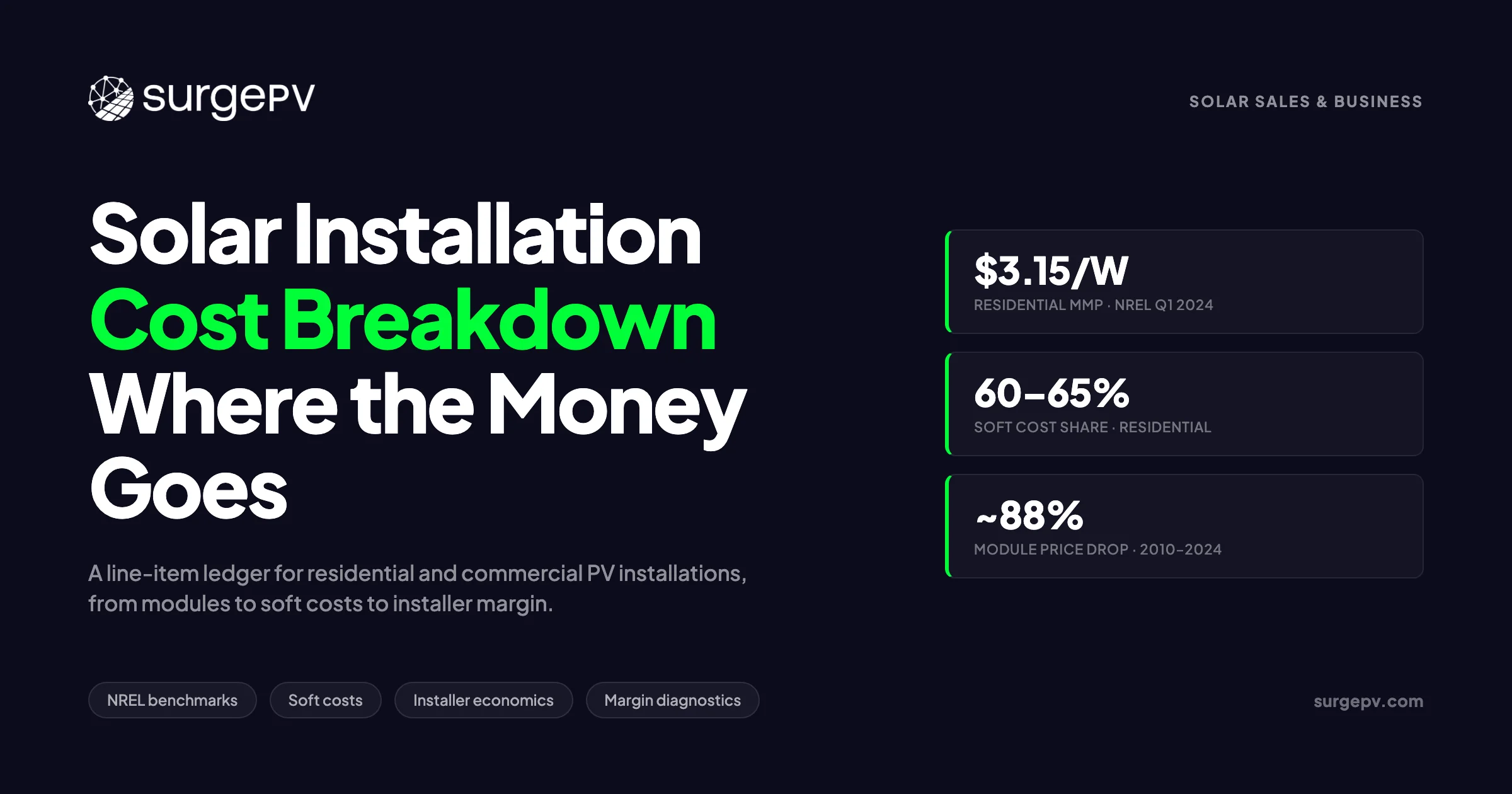
Module prices fell roughly 90% from 2010 to 2024 — from $3.28/Wdc to $0.40/Wdc in inflation-adjusted 2024 dollars (NREL 2024 Benchmark Report). The total residential installed cost fell about 65% over the same period, from $9.23/Wdc to $3.25/Wdc. That 25-percentage-point gap is the core diagnostic for solar installers: hardware got cheap, but soft costs — customer acquisition, permitting, overhead, and margin — fell more slowly. At the NREL Q1 2024 benchmark of $3.15/Wdc (DOE-cited figure), a standard 8 kW residential job totals $25,200. Of that, only 35–40 cents of every dollar goes to hardware. The rest — 60–65% — is soft costs. This post breaks down every dollar, identifies which line items are fixed by the market and which ones an installer can actually compress, and ties the analysis to the decisions that protect margin in 2026.
The total residential installed cost fell about 65% over the same period, from $9.23/Wdc to $3.25/Wdc. At the NREL Q1 2024 benchmark of $3.15/Wdc (DOE-cited figure), a standard 8 kW residential job totals $25,200. Module costs up ~13% YoY for distributed segments (SEIA Q2 2025) Section 232 steel/aluminum tariffs.
Quick Answer
In 2026, U.S. homeowners pay $2.50–$3.39 per watt to install solar panels before incentives. A typical 8 kW residential system costs $20,000–$27,000 gross. Commercial systems average $1.44–$1.72 per watt, and utility-scale projects land near $1.06–$1.20 per watt.
TL;DR — The Short Version
The NREL Q1 2024 benchmark puts a typical US residential system at $3.15/Wdc — $25,200 for an 8 kW job. Hardware (panels, inverter, racking, wiring) accounts for roughly 35–40% of that total. The remaining 60–65% is soft costs: customer acquisition, permitting, overhead, and margin. Hardware is a commodity. Soft costs are the only line items an installer can actually compress.
In this guide:
- A line-item ledger for an 8 kW residential job — every dollar accounted for at 2026 prices
- A 500 kW commercial project ledger — how C&I cost structure differs from residential
- Why 60–65% of US residential cost is soft costs, and why that share has grown since 2010
- A deep dive into every soft-cost category and which ones an installer can compress
- Why US solar costs 2× Germany and 3× Australia — and what drives that gap
- The three compressible budget items: design time, customer acquisition, and proposal turnaround
- Policy context for 2026: what changed with the ITC, AD/CVD tariffs, and the Section 48E begin-construction deadline Also see: Germany solar subsidies.
For more details, see our guide on solar LCOE by country.
Latest Updates for 2026 — Cost Trajectory and Policy Context
The cost environment in 2026 differs from 2024. Three policy changes and two tariff events have restructured the cost stack — and one of them directly removes a selling point that many residential installers have relied on for years.
| Change | Effective Date | Impact on Installed Cost |
|---|---|---|
| Section 25D residential ITC | Expired Dec 31, 2025 | Homeowner-owned residential systems: no federal tax credit in 2026 |
| AD/CVD on SE Asia modules | Finalized May 20, 2025 | Module costs up ~13% YoY for distributed segments (SEIA Q2 2025) |
| Section 232 steel/aluminum tariffs | Effective March 2025 | Residential racking +$0.03/Wdc; frames +$0.01/Wdc (NREL Spring 2025 Update) |
| Section 48E commercial ITC | Active; begin-construction cliff July 4, 2026 | Commercial projects beginning construction after July 4 get a lower placed-in-service deadline |
| OBBBA MACRS 100% bonus depreciation | Qualified property acquired after Jan 19, 2025 | Accelerates commercial project cash flow; verify current IRS guidance before advising clients |
| Domestic content bonus (48E) | 50% threshold in 2026 | +10% ITC adder if FEOC-compliant threshold is met |
The most consequential change for residential installers is the Section 25D expiration. The 30% federal homeowner credit expired December 31, 2025. Homeowners who installed systems in 2025 or earlier may still claim it on their tax return; new residential installations in 2026 are not eligible. Quoting it as available is both factually wrong and creates legal exposure.
On the pricing side, SEIA/Wood Mackenzie Q4 2025 puts residential at $3.39/Wdc (−1% YoY), commercial at $1.72/Wdc (+10% YoY), and utility fixed-tilt at $1.18/Wdc (+11% YoY). The commercial and utility increases are partly driven by the Section 232 tariffs on steel and aluminum racking, plus AD/CVD duties on Southeast Asian module imports that pushed distributed-segment module costs up roughly 13% year-over-year. Note that Wood Mackenzie changed its methodology in 2025 — taxes are now folded into the equipment category, so direct year-over-year comparisons with 2024 NREL data are not apples-to-apples. Read more about Agricultural Solar Case Study.
One forward-looking figure stands out: Wood Mackenzie’s March 2026 forecast projects customer acquisition cost — already the single largest soft-cost line item — set to surge 40% after reaching a five-year low of $0.60/Wdc in 2025. That trajectory means the compressible budget is getting more expensive, not less.
For commercial projects, the Section 48E investment tax credit remains active. The base rate is 30%, with adders for domestic content (+10%), energy community location (+10%), and low-income status (+10–20%). A project that qualifies for all three adders can reach a 70% effective credit rate. The critical constraint is the begin-construction deadline: projects that begin construction by July 4, 2026 have until December 31, 2027 to be placed in service. Projects beginning construction after that date face a tighter timeline. Use SurgePV’s PV generation and financial modeling to model the cash flow impact of ITC stacking on specific projects before committing to a construction schedule.
The domestic content bonus threshold in 2026 is 50% — meaning at least 50% of the total cost of components (excluding labor) must come from FEOC-compliant sources. That threshold rises to 55% after 2026. For projects that can meet it, the 10% adder is material. For those that cannot, sourcing from Southeast Asia at post-AD/CVD prices and forgoing the adder may still produce better economics — model both scenarios before advising a client.
Cost per Watt by Sector — The NREL 2024 Benchmarks
The NREL Q1 2024 benchmark is the authoritative reference for US installed solar cost. Every installer should understand what it measures and where its numbers come from.
| Sector | Typical System | MSP ($/Wdc) | MMP ($/Wdc) | O&M ($/kWdc/yr) | LCOE ($/MWh) |
|---|---|---|---|---|---|
| Residential (RPV) | 8 kWdc | $2.74 | $3.15 | $30 | $142 |
| Commercial (APV) | 3 MWdc | $1.34 | $1.51 | $22 | $75 |
| Utility-scale (UPV) | 100 MWdc | $0.98 | $1.12 | $19 | $47 |
Source: NREL/DOE Q1 2024 Benchmarks
MSP vs MMP — What the Numbers Actually Mean
MSP (Minimum Sustainable Price) is the lowest price a financially healthy installer can charge long-term without losing money. MMP (Modeled Market Price) adds real-world market distortions — dealer fees, financing costs, regional premiums, and competitive markup. Most installers price above MSP and below MMP. EnergySage’s consumer-facing average of $2.58/Wdc is lower than NREL’s MMP because it excludes dealer fees. LBNL’s median of $4.20/Wac (2023 data, including dealer fees) is higher for the same reason. When comparing cost figures across sources, always check whether dealer fees and financing costs are in or out.
The three-sector gap — $3.15 residential vs $1.51 commercial vs $1.12 utility — reflects scale, not complexity. Larger projects spread fixed permitting and engineering costs across more watts, use lower-cost centralized components, and benefit from volume procurement. A commercial rooftop at 500 kW does not cost twice as much to engineer as one at 250 kW; the marginal cost per additional watt falls sharply.
The LCOE figures illustrate why utility-scale solar has achieved grid parity in most US markets and residential solar has not. At $142/MWh, residential solar design platform-enabled systems remain above most utility retail rates in the Southeast and Midwest, but below retail rates in California, Hawaii, and the Northeast. At $47/MWh, utility-scale solar beats most forms of new generation capacity outright. The residential LCOE gap is a soft-cost problem — not a technology problem.
SEIA/WoodMac Q4 2025 data shows residential at $3.39/Wdc, slightly above the 2024 NREL benchmark. The small increase from $3.15 to $3.39 reflects the tariff-driven hardware cost increases described in the previous section. Commercial’s jump to $1.72/Wdc (versus NREL’s $1.51/Wdc) is larger in percentage terms — up 10% year-over-year — driven by utility-grade interconnection study costs and the Section 232 impact on racking for larger rooftop systems.
The Residential Line-Item Ledger — An 8 kW Job in 2026 Dollars
An 8 kW residential system at the NREL Q1 2024 MMP of $3.15/Wdc totals $25,200. Here is every dollar.
| Line Item | $/Wdc | Total (8 kW) | % of Project | Installer Control? |
|---|---|---|---|---|
| Solar modules | $0.40 | $3,200 | 12.7% | Minimal (spec-driven) |
| Inverter(s) | $0.37 | $2,960 | 11.7% | Minimal (spec-driven) |
| Structural BOS (racking, mounts) | $0.32 | $2,560 | 10.2% | Minimal (+tariff impact) |
| Electrical BOS (wiring, combiner, conduit) | $0.30 | $2,400 | 9.5% | Minimal |
| Installation labor (fieldwork) | $0.21 | $1,680 | 6.7% | Low (wage-regulated) |
| Permitting, inspection, interconnection (PII) | $0.18 | $1,440 | 5.7% | Low (AHJ-set fees) |
| Customer acquisition / sales & marketing | $0.84 | $6,720 | 26.7% | HIGH |
| Overhead & G&A | $0.73 | $5,840 | 23.2% | HIGH |
| Supply chain / logistics | ~$0.06 | $480 | 1.9% | Low |
| Sales tax | ~$0.06 | $480 | 1.9% | None |
| Total (MMP) | $3.15 | $25,200 | 100% | — |
Source: NREL Q1 2024 Benchmark Report (docs.nrel.gov/docs/fy25osti/92536.pdf); customer acquisition cost per Wood Mackenzie Q4 2024 / SEIA Solar Market Insight.
For a deeper look at how these components fit together into a complete system design, see our guide on how to design a residential solar system.
The hardware column — modules ($0.40) + inverter ($0.37) + structural and electrical BOS ($0.62) — totals $1.39/Wdc, or about 44% of the project. One thing installers learn quickly: switching to a cheaper module spec does not automatically improve margin. A lower-wattage panel may require more mounting points, increase electrical BOS complexity, or trigger an engineering revision — turning a $200 hardware saving into a net cost.
The labor and PII column — fieldwork ($0.21) + permitting/inspection/interconnection ($0.18) — totals $0.39/Wdc, or 12.4% of the project. The direct PII fee of $0.18/Wdc represents the cash cost of permits and interconnection applications. The total cost of the permitting process — including re-inspections, design changes triggered by AHJ comments, and carrying costs during delays — approaches $1.00/Wdc per project, according to PermitPower/OpenSolar analysis cited by NREL SolarAPP research. An installer cannot set AHJ fees, but can reduce the time and rework those fees generate.
The compressible column — customer acquisition ($0.84) + overhead ($0.73) — totals $1.57/Wdc, or 49.8% of the project. On a single 8 kW job, that is $12,560. This is the only column where process changes translate directly to margin. Solar proposal generation that cuts the design-to-proposal cycle from 5 days to 48 hours does not change the hardware spec — it reduces the cost of converting a lead, which is the most expensive variable in this ledger.
Pro Tip — The ROI Math on Faster Proposals
If CAC + overhead totals $12,560 on a typical 8 kW job, improving your close rate by 10% — one extra signed contract per 10 leads — recovers roughly $1,256 in effective cost per project. That is the financial case for investing in faster design and proposal tools.
See Where Your Margin Is Going
SurgePV’s generation and financial tool models your actual cost stack — from module to margin — on any project in minutes.
Book a DemoNo commitment required · 20 minutes · Live project walkthrough
For a direct comparison, see Arka 360 vs SurgePV.
The C&I Line-Item Ledger — A 500 kW Commercial Job
Commercial solar cost structure differs from residential in ways that matter for both the installer and the project owner. A 500 kW commercial rooftop at SEIA/WoodMac Q4 2025 pricing of $1.72/Wdc totals $860,000.
The per-line-item figures below are derived by applying NREL Q1 2024 proportional breakdowns for commercial projects to the SEIA Q4 2025 sector benchmark. They are allocation-based, not line-by-line sourced from a single data point.
| Line Item | $/Wdc | Total (500 kW) | % of Project | Notes |
|---|---|---|---|---|
| Solar modules | $0.31 | $155,000 | 18.0% | Lower $/Wdc at volume; AD/CVD applies |
| Inverters (central or string) | $0.18 | $90,000 | 10.5% | String inverter typical at this scale |
| Structural BOS | $0.22 | $110,000 | 12.8% | Ballasted or penetrating depending on roof |
| Electrical BOS | $0.18 | $90,000 | 10.5% | Longer wire runs than residential |
| Installation labor | $0.15 | $75,000 | 8.7% | Prevailing wage for projects above 1 MW |
| Permitting, engineering, interconnection | $0.12 | $60,000 | 7.0% | Higher absolute cost; lower $/Wdc than residential |
| EPC overhead & G&A | $0.28 | $140,000 | 16.3% | Larger project teams, insurance |
| Developer margin / profit | $0.18 | $90,000 | 10.5% | 10–12% net on C&I |
| Financing costs | $0.10 | $50,000 | 5.8% | Construction loan interest |
| Total | $1.72 | $860,000 | 100% | SEIA Q4 2025 commercial benchmark |
Source: SEIA/WoodMac Solar Market Insight Q4 2025 ($1.72/Wdc); NREL Q1 2024 APV breakdown; GreenLancer Commercial Solar Guide.
For a technical walkthrough of how these systems are designed and laid out, see our guide on commercial solar system design.
How C&I Cost Structure Differs from Residential
The per-watt figure drops from $3.15 to $1.72 primarily because scale spreads fixed costs across more watts and unlocks volume procurement on modules and labor. Several structural differences are worth understanding.
Absolute permitting and engineering costs are higher on commercial projects — structural reports, single-line diagrams, arc flash studies, and utility-grade interconnection studies add thousands in engineering fees that a residential permit does not require. But those costs, divided across 500 kW instead of 8 kW, shrink to $0.12/Wdc versus $0.18/Wdc for residential. The same logic applies to EPC overhead: the project management layer is thicker on commercial jobs, but the overhead per watt is lower. Also see: Us Residential Solar Market Trends 2026.
Financing cost is an explicit line item at this scale. Construction loans, bridge financing, and WACC considerations are part of every commercial project budget in a way they are not for residential installs. This is a cost category that residential installers rarely model explicitly but that commercial solar PV design software tools — and the project owners who fund these jobs — treat as a first-class line item.
Soft costs at the C&I level (overhead + margin + financing) represent about 32% of total cost — lower than the residential 50%, but on a much larger absolute dollar base. On a $860,000 project, 32% soft costs equal $275,200. That is the compressible budget on a single commercial deal.
Policy Levers That Change This Ledger
Section 48E is the defining policy variable for commercial solar in 2026. The base ITC is 30%. Add the domestic content bonus (+10% for FEOC-compliant component sourcing at the 50% threshold), the energy community bonus (+10% for brownfields or coal-closure census tracts), and the low-income bonus (+10–20%, application-based, 1.8 GW/year cap), and a fully stacked project reaches 70%.
At 40% effective ITC on an $860,000 project, the tax credit is $344,000 — which reduces the owner’s net cost to $516,000, or $1.03/Wdc. The installer does not receive the ITC; the project owner does. But ITC availability shapes the owner’s willingness to pay and, therefore, the installer’s pricing power on individual deals. Projects that can stack domestic content plus energy community bonuses have materially more pricing flexibility than projects that qualify only for the base rate.
MACRS 100% bonus depreciation — reinstated by OBBBA for qualified property acquired after January 19, 2025 — accelerates commercial cash flow by allowing full first-year depreciation of qualifying solar assets. Verify the current IRS guidance and confirm your client’s tax position before building this into a project model. Use the solar financial modeling to run the pre- and post-depreciation scenarios side by side.
For a deeper dive into commercial solar deal structures and how to present them to building owners, see SurgePV’s commercial solar page.
Hardware vs Soft Costs — The 15-Year Divergence
Hardware in a solar installation means the module, the inverter, and the balance of system (BOS) — structural BOS (racking, mounts, fasteners) and electrical BOS (wiring, conduit, combiner boxes, disconnects, monitoring). Everything else — fieldwork labor, permitting, customer acquisition, overhead, profit, and financing — is a soft cost.
| Year | Module ($/Wdc) | Inverter ($/Wdc) | BOS ($/Wdc) | Labor ($/Wdc) | Soft Costs ($/Wdc) | Total Residential MMP ($/Wdc) |
|---|---|---|---|---|---|---|
| 2010 | $3.28 | $0.59 | $0.71 | $1.43 | $3.22 | $9.23 |
| 2017 | $0.45 | $0.28 | $0.58 | $0.38 | $1.83 | $3.52 |
| 2020 | $0.50 | $0.30 | $0.55 | $0.26 | $1.72 | $3.33 |
| 2023 | $0.36 | $0.30 | $0.60 | $0.22 | $1.39 | $2.87 |
| 2024 Q1 | $0.40 | $0.37 | $0.62 | $0.21 | $1.64 | $3.25 |
Source: NREL 2024 Benchmark Report, Tables A-5 and A-6
Module prices fell 88% from 2010 to 2024 ($3.28 → $0.40/Wdc). Inverter prices fell 37% ($0.59 → $0.37/Wdc). Total residential MMP fell 65% ($9.23 → $3.25/Wdc). The gap exists because soft costs fell from $3.22/Wdc to $1.64/Wdc — a 49% reduction, substantially slower than the 88% fall in modules.
Key Takeaway
Module costs fell 88% from 2010 to 2024. Total installed cost fell 65%. That 23-percentage-point gap is entirely explained by soft costs — the administrative, sales, and permitting overhead that hardware price drops cannot touch.
The soft-cost share of total residential cost has actually grown over this period. In 2010, soft costs represented about 35% of the $9.23/Wdc residential MMP. By 2024, using NREL’s own narrow category, soft costs represent approximately 51% of the $3.25/Wdc MMP ($1.64/$3.25). Under the broader definition used by EnergySage — which includes supply chain logistics, sales tax, sales and marketing, overhead, profit, and permitting separately — soft costs represent 66% of total installed price.
Why have soft costs proven sticky while hardware costs collapsed? Three structural reasons. First, permitting fragmentation: the US has more than 20,000 AHJs (authorities having jurisdiction), each with distinct application forms, inspection requirements, and timelines. A module manufacturer can benefit from economies of scale across millions of units globally; a local permitting office has no equivalent scale lever. Second, customer acquisition cost scales with the competitiveness of the installer market, not with module prices. As more installers compete for the same leads, CAC rises — which is exactly the dynamic Wood Mackenzie projects for 2026. Third, overhead and administrative costs scale with company headcount and operational complexity, not with hardware unit economics.
The 2024 Q1 figure ($3.25/Wdc) is slightly higher than 2023 ($2.87/Wdc), which warrants an explanation. The increase is not a market reversal — it reflects a model change in NREL’s methodology that captures a shift toward microinverters in the residential mix. Microinverters cost more per watt than string inverters. The underlying module price in 2024 was actually lower than in 2023. When comparing year-over-year NREL figures, always check whether the benchmark composition has changed.
Accurate solar shadow analysis software links to cost structure directly: every unnecessary site visit or post-design revision driven by inaccurate shade modeling adds to the overhead line item, not the hardware line item. The hardware cost is fixed once the spec is set. The overhead cost keeps accumulating until the project closes.
Soft Costs Deep Dive — Where the Margin Lives and Dies
Soft costs — at $1.64/Wdc in the NREL Q1 2024 model and representing 60–65% of total installed cost by broader measure — are not one thing. They are six distinct categories, each with its own driver and its own compression potential.
Customer Acquisition — The Largest Single Soft Cost
At $0.84/Wdc (Wood Mackenzie Q4 2024, per SEIA Solar Market Insight), customer acquisition is the single largest soft-cost line item in US residential solar. On an 8 kW job, that is $6,720 — 26.7% of total project cost — spent before the first module ships.
Wood Mackenzie’s March 2026 forecast projects CAC rising 40% from the 2025 five-year low of $0.60/Wdc. If that materializes at $0.84/Wdc or above, the customer acquisition line will consume a larger fraction of margin in 2026 than it did in 2024. EnergySage marketplace data puts sales and marketing at 18% of total system cost ($5,531 on a 12 kW system, approximately $0.46/Wdc) — lower than the WoodMac figure because EnergySage’s marketplace model reduces lead cost for participating installers.
The LBNL finding on dealer fees compounds this picture: for loan-financed projects, dealer fees add 5–50% to reported project cost, and these fees often sit inside the CAC or financing line. An installer quoting $3.00/Wdc on a cash deal and $3.00/Wdc on a dealer-fee loan is underpricing the latter — sometimes by $0.15–$1.50/Wdc.
This line item responds directly to solar proposal software investment. A faster, more accurate proposal increases the close rate on existing leads — which lowers the effective cost per won deal without changing the cost per lead. A 10% improvement in close rate on a $6,720 CAC is worth $672 per project in recovered margin.
Permitting, Inspection, and Interconnection (PII)
The direct cash cost of permitting, inspection, and interconnection fees runs $0.10–$0.20/Wdc — roughly $800–$1,600 for an 8 kW residential system (SiteCapture/NREL). In the residential ledger above, the $0.18/Wdc figure represents this direct fee.
The total cost of the permitting process is a different number. When re-inspections, AHJ-triggered design changes, interconnection study delays, and carrying costs are included, NREL SolarAPP analysis and PermitPower/OpenSolar data put the total impact at approximately $1.00/Wdc per project — roughly $7,000–$8,000 on a typical residential install. The direct fee is 18% of that; the indirect cost is 82%.
EnergySage data puts permitting and interconnection at 8% of total system cost ($2,421 on a 12 kW system). With more than 20,000 AHJs in the US, each operating on its own timeline and form requirements, no installer controls the fee structure. The lever available is digital permitting: SolarAPP+ reduces approval time from weeks to hours in participating jurisdictions, with an estimated $700–$1,000 per-job saving when delay costs are included. Adoption remains uneven across AHJs, but checking which jurisdictions in your service area participate is worth the time.
Installation Labor — Regulated, Not Negotiable
Fieldwork labor costs $0.21/Wdc at NREL Q1 2024 benchmarks — $1,680 on an 8 kW job, representing 6.7% of total project cost. In 2010, the same line item was $1.43/Wdc. The 85% reduction over 14 years is one of the most dramatic efficiency gains in the solar industry, driven by faster installation workflows, standardized mounting hardware, pre-wired DC combiners, and larger crews with specialized roles.
For commercial projects above 1 MW, prevailing wage requirements apply under the IRA to receive the full Section 48E ITC rate. This raises effective labor cost by 15–30% on large C&I projects where prevailing wages are materially above market rates in that region. The installer cannot negotiate wage rates in a prevailing-wage context; the only lever is crew specialization and throughput per crew-hour. Certified NABCEP crews with standardized equipment and pre-engineered mounting systems consistently outperform general-labor crews on time-per-kW. For more on this topic, see Design Commercial Solar System 1MW.
For more details, see our guide on solar design courses.
Overhead and G&A — The Hidden Cost of Running a Company
Overhead and G&A sits at approximately $0.73/Wdc in the NREL Q1 2024 model — $5,840 on a typical 8 kW job. EnergySage breaks this out as overhead (11%, $3,226) plus profit (11%, $3,226) on a 12 kW system, together representing 22% of total cost. The NREL figure combines these categories slightly differently, but the aggregate is consistent.
Overhead components include office rent, software licenses, insurance, vehicle costs, and administrative headcount. The key insight is that overhead per project falls as volume increases — a 10-project-per-month installer has substantially lower overhead per project than a 3-project-per-month installer, assuming the same fixed cost base. This is why design efficiency matters beyond the individual project: every hour of unnecessary revision or re-engineering on one project is an overhead cost that repeats across every project, all month.
SurgePV’s Clara AI assists with design review and error-checking during the proposal cycle — reducing the back-and-forth that accumulates as overhead before a project is even signed.
Profit — 11–20% Gross Margin
Gross margin for residential solar installers runs 11–20% across the major benchmarks. NREL cites average gross margin “just over 20%” for residential. EnergySage marketplace data puts profit at 11% ($3,226 on a $30,505 twelve-kilowatt system). SolarReviews estimates approximately 16%.
The range reflects company size and business model. High-volume installers operate on thinner per-project margins and make it up in throughput. Independent installers targeting premium customers can sustain higher per-project margins. The diagnostic question for any installer is: if CAC is rising (as projected) and margin is flat or compressing, the math only works if overhead falls or volume increases. Cutting hardware spend does not solve a CAC and overhead problem.
Sales Tax and Supply Chain Logistics
Sales tax averages about 2% of total system cost (EnergySage: $691 on a 12 kW system). It varies by state and product classification — some states exempt solar equipment, others tax it at the standard rate. This is a zero-control line item for installers beyond the state they choose to operate in.
Supply chain and logistics average approximately 9% of total cost per EnergySage data ($2,765 on a 12 kW system), covering shipping, storage, and project coordination. Consolidated purchasing through regional distributors reduces the logistics cost per project; ad hoc procurement from multiple vendors increases it. Volume purchasing agreements are one of the few supply-side levers available to established installers.
Why US Solar Costs More Than Germany, Australia, and India
US residential solar costs roughly 2× the German equivalent and 3× the Australian figure (after Australia’s STC rebate). The gap is not a technology gap — it is a soft-cost gap. For Australia-specific compliance details, see Australia comparisons/lgc-vs-stc.
| Country | Residential ($/Wdc, approx.) | Soft-Cost Proportion | Primary Driver of Gap vs US | Source |
|---|---|---|---|---|
| United States | $2.74–$3.39 | ~65% | Baseline — 20,000+ AHJs, tariffs, high CAC | NREL/SEIA Q4 2025 |
| Germany | ~$1.52–$1.69 | ~30% lower soft costs | Streamlined permitting, no Section 232/AD/CVD, EEG policy consistency | BU/ECI International Cost Comparisons |
| United Kingdom | ~$1.80–$2.40 | Comparable to Germany | Simpler grid connection, no tariff premiums | GreenMatch; Solar4Good (2022–2023 est.) |
| Australia | ~$0.58–$0.78 (post-STC) | Lower soft costs, mature market | STC rebate reduces effective cost; ~AU$1.20/W before rebate | Solar Choice April 2026 |
| India | ~$0.31–$0.42 | Lowest absolute cost | Low labor costs, PM Surya Ghar subsidy, MNRE benchmarks | Kondaas; IndiaSolarMission 2025 |
Sources: BU/ECI International Cost Comparisons (July 2025); Solar Choice Australia (April 2026); Kondaas India; NREL/SEIA Q4 2025. For the latest details on France, see Floating Solar Farms France.
A Note on International Comparisons
Currency conversions, subsidy treatment, and system-size differences make cross-country comparisons directional, not precise. The Australia figure includes the Small-scale Technology Certificate (STC) upfront rebate; ex-rebate cost is approximately AU$1.20/W (~$0.78/W). UK data is sparse — most available benchmarks are 2022–2023 estimates. Treat this table as a structural comparison, not a price quotation.
For the latest details on UK, see Battery Solar System Design UK.
For a related look at solar incentives in Europe and how policy consistency drives cost reduction, see our European market analysis. Also see: European Solar Tax Credits.
The Permitting Problem — 20,000 AHJs
The US has more than 20,000 AHJs, each with distinct application forms, inspection timelines, and fee schedules (NREL SolarAPP analysis). Germany operates under a single federal building code — local permits are largely administrative, with fixed timelines and standardized documentation. LBNL estimates that German residential soft costs run approximately 73% below equivalent US costs.
The direct permitting cost gap between US and Germany is estimated at $0.30–$0.50/Wdc per BU/ECI International Cost Comparisons research. That is not a hardware difference. It is an administrative overhead difference produced by regulatory fragmentation. The US system cannot be fixed at the installer level, but the indirect costs — delays, re-engineering, carrying costs — can be reduced through digital permitting adoption and pre-vetted design packages.
Tariffs — A US-Specific Cost Layer
Section 232 steel and aluminum tariffs (25%, effective March 2025) add approximately $0.04/Wdc to structural BOS in the US. AD/CVD duties on Southeast Asian modules, finalized May 2025, raised distributed-segment module costs roughly 13% year-over-year (SEIA Q2 2025). Neither of these cost layers applies in Germany, Australia, or the UK, which source modules and racking under different trade arrangements.
The practical result: the US installer paying $0.40/Wdc for modules today is paying more for the same product than a German or Australian installer, purely because of trade policy. This is a fixed cost layer that no amount of supply chain optimization eliminates.
Customer Acquisition in a Saturated Market
US CAC reached $0.84/Wdc in 2024 (Wood Mackenzie) and is projected to rise further in 2026. German and Australian installer markets operate with lower marketing costs — referral and utility-partnership channels dominate in markets where solar is more standardized and competitive intensity is lower. No direct comparable data exists for German or Australian CAC per watt, but the structural conditions — fewer competing installers per lead, simpler product comparison, lower decision complexity — suggest materially lower acquisition costs. This is the gap that solar software investment directly addresses for US installers.
Further Reading
See our deep-dive on community solar projects in Germany for more on how streamlined permitting and grid-connection policy translates to faster project timelines and lower soft costs.
Read Community Solar Business Model for a complete walkthrough.
For context on India’s cost structure, see our breakdown of 5 kW solar panel pricing in India.
The Compressible Budget — Where Installers Can Actually Move the Numbers
Most of the residential cost ledger is not under installer control. Here is the control matrix in full.
| Cost Line | $/Wdc | Installer Control Level | Why |
|---|---|---|---|
| Modules | $0.40 | Minimal | Commodity; spec-driven; no negotiating leverage vs. distributor |
| Inverter | $0.37 | Minimal | Product specs set by engineering; volume discount marginal |
| Structural BOS | $0.32 | Low | Roof type determines racking; Section 232 tariffs apply regardless |
| Electrical BOS | $0.30 | Low | NEC requirements; wire runs determined by system layout |
| Installation labor | $0.21 | Low | Wage-regulated; crew throughput is the only lever |
| PII | $0.18 (direct) | Low | AHJ-set; digital permitting (SolarAPP+) reduces indirect costs |
| Customer acquisition | $0.84 | High | Close rate, proposal quality, lead source — all controllable |
| Overhead | $0.73 | High | Design revisions, site visits, change orders — all reducible |
| Financing/dealer fees | Variable | Moderate | Product selection, term negotiation |
| Profit | 11–20% | Full | Pricing strategy, volume |
The compressible budget — CAC plus overhead — is $1.57/Wdc, or $12,560 on a standard 8 kW job. That is the only pool of cost that responds to process improvement. Hardware is bought at market price. Labor is hired at market rates. AHJ fees are set by bureaucracies with no incentive to move quickly. The only line items where investment in systems and tools returns money directly to margin are customer acquisition and overhead.
Lever 1: Reduce the cost of a won lead. At $0.84/Wdc CAC, an 8 kW job costs $6,720 to acquire before a single panel is ordered. Improving close rate from 25% to 27.5% — one extra win per 40 leads — recovers $672 in effective CAC per project. Faster, more accurate proposals are the most direct path to a higher close rate; a solar sales professional who can send a complete, accurate design within 48 hours of the initial site assessment closes more deals from the same lead pool.
Lever 2: Reduce design revisions and site-visit frequency. Every design revision after a site visit costs 2–4 hours of engineering time. At a fully-loaded rate of $80–$120/hour, one avoided revision is worth $160–$480. Solar shadow analysis software that models shading conditions before the first site visit cuts the revision loop — reducing both the overhead per project and the time between lead and signed contract.
Lever 3: Shorten the design-to-proposal cycle. A 48-hour proposal cycle versus a 5-day cycle means more proposals land while the homeowner is still in buying mode. Conversion research across sales channels consistently shows that response speed in the first 24 hours is a strong predictor of close rate. This is where solar design platform creates measurable ROI — not by changing what goes into the system, but by reducing how long it takes to get a credible design in front of a qualified lead.
Pro Tip — Build Your Own Compressible-Budget Model
Take your last 12 months of completed projects. Sum your total CAC + overhead spend. Divide by projects completed. That is your per-project compressible cost. A 10% reduction in that number — without touching hardware or labor — goes directly to margin. For a 20-project-per-month installer at $1.57/W combined CAC + overhead on 8 kW average jobs, a 10% reduction is worth over $200,000 per year in recovered margin.
Design Faster. Propose Sooner. Win More Jobs.
SurgePV’s solar proposal software cuts design-to-proposal time so your CAC works harder on every lead.
Book a Free DemoNo commitment required · 20 minutes · Live project walkthrough
Cost Trajectory — 2010 to 2024 and What Happens Next
| Year | Residential MMP ($/Wdc) | Key Driver |
|---|---|---|
| 2010 | $9.23 | High module prices, small market |
| 2015 | $4.13 | First wave of Chinese module cost reductions |
| 2018 | $3.42 | Section 201 tariffs (first wave); BOS standardization |
| 2020 | $3.33 | COVID supply chain; labor shortages |
| 2022 | $3.41 | Supply chain spike; AD/CVD uncertainty |
| 2023 | $2.87 | Module prices at record lows; installer efficiency gains |
| 2024 Q1 | $3.25 | Microinverter mix shift; BOS cost increase |
| 2025 (SEIA) | $3.39 | AD/CVD on SE Asia; Section 232; CAC rise |
Source: NREL 2024 Benchmark Report; SEIA Q4 2025
The 2024 Q1 figure ($3.25/Wdc) is higher than 2023 ($2.87/Wdc) — not because the market reversed, but because NREL’s model reflected a shift toward microinverters, which cost more per watt than string inverters. The underlying module price in 2024 was lower than 2023. This distinction matters when installers interpret the benchmark: the 2024 increase is a product-mix artifact, not an indication that installed costs are on an upward trend from a cost-structure perspective.
The 2025 SEIA figure ($3.39/Wdc residential) reflects two new policy-driven cost inputs: Section 232 tariffs adding $0.03–$0.04/Wdc to structural BOS, and AD/CVD on Southeast Asian modules raising distributed-segment module costs approximately 13% year-over-year. Neither of those inputs was in the 2024 NREL model. Both are now structural costs that every US residential installer carries.
Global module spot prices reached $0.09–$0.30/Wdc in late 2024 (SEIA Q4 2025), with polysilicon prices down 11% year-over-year. Raw module cost is near its floor. The cost increases showing up in US residential pricing are tariff and soft-cost driven — not a hardware supply problem. Any installer strategy premised on waiting for hardware prices to fall further is misreading the cost structure. For Global-specific compliance details, see Global net-metering-by-country.
For a detailed look at how these financial trajectories affect project ROI, see our guide on NPV, IRR, and payback for solar — which models how cost inputs flow through to investor returns.
2026 Outlook
Module prices globally are near record lows. US installed costs are rising anyway, driven by tariffs, CAC growth, and the removal of the residential ITC. Installers who compress soft costs in 2026 will widen their margin against competitors who are still trying to win on hardware price.
Five Mistakes That Erode Installer Margin
The following mistakes show up consistently across NREL benchmark analysis, EnergySage marketplace data, and LBNL Tracking the Sun research. Each one has a measurable cost.
-
Competing on module price. Modules are $0.40/Wdc on an 8 kW job — $3,200 out of a $25,200 project. Shaving 10% on module cost saves $320; losing one lead to a faster competitor costs $6,720 in CAC (Wood Mackenzie Q4 2024). The math on hardware price competition does not work.
-
Ignoring the indirect cost of permitting delays. Direct PII fees are $0.10–$0.20/Wdc. When re-inspection, re-engineering, and carrying costs are included, the total impact reaches approximately $1.00/Wdc per project (PermitPower/OpenSolar, cited by NREL SolarAPP). Delays that look like scheduling problems are margin problems.
-
Underestimating customer acquisition cost in bids. EnergySage data shows sales and marketing at 18% of total system cost. Many installers budget 8–10%. The difference shows up in project-level losses that look like “bad luck” but are actually a systematic failure to account for CAC in the pricing model.
-
Ignoring dealer fees in loan-financed projects. LBNL’s Tracking the Sun notes that dealer fees for loan-financed systems add 5–50% to reported project cost. An installer quoting $3.00/Wdc on a cash sale and $3.00/Wdc on a dealer-fee loan is underpricing the financed deal by $0.15–$1.50/Wdc. See our guide on solar financing options for a full breakdown of how financing structures affect project economics.
-
Quoting the residential federal ITC to homeowners in 2026. Section 25D expired December 31, 2025. Homeowner-owned residential systems installed in 2026 have no federal tax credit. Quoting it as available is factually wrong and creates legal exposure. For commercial clients, the Section 48E begin-construction deadline of July 4, 2026 is the relevant constraint — and it applies regardless of whether the installer mentions it.
Control What You Can Control
Three things to take away from this analysis:
- Hardware is bought at market price. Negotiate volume, not brand — the per-watt difference between module tiers on a residential job is rarely more than $300–400.
- Labor and permitting are regulated or AHJ-controlled. Optimize the process — digital permitting, standardized design packages, certified crews — not the price.
- Design time, proposal speed, and customer acquisition are yours to compress. These are the only line items that respond to investment in systems and tools, and they represent nearly 50% of every residential project’s total cost.
In 2026, soft-cost efficiency separates growing installation businesses from shrinking ones. The residential ITC is gone, module prices are near-floor, and CAC is rising. The installers who win are the ones running tighter design cycles and faster proposals — not the ones quoting the lowest module spec.
Ready to Compress Your Soft Costs?
Book a 20-minute walkthrough and see how SurgePV’s solar design and proposal tools work on a real project from your pipeline.
Book a DemoNo commitment required · 20 minutes · Live project walkthrough
Frequently Asked Questions
What is the biggest cost in a solar installation?
Soft costs — customer acquisition, permitting, overhead, and profit — are the largest combined line item in a US residential solar installation, accounting for 60–65% of the total installed price. At the NREL Q1 2024 benchmark of $3.15/Wdc, that works out to roughly $16,000–$17,000 of a $25,200 eight-kilowatt job. Hardware (panels, inverter, racking, and wiring) accounts for the remaining 35–40%. The single largest individual line item is customer acquisition at $0.84/Wdc — $6,720 on an 8 kW job, representing 26.7% of total project cost by itself.
Why are US soft costs higher than Germany’s?
The US has more than 20,000 local permitting jurisdictions, each with different application requirements, inspection processes, and fee schedules. Germany operates under a single federal permitting framework with consistent timelines and lower administrative overhead. LBNL research estimates that German residential soft costs run approximately 73% lower than equivalent US costs, with permitting fragmentation and higher customer acquisition costs accounting for most of the gap. US-specific tariffs — Section 232 on steel and aluminum, and AD/CVD duties on Southeast Asian modules — add costs that German installers do not face, further widening the gap.
How much does solar permitting cost?
Direct permitting, inspection, and interconnection fees typically run $0.10–$0.20/Wdc — $800–$1,600 for a standard 8 kW residential system (SiteCapture/NREL). When the indirect costs of delays, re-inspections, and carrying costs are included, the total impact reaches approximately $1.00/Wdc per project, per NREL SolarAPP and PermitPower/OpenSolar analysis. Jurisdictions using digital permitting tools like SolarAPP+ can reduce the approval timeline from weeks to hours, which materially reduces the indirect cost component. EnergySage puts permitting and interconnection at 8% of total system cost, or $2,421 on a 12 kW system.
What is BOS in solar?
BOS stands for balance of system — all the components in a solar installation other than the modules and inverter(s). Structural BOS includes racking, mounts, and hardware that attach the panels to the roof or ground. Electrical BOS includes wiring, conduit, combiners, disconnects, and metering equipment. At the NREL Q1 2024 benchmark, structural BOS costs $0.32/Wdc and electrical BOS costs $0.30/Wdc — together $0.62/Wdc, or about 19% of a residential system’s total installed price. Section 232 tariffs on steel and aluminum (effective March 2025) added approximately $0.03–$0.04/Wdc to structural BOS costs.
Can installers really compete on hardware price?
In practice, no. Module prices fell from $3.28/Wdc in 2010 to $0.40/Wdc in 2024 — an 88% reduction — and global spot prices reached $0.09–$0.30/Wdc in late 2024 (SEIA Q4 2025). At these price levels, modules are a commodity, and the difference between the cheapest and most expensive spec on a residential job is often under $400. Customer acquisition cost on the same job is $6,720 (at Wood Mackenzie’s $0.84/Wdc, NREL Q1 2024). The competitive advantage for US installers in 2026 is in proposal speed and close rate, not module cost.
How much do solar installers make in profit?
Gross profit margins for residential solar installers range from 11% to just over 20% of total project cost, depending on company size, business model, and financing approach. EnergySage data puts profit at 11% — $3,226 on a $30,505 twelve-kilowatt system. NREL cites an average “just over 20%.” SolarReviews estimates approximately 16%. The gap between sources reflects whether dealer fees and financing costs are included in the denominator. Net margins after all overhead are typically in the 5–12% range for residential installers.
Is the federal solar tax credit still available in 2026?
The Section 25D residential investment tax credit — which provided a 30% credit on homeowner-owned residential systems — expired December 31, 2025. Homeowners who installed systems in 2025 or earlier and meet IRS requirements can still claim it on their tax return; new residential installations in 2026 are not eligible. The Section 48E commercial ITC remains active, but projects must begin construction by July 4, 2026 to meet the more favorable placed-in-service deadline. Lease and PPA providers may still claim Section 48E for residential projects they own, since they are the commercial party receiving the credit — not the homeowner.
How much has solar cost dropped since 2010?
US residential solar installed cost fell approximately 65% from 2010 to 2024 — from $9.23/Wdc to $3.25/Wdc in inflation-adjusted 2024 dollars, per NREL’s 2024 Benchmark Report. Module prices alone fell about 88% over the same period ($3.28 → $0.40/Wdc). The gap between the 65% total cost reduction and the 88% module reduction exists because soft costs — permitting, customer acquisition, and overhead — fell more slowly than hardware. Soft costs dropped from $3.22/Wdc in 2010 to $1.64/Wdc in 2024, a 49% reduction versus 88% for modules.
Where this fits
This article is part of SurgePV's Solar Incentives & Policy hub, which works through the topic from first principles to the decisions a project team actually has to make.
