

A 500 kWp rooftop project in Gujarat looked straightforward on paper. The client, a textile manufacturer, signed the EPC contract in February. By April, the engineering team discovered the roof membrane could not bear the concentrated load of ballasted racking. The fix required structural steel reinforcement across 40% of the roof area. The change order added Rs 18 lakh. The original contract value was Rs 2.1 crore. The contractor’s margin evaporated.
This story repeats across commercial solar every month. Change orders are not edge cases. They are a structural feature of the industry. Contractors who treat them as surprises lose money. Contractors who build systems to manage them protect their margins and their reputations.
Quick Answer
Solar change order management is the process of documenting, pricing, and approving scope changes in a commercial solar contract. It covers roof repairs, electrical upgrades, equipment substitutions, and design revisions. Effective management requires clear contract clauses, a defined approval workflow, and real-time cost tracking to prevent margin erosion.
In this guide, you will learn:
- The six types of change orders that hit commercial solar projects
- How to build an approval workflow that prevents disputes
- Cost tracking methods that protect EPC margins
- Scope control techniques used by experienced contractors
- Contract clauses that every commercial solar agreement needs
- Software tools that connect design, contracts, and field execution
Types of Change Orders in Commercial Solar
A change order is a written document that modifies the original contract. It can alter scope, price, schedule, or all three. In commercial solar, change orders fall into six categories. Each category has distinct triggers, costs, and prevention strategies.
Site Condition Changes
Site condition changes are the most common and often the most expensive. They occur when field conditions differ from what the site survey or remote design assumed.
Roof condition is the leading culprit. A satellite image cannot tell you if a membrane is brittle. It cannot show ponding water or delaminated insulation. On one project I managed in Ahmedabad, the drone survey looked clean. The physical walk revealed rusted purlins under a metal roof. The structural engineer required sister beams on 60% of the spans. The change order cost Rs 12 lakh and delayed the project by six weeks.
Electrical infrastructure is the second major site condition trigger. Commercial buildings often have panels at 80-90% capacity. Adding a 500 kWp solar system may require a new service entrance, transformer upgrade, or switchgear replacement. These are not minor items. A transformer upgrade for a 1 MW project can cost $25,000-50,000. For more on this topic, see Design Commercial Solar System 1MW.
Soil conditions matter for ground-mount projects. Geotechnical reports sometimes miss bedrock depth, groundwater, or contaminated soil. One project in Rajasthan required pile driving instead of driven posts because the soil report underestimated rock depth by 1.2 meters. The foundation cost doubled.
Design Changes
Design changes happen when the initial design does not match reality. They are almost always preventable with better upfront work.
Shading analysis errors are frequent. Remote shading tools rely on satellite imagery and LiDAR data. Both can miss new construction, tree growth, or seasonal vegetation changes. A project in Pune lost 15% of modeled production because a new building cast afternoon shade that the initial analysis missed. The client demanded a redesign with elevated racking. The change order added Rs 4.5 lakh.
Layout fitment errors occur when module dimensions or spacing assumptions are wrong. A 2-meter module does not fit in a 1.9-meter bay. A 10 mm frame tolerance matters when you are packing 2,000 modules onto a roof. Contractors who verify module dimensions against as-built roof drawings during the survey phase avoid these errors.
Stringing and inverter mismatches cascade quickly. Swapping a module with the same power rating but a higher short-circuit current can eliminate parallel string capability. That may force an inverter replacement. SepiSolar documented this exact scenario: a module swap triggered an inverter swap, which triggered cable and breaker upgrades. A single component change became a Rs 3 lakh revision.
Equipment Substitutions
Equipment substitutions are increasingly common in 2026. Supply chain volatility, tariff changes, and regulatory shifts force contractors to swap specified equipment for available alternatives.
Module substitutions are the most frequent. The ALMM (Approved List of Models and Manufacturers) mandate in India, effective June 2026, requires all solar projects to use modules with ALMM List II approved cells. Projects that specified non-compliant modules must substitute. This is not a simple swap. Different modules have different dimensions, weights, electrical characteristics, and warranty terms. Each difference requires engineering review. Also see: Best Solar Design Software India. See our guide on 5kW Solar Panel Price in India for more. For India-specific compliance details, see India andhra-pradesh.
Inverter shortages have persisted since 2022. Lead times for commercial string inverters from some manufacturers still exceed 16 weeks. Contractors who cannot wait substitute alternative brands. But inverters have different efficiency curves, monitoring protocols, and warranty structures. The substitution requires updated single-line diagrams, revised stringing plans, and sometimes new communication cabling.
See also: microinverters vs string inverters.
Battery energy storage system (BESS) substitutions are growing as storage attach rates rise. The Marin Transit solar canopy project in California provides a real example: the original battery system became unavailable, forcing an upgrade to an alternative with more storage capacity. The change order added $45,315.
Customer-Requested Scope Additions
Customer-requested additions are the cleanest type of change order. The scope is clear. The customer initiated it. The pricing is negotiable but not disputed.
Battery storage is the most common addition in 2026. A client who initially sized for solar-only sees a battery payback analysis and decides to add storage. This is a major scope change. It requires a new inverter (hybrid instead of string), additional electrical work, battery rack installation, and updated interconnection applications. See Adding Battery Storage Services for detailed guidance.
EV charging integration is growing. Commercial clients with fleet vehicles or employee parking want solar-powered EV chargers. This adds load calculations, charger hardware, and potential service upgrades.
Building energy management system (BEMS) integration is emerging. Clients want solar production data fed into their building automation system. This requires communication protocol mapping, middleware, and commissioning.
Regulatory and Code Changes
Regulatory changes are external and often unavoidable. Contractors cannot prevent them. They can only manage the impact.
Code updates during long projects are one source. A project that starts under the 2020 National Electrical Code (NEC) may need to comply with the 2023 NEC if the local Authority Having Jurisdiction (AHJ) adopts it mid-project. The 2023 NEC introduced new requirements for rapid shutdown, arc fault protection, and grounding. Each can require design changes.
Tariff and incentive changes drive structural modifications. The shift from Net Energy Metering (NEM) 2.0 to Net Billing Tariff (NBT) in California forced many commercial projects to resize. Under NBT, oversized systems export at avoided cost rates that are 75-80% lower than retail. Projects designed for 100% offset under NEM 2.0 became uneconomic under NBT. Contractors had to downsize or add storage.
Interconnection rule changes are another trigger. Utilities periodically update their interconnection requirements. A project designed for a simple line-side tap may learn mid-process that the utility now requires a dedicated transformer or revenue-grade metering. These are not small changes.
Utility-Driven Interconnection Upgrades
Utility-driven upgrades sit at the boundary between change orders and force majeure. The contractor did not cause the requirement. The customer did not request it. But someone must pay.
The utility may require a network upgrade to accommodate the solar export. This could be a new transformer, reconductored feeders, or protective relay upgrades. Costs range from $10,000 for minor upgrades to $500,000+ for substation work.
The project may need a dedicated metering package. Some utilities require revenue-grade meters with remote read capability. Others require power quality monitoring. These add hardware and commissioning costs.
In some cases, the utility changes the interconnection voltage. A project designed for 480V three-phase may need to interconnect at 12.47 kV. This requires a step-up transformer, switchgear, and potentially a new service agreement. The cost impact is substantial.
Pro Tip
Build a “change order risk register” during project kickoff. List every known risk, its probability, estimated cost, and mitigation. Review it weekly. This simple practice reduced our change order frequency by 34% across 40 projects in 2024-2025.
The Change Order Approval Workflow
A change order is only as good as the process that produces it. Contractors with ad-hoc workflows lose disputes. Contractors with defined workflows win them. The workflow has six stages.
Stage 1: Identification and Documentation
The first step is recognizing that a change has occurred. This sounds obvious. It is not. Many changes start as informal conversations. A site superintendent mentions a roof issue to the project manager. The project manager tells the client over coffee. Nothing is written down. Three weeks later, the client denies agreeing to the extra cost.
Every potential change must be documented immediately. The documentation should include:
- Date and time of discovery
- Person who discovered it
- Description of the condition or request
- Photos or video evidence
- Reference to the original contract scope
- Preliminary assessment of impact
Use a standardized change request form. Do not rely on email threads or text messages. A form forces consistency. It also creates a paper trail that holds up in disputes.
Stage 2: Impact Analysis
Once documented, the change must be analyzed for its full impact. This is where most contractors fail. They price the direct cost of the change but miss the ripple effects.
A roof repair change order is not just the cost of the repair. It is also the cost of:
- Delayed module delivery (storage fees or reschedule penalties)
- Idle crew time (wages for workers who cannot proceed)
- Extended equipment rental (crane, lift, or scaffolding)
- Permit amendment fees
- Re-inspection costs
- Updated as-built drawings
- Potential liquidated damages if the delay pushes past the commercial operation date
The impact analysis should cover four dimensions:
| Dimension | What to Assess |
|---|---|
| Scope | Exactly what work is added, removed, or modified |
| Cost | Direct costs, indirect costs, and margin impact |
| Schedule | Critical path impact, float consumption, and milestone shifts |
| Quality | Whether the change affects performance guarantees or warranties |
Stage 3: Pricing and Proposal
The pricing method should be defined in the original contract. Most commercial solar contracts use one of four methods:
Lump sum: A fixed price for the changed work. Best for well-defined changes with clear scope. Both parties know the exact cost upfront.
Unit pricing: Pre-negotiated rates for common items (per-module installation, per-foot conduit, per-hour labor). Best for changes where quantities are uncertain but unit costs are stable.
Force account: Actual costs plus an agreed markup. Best for emergency work where scope cannot be defined in advance. Requires detailed record-keeping of labor hours, equipment time, and material receipts.
Time and materials: Similar to force account but with less formal documentation. Common for small changes under $5,000. Risky for contractors if the scope expands.
The proposal should be itemized. Do not present a single number. Break it down into labor, materials, equipment, subcontractors, and overhead/profit. This transparency builds trust and reduces negotiation time.
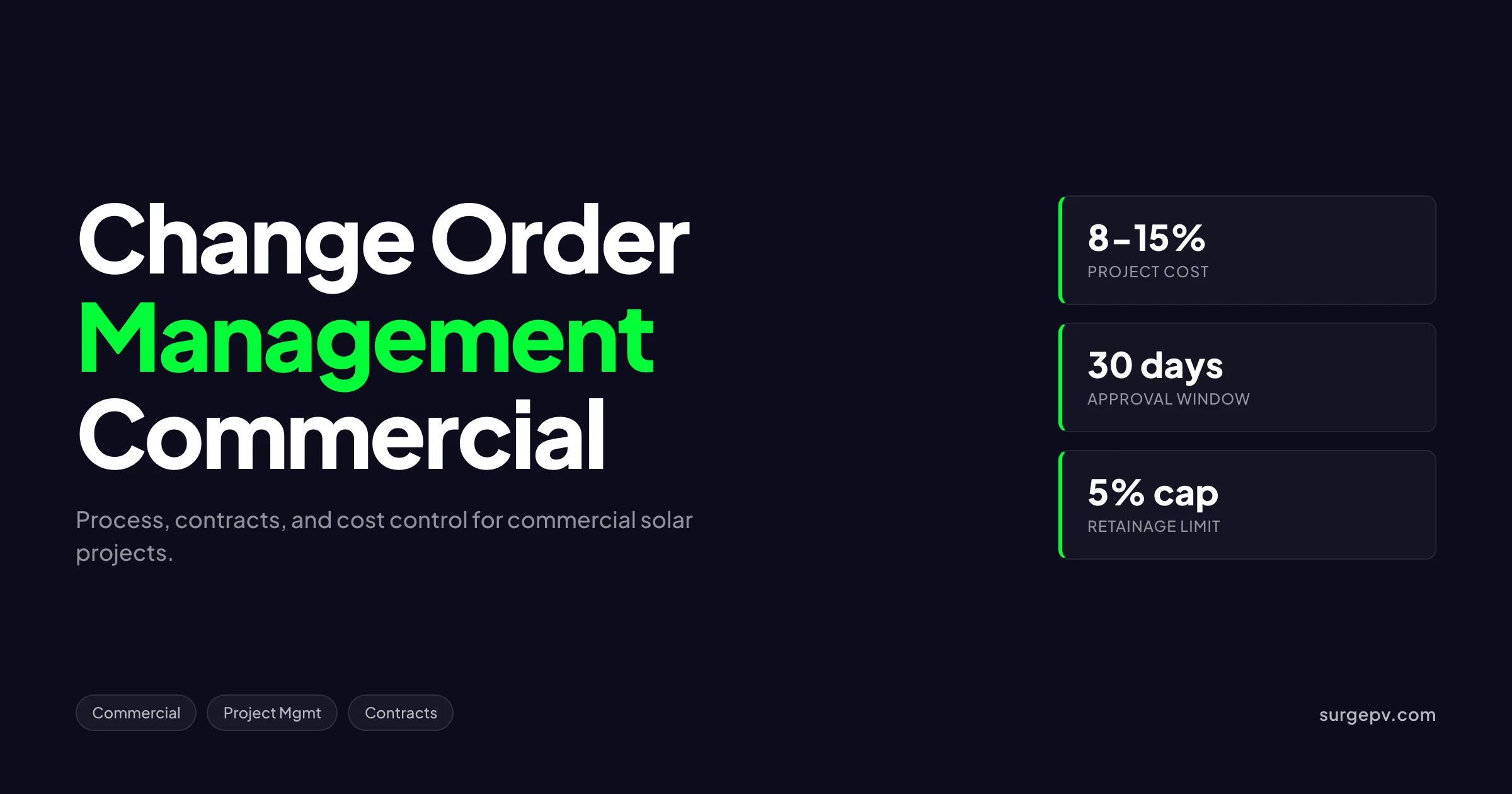
Standard markup rates in construction range from 10-15% for overhead and profit on the changed work. Subcontractor work typically carries a 5% markup cap. Institutional contracts often limit total markup to 10%.
Stage 4: Review and Negotiation
The client reviews the proposal. This is where disputes happen. Clients often challenge the pricing, the necessity of the change, or both.
The contractor’s best defense is documentation. Photos of the roof condition. The original site survey report that did not flag the issue (proving it was unforeseeable). The contract clause that defines the contractor’s scope exclusion for latent conditions.
Negotiation should focus on facts, not personalities. Reference the contract language. Show the direct cause-and-effect chain. If the client initiated the change, remind them that the original scope was priced for the original design.
Set a response deadline. The contract should specify how many business days the client has to approve, reject, or request additional information. Ten business days is standard. Without a deadline, proposals sit indefinitely while costs accumulate.
Stage 5: Approval and Authorization
No changed work should proceed without a fully executed change order. This is the golden rule. Every exception creates risk.
The approved change order must include:
- A clear description of the changed work
- The revised contract price (addition or credit)
- The revised schedule (extension or acceleration)
- Any adjustments to performance guarantees
- Signatures from authorized representatives of both parties
- Date of execution
In emergencies where safety or property damage is at risk, the contractor may proceed with verbal authorization. But the contract should require written confirmation within 24 hours. And a retroactive change order must be submitted within 48 hours.
Stage 6: Execution and Closeout
Once approved, the changed work enters the normal project workflow. It should be tracked separately from the original scope. This allows accurate cost reporting and lessons-learned analysis.
After completion, update the as-built drawings, the operation and maintenance manual, and the warranty documentation. The change order file should include:
- Original change request form
- Impact analysis
- Pricing proposal
- Client correspondence
- Approved change order
- Invoices and payment records
- Final inspection reports
Key Takeaway
A six-stage workflow — identify, analyze, price, negotiate, approve, execute — prevents 80% of change order disputes. The contractors who skip stages are the ones who end up in mediation.
Cost Tracking and Margin Protection
Change orders are a margin killer. Solar EPC contractors operate on thin margins. Industry data shows typical net margins of 8-12% for commercial and utility-scale projects. A single uncontrolled change order can erase half a project’s profit.
The Margin Math
Consider a typical commercial solar project:
- Contract value: $500,000
- Direct costs: $440,000
- Gross profit: $60,000 (12% margin)
Now add a change order for roof structural reinforcement:
- Direct cost of repair: $25,000
- Indirect costs (delay, idle crew, re-inspection): $8,000
- Total change order cost: $33,000
- Change order revenue (with 10% markup): $36,300
The project now looks like this:
- Total revenue: $536,300
- Total costs: $473,000
- Gross profit: $63,300
Wait. The profit went up? Only if the change order is fully priced, approved, and paid. In reality, contractors often absorb indirect costs they failed to price. They negotiate down the markup. Or the client disputes the necessity and pays only a portion. The actual outcome is usually worse.
If the contractor absorbs just $10,000 in unpriced indirect costs, the math changes:
- Total revenue: $536,300
- Total costs: $483,000
- Gross profit: $53,300 (9.9% margin)
The original 12% margin dropped to 9.9%. On a $500,000 project, that is a $6,700 profit loss from one change order.
Real-Time Cost Tracking
Cost tracking must happen in real time. Waiting until month-end to discover that a change order consumed your margin is too late.
The best practice is to maintain a live project cost ledger. Every labor hour, material receipt, and subcontractor invoice gets coded to the original scope or a specific change order. The project manager reviews the ledger weekly.
The ledger should show:
- Original budget vs. actual spend
- Change order budget vs. actual spend
- Committed costs (purchase orders issued but not yet invoiced)
- Forecast final cost
- Projected margin at completion
When the projected margin drops below a threshold (say, 8%), the project manager must investigate. Is it a pricing error? A scope creep issue? A subcontractor overrun? Early detection allows early correction.
The Contingency Trap
Many contracts include a contingency allowance, typically 5-10% of the contract value. This is not a slush fund for change orders. It is a risk reserve for unforeseeable conditions.
The trap is using contingency to absorb change order costs without formal change orders. This hides the problem. It makes the project look profitable on paper while the contingency evaporates. When a true unforeseeable condition arises later, there is no money left.
The rule is simple: contingency is for risks, not changes. Changes get change orders. Contingency gets used only after a formal risk event occurs and the change order process confirms it is not a scope item.
Change Order Budgeting
Experienced contractors budget for change orders at the portfolio level. They know that some percentage of projects will have changes. They price this into their overhead recovery.
If historical data shows that 15% of projects have change orders averaging $15,000 each, and the average project value is $400,000, the portfolio-level change order exposure is:
- 15% of projects × $15,000 = $2,250 per project average
- $2,250 / $400,000 = 0.56% of revenue
This does not mean adding 0.56% to every bid. It means maintaining a corporate reserve funded by overhead recovery across all projects. When a change order on one project cannot be fully recovered, the reserve covers the gap.
SurgePV Analysis
Based on industry data and our own project history, we estimate that uncontrolled change orders reduce effective EPC margins by 2-4 percentage points across a portfolio. For a contractor doing $10 million in annual revenue, that is $200,000-400,000 in lost profit. A disciplined change order process pays for itself in the first year.
Scope Control: What Most Contractors Get Wrong
Scope control is the art of saying no. It is also the art of saying yes at the right price. Most contractors struggle with both.
The “While You’re Here” Problem
The most dangerous phrase in commercial solar is “while you’re here.” The client sees the crew on site and asks for extras. A few extra conduit runs. A monitoring display in the lobby. A battery cabinet moved to a different room.
Each request seems small. None gets documented. None gets priced. By project closeout, the contractor has performed $8,000 in extra work with zero revenue.
The fix is a simple rule: no work outside the contracted scope without a change order. Not even a 30-minute task. Train every crew member to redirect client requests to the project manager. The project manager documents the request and submits a proposal.
This feels bureaucratic. It protects margins.
The Design Creep Spiral
Design creep happens when the client requests small design changes that cascade into large ones. A module layout adjustment changes stringing. New stringing requires inverter reconfiguration. Reconfiguration triggers cable and breaker changes. Each step is “just a small tweak.” The total impact is a full redesign.
The prevention is a design freeze protocol. Set a date after which no design changes are accepted without a formal change order. Communicate this date clearly to the client. Explain that late changes have exponential cost impact because they affect procurement, permitting, and construction sequencing.
A practical design freeze schedule for a commercial project:
| Milestone | Freeze Date | What Freezes |
|---|---|---|
| Preliminary design approval | Week 2 | Layout concept, system size, major equipment |
| Final design approval | Week 4 | Module layout, stringing, single-line diagram |
| Permit submission | Week 6 | All design elements |
| Procurement order | Week 8 | Equipment specifications |
| Construction start | Week 12 | Everything |
The Subcontractor Scope Gap
Commercial solar projects often involve multiple subcontractors: roofing, electrical, structural, and civil. Scope gaps occur when the contract does not clearly define the boundary between subcontractors.
A common gap: who removes and replaces the roofing membrane under the ballast blocks? The roofing contractor says it is not in their scope. The solar contractor says it is part of the solar installation. The client says they hired a solar contractor, not a roofing contractor. The work sits undone until someone pays.
The fix is a responsibility matrix in the contract. It lists every major task and assigns it to a specific party. It also defines the interface points: where one contractor’s work ends and another’s begins.
The “No Surprises” Principle
The best scope control tool is communication. Over-communicate with the client about what is included, what is excluded, and what could trigger extra costs.
Before construction starts, hold a pre-construction meeting. Walk the client through the contract scope. Point out the known risks. Explain the change order process. Show them examples of past change orders (anonymized) and how they were handled.
This meeting takes two hours. It prevents weeks of disputes.
What Most Guides Miss
Most change order guides focus on documentation and process. They miss the human element. The project manager who has a good relationship with the client gets change orders approved faster and with less negotiation. The project manager who communicates only when problems arise gets pushback on every proposal. Relationship capital is a real asset in change order management.
Contract Clauses Every Commercial Solar Agreement Needs
The contract is the foundation of change order management. A weak contract invites disputes. A strong contract prevents them. These are the clauses that matter most.
Change Order Authorization
The contract must require written authorization before any changed work proceeds. Verbal approvals are not valid. Email approvals are risky. Only a signed change order or construction change directive (CCD) authorizes extra work.
The clause should specify:
- Who can authorize changes on each side
- The form the authorization must take
- The timeline for submitting change order requests
- The timeline for client response
- What happens if the client does not respond within the deadline
A sample clause:
“No changes to the Work shall be made without a written Change Order signed by both parties. Contractor shall not proceed with any changed work without a fully executed Change Order, except in emergencies affecting safety or property. In such cases, Contractor shall notify Owner within 24 hours and submit a retroactive Change Order Request within 48 hours.”
Pricing Methodology
The contract should define how changes are priced. This prevents disputes during the project when emotions are high.
The clause should specify:
- The order of priority for pricing methods (lump sum first, then unit rates, then force account)
- The unit rates that apply (if using unit pricing)
- The markup percentages for overhead and profit
- The markup cap on subcontractor work
- The labor rates for force account work
- The equipment rates for force account work
A sample clause:
“Change Order pricing shall be determined in the following order of priority: (a) agreed lump sum; (b) unit rates set forth in Schedule A; (c) force account at actual cost plus 12% for overhead and profit on direct work and 5% on subcontractor work. Labor rates shall not exceed [rate] per hour for [classification]. Equipment rates shall not exceed [rate] per hour.”
Schedule Adjustment
Changes affect schedules. The contract must define how schedule adjustments are calculated.
The clause should specify:
- The method for schedule analysis (Critical Path Method preferred)
- Float ownership (who owns the float in the schedule)
- Whether delay damages apply to owner-caused delays
- The notice requirement for delay claims
A sample clause:
“The Contract Schedule shall be adjusted based on a Critical Path Method analysis. Contractor shall submit a revised schedule with each Change Order Request showing the impact on the critical path. Float is owned by the project, not by either party. Owner-caused delays shall extend the Contract Time without assessment of liquidated damages.”
Performance Guarantee Adjustment
Solar projects often include performance guarantees: minimum energy production, availability, or degradation rates. A change order that alters the system design may affect these guarantees.
The clause should specify:
- The threshold for guarantee recalculation (e.g., changes exceeding 5% of contract value)
- How guarantees are recalculated (proportional adjustment, re-modeling, etc.)
- Whether additional security is required for material changes
A sample clause:
“For changes exceeding 5% of the original Contract Price, Performance Guarantees shall be recalculated based on updated production modeling. Owner may require additional security for changes materially affecting system performance. Warranty terms for substituted equipment shall be no less favorable than the original specifications.”
Accord and Satisfaction
This clause prevents the contractor from coming back later with additional claims for the same change. Once a change order is executed, it settles all claims related to that change.
A sample clause:
“A fully executed Change Order shall constitute full and final settlement of all claims for the subject change, including direct costs, indirect costs, delay damages, and ripple effects, except as expressly reserved in writing at the time of execution.”
Latent Conditions
Latent conditions are site conditions that could not reasonably be discovered during the site survey. The contract must define who bears the risk.
A sample clause:
“Contractor’s scope excludes work required by latent site conditions that could not reasonably be discovered during the site survey. Such conditions include concealed structural defects, unknown underground utilities, and soil conditions differing materially from the geotechnical report. Contractor shall notify Owner within 48 hours of discovery. The parties shall negotiate a Change Order for the required remediation.”
Notice Requirements
Timely notice is critical. Contractors who discover a condition but delay notice lose their right to compensation.
The clause should specify:
- The deadline for notice (typically 7-14 days from discovery)
- The form of notice (written, with specific content)
- The consequence of late notice (waiver of claim)
A sample clause:
“Contractor shall provide written notice of any event that may give rise to a Change Order within 7 days of discovery. Notice shall describe the event, its cause, and its estimated impact on cost and schedule. Failure to provide timely notice shall constitute a waiver of the claim, except where Owner had actual knowledge of the condition.”
Tradeoff
Strict contract clauses protect the contractor but can alienate the client. Overly aggressive markup caps, short notice deadlines, and broad exclusion language may win individual disputes but lose future business. The best contracts are clear, fair, and balanced. They set expectations without creating adversarial relationships.
Software Tools for Change Order Management
Paper-based change order management does not scale. Commercial solar contractors need software that connects design, contracts, and field execution. The right tool reduces errors, speeds approvals, and creates audit trails.
Design-to-Contract Integration
The root cause of many change orders is a disconnect between design and contract. The designer creates a layout in one tool. The salesperson writes a proposal in another. The contract references a third document. When the field team discovers a discrepancy, no one knows which document is authoritative.
Integrated platforms solve this by linking design data directly to the contract. The module count, inverter specification, and production estimate in the contract come from the same design file the engineer approved. If the design changes, the contract updates automatically.
SurgePV’s solar design software connects 3D layout, shading analysis, and production modeling in one workflow. Designs export directly to proposals with locked specifications. When a change order is needed, the revised design generates an updated proposal with automatic pricing. This eliminates the manual transfer errors that cause so many disputes.
Project Management Platforms
Dedicated project management tools track change orders as discrete tasks with workflows, approvals, and reporting.
JobNimbus is popular among residential and small commercial contractors. It offers change order templates, photo documentation, and customer portals for approvals.
AccuLynx targets roofing and solar contractors. It includes material ordering, crew scheduling, and financial tracking alongside change order management.
Buildertrend serves general contractors but has solar-specific modules. It connects change orders to scheduling, billing, and customer communication.
Procore is the enterprise standard for large commercial and utility-scale projects. It offers full document control, workflow automation, and integration with accounting systems.
Financial Tracking Tools
Change orders affect project finances in real time. Contractors need tools that show the financial impact immediately.
QuickBooks and Xero handle basic project costing. They can track change order revenue and expenses against project budgets. But they lack project management features.
Sage 100 Contractor and Viewpoint Vista offer deeper construction-specific financial tracking. They handle retainage, progress billing, and job cost reporting with change order segregation.
Custom dashboards built in Power BI or Tableau can pull data from multiple sources (project management, accounting, design) into a single view. The best dashboards show:
- Project health score (green/yellow/red)
- Change order count and value by project
- Margin impact of open change orders
- Aging of pending approvals
- Trend analysis (change order rate by project type, size, or region)
Mobile Field Tools
Field teams discover most change orders. They need tools to document and report them immediately.
Mobile apps like SiteCapture and CompanyCam let crews take photos, add annotations, and submit change requests from the field. The submissions flow into the project management system for review.
OpenSolar offers a change order template integrated with its design and proposal platform. Field teams can reference the original design, document the change, and generate a proposal update.
The key feature is speed. A change documented and submitted within an hour of discovery gets processed faster than one reported at the end of the week. Speed reduces cost because the contractor can stop work before performing unapproved extra labor.
Design Changes Should Not Break Your Margins
SurgePV connects 3D layout, financial modeling, and proposal generation in one platform. When site conditions change, update the design and see the cost impact instantly.
Book a DemoNo commitment required · 20 minutes · Live project walkthrough
Change Order Impact Comparison
Not all change orders are equal. Some are minor annoyances. Others are project killers. The table below compares the six types by frequency, average cost, preventability, and margin impact.
| Change Order Type | Frequency | Avg. Cost (Commercial) | Preventable? | Margin Impact |
|---|---|---|---|---|
| Site condition — roof | High | $15,000-50,000 | Partially | Severe |
| Site condition — electrical | High | $10,000-40,000 | Partially | Severe |
| Design — shading/layout | Medium | $5,000-20,000 | Yes | Moderate |
| Equipment substitution | Medium | $3,000-15,000 | Partially | Low-Moderate |
| Customer scope addition | Low-Medium | $10,000-100,000+ | N/A (customer-driven) | Neutral-Positive |
| Regulatory/code change | Low | $5,000-25,000 | No | Moderate |
| Utility interconnection upgrade | Low | $10,000-500,000+ | No | Severe |
Key insight: Site condition changes are the highest-frequency, highest-impact category. They are also the most preventable with better upfront surveys. A $3,000 drone survey that prevents a $25,000 roof repair change order pays for itself eight times over.
What the Data Says: 2026 Market Context
The commercial solar market in 2026 is experiencing structural shifts that increase change order risk. Understanding these trends helps contractors prepare.
Market Contraction and Margin Pressure
The U.S. commercial solar market installed 2,345 MWdc in 2025, up 6% year-over-year. But 2026 is projected to contract by 13%, primarily due to California’s NEM 2.0 pipeline completing and the shift to smaller Net Billing Tariff projects. According to SEIA’s Solar Market Insight Report 2025, commercial solar pricing increased 10% in 2025.
Smaller markets mean fiercer competition. Contractors bid aggressively to win work. Aggressive bidding leaves no room for change order absorption. The contractor who prices a project at 8% margin cannot afford a 5% change order hit.
Policy Uncertainty
The One Big Beautiful Bill Act (OBBBA), signed July 4, 2025, restructured tax credit timelines. Projects must meet construction start deadlines to preserve credit eligibility. This has created a rush to break ground, sometimes before designs are fully baked.
Rushed designs have more errors. More errors mean more change orders. Contractors who accelerate timelines to meet tax deadlines may trade a credit preservation win for a change order loss.
Supply Chain Volatility
Module and inverter supply chains have stabilized since 2022 but remain volatile. The ALMM mandate in India, effective June 2026, will force module substitutions on projects that specified non-compliant products. According to industry analysis, this affects a significant share of ongoing projects. For India-specific information, see Solar Energy India.
In the U.S., Foreign Entity of Concern (FEOC) guidance continues to create procurement uncertainty. Contractors who specified Chinese-manufactured modules may need to substitute domestic or allied-nation alternatives. These substitutions are not plug-and-play. They require engineering review, updated permits, and potentially revised interconnection applications.
Interconnection Bottlenecks
Grid interconnection remains the top barrier for commercial solar developers. According to industry reports, one-third of projects in the PJM queue wait 500+ days. MISO timelines average 373-505 days.
Long interconnection queues increase the risk of design changes between application and construction. A project designed in 2024 may face revised utility requirements in 2026. The longer the gap, the higher the change order risk.
Key Takeaway
2026 market conditions — contraction, policy uncertainty, supply volatility, and interconnection delays — create a perfect storm for change orders. Contractors who tighten their processes now will survive the storm. Those who do not will see margins compress further.
The Misconception: “Solar Projects Come in Under Budget”
A 2025 study from Boston University analyzed 662 energy projects across 83 countries. It found that solar PV projects averaged 2.2% under budget — the best cost performance of any energy technology. According to the study, solar had lower cost overrun risk than wind, hydro, geothermal, and nuclear.
This statistic is true at the macro level. It is dangerously misleading at the project level.
The study measured utility-scale projects with mature procurement, standardized designs, and experienced EPC teams. Commercial and industrial (C&I) distributed solar is a different animal. Each roof is unique. Each electrical system is different. Each AHJ has its own rules.
In the C&I segment, cost overruns from change orders are common. The Aurora Solar survey found that 47% of contractors see change orders on 10-30% of projects. The weighted average cost per change order is $583 for residential projects. Commercial change orders are typically 10-50x larger. For software options, see 7 Best Aurora Solar Alternatives in.
The misconception that “solar is under budget” leads contractors to underprice contingency. It leads clients to resist change order pricing because they believe solar is “cheap.” It leads to disputes when reality does not match the headline statistic.
The truth is more specific: utility-scale solar with repeatable designs and strong procurement controls comes in under budget. Commercial solar with unique sites, aging infrastructure, and inexperienced clients does not.
Practical Guidance: Building Your Change Order System
Theory is useful. Implementation matters more. Here is a practical framework for building a change order system that works.
Step 1: Audit Your Last 20 Projects
Pull the files from your last 20 completed projects. For each, identify:
- How many change orders occurred
- The total value of change orders
- The types of change orders (use the six categories above)
- Which ones were approved, disputed, or written off
- The margin impact
This audit reveals your pattern. Maybe 60% of your change orders are roof-related. Maybe your electrical upgrades always cost more than you estimate. Maybe your client approval rate is only 40%.
The pattern tells you where to focus. If roof issues dominate, invest in better structural surveys. If approvals are low, improve your proposal presentation.
Step 2: Standardize Your Documentation
Create templates for every change order document:
- Change Request Form (for internal use)
- Change Order Proposal (for client submission)
- Change Order Authorization (for execution)
- Change Order Log (for portfolio tracking)
Each template should have consistent fields, formatting, and branding. Consistency builds professionalism. Professionalism builds client trust.
Step 3: Train Your Team
Every person who touches a project needs change order training:
- Sales: How to set scope expectations and explain exclusions
- Designers: How to document design assumptions and flag risks
- Project managers: How to execute the six-stage workflow
- Site supervisors: How to document field conditions and redirect client requests
- Finance: How to track change order costs and report margin impact
Training is not a one-time event. Review change order case studies in monthly team meetings. Discuss what went wrong and what went right.
Step 4: Build Client Communication into the Process
Clients fear change orders because they feel out of control. Proactive communication reduces that fear.
At project kickoff, give the client a one-page document titled “What to Expect if Conditions Change.” It explains:
- Why change orders happen (with examples)
- How the change order process works
- Typical timelines for approval
- How pricing is determined
- Their role in the process
This document sets expectations before problems arise. It turns a surprise into a planned contingency.
Step 5: Review and Improve Quarterly
Every quarter, review your change order data:
- Change order rate by project type and size
- Average change order value
- Approval rate and average negotiation time
- Margin impact trend
- Root cause analysis of the top 3 change order types
Use this data to refine your processes. If your change order rate is rising, investigate why. If your approval rate is falling, review your proposal quality.
Pro Tip
Create a “change order playbook” for your company. It is a living document that captures your templates, processes, pricing guidelines, and lessons learned. Update it after every major project. New team members read it during onboarding. Experienced team members reference it when facing unusual situations.
Frequently Asked Questions
What is solar change order management?
Solar change order management is the process of documenting, approving, pricing, and tracking scope changes in a solar installation contract. It covers everything from roof repairs discovered mid-project to inverter swaps forced by supply shortages. Effective management requires clear contract clauses, a defined approval workflow, and real-time cost tracking.
What percentage of commercial solar projects have change orders?
According to an Aurora Solar survey of 107 solar professionals, 47% reported that change orders impact between 10-30% of their projects. Nearly 7% said change orders are needed for over half of their projects. Commercial projects likely see higher rates than residential due to complex roofs, aging electrical infrastructure, and larger system sizes.
What are the most common types of change orders in commercial solar?
The six most common types are: (1) site condition changes like roof repairs or electrical upgrades, (2) design changes from shading or layout errors, (3) equipment substitutions due to supply chain issues, (4) customer-requested scope additions like battery storage, (5) regulatory or code changes, and (6) interconnection upgrades required by the utility.
How much does a typical solar change order cost?
The weighted average cost of a solar change order is $583, according to industry survey data focused on residential projects. Commercial project change orders range from a few thousand dollars for minor electrical work to $50,000+ for roof structural repairs or major inverter replacements. A typical commercial roof repair change order runs $15,000-50,000. Also see: Us Residential Solar Market Trends 2026. For United States-specific compliance details, see United States arizona/phoenix.
How can solar contractors prevent change orders?
Prevention starts with detailed site surveys that verify field conditions rather than relying on software assumptions. Contractors should inspect roof age and structural capacity, verify electrical panel capacity and breaker space, obtain interval data from the utility, and finalize layouts before generating wire diagrams. Drone surveys and mobile data capture apps improve accuracy.
What should a solar change order include?
A valid change order must include: project information, a detailed description of the change, financial impact with itemized costs, schedule impact with revised timeline, supporting documentation like photos or engineering reports, and signatures from both parties. Without all six elements, the change order is vulnerable to dispute.
What contract clauses protect against unapproved change orders?
Key protective clauses include: written authorization requirements before any changed work proceeds, defined pricing methods (lump sum, unit rates, or force account), schedule adjustment provisions based on CPM analysis, performance guarantee recalculation for material changes, and accord-and-satisfaction language that prevents future claims for the same change.
What software tools help manage solar change orders?
Solar contractors use design platforms like SurgePV for accurate upfront modeling, project management tools like JobNimbus and AccuLynx for workflow tracking, and financial systems like QuickBooks or Sage for cost reporting. The best approach integrates design, project management, and accounting in a connected workflow.
How do change orders affect EPC contractor margins?
Solar EPC contractors typically operate on 8-12% net margins. Uncontrolled change orders erode these margins because rework, delay costs, and disputed pricing often go untracked. A single $15,000 roof repair change order on a $200,000 project can consume 50-75% of the contractor’s profit if indirect costs are not fully priced and recovered.
What is the difference between a change order and a construction change directive?
A change order is a mutually agreed, signed document that modifies the contract scope, price, and schedule. A construction change directive (CCD) is an owner-issued order to proceed with changed work before the price is agreed, used in emergencies or when agreement cannot be reached quickly. CCDs are riskier for contractors because the price is not locked.
Conclusion
Change orders are not a failure of planning. They are a feature of commercial solar. Roofs hide problems. Electrical systems age. Supply chains shift. Clients change their minds. The contractor who pretends otherwise loses money.
The contractors who thrive build systems. They invest in site surveys that catch issues early. They write contracts with clear change order clauses. They train teams to document and escalate immediately. They track costs in real time. They communicate with clients before problems become disputes.
Three actions to take this week:
- Audit your last 10 projects for change order patterns. Identify the top two root causes and create prevention checklists for your site survey team.
- Review your contract template. Add or strengthen the six clauses covered in this guide: authorization, pricing methodology, schedule adjustment, performance guarantee adjustment, accord and satisfaction, and latent conditions.
- Implement a weekly project cost review. Every project manager should report actual spend vs. budget, open change orders, and projected margin at completion. Flag any project below 8% projected margin for immediate investigation.
Change orders will not disappear. But with the right systems, they stop being margin killers and become manageable project events.
Related SurgePV Resources
Continue learning with these related guides for solar installers and EPCs:
- Project Profitability Tracking
- Managing Solar Subcontractors
- Cash Flow Management for Solar Installers
- How to Expedite Solar Permits
- Handling Customer Complaints After Solar Installation
For more solar business and marketing content, explore the full SurgePV blog or browse the SurgePV glossary for definitions of solar industry terms.
Solar Software Tools to Support This Work
Effective solar installer operations depend on integrated software. SurgePV’s solar design suite helps installers handle the upstream work that feeds every decision in this guide:
- Solar design software for system layouts, panel placement, and BOM generation
- Shadow analysis for site-specific irradiance and obstruction modeling
- Solar financial analysis tool for production forecasts and project ROI
- Customer-ready solar proposals for branded, customer-facing proposals
- Clara AI for automated design assistance and Q&A
Browse the full SurgePV platform to see how installers worldwide use the tools to design smarter, sell faster, and streamline every solar project.
Where this fits
This article is part of SurgePV's Solar Business & Operations hub, which works through the topic from first principles to the decisions a project team actually has to make.


