

Quick Answer
Solar subcontractor management requires verifying licenses (electrical, roofing), insurance ($1M+ general liability), and NABCEP certification. Contracts should define scope, timeline, payment terms, and warranty responsibilities. Quality control: pre-work inspections, photo documentation, and final walkthroughs with punch lists.
A 50 MW solar farm in Texas lost 60 days on site. The cause was not weather, permits, or interconnection. It was a roofing subcontractor who walked off the job after a payment dispute. The prime EPC had to source a replacement crew, redo partially completed work, and absorb $2 million in delay costs. That single subcontractor failure erased the project’s margin.
Solar subcontractor management requires verifying licenses (electrical, roofing), insurance ($1M+ general liability), and NABCEP certification. Contracts should define scope, timeline, payment terms, and warranty responsibilities. Quality control: pre-work inspections, photo documentation, and final walkthroughs with punch lists.
Solar subcontractor management requires verifying licenses (electrical, roofing), insurance ($1M+ general liability), and NABCEP certification. Contracts should define scope, timeline, payment terms, and warranty responsibilities. Quality control: pre-work inspections, photo documentation, and final walkthroughs with punch lists.
This is not an edge case. The solar industry runs on subcontractors. Electricians, racking crews, roofing specialists, trenching teams, and commissioning technicians handle the bulk of physical installation. Yet the systems that manage them — contracts, insurance, quality checks, payment workflows — lag far behind the technical sophistication of the panels and inverters being installed.
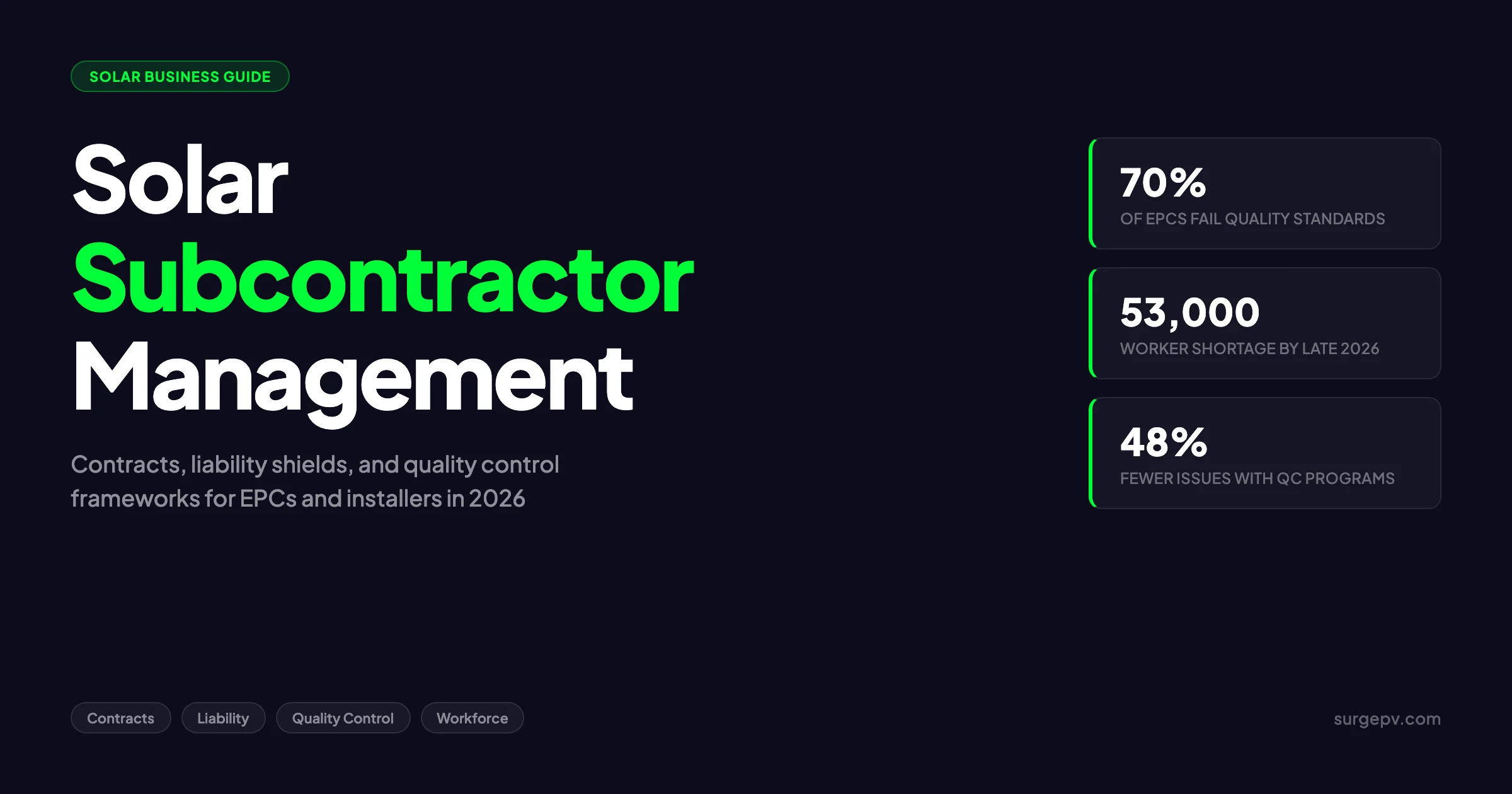
The 2025 HelioVolta SolarGrade report found that nearly 70% of evaluated EPCs did not meet baseline quality standards. Eighty percent of projects had wiring issues. Eighty-three percent had connector problems. The sample covered 5 GW of assets, over 1,000 projects, and roughly 120 subcontractors. The data is clear: subcontractor management is not an administrative afterthought. It is the single biggest operational risk in solar construction.
This guide covers the full framework for managing solar subcontractors in 2026. You will learn how to structure contracts that protect your margin, how to verify insurance and liability coverage, how to build quality control gates that catch problems before they cascade, and how to navigate the workforce shortage that makes finding good subcontractors harder than ever.
Quick Answer
Solar subcontractor management is the end-to-end process of selecting, contracting, supervising, and paying specialized trade contractors who perform installation work under a prime EPC or installer. Effective management requires clear contracts with indemnification and insurance requirements, milestone-based payment gates, three-phase quality inspections, and documented compliance with prevailing wage and apprenticeship rules on federally backed projects.
In this guide:
- Why solar projects rely on subcontractors and where the risk concentrates
- How to structure subcontractor contracts that protect your margin and schedule
- Insurance, liability, and indemnification: what to require and how to verify it
- A three-gate quality control framework with inspection checklists
- The 2026 workforce shortage and how it changes subcontractor strategy
- What most EPCs get wrong about subcontractor oversight
- Specific action items you can implement this week
Why Solar Projects Run on Subcontractors
Solar construction is a coordination problem disguised as an engineering problem. A typical commercial installation involves electrical work, structural mounting, roofing penetration, trenching, and utility interconnection. No single crew has expertise in all of these trades. Subcontractors fill the gaps.
The Subcontractor Ecosystem in Solar
A utility-scale solar project typically engages five to eight subcontractor types. A residential rooftop project uses two to four. The most common subcontractor categories are:
| Subcontractor Type | Typical Scope | When Used |
|---|---|---|
| Electrical contractor | DC wiring, AC tie-in, inverter installation, grounding | Every project |
| Racking/mounting crew | Structural assembly, rail installation, module clamping | Ground-mount and large rooftop |
| Roofing contractor | Penetration sealing, structural reinforcement, tile work | Residential and commercial rooftop |
| Trenching/excavation | Conduit runs, foundation work, civil preparation | Ground-mount and carport |
| Commissioning technician | Performance testing, IV curve tracing, SCADA setup | Commercial and utility-scale |
| Monitoring installer | Revenue-grade meter, data logger, remote monitoring | Most projects above 100 kW |
| Crane/rigging operator | Module lifting, heavy equipment placement | Utility-scale and large C&I |
Each of these trades carries its own licensing requirements, safety protocols, and quality standards. The prime contractor’s job is not to perform the work. It is to integrate these specialized inputs into a coherent project that passes inspection, performs to specification, and delivers on budget.
Why Subcontractors Are Not Optional
The US solar industry faces a 53,000-worker shortage by late 2026, according to PV Magazine. Eighty-six percent of solar employers report difficulty filling open positions. In this environment, maintaining a fully in-house workforce for every trade is not just expensive. It is impossible.
Subcontractors offer three advantages that make them structurally necessary:
Variable cost structure. You pay for labor when you need it. Fixed payroll for electricians, roofers, and racking crews would bankrupt most installers during slow seasons.
Access to specialized skills. A licensed master electrician with solar experience commands a premium salary. Most residential and small commercial installers cannot justify that headcount full-time. Subcontracting gives you access to the skill without the fixed cost.
Geographic flexibility. Projects in multiple states or regions require local labor. Subcontractor networks let you bid work outside your home market without relocating crews.
The tradeoff is control. When you subcontract, you trade direct oversight for flexibility. The quality of that trade depends entirely on your management systems.
Pro Tip
Build your subcontractor bench before you need it. Pre-qualify 3–5 electrical contractors, 2–3 roofing crews, and 2 racking specialists in each market you serve. A pre-qualified bench turns a 3-week search into a 2-day phone call when a project award comes in.
Contract Structures That Protect Your Margin
The subcontractor contract is your primary risk management tool. A well-drafted agreement defines scope, allocates liability, ties payment to performance, and gives you exit options when things go wrong. A weak contract leaves you exposed to cost overruns, schedule delays, and quality failures you cannot remedy.
The Seven Essential Contract Clauses
Every solar subcontractor agreement should include these seven elements:
1. Scope of work with material specifications. Define exactly what the subcontractor will do and what materials they will use. Reference the approved Bill of Materials (BOM) by manufacturer and model number. Vague scope descriptions — “install electrical” or “complete wiring” — create disputes when the subcontractor uses cheaper components than you specified.
2. Schedule with milestone dates. Break the work into discrete milestones: material delivery, rough-in completion, final connection, inspection readiness. Tie each milestone to a calendar date and define the consequences of missing it.
3. Payment terms tied to inspection gates. Never pay based on time alone. Structure payments as percentages of contract value released at milestone completion: 30% at material delivery, 40% at rough-in completion, 20% at final inspection pass, 10% retainage at project acceptance. This aligns the subcontractor’s cash flow with your verification of their work.
4. Insurance and bonding requirements. Specify minimum coverage amounts, additional insured status for the prime, and certificate of insurance (COI) delivery before work begins. Require the subcontractor to maintain coverage throughout the project and for the warranty period.
5. Warranty period and remedy obligations. Define how long the subcontractor warrants their work and what happens when defects appear. A standard warranty period is 12 months from substantial completion for labor and 24 months for equipment installation. The remedy clause should require the subcontractor to repair or replace at their cost within a specified timeframe.
6. Change order procedures. Scope changes are inevitable. The contract must require written change orders signed by both parties before any additional work proceeds. Verbal approvals create disputes about what was agreed and what it cost.
7. Termination rights. Reserve the right to terminate for convenience (with notice and payment for work completed) and for cause (immediately, for safety violations, abandonment, or material breach). Without termination for cause, you are stuck with a failing subcontractor until the project ends.
Liquidated Damages and Schedule Risk
Schedule delays in solar projects are expensive. Percepto data shows the average 50 MW PV construction project delay costs approximately $2 million. The World Bank’s utility-scale solar guidelines identify reliance on third-party contractors as a primary source of delay risk.
Liquidated damages clauses specify a fixed daily amount the subcontractor pays for schedule overruns attributable to their scope. The amount must be a reasonable estimate of actual damages — not a penalty — to be enforceable. A common structure is $500–$2,000 per day depending on project size and the criticality of the subcontractor’s path.
The key is specificity. Liquidated damages only apply to delays within the subcontractor’s control. Force majeure, owner-directed changes, and utility interconnection delays are standard exclusions. Define these exclusions clearly to avoid disputes.
Retainage: How Much and When to Release
Retainage is the portion of contract value held back until final completion. It is your leverage to ensure the subcontractor fixes punch-list items and submits required documentation.
Standard retainage for solar subcontractors is 5–10%. The release schedule matters as much as the amount:
| Project Phase | Retainage Release | Condition |
|---|---|---|
| Substantial completion | 50% of retainage | All work complete, inspection passed, punch list under 10 items |
| Final acceptance | 50% of retainage | Punch list cleared, as-builts submitted, lien waivers received |
| Warranty period end | 0% (already released) | No defect claims in first 12 months |
For first-time subcontractors or those with limited track records, 10% retainage is appropriate. For established partners with three or more clean projects, 5% is reasonable. Never release 100% of retainage at substantial completion. The final 5% is your only leverage for documentation and minor corrections.
Key Takeaway
A subcontractor contract without milestone-based payments, retainage, and termination for cause is not a contract. It is a donation request. The seven essential clauses above are non-negotiable for any solar project where you are the prime contractor.
Insurance, Liability, and Indemnification
Subcontractors bring risk onto your project. Their employees can get injured. Their work can damage property. Their mistakes can cause system failures. Your contract and insurance framework determines who pays when these events occur.
The Insurance Stack Every Subcontractor Needs
Require every solar subcontractor to carry these coverages before they step on site:
| Coverage Type | Minimum Limit | Why It Matters |
|---|---|---|
| General liability | $1M per occurrence / $2M aggregate | Covers bodily injury and property damage from the subcontractor’s operations |
| Workers compensation | Statutory limits | Covers employee injuries; without it, the prime may be liable under “statutory employer” doctrines |
| Auto liability | $1M | Covers vehicle accidents involving subcontractor vehicles on or near the site |
| Umbrella/excess | $2–5M | Provides additional limits above primary policies for catastrophic claims |
| Professional liability (E&O) | $1M | Covers design or engineering errors for subcontractors performing design work |
The prime contractor must be named as an additional insured on the subcontractor’s general liability policy. This gives the prime direct rights under the subcontractor’s policy if a claim arises from the subcontractor’s work.
Certificate of Insurance Verification
A certificate of insurance (COI) is not coverage. It is a snapshot of coverage at a single point in time. Verify these elements on every COI:
- Policy effective dates cover the project duration
- Coverage limits meet or exceed contract requirements
- The prime is listed as additional insured
- The certificate holder (you) is named correctly
- The insurance carrier is rated A- or better by AM Best
Request updated COIs at contract signing, project midpoint, and policy renewal. Subcontractors let coverage lapse more often than you would expect. A lapsed policy discovered after an incident is a $50,000 mistake on a small project and a multi-million dollar mistake on a large one.
The 2026 Insurance Market Reality
The renewable energy insurance market is tightening. AmWins reports that 2026 will bring “more scrutiny on subcontractor qualification and oversight in solar and BESS construction.” General liability premiums are rising 5–15% for best-in-class contractors and more for poor performers.
The solar plant insurance market reached $6.2 billion in 2025 and is growing at 9.4% annually. Liability insurance is the fastest-growing segment at 15.8% CAGR. Insurers are increasingly requiring detailed subcontractor pre-qualification, safety plans, and loss control programs as a condition of coverage.
What this means practically: your subcontractors will face higher insurance costs in 2026. Some may struggle to obtain coverage at all. Build insurance verification into your pre-qualification process, not just your contract signing process. A subcontractor who cannot obtain adequate coverage is a subcontractor you cannot use.
Indemnification: Who Pays for What
The indemnification clause allocates financial responsibility for claims arising from the subcontractor’s work. A standard mutual indemnification structure works as follows:
- The subcontractor indemnifies the prime for claims arising from the subcontractor’s negligence, willful misconduct, or breach of contract
- The prime indemnifies the subcontractor for claims arising from the prime’s negligence, willful misconduct, or breach of contract
- Each party indemnifies the other for claims arising from their own employees’ actions
This is fair and standard. What is not fair — and what some subcontractors will try to insert — is a broad form indemnification where the subcontractor holds the prime harmless for the prime’s own negligence. Reject this. It shifts liability for your mistakes onto a party with no control over your actions.
The Davis-Bacon Liability Trap
The 2024 Department of Labor final rule made a critical change for solar subcontractors: prime contractors are now explicitly liable for subcontractor back wages under the Davis-Bacon Act. If your electrical subcontractor pays less than the prevailing wage on a federally funded or IRA-backed project, you — the prime — owe the difference.
The penalties are severe. Intentional disregard of prevailing wage requirements triggers tripled correction payments and doubled IRS penalties for IRA-related projects. Debarment from federal contracting for up to three years is possible.
The practical implication: you cannot delegate Davis-Bacon compliance to your subcontractor and hope for the best. You must verify their payrolls, confirm their worker classifications match DOL wage determinations, and document everything. The 2024 rule makes this a prime contractor obligation by operation of law.
What Most EPCs Get Wrong
Most prime contractors treat the subcontractor’s COI as a checkbox item. They verify it once at contract signing and never check again. Coverage lapses, limits decrease, and additional insured endorsements expire. The correct approach is quarterly COI verification with automatic holds on payment if coverage gaps appear. Treat insurance like a living requirement, not a one-time formality.
A Three-Gate Quality Control Framework
Quality control is where most subcontractor management systems break down. The HelioVolta 2025 report found that 85% of evaluated projects contained major issues requiring urgent corrective action. Seven percent had critical issues so severe they triggered immediate de-energization. These were not amateur operations. The sample included 70 EPCs with collective experience across thousands of projects. Also see: Us Residential Solar Market Trends 2026. For United States-specific compliance details, see United States arizona/phoenix. For United States-specific compliance details, see United States california/los-angeles.
The problem is not lack of knowledge. It is lack of systematic inspection. Most EPCs rely on a single final walkthrough to catch problems. By that point, defects are buried behind finished work. Rework costs 3–5x more than catching the same issue during installation.
Gate 1: Pre-Installation Verification
Before any subcontractor begins work, verify three things:
Materials match the approved BOM. The subcontractor must deliver panels, inverters, racking, wiring, and connectors that match the specifications exactly. Substitutions require written approval. A common failure mode is the subcontractor using a lower-grade cable or generic connector to save cost. The BOM verification gate prevents this.
Personnel are qualified. Verify that the subcontractor’s lead technician holds the required licenses and certifications. For electrical work, this means a state-issued electrician’s license. For roofing work, a roofing contractor license. For racking work, OSHA-10 minimum and fall protection training. Request copies of licenses and certifications before work begins.
Site conditions match the design. The subcontractor must confirm that roof structure, electrical service capacity, and site access match the assumptions in the design documents. Discrepancies discovered after work begins are change orders. Discrepancies discovered before work begins are design corrections.
Gate 2: In-Process Inspections
Do not wait until the subcontractor finishes to inspect their work. Schedule inspections at 25%, 50%, and 75% completion. Each inspection focuses on different elements:
| Completion | Inspection Focus | Common Issues to Catch |
|---|---|---|
| 25% | Layout and rough-in | Module spacing, conduit routing, grounding path |
| 50% | Connections and terminations | Torque specs, wire management, connector integrity |
| 75% | Final assembly and labeling | Label placement, disconnect accessibility, rapid shutdown compliance |
Photo documentation is mandatory at each gate. The subcontractor should provide dated photos of key work stages: racking assembly, DC homerun routing, inverter installation, AC tie-in, and grounding connections. These photos serve three purposes: quality verification, as-built documentation, and dispute resolution if defects appear later.
The HelioVolta data shows that wiring issues appear in 80% of projects and connector issues in 83%. These are not complex failures. They are basic installation errors: loose connections, incorrect wire sizing, damaged insulation, and improper torque. In-process inspections catch these errors when they are still easy to fix. Read Solar Cable Sizing Calculation for a complete walkthrough.
Gate 3: Post-Installation Testing
After the subcontractor completes their scope, perform functional testing before releasing final payment:
Electrical testing:
- Open-circuit voltage (Voc) verification per string
- Insulation resistance testing (megger test)
- Ground fault protection device testing
- Arc-fault circuit interrupter (AFCI) functionality
Performance testing:
- Performance ratio calculation under actual conditions
- Inverter startup and shutdown sequence
- Anti-islanding protection verification
- Revenue-grade meter calibration check
Safety verification:
- Rapid shutdown system functionality (NEC 690.12)
- AC and DC disconnect accessibility and labeling
- Warning label placement per NEC 690.13
- Fire classification compliance for roof-mounted systems
Do not release final retainage until all tests pass and the subcontractor submits as-built drawings, warranty documentation, and signed lien waivers.
The 48% Quality Improvement
EPCs that participate in third-party quality programs show a 48% reduction in issues per MW over time, according to HelioVolta. The mechanism is not mysterious. Third-party programs enforce consistent inspection protocols, document findings in a shared database, and create accountability through benchmarking.
You do not need a third-party program to get most of this benefit. You need three things: a written inspection checklist for each trade, a photo documentation requirement, and a feedback loop where inspection findings are reviewed with the subcontractor before the next project. The 48% improvement comes from consistency, not from the third-party brand.
Real-World Example
A mid-size EPC in the Southwest implemented a three-gate inspection system across 12 projects in 2024. Gate 1 caught BOM substitutions on 4 projects. Gate 2 caught torque violations on 7 projects. Gate 3 caught grounding errors on 2 projects. Total rework cost: $18,000. Their previous approach — single final inspection — had averaged $89,000 in rework per comparable project batch. The inspection system paid for itself in the first quarter.
The 2026 Workforce Shortage and What It Changes
The US solar industry needs approximately 355,000 workers by late 2026 to meet deployment targets. It currently has roughly 280,000. The 53,000-worker gap is not evenly distributed. It concentrates in skilled trades: electricians, lead technicians, and project supervisors.
Eighty-six percent of solar employers report difficulty filling open positions. Twenty-seven percent describe hiring for installation and project development roles as “very difficult.” Forty-seven percent face significant hurdles hiring directors and supervisors. These numbers come from the 2025 US Energy and Employment Report (USEER) and IREC census data.
What the Shortage Means for Subcontractor Strategy
The workforce shortage changes subcontractor management in three ways:
1. Good subcontractors are harder to find and more expensive.
Skilled electrical contractors with solar experience can command premium rates. In high-demand markets like California, Texas, and Florida, subcontractor bids for electrical work have risen 15–25% since 2023. The subcontractors who remain available at lower rates often lack experience, carry minimal insurance, or have quality issues that show up later.
2. Subcontractor reliability is declining.
Overcommitted subcontractors are a growing problem. A crew that commits to your project may no-show if a higher-paying job comes along. The 2026 construction deadline for OBBBA tax credits is compressing schedules and creating bidding wars for labor. Subcontractors with multiple commitments will prioritize the highest-paying or most urgent job.
3. Apprenticeship requirements add complexity.
The IRA requires 15% of total labor hours on projects beginning January 1, 2024 or later to be performed by qualified apprentices. Only 43% of the US workforce has access to the skills training necessary for these roles. Subcontractors who cannot meet apprenticeship requirements put your tax credit at risk.
Building a Subcontractor Bench in a Tight Market
Pre-qualification is the answer to all three challenges. A pre-qualified subcontractor bench gives you:
- Speed: When a project award comes in, you call your bench instead of sourcing from scratch
- Quality control: Pre-qualification includes reference checks, past project reviews, and insurance verification
- Pricing leverage: Multiple qualified subcontractors per trade create competitive bidding
Build your bench before you need it. For each market you serve, pre-qualify:
- 3–5 electrical contractors with solar experience
- 2–3 roofing contractors with PV-specific work history
- 2 racking/mounting specialists
- 1–2 commissioning technicians
The pre-qualification process should include:
- License and certification verification
- Insurance certificate review with your broker
- Reference checks from at least three past prime contractors
- Review of one completed project for quality (photos, inspection reports)
- Financial stability check (credit report or bank reference)
- Safety record review (OSHA 300 logs, experience modification rate)
Update your bench quarterly. Subcontractors go out of business, lose key personnel, or let insurance lapse. A bench that was current in January may be stale by June.
The In-House vs. Subcontractor Tradeoff
The workforce shortage is pushing some EPCs to bring more work in-house. This is not always the right move. The tradeoff looks like this:
| Factor | In-House Crews | Subcontractors |
|---|---|---|
| Quality control | Direct oversight, consistent standards | Variable, depends on management systems |
| Cost structure | Fixed (payroll, benefits, vehicles) | Variable (pay per project) |
| Scheduling | Full control | Dependent on subcontractor availability |
| Scalability | Limited by hiring speed | Flexible, can add capacity quickly |
| Geographic reach | Requires relocation or new offices | Access to local labor in any market |
| Liability | Direct employer responsibility | Shifted to subcontractor (with proper contract) |
The optimal structure for most solar installers is hybrid. Maintain in-house lead technicians and project managers who control quality and customer relationships. Use subcontractors for specialized trades (electrical, roofing, trenching) and for capacity spikes during busy seasons.
SurgePV Analysis
At 1,000 projects and 5 GW of evaluated assets, the HelioVolta data shows that project size predicts quality more reliably than contractor reputation. Projects under 5 MWDC averaged 109.48 issues per MWDC. Projects over 100 MWDC averaged 0.45 issues per MWDC. The difference is not that large EPCs are better. It is that large projects enforce standardized protocols that small projects skip. A 5 kW residential installer who adopts the same inspection discipline as a 100 MW utility developer will outperform most competitors in their segment.
For a direct comparison, see Arka 360 vs SurgePV.
What Most Guides Miss: The Hidden Costs of Poor Subcontractor Management
Most articles on subcontractor management focus on contracts, insurance, and inspections. These are necessary but not sufficient. The real cost of poor subcontractor management shows up in places that do not appear on standard checklists.
The Rework Multiplier
A wiring error caught during installation costs $50 to fix. The same error caught after commissioning costs $200. If it causes an inverter failure six months later, the cost is $2,000 plus lost production. The HelioVolta report found that projects with poor workmanship are six times more likely to need corrective maintenance if errors are not remediated promptly.
The multiplier is not just financial. Rework disrupts schedules, damages customer relationships, and consumes management attention that should go to new projects. A single rework cycle on a commercial project can delay the next project by two weeks.
The Lien Risk
Unpaid subcontractors file liens. Unpaid lower-tier subcontractors — the electrician’s helper, the roofing supplier — also file liens. In most states, a lien can be filed by anyone who provided labor or materials to your project, even if you paid your direct subcontractor in full.
The protection is a lien waiver system. Require partial lien waivers with each progress payment and a final lien waiver before releasing retainage. The waiver should cover not just the subcontractor’s own labor but also the labor and materials of everyone below them. A properly executed final lien waiver is your proof that no one downstream has a claim.
The Reputation Cascade
A subcontractor’s mistake becomes your mistake in the customer’s eyes. The homeowner does not know that the roofing leak came from a subcontractor. They know that your company installed solar and now their roof leaks. Bad reviews, warranty claims, and referral losses follow.
The cost of a single one-star review from a subcontractor-caused defect far exceeds the cost of the defect itself. Solar is a referral-driven business. A damaged reputation in a local market can take two years to rebuild.
The Insurance Claim That Was Not Covered
Here is a scenario that plays out more often than it should: A subcontractor’s employee falls from a roof. The subcontractor’s workers compensation policy lapsed two months ago. The prime contractor’s general liability policy excludes employee injuries. The prime’s umbrella policy has a subcontractor exclusion. The injured worker sues the prime contractor.
Without proper insurance verification and additional insured status, this scenario ends in a settlement that exceeds the project’s total value. The contract indemnification clause helps, but only if the subcontractor has assets to enforce against. A judgment-proof subcontractor makes indemnification worthless.
Common Mistake
The most common subcontractor management mistake is treating the relationship as transactional. You bid a job, award to the lowest bidder, inspect at the end, and move on. This works until it does not. The EPCs with the lowest rework costs and highest customer satisfaction treat subcontractors as long-term partners. They invest in pre-qualification, provide clear expectations, give timely feedback, and pay on schedule. Subcontractors who feel valued show up on time, do better work, and prioritize your projects.
Compliance and Regulatory Environment in 2026
Solar subcontractors operate in an increasingly regulated environment. Three regulatory areas demand attention in 2026: prevailing wage, apprenticeship, and domestic content.
Prevailing Wage Requirements
The Inflation Reduction Act ties enhanced tax credits to prevailing wage and apprenticeship compliance. The 2024 DOL final rule explicitly includes solar panel installations in the definition of “building or work” under the Davis-Bacon Act. This means:
- Solar subcontractors on federally funded or IRA-backed projects must pay prevailing wages
- Prime contractors are liable for subcontractor back wages
- Weekly certified payrolls (Form WH-347) are required
- Worker classifications must match DOL wage determinations from SAM.gov
The penalty for non-compliance is severe. Projects that fail prevailing wage requirements receive only the base tax credit rate — one-fifth of the enhanced rate. On a $10 million project, that is a $2 million difference.
Apprenticeship Requirements
The IRA requires 15% of total labor hours on qualifying projects to be performed by qualified apprentices. The ratio of apprentices to journeymen must meet DOL standards (typically one apprentice per three to five journeymen, depending on the trade).
Subcontractors must participate in registered apprenticeship programs. Verify their registration status with the DOL Office of Apprenticeship or a state apprenticeship agency. Unregistered “training programs” do not count.
Domestic Content Requirements
The IRA’s domestic content bonus adds 10 percentage points to the base credit rate for projects using US-made steel, iron, and manufactured products. In 2026, this becomes mandatory for elective pay entities seeking full credits.
Subcontractors who procure materials must document the domestic content percentage of their supplies. The calculation is complex: 40% of manufactured products must be US-made for projects under 1 MW, and 20% of total project cost must be domestic for larger projects. Require your subcontractors to provide manufacturer certifications and bill of materials with country of origin. For more on this topic, see Design Commercial Solar System 1MW.
In Simple Terms
Prevailing wage means paying the locally established union-equivalent rate, even if your subcontractors are non-union. Apprenticeship means 15% of hours must go to workers in formal training programs. Domestic content means tracking where every major component was made. All three requirements must be documented with payroll records, apprenticeship agreements, and manufacturer certificates. Miss any one, and your tax credit drops by 80%.
Digital Tools for Subcontractor Management
Paper-based subcontractor management does not scale. At 10 projects per month, the volume of COIs, inspection reports, change orders, and lien waivers becomes unmanageable without software.
Core Software Categories
| Tool Type | Purpose | Examples |
|---|---|---|
| Project management | Schedule coordination, task assignment, document sharing | Scoop Solar, Procore, Buildertrend |
| Field documentation | Photo capture, inspection checklists, daily reports | CompanyCam, Fulcrum, SafetyCulture |
| Payroll compliance | Certified payroll generation, prevailing wage tracking | LCPtracker, Payroll4Construction, eMars |
| Insurance verification | COI tracking, expiration alerts, coverage verification | myCOI, TrustLayer, bcs |
| Design and proposal | System design, BOM generation, proposal creation | SurgePV, Aurora Solar, OpenSolar |
The key integration point is between project management and field documentation. When a subcontractor marks a milestone complete in the project management system, it should trigger an inspection request in the field documentation system. When the inspection passes, it should trigger a payment authorization in the accounting system. Disconnected tools create gaps where things fall through.
What to Look For in Subcontractor Management Software
When evaluating software for subcontractor management, prioritize these capabilities:
Mobile access for field crews. Subcontractors work on roofs and in fields, not at desks. Any tool they need to use must work on a smartphone with spotty connectivity.
Photo and document attachment. Every inspection, delivery, and completion milestone should support photo documentation with automatic timestamp and geolocation.
Automated alerts. The system should notify you when subcontractor insurance expires, milestones are missed, or inspections are overdue.
Subcontractor portal. Give subcontractors limited access to view their tasks, upload completion photos, and submit invoices. This reduces email volume and creates an audit trail.
Integration with accounting. Payment authorization should flow directly from milestone completion to your accounting system. Manual re-entry of payment data creates errors and delays.
Design Smarter. Manage Better.
SurgePV helps solar EPCs generate accurate designs, BOMs, and proposals in minutes — so your subcontractors start every project with clear specifications and fewer change orders.
Book a DemoNo commitment required · 20 minutes · Live project walkthrough
Frequently Asked Questions
What is solar subcontractor management?
Solar subcontractor management is the process of selecting, contracting, supervising, and paying specialized trade contractors who perform portions of a solar installation under a prime EPC or installer. It spans pre-qualification, scope definition, schedule coordination, quality inspection, and payment release tied to milestone completion.
How do you manage liability with solar subcontractors?
Manage liability through four layers: contractual indemnification clauses, certificate of insurance verification with additional insured status, retainage of 5–10% held until final inspection, and clear scope boundaries that define where the subcontractor’s responsibility begins and ends. The 2024 DOL final rule makes prime contractors liable for subcontractor back wages on Davis-Bacon projects, so payroll verification is now a liability management requirement.
What should a solar subcontractor contract include?
A solar subcontractor contract must include scope of work with material specifications, schedule with milestone dates and liquidated damages, payment terms tied to inspection gates, insurance and bonding requirements, warranty period and remedy obligations, safety and OSHA compliance terms, change order procedures, and termination rights. For IRA-backed projects, add prevailing wage and apprenticeship compliance clauses.
How much retainage should you hold on solar subcontractors?
Standard retainage is 5–10% of contract value. Hold 10% for first-time or unproven subcontractors. Hold 5% for established partners with clean track records. Release 50% at substantial completion and 50% at final acceptance after punch-list clearance and lien waiver submission.
What insurance should solar subcontractors carry?
Solar subcontractors should carry general liability ($1M/$2M), workers compensation (statutory), auto liability ($1M), and umbrella coverage ($2–5M). The prime should be named as additional insured. Electrical subcontractors should also carry professional liability ($1M) for design or engineering work.
How do you ensure quality control with solar subcontractors?
Use a three-gate system: pre-installation material and personnel verification, in-process inspections at 25%, 50%, and 75% completion with photo documentation, and post-installation testing including open-circuit voltage, insulation resistance, and performance ratio verification. EPCs in third-party quality programs reduce issues per MW by 48%.
What are the biggest risks when using solar subcontractors?
The biggest risks are quality failures (80% of projects have wiring issues per HelioVolta 2025), schedule delays from no-shows or slow progress, liability from uninsured subs, Davis-Bacon prevailing wage violations on federally backed projects, and lien claims from unpaid lower-tier subcontractors.
Should residential solar installers use subcontractors or in-house crews?
The tradeoff depends on volume consistency. In-house crews offer control but carry fixed costs and hiring risk in a market where 86% of employers report difficulty filling positions. Subcontractors offer flexibility but require stronger oversight. Most installers with 5+ crews use a hybrid: in-house lead technicians plus subcontracted labor for specialized trades.
Conclusion
Solar subcontractor management is not about finding the cheapest bid and hoping for the best. It is about building a system that selects the right partners, defines expectations clearly, verifies performance at every stage, and protects your business when things go wrong.
The data is unambiguous. Seventy percent of EPCs fail quality standards. Eighty-five percent of projects have major issues. The average delay on a 50 MW project costs $2 million. These are not abstract risks. They are the statistical reality of an industry that has grown faster than its management systems.
Three actions will move your subcontractor management from reactive to systematic:
-
Pre-qualify your subcontractor bench this quarter. For each market you serve, identify 3–5 electrical contractors, 2–3 roofing crews, and 2 racking specialists. Verify their licenses, insurance, references, and safety records before you need them. A bench built in advance turns a 3-week search into a 2-day phone call.
-
Implement three-gate quality inspections on your next project. Verify materials and personnel before work begins. Inspect at 25%, 50%, and 75% completion with photo documentation. Test every system before releasing final payment. The EPCs that do this consistently show 48% fewer issues per MW than those that rely on final walkthroughs alone.
-
Audit your insurance verification process. Review every subcontractor COI for effective dates, coverage limits, additional insured status, and carrier ratings. Set calendar alerts for policy expirations. Hold payment if coverage gaps appear. A single uninsured loss can exceed the profit on ten projects.
The solar industry will add 60–70 GW annually through 2030. The subcontractors who build that capacity are already working. The question is whether you are managing them with the discipline that projects of this scale demand.
Related SurgePV Resources
Continue learning with these related guides for solar installers and EPCs:
- Solar Installer Insurance Requirements
- Change Order Management for Commercial Solar
- How to Expedite Solar Permits
- Solar Business Succession Planning
- Hiring Solar Electricians
For more solar business and marketing content, explore the full SurgePV blog or browse the SurgePV glossary for definitions of solar industry terms.
Solar Software Tools to Support This Work
Effective solar installer operations depend on integrated software. SurgePV’s solar design software helps installers handle the upstream work that feeds every decision in this guide:
- Solar design software for system layouts, panel placement, and BOM generation
- Solar shading analysis for site-specific irradiance and obstruction modeling
- Generation and financial tool for production forecasts and project ROI
- Customer-ready solar proposals for branded, customer-facing proposals
- Clara AI for automated design assistance and Q&A
Browse the full SurgePV platform to see how installers worldwide use the tools to design smarter, sell faster, and streamline every solar project.
Where this fits
This article is part of SurgePV's Solar Business & Operations hub, which works through the topic from first principles to the decisions a project team actually has to make.

