

A residential solar project in Phoenix can get a permit in 24 hours. The same project in Boston might wait six weeks. Both use the same panels, the same inverters, and the same NEC code. The difference is not technical. It is procedural.
Permit delays are the single most controllable bottleneck in solar project delivery. Module supply chains fluctuate. Weather interrupts construction. Utility interconnection timelines are largely fixed. But permitting — the bridge between sales contract and physical installation — responds directly to how well an installer understands local processes, builds relationships, and manages documentation.
I have filed solar permits in 23 US states and 12 countries. The pattern is consistent. Installers who treat permitting as a relationship business move faster than those who treat it as a paperwork exercise. This guide covers what actually works in 2026: the permit types you need to understand, how to build productive AHJ relationships, which online portals save the most time, why permits get rejected, and the specific strategies that cut approval timelines by 40-60%.
Quick Answer — Solar Permit Expediting 2026
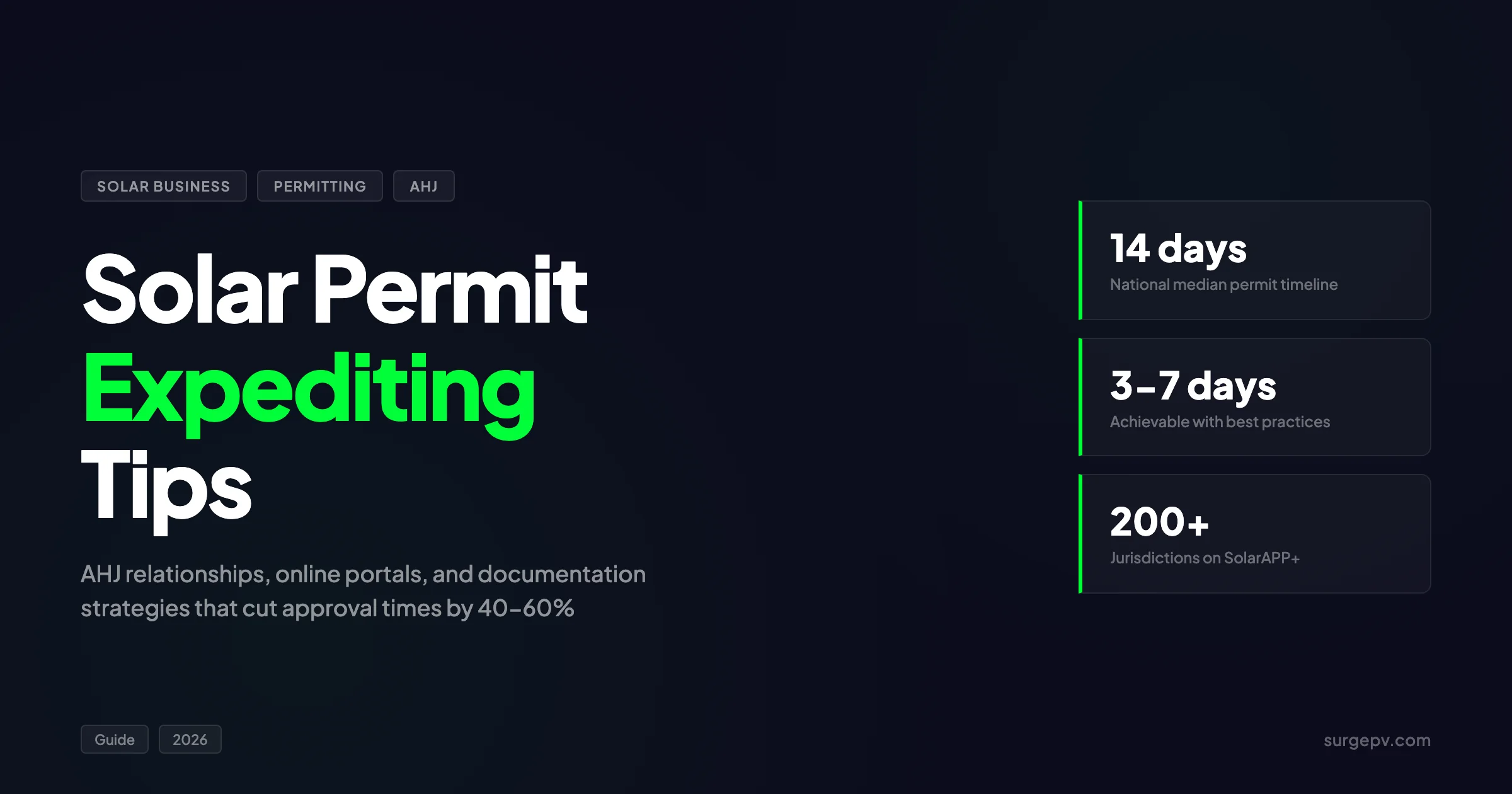
Build relationships with plan reviewers at your top 5 AHJs. Submit through online portals where available. Use pre-approved standard designs for common roof types. Include a cover memo addressing every checklist item. Track all rejections in a shared database. Installers who systematize these four practices report median approval times of 3-7 business days versus the national median of 14 days.
In this guide:
- Solar permit types explained — building, electrical, structural, and interconnection
- How AHJs actually work and why relationships matter more than most think
- Online permitting portals: SolarAPP+, Accela, and jurisdiction-specific systems
- The most common permit rejection reasons and how to prevent them
- State-by-state permit timeline comparison table
- Documentation best practices that eliminate back-and-forth
- What most installers get wrong about permit expediting
- Practical strategies you can implement this week
Solar Permit Types: What You Actually Need
Every grid-tied solar installation requires multiple permits from multiple entities. Understanding the full permit stack before starting any project prevents mid-process surprises that add weeks to timelines.
Building Permit
The building permit is the primary authorization for physical construction. It covers structural attachment, roof loading, fire setbacks, and code compliance. The AHJ building department issues this permit after reviewing site plans, structural calculations, and equipment specifications.
Most residential solar projects fall under a single building permit that covers both the photovoltaic system and associated electrical work. Some jurisdictions issue separate permits for the solar array and the electrical interconnection. Commercial projects almost always require separate structural, electrical, and sometimes mechanical permits.
Building permit fees are typically based on project valuation. For residential solar, this means the estimated installed cost of the system. A 10 kW residential system valued at $25,000 might trigger a permit fee of $300-$600 depending on the jurisdiction’s fee schedule.
Electrical Permit
The electrical permit authorizes the wiring, inverter installation, disconnect placement, and grid interconnection work. In many jurisdictions, the electrical permit is bundled with the building permit for residential solar. In others, it is a separate application requiring a licensed electrician’s signature.
The electrical permit review focuses on NEC compliance: wire sizing, overcurrent protection, grounding, labeling, and disconnect accessibility. Plan reviewers check that the single-line diagram matches the actual equipment list and that all conductors are sized correctly for the calculated current. For more on this topic, see Solar Cable Sizing Calculation.
Structural Permit or Engineering Letter
Structural review determines whether the roof can support the additional dead load of the solar array plus the live loads from wind and snow. Most jurisdictions accept a structural engineering letter for residential projects on standard wood-framed roofs less than 15 years old. The letter certifies that the proposed attachment method and loading are within the structural capacity of a typical roof built to local code.
Older roofs, tile roofs, flat commercial roofs, and buildings in high wind or snow zones require project-specific structural calculations. These calculations must be stamped by a licensed structural engineer registered in the state where the project is located. Out-of-state PE stamps are not accepted in most jurisdictions.
Interconnection Agreement
The interconnection agreement is not a permit in the traditional sense, but it is a mandatory authorization process. The local utility or distribution system operator reviews the proposed system for grid safety, capacity constraints, and net metering eligibility.
Interconnection timelines vary by utility and system size:
| System Size | Review Type | Typical Timeline |
|---|---|---|
| Under 10 kW (residential) | Simplified / fast-track | 1-4 weeks |
| 10-100 kW (small commercial) | Standard review | 2-8 weeks |
| 100 kW-1 MW (commercial) | Detailed study | 4-16 weeks |
| Over 1 MW (utility-scale) | Full impact study | 3-12 months |
Source: Interstate Renewable Energy Council (IREC), 2025 interconnection study.
The interconnection process runs in parallel with permitting but should be initiated early. Some utilities require interconnection pre-approval before the AHJ will issue a building permit. Others accept concurrent processing. Know your utility’s sequence requirements before starting.
Additional Permits and Clearances
Some projects require permits beyond the standard set:
HOA approval. Homeowners associations in 28 states can impose design restrictions on solar installations. California, Florida, and Hawaii have solar access laws that limit HOA restrictions, but most states allow HOAs to regulate panel visibility, placement, and color. HOA review typically adds 2-4 weeks.
Historical district clearance. Properties in National Register districts or local historic preservation zones require additional review. This can add 4-8 weeks and may restrict visible roof-mounted systems.
Zoning variance. Setback violations, height restrictions, or ground-mount systems in residential zones may require a zoning variance or conditional use permit. These processes involve public hearings and can take 2-6 months.
Fire department review. Some jurisdictions require separate fire department sign-off for commercial systems or residential systems over a certain size. Fire review focuses on setback compliance, roof access pathways, and rapid shutdown system configuration.
Pro Tip — Build a Permit Checklist Library
Create a separate permit checklist for every jurisdiction you work in. Update it after every submission. Include the exact document list, fee amount, preferred file format (PDF vs. DWG), online portal URL, and the name of the primary plan reviewer. A well-maintained checklist library prevents the most common cause of permit rejection: missing documents.
How AHJs Work and Why Relationships Matter
The Authority Having Jurisdiction is not a monolith. It is a group of people with workloads, preferences, and institutional memory. Understanding how they work is the first step to working with them effectively.
What an AHJ Actually Is
An AHJ is any organization responsible for enforcing the building code in a specific geographic area. For solar permitting, the relevant AHJs are:
- City building departments — the most common AHJ for urban and suburban solar
- County planning/building departments — common in unincorporated areas
- Township code enforcement offices — typical in the Northeast and Midwest
- Special districts — fire protection districts, utility districts, or coastal commissions with independent permitting authority
Each AHJ interprets the same model codes (IBC, IRC, NEC, IFC) with local amendments. Two cities in the same county can have materially different permit requirements. San Francisco and Daly City are 10 miles apart but have different fire setback rules, different structural letter requirements, and different online systems.
The Plan Reviewer’s Perspective
Plan reviewers are not obstacles. They are overworked professionals with queues of applications and limited time. A typical city building department plan reviewer processes 8-15 applications per day. Solar permits compete for attention with commercial construction, ADUs, and major renovations.
When a plan reviewer opens your application, they are asking three questions in sequence:
- Is the application complete? Missing documents go straight to the rejection pile.
- Does it comply with the checklist? Checklist items are binary — yes or no.
- Are there any red flags? Unusual designs, marginal structural calculations, or atypical equipment trigger deeper scrutiny.
An application that answers all three questions quickly gets approved. An application that forces the reviewer to hunt for information, request clarifications, or consult a supervisor gets delayed.
Why Personal Relationships Accelerate Permits
I have seen the same plan set approved in 2 days by a reviewer who knew the installer and rejected in 10 days by a reviewer who did not. The plan set was identical. The difference was trust.
When a plan reviewer knows an installer, several things change:
- Clarifications happen informally. A quick phone call replaces a formal rejection letter.
- Edge cases get the benefit of the doubt. A marginal structural detail might pass with a known installer but fail with an unknown one.
- Process knowledge flows both ways. The reviewer tells the installer about upcoming code changes. The installer tells the reviewer about industry practices that the code does not yet address.
- Expedited review becomes available. Many jurisdictions offer expedited review for a fee or for repeat applicants with clean track records.
Building these relationships requires showing up in person, being respectful of the reviewer’s time, and consistently submitting high-quality applications. One sloppy submission can undo months of relationship-building.
The “Known Quantity” Effect
AHJs maintain informal reputational tracking. Installers who submit clean applications, respond promptly to corrections, and show up for inspections on time develop a positive reputation. Installers who submit incomplete applications, argue aggressively over minor corrections, or miss scheduled inspections develop a negative reputation.
The practical effect is significant. A known-quantity installer with a clean track record might get a phone call about a minor issue. An unknown or poorly regarded installer gets a formal rejection letter with a 2-week re-review queue.
What Most Installers Get Wrong
Most installers treat permitting as a back-office function handled by the least experienced person in the office. They delegate permit filing to junior staff who have never met a plan reviewer and do not understand the local code amendments. The result is a high rejection rate, long timelines, and no institutional knowledge. The installers who move fastest assign permitting to experienced staff who build and maintain AHJ relationships as a core job function.
How to Build AHJ Relationships Systematically
Here is a practical approach that works in any market:
Step 1: Map your top 5 AHJs. Identify the five jurisdictions that account for 70%+ of your project volume. For most regional installers, this is 3-5 cities or counties.
Step 2: Schedule in-person introductions. Visit the building department during slow hours (typically mid-morning on Tuesdays or Wednesdays). Introduce yourself. Ask about their process, their preferred submission format, and any local amendments that solar installers commonly miss. Bring business cards and a one-page company summary.
Step 3: Submit your first application with extra care. Your first submission to a new AHJ sets your reputation. Spend extra time on completeness. Include a cover memo. Use the exact document format they prefer. If possible, have an experienced permit expeditor review it before submission.
Step 4: Follow up personally on every rejection. Do not just resubmit corrected documents. Call or visit the reviewer to understand the root cause. Ask what you could have done differently. Take notes. Update your checklist.
Step 5: Maintain contact quarterly. Even if you have no active applications, stop by or call every few months. Ask about code changes, staff changes, or process updates. Bring coffee. These small interactions maintain the relationship at minimal cost.
The Contrarian View: Relationships Are Not Everything
Some installers argue that online portals and automated review make AHJ relationships obsolete. This is half true. In jurisdictions with mature online systems and automated plan review, the relationship matters less. A SolarAPP+ submission in Tucson does not need a personal connection to get approved in 24 hours.
But automated review covers only a subset of projects. Complex roofs, commercial systems, battery additions, and any project requiring a variance still goes through human review. And even in automated jurisdictions, relationships matter for edge cases, appeals, and process questions.
The optimal strategy is not relationships OR automation. It is relationships AND automation. Use online portals for standard projects. Use relationships for everything else.
Online Permitting Portals: The Speed Multiplier
Online permitting portals have transformed solar permitting in the last five years. Jurisdictions that have invested in digital submission and automated review have cut median approval times from weeks to days.
SolarAPP+
SolarAPP+ is the most significant development in US solar permitting since the adoption of the NEC. Developed by NREL in partnership with SEIA, ICC, and IAPMO, it is an automated plan review platform that generates code-compliant plan sets and performs instant plan review.
How it works:
- The installer enters project data into the SolarAPP+ web interface: address, system size, roof type, attachment method, equipment list
- SolarAPP+ generates a complete plan set including site plan, roof plan, electrical diagram, and structural calculations
- The system performs automated code compliance checks against the local jurisdiction’s adopted codes and amendments
- If the project passes all checks, the system issues a permit automatically or flags the application for a brief human review
- The permit is issued electronically, often within 24 hours
Jurisdictions using SolarAPP+ as of early 2026:
Over 200 jurisdictions across 35 states have adopted SolarAPP+. Major markets include Tucson, AZ; San Antonio, TX; Orlando, FL; Sacramento, CA; and Raleigh, NC. The platform is particularly strong in Arizona, Texas, Florida, and California, where state-level mandates or utility programs have driven adoption.
Limitations:
SolarAPP+ works best for standard residential projects on common roof types. It does not yet handle:
- Commercial systems over 100 kW
- Ground-mount systems
- Battery storage additions (though this is in development)
- Tile roofs with non-standard attachment methods
- Projects requiring structural engineering beyond standard calculations
- Jurisdictions with extensive local amendments not yet coded into the platform
Accela and Government-Specific Portals
Many jurisdictions use Accela Civic Platform or custom-built portals for online permitting. These systems vary widely in quality and functionality.
High-functionality portals (Austin, TX; San Jose, CA; Denver, CO) offer:
- Online application submission with document upload
- Real-time status tracking
- Automated email notifications at each stage
- Online fee payment
- Digital plan review with markup tools
- Same-day or next-day approval for complete applications
Low-functionality portals (common in smaller jurisdictions) offer:
- PDF form download and email submission
- Limited or no status tracking
- Phone-based status inquiries
- In-person or mail-based fee payment
- 1-2 week review timelines even for complete applications
The difference in experience is stark. An installer working in Austin can submit a permit at 10 PM on Sunday and get approval by Tuesday morning. An installer working in a jurisdiction with PDF-based submission might wait two weeks for an initial review.
The Online Portal Adoption Gap
Despite the clear benefits, online portal adoption remains uneven. According to NREL’s 2025 solar permitting report, only 47% of US jurisdictions serving populations over 50,000 offer online solar permit submission. The remaining 53% require in-person submission, mail, or email-based processes.
The adoption gap follows predictable patterns:
| Jurisdiction Type | Online Portal Likelihood | Typical Review Time |
|---|---|---|
| Population over 500,000 | 78% | 1-5 days |
| Population 100,000-500,000 | 52% | 3-10 days |
| Population 50,000-100,000 | 31% | 5-14 days |
| Population under 50,000 | 18% | 10-30 days |
| Rural/unincorporated | 8% | 14-45 days |
Source: NREL, “Solar Permitting and Inspection Best Practices,” 2025.
Strategies for Working With and Without Portals
In portal jurisdictions:
- Learn the portal’s specific requirements. Each system has quirks in file naming, document order, and field formatting.
- Use the portal’s checklist feature if available. Some systems generate a custom checklist based on your project inputs.
- Upload all documents in a single submission. Partial submissions often trigger automatic rejection.
- Check status daily. Portal-based systems move fast, and missing a correction request by even one day can add a week to the timeline.
In non-portal jurisdictions:
- Call ahead to confirm current requirements. Small jurisdictions change processes without updating websites.
- Submit in person if possible. In-person submission allows immediate feedback on completeness.
- Bring extra copies. Paper-based jurisdictions often require multiple physical copies of plans.
- Get a receipt with a tracking number. Without digital tracking, the receipt is your only proof of submission date.
Pro Tip — The Pre-Submission Phone Call
Before submitting any permit in a non-portal jurisdiction, call the building department and ask three questions: What is the current turnaround time? Has the fee schedule changed recently? Is there any new documentation required that is not on the website? These three questions take five minutes and prevent the most common source of delay: submitting against outdated requirements.
Common Permit Rejection Reasons and Prevention
Understanding why permits get rejected is the fastest way to reduce rejection rates. Every rejection adds days or weeks to the project timeline. A rejection rate above 15% is a signal that your permit preparation process needs systematic improvement.
The Top Eight Rejection Reasons
Based on data from permit expediting services and direct AHJ feedback, these are the most common rejection reasons ranked by frequency:
1. Incomplete or illegible plan sets (28% of rejections)
Plan sets that are missing pages, have unreadable scans, or omit required details force reviewers to reject without substantive review. This is the most common and most preventable rejection reason.
Prevention: Use a standard plan set template with a built-in checklist. Have a second person review every plan set before submission. Ensure all scans are at minimum 300 DPI and all text is legible.
2. Incorrect electrical calculations (19% of rejections)
Wire sizing errors, incorrect overcurrent protection ratings, and mismatched inverter specifications are common. Plan reviewers check these calculations against the NEC tables.
Prevention: Use automated electrical design software that generates NEC-compliant calculations. Have a licensed electrician review all calculations before submission. Double-check that the equipment list in the plan set matches the actual equipment being installed.
3. Missing fire setback compliance (16% of rejections)
Fire setbacks are governed by the International Fire Code (IFC) Section 605.11.3 and local amendments. California has specific requirements under Title 24. Many installers miscalculate setbacks or fail to document them.
Prevention: Use design software that automatically calculates and labels fire setbacks on the roof plan. Include a separate fire setback compliance sheet that shows measurements from panels to ridge, eaves, and hips.
4. Structural calculations that do not match roof condition (12% of rejections)
Standard structural letters assume a roof in good condition built to code. Older roofs, sagging rafters, or non-standard framing require project-specific engineering.
Prevention: Conduct a physical roof assessment before designing the system. Photograph the attic framing, rafter spacing, and any signs of distress. If the roof is over 20 years old or shows any structural concerns, order project-specific calculations from a structural engineer.
5. Equipment not on approved products list (8% of rejections)
Some jurisdictions maintain approved products lists for solar equipment. Using unlisted inverters, panels, or racking can trigger rejection.
Prevention: Check the AHJ’s approved products list before specifying equipment. Most lists are published on the jurisdiction’s website. If a preferred product is not listed, contact the AHJ to request approval or select an alternative.
6. Zoning violations (7% of rejections)
Setback violations, height restrictions, or ground-mount systems in prohibited zones cause rejection. These issues should be caught during site assessment but sometimes slip through.
Prevention: Verify zoning requirements before designing the system. Check setbacks from property lines, maximum structure heights, and any solar-specific zoning restrictions. For ground-mount systems, confirm the zoning district allows accessory structures of the proposed size.
7. Expired contractor credentials (5% of rejections)
Expired licenses, lapsed insurance certificates, or missing bonding documentation are easy rejections.
Prevention: Maintain a credential tracking system with expiration dates 60 days in advance. Set calendar reminders for license renewals, insurance renewals, and bond continuations. Submit current certificates with every permit application.
8. Missing utility pre-approval (5% of rejections)
Some utilities require pre-approval before the AHJ will issue a building permit. Missing or incomplete utility documentation triggers rejection.
Prevention: Know the sequence requirements for every utility you work with. Initiate interconnection applications before or concurrent with permit applications. Include utility pre-approval letters in the permit package when required.
The Rejection Tracking Database
Every rejection is a learning opportunity that is wasted if not recorded. Create a simple database — a shared spreadsheet is sufficient — with these columns:
- Date
- Jurisdiction
- Rejection reason (from the 8 categories above)
- Specific correction required
- Days added to timeline
- Root cause (incomplete checklist, design error, process error, new requirement)
Review this database monthly. Look for patterns. If 40% of your rejections are for incomplete plan sets, invest in a better checklist and a second-review process. If a specific jurisdiction rejects for a reason no other jurisdiction cares about, update your jurisdiction-specific checklist.
Installers who track and analyze rejections systematically reduce their rejection rate by 50-70% within six months. The data makes the problem visible and the solution obvious.
State-by-State Solar Permit Timelines 2026
Permit timelines vary dramatically by state, driven by state-level mandates, local jurisdiction capacity, and market maturity. This table summarizes current conditions as of early 2026.
Residential Solar Permit Timeline Comparison
| State | Fastest Jurisdictions | Slowest Jurisdictions | Statewide Median | Key Factors |
|---|---|---|---|---|
| Arizona | Same day (Tucson, Mesa) | 2-3 weeks (rural counties) | 2-5 days | SolarAPP+ adoption; solar-friendly state policy |
| California | 1-3 days (San Jose, San Diego) | 2-6 weeks (small coastal cities) | 3-7 days | AB 2188 mandate; high volume; portal adoption |
| Colorado | 1-3 days (Denver, Boulder) | 2-4 weeks (mountain towns) | 3-8 days | State standardization efforts; active solar market |
| Connecticut | 1-2 weeks (Hartford area) | 4-8 weeks (small towns) | 2-4 weeks | Layered state + local review; older building stock |
| Florida | Same day (Orlando, Tampa) | 2-4 weeks (Gulf Coast small towns) | 2-5 days | SolarAPP+; state solar access law; high volume |
| Hawaii | 1-2 weeks (Honolulu) | 3-6 weeks (neighbor islands) | 2-3 weeks | Unique electrical code; utility coordination |
| Illinois | 3-7 days (Chicago suburbs) | 3-6 weeks (downstate) | 1-2 weeks | Growing market; inconsistent local capacity |
| Massachusetts | 1-2 weeks (Boston area) | 4-10 weeks (Cape Cod, islands) | 2-4 weeks | SMART program requirements; historic districts |
| Nevada | 2-5 days (Las Vegas, Reno) | 1-3 weeks (rural) | 3-7 days | NV Energy coordination; desert climate = simple roofs |
| New Jersey | 1-2 weeks (major utilities) | 3-6 weeks (municipal utilities) | 1-3 weeks | SREC market maturity; dense urban conditions |
| New York | 1-2 weeks (NYC, Long Island) | 4-8 weeks (upstate small towns) | 2-4 weeks | NY-Sun program; complex urban rooftops |
| North Carolina | 3-7 days (Raleigh, Charlotte) | 2-4 weeks (rural) | 1-2 weeks | Duke Energy territory standardization |
| Oregon | 3-7 days (Portland, Eugene) | 2-4 weeks (coastal, eastern) | 1-2 weeks | State energy code; environmental review |
| Pennsylvania | 1-2 weeks (Philadelphia, Pittsburgh) | 3-6 weeks (rural townships) | 1-3 weeks | Home rule municipalities; inconsistent processes |
| Texas | Same day (Austin, San Antonio) | 2-4 weeks (small towns) | 2-5 days | Minimal state oversight; market-driven efficiency |
| Utah | 2-5 days (Salt Lake City) | 1-3 weeks (rural) | 3-7 days | Rocky Mountain Power coordination; simple climate |
| Washington | 3-7 days (Seattle area) | 2-4 weeks (eastern WA) | 1-2 weeks | Seattle City Light efficiency; state energy code |
Sources: NREL Solar Permitting Database 2025, SEIA state reports, direct jurisdiction data. Median times reflect complete applications from established installers. First-time or incomplete applications take 2-3x longer.
What the Data Shows
Three patterns emerge from this comparison:
The portal effect is real. States with high SolarAPP+ or mature online portal adoption (Arizona, Texas, Florida, California) have median approval times under one week. States relying on paper or email submission (Connecticut, Massachusetts, upstate New York) have median times of 2-4 weeks.
State mandates matter. California’s AB 2188, which mandates over-the-counter or online approval for residential systems under 15 kW, has driven statewide median times down to 3-7 days. States without similar mandates show much wider variation between fast and slow jurisdictions.
Market volume drives efficiency. High-volume solar markets (California, Texas, Florida, Arizona) have invested in permitting infrastructure because the volume justifies the cost. Low-volume markets (Connecticut, Hawaii, rural areas everywhere) have not made similar investments, and permit timelines reflect that.
The Northeast Challenge
The Northeast — particularly Massachusetts, Connecticut, and New York — presents unique permitting challenges that extend timelines beyond what the raw data suggests.
Older building stock. Pre-1950s housing dominates many Northeast markets. These roofs often require project-specific structural engineering, adding 1-2 weeks and $500-$1,500 in engineering costs.
Layered review. Some jurisdictions require separate reviews by the building department, fire department, historical commission, and zoning board. Each layer adds time and potential rejection points.
Municipal utilities. Municipal electric departments in Massachusetts and New York have their own interconnection requirements that add complexity beyond the standard utility process.
Seasonal backlog. Northeast building departments experience seasonal surges in spring and summer that extend review times by 50-100% during peak months.
Installers operating in the Northeast should budget 3-5 weeks for permitting on average projects and 6-10 weeks for projects requiring structural engineering or historical review.
Documentation Best Practices That Eliminate Back-and-Forth
The quality of your permit documentation determines whether you get approved on the first review or enter a cycle of rejections and resubmissions. These practices separate fast installers from slow ones.
The Cover Memo
A well-written cover memo is the most underused tool in solar permitting. It addresses every checklist item explicitly and signals to the reviewer that you have done your homework.
A good cover memo includes:
- Project summary: address, system size, number of panels, inverter type
- Code compliance statement: “This project complies with [specific code edition] as adopted by [jurisdiction name]”
- Fire setback summary with measurements
- Structural approach summary
- Equipment list with model numbers and certifications
- Utility interconnection status
- Contact information for the responsible party
The cover memo should be one page. It is not a substitute for the plan set. It is a roadmap that helps the reviewer navigate the plan set efficiently.
Standardized Plan Sets
Develop a standardized plan set template for your most common project types. A typical residential template includes:
- Cover sheet with project info, permit application, and cover memo
- Site plan showing property lines, building footprint, panel layout, and setbacks
- Roof plan showing panel placement, attachment points, and fire setbacks
- Structural details or engineering letter
- Electrical single-line diagram
- Equipment specifications and cut sheets
- Fire setback compliance sheet
- Utility interconnection pre-approval (if required)
Each page should have a consistent header with project address, date, and page number. Use the same drawing scale for all plan views. Label every dimension clearly.
The Pre-Submission Review Checklist
Before submitting any permit, run through this checklist:
- All pages present and in correct order
- All text legible at print size
- Project address matches on every page
- System size and equipment list consistent across all pages
- Electrical calculations checked against NEC tables
- Fire setbacks calculated and labeled
- Structural letter or calculations included and current
- Contractor license and insurance certificates current
- Fees calculated correctly and payment method confirmed
- Utility pre-approval included if required
- Cover memo addresses all checklist items
Have a second person complete this checklist independently. The person who prepared the plan set should not be the only person who checks it.
Digital Document Standards
For online portal submissions, follow these standards:
- File format: PDF unless the portal specifies otherwise
- File size: Under 10 MB per file; compress if necessary
- Resolution: 300 DPI minimum for scanned documents
- Naming convention: Use descriptive filenames like “123_Main_St_SitePlan.pdf” not “document1.pdf”
- Orientation: All pages in portrait orientation unless the drawing requires landscape
- Bookmarks: Add PDF bookmarks for multi-page plan sets if the portal supports them
The Correction Response Protocol
When a permit is rejected with corrections, respond with these principles:
Speed matters. Every day you delay the response adds to the timeline. Aim to resubmit within 24 hours of receiving the correction notice.
Address every item explicitly. Do not just fix the problem. State what you changed and where. Use a response letter that lists each correction request and your response.
Highlight changes. Use cloud marks, revision triangles, or color-coded highlights to show exactly what changed in the revised plan set. Do not make the reviewer hunt for your corrections.
Do not argue unless the correction is factually wrong. Plan reviewers have discretion. Arguing over minor corrections wastes relationship capital. Fix it and move on. Only challenge corrections that are clearly incorrect under the adopted code.
Practical Expediting Strategies You Can Implement This Week
Here are specific, actionable strategies that cut permit timelines. They require no special technology and minimal cost.
Strategy 1: The Batch Submission Approach
Instead of submitting permits one at a time as projects sell, batch your submissions. Submit 3-5 permits on the same day to the same jurisdiction.
Why this works: Plan reviewers develop rhythm and familiarity when they see multiple applications from the same submitter in sequence. They recognize your format, your quality level, and your attention to detail. The fifth application in a batch gets reviewed faster than the first because the reviewer is already familiar with your work.
Implementation: Hold permits for 2-3 days to build a batch. Submit on Tuesday or Wednesday morning when reviewers are fresh and queues are shortest.
Strategy 2: The Tuesday Morning Window
Building departments are typically slowest on Monday (backlog from weekend) and Friday (staff leaving early). Tuesday and Wednesday mornings are the optimal submission windows.
Implementation: Schedule all permit submissions for Tuesday or Wednesday between 9 AM and 11 AM local time. Avoid submitting on Friday afternoons, holiday weeks, or the first week of the month (when new fee schedules often take effect).
Strategy 3: The Pre-Design Consultation
Some jurisdictions offer pre-design consultations where you can discuss a project concept with a plan reviewer before preparing full plans. This 30-minute conversation can prevent weeks of revisions.
Implementation: Call the building department and ask if pre-design consultations are available. If yes, schedule one for any project with unusual features: complex roof geometry, marginal structural conditions, or equipment outside your standard list.
Strategy 4: The Expedited Review Fee
Many jurisdictions offer expedited review for an additional fee, typically 50-100% of the standard permit fee. For a $400 permit, the expedited fee might be $200-$400.
The math is simple. If expedited review saves two weeks and your crew cost is $2,000 per week, the $400 fee pays for itself five times over.
Implementation: Ask about expedited review options at every jurisdiction. Track the fee and the actual time savings. Some jurisdictions advertise expedited review but cannot deliver due to staffing constraints.
Strategy 5: The Permit Coordinator Role
Assign one person in your organization to own permitting full-time. This person builds relationships, maintains checklists, tracks rejections, and continuously improves the process.
The permit coordinator should:
- Submit all permits
- Track all permit statuses
- Respond to all corrections
- Maintain the rejection database
- Build AHJ relationships
- Train new staff on permit preparation
This is not an entry-level role. The permit coordinator needs technical knowledge, people skills, and attention to detail. A good permit coordinator is worth their salary in reduced timelines alone.
Cut Permit Delays with Integrated Project Workflows
SurgePV’s solar design software connects permit-ready plan generation with project tracking. Generate NEC-compliant single-line diagrams, automatic fire setback calculations, and equipment specification sheets — all exportable in the format your AHJ requires. Stop rebuilding plan sets from scratch for every jurisdiction.
Book a DemoNo commitment required · 20 minutes · Live project walkthrough
What Most Installers Get Wrong About Permit Expediting
After a decade of filing permits across dozens of markets, I have observed the same mistakes repeatedly. Here are the most costly misconceptions.
Misconception: Faster Permits Mean Cutting Corners
The opposite is true. The fastest approvals go to the most complete, most compliant applications. Installers who try to speed up permitting by omitting details or using generic plans get rejected more often, which slows them down.
The real speed comes from precision, not shortcuts. A complete application with every checklist item addressed gets approved on the first review. An incomplete application gets rejected, corrected, resubmitted, and reviewed again. The “fast” shortcut is actually the slow path.
Misconception: All Jurisdictions in a State Are Similar
California has 482 cities and 58 counties. Each one is its own AHJ with its own amendments, fee schedules, and review processes. An installer who masters San Jose’s process will still struggle in Palo Alto if they assume the rules are the same.
Treat every jurisdiction as unique until proven otherwise. Build separate checklists. Develop separate relationships. The investment pays off in faster approvals and fewer surprises.
Misconception: Online Portals Eliminate the Need for Relationships
Online portals handle routine submissions efficiently. But they do not handle edge cases, appeals, process questions, or new staff training. When a portal submission fails for an unclear reason, a phone call to a plan reviewer you know resolves the issue in minutes. An email to a generic help desk might take days.
Relationships complement automation. They do not replace it.
The Tradeoff: Standardization vs. Customization
Every installer faces a tension between standardization and customization. Standardized designs are faster to prepare and easier to permit. Customized designs win more sales by addressing specific customer needs.
The optimal balance depends on your market. In markets with simple roofs and consistent conditions (Arizona, Nevada, Texas), heavy standardization makes sense. In markets with complex roofs and varied conditions (Northeast, Pacific Northwest), more customization is necessary.
My recommendation: standardize 70% of your designs and customize 30%. The 70% standard designs should use your most common equipment combinations, roof types, and system sizes. These are your permit-fast-track projects. The 30% custom designs get extra engineering attention and longer permit timelines built into the project schedule.
The Original Calculation: Permit Delay Cost
Here is a calculation every installer should run for their own business:
Assumptions:
- Average project margin: $5,000
- Average permit delay: 14 days
- Crew cost per week: $8,000
- Projects delayed per year: 50
Cost of delay:
- Direct crew idle cost: 2 weeks × $8,000 × 50 projects = $800,000
- Customer cancellation risk: 5% of delayed projects cancel = 2.5 projects × $5,000 = $12,500
- Financing cost: delayed projects mean delayed revenue on financed sales
- Reputation cost: delayed projects generate negative reviews and referral loss
Total annual cost of permit delays: $800,000+ for a 50-project-per-year installer.
Now compare this to the investment required to fix it:
- Permit coordinator salary: $65,000/year
- Expedited review fees: $20,000/year
- Plan review software: $5,000/year
- Relationship-building time: $10,000/year (opportunity cost)
- Total investment: $100,000/year
Return on investment: 8:1 or better. Every dollar invested in permit process improvement returns eight dollars in reduced delay costs.
Latest Updates: Solar Permitting 2026
The permitting environment continues to evolve. Here are the most significant developments as of early 2026.
SolarAPP+ Expansion
SolarAPP+ added support for battery storage systems in late 2025, expanding the platform’s addressable market significantly. Battery add-on permits are now available in jurisdictions that have enabled the battery module. The platform also added support for three-phase residential systems up to 25 kW. Read Adding Battery Storage Services for a complete walkthrough.
NREL’s target is 500 jurisdictions by end of 2026, up from 200 in early 2026. State-level mandates in Colorado, New Mexico, and Nevada are driving adoption in the Mountain West.
California AB 2188 Implementation
California’s AB 2188, enacted in 2022, mandates that jurisdictions issue residential solar permits over-the-counter or through an online system for systems under 15 kW. Implementation has been uneven. Large cities (San Jose, San Diego, Los Angeles) complied quickly. Smaller jurisdictions have been slower, with some arguing that the law does not apply to their specific circumstances.
As of early 2026, the California Solar and Storage Association (CALSSA) reports that approximately 75% of California jurisdictions are in full compliance with AB 2188. The remaining 25% are subject to ongoing advocacy and potential legal action.
Massachusetts SMART Program Changes
Massachusetts’ Solar Massachusetts Renewable Target (SMART) program introduced new permitting requirements in 2025 that add complexity for commercial projects over 25 kW. Projects must now include a grid impact study in the initial permit package, adding 2-4 weeks to the timeline.
Residential projects under 25 kW are unaffected by this change.
Texas Market Growth and Permitting Pressure
Texas added over 12 GW of solar capacity in 2024-2025, making it the fastest-growing US solar market. This volume has strained permitting capacity in major metro areas. Austin and San Antonio have responded by expanding online portal capacity and adding plan review staff. Houston and Dallas-Fort Worth have experienced longer timelines due to rapid growth outpacing staffing increases.
Installers in Texas should expect 3-7 day approval times in Austin and San Antonio, 5-10 days in Houston, and 7-14 days in DFW for standard residential projects.
Illinois Shines Program Updates
The Illinois Shines program, which provides renewable energy credits for solar projects, updated its documentation requirements in late 2025. Projects must now include an Illinois Shines application number in the building permit application. This coordination requirement adds one step to the process but does not materially extend timelines for installers who are already familiar with the program.
Conclusion
Solar permitting is not a bureaucratic obstacle to work around. It is a process to master. The installers who treat permitting as a core competency finish projects faster, carry lower overhead, and win more repeat business.
The data is clear. Installers who build AHJ relationships, use online portals, standardize documentation, and track rejections systematically achieve median approval times of 3-7 business days. Installers who treat permitting as an afterthought wait 2-6 weeks. At 50 projects per year, that difference is worth $800,000 in crew productivity alone.
The strategies in this guide are not theoretical. I have used them in markets from Arizona to Massachusetts. They work because they respect the plan reviewer’s time, eliminate preventable errors, and build the trust that turns a transactional process into a collaborative one.
Three actions to take this week:
-
Map your top 5 jurisdictions and schedule introductory meetings. If you have never met the plan reviewers who handle 70% of your volume, you are leaving time on the table. A 30-minute introduction pays dividends for years.
-
Create a rejection tracking spreadsheet and review last quarter’s data. Identify your top two rejection reasons and fix them. Most installers can cut their rejection rate by 50% with two targeted process changes.
-
Audit your current plan set template against the checklist in this guide. Add a cover memo if you do not use one. Add a fire setback compliance sheet if it is missing. Have a second person review every plan set before submission.
For solar companies managing project pipelines across multiple jurisdictions, PV design software with integrated permitting support streamlines plan set generation and ensures NEC compliance from the first draft. Accurate shadow analysis and structural modeling built into the design process prevent the most common rejection triggers before they reach the plan reviewer.
Frequently Asked Questions
What does AHJ mean in solar permitting?
AHJ stands for Authority Having Jurisdiction. It is the local government body that reviews and approves solar permit applications. The AHJ can be a city building department, county planning office, or township code enforcement office. Each AHJ sets its own permit requirements, fees, and review timelines.
How long does solar permitting take in the US?
Solar permitting timelines vary dramatically by jurisdiction. Fast-track online portal jurisdictions like San Jose, CA or Austin, TX can approve residential permits in 1-3 business days. Traditional review jurisdictions average 2-6 weeks. Complex commercial projects in jurisdictions with understaffed departments can take 8-16 weeks. NREL data shows the national median for residential solar permitting is 14 business days as of 2025.
What is SolarAPP+ and which jurisdictions use it?
SolarAPP+ is an automated solar permitting platform developed by the National Renewable Energy Laboratory (NREL) and the Solar Energy Industries Association (SEIA). It uses standardized inputs to generate code-compliant plan sets and performs automated plan review. Over 200 jurisdictions across 35 states have adopted SolarAPP+ as of early 2026, including major markets like Tucson, AZ; San Antonio, TX; and Orlando, FL.
What documents are required for a solar permit application?
Standard solar permit packages include: (1) site plan showing panel layout and setbacks, (2) roof plan or structural attachment details, (3) electrical single-line diagram, (4) equipment specifications (panels, inverter, racking), (5) structural engineering letter or calculations, (6) fire setback compliance documentation, and (7) interconnection application for the local utility. Some AHJs also require HOA approval letters, historical district clearances, or utility pre-approval.
How much do solar permits cost?
Residential solar permit fees range from $150 to $1,500 depending on jurisdiction and system size. California jurisdictions under AB 2188 are capped at $450 for systems under 15 kW. Texas cities typically charge $200-$400. Northeast jurisdictions (NY, MA, CT) often charge $500-$1,200. Commercial permits scale with project value and can run $2,000-$15,000. Some jurisdictions also charge separate electrical permit fees and fire department review fees.
Can a solar installer pull permits on behalf of a homeowner?
Yes, licensed solar contractors can pull permits on behalf of homeowners in most jurisdictions. The contractor must hold the appropriate license classification (typically C-10 electrical or C-46 solar in California, master electrician or solar contractor in other states). The homeowner remains the permit holder of record, but the contractor acts as the authorized agent. Some jurisdictions require a notarized authorization letter from the homeowner.
What is the difference between a building permit and an interconnection agreement?
A building permit authorizes physical construction and is issued by the local AHJ. An interconnection agreement authorizes grid connection and is issued by the local utility or distribution system operator. Both are required for grid-tied solar. The building permit process covers code compliance, structural safety, and fire setbacks. The interconnection process covers electrical safety, grid impact studies, and net metering enrollment. These processes run in parallel but are managed by different entities.
What are the most common reasons solar permits get rejected?
The top rejection reasons are: (1) incomplete or illegible plan sets, (2) incorrect electrical calculations or wire sizing, (3) missing fire setback compliance documentation, (4) structural calculations that do not match the actual roof condition, (5) equipment not listed on the AHJ’s approved products list, (6) zoning violations (setbacks, height limits), (7) expired contractor license or insurance certificate, and (8) missing utility pre-approval for systems over certain size thresholds.
How can I speed up solar permitting in my market?
Five proven strategies: (1) Build personal relationships with plan reviewers at your top 5 AHJs — know their preferences and common objections, (2) Submit through online portals rather than in-person or paper, (3) Use pre-approved standard designs for common roof types and system sizes, (4) Include a cover memo that addresses every checklist item explicitly, and (5) Track rejection reasons in a shared database so your team never repeats the same mistake. Installers who systematize these practices report faster approval times.
Which states have the fastest solar permitting processes?
Arizona, Texas, and Florida lead for residential solar permitting speed, with many jurisdictions offering same-day or next-day online approvals. California has improved significantly since AB 2188 (2022) mandated over-the-counter or online approval for residential systems under 15 kW. Massachusetts and New York remain slower due to layered state and local requirements, though both have active reform efforts. The slowest states are typically those with home rule jurisdictions that resist state-level standardization.
Related SurgePV Resources
Continue learning with these related guides for solar installers and EPCs:
- Solar Inspection Preparation Checklist
- Managing Solar Subcontractors
- Change Order Management for Commercial Solar
- OSHA Compliance Checklist for Solar Installers
- Solar Crew Scheduling Optimization
For more solar business and marketing content, explore the full SurgePV blog or browse the SurgePV glossary for definitions of solar industry terms. For a direct comparison, see Arka 360 vs SurgePV.
Solar Software Tools to Support This Work
Effective solar installer operations depend on integrated software. SurgePV’s solar design tools helps installers handle the upstream work that feeds every decision in this guide:
- Solar design software for system layouts, panel placement, and BOM generation
- Solar shading analysis for site-specific irradiance and obstruction modeling
- Solar financial analysis tool for production forecasts and project ROI
- Solar proposal software for branded, customer-facing proposals
- Clara AI for automated design assistance and Q&A
Browse the full SurgePV platform to see how installers worldwide use the tools to design smarter, sell faster, and streamline every solar project.
Where this fits
This article is part of SurgePV's Solar Business & Operations hub, which works through the topic from first principles to the decisions a project team actually has to make.

