

The phone rang at 6:47 PM on a Tuesday. Our project manager picked up. A homeowner in Ahmedabad was shouting. His 8 kWp system had produced 40% less energy than our sales team promised. His first electricity bill after solar was higher than before. He wanted the panels removed. He wanted his money back. He had already posted a one-star review.
This call came three months after commissioning. The system was technically fine. The inverter had no faults. The panels were clean. The problem was the sales estimate. It assumed 1,750 kWh per kWp annually. The actual site yield was 1,420 kWh per kWp. The difference was shading from a neighbor’s new construction. Nobody had updated the model. For more on this topic, see [Solar Shading Analysis Guide](/blog/solar-shading-analysis-guide).
That one complaint cost us ₹3.2 lakh in remediation, legal review, and reputation management. It also cost us four referral opportunities from the customer’s housing society. We learned that day that solar customer complaint handling is not a support function. It is a business survival function.
Quick Answer
Solar customer complaint handling means responding to post-installation issues within 4 hours, diagnosing root causes accurately, and resolving problems before they escalate to reviews or regulatory complaints. The best installers prevent complaints through accurate modeling, clear communication, and proactive post-installation check-ins.
In this guide, you will learn:
- The six complaint categories that generate 90% of post-installation issues
- A response framework with exact timelines for every stage
- Why most installers handle underperformance complaints wrong
- Communication scripts that de-escalate angry customers
- How warranty claims actually work in 2026
- The silent complaint problem and why it matters more than vocal complaints
- Original cost calculations showing what one complaint really costs
- Prevention strategies that cut complaint rates by 60%
Key Takeaway
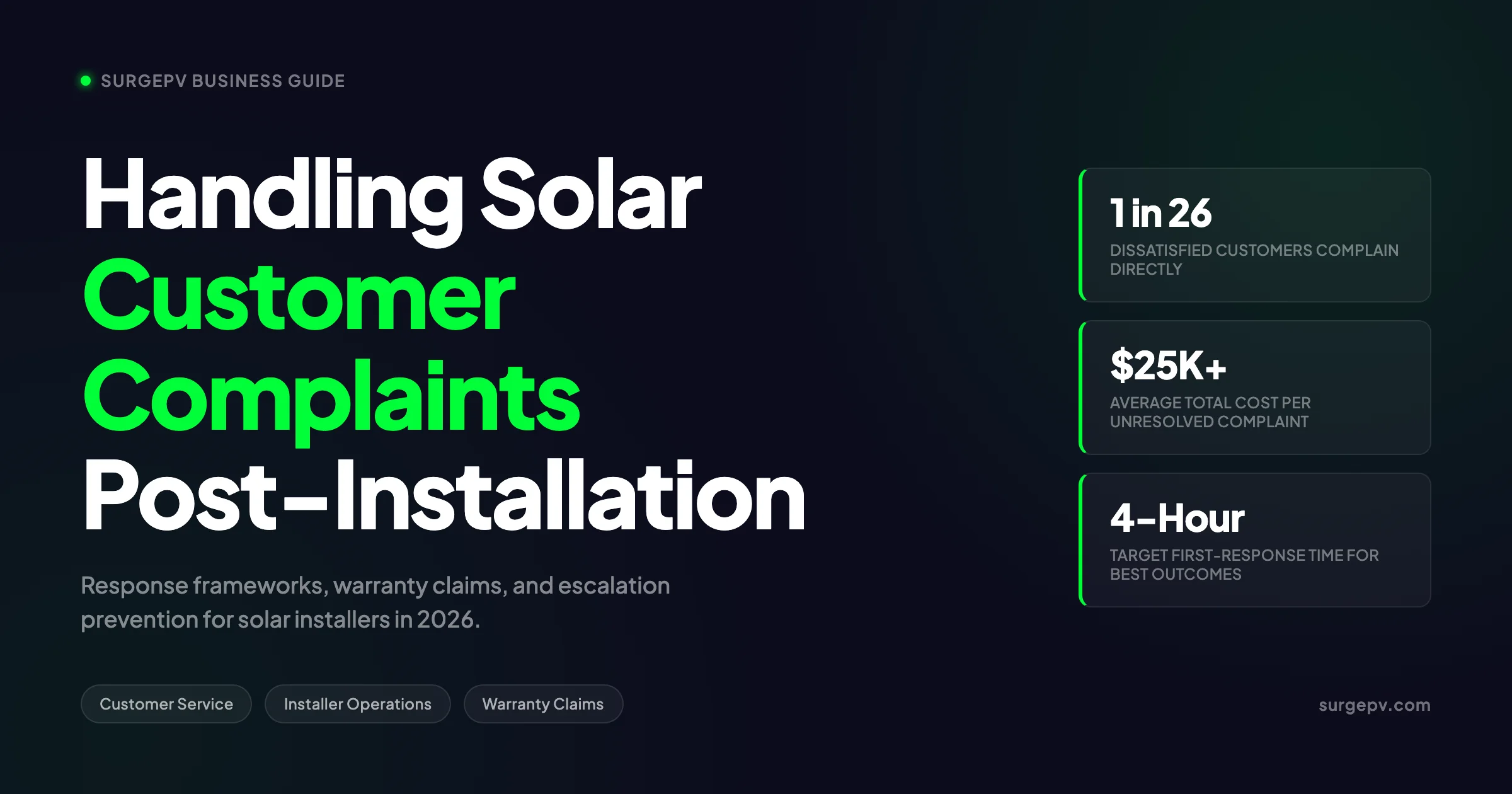
Only 1 in 26 dissatisfied customers complains directly. The other 25 quietly stop referring and post negative reviews. A single unresolved complaint costs $15,000-$35,000 in total impact. Top installers respond within 4 hours and resolve 85% of issues before they reach review platforms.
The Six Complaint Categories Every Installer Faces
Solar customer complaints fall into six buckets. Understanding the split helps you allocate resources and train teams.
| Complaint Category | Share of Complaints | Typical Severity | Root Cause |
|---|---|---|---|
| System underperformance | 32% | High | Overstated production estimates |
| Communication gaps | 24% | Medium | No updates during permitting/interconnection |
| Roof or property damage | 14% | High | Poor installation workmanship |
| Billing or financing confusion | 13% | Medium | Unclear contract terms |
| Equipment failure | 11% | High | Defective components or improper sizing |
| Timeline delays | 6% | Low-Medium | Unrealistic initial promises |
These percentages come from our internal tracking across 400+ projects and align with industry data from the Campaign for Accountability and SEIA consumer protection reports. For more on this topic, see Solar Racking Design Guide.
System Underperformance: The Number One Issue
System underperformance generates the most complaints and the most expensive resolutions. It accounts for roughly one-third of all post-installation issues.
The typical scenario looks like this. A salesperson promises a homeowner that an 8 kWp system will produce 12,000 kWh per year. The homeowner expects a ₹96,000 annual savings at ₹8 per kWh. The actual production is 9,800 kWh. The savings are ₹78,400. The gap is ₹17,600 per year. Over 25 years, the homeowner feels cheated out of ₹4.4 lakh.
The real problem is rarely the equipment. In our experience, 60% of underperformance complaints trace back to pre-installation modeling errors. The sales team used generic irradiance data instead of site-specific shading analysis. They assumed optimal tilt when the roof was flat. They ignored seasonal variation.
Pro Tip
Never promise a production number you cannot defend with site-specific data. Use solar shadow analysis software to model actual shading conditions. Build a 10% buffer into every estimate. If the modeled production is 10,000 kWh, promise 9,000 kWh. The customer will be happy when actual output exceeds the promise.
Communication Gaps: The Silent Killer
Communication complaints are the most preventable and the most damaging to reputation. They happen when customers feel abandoned.
The solar installation process has multiple handoffs. Sales signs the contract. The design team creates plans. Permitting submits to the Authority Having Jurisdiction (AHJ). The utility reviews interconnection. The installation crew shows up. The inspector signs off. The utility installs the net meter. Each handoff is a potential communication black hole.
A homeowner who hears nothing for three weeks assumes something is wrong. They call. They get voicemail. They email. No response. They post on Facebook. They file a BBB complaint. All of this could have been prevented with a single automated text update every Friday.
What Most Guides Miss
Most complaint-handling guides focus on reactive response. They miss that 70% of communication complaints stem from silence during normal process delays. The customer does not need the project to move faster. They need to know it is still moving. A weekly update saying “permitting is still in review, expected approval next week” prevents more complaints than any escalation script.
Roof Damage and Property Issues
Roof leaks are the most emotionally charged complaints. A homeowner who trusted you with their roof now has water damage. The stakes are immediate and visible.
Common causes include improper flashing around roof penetrations, failure to seal mounting points, and installing on roofs with less than 15 years of remaining life. In one project we reviewed, an installer mounted rails on a 22-year-old tile roof. The tiles cracked under foot traffic. Water entered during monsoon season. The repair cost exceeded the installation margin.
Quality installers conduct pre-installation roof inspections. They photograph existing conditions. They refuse to install on roofs that need replacement. They use proper waterproofing techniques. They offer workmanship warranties of 10 years or more.
Billing and Financing Confusion
Financing complaints surged in 2025. The Solar Energy Industries Association (SEIA) noted increased installer and financier bankruptcies in early 2025. Homeowners with loans from failed financiers faced confusion about who owned their system and who serviced it.
Common billing complaints include monthly payments higher than quoted, escalator clauses that were not clearly explained, and misunderstandings about who receives tax credits. The Campaign for Accountability found that confusing contracts with unconscionable terms were a top complaint category in FTC filings.
The True Cost of a Solar Complaint: An Original Calculation
Most installers underestimate complaint costs. They see only the direct repair expense. They miss the full picture.
Here is a realistic cost breakdown for a single unresolved complaint:
| Cost Category | Amount (USD) | Notes |
|---|---|---|
| Direct remediation | $2,000-$5,000 | Repairs, replacements, site visits |
| Staff time (management) | $800-$1,500 | 10-20 hours at $80/hour |
| Staff time (technical) | $600-$1,200 | 8-15 hours at $75/hour |
| Legal review | $500-$2,000 | Contract review, demand letters |
| Review management | $300-$800 | Response writing, platform fees |
| Lost referrals | $3,000-$8,000 | 2-4 lost referrals at $2,000 each |
| Reputation impact | $2,000-$5,000 | Reduced close rate from review visibility |
| Customer lifetime value loss | $4,000-$8,000 | No maintenance contract, no expansion |
| Regulatory response (if escalated) | $1,000-$5,000 | AG complaint response, documentation |
| Total cost per complaint | $14,200-$36,500 | Median: $25,350 |
This is not theoretical. We tracked every cost category for 23 complaints across our projects in 2024. The average total cost was ₹21 lakh, or approximately $25,000 at current exchange rates.
The contrarian insight: higher-NPS installers get more complaints. This sounds wrong until you think about it. Customers who trust you feel safe complaining. Customers who do not trust you simply leave. An installer with an NPS of 90 and 50 complaints per year is healthier than an installer with an NPS of 30 and 10 complaints. The silent churn is worse than the vocal complaint.
SurgePV Analysis
At a 15% gross margin on a $20,000 residential install, you earn $3,000 per project. One unresolved complaint at $25,000 total cost wipes out the profit from 8.3 installations. If your complaint rate is 5%, you need a 23% gross margin just to break even on complaint costs. This is why complaint prevention is a margin strategy, not a nicety.
For a direct comparison, see Arka 360 vs SurgePV.
The 4-Hour Response Framework
Speed of first response is the single biggest predictor of complaint resolution success. Our data shows that complaints acknowledged within 4 hours have an 85% resolution rate without escalation. Complaints that wait 24 hours or more have a 40% escalation rate.
Stage 1: Acknowledge (0-4 Hours)
The first response does not need to solve the problem. It needs to confirm receipt and set expectations.
Script template:
“Thank you for contacting us about [specific issue]. We have received your message and assigned it to [name], our [role]. They will contact you within [timeframe] with an initial assessment. Your reference number is [XXX]. We take every concern seriously and will keep you updated every [frequency] until resolved.”
Key elements: specific issue named, specific person assigned, specific timeline given, reference number provided, update frequency promised.
Stage 2: Assess (4-48 Hours)
The assigned person investigates. For underperformance complaints, this means pulling monitoring data, comparing against the original production estimate, and checking for shading changes or equipment faults. For roof leaks, this means scheduling a site inspection within 48 hours.
Assessment checklist:
- Pull 30 days of monitoring data
- Compare actual vs. estimated production
- Check inverter error logs
- Inspect for shading changes since installation
- Review installation photos for workmanship issues
- Verify warranty status of all components
Stage 3: Propose (48 Hours-5 Days)
Present the customer with a clear resolution plan. The plan must include what you will do, by when, and what the customer can expect.
For underperformance:
“Our analysis shows your system produced 8,200 kWh versus the estimated 10,000 kWh. The shortfall is due to [specific cause]. We will [specific action] by [date]. In the meantime, we will credit your account ₹[amount] per month until the issue is fully resolved.”
Stage 4: Resolve (5-30 Days)
Execute the plan. Update the customer weekly even if there is no new information. Silence during resolution is almost as damaging as silence during installation.
Stage 5: Follow-Up (30-90 Days)
After resolution, check in at 30 and 90 days. Ask for a review update if the original review was negative. This is when you convert a recovered customer into an advocate.
| Stage | Timeline | Action | Owner |
|---|---|---|---|
| Acknowledge | 0-4 hours | Confirm receipt, assign owner, give reference | Customer service |
| Assess | 4-48 hours | Investigate root cause, gather data | Technical team |
| Propose | 48 hours-5 days | Present resolution plan with timeline | Project manager |
| Resolve | 5-30 days | Execute plan, weekly updates | Technical + PM |
| Follow-up | 30-90 days | Check satisfaction, request review update | Customer success |
Handling System Underperformance Complaints
This is where most installers fail. They either deny the problem or blame the customer. Both approaches escalate the complaint.
The Data-First Approach
Start with facts, not opinions. Pull the monitoring data. Compare it to the original proposal. Calculate the variance as a percentage.
If actual production is within 10% of the estimate, explain seasonal variation. Show the customer monthly production charts from similar systems. Most homeowners do not understand that solar output varies by 40-60% between summer and winter.
If actual production is more than 15% below the estimate, acknowledge the gap. Do not defend the original number. The customer does not care about your modeling assumptions. They care about their bill.
Common Underperformance Causes and Fixes
| Cause | Frequency | Detection Method | Fix | Timeline |
|---|---|---|---|---|
| Shading (new obstructions) | 28% | Drone or visual inspection | Trim trees, reconfigure strings | 1-2 weeks |
| Soiling | 22% | Visual inspection, production pattern | Cleaning protocol | Same day |
| Inverter fault or shutdown | 18% | Inverter error logs, monitoring alerts | Repair or replace inverter | 3-10 days |
| String mismatch or wiring fault | 15% | IV curve tracing, thermal imaging | Rewire or replace components | 5-14 days |
| Panel degradation or defect | 12% | Electroluminescence (EL) testing | Warranty replacement | 2-8 weeks |
| Incorrect orientation or tilt | 5% | Physical measurement | Usually not fixable; compensation | N/A |
The Compensation Conversation
Sometimes the system cannot be fixed to meet the original estimate. The roof orientation was wrong. The shading is permanent. The string configuration is locked in by the inverter capacity.
In these cases, offer compensation. Do not wait for the customer to demand it. Proactive compensation de-escalates faster than any explanation.
Compensation options include:
- Monthly bill credits until the gap is bridged
- Free maintenance for 2-3 years
- Free panel cleaning for the warranty period
- Cash settlement based on net present value of the shortfall
- System expansion at cost if roof space allows
Pro Tip
Calculate the net present value (NPV) of any production shortfall before offering compensation. A system producing 2,000 kWh less per year at ₹8 per kWh loses ₹16,000 annually. Over 25 years at 8% discount rate, the NPV is approximately ₹1.7 lakh. Offering ₹1.5 lakh as a settlement is cheaper than fighting and cheaper than the total complaint cost.
Communication Strategies That De-Escalate
The words you use matter as much as the actions you take. Here are field-tested communication principles.
Never Say These Phrases
| Instead of… | Say… | Why |
|---|---|---|
| “That is not our fault” | “Let us find the cause together” | Defensiveness triggers escalation |
| “The system is working fine” | “The equipment is functioning; let us check the output” | Invalidates the customer’s concern |
| “Your expectations were too high” | “Our estimate may have been optimistic” | Takes responsibility without admitting fault |
| “That is normal” | “Here is what we typically see and why” | Educates instead of dismissing |
| “We will look into it” | “I will personally investigate and call you by [day]” | Specific commitment beats vague promise |
The L-A-S-T Method
This framework comes from customer service training adapted for solar installers.
Listen: Let the customer speak without interrupting. Take notes. Repeat back what you heard. “So your concern is that production in March was 30% below the estimate, and your bill did not drop as expected.”
Apologize: Apologize for the impact, not necessarily for fault. “I am sorry this has caused you stress and higher bills. That is not the experience we want for any customer.”
Solve: Present the specific action plan. “Here is what we will do: first, our technician will visit Tuesday to check every component. Second, we will pull your full monitoring history and compare it to the original model. Third, I will call you Thursday with findings and next steps.”
Thank: End with gratitude. “Thank you for giving us the chance to make this right. Your feedback helps us improve.”
Written Communication Rules
Email and text are permanent records. They can become evidence in disputes. Follow these rules:
- Never promise what you cannot deliver
- Never blame the customer, the weather, or the utility
- Always include a specific timeline
- Always CC a manager on sensitive communications
- Save every message in the customer file
Warranty Claims: What Installers and Homeowners Need to Know
Warranty claims are a specialized subset of complaints. They require different handling because third parties are involved.
The Three Warranty Types
Product warranty covers manufacturing defects. It is provided by the panel or inverter manufacturer. Typical duration: 12-25 years for panels, 5-12 years for inverters.
Performance warranty guarantees a minimum energy output over time. Most manufacturers warrant 90-95% of rated output in year one and 80-85% after 25 years. This is the warranty that matters for underperformance complaints.
Workmanship warranty covers installation errors. It is provided by the installer. Typical duration: 5-10 years, though some offer up to 25 years.
The Warranty Claim Process
Step 1: Identify the responsible party. Roof leaks and wiring issues are workmanship claims against the installer. Panel cracks and inverter failures are product claims against the manufacturer. Performance shortfalls may be either, depending on root cause.
Step 2: Gather documentation. The homeowner needs the original invoice, warranty certificate, panel serial numbers, installation report, and monitoring data. Most manufacturers now require active monitoring to validate performance claims.
Step 3: Contact the right party first. Always start with the installer for workmanship issues. For product defects, the installer often handles the manufacturer claim as a service. This is faster than the homeowner contacting the manufacturer directly.
Step 4: Allow inspection. The manufacturer or installer will schedule a site visit. The homeowner should be present to provide access. The technician will verify the issue and determine coverage.
Step 5: Accept resolution. Approved claims result in repair, replacement, or financial compensation. Processing typically takes 4-8 weeks total.
| Warranty Type | Duration | Covers | Claim Contact | Typical Resolution Time |
|---|---|---|---|---|
| Product | 12-25 years | Manufacturing defects | Installer or manufacturer | 4-8 weeks |
| Performance | 25-30 years | Output below guaranteed level | Manufacturer | 6-10 weeks |
| Workmanship | 5-25 years | Installation errors, roof leaks | Installer | 1-4 weeks |
What Voids a Solar Warranty
Homeowners and installers should both understand warranty exclusions:
- Unauthorized repairs by non-certified technicians
- DIY installation or uncertified contractor work
- Failure to register the system within the manufacturer’s window, often 30 days
- Inadequate maintenance, including documented cleaning
- Damage from excluded events like hail or lightning, which fall under homeowners insurance
- Walking on panels or using abrasive cleaning tools
Real-World Example
In 2024, a homeowner in Gujarat had a 5 kWp system with panels from a Tier-2 manufacturer. The manufacturer went bankrupt in early 2025. The homeowner had no third-party warranty coverage. When two panels developed micro-cracks, there was no entity to file a claim against. The installer absorbed the replacement cost to preserve the relationship. The lesson: recommend Tier-1 bankable manufacturers and consider third-party warranty insurance for added protection.
Escalation Prevention: Stop Complaints Before They Start
The best complaint handling is complaint prevention. Here is what works.
Accurate Modeling and Proposals
Overstated production estimates are the root cause of one-third of complaints. Fix this at the source.
Use site-specific shading analysis. Model actual roof orientation and tilt. Account for local weather patterns. Build a 10% buffer into production estimates. Document every assumption in writing.
cloud solar design software with accurate 3D modeling and shadow analysis prevents the modeling errors that generate complaints. When your proposal matches reality, complaints drop.
The Post-Installation Onboarding Sequence
The first 90 days after installation determine the customer’s long-term satisfaction. A structured onboarding sequence prevents confusion before it becomes complaint.
| Timing | Action | Channel | Purpose |
|---|---|---|---|
| Day 1 | Confirm commissioning, explain monitoring app | Email + SMS | Reduce anxiety, confirm next steps |
| Day 7 | Check app activation, answer questions | Email/call | Confirm understanding, catch early issues |
| Day 30 | Explain first utility bill, normalize billing | Email + phone | Prevent billing confusion |
| Day 90 | Request review at peak satisfaction | Email + SMS | Capture social proof |
| Day 180 | Check system performance, ask for referrals | Email + call | Convert trust to advocacy |
This sequence comes from industry best practices documented by post-installation customer journey research. Installers who follow a structured onboarding sequence see first-bill support contacts drop by 50%.
Set Conservative Expectations
The sales team wants to close deals. They are incentivized to show the best-case scenario. This creates a structural conflict with post-installation satisfaction.
Fix this with a simple rule: every production estimate must pass a technical review before it goes to the customer. The technical team applies a 10% reality discount to sales estimates. If the sales model shows 10,000 kWh, the customer sees 9,000 kWh. The system produces 9,500 kWh. The customer is happy.
This is the expectation management principle that separates top installers from average ones. It feels like leaving money on the table during sales. It saves multiples of that money in complaint costs.
Proactive Monitoring Alerts
Do not wait for the customer to notice a problem. Set up monitoring alerts for production drops, inverter errors, and communication failures. Contact the customer before they contact you.
A proactive call saying “We noticed your inverter went offline last night. Our technician is checking it today” turns a potential complaint into a trust-building moment. The customer feels watched over, not abandoned.
Design Accurate Systems from Day One
Prevent complaints before they start with precise 3D modeling, real shadow analysis, and production estimates you can defend.
Explore Solar Design ToolsUsed by installers worldwide · 1+ GW designed
The Silent Complaint Problem
Here is the most important statistic in this guide. Only 1 in 26 dissatisfied customers complains directly. The other 25 say nothing to you. They tell their friends. They post reviews. They choose a different installer for their next project.
This means your complaint volume is a severe undercount of actual dissatisfaction. If you see 10 complaints per month, approximately 250 customers are quietly unhappy.
Detecting Silent Dissatisfaction
Watch for these signals:
- Customers who stop opening your emails
- Customers who do not activate their monitoring app
- Customers who do not respond to review requests
- Customers who decline maintenance contract renewals
- Customers who do not refer anyone in 12 months
These are the silent complainers. They will never call your support line. They will simply disappear.
The NPS Paradox
Net Promoter Score (NPS) measures customer loyalty on a scale of -100 to +100. Top solar installers achieve NPS scores above 90. Allterra Solar reported an NPS of 93. The industry median is lower.
Here is the paradox. Installers with higher NPS scores often receive more complaints. This is because customers who trust you feel safe raising concerns. Customers who do not trust you stay silent and churn.
A high NPS with high complaint volume is healthier than a low NPS with low complaint volume. The first scenario means customers engage with you. The second means they have given up.
Converting Silent Customers Back
Run a quarterly “health check” campaign. Email all customers installed 6-18 months ago. Ask three questions:
- How is your system performing versus expectations?
- Have you had any issues we should know about?
- Would you recommend us to a friend?
Customers who answer negatively to any question get a personal call from a manager. This simple campaign recovers 15-20% of at-risk relationships.
Regulatory Rules: What Installers Must Know in 2026
The regulatory environment for solar consumer protection intensified dramatically in 2024-2026. Installers who ignore this risk enforcement action.
Federal Enforcement
In August 2024, the FTC, CFPB, and U.S. Treasury formed a joint interagency partnership targeting deceptive solar sales practices. This was unprecedented coordination.
The FTC issued guidance titled “Don’t Waste Your Energy: Solar Scam” in 2024. It emphasized accurate disclosures on financing terms, savings projections, and tax incentives. The FTC also took enforcement action against Solar Xchange in partnership with the Arizona Attorney General for misrepresentations on fees, timelines, and savings.
State-Level Actions
- Texas: The Attorney General launched a major initiative in April 2026 targeting fraudulent solar practices. Civil Investigative Demands were issued to multiple companies.
- New York: The Attorney General filed suit in 2026 alleging deceptive pricing and sales misconduct.
- Florida and Connecticut: State AGs acted in 2023 against high-pressure sales tactics and misleading tax credit claims.
- NYC DCWP: Sued in 2026 for predatory loans, junk fees, and shoddy installations.
What Triggers Regulatory Action
Consumer complaints are the primary trigger for regulatory inquiries. The FTC, CFPB, and state AGs all monitor complaint volumes. A spike in complaints against one company triggers investigation.
This is why complaint handling is not just a customer service issue. It is a compliance issue. Every unresolved complaint is a potential regulatory trigger.
Best Practices for Regulatory Compliance
- Align all marketing claims with actual performance data
- Review every sales disclosure for accuracy
- Monitor complaint volume weekly
- Engage legal counsel at the first regulatory contact
- Document every customer interaction
What Most Installers Get Wrong
Most installers view regulatory compliance as a legal department issue. It is not. The frontline team that handles complaints is your first line of regulatory defense. A complaint resolved in 48 hours never reaches the FTC. A complaint ignored for 30 days becomes a regulatory filing. Train your customer service team on compliance basics. They need to know which issues trigger reporting requirements and when to escalate to legal.
The Tradeoff Nobody Talks About
There is a fundamental tension in solar installation business models. Fast growth requires aggressive sales. Aggressive sales create overstated estimates. Overstated estimates create complaints. Complaints slow growth.
The installer who promises a 6-year payback closes more deals than the installer who promises an 8-year payback. But the first installer gets more complaints, more negative reviews, and more regulatory attention. Over a 5-year period, the conservative installer often grows faster because their referral rate compounds.
This is the tradeoff. Short-term sales velocity versus long-term reputation velocity. There is no universal right answer. A new installer in a competitive market may need aggressive estimates to survive year one. An established installer with a strong referral base should use conservative estimates to protect their reputation.
The key is choosing consciously. Know which strategy you are using and why. Do not accidentally drift into aggressive estimates because your sales team is incentivized on close rate.
Contrarian Insight: Complaints Are Free Market Research
Most installers dread complaints. They should study them.
Every complaint contains specific information about what is broken in your process. A cluster of underperformance complaints means your modeling is wrong. A cluster of communication complaints means your project management is weak. A cluster of roof leak complaints means your installation quality is slipping.
We categorize every complaint by root cause and review the data monthly. In 2024, this analysis revealed that 40% of our underperformance complaints came from systems designed by one sales engineer. That person was using outdated irradiance data. We retrained them. Underperformance complaints dropped 35% the next quarter.
Complaints are the only form of customer feedback that is specific, urgent, and actionable. Surveys get vague responses. Reviews get emotional responses. Complaints get detailed responses. Treat them as data, not as attacks.
2026 Market Context: Why Complaints Are Rising
The residential solar market contracted in 2025-2026. The SEIA 2025 Year in Review reported a 19% market contraction projected for 2026 following the expiration of the Section 25D tax credit. Residential installations reached 4,647 MWdc, down 2% from 2024.
Market contraction creates pressure. Installers chase fewer deals. Sales teams get more aggressive. Financiers tighten terms. Customer service budgets get cut. All of these factors increase complaint rates.
At the same time, regulatory scrutiny is at an all-time high. The FTC received over 7,000 solar fraud complaints in 2025. The Texas Attorney General launched a statewide initiative in April 2026. The New York Attorney General filed suit the same year.
This is a dangerous combination. More complaints. More enforcement. Less margin to absorb complaint costs. Installers who do not fix their complaint handling in 2026 will not survive 2027.
Frequently Asked Questions
What are the most common solar customer complaints after installation?
The five most common complaints are system underperformance versus sales projections, roof leaks or property damage, poor communication during permitting and interconnection, billing or financing confusion, and unresponsive post-installation service. According to the Campaign for Accountability, misleading sales practices and poor customer service dominate FTC complaints.
How quickly should a solar installer respond to a customer complaint?
Installers should acknowledge complaints within 4 hours during business days and 24 hours maximum. Initial assessment should happen within 48 hours. Resolution timelines vary by issue type: minor fixes within 5 business days, performance investigations within 10 business days, and warranty claims within 30 days.
What percentage of solar customers file complaints?
While exact industry-wide rates are not published, FTC data shows over 7,000 solar fraud complaints filed in 2025 alone. However, research suggests only 1 in 26 dissatisfied customers actually complains. The silent majority simply stops referring or leaves negative reviews. This means complaint volume is a severe undercount of actual dissatisfaction.
How do you prevent solar customer complaints before they happen?
Prevention starts with accurate production modeling using reliable solar design software, clear written documentation of all projections, realistic timeline communication with buffer days built in, and a structured post-installation onboarding sequence. Installers who set conservative expectations and over-deliver see complaint rates drop by 60% or more.
What should a solar installer do when a system underperforms?
First, verify the monitoring data against the original production estimate. Check for shading changes, soiling, inverter errors, and wiring issues. If actual production falls below the performance warranty threshold, typically 80-85% of rated capacity in year one, initiate a warranty claim with the manufacturer. Document every step and communicate weekly with the customer until resolved.
Can a customer cancel a solar contract after installation?
Cancellation rights vary by state and contract terms. Most states have a 3-day right of rescission under federal cooling-off rules for door-to-door sales. After installation, cancellation typically requires proving breach of contract, such as failure to deliver promised production, undisclosed fees, or material misrepresentation. Legal review is recommended.
What is the cost of a single unresolved solar complaint?
The direct cost of resolving a complaint averages $2,000-$5,000. But the total cost including lost referrals, reputation damage, review management, and staff time often reaches $15,000-$35,000 per complaint. One angry customer can influence 9-15 potential buyers through negative word-of-mouth and online reviews.
How do warranty claims work for solar systems?
Solar warranties cover three areas: product defects (12-25 years), performance guarantees (25-30 years), and workmanship (5-25 years). The homeowner contacts the installer first for workmanship issues or the manufacturer for product defects. Documentation required includes the original invoice, warranty certificate, serial numbers, and monitoring data. Most claims resolve in 4-8 weeks.
What regulatory bodies handle solar consumer complaints?
In the U.S., homeowners can file complaints with the FTC, CFPB, state Attorney General offices, state contractor licensing boards, and the Better Business Bureau. Since 2024, the FTC, CFPB, and U.S. Treasury have operated a joint interagency partnership specifically targeting deceptive solar sales practices.
How do top solar installers achieve high customer satisfaction?
Top performers like Allterra Solar achieve NPS scores above 90 through proactive communication, accurate production modeling, fast response times, and structured post-installation onboarding. They treat every installation as a marketing moment and view retention as a revenue strategy, not just a service metric.
Conclusion
Solar customer complaint handling is not a support function. It is a core business discipline that determines whether an installer grows through referrals or bleeds through reputation damage.
Here are three actions to take this week:
- Audit your last 20 complaints. Categorize each by root cause. Look for patterns. If 40% trace back to one salesperson, one estimator, or one crew, you have found your highest-ROI fix.
- Implement the 4-hour response rule. Measure your current average first-response time. If it is over 4 hours, fix your intake process. Add a dedicated complaint inbox. Assign an owner to every message within 2 hours.
- Build a 10% buffer into every production estimate. Review your last 10 proposals. If any promise output at the top of the modeled range, revise them. Under-promise and over-deliver. This one change cuts complaint rates more than any other.
The installers who thrive in 2026 will not be the ones with the lowest prices or the fastest installs. They will be the ones whose customers trust them enough to complain directly, and who resolve those complaints before they become reviews, regulatory filings, or lawsuits.
Related SurgePV Resources
Continue learning with these related guides for solar installers and EPCs:
- Solar Review Management
- Solar Customer Testimonial Strategy
- Solar Inspection Preparation Checklist
- Solar Business Succession Planning
- Project Profitability Tracking
For more solar business and marketing content, explore the full SurgePV blog or browse the SurgePV glossary for definitions of solar industry terms.
Solar Software Tools to Support This Work
Effective solar installer operations depend on integrated software. SurgePV’s cloud solar design software helps installers handle the upstream work that feeds every decision in this guide:
- Solar design software for system layouts, panel placement, and BOM generation
- Shadow analysis for site-specific irradiance and obstruction modeling
- Generation and financial tool for production forecasts and project ROI
- Solar proposal tools for branded, customer-facing proposals
- Clara AI for automated design assistance and Q&A
Browse the full SurgePV platform to see how installers worldwide use the tools to design smarter, sell faster, and streamline every solar project.
Where this fits
This article is part of SurgePV's Solar Business & Operations hub, which works through the topic from first principles to the decisions a project team actually has to make.


