

You are looking at two solar panels rated 400 watts. One has thin silver lines crossing every cell and small gaps between cells. The other looks like a sheet of dark glass with no visible wiring. Both produce the same power on the spec sheet. So why does the second one cost more, take up less roof area, and behave differently when a chimney throws a shadow across it?
That second panel is a shingled module. The first is a conventional half-cut design that dominates the global PV market. The difference between them is not marketing — it is a fundamentally different way of connecting solar cells, and that difference reshapes how the module performs in shading, how much power fits on a roof, and how the manufacturer prices the product. For Global-specific compliance details, see Global net-metering-by-country.
This guide explains how shingled modules work, where their advantages are real, and where they fall short. It draws on data from Fraunhofer ISE, the International Technology Roadmap for Photovoltaics, and the product catalogues of Maxeon, Tongwei, Risen Energy, JA Solar, and Trina Solar. If you are designing a residential rooftop and weighing aesthetics against utility-grade economics, this is the technology comparison that matters — and the one your solar software needs to model accurately before you sign the contract. See our guide on Agricultural Solar Case Study for more.
Quick Answer
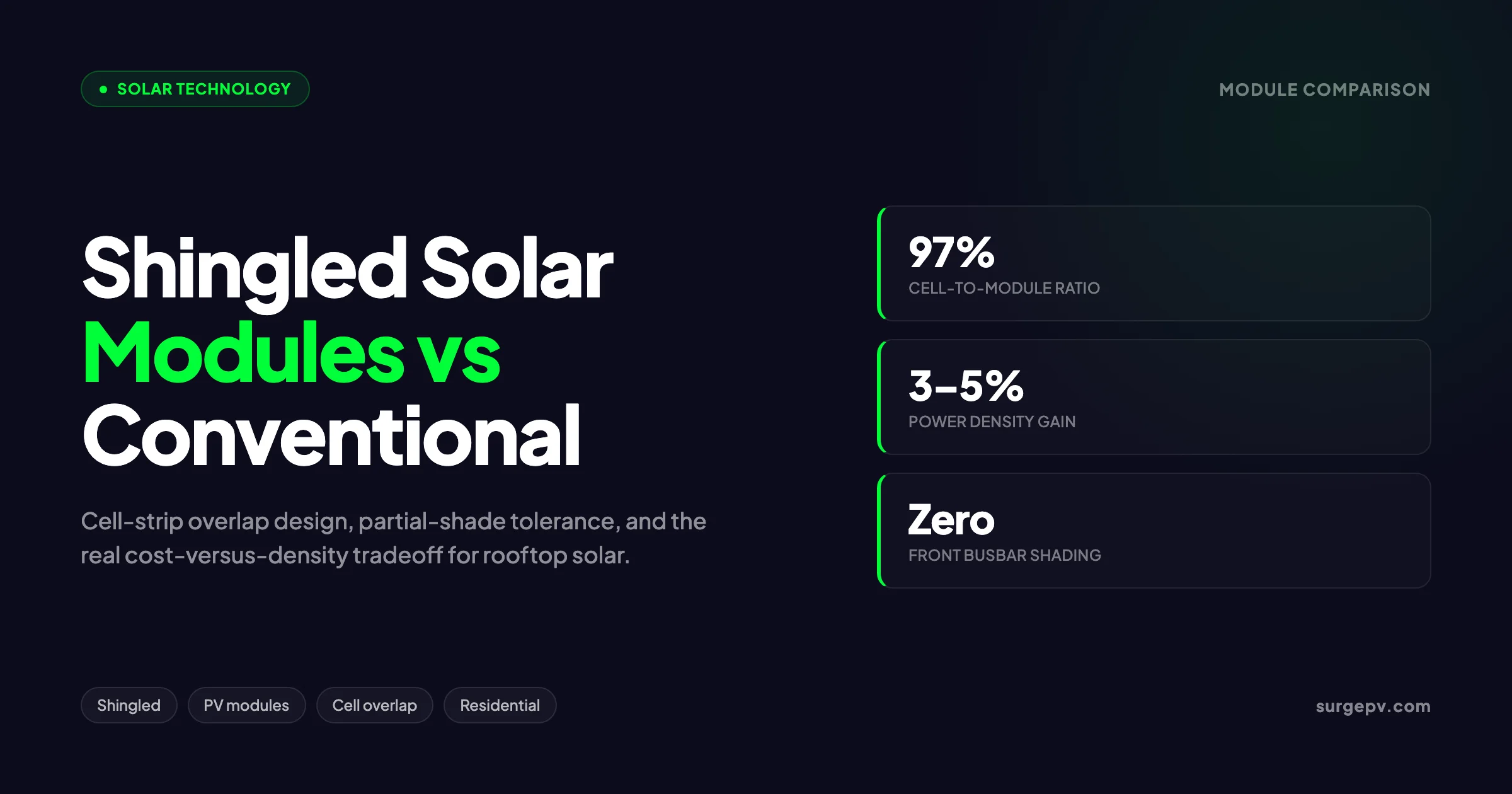
Shingled modules cut conventional cells into 5 or 6 strips and overlap them with electrically conductive adhesive, eliminating front busbars and inter-cell gaps. This raises the cell-to-module area ratio from around 92 percent to 97 percent, increasing power density by 3 to 5 percent and dramatically improving partial shading tolerance. The tradeoffs are 5 to 10 percent higher cost, more complex manufacturing, and a roughly 10 percent projected market share by 2029. Shingled wins on residential rooftops, building-integrated PV, and aesthetic-driven projects. Conventional half-cut TOPCon wins on cost-driven utility-scale and commercial ground mounts.
Read Ground Mounted Solar Design Guide for a complete walkthrough.
In this guide:
- What shingled solar modules actually are, with a plain-language description of the cell strip and overlap geometry
- A side-by-side breakdown of shingled versus conventional architecture, including the spec table designers need
- The six real engineering advantages of shingled designs, supported by Fraunhofer ISE and ITRPV data
- The four genuine disadvantages that have kept shingled at premium-niche status
- How shingled cells are made, from laser scribing to adhesive bonding
- The 2026 market reality, including why SunPower and Solaria collapsed financially while the technology lived on
- A decision matrix for when to specify shingled and when to skip it
What Are Shingled Solar Modules?
A shingled solar module is a PV panel built from full-size solar cells that have been cut into narrow strips and overlapped along one edge, the way clay tiles overlap on a roof. The overlap itself carries the electrical current from one strip to the next, replacing the metal ribbons and copper busbars used in conventional modules.
The cell strips are bonded together with electrically conductive adhesive (ECA), a specialised compound that conducts electricity along the overlap while flexing enough to absorb the thermal stresses that would crack a soldered joint. A typical 60-cell conventional module footprint can hold around 360 shingle strips when each cell is cut into 6 pieces. Those strips are wired into parallel groups inside the module, giving each panel many independent current paths instead of one long series chain.
The visual difference is obvious. A conventional module shows a grid of square cells with thin silver lines (the busbars) running across each cell and 2 to 4 millimetre gaps between cells. A shingled module looks like a continuous dark surface, with the strip overlaps invisible from a normal viewing distance.
The functional difference matters more. Removing the front busbars eliminates the shading they cast on the active cell surface. Removing the inter-cell gaps adds active area in the same panel footprint. Parallel wiring of strips reduces the impact of partial shading. Lower per-strip current cuts resistive losses. Each of those design decisions adds a small efficiency gain. Stacked together, they produce a module that delivers 3 to 5 percent more power per square metre than a conventional design using identical cell chemistry.
Pro Tip
Do not confuse shingled solar modules with solar shingles. Solar shingles are roof-integrated products that replace asphalt or tile roofing materials with PV-active shingles — a different product category sold by Tesla, GAF Energy, and CertainTeed. Shingled solar modules are standard-format glass-and-aluminium panels that happen to use overlapping cell strips inside. The shared “shingle” name causes confusion in customer conversations more often than it should.
Shingled vs Conventional Module Architecture: A Side-by-Side Breakdown
The cleanest way to see the difference is to lay both designs out feature by feature. The table below assumes mainstream 2026 cell technology (n-type TOPCon) on both sides, with shingled strips at 1/6 cell width.
| Design Element | Conventional Half-Cut Module | Shingled Module |
|---|---|---|
| Cell format | 182mm or 210mm cells cut in half | 182mm or 210mm cells cut into 5 or 6 strips |
| Number of cell units per panel | 120 to 144 half-cells | 300 to 432 shingle strips |
| Interconnection | 9 to 16 round or flat ribbons soldered across busbars | Electrically conductive adhesive at strip overlap |
| Front busbars | 9 to 16 visible silver lines per cell | None on the active cell face |
| Inter-cell gap | 2 to 4 millimetres | Zero (strips overlap) |
| Cell-to-module area ratio | 91 to 93 percent | 97 to 98 percent |
| Internal wiring | 1 or 2 series strings with 3 bypass diodes | Multiple parallel-series sub-strings |
| Module efficiency (TOPCon) | 21 to 22.5 percent | 20.5 to 21.5 percent |
| Power per square metre | 210 to 225 watts | 215 to 235 watts |
| Current per strip/cell | 13 to 18 amps (half-cell) | 2 to 3 amps (shingle strip) |
| Resistive loss share | 2 to 3 percent | 1 to 1.5 percent |
| Partial shading penalty | Heavy (3 bypass diodes cover full strings) | Light (parallel paths route around shade) |
| Aesthetics | Visible grid pattern | Uniform dark surface |
| Cost premium per watt | Baseline | 5 to 10 percent higher |
| Typical 2026 use case | Utility, commercial, low-cost residential | Premium residential, BIPV, shaded sites |
Notice that module efficiency in percent terms is similar — sometimes lower on shingled — even though shingled delivers more watts per square metre. The reason is technical: efficiency is measured on the full panel area including frame and edges, and shingled modules pack more active cells into roughly the same outer dimensions, raising the rated wattage but also raising the active area used in the efficiency calculation. The number that matters for rooftop designers is power per square metre, not nameplate efficiency.
Key Takeaway
Shingled modules trade higher manufacturing cost for higher cell-to-module ratio. Every other advantage — shading tolerance, aesthetics, reduced resistive loss — flows from removing the busbars, ribbons, and gaps that conventional modules need but shingled designs do not.
How Shingled Modules Are Manufactured
The shingled production process diverges from conventional module assembly at two critical steps: laser cutting and adhesive bonding. Everything before laser cutting (wafer growth, cell texturing, junction formation, metallisation) is identical to conventional cell production. Everything after lamination (framing, junction box, flash testing) is also identical. The shingled-specific work happens in the middle.
Step 1: Laser Scribing Full-size solar cells arrive at the shingling line on production trays. A laser system scribes shallow grooves along the cell at the cut lines — typically 4 or 5 grooves to produce 5 or 6 strips per cell. The scribe does not cut all the way through. Instead, the cell is then mechanically broken along the scribe lines. This thermal laser separation method, originally developed by Fraunhofer ISE and 3D-Micromac, minimises edge damage but still creates more recombination-active edge surface than uncut cells.
Step 2: Edge Passivation (optional) Higher-end shingled lines apply a passivation treatment to the cut edges to suppress recombination losses. Without this step, the cell efficiency penalty from cutting can reach 0.5 to 1 percent absolute. With it, the penalty drops to 0.1 to 0.2 percent. Many shingled lines skip this step on cost grounds and accept the lower cell-level efficiency.
Step 3: Conductive Adhesive Application A precision dispensing head applies a bead of electrically conductive adhesive along one long edge of each strip. The adhesive is a polymer matrix loaded with silver flakes that conduct electricity along the bondline. The bead is approximately 0.2 to 0.5 millimetres wide and continuous along the strip length.
Step 4: Strip Stacking Strips are placed onto the EVA-coated front glass with each new strip overlapping the previous one by 1 to 2 millimetres along the ECA bead. The result is a column of overlapped strips that resembles roof shingling. Each column is one current path. Columns are wired into parallel groups using interconnect ribbons that run along the bottom edge of the module, hidden under the backsheet or back glass.
Step 5: Curing and Lamination The stacked strips travel into a curing oven that hardens the ECA into a conductive solid. Some manufacturers use UV-cure ECA for faster throughput. After ECA cure, the module enters a standard laminator that bonds the front glass, EVA encapsulant, cell layer, second EVA layer, and backsheet (or back glass for bifacial designs) into a single weatherproof unit. See Bifacial Solar Panel Design Guide for detailed guidance.
The throughput penalty is significant. A conventional ribbon-stringer can interconnect a full 144-half-cell module in about 8 to 12 seconds. A shingled line takes 30 to 60 seconds per module for an equivalent footprint, depending on stripping speed and ECA cure time. Cell yield is also lower because every cut introduces a chance of microcracking. Industry reports put shingled cell yields 2 to 4 percentage points below uncut yields, though the leading manufacturers have closed much of that gap by 2026.
Pro Tip
If a shingled module spec sheet does not state the ECA cure method (UV, thermal, or hybrid) or the strip-cutting technique (thermal laser separation versus mechanical scribe), ask the manufacturer. These details predict adhesive longevity, edge recombination losses, and warranty risk more than headline efficiency numbers.
The Six Real Advantages of Shingled Solar Modules
Marketing materials list a dozen advantages. Most of them collapse into six engineering effects that come directly from the overlapping strip geometry. Below is what holds up to scrutiny.
Higher Cell-to-Module Ratio
This is the headline number. A conventional half-cut module wastes 7 to 9 percent of its surface on inter-cell gaps, the cell-spacing required to leave room for solder ribbons, and the busbar shading inside each cell. A shingled module wastes 2 to 3 percent. That delta of 5 to 6 percentage points translates directly into more watts on the same panel footprint.
For a 1.95 square metre panel format, this means an additional 15 to 25 watts of nameplate power before any other cell or module improvement is applied. On a 30-panel residential rooftop, that adds up to 450 to 750 watts of system capacity in the same roof area — often the difference between a 9 kilowatt and a 9.75 kilowatt installation.
Elimination of Front Busbar Shading
Conventional modules use 9 to 16 thin silver busbars on the front of each cell to collect current. Those busbars are inactive — sunlight that hits them reflects or absorbs without producing electricity. Fraunhofer ISE and module manufacturer testing put busbar shading losses at 2 to 3.5 percent of cell power.
Shingled designs use the overlap as the electrical interconnect, so the front face of each strip carries only fine fingers — no busbars. The active surface increases by the full busbar area, recovering most of that 2 to 3.5 percent loss. For a designer using cloud solar design software to estimate yield, this shows up as a modest but real boost in DC nameplate per square metre.
Better Partial Shading Tolerance
This is the advantage that matters most on real rooftops. Conventional 60-cell or 120-half-cell modules typically have 3 bypass diodes, each covering one-third of the cells in series. When a chimney shadow falls across two cells, the bypass diode for that whole sub-string activates and disables 20 cells of output — a 33 percent power loss for two shaded cells.
Shingled modules split the cells into many short strips wired in parallel groups. A typical shingled architecture has dozens of independent current paths inside the module. When a chimney shadow crosses 5 strips, only those 5 strips drop out — usually less than 5 percent of the module’s output. Fraunhofer ISE testing of matrix-style shingled designs (an evolved layout with parallel and series interconnection) found power gains of up to 73.8 percent under diagonal shading and 96.5 percent under random shading compared to conventional string approaches.
For sites with dormers, vent stacks, neighbouring trees, or any other foreseeable shading, this is the single strongest case for shingled. Plug your roof into a shadow analysis tool, compare annual yield with conventional versus shingled modules, and the kilowatt-hour delta often justifies the price premium on its own.
Reduced Series Resistance
A solar module loses some of its theoretical maximum power to internal resistance — the electrical resistance of the metal fingers, busbars, ribbons, and solder joints that carry current. Lower current at the same voltage means lower I²R loss.
Shingled cells are cut into strips one-fifth or one-sixth the width of a full cell. The strip current is correspondingly one-fifth or one-sixth of the full-cell current. Even though the strips are wired into series strings, the per-strip current is small enough that resistive losses drop noticeably. Combined with the removal of ribbon solder joints, shingled modules typically operate with 1 to 1.5 percent resistive loss versus 2 to 3 percent for full-cell conventional designs.
Lower resistance also means lower heat generation. Shingled modules tend to run 1 to 3 degrees Celsius cooler than conventional modules under identical irradiance, which slightly improves their power temperature coefficient and energy yield, especially in hot climates.
Improved Aesthetics
This is not a vanity advantage. For residential rooftop sales, the visual quality of the module is a closeable feature. Conventional modules show a grid of silver busbar lines that read as “industrial” from kerb level. Shingled modules read as a smooth dark sheet, blending with dark roofing tiles and slate.
The aesthetic advantage compounds with all-black framing and black backsheets. Maxeon, Tongwei, and several second-tier shingled manufacturers position their products explicitly for the premium residential market in Europe, Australia, and Japan, where homeowners pay attention to how the system looks. Building-integrated PV (BIPV) — solar incorporated into facades, canopies, and curtain walls — also benefits because the absence of visible cell grid lines allows the surface to read as architectural material rather than industrial equipment. Also see: European Solar Incentives. For Australia-specific compliance details, see Australia comparisons/lgc-vs-stc.
Mechanical Durability and Hot-Spot Resistance
Conventional modules contain roughly 30 metres of soldered busbar and ribbon per panel. Each solder joint is a potential failure point under thermal cycling, mechanical stress, or moisture ingress. Shingled modules eliminate the soldering entirely and replace it with flexible adhesive that absorbs thermal expansion mismatch.
Independent static and dynamic load testing has shown shingled modules to survive higher loading without microcracking compared to conventional modules of the same glass thickness. The smaller strip area also means that a single cell crack affects a smaller portion of the module — useful in hail-prone or high-wind environments. Hot-spot risk is lower because the multiple parallel paths inside a shingled module prevent a single shaded or damaged cell from forcing a large reverse current through itself.
Key Takeaway
Of the six advantages above, four are inherent to the overlapping-strip geometry and unavoidable. Two — aesthetics and partial shading tolerance — are the ones that move the needle on residential sales calls. The other four show up in the kilowatt-hour yield over the system’s 25-year life.
The Four Real Disadvantages
Every technology has tradeoffs. Shingled modules have four that explain why the technology has stayed at 5 to 10 percent of the global PV market rather than displacing conventional designs.
Manufacturing Complexity and Lower Yields
The shingling process is harder to run at high yields than the ribbon-soldering process it replaces. Laser scribing must be deep enough to cleave the cell cleanly but shallow enough to avoid edge damage. ECA dispensing must be precise — too little adhesive causes resistive hot spots, too much squeezes out and contaminates the active cell area. Strip placement must be accurate to 50 microns to maintain consistent overlap.
These tolerances translate into lower line yields and higher equipment cost. A modern conventional cell stringer costs roughly half what a shingling line of equivalent capacity costs, and runs faster. The gap is closing as suppliers like 3D-Micromac and Teamtechnik refine their shingling tools, but the cost-per-watt premium remains real.
Cell Breakage During Laser Cutting
Cutting a solar cell into 6 narrow strips creates 6 times the edge surface compared to an uncut cell. Cell edges are where minority-carrier recombination is most intense, so more edge means more efficiency loss at the cell level. The phenomenon is well documented in the photovoltaics literature — edge recombination accounts for 0.5 to 1 percent absolute efficiency loss in unpassivated cut cells, partially offsetting the cell-to-module gain from elimination of busbars and gaps.
Manufacturers address this in two ways: edge passivation chemistry applied to the cut edge, and selection of cell technologies less sensitive to edges. TOPCon cells, with their carrier-selective rear contact, tend to lose less efficiency to cutting than older PERC cells. Heterojunction (HJT) cells lose somewhat more because the thin amorphous-silicon layers are sensitive to cut-induced damage.
Heat Dissipation Within Strip Strings
Series-connected strips inside a column share a current path. If the column overheats at any point, the heat conducts along the silicon and through the ECA into adjacent strips. In high-irradiance, high-temperature climates, shingled modules can develop temperature gradients along the column that contribute to localised cell ageing. This is one reason most shingled product warranties have been carefully limited to specific climate zones in their early years.
The effect is mitigated by good thermal design of the backsheet or back glass and by the inherently lower resistive heating from reduced current. By 2026, leading manufacturers report long-term degradation rates comparable to conventional modules, but the field data is still thinner than the half-cut TOPCon track record.
Adhesive Longevity Uncertainty
Conventional modules use solder joints that have 50-plus years of field history in PV. Electrically conductive adhesive has 15 to 20 years of meaningful field exposure at scale, and the chemistry varies between manufacturers. Maxeon and its predecessors at SunPower and Solaria invested heavily in aerospace-grade ECA formulations specifically to address the question of 25-year durability. Second-tier shingled module manufacturers use various ECA formulations of less-documented track record.
The risk is not catastrophic failure — it is gradual increase in contact resistance over time as the adhesive ages, leading to slow power degradation that exceeds the warranted curve. Buyers should look for explicit warranty language covering ECA-related degradation, not just generic 25-year power output guarantees. This is the single biggest reason large-utility EPCs have stayed away from shingled designs — they have no field data old enough to retire a 30-year project finance model on.
Pro Tip
If you are speccing shingled modules for a commercial or institutional project, request the manufacturer’s accelerated aging test data on the specific ECA formulation, ideally IEC 61215 extended sequences with 1,000 hours of damp heat, 200 thermal cycles, and 50 kWh per square metre UV exposure. The numbers should show degradation under 2 percent across all sequences. Anything higher is a warning.
Why Shingled Modules Lost Mainstream Adoption Despite Being Better
Shingled is the technically superior option on a panel-by-panel basis. The cell-to-module ratio advantage is real. The shading tolerance is meaningfully better. The aesthetics are objectively cleaner. And yet the technology has held roughly 5 to 8 percent of global module shipments through 2024 and 2025, with the International Technology Roadmap for Photovoltaics projecting only about 10 percent share by 2029.
That is not how a technically superior technology usually behaves. The reason is not technical. It is economic and corporate.
The two pioneer companies — SunPower and Solaria — bet their businesses on shingled modules as a residential premium product. Both built capacity, secured patents, and ran aggressive marketing campaigns in the United States, Australia, and Europe. Both failed financially. SunPower filed for bankruptcy in August 2024 and was acquired by Complete Solar (which had merged with Solaria in 2022 to form Complete Solaria). Maxeon, the manufacturing arm spun off from SunPower in 2020, became Maxeon Solar Technologies and is now owned by China’s TCL Group.
The failures were not because shingled modules did not work. The failures came from cost competition. Chinese manufacturers ran half-cut multi-busbar (MBB) conventional modules at brutally low prices that the premium shingled segment could not match. Tongwei, the largest Chinese manufacturer with a shingled product line, scaled aggressively but kept shingled production deliberately limited — typically a few gigawatts in a portfolio of over 100 gigawatts of conventional capacity. By 2024 Tongwei delisted its shingled PERC product from premium rankings because it had moved its premium volume to TOPCon and heterojunction.
The mainstream PV industry chose a different path to higher power. Multi-busbar designs (9 to 16 busbars per cell) reduced busbar shading without changing the basic interconnection method. Third-cut and quarter-cut cells reduced resistive losses without going to full shingling. TOPCon and HJT raised cell efficiency through better junction physics. Each of these increments shipped at conventional manufacturing cost. Stacked together, they produced modules that match shingled performance in many use cases at conventional prices.
The result is a market where shingled remains the better choice for a specific niche — premium residential rooftop, BIPV, partial-shade-sensitive sites — but where the niche has not grown into the mainstream because the conventional path closed most of the performance gap at lower cost. Trina Solar and JA Solar are now releasing triple-slice and quad-slice products that are technically half-cut variants, not full shingling, but capture some of the same cell-to-module gains.
This is the contrarian read for 2026: shingled modules are not gaining mainstream share because they do not need to. They occupy a real, defendable niche, and the broader market has incorporated enough of the shingled playbook into conventional designs that the technical gap is no longer compelling at the utility-scale price point.
Cost Comparison: What Shingled Modules Really Cost in 2026
Pricing data for premium PV modules is messy. Distributor prices vary by region, project size, and shipping. Public list prices often do not reflect what large-volume buyers actually pay. The numbers below are blended estimates from 2026 distributor reports across Europe, North America, and Asia.
| Module Type | Typical Wattage (residential) | Distributor Price (€/W) | Premium vs Half-Cut TOPCon |
|---|---|---|---|
| Half-cut PERC (legacy) | 380 to 420 W | 0.12 to 0.18 | -10 to -15% |
| Half-cut TOPCon (baseline) | 425 to 470 W | 0.15 to 0.22 | Baseline |
| Half-cut HJT | 440 to 490 W | 0.22 to 0.32 | +25 to +35% |
| Shingled PERC | 380 to 430 W | 0.18 to 0.26 | +15 to +25% |
| Shingled TOPCon | 415 to 460 W | 0.20 to 0.30 | +20 to +30% |
| Maxeon Performance (premium shingled) | 410 to 440 W | 0.30 to 0.45 | +60 to +80% |
The cost premium for mass-market shingled modules sits between 15 and 30 percent in 2026, depending on cell technology. Maxeon’s premium-tier shingled Performance line sits well above that band because it includes proprietary cell technology, premium framing, and a 40-year warranty.
For a residential 8 kilowatt system, the panel cost delta between half-cut TOPCon and mid-tier shingled TOPCon works out to roughly €400 to €800 — typically 5 to 10 percent of the total installed cost. Whether that pencils out depends on three factors:
- Roof area constraint. If the roof is space-limited, the 3 to 5 percent power density gain from shingled lets you size a larger system. The extra kilowatt-hours over 25 years often cover the panel premium.
- Shading exposure. If the site has dormers, neighbouring trees, or vent obstacles, the partial shading advantage of shingled can add 5 to 15 percent to annual yield. This alone often justifies the upgrade.
- Aesthetic priority. If the homeowner cares about appearance — and many premium residential customers do — the all-black shingled look is a closeable feature that protects the deal price.
For utility-scale or commercial rooftop projects with no shading and no aesthetic constraint, conventional half-cut TOPCon almost always wins on levelised cost of energy.
Compare shingled vs conventional module yield on your actual site
Run side-by-side annual yield simulations using real shading, irradiance, and module spec data — and see whether shingled pays back on your specific rooftop.
Book a DemoNo commitment required · 20 minutes · Live project walkthrough
Where Shingled Modules Win: Application Decision Matrix
Use the matrix below as a quick screen for whether to specify shingled modules on a given project. The decision points are partial shading exposure, roof area constraint, aesthetic priority, and budget flexibility.
| Project Type | Roof Constraint | Shading Risk | Aesthetic Priority | Recommended Module | Why |
|---|---|---|---|---|---|
| Premium residential rooftop, clear roof | Moderate | Low | High | Shingled TOPCon | Aesthetics close the sale; small power density gain |
| Residential rooftop with shading obstacles | Moderate | High | Moderate | Shingled TOPCon or matrix shingled | Partial shading tolerance is the deciding factor |
| Standard residential, cost-sensitive | Low | Low | Low | Half-cut TOPCon | No reason to pay shingled premium |
| Small commercial rooftop, space constrained | High | Low | Low | Shingled TOPCon | Power density compounds across roof area |
| Commercial rooftop, large clear area | Low | Low | Low | Half-cut TOPCon | LCOE favours conventional |
| BIPV facade or canopy | High | Variable | Very High | Shingled (typically custom-format) | Uniform appearance is mandatory |
| Solar carport, residential | Moderate | Low | Moderate | Shingled or half-cut | Either works; pick by budget |
| Utility-scale ground mount | Low | Low | Low | Half-cut TOPCon or HJT | Cost dominates every other factor |
| Floating PV | Low | Low | Low | Half-cut TOPCon | Bifacial conventional captures water reflection |
| Heavy-shading commercial | Moderate | Very High | Low | Shingled or microinverters with conventional | Compare shingled cost vs MLPE on conventional |
For most installers serving residential homeowners with shading sensitivity, the workflow is straightforward. Run a generation and financial tool simulation with both module types using the actual site shading. If the shingled module produces 4 percent or more additional annual energy at the site, and the homeowner is paying for the system over 25 years, the shingled choice usually wins on net present value despite the higher upfront cost.
2026 Market Reality: Who Makes Shingled Modules Today
The shingled supply chain has changed significantly in the past three years. Below is the 2026 landscape, organised by manufacturer type.
Maxeon (TCL Group) — Inherited the SunPower and Solaria shingled patent portfolios after acquiring Solaria’s IP in 2023 and SunPower-branded assets through Complete Solar’s bankruptcy purchase. Now owned by China’s TCL Technology, with the new TCL SunPower Global business unit operating independently from Maxeon. Maxeon continues to produce its Performance shingled line for residential and commercial markets globally, claiming over 3 gigawatts deployed across 60 countries.
Tongwei — Chinese cell giant with the largest scaled shingled production line. Released its Terra shingled series in 2022 in 400 to 430 watt classes, with shingled module capacity around 14 gigawatts as of late 2024. Tongwei’s shingled PERC product was delisted from premium rankings in September 2024 as the company moved its high-power volume to TOPCon and HJT, but shingled remains in the product portfolio.
Risen Energy — Offers the Evo X Shingled line alongside its TOPCon and HJT series. Risen’s main 2026 power story is HJT with the Hyper-ion line reaching 740 W certified at 26.61 percent cell efficiency — that line is not shingled but pushes the same high-density direction through other means.
Maysun Solar, Sungold, GVE Group — Mid-tier European and Chinese manufacturers with shingled products targeted at residential rooftop. Quality varies considerably; specify carefully.
JA Solar, Trina Solar, LONGi — The three largest Chinese module manufacturers have largely passed on full shingling in favour of triple-cut and quad-cut TOPCon designs. Trina’s Vertex 3rd generation uses quad-slice technology in TOPCon up to 760 watts, expected to reach mass production in Q3 2026. JA Solar’s DeepBlue 5.0 series covers triple-slice and quad-slice variants in 645 to 670 watt power classes. These are technically not shingled designs — they keep ribbon interconnection — but they capture much of the cell-to-module gain through finer cell division.
Heterojunction-shingled hybrids — Several Chinese manufacturers (Lians Technology, smaller players) have begun producing heterojunction multi-slice modules that combine HJT cells with shingled-style overlap. The April 2026 EnergyTrend report flagged this as the breakout segment for 2026, with multiple producers entering small-batch trial production.
The clearest read for 2026 is that pure shingling has stayed a 5 to 10 percent niche, while the broader industry has adopted ever-smaller cell cuts (third-cut, quarter-cut, fifth-cut) within conventional ribbon architecture to chase the same efficiency gains. Designers running a project today have a choice between true shingled products from Maxeon, Tongwei, and Risen, or shingle-adjacent multi-slice designs from JA Solar and Trina at conventional pricing.
Comparing Shingled Modules to Other High-Density Designs
Shingled is one of three competing roads to higher cell-to-module ratio. The other two are multi-busbar (MBB) and multi-slice (third-cut, quarter-cut). Each takes a different design path.
Multi-Busbar (MBB) Conventional
Increases busbar count from 4 or 5 to 9, 12, or 16 fine round wires per cell. Smaller individual busbars mean less shading per busbar (the wires are round, not flat, so they reflect light into the cell instead of fully blocking it) and shorter current paths inside each cell. MBB captures about 60 percent of the busbar-related gain of shingling at almost no manufacturing cost premium. This is the dominant 2026 mainstream technology.
Multi-Slice (Third-Cut or Quarter-Cut)
Same interconnection topology as half-cut but with cells cut into 3 or 4 pieces instead of 2. Smaller cells carry less current, so resistive losses drop. Trina Vertex 3rd-generation modules and JA Solar DeepBlue 5.0 modules use this approach. Multi-slice captures about 70 percent of the resistive-loss benefit of shingling, but does not eliminate busbars or gaps, so the cell-to-module ratio remains around 93 to 94 percent rather than 97 percent.
Full Shingled
Captures both the busbar elimination and the resistive-loss reduction, plus the cell-to-module ratio gain from removing inter-cell gaps. Highest density per square metre, highest cost.
The competition between these three is what is keeping shingled in its current niche. MBB plus multi-slice on TOPCon delivers roughly 80 percent of full shingling’s benefits at 90 percent of full shingling’s manufacturing cost. Unless the application needs the last 20 percent of benefit — primarily the partial shading tolerance and aesthetic — the conventional path wins on economics.
Key Takeaway
If a manufacturer offers you a “third-cut TOPCon” or “quad-cut TOPCon” module, it is not a shingled module. It is a multi-slice conventional module that captures some of the same gains at lower cost. The distinction matters for warranty terms, partial shading behaviour, and long-term degradation curves.
ROI Examples: When Shingled Pays Back
Three realistic 2026 scenarios show how the shingled premium plays out over a 25-year system life. All assume German residential pricing (€0.30/kWh retail electricity, 75 percent self-consumption with battery, 0.5 percent annual degradation, 4 percent discount rate). See our guide on Community Solar Projects Germany for more. Read more about Multi-Family Residential Solar Case Study.
Scenario A: Standard 8 kW rooftop, no shading
- 20 half-cut TOPCon modules at 410 W = 8.2 kW DC, system price €13,000
- 20 shingled TOPCon modules at 425 W = 8.5 kW DC, system price €13,600
- Premium: €600 (4.6 percent)
- Annual yield delta: ~340 kWh (mostly from extra capacity)
- 25-year value of extra yield: ~€2,500 net present value
- Verdict: Shingled wins by ~€1,900 NPV. Premium pays back in ~6 years.
Scenario B: Same 8 kW rooftop, with dormer shading 15 percent of array
- Conventional system loses ~7 percent annual yield to shading mismatch
- Shingled system loses ~2 percent annual yield to shading mismatch
- Net yield delta: ~750 kWh per year
- 25-year value: ~€5,500 NPV
- Verdict: Shingled wins by ~€4,900 NPV. Premium pays back in ~2.5 years.
Scenario C: 500 kW commercial rooftop, no shading
- Half-cut TOPCon at €0.18/W installed for panels, total system €380,000
- Shingled TOPCon at €0.23/W installed for panels, total system €405,000
- Premium: €25,000 (6.6 percent)
- Annual yield delta: ~3 percent from higher density and lower losses, ~15,000 kWh
- 25-year value at €0.10/kWh commercial rate: ~€32,000 NPV
- Verdict: Shingled wins by ~€7,000 NPV. Premium pays back in ~17 years.
The pattern across the three scenarios: shingled wins consistently when there is shading or roof-area pressure, wins modestly when there is no shading and a residential retail tariff, and is closer to break-even at commercial rates with no shading. None of the scenarios make conventional the clear winner on NPV — shingled almost always pays back across a 25-year window if you can carry the upfront cost. The objection is liquidity, not lifetime economics.
Conclusion: When to Specify Shingled Modules
Three takeaways for solar designers and installers in 2026:
-
Specify shingled on shaded residential rooftops. Partial shading tolerance is the strongest engineering advantage. The yield gain compounds across 25 years and typically pays back the premium in under 5 years. Use solar proposal software and a capable solar design software platform to model the actual delta on each site.
-
Specify shingled on space-constrained or aesthetically driven projects. Roof area is finite. Visible cell grids hurt premium residential sales. If either condition applies, the 3 to 5 percent power density gain and uniform appearance carry real economic value.
-
Stick with half-cut TOPCon for utility-scale, large commercial, and cost-sensitive residential. The conventional path has absorbed enough of the shingled playbook through MBB, multi-slice, and TOPCon cells that the remaining technical gap rarely justifies the cost premium at scale.
The 2026 reality is that shingled modules are a healthy, defensible premium niche, not a coming wave. Maxeon, Tongwei, and Risen Energy will continue producing them for the customers who need them. JA Solar, Trina, and LONGi will continue capturing most of the same gains through multi-slice conventional designs. Both paths are valid. Match the technology to the application, not the marketing.
Frequently Asked Questions
What are shingled solar modules? Shingled solar modules are PV panels where standard cells are laser-cut into 5 or 6 narrow strips, then overlapped along their edges like roof shingles. Conductive adhesive bonds the overlap, replacing the front busbars and ribbons used in conventional modules. The result is a panel with no visible gridlines, no gaps between cells, and a cell-to-module area ratio above 97 percent.
Are shingled solar panels more efficient than conventional? Shingled modules deliver about 3 to 5 percent more power per square metre than a conventional module of the same cell technology, mainly because the overlap removes busbar shading and gaps between cells. Module-level efficiency typically lands between 19 and 21 percent for shingled mono PERC and TOPCon products, similar to high-end conventional panels but in a smaller footprint.
Why did SunPower and Solaria stop making shingled modules? SunPower filed for bankruptcy in August 2024 and its assets were acquired by Complete Solar. Solaria had already merged with Complete Solar in 2022 to form Complete Solaria, which later sold its shingled module patents to Maxeon in 2023. The technology did not fail — the companies failed financially against low-cost Chinese competition. Maxeon, now part of TCL Group, still produces shingled Performance panels.
Are shingled modules better for partial shading? Yes, in most cases. A conventional 60-cell module typically has 3 bypass diodes covering 20 cells each, so shading a single cell can disable a third of the module. Shingled modules split cells into many short strips wired in parallel groups, so shading a small area drops only the shaded strip’s output. Lab testing has shown power gains of up to 73 percent under diagonal shading compared to standard string layouts.
What is the cell-to-module ratio of shingled panels? Cell-to-module (CTM) ratio measures how much of the panel’s surface is active solar cell area versus inactive frame, glass, and gaps. Shingled modules reach CTM ratios of 97 to 98 percent, compared to roughly 91 to 93 percent for half-cut conventional modules. The higher ratio is the single biggest reason shingled designs produce more watts per square metre.
How much more do shingled solar panels cost? Expect a 5 to 10 percent premium per watt versus equivalent conventional modules in 2026, though the gap has narrowed as manufacturing matures. The premium reflects slower production throughput, higher equipment costs, lower cell yields from laser cutting, and the use of electrically conductive adhesive instead of solder. On rooftop projects where space is tight, the higher power density often offsets the premium through reduced balance-of-system costs.
Do shingled panels work with bifacial designs? Yes, and the pairing is technically strong. Shingled cells leave no gaps for light to pass through to the back glass uselessly, so combining shingled topology with bifacial cells captures more rear-side light than gapped conventional bifacial modules. Several manufacturers including Risen Energy, Tongwei, and Maxeon offer shingled bifacial products primarily aimed at commercial and BIPV applications.
Will shingled modules become mainstream by 2030? Unlikely as a dominant technology. The International Technology Roadmap for Photovoltaics projects shingled designs reaching around 10 percent market share by 2029. The mainstream path for 2026 to 2030 is multi-busbar TOPCon and heterojunction cells with half-cut or third-cut wafers, which deliver most of the cell-to-module gain at lower manufacturing cost. Shingled modules will likely stay a premium segment for residential rooftop, building-integrated, and aesthetic-driven projects.
Related Reading
- Half-Cut vs Full-Cell Solar Panels: Performance Comparison
- PERC vs TOPCon vs HJT Field Performance
- Bifacial Solar Gain by Mounting Type
- Solar Panel Warranty Comparison
Further Reading
Designing a residential project with partial shading? Compare shadow analysis software outputs for conventional and shingled module yield. The kWh delta usually tells you whether the shingled premium is worth it within five minutes.
Where this fits
This article is part of SurgePV's Solar Technology hub, which works through the topic from first principles to the decisions a project team actually has to make.
