

Quick Answer
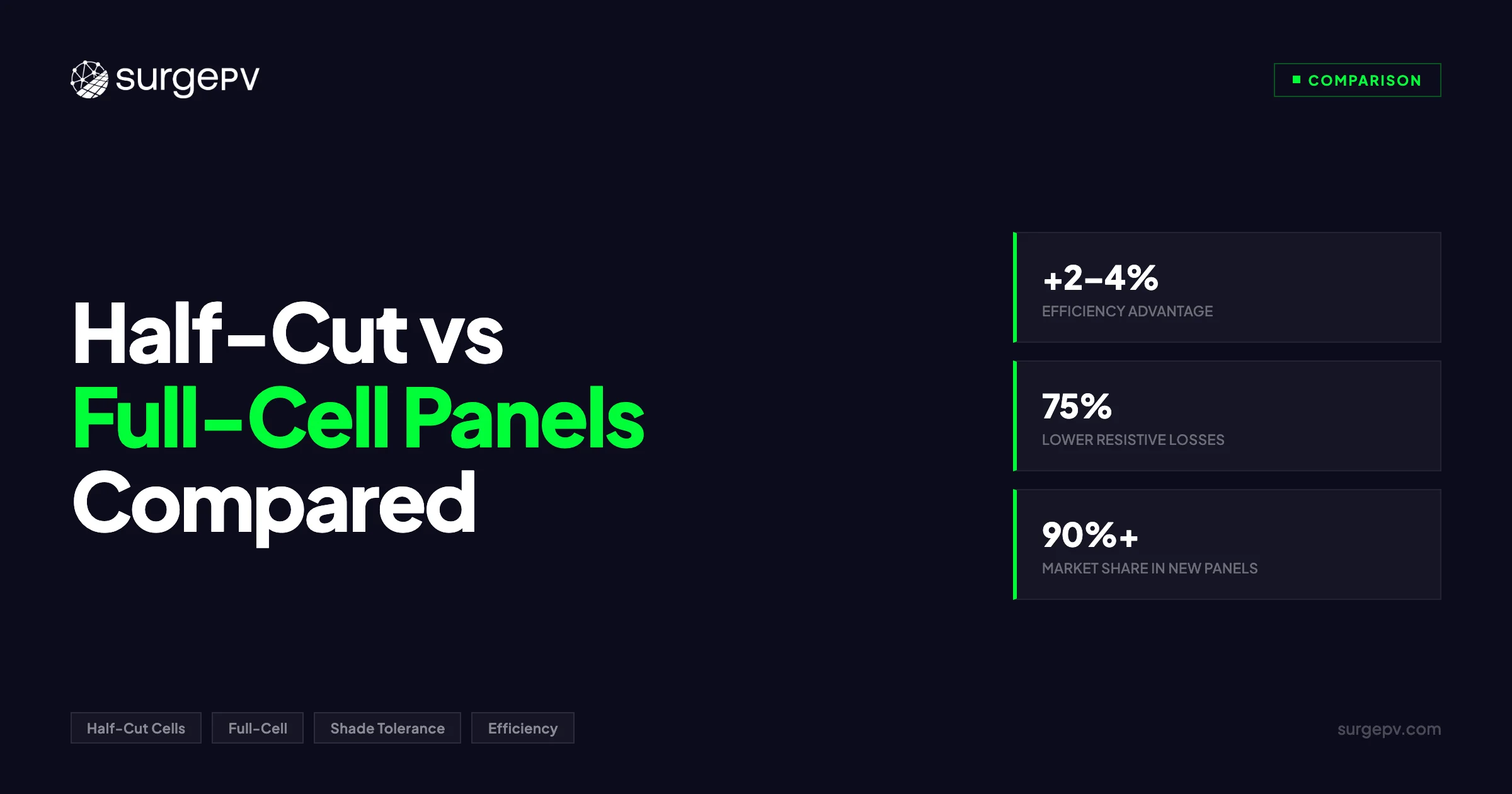
Half-cut solar panels split cells in half, reducing resistive losses and improving shading tolerance by 2–3%. They perform better in partial shade and hot conditions. Full-cell panels are cheaper but less efficient.
Half-cut cell panels outsell full-cell panels by a wide margin in 2026. Every major manufacturer, from LONGi to JA Solar to Trina, ships half-cut as the default residential and commercial product. Full-cell modules are still available, but they are increasingly a legacy option.
Half-cut solar panels split cells in half, reducing resistive losses and improving shading tolerance by 2–3%. They perform better in partial shade and hot conditions. Full-cell panels are cheaper but less efficient. Shadow analysis software identifies shading issues before installation. See [Solar Shading Analysis Guide](/blog/solar-shading-analysis-guide) for detailed guidance.
The reasons are straightforward: half-cut cells reduce resistive losses, handle shade better, and lower hot spot risk. The cost difference has shrunk to near zero. For most installations, half-cut is the better choice. But “most” is not “all,” and understanding where the advantage comes from helps you make the right call for each project.
Quick Verdict
Half-cut panels win on shade tolerance, efficiency, and reliability. Full-cell panels are only worth considering for budget-constrained, shade-free projects where the per-watt price difference still exists. For any roof with partial shading, half-cut is the clear choice.
How Half-Cut Cells Work
A half-cut cell is exactly what the name suggests: a standard solar cell cut in half with a laser. A 166 mm full cell becomes two 83 mm half cells. A 182 mm cell becomes two 91 mm half cells.
The key change is electrical, not physical. Cutting the cell in half reduces the current by 50%. Since resistive power loss follows P = I²R, halving the current reduces resistive losses by 75% within each cell.
At the module level, a standard 60-cell panel becomes a 120-half-cut-cell panel. The top 60 half-cells and bottom 60 half-cells operate as two independent circuits connected in parallel at the junction box.
If shade covers only the bottom half, the top half continues producing at full power. In a full-cell panel, the same shadow would activate bypass diodes that affect the entire module.
For a deeper look at how shading interacts with panel design, see our guide on how shading affects solar panels.
Head-to-Head Comparison
| Specification | Half-Cut Cell Panel | Full-Cell Panel |
|---|---|---|
| Cell count (typical) | 120 or 144 | 60 or 72 |
| Cell current | ~5.5 A per cell | ~11 A per cell |
| Resistive (I²R) loss | 75% lower per cell | Baseline |
| Module efficiency (STC) | 21.5-23.5% | 21.0-22.5% |
| Real-world energy yield | 2-3% higher | Baseline |
| Shade tolerance | Two independent halves + 6 bypass diode groups | Single circuit + 3 bypass diode groups |
| Partial shade energy recovery | 5-10% better annually | Baseline |
| Hot spot temperature | 10-15°C lower | Baseline |
| Hot spot failure risk | Low | Moderate |
| Price premium (2026) | 0-3% | Baseline |
| Warranty terms | Identical (25-30 year product, 25-30 year performance) | Identical |
| Manufacturer availability | Standard product from all Tier 1 | Declining availability |
The efficiency difference at STC (Standard Test Conditions: 25°C, 1000 W/m², AM1.5) is small because STC does not capture the conditions where half-cut cells perform best: high temperatures, partial shade, and high-current operation. Real-world yield differences of 2-3% are consistently measured in field studies.
Where Half-Cut Cells Win
1. Roofs with Partial Shading
This is the biggest advantage. When a shadow from a chimney, dormer, or tree falls across the bottom half of a half-cut panel, the top half keeps producing. A full-cell panel loses output across the entire module because the shaded cells limit current for every cell in the string.
On a roof with moderate shading, half-cut panels paired with microinverters or optimizers can recover 5-10% more annual energy than full-cell panels with the same electronics.
For shade assessment methodology, see our solar shading analysis tools comparison. See our guide on Agricultural Solar Case Study for more.
2. Hot Climate Installations
Solar panel efficiency drops as temperature increases. The temperature coefficient for most panels is around -0.35%/°C. At 65°C cell temperature (common in hot climates), a 400 W panel produces roughly 346 W.
See also: solar panel efficiency ranking.
Half-cut cells run cooler because lower current means less heat at cell interconnects and busbars. Field measurements show 10-15°C lower hot spot temperatures compared to full-cell panels. That translates to 1-2% better performance in hot climates beyond the baseline efficiency advantage.
3. Long String Configurations
In string inverter systems with long strings (12-15 panels), cumulative resistive losses along the string are higher. Half-cut cells compound less loss over the string length.
On commercial rooftops where string lengths are maximized to reduce wiring costs, the resistive loss savings from half-cut cells can add 1-1.5% to annual production on a 15-panel string.
For string design best practices, see common solar string design mistakes. Read String Sizing Solar PV System for a complete walkthrough.
4. High-Efficiency System Designs
On a space-constrained roof where you need maximum output from minimum area, half-cut cells deliver. The 2-3% real-world yield advantage means a 10 kWp half-cut array produces the same energy as a 10.2-10.3 kWp full-cell array.
On a roof that fits exactly 20 panels, that 2-3% can be the difference between meeting the customer’s consumption target and falling short.
Pro Tip
When modeling a system with solar design software, run the simulation with both half-cut and full-cell panel options. The energy difference on shaded roofs is often larger than the nameplate wattage difference suggests, because the simulation captures the bypass diode activation patterns that STC ratings miss.
Where Full-Cell Panels Still Have a Place
Full-cell panels are not obsolete, but their use cases have narrowed.
Budget-constrained, shade-free projects. On a large ground-mount with no shading and a tight budget, full-cell panels from a Tier 2 manufacturer can save 3-5% on module cost. If shade is not a factor, the efficiency penalty is small.
Legacy system expansions. When adding panels to an existing full-cell string, matching the cell technology avoids electrical mismatch. Mixing half-cut and full-cell panels on the same string creates current imbalance that can reduce performance more than the half-cut advantage provides.
Specific utility procurement contracts. Some utility-scale procurements still specify full-cell modules based on bankability studies done before half-cut became standard.
The full-cell use case shrinks every quarter. Most Tier 1 manufacturers have stopped producing full-cell residential panels entirely.
Beyond Half-Cut: Next-Generation Cell Technologies
Half-cut cells were the first step in splitting cells for better performance. The industry has continued the trend.
Third-Cut Cells
Some manufacturers now cut cells into thirds, creating 180-cell modules from a 60-cell base. Current drops to one-third of the original, and resistive losses drop by nearly 90%. Shade tolerance improves further with more bypass diode groups and smaller affected zones.
Third-cut panels are still niche but gaining traction in commercial applications where shade tolerance and maximum energy density matter.
Shingled Cells
Shingled cell technology overlaps narrow cell strips like roof tiles, eliminating gaps between cells. This increases active cell area per module and creates parallel current paths that improve shade tolerance.
Shingled panels from SunPower (Maxeon) and Canadian Solar show 3-5% higher energy density than half-cut panels of the same size. The manufacturing process is more complex, so prices remain 5-10% higher. For Canada-specific compliance details, see Canada comparisons/solar-designing.
TOPCon and HJT
TOPCon (Tunnel Oxide Passivated Contact) and HJT (Heterojunction) are cell efficiency improvements independent of the half-cut vs. full-cell question. Both achieve higher base efficiency (23-25% module level) and are almost always paired with half-cut cell architecture.
TOPCon has become the dominant high-efficiency cell technology, largely replacing standard PERC. HJT occupies the premium tier with the best temperature coefficients (-0.26%/°C vs. -0.35%/°C for PERC).
| Technology | Module Efficiency | Temperature Coefficient | Cell Architecture | Price vs. Standard PERC |
|---|---|---|---|---|
| PERC (half-cut) | 21.5-22.5% | -0.35%/°C | Half-cut standard | Baseline |
| TOPCon (half-cut) | 22.5-24.0% | -0.30%/°C | Half-cut standard | +5-10% |
| HJT (half-cut) | 23.0-24.5% | -0.26%/°C | Half-cut standard | +10-15% |
| Shingled (PERC) | 22.0-23.0% | -0.35%/°C | Shingled strips | +5-10% |
Key Takeaway
Half-cut is no longer a premium feature. It is the baseline. The real technology decisions in 2026 are between PERC, TOPCon, and HJT cell chemistry, and between standard half-cut and shingled architectures. All of these use half-cut or smaller cell divisions as the default.
Design Implications for Installers
The shift to half-cut cells changes a few things in your design workflow.
String Sizing
Half-cut panels have the same Voc as full-cell equivalents (the two halves connect in parallel), but the Imp is halved. String sizing calculations remain the same for voltage, but the lower string current means you can use slightly smaller DC cables on long runs without exceeding voltage drop limits.
Orientation Matters More
Because the top and bottom halves operate independently, panel orientation relative to the shade source matters. Place panels so that shade crosses from side to side (affecting cells in both halves equally) rather than from top to bottom (which knocks out one entire half).
Portrait orientation often handles bottom-edge shade better than landscape, because the shadow stays within one half of the panel.
Equipment Pairing
Half-cut panels pair well with all inverter topologies. The combination of half-cut cells plus microinverters provides maximum shade resilience: per-panel independence from the microinverter, plus within-panel tolerance from the half-cut architecture.
For systems limited to string inverters, half-cut panels still outperform full-cell panels in shade. The bypass diode groups are smaller, so less output is lost when a diode activates.
Use solar design platform to model the specific combination of panel technology and inverter type for each project, then export the verified yield into solar proposal software for the customer-facing quote. The interaction between half-cut cell architecture and inverter MPPT behavior affects real-world yield in ways that cannot be calculated by hand.
Model Half-Cut vs. Full-Cell Performance
SurgePV’s simulation engine models bypass diode activation and shade losses for any panel technology. See the difference before you specify.
Book a DemoNo commitment required · 20 minutes · Live project walkthrough
For a direct comparison, see Arka 360 vs SurgePV.
Further Reading
Explore our guide to Solar Technology: Panel Types for a broader comparison of PERC, TOPCon, HJT, and shingled cell architectures.
For the latest details on France, see Floating Solar Farms France.
Frequently Asked Questions
Are half-cut solar panels better than full-cell panels?
In most scenarios, yes. Half-cut panels offer 2-3% higher energy yield, better shade tolerance, lower hot spot risk, and reduced resistive losses. The cost premium has largely disappeared in 2026, with most Tier 1 manufacturers shipping half-cut as their standard product. Full-cell panels still make sense only for budget-constrained projects on shade-free roofs.
Do half-cut solar panels cost more?
In 2026, the price gap has nearly closed. Half-cut panels carry a 0-3% price premium over equivalent full-cell models from the same manufacturer. Many manufacturers have discontinued full-cell lines entirely, making half-cut the default at the same price point. The slightly higher manufacturing cost (laser cutting adds one process step) is offset by better yield that justifies volume production.
How much more efficient are half-cut cell panels?
Half-cut panels deliver 2-3% higher module efficiency in real-world conditions compared to full-cell panels using the same cell technology. Under STC lab conditions the difference is smaller (under 1%) because STC does not capture the reduced resistive losses and better shade handling that show up in field operation. On shaded roofs, the advantage can reach 5-10% in annual energy yield.
Are half-cut panels better in shade?
Yes. Half-cut panels split into two independent electrical halves, each with its own bypass diode groups. When shade covers only the top or bottom portion, the unshaded half continues at full output. A full-cell panel with the same shade pattern loses output across the entire module. Field data shows 5-10% better annual yield for half-cut panels in partial shade conditions. For a detailed breakdown of shade physics, see our guide on how shading affects solar panels.
Where this fits
This article is part of SurgePV's Solar Technology hub, which works through the topic from first principles to the decisions a project team actually has to make.
