

Quick Answer
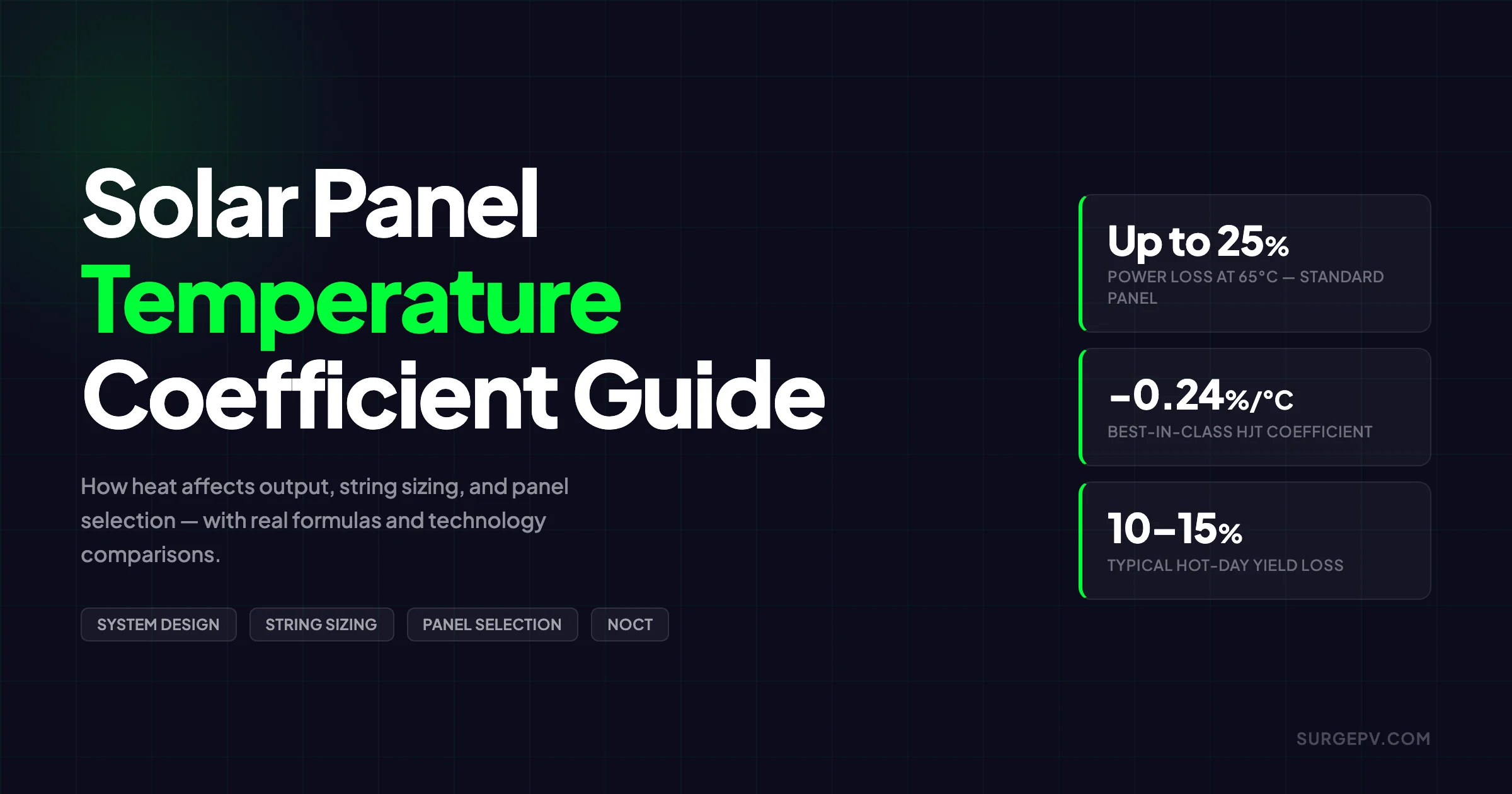
Solar panel temperature coefficient measures output loss per degree above 25°C. Typical values: PERC -0.35%/°C, TOPCon -0.29%/°C, HJT -0.24%/°C. In hot climates (45°C cell temperature), HJT loses only 5% versus 7% for PERC. Lower coefficients justify premium pricing in hot regions.
A 400 W solar panel often delivers only 320–340 W on a clear summer afternoon in Phoenix or Dubai. The missing 60–80 W is not a defect — temperature is consuming it. The temperature coefficient tells you precisely how much power a panel loses for every degree Celsius above its rated test condition. It appears on every datasheet, gets overlooked in most installs, and quietly reduces system performance across every hot summer day for 25 years. Any solar software worth using should apply this correction automatically — but understanding the math yourself is what separates a competent system designer from one who just clicks through defaults.
Solar panel temperature coefficient measures output loss per degree above 25°C. Typical values: PERC -0.35%/°C, TOPCon -0.29%/°C, HJT -0.24%/°C. In hot climates (45°C cell temperature), HJT loses only 5% versus 7% for PERC. Lower coefficients justify premium pricing in hot regions.
TL;DR — Temperature Coefficient
Solar panels lose 0.3%–0.5% of rated output per °C above 25°C. On a summer day with panel temperatures reaching 65°C, that is a 12–20% power loss before any other derating. HJT panels at -0.24%/°C outperform standard mono-PERC at -0.38%/°C by 5+ percentage points in the same conditions. Every string design calculation also depends on the Voc coefficient — skip it, and you risk exceeding inverter input limits on cold winter mornings.
Here is what this guide covers:
- What temperature coefficient means and the three values on every datasheet
- How to calculate real-world power derating using NOCT
- Technology-by-technology comparison: HJT, TOPCon, PERC, thin-film
- Step-by-step string sizing with temperature corrections
- How mounting type affects cell temperature
- A framework for choosing panels in hot vs. cold climates
- The link between temperature, LID degradation, and 25-year yield
What Is Solar Panel Temperature Coefficient?
Solar panels are tested and rated under Standard Test Conditions (STC): 25°C cell temperature, 1,000 W/m² irradiance, and an AM 1.5 solar spectrum. The watt rating stamped on the panel — 400 W, 440 W, 550 W — only applies at exactly these lab conditions.
Real panels never operate at 25°C during peak generation hours. A dark-framed module in Las Vegas in July absorbs shortwave radiation from the sun and re-radiates longwave heat. Panel surface temperatures routinely reach 55–70°C in summer. Every degree above 25°C reduces rated output.
The temperature coefficient quantifies this loss. It is expressed as a percentage change in electrical output per degree Celsius change in cell temperature from the 25°C STC baseline. A coefficient of -0.38%/°C means: for every 1°C increase above 25°C, output falls by 0.38%.
The relationship is linear across the operating range most installations encounter. If a panel has a 400 W STC rating and a temperature coefficient of -0.38%/°C, and cell temperature reaches 65°C:
ΔP = -0.38% × (65 - 25) = -0.38% × 40 = -15.2%
Actual output = 400 × (1 - 0.152) = 338.8 W
The panel produces 339 W, not 400 W. That is 61 W of lost capacity per panel. On a 10-panel string, that is 610 W of missing power during the hottest hours — exactly when load demand is highest.
Temperature coefficient works symmetrically. Below 25°C, output rises above the STC rating. At 5°C cell temperature with the same panel:
ΔP = -0.38% × (5 - 25) = -0.38% × (-20) = +7.6%
Actual output = 400 × 1.076 = 430.4 W
That 430 W is real, measurable, and important for string sizing in cold climates — because Voc rises alongside it, and an undersized inverter’s DC input can be breached on a cold, clear morning.
Pro Tip
Temperature coefficient is labeled “Temp. Coeff. of Pmax” or “γPmax” on spec sheets. It is always negative for power and voltage, slightly positive for current. When comparing panels, lower absolute value is better — a coefficient of -0.24%/°C loses less to heat than one at -0.45%/°C.
The Three Temperature Coefficients on Every Datasheet
Every panel datasheet publishes three separate temperature coefficients. Each describes how a different electrical parameter responds to temperature change. System designers need all three.
Temperature Coefficient of Pmax (γPmax)
This is the primary figure — percentage change in maximum power output per degree Celsius. Typical values by technology:
| Panel Technology | Pmax Temperature Coefficient |
|---|---|
| HJT (Heterojunction) | -0.24% to -0.26%/°C |
| TOPCon (N-type) | -0.28% to -0.30%/°C |
| IBC (N-type back-contact) | -0.29% to -0.32%/°C |
| Mono-PERC (P-type) | -0.35% to -0.40%/°C |
| Polycrystalline (P-type) | -0.44% to -0.50%/°C |
| Thin-film CdTe | -0.19% to -0.22%/°C |
| BIPV / building-integrated | -0.38% to -0.50%/°C |
Use Pmax coefficient for energy yield calculations, panel-to-panel comparisons, and temperature derating in production reports. For the latest details on France, see Agricultural Solar Case Study.
Temperature Coefficient of Voc (βVoc)
Open-circuit voltage drops with rising temperature. The Voc coefficient is typically more negative than the Pmax coefficient — voltage falls faster than power because the short-circuit current partially offsets the power loss.
Typical values: -0.24%/°C for HJT, -0.28%/°C for TOPCon, -0.30% to -0.45%/°C for silicon P-type.
This is the coefficient that drives maximum string length calculations. At low temperatures, Voc rises above the STC value. A panel rated at 40 V Voc can reach 44–47 V at -20°C ambient, and string voltage can breach the inverter’s maximum DC input limit if you sized the string using only STC values. NEC 690.7 (US) and IEC 62548 both require Voc temperature corrections using the lowest expected ambient temperature.
Temperature Coefficient of Isc (αIsc)
Short-circuit current increases slightly with temperature. Typical values: +0.04% to +0.07%/°C. Warmer cells have a slightly narrower bandgap, absorbing marginally more photons. The gain is small — a 40°C temperature rise above STC adds only about 2% to Isc.
This coefficient matters for sizing overcurrent protection devices (fuses, breakers, combiners). A string producing 10 A at STC conditions produces 10.2 A at 65°C cell temperature. That 0.2 A difference must be covered in the conductor and fuse sizing calculation under NEC 690.8.
Key Takeaway
For yield analysis: use Pmax coefficient. For maximum string length: use Voc coefficient. For overcurrent device sizing: use Isc coefficient. All three are on the datasheet. Record all three when speccing any project in a climate with meaningful temperature swings.
How Temperature Coefficient Affects Real-World Output
STC ratings describe a lab condition that never occurs in the field during peak generation hours. Real-world output analysis requires translating STC to actual operating conditions using two pieces of information: the site’s ambient temperature and the panel’s NOCT value.
The NOCT-Based Cell Temperature Formula
Cell temperature in the field depends on ambient temperature, irradiance intensity, wind speed, and mounting configuration. The standard formula used in most design tools and energy yield models:
T_cell = T_ambient + (NOCT - 20) × (G / 800)Where:
- T_ambient = ambient air temperature (°C)
- NOCT = Nominal Operating Cell Temperature from the datasheet (typically 42–48°C)
- G = irradiance in W/m²
At peak irradiance (1,000 W/m²) with 30°C ambient and NOCT = 45°C:
T_cell = 30 + (45 - 20) × (1000 / 800)
T_cell = 30 + 25 × 1.25 = 61.25°C
The cell is operating at 61.25°C — not 25°C, not 30°C. The 31°C gap between ambient and cell temperature is driven entirely by solar absorption.
Power Derating Calculation
With T_cell = 61.25°C, comparing standard PERC vs. HJT:
Standard mono-PERC (-0.38%/°C):
ΔP = -0.38% × (61.25 - 25) = -0.38% × 36.25 = -13.8%HJT (-0.24%/°C):
ΔP = -0.24% × 36.25 = -8.7%A 5.1-point difference. On a 10 kW system, HJT produces 510 W more than standard PERC at that moment. Over a hot summer — 6 peak hours per day for 120 days — that is:
510 W × 6 h/day × 120 days = 367 kWh per yearAt $0.12/kWh, HJT recovers roughly $44/year per 10 kW from temperature coefficient alone. Over 25 years at that rate, that is $1,100. In climates like Phoenix, Dubai, or Chennai — where high-temperature hours extend across most of the year — the number is substantially larger.
Climate Zone Impact Table
Temperature coefficient matters most in hot climates where peak irradiance and peak ambient temperatures overlap. The table below compares annual yield loss between two panel technologies across representative locations:
| Location | Avg Summer Ambient °C | Est. Peak Cell Temp (NOCT 45°C) | Loss at -0.38%/°C | Loss at -0.24%/°C | Difference |
|---|---|---|---|---|---|
| Phoenix, AZ | 40°C | ~68°C | -16.4% | -10.3% | 6.1% |
| Dubai, UAE | 42°C | ~70°C | -17.1% | -10.8% | 6.3% |
| Chennai, India | 38°C | ~66°C | -15.6% | -9.8% | 5.8% |
| Rome, Italy | 33°C | ~61°C | -13.7% | -8.6% | 5.1% |
| Sydney, Australia | 28°C | ~56°C | -11.8% | -7.4% | 4.4% |
| Berlin, Germany | 24°C | ~52°C | -10.3% | -6.5% | 3.8% |
| London, UK | 22°C | ~50°C | -9.5% | -6.0% | 3.5% |
| Oslo, Norway | 18°C | ~46°C | -7.9% | -5.0% | 2.9% |
In northern Europe, the gap between HJT and standard PERC is 3–3.5 percentage points. In the Middle East or southern US, it exceeds 6 points. Panel selection decisions should scale to the site’s thermal reality. Also see: European Solar Incentives.
From STC to Field: NOCT and NMOT Explained
NOCT stands for Nominal Operating Cell Temperature. It measures the temperature a panel reaches under specific but more realistic conditions than STC: 800 W/m² irradiance, 20°C ambient temperature, and open-circuit (no current flowing). The NOCT value appears on every panel datasheet, typically between 42°C and 48°C.
The IEC 61215:2016 standard formally replaced NOCT with NMOT (Nominal Module Operating Temperature) using a more accurate Faiman model. Most datasheets still print NOCT because many markets haven’t updated their documentation practices. The calculation and purpose are functionally identical.
Why NOCT Matters Beyond the Temperature Coefficient
Two panels with identical temperature coefficients can still produce meaningfully different outputs in the field if they have different NOCT values. A lower NOCT means the panel runs cooler — so the temperature coefficient applies to a lower baseline temperature.
Comparing NOCT 42°C vs. NOCT 48°C at 30°C ambient, 1,000 W/m²:
NOCT 42°C:
T_cell = 30 + (42 - 20) × 1.25 = 30 + 27.5 = 57.5°C
Derating (-0.38%/°C) = -0.38% × (57.5 - 25) = -12.4%
NOCT 48°C:
T_cell = 30 + (48 - 20) × 1.25 = 30 + 35.0 = 65.0°C
Derating (-0.38%/°C) = -0.38% × (65.0 - 25) = -15.2%
A 2.8-point difference in derating from NOCT alone, before accounting for any difference in the coefficient itself. For a 10 kW system at 6 peak hours over 120 summer days, this NOCT difference produces about 200 kWh/year in additional yield.
NOCT and Temperature Coefficient Together
The combination of low NOCT and low temperature coefficient defines a thermally efficient panel. HJT modules typically achieve both: NOCT around 43–44°C and Pmax coefficient around -0.24%/°C. Standard PERC panels often sit at NOCT 45–48°C with coefficient -0.35% to -0.38%/°C. The compounding effect is real.
When evaluating panels for a hot-climate project, always compare the full thermal picture: NOCT × temperature coefficient at peak expected cell temperature — not just the coefficient in isolation.
Key Takeaway
Check both NOCT and Pmax coefficient when comparing panels for hot-climate projects. A panel with lower NOCT runs cooler from the start, so its temperature coefficient advantage compounds. Panels that lead on one metric but lag on the other may not deliver the thermal performance their marketing suggests.
Temperature Coefficient by Panel Technology
The physics of semiconductor bandgap determines why different cell technologies respond differently to heat. Silicon cells lose voltage as temperature rises because the bandgap narrows, reducing the built-in electric field that drives photovoltage. Technologies that use amorphous silicon layers (HJT) or engineered passivation contacts (TOPCon, IBC) partially buffer this effect.
Technology Comparison Table
| Technology | Pmax Coeff | Voc Coeff | Typical NOCT | Hot-Climate Suitability |
|---|---|---|---|---|
| HJT (Heterojunction) | -0.24%/°C | -0.20%/°C | 43–44°C | Excellent |
| TOPCon (N-type) | -0.28%/°C | -0.24%/°C | 43–45°C | Very good |
| IBC (N-type back-contact) | -0.30%/°C | -0.25%/°C | 44–46°C | Very good |
| Mono-PERC (P-type) | -0.35% to -0.38%/°C | -0.30%/°C | 45–48°C | Adequate in temperate climates |
| Polycrystalline (P-type) | -0.44% to -0.50%/°C | -0.40%/°C | 46–48°C | Not recommended above 35°C ambient |
| Thin-film CdTe | -0.19% to -0.22%/°C | -0.20%/°C | 44–46°C | Excellent (utility scale) |
| BIPV / facade | -0.38% to -0.50%/°C | varies | 50–70°C | Specify HJT/TOPCon only |
Real Manufacturer Datasheet Values
These are confirmed values from current product datasheets:
| Manufacturer | Model | Technology | Pmax Coeff | Voc Coeff |
|---|---|---|---|---|
| REC Group | Alpha Pure-RX 430W | HJT | -0.24%/°C | -0.20%/°C |
| Jinko Solar | Tiger Neo 430W | TOPCon | -0.29%/°C | -0.24%/°C |
| LONGi | Hi-MO X6 430W | TOPCon | -0.29%/°C | -0.24%/°C |
| Maxeon | Maxeon 7 440W | IBC | -0.30%/°C | -0.23%/°C |
| Canadian Solar | HiKu6 430W | Mono-PERC | -0.35%/°C | -0.28%/°C |
| JA Solar | JAM72S20 440W | Mono-PERC | -0.35%/°C | -0.29%/°C |
| First Solar | Series 6+ 420W | CdTe | -0.19%/°C | -0.25%/°C |
Always verify against the specific datasheet for the panels you are specifying. Manufacturers occasionally update coefficients between production runs.
Why N-Type Outperforms P-Type Thermally
N-type silicon (HJT, TOPCon, IBC) has a fundamental thermal advantage over P-type. P-type cells contain boron-oxygen complexes that activate at elevated temperatures — the mechanism that drives light-induced degradation (LID). At sustained high temperatures of 60°C+, this activation accelerates, adding a degradation pathway on top of the base temperature coefficient loss.
N-type cells contain no boron-oxygen complexes. They avoid LID entirely and maintain more stable output over both the daily peak and the multi-year degradation curve. In hot climates where panels spend thousands of hours annually above 55°C, N-type’s thermal stability is a long-term yield argument, not just a specification comparison. Also see: Us Residential Solar Market Trends 2026.
Our post on TOPCon vs HJT vs Perovskite solar panels covers the full technology comparison including efficiency, bankability, and degradation rates.
Pro Tip
When pulling panel specs into design software, record the temperature coefficient from the specific production-year datasheet. Some manufacturers have improved their N-type coefficients in 2025–2026 production runs. A 2023 datasheet for a TOPCon module may show -0.30%/°C where the 2026 version shows -0.28%/°C.
Temperature Coefficient in String Design
This is where temperature coefficient becomes a hard engineering constraint rather than a comparison metric. String sizing for any inverter must account for how voltage changes with temperature — both at the cold extreme (maximum Voc, which determines the maximum number of panels per string) and the hot extreme (minimum Vmp, which determines the minimum number of panels per string).
Getting this wrong has direct consequences:
- Too cold, too many panels: String Voc exceeds inverter maximum DC input voltage → inverter protection shutdown or component damage
- Too hot, too few panels: String Vmp drops below inverter MPPT minimum → inverter cannot track peak power, output clipping or disconnect
Step-by-Step Temperature-Corrected String Sizing
Step 1: Identify design temperatures
Pull site-specific temperature data:
- Minimum design temperature: ASHRAE 2% extreme low temperature for the location
- Maximum design temperature: ASHRAE 2% summer dry-bulb, or calculate peak cell temperature using NOCT at peak irradiance
Common design low temperatures: -20°C (Phoenix), -30°C (Denver), -40°C (Minneapolis), -15°C (London), -25°C (Berlin). See our guide on Community Solar Projects Germany for more. Read Community Solar Business Model for a complete walkthrough.
Step 2: Calculate Voc at minimum temperature
At minimum temperature, cell temperature equals ambient temperature (no significant solar heating at the coldest hours):
Voc(Tmin) = Voc_STC × [1 + (βVoc / 100) × (T_min - 25)]Example: Panel with Voc_STC = 38.8 V, βVoc = -0.24%/°C, design low = -20°C:
Voc(-20°C) = 38.8 × [1 + (-0.24/100) × (-20 - 25)]
Voc(-20°C) = 38.8 × [1 + (-0.24/100) × (-45)]
Voc(-20°C) = 38.8 × [1 + 0.108]
Voc(-20°C) = 38.8 × 1.108 = 43.0 V per panel
Step 3: Calculate maximum panels per string
Max panels = floor(Inverter_Vdc_max / Voc_at_Tmin)With inverter Vdc max = 600 V:
Max panels = floor(600 / 43.0) = floor(13.95) = 13 panelsStep 4: Calculate Vmp at maximum operating temperature
First, find peak cell temperature using the NOCT formula:
T_cell_max = T_ambient_max + (NOCT - 20) × (G_peak / 800)With T_ambient = 45°C (Phoenix summer), NOCT = 43°C, G = 1,000 W/m²:
T_cell_max = 45 + (43 - 20) × (1000/800)
T_cell_max = 45 + 23 × 1.25 = 73.75°C
Then calculate Vmp at that cell temperature (using βVoc as proxy for βVmp if a specific Vmp coefficient is not listed):
Vmp(Tmax) = Vmp_STC × [1 + (βVoc / 100) × (T_cell_max - 25)]
Vmp(73.75°C) = 32.1 × [1 + (-0.24/100) × (73.75 - 25)]
Vmp(73.75°C) = 32.1 × [1 - 0.117]
Vmp(73.75°C) = 32.1 × 0.883 = 28.3 V per panel
Step 5: Calculate minimum panels per string
Min panels = ceil(MPPT_min / Vmp_at_Tmax)With inverter MPPT minimum = 175 V:
Min panels = ceil(175 / 28.3) = ceil(6.18) = 7 panelsValid string length for this configuration: 7 to 13 panels.
Comparing N-Type vs. P-Type String Sizing Impact
Repeat the same calculation with a mono-PERC panel at βVoc = -0.30%/°C, same Voc_STC = 38.8 V, Vmp_STC = 32.1 V:
At -20°C:
Voc(-20°C) = 38.8 × [1 + (-0.30/100) × (-45)]
Voc(-20°C) = 38.8 × [1 + 0.135] = 38.8 × 1.135 = 44.0 V
Max panels = floor(600 / 44.0) = 13 panels
At 73.75°C cell temp:
Vmp(73.75°C) = 32.1 × [1 + (-0.30/100) × 48.75]
Vmp(73.75°C) = 32.1 × [1 - 0.146] = 32.1 × 0.854 = 27.4 V
Min panels = ceil(175 / 27.4) = ceil(6.39) = 7 panels
Same valid range of 7–13 panels in this example. The temperature coefficient difference shows up more significantly in tight-range MPPT inverters, or when designing strings at the maximum panel count to minimize balance-of-system costs. With a 1,000 V inverter at -30°C:
- TOPCon at βVoc = -0.24%/°C: Voc(-30°C) = 38.8 × 1.132 = 43.9 V → max 22 panels
- PERC at βVoc = -0.30%/°C: Voc(-30°C) = 38.8 × 1.165 = 45.2 V → max 22 panels
Still matched at -30°C for this voltage and coefficient combination. The gap becomes meaningful at the system design level when many strings and inverter MPPT channels are in play — a few panels more or fewer per string changes the total string count and BOS component count.
Key Takeaway
NEC 690.7 (US) and IEC 62548 require temperature-corrected Voc calculations using the lowest expected ambient temperature. Most AHJs reject permit applications with uncorrected string voltages. Document the minimum design temperature, the corrected Voc, and the inverter Vdc max in the permit design set on every project.
For the full string sizing workflow including inverter MPPT compatibility and parallel string configuration, see our post on solar string design. For inverter sizing ratios that interact with temperature-driven power fluctuations, see solar inverter sizing guide.
Cold-Climate String Design: The Binding Constraint
In climates that regularly drop below -20°C, the Voc correction becomes the primary driver of string length limits. At -40°C (northern Canada, Siberia, northern Scandinavia) with a panel Voc of 40 V and βVoc of -0.30%/°C: For Canada-specific compliance details, see Canada comparisons/solar-designing.
Voc(-40°C) = 40 × [1 + (-0.30/100) × (-40 - 25)]
Voc(-40°C) = 40 × [1 + 0.195] = 40 × 1.195 = 47.8 V
Max panels (600 V inverter) = floor(600 / 47.8) = 12 panels
A 1,000 V system handles:
Max panels (1,000 V) = floor(1000 / 47.8) = 20 panelsThis is why commercial and utility systems in cold climates almost universally spec 1,000 V or 1,500 V inverter input. Higher DC voltage allows longer strings regardless of temperature extremes, reducing the total number of strings and inverter inputs required.
Mounting Type and Thermal Performance
The physical mounting configuration determines how much heat the panel retains and, therefore, its effective cell temperature in the field. Panels mounted directly against a roof surface with no airflow gap run significantly hotter than rack-mounted panels with open air flow on both sides.
Australia’s Clean Energy Council defines three standard installation types with associated temperature rises above ambient, widely used in international energy yield modeling: For Australia-specific compliance details, see Australia comparisons/lgc-vs-stc.
| Mounting Type | Airflow Condition | Temperature Rise Above Ambient | Common Use Case |
|---|---|---|---|
| Flush/parallel to roof | No airflow gap | +35°C | Some residential rooftop installs |
| Rack-mounted (150 mm+ gap) | Moderate airflow underneath | +30°C | Standard residential and commercial racking |
| Pole-mounted or ground-mounted | Full airflow on all sides | +25°C | Ground mounts, pole mounts, open-field arrays |
| BIPV / building-integrated | No airflow, thermally coupled | +40–50°C | Solar tiles, facade cladding, carport canopies |
These temperature rise values feed directly into the yield derating calculation:
Derating = Pmax_coeff × (T_ambient + T_rise - 25)Example — 30°C ambient day, -0.38%/°C panel:
Flush-mounted (+35°C):
T_cell = 30 + 35 = 65°C
Derating = -0.38% × (65 - 25) = -15.2%
Rack-mounted (+30°C):
T_cell = 30 + 30 = 60°C
Derating = -0.38% × (60 - 25) = -13.3%
Ground-mounted (+25°C):
T_cell = 30 + 25 = 55°C
Derating = -0.38% × (55 - 25) = -11.4%
The difference between flush-mounted and ground-mounted is 3.8 percentage points — comparable to upgrading from standard PERC to TOPCon. Mounting configuration is a yield lever that costs nothing extra in a well-designed system.
BIPV: The Worst-Case Thermal Scenario
Building-integrated photovoltaics operate at the highest temperatures of any mounting configuration. Solar roof tiles, facade panels, and carport canopy modules are thermally coupled to the building structure with little or no rear ventilation. Cell temperatures of 80–90°C are possible in direct sunlight at high ambient temperatures. For more on this topic, see Commercial Solar Carport Design Guide.
For BIPV projects, specifying a low temperature coefficient is a primary design criterion, not a secondary consideration. HJT or TOPCon in a BIPV application recovers 4–6 additional percentage points of output compared to standard PERC under the same thermal conditions. At 85°C cell temperature:
HJT (-0.24%/°C): ΔP = -0.24% × (85 - 25) = -14.4%
PERC (-0.38%/°C): ΔP = -0.38% × (85 - 25) = -22.8%
That is an 8.4-point gap — far larger than any efficiency difference between the technologies at STC. BIPV panel selection must be driven by thermal performance above all other metrics.
Pro Tip
For flush-mounted residential systems in hot climates, use a 40°C temperature rise offset instead of 35°C in yield models. Urban heat island effects and dark-colored roof substrates commonly push panel temperatures 5°C higher than models assuming rural conditions.
Choosing Panels for Hot Climates: A Framework
The decision to upgrade from standard PERC to TOPCon or HJT based on temperature coefficient comes down to one calculation: how much additional annual yield does the lower coefficient recover, and does it pay back the price premium?
Step 1: Calculate Site Peak Cell Temperature
Pull the ASHRAE 2% design dry-bulb temperature for the installation location. This is the ambient temperature exceeded only 2% of hours during summer months. Add the NOCT offset:
Peak T_cell = T_db_2% + (NOCT - 20) × (1000 / 800)For Phoenix, AZ — T_db_2% ≈ 44°C, NOCT = 45°C:
Peak T_cell = 44 + 25 × 1.25 = 75.25°CFor London, UK — T_db_2% ≈ 28°C, NOCT = 45°C:
Peak T_cell = 28 + 31.25 = 59.25°C
``` For the latest details on UK, see [Battery Solar System Design UK](/blog/battery-solar-system-design-uk).

### Step 2: Calculate Derating Difference Between Options

**Phoenix — PERC vs. TOPCon:**
- PERC (-0.38%/°C): -0.38% × (75.25 - 25) = -19.1%
- TOPCon (-0.29%/°C): -0.29% × 50.25 = -14.6%
- Difference: 4.5 percentage points

**London — PERC vs. TOPCon:**
- PERC (-0.38%/°C): -0.38% × (59.25 - 25) = -13.0%
- TOPCon (-0.29%/°C): -0.29% × 34.25 = -9.9%
- Difference: 3.1 percentage points

### Step 3: Estimate Annual Energy Recovery

Estimate the number of high-temperature hours annually — hours where ambient temperature exceeds 30°C (pushing cell temperature above 55°C where the coefficient gap becomes economically significant). Phoenix: approximately 2,000 hours. London: approximately 400 hours.
Annual extra energy per kW = Coeff_diff% × 1,000 W × peak_hours × 0.9 capacity_factor
**Phoenix (10 kW system):** 4.5% × 10 kW × 2,000 h × 0.9 = 810 kWh/year
**London (10 kW system):** 3.1% × 10 kW × 400 h × 0.9 = 112 kWh/year

### Step 4: Payback on the Premium

If TOPCon panels cost $0.02/W more than PERC on a 10 kW system ($200 premium):

- Phoenix at $0.12/kWh: 810 kWh × $0.12 = $97/year → payback ~2 years
- London at $0.12/kWh: 112 kWh × $0.12 = $13/year → payback ~15 years

The value of upgrading temperature coefficient scales near-linearly with average ambient temperature. Hot climates pay back fast. In northern Europe, bankability, degradation rate, and warranty terms often outweigh temperature coefficient as selection criteria.

<div class="callout callout-note">
<p class="callout-title">Key Takeaway</p>
<p>There is no universal "best temperature coefficient." The value of a 0.1%/°C improvement is six to seven times greater in Phoenix than in London. Build the climate-adjusted payback analysis before recommending a panel upgrade to a customer — the numbers either justify it quickly or they do not.</p>
</div>

<div class="inline-cta">
<h3>Model Temperature Losses Accurately — Before You Quote</h3>
<p>SurgePV applies real-site NOCT corrections, mounting type deratings, and temperature coefficient adjustments automatically. Your yield projections reflect what the system actually produces, not what the label says.</p>
<a href="/demo" class="cta-btn">Book a Demo <svg class="cta-arrow" width="16" height="16" viewBox="0 0 24 24" fill="none" stroke="currentColor" stroke-width="1.5" stroke-linecap="round" stroke-linejoin="round"><circle cx="12" cy="12" r="10"/><path d="M8 12h8"/><path d="M12 8l4 4-4 4"/></svg></a>
<p class="cta-sub">No commitment required · 20 minutes · Live project walkthrough</p>
</div>

## Temperature, LID, and 25-Year Yield Degradation

Temperature coefficient describes instantaneous power loss. But high operating temperatures also affect how panels degrade over their 25-year lifetime — an often-overlooked compounding factor.

### Light-Induced Degradation in P-Type Cells

P-type silicon cells contain boron-oxygen (B-O) complexes that form defects when the cell is first exposed to sunlight — a process called Light-Induced Degradation (LID). These defects reduce power output by 1–3% in the first few days to weeks of operation.

At sustained high temperatures, LID activation accelerates. The same B-O defects that form during initial light exposure regenerate more rapidly when the cell operates above 60°C. In practical terms: a P-type panel in Phoenix experiences faster LID progression than the same panel in London, leading to an additional 0.5–1.5% yield gap beyond the instantaneous temperature coefficient difference.

LeTID (Light and Elevated Temperature Induced Degradation) is a related mechanism observed in some PERC cells, causing 2–5% additional power loss when panels experience sustained elevated temperatures above 50°C under illumination. This phenomenon has been documented in field deployments in high-irradiance, high-temperature regions.

### N-Type Cells: No B-O Defects, No LID

N-type silicon (HJT, TOPCon, IBC) contains no boron-oxygen complexes. These cells do not exhibit LID or LeTID. Their degradation behavior under high-temperature operation is more stable and more predictable over the system lifetime.

For hot-climate installations, the gap between N-type and P-type panels compounds over time:
- Instantaneous temperature coefficient difference: 4–6 percentage points at peak
- LID/LeTID differential in P-type: additional 1–3% over lifetime
- Combined 25-year yield gap: can exceed 5–7% in Phoenix-class climates

The <a href="https://www.nrel.gov/pv/cell-pv-eff-emergingpv.html" target="_blank" rel="noopener noreferrer">NREL photovoltaics research program</a> has extensively documented these degradation mechanisms in field-deployed modules across climate zones.

## Cold Weather Performance: When Low Temperatures Help

Below 25°C, the temperature coefficient works in reverse — output rises above the STC rating. Cold, clear days with high irradiance can push a panel above its rated wattage.

**At 5°C cell temperature with a 400 W, -0.38%/°C panel:**
ΔP = -0.38% × (5 - 25) = -0.38% × (-20) = +7.6% Actual output = 400 × 1.076 = 430 W
A 10-panel string at 5°C produces 4,305 W vs. 4,000 W at 25°C. This is measurable and real — energy yield models that cap at STC underestimate winter generation for high-latitude sites.

Two caveats apply:

1. **Irradiance is lower in winter.** The cold-temperature power boost does not override the seasonal reduction in sun hours and solar angle. Total daily winter yield remains lower than summer for most locations regardless of the temperature boost. The boost helps most in high-latitude spring and autumn — clear, cold days with reasonable irradiance.

2. **Voc rises in cold temperatures.** The same calculation that produces more watts also raises Voc above STC. String designers must account for the coldest expected temperature to prevent the string from exceeding the inverter's maximum DC input. We covered this in the string sizing section.

For energy yield methodology including how irradiance components (GHI, DNI, DHI) feed into production models alongside temperature corrections, see our post on [solar irradiance — GHI, DNI, and DHI explained](/blog/solar-irradiance-ghi-dni-dhi-guide).

## Temperature Losses in Context: System Loss Hierarchy

Temperature is one of many loss categories in a real solar system. Understanding where it ranks helps designers prioritize which factors to address. Standard PVsyst system loss breakdowns for a hot-climate installation: For software options, see [7 Best PVsyst Alternatives in](/best-solar-software/pvsyst-alternatives).

| Loss Category | Typical Range (Hot Climate) | Typical Range (Temperate) |
|---|---|---|
| Temperature losses | 8–18% | 5–10% |
| Shading (near and horizon) | 0–20% | 0–15% |
| DC wiring losses | 1–3% | 1–3% |
| Inverter efficiency loss | 2–4% | 2–4% |
| Soiling and dust | 2–6% | 1–3% |
| Module mismatch | 1–3% | 1–2% |
| Irradiance (spectral, AOI) | 2–4% | 2–3% |
| System availability | 1–2% | 1–2% |

Temperature losses in hot climates consistently rank in the top two categories alongside shading. For sites with minimal shading, temperature is often the single largest reducible loss. Improving the temperature coefficient from -0.38% to -0.26%/°C on a Phoenix installation recovers 5–7% of temperature losses — equivalent in impact to eliminating moderate shading from a nearby obstruction.

[Solar software](/) that automates temperature correction, shading analysis, and system loss modeling lets designers compare these tradeoffs across panel options in minutes. The [generation and financial tool](/generation-financial-tool) translates these yield differences into 25-year cash flow impact — useful for framing the panel upgrade conversation with customers.

For a complete breakdown of all system loss categories and how each is modeled, see our post on [solar system losses](/blog/solar-system-losses). For [performance ratio](/glossary/performance-ratio) targets that incorporate temperature losses, see [solar performance ratio guide](/blog/solar-performance-ratio-guide).

## Design Checklist: Temperature Coefficient in Every Project

Use this checklist on every project in a climate with meaningful temperature swings — either hot summers above 30°C ambient, or cold winters below -10°C:

**Panel Selection**
- [ ] Record Pmax coefficient, Voc coefficient, and Isc coefficient from the specific datasheet
- [ ] Record NOCT value — not just temperature coefficient
- [ ] For hot-climate sites with summer ambient above 30°C, target Pmax coefficient below -0.32%/°C
- [ ] For BIPV or flush-mounted projects, specify HJT or TOPCon only
- [ ] For cold climates: verify Voc coefficient, not just Pmax coefficient, drives string size

**String Sizing**
- [ ] Pull ASHRAE 2% design temperatures for the site
- [ ] Calculate Voc at the design low temperature using βVoc
- [ ] Confirm max panels per string does not exceed inverter Vdc_max with temperature correction
- [ ] Calculate Vmp at peak cell temperature using the NOCT formula
- [ ] Confirm min panels per string keeps Vmp within the inverter MPPT range
- [ ] Document temperature-corrected string voltages in the permit package

**Energy Yield Modeling**
- [ ] Confirm design software applies NOCT-based cell temperature (not STC) in yield calculations
- [ ] Apply the correct mounting type temperature offset (flush, racked, or ground)
- [ ] Review the loss diagram — temperature losses should show as a non-zero value
- [ ] For high-temperature sites, run a sensitivity analysis comparing PERC vs. TOPCon vs. HJT

**Customer Proposals and Documentation**
- [ ] Include datasheet temperature coefficients in the project specification
- [ ] Report NOCT-adjusted system output, not just STC wattage, in customer proposals
- [ ] Document cold-climate Voc correction in permit design set
- [ ] For hot climates, quantify the yield recovery from low-coefficient panel selection

[Solar design platform](/solar-designing) handles temperature coefficient lookups, NOCT calculations, and string voltage checks within the design workflow. [Shadow analysis software](/shadow-analysis) accounts for thermal shading interactions that compound with temperature losses in partially shaded systems.

## Conclusion

Temperature coefficient is a datasheet value that quietly shapes system economics for 25 years. Three actions matter:

- **Match temperature coefficient to climate.** In climates with peak ambient above 35°C, specify panels at -0.30%/°C or lower. The payback from recovered energy yield typically justifies any cost premium within two to four years in hot markets.
- **Run temperature-corrected string calculations on every project.** Cold-temperature Voc corrections are a code requirement. Hot-temperature Vmp checks prevent summer MPPT drop-outs. Both take under five minutes with the right tool and prevent permit rejections and field problems.
- **Report temperature-adjusted yields to customers.** A system modeled at STC over-promises output in hot climates. Temperature-adjusted yield reports match monitoring data after commissioning — and remove the uncomfortable conversation about why production is lower than the original quote.

[Solar proposal software](/solar-proposals) that builds these corrections into the yield model and customer report automatically removes the manual calculation burden — and produces proposals that hold up when the monitoring data comes in.

## Frequently Asked Questions

### What is a good temperature coefficient for solar panels?

A good temperature coefficient is -0.30%/°C or lower. HJT panels lead at around -0.24%/°C. Standard mono-PERC panels average -0.38%/°C. For hot climates where ambient temperatures exceed 35°C, choosing panels with a coefficient below -0.30%/°C can recover several percentage points of annual yield.

### How do you calculate temperature derating for solar panels?

Multiply the temperature coefficient of Pmax by the difference between cell operating temperature and 25°C. Cell temperature equals ambient temperature plus the NOCT-based offset. For example, with a -0.38%/°C panel, ambient of 35°C, and NOCT of 45°C — cell temp = 35 + (45 minus 20) = 60°C. Derating = -0.38% times (60 minus 25) = -13.3%.

### Do solar panels work better in cold weather?

Yes. Cold weather raises Voc and Vmp above STC values, temporarily increasing power output. A panel rated 400 W at 25°C can produce 410–420 W at 0°C, assuming equal irradiance. However, irradiance is typically lower in winter months, so cold climate sites do not automatically generate more annual energy.

### What is the difference between STC and NOCT for solar panels?

STC (Standard Test Conditions) rates panels at 25°C cell temperature, 1,000 W/m² irradiance, and AM 1.5 spectrum — ideal lab conditions. NOCT (now called NMOT under IEC 61215:2016) measures panel behavior at 800 W/m², 20°C ambient, and open-circuit to estimate real-field temperatures. NOCT outputs are typically 10–15% lower than STC.

### How does temperature coefficient affect string sizing?

At cold temperatures, Voc rises above STC — use the Voc coefficient to confirm the string does not exceed the inverter maximum input voltage. At hot temperatures, Vmp drops — use the Pmax coefficient to confirm Vmp stays within the MPPT window. Ignoring temperature corrections can cause inverter shutdowns or clipping.

### Which solar panel technology has the lowest temperature coefficient?

HJT (Heterojunction Technology) panels have the lowest temperature coefficient, typically -0.24%/°C to -0.26%/°C. TOPCon follows at around -0.28%/°C. Standard mono-PERC averages -0.38%/°C. Thin-film CdTe panels achieve around -0.20%/°C but are uncommon in residential systems. [Solar design software](/solar-designing) helps optimize system design.
Where this fits
This article is part of SurgePV's Solar Technology hub, which works through the topic from first principles to the decisions a project team actually has to make.
