

Quick Answer
Perovskite solar cells have reached 33.9% efficiency in lab tandem configurations with silicon. However, commercial viability is delayed by stability challenges — perovskites degrade under heat, moisture, and UV exposure. First commercial perovskite-silicon tandems are expected in 2027–2028 at premium prices 20–40% above standard silicon.
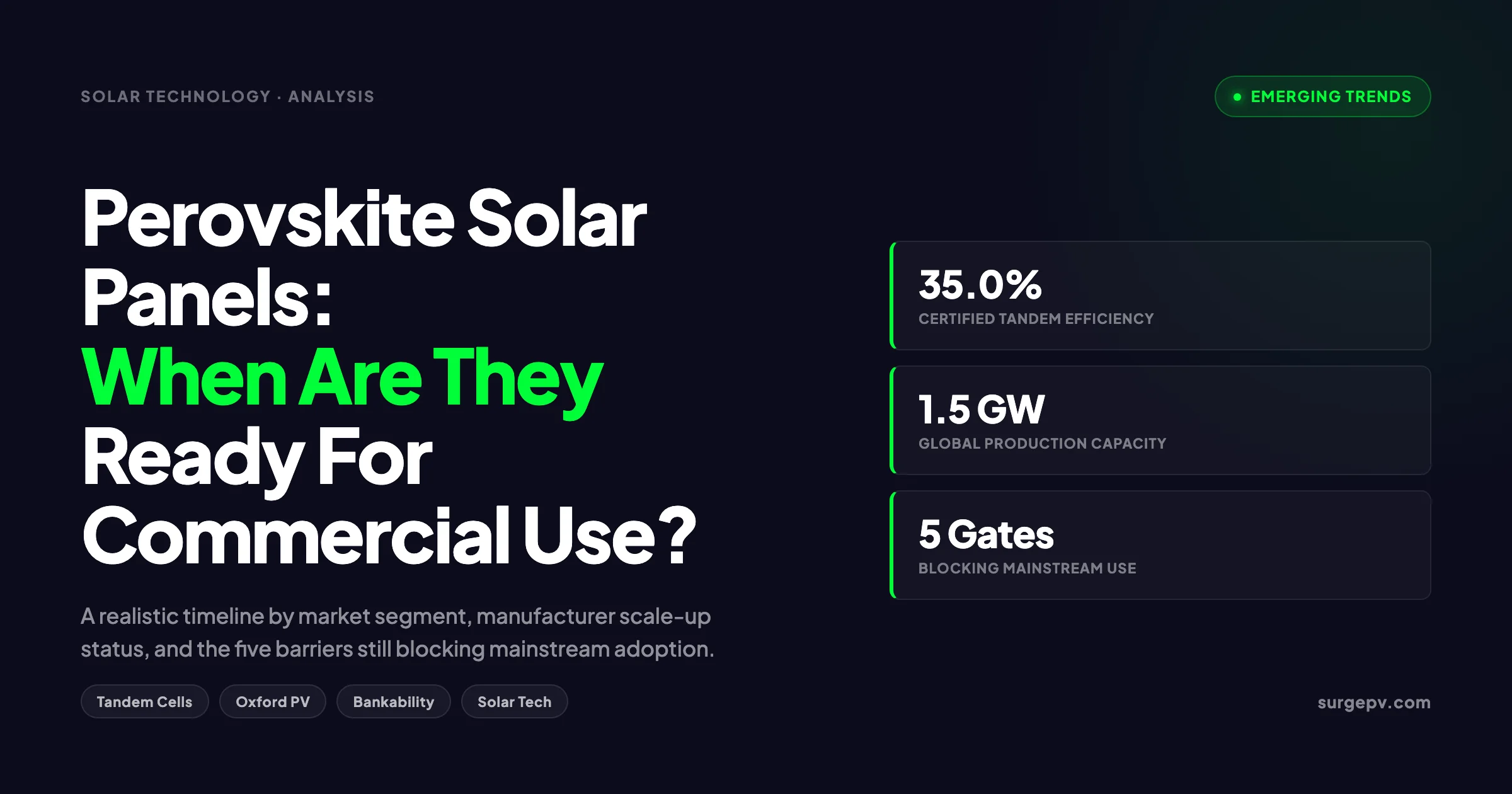
In February 2026, LONGi Green Energy and the National Renewable Energy Laboratory certified a perovskite-silicon tandem solar cell at 35.0% efficiency. That number broke a barrier the photovoltaic industry had treated as out of reach for two decades. The best commercial silicon module you can buy today converts 22 to 24% of incoming sunlight, so a 35% tandem represents a 50% jump in energy yield per square meter — enough to reshape the economics of every rooftop, every utility-scale project, and every grid-export-constrained installation in Europe. Also see: European Solar Incentives.
Perovskite solar cells have reached 33.9% efficiency in lab tandem configurations with silicon. However, commercial viability is delayed by stability challenges — perovskites degrade under heat, moisture, and UV exposure. First commercial perovskite-silicon tandems are expected in 2027–2028 at premium prices 20–40% above standard silicon.
Perovskite solar cells have reached 33.9% efficiency in lab tandem configurations with silicon. However, commercial viability is delayed by stability challenges — perovskites degrade under heat, moisture, and UV exposure. First commercial perovskite-silicon tandems are expected in 2027–2028 at premium prices 20–40% above standard silicon.
Yet if you walk into a solar distributor in Hamburg, Houston, or Hyderabad in 2026 and ask for perovskite panels, you will not find them on the shelf. The question this guide answers is not whether perovskite works — it does — but when perovskite solar panels will be ready for genuine commercial use across the segments that matter: utility-scale projects, commercial rooftops, and residential installations.
TL;DR — Perovskite Commercial Readiness in 2026
Utility-scale commercial deployment has begun: Oxford PV, UtmoLight, GCL, and Microquanta are shipping perovskite-silicon tandem panels at limited volumes. Mainstream commercial rooftop availability is realistic for 2027-2028. Residential availability with full 25-year warranties is a 2028-2030 story. The barriers are no longer efficiency — they are stability certification, manufacturing yield, and bankability.
What you will learn in this guide:
- What “commercial use” actually means for a solar panel and the specific certifications required
- Which perovskite manufacturers are shipping commercial products in 2026, with verified production capacity and project deployments
- The five remaining technical and commercial barriers blocking mainstream adoption
- A realistic timeline by market segment from 2026 through 2032
- Cost comparisons between commercial perovskite tandem and premium silicon panels today
- What solar installers, developers, and asset owners should do right now to prepare
This is a market analysis for professionals making real procurement decisions. If you are designing systems with PV design software today, you need to know whether to specify perovskite-ready inverters, plan for tandem-module string sizing, or treat perovskite as a 2030 problem.
What “Commercial Use” Actually Means for Solar Panels
The phrase “commercial use” gets thrown around loosely in perovskite reporting. A panel installed on a rooftop in 2024 as part of a marketing demonstration is not the same as a panel that a project finance lender will underwrite for a 20-year power purchase agreement. To answer the timeline question honestly, three definitions matter.
Three Tiers of Commercial Readiness
| Tier | Definition | Required Evidence | Current Perovskite Status |
|---|---|---|---|
| Tier 1 — Pilot deployment | Modules installed at small scale to gather field data | Manufacturer self-certification, limited warranty | Achieved (2021-2024) |
| Tier 2 — Commercial sale | Modules sold through distribution channels with standard warranties | IEC 61215 certification, 10-15 year warranty | Partially achieved (2024-2026) |
| Tier 3 — Bankable commercial | Modules accepted by project finance lenders for 20+ year PPAs | IEC 61215 + IEC 61730, 25-year linear power warranty, 5+ years field data, top-tier insurance | Not yet achieved |
Silicon panels passed Tier 3 around 2010 after decades of accumulated field data. Perovskite-silicon tandem modules have crossed Tier 1 and partially crossed Tier 2. The jump to Tier 3 — the threshold that matters for the gigawatts of solar deployed annually — requires data that physics cannot accelerate. You cannot run a 25-year accelerated test in 18 months and have lenders accept the result without question.
The Certifications That Gate Commercial Use
Two IEC standards govern whether a solar panel can be sold into commercial channels:
- IEC 61215 covers design qualification and type approval. It includes thermal cycling (-40°C to +85°C, 200 cycles), damp heat (85°C / 85% relative humidity for 1,000 hours), humidity-freeze cycling, mechanical load tests, and UV exposure. Most Chinese perovskite manufacturers now claim IEC 61215 compliance for their tandem products, though independent third-party verification remains uneven.
- IEC 61730 covers safety qualification, including fire resistance, electrical insulation, and bypass diode performance. This is largely a packaging and bill-of-materials test, and perovskite-silicon tandem modules pass it routinely because the encapsulation system is borrowed from mainstream silicon production.
The harder gate is the UL 3703 / IEC 63209 extended reliability suite that lenders increasingly demand for project finance. These tests run damp heat for 2,000-3,000 hours rather than the standard 1,000, add UV-thermal-humidity cycling, and require documented field performance correlation. Independent testing labs like RETC (Renewable Energy Test Center) and PVEL publish annual scorecards; as of early 2026, only a handful of perovskite tandem products have completed the full extended sequence.
Where Perovskite Stands Today: The 2026 Commercial Reality
Here is the verified state of commercial perovskite deployment as of May 2026, based on manufacturer disclosures, NREL chart updates, and reporting from pv-magazine and the U.S. Department of Energy Solar Energy Technologies Office.
Active Commercial Deployments
| Manufacturer | Country | Production Line Capacity | Module Efficiency | Warranty Offered | First Commercial Shipment |
|---|---|---|---|---|---|
| Oxford PV | Germany (Brandenburg) | 100 MW (scaling to 1 GW) | 24.5% (tandem, 72-cell) | 10-year product, 20-year power | September 2024 (US utility) |
| UtmoLight | China (Wuxi) | 1 GW (operational Feb 2025) | 22.4% (tandem module) | 25-year power output | Q2 2025 |
| Microquanta | China (Hangzhou) | 100 MW | 19.6% (single-junction module) | 10-year product | 2023 (8.6 MW solar farm) |
| GCL Perovskite | China (Kunshan) | 200 MW pilot | 26.0% (tandem cell, 23.5% module) | 12-year product | 2025 |
| Hanwha Qcells | South Korea | Pilot scale | 28.6% (M10 cell), ~24% module | Not commercial yet | Targeted late 2026 |
| Saule Technologies | Poland | Roll-to-roll, low volume | 11-13% (flexible BIPV) | 5-year product | 2021 |
Key observation: Total global perovskite production capacity in 2026 is approximately 1.5 GW. For perspective, global solar installations in 2025 exceeded 540 GW. Perovskite represents roughly 0.3% of available manufacturing capacity. Even if every operational line ran at 100% utilization, perovskite would supply less than half of one percent of new solar projects this year. For Global-specific compliance details, see Global net-metering-by-country.
What Is Actually Being Built Today
The first commercial perovskite-silicon tandem deployments fall into three buckets:
- Utility-scale demonstration projects — Oxford PV’s 2024 U.S. shipment supplied an unnamed utility-scale developer running a side-by-side performance comparison against TOPCon silicon. UtmoLight has supplied modules to projects in Hebei and Jiangsu provinces totaling roughly 40 MW.
- Building-integrated photovoltaics (BIPV) — Saule Technologies has installed flexible perovskite modules on commercial buildings in Warsaw, Tokyo, and several Japanese train stations. These are aesthetic and integration projects, not bulk-power projects.
- Specialty markets — Curved surfaces, indoor light harvesting, low-light off-grid applications, and aerospace are absorbing small perovskite volumes where silicon is poorly suited. Read more about Agricultural Solar Case Study.
What is conspicuously absent: a single mainstream residential rooftop project quoted to a homeowner with a perovskite panel and a standard 25-year warranty. That gap is the heart of the commercial-readiness question.
Recent Efficiency Records: 2026 Highlights
The lab-scale efficiency picture in 2026 looks dramatically different from the commercial picture. Key certified numbers from the NREL Best Research-Cell Efficiency Chart and recent peer-reviewed publications:
- 35.0% perovskite-silicon tandem (LONGi, Feb 2026) — the current world record for any two-junction PV technology
- 30.02% perovskite-silicon triple-junction — independently certified in March 2026, surpassing the previous 27.1% record
- 27.87% single-junction perovskite — claimed by Chinese startup SolaEon, certified by China’s National PV Industry Metrology and Testing Center in January 2026
- 28.6% perovskite-silicon tandem on M10-sized cells — Hanwha Qcells, December 2024, on full-area mass-production cell format
The 10-percentage-point gap between lab cells (35%) and shipping commercial modules (24-25%) is normal for any new photovoltaic technology. Silicon took 30 years to close a similar gap. Perovskite is closing it faster, but it is not closed yet.
The Five Barriers Still Blocking Mainstream Commercial Use
Efficiency is no longer the constraint. Five other constraints are. Each has a different timeline and a different probability of resolution.
Barrier 1: Long-Term Outdoor Stability
Perovskite materials are intrinsically sensitive to moisture, oxygen, ultraviolet light, and elevated temperatures — the four conditions a solar panel must survive for 25 years on a rooftop. The crystal structure that gives perovskite its remarkable optoelectronic properties also gives it ionic mobility, which causes hysteresis, halide segregation, and gradual decomposition under operational stress.
Recent progress is real. Hanwha Qcells reported 10 cm × 10 cm modules retaining 94% of initial efficiency after 1,000 hours at 65°C and 65% relative humidity in 2024. UtmoLight’s commercial product carries an internal accelerated test result equivalent to 25-year power output retention above 80%. The peer-reviewed literature (see Nature Photonics, 2025) documents perovskite-silicon tandem cells holding above 95% of initial efficiency through 2,000 hours of damp-heat testing.
But three problems remain unresolved at scale:
- UV degradation of the perovskite/transport-layer interface — current encapsulation strategies trade UV protection against transmission of high-energy photons that perovskite needs to convert
- Reverse bias resilience — partial shading drives perovskite cells into reverse bias more readily than silicon, accelerating degradation
- Field performance correlation — accelerated aging tests do not yet reliably predict 20-year outdoor behavior, because the degradation pathways differ from silicon
The bankability gate requires not just passing a 1,000-hour test but accumulating 3-5 years of correlated field data across multiple climates. That clock started in 2024. It cannot finish before 2027 at the earliest.
Barrier 2: Manufacturing Yield at Scale
Perovskite module manufacturing involves depositing a film roughly 500 nanometers thick uniformly across a 2-square-meter substrate, then encapsulating it before atmospheric moisture can cause damage. Solution-processing methods (slot-die coating, blade coating) achieve high throughput but struggle with defect density. Vapor-deposition methods give better uniformity but lower throughput and higher cost.
Industry-published yield numbers for perovskite-silicon tandem production lines in 2026 sit in the 70-85% range, compared to 96-98% for mature silicon lines. Each lost percentage point of yield adds roughly $0.01-0.02 per watt to module cost. UtmoLight has publicly stated that its 1 GW Wuxi line achieved 80% yield by mid-2025, with a target of 92% by end of 2026.
The implication: even with full capacity utilization, the cost of a perovskite-silicon tandem panel will not approach silicon parity until yields climb above 90% on multi-gigawatt lines. That is a 2027-2028 milestone, not a 2026 one.
Barrier 3: Bankability and Project Finance
Solar projects above roughly 1 MW are financed through power purchase agreements that monetize 20-25 years of generation. Lenders require:
- A bankable manufacturer (financial strength, track record, insurance backing)
- A 25-year linear power warranty (typically 87-92% retention at year 25)
- Independent reliability test results from PVEL, RETC, or equivalent
- Field performance data from prior installations of the specific module
- A clear path to warranty enforcement if the manufacturer fails
No perovskite manufacturer in 2026 satisfies all five criteria. Oxford PV is closest on testing but still small in financial scale. UtmoLight has the production scale but a limited Western track record. Chinese banks are financing domestic perovskite projects, but international project finance remains skeptical.
This is the single largest constraint on commercial deployment above small commercial rooftop scale. It will resolve gradually as field data accumulates, not through a single breakthrough.
Barrier 4: Lead Toxicity and Environmental Compliance
Methylammonium lead iodide and related perovskite formulations contain lead. The quantities are small — roughly 0.4 grams of lead per square meter of panel, compared to about 12 grams in a typical residential lead-acid battery — but solar panel end-of-life regulations in the EU (WEEE Directive), several U.S. states, and Japan are tightening.
Three responses are progressing in parallel:
- Lead containment strategies — encapsulation that prevents lead leaching even after panel breakage, validated by independent leaching tests
- Lead-tin perovskite formulations — partial lead replacement at modest efficiency cost, currently around 22% certified efficiency for tin-lead variants
- Closed-loop recycling protocols — manufacturer-funded take-back programs that recover lead-bearing perovskite layers separately from glass and silicon
The regulatory question is not whether perovskite can clear environmental compliance — it can — but whether the compliance overhead adds enough cost to erase the efficiency advantage in price-sensitive residential markets. Commercial and utility markets are less affected because the compliance cost is amortized over higher project values.
Barrier 5: Inverter and Balance-of-System Compatibility
Perovskite-silicon tandem modules have different electrical characteristics than mainstream silicon panels: higher open-circuit voltage per cell, different temperature coefficients, and different low-light response curves. Existing string inverters generally work with tandem modules, but optimal performance requires:
- Updated maximum power point tracking algorithms tuned for tandem voltage curves
- Wider input voltage ranges to accommodate the higher per-cell Voc
- Revised string sizing rules in solar design software and PV layout tools
Manufacturers like SMA, Huawei, Sungrow, and Fronius have begun publishing tandem-compatible inverter specifications, but the ecosystem is still maturing. For installers, this means tandem-module projects in 2026-2027 require deliberate design choices and careful equipment selection rather than drop-in substitution. Tools that handle PV shade analysis and string sizing need updated module databases that include tandem electrical parameters.
Manufacturing Scale-Up: Who Is Building Real Production Lines
The geography of perovskite manufacturing tells you more about the commercial timeline than any efficiency record. Six manufacturers matter for the next three years.
Oxford PV — The Western Reference
Oxford PV remains the most-watched perovskite company outside China. Its Brandenburg, Germany facility began commercial shipment in September 2024 with 24.5% efficient tandem modules in standard 72-cell format. The current production capacity is around 100 MW per year, with a publicly stated target to reach gigawatt-scale by 2027.
Oxford PV’s commercial strength is its testing pedigree. The company has run accelerated lifetime testing under multiple independent labs and has the most credible Western data set on perovskite-silicon tandem reliability. Its commercial weakness is scale — at 100 MW per year, Oxford PV produces less than a single Tier-1 silicon manufacturer makes in a week.
UtmoLight — The Chinese Scale Leader
UtmoLight’s 1 GW production line in Wuxi began operating in February 2025, making it the largest dedicated perovskite-silicon tandem facility in the world. The company offers a 25-year power output guarantee on its commercial product — the first in the industry — which suggests internal confidence in stability data even as third-party Western validation lags.
UtmoLight’s modules are reaching utility-scale projects in China at 22-23% module efficiency. The company has begun export-oriented sales conversations but has not yet established a meaningful presence in European or North American markets.
Microquanta — The Operational Track Record
Microquanta Semiconductor in Hangzhou holds the longest operational track record of any perovskite manufacturer. Its 100 MW line has been producing single-junction perovskite modules since 2021, and the company grid-connected the world’s largest dedicated perovskite solar farm at 8.6 MW in late 2024. Module efficiencies are lower than tandem competitors (around 19.6%), but field performance data is the longest available.
For asset owners and lenders looking for the longest paper trail of outdoor perovskite operation, Microquanta is the case study. Its single-junction approach makes it less competitive on efficiency but more straightforward to manufacture and certify.
GCL Perovskite — The Vertical Integrator
GCL is one of China’s largest polysilicon and silicon wafer manufacturers, and its perovskite division benefits from existing relationships with module assemblers, distributors, and project developers. GCL’s 200 MW pilot perovskite-silicon tandem line in Kunshan reached 23.5% module efficiency in 2025, and the company has signed offtake agreements for tandem modules with several large Chinese project developers.
GCL’s vertical integration advantage matters because it accelerates the path to bankability — a familiar manufacturer name carries more weight with project finance lenders than a perovskite-only startup.
Hanwha Qcells — The Late but Credible Entrant
Qcells (now part of Hanwha Solutions) has invested heavily in perovskite-silicon tandem R&D and holds the record for the highest certified efficiency on mass-production-format M10 cells (28.6%). Its commercial production timeline targets late 2026 or early 2027 for first deliveries, with full commercial scale-up through 2028.
Qcells brings two advantages no other manufacturer matches: an established global distribution network and a recognized residential brand. When Qcells starts shipping perovskite tandem modules at scale, that is the moment perovskite enters the residential mainstream.
Saule Technologies — The BIPV Specialist
Poland’s Saule Technologies has taken a different path: roll-to-roll printed flexible perovskite modules optimized for building-integrated applications. Efficiencies are lower (11-13% module), but the modules can be applied to curved surfaces, glass facades, and lightweight structures where conventional silicon is impractical.
Saule’s commercial timeline is already in motion for its niche. Building-integrated photovoltaics is a small market (under 2 GW globally per year) but a high-margin one, and perovskite’s advantages there will not be challenged by silicon.
Design tandem-ready solar systems with confidence
Whether you are planning a 2026 silicon project or preparing for the perovskite transition, SurgePV gives you the solar design platform tools to model module-level performance, run shadow analysis, and generate professional proposals in one workflow.
Book a DemoNo commitment required · 20 minutes · Live project walkthrough
Realistic Commercial Timeline by Market Segment
Perovskite will not enter every market at the same time. The economics, the certification requirements, and the bankability thresholds differ across utility-scale, commercial rooftop, and residential applications. Here is a realistic phasing for the next seven years.
Phase 1 — Already Underway (2024-2026)
Active markets: Utility-scale demonstration projects, BIPV, specialty applications
Oxford PV, UtmoLight, GCL, and Microquanta are shipping modules to specific projects under negotiated terms, often with extended testing protocols. Total perovskite deployment in 2025 was approximately 80-120 MW globally; 2026 is on track for 250-400 MW. These are real revenue but a vanishingly small share of the global solar market.
What this means for procurement: if you are a utility-scale developer interested in perovskite, you can buy commercial modules today, but you will negotiate every term — warranty, performance guarantee, replacement liability — directly with the manufacturer. There is no spot market.
Phase 2 — Commercial Rooftop Entry (2027-2028)
Active markets: Large commercial rooftops (>500 kW), industrial installations, government projects
By 2027, multiple manufacturers will have completed extended IEC reliability sequences and accumulated 3-4 years of field data from Phase 1 deployments. UtmoLight, Oxford PV, and GCL will have proven gigawatt-scale production. Project finance lenders will start accepting perovskite tandem modules from approved manufacturers under modified PPA terms (typically with shorter performance warranties — 15-20 years instead of 25).
Module pricing will narrow toward a 15-25% premium over premium silicon, justified by 20-30% higher energy yield per square meter — a clear win for space-constrained rooftops. Commercial installers should begin training on tandem-specific design considerations now to be ready for this transition.
Phase 3 — Residential Mainstream (2028-2030)
Active markets: Premium residential rooftops, EU rooftop mandate compliance, space-constrained urban installations
Residential adoption requires three things to align: bankable manufacturers with strong consumer brands (Hanwha Qcells, possibly Trina or Jinko if they enter the space), a 25-year linear power warranty backed by insurance, and a price point within 20% of premium silicon panels. All three should converge between 2028 and 2030 if current production scaling and stability progress continues.
The first residential perovskite tandem panels will be sold as premium-tier products in markets where roof space is a binding constraint — German EU rooftop mandate compliance, Japanese residential, dense European cities. Mass-market residential adoption follows as production scales and costs fall.
Phase 4 — Mainstream Utility-Scale (2029-2032)
Active markets: Mainstream utility-scale solar farms, agrivoltaics, floating solar See Agrivoltaics Design for detailed guidance.
By 2030, perovskite-silicon tandem modules should be the default specification for new utility-scale projects in markets where land is expensive or generation density matters. Tandem modules deliver 20-30% more energy per acre than silicon, which compresses interconnection queues, reduces racking and BOS costs per watt, and improves project economics in transmission-constrained regions.
This is the phase that reshapes global solar deployment. Utility-scale annual installations are roughly 350-400 GW per year globally; converting even half to tandem architecture would require 200+ GW of perovskite tandem production capacity by 2032. That is achievable based on currently announced expansions, but requires no major setbacks.
Phase 5 — All-Perovskite and Triple-Junction (2030+)
Active markets: Specialty high-efficiency applications, then mainstream
Beyond perovskite-silicon tandems, all-perovskite tandems (two perovskite layers, no silicon) and triple-junction perovskite-silicon cells offer theoretical efficiency ceilings above 40%. The 30.02% triple-junction record certified in March 2026 is a milestone, but commercial-scale triple-junction modules require manufacturing techniques that no production line currently uses.
This phase is the long tail of perovskite commercialization. It matters for the 2030s and beyond but should not influence procurement decisions in 2026.
Timeline Summary Table
| Year | Utility-Scale | Commercial Rooftop | Residential | Total Annual Perovskite Production |
|---|---|---|---|---|
| 2026 | Pilot deployments (limited) | Specialty/demo only | Not commercially available | ~400 MW |
| 2027 | Expanding (multiple manufacturers) | Early entry (large projects) | Pilot only | ~1.5 GW |
| 2028 | Mainstream-credible | Active commercial market | First premium products | ~5 GW |
| 2030 | Default for premium projects | Mainstream | Active residential market | ~25 GW |
| 2032 | Dominant in space-constrained markets | Standard offering | Mass market | ~80 GW |
These projections assume continued capital investment, no major reliability setback, and a stable trade environment for solar manufacturing equipment.
Cost and ROI: When Perovskite Beats Silicon on Levelized Cost
The cost question matters more than the efficiency question for actual procurement decisions. A 35% efficient panel that costs three times as much as a 24% silicon panel does not improve project economics. The relevant comparison is levelized cost of energy (LCOE), and the verdict depends on the application.
Module Cost Comparison — May 2026
| Module Type | Efficiency | Price ($/W) | Energy Yield (kWh/m²/yr at 1,500 sun-hours) | Cost per kWh of First-Year Generation |
|---|---|---|---|---|
| Standard PERC silicon (TOPCon) | 22.0% | $0.12 | 330 | $0.36 |
| Premium n-type silicon (HJT) | 23.5% | $0.15 | 353 | $0.42 |
| Perovskite-silicon tandem (Oxford PV / UtmoLight) | 24.5% | $0.20 | 368 | $0.54 |
| Future tandem (projected 2028) | 27.0% | $0.18 | 405 | $0.44 |
The current premium for perovskite tandem is roughly 33-67% over silicon, against an energy-yield advantage of 4-12%. On pure per-kWh cost, silicon still wins in 2026.
Where Perovskite Already Wins
Three project types where perovskite tandem economics make sense in 2026 even at current prices:
- Space-constrained rooftops — when roof area is the binding constraint and load demand exceeds what silicon can supply, the additional yield per square meter justifies the module premium. Use the solar yield and financial analysis to model this for specific projects.
- Grid-export-limited installations — in countries with hard zero-export caps (parts of Germany, Belgium, Australia), higher-efficiency modules let you maximize self-consumption from a fixed export envelope.
- High electricity price markets — where grid prices exceed €0.30/kWh, the premium for additional generation pays back faster than in low-price markets. For Australia-specific compliance details, see Australia comparisons/lgc-vs-stc.
For most utility-scale and commercial rooftop projects in 2026, mainstream silicon remains the rational choice. That balance shifts decisively in favor of tandem modules around 2028-2029 as production costs fall and warranties extend.
LCOE Crossover Projection
Independent analysis from the IEA World Energy Outlook 2025 and several investment bank research notes suggest perovskite-silicon tandem will reach LCOE parity with mainstream silicon for utility-scale projects between 2027 and 2029, depending on region. The crossover happens earlier in expensive markets (Japan, Germany) and later in cheap markets (India, Saudi Arabia). Also see: Best Solar Design Software India. For India-specific information, see 5kW Solar Panel Price in India.
By 2030, tandem modules should be cheaper than silicon on an LCOE basis in nearly every market with adequate solar resource — the combination of higher yield, similar BOS costs, and matched financing terms makes the math straightforward.
What Solar Installers and Developers Should Do Right Now
The transition from silicon to tandem will not happen overnight, but it will happen faster than the silicon-to-silicon technology shifts of the past decade. Here is the practical preparation for installers, developers, and asset owners working in 2026.
For Installers and EPCs
- Maintain silicon expertise as the baseline. Through 2027, 99% of installations will use silicon. Do not pivot away from silicon design and installation skills.
- Begin tandem-aware design. Update cloud solar design tool module databases to include tandem electrical characteristics. Train engineering staff on tandem string sizing, voltage range considerations, and inverter compatibility.
- Establish supplier relationships now. If your business model depends on premium installations, talk to Oxford PV, Qcells, and UtmoLight about pilot allocations for 2027-2028 deployments. Early access becomes a competitive differentiator.
- Educate customers honestly. Customers asking about perovskite in 2026 should hear “promising but not ready for residential” rather than either dismissal or oversell. Setting realistic expectations protects your reputation.
For Project Developers
- Run pilot tandem projects. A 1-5 MW perovskite tandem deployment in 2026-2027 generates field data, builds operational expertise, and positions your firm as an early mover. Several manufacturers actively seek pilot partners.
- Negotiate technology-neutral PPAs where possible. PPA structures that allow module substitution as technology improves protect against being locked into 2026 silicon when 2028 tandem is more economical.
- Plan for higher inverter densities. Tandem modules generate more energy per module slot, which means higher DC-AC ratios and potentially different inverter selection strategies.
For Asset Owners and Lenders
- Track the certification milestones. The bankability question turns on specific independent testing milestones from PVEL, RETC, and equivalent labs. Subscribe to their annual scorecards and follow which manufacturers complete the extended reliability sequences.
- Watch the warranty market. Insurance providers backing module performance warranties (Solar Insure, kWh Analytics, Munich Re) will signal commercial readiness through what they are willing to underwrite. The first 25-year insurance-backed tandem warranty is the moment perovskite becomes truly commercial.
- Avoid premature commitments. A 2026 PPA that locks in silicon-only modules for 25 years may look expensive by 2030. Build optionality into long-term commitments.
For Software and Tooling Providers
The PV industry’s design tools, simulation software, and proposal platforms need updated module libraries, refined string-sizing logic, and tandem-aware shading models. Vendors of solar proposal generation and design platforms that lead on tandem support will capture the early professional market. SurgePV’s roadmap includes tandem module support, updated electrical parameters, and revised energy yield modeling for 2026-2027 releases. For a direct comparison, see Arka 360 vs SurgePV.
How Perovskite Compares to Other Emerging Solar Technologies
Perovskite is not the only technology pursuing higher efficiency than mainstream silicon. Understanding the alternatives helps clarify why perovskite is winning the race to commercial adoption.
TOPCon and HJT: The Silicon Incumbents Pushing Higher
TOPCon (tunnel oxide passivated contact) and HJT (heterojunction) silicon technologies represent the silicon industry’s response to perovskite. TOPCon modules now ship at 22-23.5% efficiency in volume production. HJT pushes to 23.5-25% with bifacial gain on top. Both offer better temperature coefficients and lower degradation rates than legacy PERC silicon. See Bifacial Solar Panel Design Guide for detailed guidance.
The comparison matters because TOPCon and HJT are real, available, and bankable today. A solar developer choosing in 2026 between a 23.5% TOPCon module at $0.14 per watt and a 24.5% perovskite tandem at $0.20 per watt has a clear short-term answer: TOPCon. The perovskite case strengthens as efficiency climbs above 27% and prices fall below $0.16 per watt — a 2028 picture, not a 2026 one. For a deeper comparison, see our analysis of TOPCon versus HJT versus perovskite solar panels.
CIGS and CdTe Thin Film: The Other Tandem Candidates
Copper indium gallium selenide (CIGS) and cadmium telluride (CdTe) thin-film technologies have been commercial for two decades. First Solar’s CdTe modules reach 19-20% efficiency at production scale, with strong market share in U.S. utility-scale projects. CIGS has struggled to scale but offers good low-light performance.
Both technologies have been proposed as bottom cells for perovskite tandems, but practical development has favored perovskite-on-silicon because silicon manufacturing scale already exists. CIGS-perovskite tandems remain a research direction; commercial deployment is unlikely before 2030.
III-V Multi-Junction: The Aerospace Reference
III-V multi-junction cells (gallium arsenide and related semiconductors) reach efficiencies above 47% under concentrated sunlight, but cost per watt is roughly 100 times higher than silicon. They power satellites and specialty terrestrial concentrator systems. They will not enter mainstream rooftop or utility-scale solar at any reasonable timeline because the underlying epitaxial growth process is fundamentally expensive.
Perovskite occupies the technical sweet spot: significantly higher efficiency than silicon, but compatible with mass-production manufacturing and roughly comparable cost per watt at maturity.
Organic Photovoltaics and Quantum Dots: The Long-Term Possibilities
Organic PV cells have reached 19% efficiency in research and offer flexible, lightweight form factors. Quantum dot solar cells use solution-processed nanocrystals and have demonstrated efficiency above 18%. Both technologies are on roughly the same scientific maturity curve as perovskite was in 2010.
Neither is commercially relevant for the 2026-2030 window. They matter for the 2030s and the niche markets perovskite cannot easily address (extreme flexibility, transparency, building-integrated facade applications).
Case Studies: Three Real Perovskite Deployments
Abstract market analysis is less useful than concrete project data. Here are three commercial perovskite deployments with verified performance to date.
Case Study 1: Microquanta 8.6 MW Solar Farm (China)
Location: Quzhou, Zhejiang Province, China Commissioned: November 2024 Capacity: 8.6 MW DC Module type: Microquanta single-junction perovskite (~19% efficiency) Reported first-year performance ratio: 0.82
This is the world’s largest dedicated perovskite-only solar farm. After 18 months of operation through April 2026, the project reports performance retention above 96% of initial output, with no module failures attributed to perovskite degradation. The deployment is the most-cited reference for utility-scale perovskite reliability and is closely watched by Chinese government agencies and international PV reliability researchers.
The lesson: perovskite-only systems can operate at utility scale, but the lower efficiency relative to tandem or silicon means project economics work only with very low module costs and attractive land terms.
Case Study 2: Oxford PV / U.S. Utility Demonstration
Location: Undisclosed U.S. utility-scale site Commissioned: October 2024 Capacity: Limited (project specifics confidential) Module type: Oxford PV 72-cell tandem (24.5% efficiency) Performance comparison: side-by-side against TOPCon silicon
Oxford PV’s first U.S. commercial shipment went to a utility customer for direct performance benchmarking against premium silicon. While exact site data is confidential, Oxford PV’s 2025 reporting indicates the tandem array is generating roughly 22-24% more energy per square meter than the silicon comparison, consistent with module-level efficiency differences.
This is the project that matters for U.S. project finance acceptance. The data Oxford PV accumulates here will feed into PVEL and RETC reliability scorecards and shape the bankability conversation for 2027-2028 projects.
Case Study 3: Saule Technologies BIPV Installation (Japan)
Location: Multiple Japanese train station facades Commissioned: 2022-2024 (phased) Capacity: Various, totaling roughly 200 kW across installations Module type: Saule flexible perovskite (11-12% efficiency) Application: Building-integrated photovoltaics on curved facades
Saule’s Japanese deployment demonstrates perovskite’s value where silicon physically cannot be installed. The facades curve, the available area is limited, and aesthetics matter. Silicon could not have completed these projects at all. Perovskite efficiency is lower, but it is the only PV technology that fits the use case.
The lesson: BIPV is a niche but immediate market for perovskite, and the commercial timeline there is already in motion. If your business model includes architectural integration, flexible solar, or non-standard form factors, perovskite is available now.
Frequently Asked Questions
Are perovskite solar panels commercially available in 2026?
Limited commercial perovskite-silicon tandem panels are shipping to utility-scale projects in 2026, primarily from Oxford PV, UtmoLight, GCL, and Microquanta. Oxford PV delivered its first 24.5% efficient commercial tandem modules to a U.S. utility customer in September 2024, and UtmoLight launched a 1 GW production line in February 2025. However, perovskite panels are not stocked by mainstream residential distributors and carry no widely accepted 25-year warranty yet.
When will perovskite solar panels be available for residential installations?
Mainstream residential availability with full 25-year power warranties is realistically expected between 2028 and 2030. The bottleneck is not efficiency — tandem cells already exceed 35% in the lab — but completion of IEC 61215 accelerated lifetime testing and accumulation of three to five years of field performance data that satisfies project finance lenders and homeowner warranty providers.
Why are perovskite solar panels not commercially mainstream yet?
Four barriers remain: long-term outdoor stability under heat, humidity, and UV; manufacturing yield at gigawatt scale; bankability for project finance lenders who demand 25-year performance guarantees; and lead toxicity concerns that complicate end-of-life recycling. Silicon panels solved these problems over 40 years; perovskite has had roughly 15 years of serious commercial development.
How much do perovskite solar panels cost compared to silicon?
First-generation commercial perovskite-silicon tandem modules from Oxford PV and UtmoLight currently sell at a 30-50% premium over premium TOPCon silicon panels — roughly $0.18-0.25 per watt versus $0.12-0.15 for silicon as of early 2026. The premium is justified by 25-30% higher energy yield per square meter, which improves levelized cost of energy on space-constrained rooftops and utility projects.
Who are the leading perovskite solar panel manufacturers in 2026?
Oxford PV (UK/Germany), UtmoLight (China, 1 GW line), Microquanta Semiconductor (China, operating 100 MW line), GCL Perovskite (China), Hanwha Qcells (South Korea), Saule Technologies (Poland, flexible BIPV focus), and Swift Solar (USA) are the most advanced. Chinese manufacturers currently lead in installed production capacity, while Oxford PV and Qcells lead in module-scale efficiency for the Western market. Also see: Us Residential Solar Market Trends 2026. For the latest details on UK, see Battery Solar System Design UK.
What is the highest perovskite solar cell efficiency achieved so far?
The current certified record is 35.0% for a perovskite-silicon tandem cell, achieved by LONGi Green Energy and certified by NREL in February 2026. Single-junction perovskite cells hit 27.87% (SolaEon, January 2026). Triple-junction perovskite-silicon cells reached 30.02% in March 2026. These are laboratory cells; commercial module efficiencies trail by 6-10 percentage points.
Will perovskite solar panels replace silicon?
Not in the next decade. The dominant trajectory is hybrid: perovskite layers deposited on top of silicon wafers to form tandem cells, combining silicon’s proven 25-year durability with perovskite’s high-energy photon capture. Pure all-perovskite or perovskite-only commercial panels remain a longer-term possibility, but every credible commercial roadmap through 2032 is built on perovskite-silicon tandem architecture.
Signals to Watch in 2026 and 2027
A handful of specific events will tell you whether perovskite commercial readiness is on track or running behind schedule. Watching these signals is more useful than tracking efficiency records, which have become routine.
Manufacturing Milestones
- First gigawatt-year of perovskite tandem production — likely UtmoLight in 2026. Until a manufacturer actually produces 1 GW in a calendar year at commercial yields, gigawatt-scale tandem is a claim, not a fact.
- First Western gigawatt-scale tandem line — Oxford PV, Qcells, or a U.S. entrant under the Inflation Reduction Act. The geographic distribution of perovskite manufacturing matters for trade policy and national supply chain security.
- First module priced below $0.15 per watt — the price point at which tandem economics broadly compete with premium silicon. Probably late 2027 based on cost-down trajectories.
Reliability and Certification Milestones
- First independent IEC 63209 extended reliability completion — the harder version of damp-heat testing that lenders are starting to require. Multiple manufacturers should clear this in 2026-2027.
- First PVEL Top Performer designation for a perovskite tandem product — PVEL’s annual scorecards are the leading independent reliability signal. The first perovskite product to earn the designation will trigger a wave of project finance acceptance.
- First insurance-backed 25-year power warranty for a perovskite tandem panel — when a major insurer (Munich Re, Swiss Re, Solar Insure) underwrites a 25-year tandem warranty, residential commercial readiness has effectively arrived.
Project Finance Milestones
- First non-recourse PPA financed for a 100+ MW perovskite tandem project — separates demonstration deployments from genuine commercial markets.
- First international project finance deal with perovskite modules — currently most perovskite financing is domestic Chinese. International cross-border financing signals broader bankability.
- First Tier-1 module manufacturer designation for a perovskite producer — Bloomberg’s Tier-1 list is the most-cited bankability proxy for module manufacturers. UtmoLight, Oxford PV, and Qcells are the candidates most likely to earn it first.
Policy and Regulatory Milestones
- EU Net-Zero Industry Act qualifications — perovskite-silicon tandems should qualify as strategic clean technologies under the EU framework, with corresponding manufacturing incentives.
- U.S. Inflation Reduction Act domestic content treatment — clear rules on whether perovskite-silicon tandems with imported silicon and domestic perovskite layers qualify for IRA bonuses will shape U.S. manufacturing investment.
- First country to mandate or strongly incentivize tandem modules for new residential installations — likely Germany or the Netherlands as part of EU rooftop mandate compliance pathways.
These signals are concrete, datable, and observable. Tracking them gives a much sharper picture of perovskite commercial readiness than headlines about new lab efficiency records.
Conclusion: What to Do With This Information
The honest summary for solar professionals making decisions in 2026:
- Treat perovskite as a 2027-2028 commercial reality for utility and large commercial projects, and a 2028-2030 reality for residential. Plan procurement, design tools, and customer education accordingly.
- Specify silicon for almost everything you build today, but keep tandem-ready inverters and design flexibility in long-term projects. The cost of optionality is small; the cost of being locked into obsolete technology is large.
- Build relationships with perovskite manufacturers now if your business depends on premium positioning. The installers, developers, and asset owners who deploy the first 100 MW of commercial tandem will own the credibility and operational know-how that defines the 2030 market.
For deeper context on related solar technology shifts, see our analysis of TOPCon, HJT, and perovskite solar panel comparison, the broader perovskite solar cells efficiency and timeline guide, and the future of solar energy analysis. To plan and price systems with current and emerging module technology, the SurgePV solar software platform platform supports module-level energy modeling, solar shadow analysis software, and end-to-end proposal generation in a single workflow.
Where this fits
This article is part of SurgePV's Solar Technology hub, which works through the topic from first principles to the decisions a project team actually has to make.
