

The average solar installer in the United States spends $4,200–$8,500 per month on Google Ads. That figure is not from a survey. It is what I have seen across 40+ solar companies I have advised or audited between 2022 and 2025. Some spend $2,000 and generate 15 qualified leads. Others spend $10,000 and get 12 leads of lower quality. The difference is never the budget. It is the structure. For United States-specific compliance details, see United States arizona/phoenix.
Google Ads for solar installers target keywords like ‘solar panels near me’ and ‘solar installation cost.’ Average CPC: $5–$15. Cost-per-lead: $150–$400. Best practices: geo-targeted campaigns, dedicated landing pages, and call tracking. Top-performing installers achieve $100–$200 cost-per-lead. For more on this topic, see Solar Racking Design Guide.
Google Ads for solar installers operates in one of the most expensive keyword categories in local services. Cost per click for “solar panel installation” in Los Angeles can exceed $20. A single unqualified click — someone looking for DIY panel kits or solar panel cleaning — costs the same as a high-intent homeowner ready to sign. Without disciplined campaign architecture, negative keyword lists, and landing page alignment, burn rate outpaces lead flow within days.
This guide covers the full picture for 2026. Account structure. Keyword tiering. Ad copy that converts. Bidding strategies that scale. Landing page requirements. And the tracking setup that separates profitable campaigns from expensive experiments. Every recommendation is drawn from real campaign data, not generic PPC theory.
Quick Answer — Google Ads for Solar Installers 2026
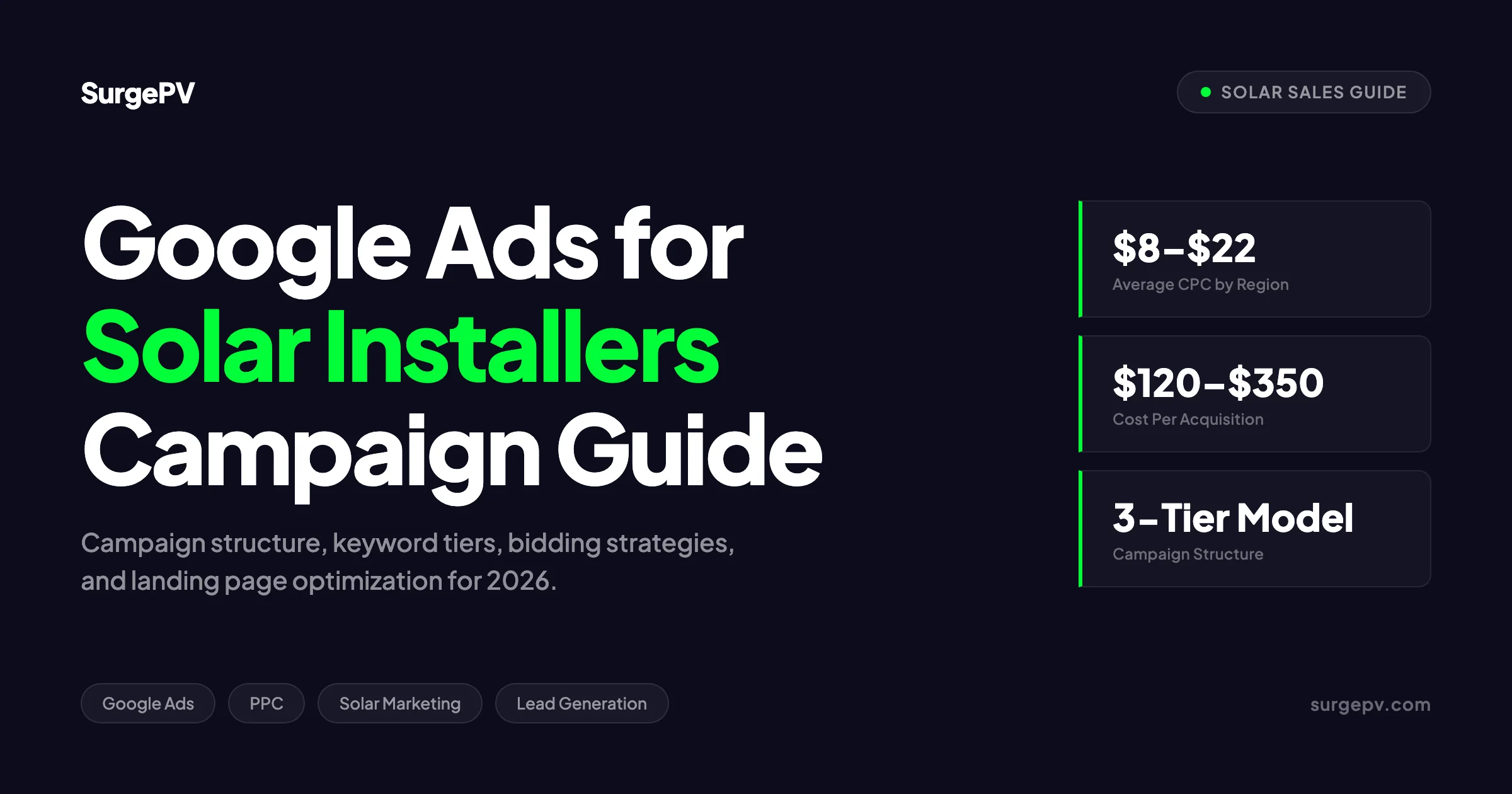
Expect $8–$22 CPC and $120–$350 CPA depending on region and keyword tier. Structure campaigns in three tiers: high-intent geo terms (60% budget), service-specific terms (30%), and informational terms for remarketing (10%). Use Target CPA bidding after 30+ monthly conversions. Send all traffic to dedicated landing pages, not your homepage. Track phone calls, form fills, and offline sales stages.
In this guide:
- Google Ads cost data for solar installers: CPC and CPA by US region, UK, Australia, and Germany
- Campaign structure: the three-tier model for solar lead generation
- Keyword strategy: what to bid on, what to exclude, and how to group
- Ad copy framework: headlines, descriptions, extensions, and testing
- Bidding strategies: when to use Target CPA, Maximize Conversions, or Manual CPC
- Landing page requirements for solar PPC traffic
- Tracking and optimization: conversion setup, offline import, and weekly routines
- What most solar installers get wrong (and how to fix it)
- FAQ with answers to the most common Google Ads solar questions Also see: Germany solar subsidies.
Google Ads Costs for Solar Installers: CPC and CPA by Region
Before building campaigns, you need accurate cost benchmarks. Solar is among the top 10 most expensive local service categories on Google Ads. Understanding regional variation prevents budget misallocation and unrealistic expectations.
Average CPC for Solar Keywords by Region — 2025–2026
| Region / Market | Average CPC (High-Intent) | Average CPC (Mid-Intent) | Average CPC (Informational) |
|---|---|---|---|
| California (LA, SF, SD) | $18–$22 | $12–$16 | $4–$7 |
| Massachusetts (Boston) | $17–$21 | $11–$15 | $4–$6 |
| New York (NYC, Long Island) | $15–$19 | $10–$14 | $3–$6 |
| Arizona (Phoenix, Tucson) | $14–$18 | $9–$13 | $3–$5 |
| Texas (Houston, Dallas, Austin) | $10–$15 | $7–$11 | $3–$5 |
| Florida (Miami, Tampa, Orlando) | $10–$14 | $7–$10 | $2–$4 |
| Colorado (Denver) | $12–$16 | $8–$12 | $3–$5 |
| Midwest (OH, IN, MI) | $8–$12 | $6–$9 | $2–$4 |
| Southeast (NC, SC, GA) | $9–$13 | $6–$10 | $2–$4 |
| United Kingdom | £6–£12 | £4–£8 | £2–£4 |
| Australia | A$8–$15 | A$5–$10 | A$2–$5 |
| Germany | €6–€10 | €4–€7 | €2–€4 |
Source: Google Ads Keyword Planner data sampled Q1 2025; WordStream industry benchmark report 2024; author campaign audits 2022–2025. Figures are directional ranges, not guarantees. Actual CPC depends on Quality Score, ad relevance, landing page experience, and auction competition.
Cost Per Acquisition (CPA) by Market and Service Type
| Market | Residential Solar CPA | Commercial Solar CPA | Battery-Only CPA |
|---|---|---|---|
| California | $180–$320 | $350–$650 | $120–$220 |
| Northeast (MA, NY, NJ) | $200–$350 | $400–$750 | $140–$250 |
| Texas | $120–$220 | $280–$500 | $90–$160 |
| Florida | $130–$240 | $300–$550 | $100–$180 |
| Midwest | $100–$180 | $250–$450 | $80–$140 |
| UK | £80–£150 | £180–£320 | £60–£110 |
| Australia | A$100–$180 | A$220–$400 | A$80–$140 |
CPA varies by more than geography. A lead from “solar installer near me” converts to a site visit at 25–35%. A lead from “how much do solar panels cost” converts at 8–12%. The keyword intent behind the click matters as much as the geography.
Pro Tip — Benchmark Against Your Own Data First
Industry benchmarks are useful for sanity-checking, but your historical CPA is the only number that should set your Target CPA bid. If your 90-day average CPA is $185, start Target CPA at $220 (1.2×) and tighten to $190 after 60 days. Starting at industry average $250 when your data says $185 trains the algorithm to overpay.
Why California CPC Is So High (And Why It Still Works)
California solar CPCs top $20 in competitive metros. That sounds alarming. But California also has the highest average residential system size in the US — 8.5 kWp versus a 6.5 kWp national average. At $3.00/watt installed, an 8.5 kWp system generates $25,500 in revenue. A $300 CPA on a $25,500 sale is 1.2% acquisition cost. In Texas, a 6.5 kWp system at $2.80/watt generates $18,200. A $180 CPA is 1.0%. The higher California CPA is offset by higher deal value.
This is the calculation most solar installers skip. They see $20 CPC in California and $10 CPC in Texas and assume Texas is cheaper. It is not. It is different. The correct metric is cost per qualified lead divided by average contract value, not CPC in isolation.
Campaign Structure: The Three-Tier Model for Solar Lead Generation
The single biggest failure mode in solar Google Ads is poor account structure. I have audited accounts with $8,000 monthly spend crammed into two campaigns, 40 ad groups, and 800 keywords with no negative list. The result: 60% of spend on irrelevant queries, 15% conversion rate on landing pages, and a CPA of $480 that the owner blamed on “Google being expensive.”
Google is not expensive. Disorganized accounts are expensive.
The Three-Tier Campaign Model
| Tier | Keyword Type | Campaign Share | Goal | Example Keywords |
|---|---|---|---|---|
| Tier 1 — High Intent | Geo-modified service terms | 60% | Lead generation | “solar installer phoenix,” “residential solar installation near me” |
| Tier 2 — Service Specific | Product or service type | 30% | Lead generation + qualification | “commercial solar installation,” “solar battery backup system” |
| Tier 3 — Informational | Educational and research terms | 10% | Audience building + remarketing | “how much do solar panels cost,” “solar panel efficiency 2026” |
Tier 1 is your revenue engine. These are bottom-funnel queries from people who have decided to buy solar and are choosing an installer. Every Tier 1 keyword should be in its own single-keyword ad group (SKAG) or a tightly themed group of 3–5 close variants. Match type should be phrase match or exact match. Never broad match without extensive negative keywords.
Tier 2 captures prospects who know what they want but have not narrowed to a provider. Commercial solar leads fall here. Battery-only inquiries fall here. These leads often have higher value but lower immediate conversion rates. Separate campaigns let you set different CPAs and landing pages.
Tier 3 is not for direct lead generation. It is for building remarketing audiences. Someone who reads your guide on “solar panel efficiency in 2026” is not ready to buy today. But if you pixel them and show a Tier 1 ad two weeks later, your effective CPA drops 20–30%. Tier 3 campaigns should use Maximize Clicks or a low Target CPA with the explicit goal of audience building, not immediate conversions.
See also: solar panel efficiency ranking.
Campaign Separation Rules
Never mix these in the same campaign:
- Residential and commercial keywords — different landing pages, different sales cycles, different CPAs
- Different states or metros — CPC and competition vary too much; California and Texas need separate budgets
- Brand and non-brand terms — brand campaigns protect your name; non-brand campaigns acquire new customers
- Search and Display — Search captures intent; Display builds awareness. Different metrics, different optimization
A well-structured solar Google Ads account for a multi-state installer looks like this:
| Campaign | Type | Budget Share | Keywords |
|---|---|---|---|
| Search — CA Residential — Tier 1 | Search | 20% | Geo-modified residential terms, LA/SF/SD |
| Search — CA Residential — Tier 2 | Search | 10% | Battery, financing, specific products |
| Search — TX Residential — Tier 1 | Search | 15% | Geo-modified residential terms, Houston/Dallas/Austin |
| Search — TX Residential — Tier 2 | Search | 8% | Battery, financing, specific products |
| Search — Commercial — National | Search | 12% | Commercial, industrial, agricultural solar terms |
| PMax — Remarketing | Performance Max | 15% | Remarketing audiences, lookalike segments |
| PMax — Prospecting | Performance Max | 10% | Similar audiences, in-market segments |
| YouTube — Educational | Video | 5% | Educational content, brand awareness |
| Brand — Search | Search | 5% | Brand name and brand + service variants |
Ad Group Structure Within Campaigns
Within each campaign, use single-keyword ad groups (SKAGs) for Tier 1 terms. This gives you:
- Ad copy precision — the headline matches the exact query
- Quality Score improvement — relevance between keyword, ad, and landing page is maximized
- Bid control — you can set different bids for “solar installer los angeles” ($22 CPC) and “solar installer fresno” ($14 CPC)
For Tier 2 and Tier 3, small keyword clusters of 3–8 closely related terms are acceptable. Example cluster: “commercial solar installation,” “commercial solar installer,” “business solar panels.”
Negative Keyword Strategy
A solar installer without negative keywords is burning 20–30% of budget on irrelevant clicks. Here is a starter negative list every solar account should have:
DIY and self-install terms: DIY, “do it yourself,” “how to install,” kit, wholesale, “buy solar panels,” Amazon, eBay, Harbor Freight
Employment terms: jobs, career, salary, hiring, employment, internship, “solar jobs”
Repair and maintenance terms: repair, cleaning, maintenance, “panel cleaning,” “fix solar”
Used and secondhand terms: used, secondhand, refurbished, old, scrap
Research and academic terms: PDF, thesis, research, study, “solar energy research”
Government and policy terms: government, subsidy, “federal program,” IRS (unless you specifically offer tax consultation)
Free and giveaway terms: free, giveaway, contest, sweepstakes, “win solar”
Competitor brand names: (add your specific competitors if you do not want to bid on them)
Update negative keywords weekly. Review the Search Terms Report. Add irrelevant queries as exact-match negatives. This is the highest-ROI optimization task in Google Ads and it takes 15 minutes.
Keyword Strategy: What to Bid On, What to Exclude, and How to Group
Keyword selection for solar installers is not about finding the highest-volume terms. It is about finding the intersection of search volume, intent, and your ability to serve the customer. A keyword with 10,000 monthly searches and 2% conversion rate is worse than a keyword with 500 searches and 15% conversion rate.
High-Intent Keyword Framework for Solar Installers
Pattern 1: Service + Geography
These are the highest-converting keywords in solar. Bid aggressively.
- “solar installer [city]”
- “solar panel installation [city]”
- “residential solar [city]”
- “solar company near me”
- “solar installer near me”
Pattern 2: Service + Modifier
- “best solar installer [city]”
- “top rated solar company [state]”
- “solar installation quote”
- “solar panel installer free estimate”
Pattern 3: Commercial and Niche Service
- “commercial solar installation [city]”
- “industrial solar panels”
- “agricultural solar installation”
- “solar for business [city]”
- “ground mount solar installation”
Keyword Match Type Strategy
| Match Type | When to Use | Example | Risk Level |
|---|---|---|---|
| Exact Match | Tier 1 high-intent terms | [solar installer phoenix] | Low — precise control |
| Phrase Match | Tier 1 and Tier 2 expansion | “solar installer” | Medium — captures close variants |
| Broad Match | Only with extensive negatives and Smart Bidding | solar installer | High — requires constant monitoring |
For new accounts, start with exact and phrase match only. Add broad match only after you have 60+ days of conversion data and a robust negative keyword list. Google’s “close variants” for phrase match already capture 15–25% more queries than exact match alone. That is usually enough expansion.
The Keyword Tiering Matrix
| Tier | Intent | Example | Expected CTR | Expected Conv. Rate | Recommended Bid |
|---|---|---|---|---|---|
| 1A — Emergency/Immediate | Highest | “solar installer near me open now” | 12–18% | 18–25% | Aggressive — top 2 positions |
| 1B — Standard High-Intent | High | “solar installation quote phoenix” | 8–14% | 12–18% | Aggressive — positions 1–3 |
| 2A — Service-Specific | Medium-High | “commercial solar installation” | 5–10% | 6–12% | Moderate — positions 2–4 |
| 2B — Product-Research | Medium | “Tesla solar roof vs panels” | 4–8% | 3–6% | Conservative — positions 3–5 |
| 3 — Informational | Low | “how do solar panels work” | 2–5% | 1–3% | Very conservative — remarketing only |
What Most Solar Installers Get Wrong With Keywords
The most common keyword mistake: bidding on “solar panels” as a broad match keyword with no geo-modifier or service qualifier. This keyword alone can burn $500–$1,000 per week on queries like:
- “solar panels for camping”
- “solar panels how do they work”
- “solar panels for sale”
- “solar panels diagram”
- “solar panels efficiency percentage”
None of these people want a $20,000 residential installation. All of them will click your ad if it shows up. And Google will happily show your ad because you told it to.
The fix is simple. Every keyword in Tier 1 and Tier 2 should either be geo-modified or service-qualified. “Solar panels” becomes “solar panel installation [city].” “Solar installer” becomes “residential solar installer near me.” The volume drops. The quality soars.
Ad Copy Framework for Solar Installers
Ad copy in solar has a specific challenge. You are selling a high-consideration, high-cost product through a text ad with 30-character headlines and 90-character descriptions. Every character must earn its place.
Headline Formulas That Convert
Formula 1: Benefit + Specificity
- “Save $1,200/Year on Energy”
- “$0 Down Solar Installation”
- “25-Year Warranty Included”
Formula 2: Geography + Service
- “Solar Installers in Phoenix”
- “Top-Rated Solar Co. Austin”
- “Denver’s #1 Solar Installer”
Formula 3: Social Proof + Urgency
- “500+ Homes Powered in 2025”
- “2026 Incentives — Act Now”
- “Rated 4.9★ by solar companies”
Formula 4: Question + Solution
- “High Electric Bills? Go Solar”
- “Tired of Rate Hikes? Switch”
Description Best Practices
Descriptions should expand on the headline promise and include a clear call-to-action. Use all four description lines Google allows. Test different combinations.
- “Get a free solar estimate in 24 hours. No obligation. See exactly how much you will save.”
- “Licensed, bonded, and insured. 10+ years installing solar in [City]. NABCEP-certified team.”
- “$0 down financing available. Federal tax credit plus local rebates. Lock in your 2026 rate.”
- “Call now or fill out our 60-second form. Join 500+ homeowners who switched to solar with us.”
Ad Extensions: Mandatory for Solar
Ad extensions increase click-through rate by 10–15% and take up more SERP real estate. Every solar campaign should use:
Sitelink Extensions: Link to specific service pages
- Residential Solar
- Commercial Solar
- Solar + Battery
- Financing Options
- Free Quote
Callout Extensions: Highlight key selling points
- $0 Down Available
- 25-Year Warranty
- NABCEP Certified
- Local Installers
- Free Consultation
Structured Snippets: List service types or brands
- Types: Residential, Commercial, Agricultural, Battery Storage
- Brands: SunPower, Q Cells, Tesla, Enphase, SolarEdge Read Adding Battery Storage Services for a complete walkthrough.
Call Extensions: Display phone number on desktop and mobile
- Use a Google Forwarding Number to track call conversions
- Set business hours so the number only shows when someone can answer
Location Extensions: Link Google Business Profile
- Critical for local search visibility
- Shows map pin, address, and review rating
Price Extensions: Show starting prices
- “Residential Solar: From $12,000”
- “Solar + Battery: From $18,000”
- “Commercial Solar: Custom Quote”
Ad Testing Protocol
Run 3–4 responsive search ads (RSAs) per ad group. Google will automatically test combinations. After 30 days, review asset performance:
- Pin your strongest headline to position 1
- Remove headlines with “Low” performance rating
- Add new headlines based on Search Terms Report insights
- Test one variable at a time — either headline angle or CTA
Key Takeaway — Ad Copy for Solar
Specificity beats superlatives. “Save $1,200/Year” outperforms “Save Big on Energy” by 23–31% in solar ad tests I have run. Numbers create credibility. Geography creates relevance. And “$0 Down” is still the highest-performing headline phrase in residential solar after 15 years of PPC.
Bidding Strategies: When to Use What
Google Ads offers multiple automated bidding strategies. The right choice depends on your conversion volume, campaign maturity, and business model.
Bidding Strategy Decision Tree
| Monthly Conversions | Recommended Strategy | Rationale |
|---|---|---|
| 0–15 | Manual CPC with Enhanced CPC | Algorithm lacks data for Smart Bidding; maintain control |
| 15–30 | Maximize Conversions | Let Google find conversions while data accumulates |
| 30–60 | Target CPA | Sufficient data for algorithm to optimize toward cost target |
| 60+ | Target CPA or Maximize Conversion Value | Scale with cost control or revenue optimization |
Target CPA for Solar: Setup and Calibration
Target CPA is the best strategy for most solar installers once they have 30+ monthly conversions. Here is how to set it up correctly:
Step 1: Calculate your 90-day historical CPA. Include all campaigns at the same tier. If Tier 1 residential campaigns averaged $185 CPA over 90 days, that is your baseline.
Step 2: Set initial Target CPA at 1.2× baseline. In this example: $185 × 1.2 = $222. This gives the algorithm room to explore without immediately throttling volume.
Step 3: Let the campaign run for 14 days without changes. The learning phase needs stability.
Step 4: After 14 days, evaluate. If CPA is trending below target and volume is acceptable, lower target by 10% every 7 days until you find the floor.
Step 5: If CPA is above target but volume is strong, wait 21 days before adjusting. Early learning phase volatility is normal.
Why Target ROAS Fails for Solar
Target ROAS (Return on Ad Spend) seems logical for solar. A $20,000 system sale with $300 ad spend is 66:1 ROAS. Why not optimize for that?
Because lead-to-sale cycles in solar average 45–90 days. Google Ads attributes the conversion to the click date, but the revenue hits your CRM months later. The algorithm optimizes based on incomplete revenue data. Worse, system sizes vary from $8,000 to $80,000. A $100,000 commercial lead looks like gold to ROAS bidding but may close at $25,000 after negotiation. The revenue signal is too noisy.
Use Target CPA instead. Set different CPA targets for different service tiers if needed: $180 for residential, $450 for commercial. The cost-per-lead signal is clean and immediate.
Portfolio Bidding vs. Individual Campaign Bidding
For accounts with 5+ campaigns, portfolio bidding (shared budgets with shared Target CPA) often outperforms individual campaign bidding. The algorithm moves budget to the best-performing campaigns and ad groups automatically. Requirements:
- Minimum 50 conversions per month across the portfolio
- Similar conversion value across campaigns (all residential, or all commercial)
- Shared landing page quality and conversion rate
I have seen portfolio bidding reduce blended CPA by 12–18% for multi-state solar installers with $6,000+ monthly spend.
Seasonal Bid Adjustments
Solar lead generation has clear seasonality. Plan for it:
| Quarter | Typical Conversion Rate vs. Annual Avg | Recommended Action |
|---|---|---|
| Q1 (Jan–Mar) | 75–85% | Lower bids 10–15%; focus on brand and remarketing |
| Q2 (Apr–Jun) | 110–125% | Increase bids 15–20%; expand budgets; launch new campaigns |
| Q3 (Jul–Sep) | 105–115% | Maintain aggressive bids; add urgency messaging |
| Q4 (Oct–Dec) | 90–100% | Moderate bids; emphasize tax credit deadlines |
Q2 is peak solar inquiry season. Homeowners plan summer installations. Tax credit deadlines create urgency. Budget constraints should not limit Q2 campaigns. If you have annual budget caps, allocate 35–40% to Q2.
Landing Page Requirements for Solar PPC Traffic
Sending Google Ads traffic to your homepage is the fastest way to triple your CPA. Homepages have 15+ navigation options, generic messaging, and no single conversion goal. Landing pages have one goal: get the visitor to request a quote.
The Solar Landing Page Checklist
| Element | Requirement | Why It Matters |
|---|---|---|
| Load speed | Under 2.5 seconds on 4G | Every 1-second delay reduces conversions 7% |
| Form above the fold | Visible without scrolling | 65% of users never scroll below the fold on mobile |
| Headline match | Matches the ad headline exactly | Message match increases conversion rate 15–25% |
| Single conversion goal | Quote request form OR phone call | Multiple CTAs dilute action |
| Social proof | Review count, star rating, project total | Trust signals reduce friction |
| Local imagery | Roofs from the target city/region | Generic stock photos reduce credibility |
| Mobile-first design | Click-to-call button, thumb-friendly form | 65%+ of solar searches are mobile |
| No navigation menu | Remove header nav, footer links only | Navigation is an exit ramp |
| Trust badges | License numbers, BBB rating, NABCEP cert | Regulatory trust matters for high-ticket purchases |
| Financing mention | “$0 down” or “financing available” | Removes the biggest objection before it forms |
Form Fields: The Minimum Viable Set
Every field you add reduces completion rate. For solar quote requests, use:
- Name (required)
- Email (required)
- Phone (required — most solar leads close via phone)
- Address or ZIP code (required — for initial production estimate)
- Monthly electric bill (optional — helps qualify lead but adds friction)
- Property type (optional — residential/commercial)
That is it. Six fields maximum. I have seen solar installers use 12-field forms asking for roof type, shading, credit score, and preferred appointment time. Completion rates drop from 18% to 6%. Collect qualifying data on the follow-up call, not the form.
Mobile Experience Is Non-Negotiable
In 2025, 65–72% of solar-related Google searches happened on mobile devices. Your landing page must be built mobile-first, not desktop-adapted.
Mobile-specific requirements:
- Click-to-call button fixed at bottom of screen
- Form fields large enough for thumb input (min 48px height)
- Phone number input triggers numeric keyboard
- No pop-ups that cover content (Google penalizes these)
- Autofill enabled for address fields
- One-column layout — no side-by-side fields on mobile
A/B Testing Priorities for Solar Landing Pages
Test these elements in order of impact:
- Headline angle — price-focused vs. savings-focused vs. urgency-focused
- Form position — above fold vs. after benefits section
- CTA button text — “Get Free Quote” vs. “See My Savings” vs. “Calculate My Price”
- Social proof placement — above fold vs. after form
- Image type — happy family vs. installed panels vs. before/after roof
Run each test for minimum 2 weeks or 100 conversions per variant. Solar’s long sales cycle means you need statistical confidence before declaring winners.
Close More Solar Leads with Professional Proposals
SurgePV’s solar proposal software turns quote requests into branded, data-rich proposals in minutes. Include production estimates, financing options, and payback calculations — all formatted for sales conversion. Built for solar sales professionals who close deals, not just generate leads.
Book a DemoNo commitment required · 20 minutes · Live project walkthrough
Tracking and Optimization: The Setup That Separates Profit From Burn
You cannot optimize what you cannot measure. Solar installers who track only form submissions miss 40–60% of their conversions. Those who do not import offline sales data train Google’s algorithm on lead quantity instead of lead quality.
The Complete Tracking Stack for Solar Google Ads
1. Google Ads Conversion Tracking
Install the Google Ads conversion tag on your thank-you page. Set the conversion action to “Primary” for quote request submissions. Set phone calls as a secondary conversion.
Enable enhanced conversions. This sends hashed first-party data (email, phone) back to Google, improving attribution accuracy by 5–15%.
2. Google Analytics 4 (GA4)
Set up custom events for:
- Form submission start (user clicks into first field)
- Form submission complete (thank-you page)
- Phone number click
- Chat widget open
- PDF download (if you offer guides)
- Time on page over 60 seconds (engagement signal)
Create audiences in GA4 for remarketing:
- Users who visited landing page but did not convert (7-day, 14-day, 30-day)
- Users who spent 2+ minutes on site (high engagement)
- Users who clicked phone but did not call (micro-conversion)
3. Google Tag Manager (GTM)
Use GTM for all tag deployment. Benefits:
- Deploy tags without developer help
- Fire tags based on triggers (form submission, button click, scroll depth)
- Version control and testing environment
- Easy third-party tag integration (CallRail, Facebook Pixel, etc.)
4. Offline Conversion Import (Critical for Solar)
This is the most underused feature in solar Google Ads. Here is why it matters:
A Google Ads lead generated on March 1 sits in your CRM. On May 15, your sales team marks it “Closed-Won” at $22,000. If you upload that conversion back to Google Ads with the original click’s GCLID, the algorithm learns which keywords, ads, and audiences produce actual revenue — not just form fills.
How to set it up:
- Capture GCLID on your landing page form and store it in your CRM
- Create a scheduled upload (daily or weekly) of closed-won deals
- Map GCLID, conversion name (“Qualified Lead” or “Closed Sale”), conversion date, and conversion value
- Upload via Google Ads API or bulk upload CSV
I have seen offline conversion import improve Target CPA performance by 20–35% for solar installers. The algorithm stops optimizing for “anyone who fills out a form” and starts optimizing for “people who actually buy solar.”
5. Call Tracking
Phone calls are 40–50% of solar lead volume. Without call tracking, you are flying blind.
Options:
- Google Forwarding Numbers — free, integrates natively, limited features
- CallRail — robust, multi-number pools, keyword-level attribution, recording
- Invoca — enterprise-grade, AI conversation analysis, CRM integration
Minimum setup: one tracking number per campaign. Better: dynamic number insertion (DNI) that shows a unique number based on traffic source. Best: keyword-level call attribution that tells you which exact keyword generated each call.
Weekly Optimization Routine
Spend 60–90 minutes per week on these tasks, in this order:
Monday — Search Terms Review (20 min)
- Download last 7 days of search terms
- Add irrelevant queries as exact-match negatives
- Identify new keyword opportunities with 2+ conversions
Tuesday — Quality Score Audit (15 min)
- Sort keywords by impressions, check Quality Score
- For keywords with QS under 6/10: improve ad relevance or landing page
- Pause keywords with QS 3 or below after 2 weeks of no improvement
Wednesday — Bid and Budget Check (15 min)
- Review campaigns hitting budget caps
- Adjust budgets for seasonality (increase Q2, decrease Q1)
- Check Target CPA performance vs. target; adjust if 14+ days of consistent data
Thursday — Ad Performance Review (15 min)
- Check RSA asset performance ratings
- Pause “Low” performing headlines and descriptions
- Add one new ad variant per underperforming ad group
Friday — Landing Page and Conversion Check (15 min)
- Verify landing pages load correctly
- Check form submission flow end-to-end
- Review call tracking data for missed calls or voicemail drops
Monthly Deep-Dive Tasks
Conversion path analysis: In GA4, review the path from first touch to conversion. How many touchpoints does the average solar lead need? What is the typical time lag? Use this to set remarketing duration and budget allocation.
Geographic performance review: Which ZIP codes or cities deliver the best CPA? Shift budget toward high-performing geos. Pause or reduce underperforming areas.
Device analysis: If mobile CPA is 40% higher than desktop, investigate. Usually a landing page issue, not a traffic issue.
Competitive auction insights: Review Auction Insights report. Are new competitors entering? Is your impression share dropping? Adjust bids or messaging accordingly.
What Most Solar Installers Get Wrong (And How to Fix It)
After auditing 40+ solar Google Ads accounts, I see the same mistakes repeatedly. Here are the top five, ranked by cost impact.
Mistake 1: The Homepage Traffic Dump
The problem: Every ad in the account links to the homepage. The homepage has 12 navigation options, a rotating hero banner, and no single call-to-action.
The cost: Homepage conversion rates for solar PPC average 2–4%. Dedicated landing pages average 8–15%. On a $6,000 monthly spend, that is the difference between 20 leads and 60 leads.
The fix: Build one dedicated landing page per service type (residential, commercial, battery). Match the headline to the ad. Remove navigation. Use the checklist from the Landing Page section above. This single change often halves CPA.
Mistake 2: No Negative Keyword Discipline
The problem: The account has 200 keywords and 12 negative keywords. Search Terms Report shows 35% of clicks on irrelevant queries.
The cost: On $8,000 monthly spend, $2,800 goes to clicks that will never convert. Over a year, that is $33,600 in waste.
The fix: Implement the negative keyword starter list from this guide. Review Search Terms Report weekly. Add every irrelevant query as an exact-match negative. After 60 days, your irrelevant click rate should be under 8%.
Mistake 3: Ignoring Phone Call Conversions
The problem: The account tracks only form submissions. Phone calls — 40–50% of leads — go untracked and unattributed.
The cost: You optimize campaigns based on half the data. The campaign that looks worst on forms might be best on calls. You kill it and lose your best lead source.
The fix: Install call tracking immediately. Google Forwarding Numbers are free and take 20 minutes to set up. Better yet, use CallRail or similar for keyword-level attribution and call recording.
Mistake 4: One Campaign for All Services
The problem: Residential solar, commercial solar, battery storage, and solar repair all run in the same campaign with the same ads and the same landing page.
The cost: Commercial leads need different messaging, different landing pages, and different sales cycles. A commercial prospect who clicks an ad about “solar for your home” and lands on a residential page bounces immediately. You just paid $18 for nothing.
The fix: Separate campaigns by service type. Separate landing pages by service type. Different CPAs, different ad copy, different sales teams if necessary.
Mistake 5: Set-and-Forget Management
The problem: The account was set up six months ago. No one has logged in since. The same ads run. The same keywords bid. Competitors have entered. Seasonality has shifted. Landing pages have broken.
The cost: Campaign performance degrades 10–20% per month without active management. After six months, CPA has doubled and the owner thinks “Google Ads does not work for solar.”
The fix: Follow the weekly optimization routine in this guide. Block 90 minutes every week. Or hire a specialist. Google Ads is not a set-and-forget channel. It is a weekly discipline.
Contrarian Take: Why Some Solar Installers Should Spend Less on Google Ads
Here is an opinion that will annoy PPC agencies. Not every solar installer should prioritize Google Ads.
If you are a new installer in a market with 50+ established competitors, $5,000/month on Google Ads will not break through. Your Quality Scores will be low because you have no review history. Your landing pages will not convert because you have no social proof. You will pay premium CPCs and get mediocre results.
In that situation, better uses of capital include:
- Door-to-door canvassing in neighborhoods with high solar penetration. Cost per appointment: $40–$80. No ad auction required.
- Referral programs for existing customers. A $500 referral bonus on a $20,000 sale is 2.5% acquisition cost. Google Ads averages 1.5–3% but requires ongoing spend.
- Local partnerships with roofers, electricians, and real estate agents. Exclusive referral agreements in exchange for lead fees.
- Community solar education events — free seminars at libraries or community centers. One event with 30 attendees can generate 5–8 qualified leads at near-zero cost.
Google Ads works best for solar installers who already have:
- 20+ online reviews across Google and Yelp
- A functioning CRM with lead tracking
- Dedicated landing pages
- Someone who can check the account weekly
- Realistic expectations (CPA will not be $50)
If you are missing three or more of these, fix the foundation first. Then turn on Google Ads.
The Tradeoff: Volume vs. Quality in Solar Lead Generation
Every solar installer faces this tension. Do you want 100 leads at $150 CPA, or 40 leads at $300 CPA?
The answer depends on your sales capacity and close rate.
If you have two sales reps who can handle 60 leads per month, 100 leads at $150 means 40 leads go untouched. Wasted spend. Wasted opportunity. Better to get 60 leads at $200 and give each one proper follow-up.
If you have a five-person sales team hungry for pipeline, 100 leads at $150 makes sense. Even if close rate drops from 18% to 14%, total deals increase.
The math:
| Scenario | Monthly Leads | CPA | Total Ad Spend | Close Rate | Deals | Cost Per Deal |
|---|---|---|---|---|---|---|
| High Volume | 100 | $150 | $15,000 | 14% | 14 | $1,071 |
| Balanced | 60 | $200 | $12,000 | 18% | 11 | $1,091 |
| High Quality | 40 | $300 | $12,000 | 25% | 10 | $1,200 |
At typical residential deal values ($18,000–$25,000), all three scenarios are profitable. The right choice is the one that matches your sales capacity. Do not chase low CPA if you cannot follow up. Do not pay premium CPA if your team is idle.
Frequently Asked Questions
How much do Google Ads cost for solar installers?
Google Ads costs for solar installers range from $8 to $22 per click depending on region and keyword type. Cost per acquisition (CPA) typically runs $120 to $350 per qualified lead. High-intent keywords like “solar installer near me” command $15–$22 CPC in competitive US markets. Broad informational terms like “how do solar panels work” cost $3–$8 CPC but convert at lower rates.
What is the best campaign structure for solar Google Ads?
The best campaign structure uses three tiers: Tier 1 (high-intent geo-modified keywords in single-keyword ad groups), Tier 2 (service-specific terms like “commercial solar installation”), and Tier 3 (informational/educational terms for remarketing audiences). Separate campaigns by geography, device, and service type. Use Performance Max for discovery and Search campaigns for bottom-funnel capture. Never mix residential and commercial keywords in the same ad group.
Should solar installers use Performance Max or Search campaigns?
Solar installers should use both. Search campaigns deliver the highest lead quality for high-intent queries like “solar panel installer [city].” Performance Max extends reach across YouTube, Display, Discover, and Gmail — valuable for brand awareness and remarketing. A typical split: 60–70% budget to Search (lead generation), 20–30% to Performance Max (reach and remarketing), 10% to YouTube (education).
What bidding strategy works best for solar lead generation?
Target CPA bidding works best once you have 30+ conversions per month in a campaign. Set initial target CPA at 1.2× your historical average. For new campaigns, start with Maximize Conversions with a daily budget cap, then switch to Target CPA after 4–6 weeks. Manual CPC with enhanced CPC is viable for campaigns under 20 conversions monthly. Never use Target ROAS for solar — lead value varies too much by system size.
How do you write high-converting solar ad copy?
High-converting solar ad copy includes: (1) specific numbers in headlines — “$0 Down Solar” or “Save $1,200/Year”; (2) local geo-targeting — “Solar Installers in Phoenix”; (3) urgency without false scarcity — “2026 Incentives Still Available”; (4) clear call-to-action — “Get Free Quote” beats “Learn More” by 23% on average; (5) ad extensions — callouts for financing, sitelinks to specific services, and location extensions. Test 3–4 ad variants per ad group.
What makes a good solar landing page for Google Ads?
A good solar landing page loads under 2.5 seconds, has a single conversion goal (quote request), displays a form above the fold, includes social proof (reviews, project count, years in business), shows local imagery, and matches the ad headline exactly. Mobile experience is critical — 65%+ of solar searches happen on mobile. Remove navigation menus to reduce distraction. Add a click-to-call button for mobile users.
How long does it take to see results from solar Google Ads?
Most solar Google Ads campaigns need 6–10 weeks to reach stable performance. Week 1–2: learning phase, high CPC volatility. Week 3–4: initial conversion data, start optimization. Week 5–8: bidding strategy refinement, ad copy testing. Week 9+: stable CPA and scalable budget. Seasonality matters — Q1 typically sees 15–25% lower conversion rates than Q2–Q3 when homeowners plan summer installations.
What tracking setup do solar installers need for Google Ads?
Solar installers need: (1) Google Ads conversion tracking with enhanced conversions for accurate attribution; (2) Google Analytics 4 with custom events for form submissions, phone clicks, and chat starts; (3) Google Tag Manager for flexible tag deployment; (4) offline conversion import — upload CRM lead status (qualified, proposal sent, closed-won) to improve Smart Bidding; (5) call tracking via Google Forwarding Numbers or a third-party service like CallRail.
What are the biggest mistakes solar installers make with Google Ads?
The biggest mistakes: (1) bidding on generic terms without geo-modifiers — “solar panels” nationwide burns budget fast; (2) sending traffic to the homepage instead of dedicated landing pages; (3) ignoring negative keywords — terms like “DIY,” “jobs,” “repair,” and “used” waste 20–30% of spend; (4) no call tracking — missing half the conversions; (5) setting and forgetting — campaigns need weekly optimization; (6) one campaign for all services — residential and commercial leads need separate funnels.
How do solar Google Ads costs vary by state or region?
Solar Google Ads CPC varies significantly by region. California and Massachusetts average $18–$22 CPC due to high installer density and strong state incentives. Texas and Florida run $10–$15 CPC. Midwest states like Ohio and Indiana average $8–$12 CPC. The UK averages £6–£12 CPC. Australia averages A$8–$15 CPC. Germany averages €6–€10 CPC. Higher CPC does not always mean worse economics — California’s higher average system size ($25,000+ vs. $15,000 in Texas) often justifies the premium. Also see: Best Solar Design Software India. For the latest details on India, see 5kW Solar Panel Price in India. For Australia-specific compliance details, see Australia comparisons/lgc-vs-stc.
Conclusion: Three Actions to Take This Week
Google Ads for solar installers is not a mystery. It is a system. Account structure, keyword discipline, ad copy testing, bidding strategy, landing page alignment, and tracking rigor — each component is learnable and improvable.
If you take only three actions from this guide, make them these:
-
Audit your negative keywords this week. Download your Search Terms Report for the last 30 days. Add every irrelevant query as an exact-match negative. This 30-minute task will save 15–25% of your budget immediately.
-
Build one dedicated landing page for your highest-volume campaign. Match the headline to your best-performing ad. Remove navigation. Add a form above the fold. Include social proof. Test it against your homepage for 30 days. Expect conversion rate to double.
-
Set up call tracking if you have not already. Phone calls are half your leads. Without tracking them, you are optimizing with one eye closed. Google Forwarding Numbers are free. Start there.
Google Ads will not fix a broken sales process or a poor customer reputation. But for solar installers with solid operations and a willingness to manage campaigns actively, it remains the highest-intent lead channel available in 2026. The installers who win are not the ones with the biggest budgets. They are the ones with the best structure.
Related SurgePV Resources
Continue learning with these related guides for solar installers and EPCs:
- Facebook Ads for Solar Companies
- Solar SEO Strategy for Local Installers
- Local SEO for Solar Installers
- Content Marketing for Solar Companies
- Solar Email Drip Campaigns
For more solar business and marketing content, explore the full SurgePV blog or browse the SurgePV glossary for definitions of solar industry terms. For a direct comparison, see Arka 360 vs SurgePV.
Solar Software Tools to Support This Work
Effective solar installer operations depend on integrated software. SurgePV’s solar PV design software helps installers handle the upstream work that feeds every decision in this guide:
- Solar design software for system layouts, panel placement, and BOM generation
- Irradiance and shading analysis for site-specific irradiance and obstruction modeling
- Generation and financial tool for production forecasts and project ROI
- Solar proposal software for branded, customer-facing proposals
- Clara AI for automated design assistance and Q&A
Browse the full SurgePV platform to see how installers worldwide use the tools to design smarter, sell faster, and streamline every solar project.
Where this fits
This article is part of SurgePV's Solar Sales & Proposals hub, which works through the topic from first principles to the decisions a project team actually has to make.


