

Back to Blog
solar roi 26 min read

Heat Pump Solar Battery System ROI 2026: Northern Europe Payback Guide

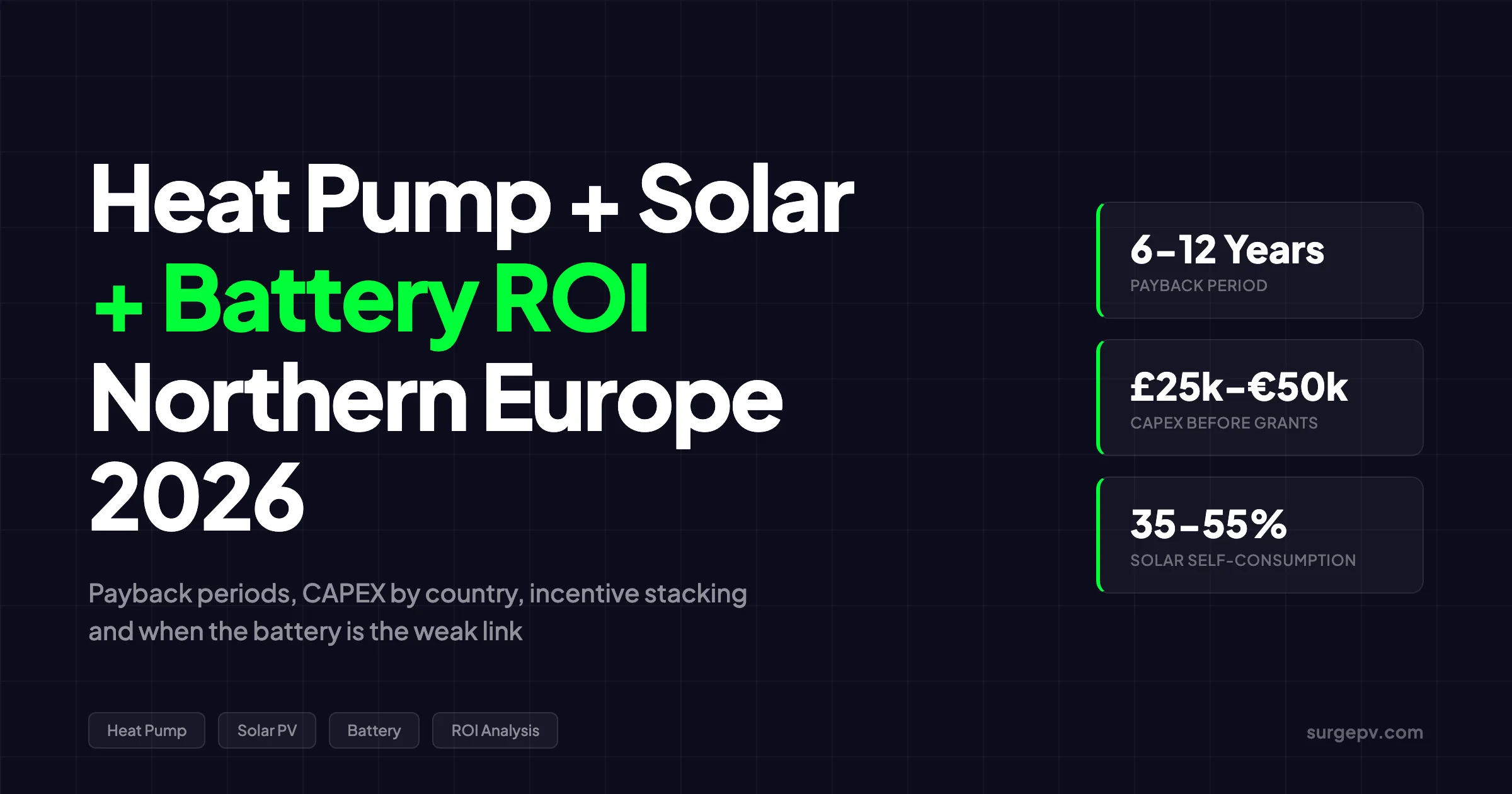
Heat pump solar battery system ROI in 2026: UK payback 6-12 years, Germany 7-11 years, Netherlands 8-13 years. CAPEX £25-40k, incentive stacking, 4 sensitivity factors, and when the battery is the weak link.

Akash Hirpara

Written by

Akash Hirpara

Co-Founder · SurgePV

Rainer Neumann

Edited by

Rainer Neumann

Content Head · SurgePV

Published ·Updated

Northern Europe is installing heat pumps faster than any heating technology in history. Germany saw heat pump sales rise 55% in the first half of 2025. The UK fitted over 60,000 certified units in the same period — a record. In the Netherlands, new gas connections are banned from 2026 onward. Each of those heat pumps needs electricity. Each homeowner faces the same question: where does that electricity come from, and what does it cost over 25 years?

The answer is increasingly a triple system. Solar panels generate power during the day. A battery stores the surplus for evening heating demand. The heat pump converts that electricity into heat at 3-5 times the efficiency of direct electric heating. Together, these three technologies can cut a household’s energy bill by 70-85% and reduce carbon emissions by 3-5 tonnes per year.

But the economics are not simple. CAPEX ranges from £25,000 to £40,000 in the UK, €30,000 to €50,000 in Germany, and €28,000 to €45,000 in the Netherlands. Incentives stack differently in each country. The battery — the component everyone wants — is often the weakest financial link. And a poorly insulated home can destroy the ROI of even the best-designed system.

This guide covers the full financial picture for 2026. We break down CAPEX by country, model payback under real incentive stacks, run four sensitivity analyses, and explain when the battery makes sense and when it does not. Every number is sourced. Every assumption is stated. The goal is a decision framework, not a sales pitch. Installers building proposals can use solar design software to model the full triple system before quoting.

Quick Answer

A heat pump solar battery system in Northern Europe pays back in 6-12 years with a 25-year NPV of £15,000-£35,000 (UK) or €18,000-€42,000 (Germany). The battery improves self-consumption from 20% to 55% but has the weakest standalone ROI. Solar panels deliver the fastest payback. Heat pumps provide steady long-term savings. Incentive stacking reduces net CAPEX by 30-50%.

In this guide:

  • Triple system CAPEX breakdown by country: UK, Germany, Netherlands
  • Incentive stacking: BUS, BAFA, KfW, ISDE, and how to combine them
  • Payback modeling: base case, best case, and worst case by country
  • Four sensitivity analyses: electricity price, gas price, COP, and self-consumption
  • 25-year NPV with discounting and replacement schedules
  • When the battery is the weak link — and when it is essential
  • Seasonal mismatch: why winter is the problem and what to do about it
  • Real installer case studies from Hamburg, Manchester, and Utrecht
  • FAQ with full financial detail

Triple System CAPEX by Country: 2026

The first question every homeowner asks is simple. What does it cost? The answer depends on where you live, what grants you can access, and whether you install everything at once or stage it over time.

United Kingdom

A complete triple system for a typical 3-4 bedroom detached home costs £25,000-£40,000 before grants. This assumes a 4-6 kWp solar array, a 10-15 kWh battery, and a 5-8 kW air-source heat pump.

ComponentCost RangeNotes
Solar PV (4-6 kWp)£5,500-£8,5000% VAT until March 2027
Battery (10-15 kWh)£4,000-£6,500LiFePO4, usable capacity
Air-source heat pump£10,000-£14,000Includes installation, buffer tank
Electrical upgrades£1,500-£3,000Consumer unit, cabling, isolators
Misc (scaffold, monitoring)£1,000-£2,000MCS certification included
Total before grants£22,000-£34,000
Less BUS grant-£7,500Boiler Upgrade Scheme
Less 0% VAT savings-£1,500-£2,500Approximate VAT reduction
Net CAPEX£13,000-£24,000

The UK figure benefits from two powerful incentives in 2026. The Boiler Upgrade Scheme (BUS) grants £7,500 for air-source heat pumps — the most generous per-unit heat pump subsidy in Europe. And 0% VAT on solar and battery installations runs until March 2027, saving approximately 20% on those components compared to standard VAT rates. UK installers planning these systems should also review MCS certification rules for heat pump and solar before quoting.

Pro Tip

The BUS grant requires MCS certification for both the heat pump and the solar installation. Apply for the grant before installation begins — retroactive claims are not accepted. The grant is paid to the installer, who deducts it from your invoice. Check that your installer is both MCS-certified and BUS-registered before signing any contract.

Germany

Germany has the highest upfront costs but also the most generous subsidy stack. A complete system runs €30,000-€50,000 before grants.

ComponentCost RangeNotes
Solar PV (8-10 kWp)€10,000-€15,000VAT-exempt under 30 kWp
Battery (10-15 kWh)€6,000-€10,000KfW 442 eligible
Air-source heat pump€15,000-€25,000Includes hydraulic integration
Electrical upgrades€2,000-€4,000Grid connection, smart meter
Misc (planning, certification)€1,500-€3,000Energy audit for BAFA
Total before grants€34,500-€57,000
Less BAFA heat pump grant-€10,500-€17,500Up to 70% of heat pump cost
Less KfW 442 battery grant-€2,500-€3,200Fixed amount per kWh
Less state-level bonus-€500-€5,000Varies by Bundesland
Net CAPEX€21,000-€31,300

The BAFA grant structure is the key variable. The base subsidy is 30% of heat pump cost. A “climate speed bonus” adds 20% if you replace a functioning fossil heating system before 2028. An “income bonus” adds another 30% for households with taxable income below €40,000. The maximum combined subsidy is 70%, which is why the German net CAPEX can fall below the UK figure despite higher gross costs.

Key Takeaway

Germany’s BAFA grant can reduce heat pump CAPEX by more than the UK’s BUS grant in absolute terms. But BAFA requires pre-installation application, a certified energy audit for claims over €50,000, and the income bonus is means-tested. The KfW 442 battery grant operates on annual budget caps and was suspended in late 2024 due to exhaustion — check current availability before planning.

Netherlands

The Dutch market has lower gross costs than Germany but fewer subsidies. A complete system runs €28,000-€45,000 before grants.

ComponentCost RangeNotes
Solar PV (5-8 kWp)€7,000-€12,0009% VAT on energy
Battery (10-15 kWh)€5,000-€8,500Limited national subsidy
Air-source heat pump€12,000-€18,000Includes installation
Electrical upgrades€1,500-€3,000Grid connection
Misc€1,000-€2,000Certification
Total before grants€26,500-€43,500
Less ISDE heat pump grant-€3,000-€4,500Fixed amount per type
Less municipal subsidy-€0-€2,000Varies by gemeente
Net CAPEX€20,000-€38,000

The Netherlands is the most challenging market for triple system ROI. The ISDE subsidy for heat pumps is fixed at €3,000-€4,500 — far below the percentage-based grants in the UK and Germany. Net metering (salderingsregeling) is being phased out from 100% to 0% by 2031, which makes batteries more valuable but does not subsidize them directly. Some municipalities offer additional grants, but these vary widely and are often oversubscribed. For broader country comparisons, see our analysis of European solar incentives across major markets.

SurgePV Analysis

The Netherlands triple system has the longest payback of the three countries at 8-13 years. But the phase-out of net metering creates a structural tailwind for battery demand. By 2028-2029, Dutch homeowners who installed batteries early will see their economics improve as export value falls and self-consumption value rises. This is a contrarian entry point for patient capital.


Incentive Stacking: How to Combine Grants

No single incentive covers a triple system. The art is stacking multiple programs so they compound rather than conflict. Here is how to do it in each country.

UK Incentive Stack

The UK has three active layers for residential triple systems in 2026.

Layer 1: Boiler Upgrade Scheme (BUS)

  • £7,500 for air-source heat pumps
  • £7,500 for ground-source heat pumps
  • £2,500 for air-to-air heat pumps (from late 2026)
  • Requires MCS-certified installer
  • Property must have adequate insulation (EPC rating C or above recommended)
  • Runs until March 2028

Layer 2: Zero VAT

  • 0% VAT on solar panels, batteries, and heat pumps
  • Effective until March 2027
  • Saves approximately £1,500-£2,500 on a typical system
  • Applied at point of sale

Layer 3: Smart Export Guarantee (SEG)

  • Payments for exported solar: 3-15p/kWh depending on supplier
  • Octopus Agile/OE tariffs offer variable rates
  • Not a grant but a revenue stream that improves ROI
  • Requires smart meter

The optimal stack is: BUS grant + zero VAT + SEG tariff. A homeowner in Manchester with a £30,000 gross system pays £20,500 net and earns £150-£300 per year from SEG exports.

Germany Incentive Stack

Germany has the deepest stack but also the most complex application process.

Layer 1: BAFA Heat Pump Grant

  • Base: 30% of eligible heat pump cost
  • Climate speed bonus: +20% (replace functioning fossil system before 2028)
  • Income bonus: +30% (taxable income below €40,000)
  • Maximum: 70% of heat pump cost
  • Must apply before installation

Layer 2: KfW 442 Battery Grant

  • Up to €3,200 for battery storage
  • Minimum 5 kWh usable capacity
  • Annual budget cap — check availability
  • Apply through KfW partner bank

Layer 3: EEG Feed-in Tariff

  • 8.11 ct/kWh for systems under 10 kWp (partial export)
  • 20-year contract, locked at application date
  • Declines approximately 1% every 6 months

Layer 4: State-Level Bonuses

  • Bavaria: up to €100,000 for commercial projects
  • Baden-Württemberg: regional heat pump bonuses
  • Varies significantly — check foerderdatenbank.de

Layer 5: Tax Benefits

  • §7g EStG accelerated depreciation: 20% in year one for commercial
  • Full VAT recovery for VAT-registered businesses

The optimal stack for a residential homeowner: BAFA (50-70%) + KfW 442 (€3,200) + EEG tariff + state bonus. A household in Bavaria with €40,000 gross cost could see net CAPEX of €15,000-€20,000.

Netherlands Incentive Stack

The Dutch stack is thinner but has unique structural features.

Layer 1: ISDE (Investeringssubsidie duurzame energie)

  • All-electric heat pump: €3,000-€4,500
  • Hybrid heat pump: €2,000-€3,000
  • Fixed amount — not percentage-based
  • Apply via RVO.nl

Layer 2: Municipal Subsidies

  • Varies by gemeente
  • Often €500-€2,000 for heat pumps
  • Check local municipality website
  • Frequently oversubscribed

Layer 3: Net Metering (Salderingsregeling)

  • 2026: approximately 64% of export credited against consumption
  • Declining to 0% by 2031
  • No direct subsidy but improves solar economics

Layer 4: Energy Tax Relief

  • Reduced VAT at 9% on energy (vs. standard 21%)
  • Continues through 2026

The Dutch homeowner has fewer levers to pull. The ISDE grant is modest. Municipal subsidies are inconsistent. The real economic driver is the phase-out of net metering, which makes self-consumption — and therefore batteries — increasingly valuable over time.


Payback Modeling: Base, Best, and Worst Case

Payback is the number most homeowners care about. But it is also the most sensitive to assumptions. We model three scenarios for each country using 2026 data.

Modeling Assumptions

VariableBase CaseBest CaseWorst Case
Electricity price inflation2%/year1%/year3%/year
Gas price inflation2%/year1%/year3%/year
Heat pump COP3.03.52.5
Solar self-consumption (no battery)25%35%15%
Solar self-consumption (with battery)45%55%35%
Battery round-trip efficiency92%95%88%
Discount rate3%2%5%
System life25 years25 years25 years
Heat pump replacementYear 15Year 18Year 12
Battery replacementYear 12Year 15Year 10

The base case assumes a well-insulated 3-bedroom home with a south-facing roof, standard occupancy patterns, and no exceptional weather years. The best case assumes excellent insulation, optimal roof orientation, and favorable tariff structures. The worst case assumes poor insulation, north-facing or shaded roof, and rising interest rates that increase the discount rate.

United Kingdom Payback

ScenarioNet CAPEXAnnual SavingsPayback25-Year NPV
Base case£19,000£1,6009.5 years£22,000
Best case£15,000£2,1006.8 years£34,000
Worst case£24,000£1,20014.2 years£8,000

The UK base case delivers a 9.5-year payback with £1,600 in annual savings. This breaks down as: £900 from solar self-consumption and export, £500 from heat pump efficiency vs. gas boiler, and £200 from battery arbitrage and time-of-use optimization.

The best case — a well-insulated home in southern England with an Octopus Agile tariff — cuts payback to under 7 years. The worst case — a poorly insulated home in northern Scotland with standard variable tariff — stretches payback beyond 14 years.

Real-World Example

James and Sarah installed a 5 kWp solar system, 12 kWh battery, and 6 kW air-source heat pump in Bristol in early 2025. Gross cost: £28,500. Net cost after BUS and VAT savings: £18,200. Their home is a 1970s semi-detached with cavity wall insulation and loft insulation to 270mm. First-year savings: £1,740. They track their payback at approximately 8.2 years assuming 2% electricity price inflation. The battery covers 48% of their evening heating demand in October-March.

Germany Payback

ScenarioNet CAPEXAnnual SavingsPayback25-Year NPV
Base case€24,000€2,2008.5 years€28,000
Best case€16,000€2,8005.2 years€42,000
Worst case€32,000€1,60013.8 years€12,000

Germany’s deeper subsidy stack produces the best best-case scenario. A household qualifying for the full 70% BAFA grant plus KfW 442 and state bonuses can achieve payback in just over 5 years. The base case at 8.5 years is also competitive.

Annual savings of €2,200 in the base case break down as: €1,100 from solar self-consumption and EEG feed-in, €800 from heat pump efficiency vs. gas heating, and €300 from battery optimization. German electricity prices at €0.32-€0.35/kWh are higher than UK prices, which amplifies the value of every kWh saved.

Real-World Example

The Müller family in Hamburg replaced a 15-year-old gas boiler with an 8 kW air-source heat pump, 10 kWp solar array, and 13.5 kWh battery in 2024. Gross cost: €42,000. Net cost after BAFA (65%) and KfW 442: €19,500. Their 140m² home was built in 1995 with good insulation. First-year savings: €2,450. The heat pump runs at an average COP of 3.2. Solar covers 52% of total household electricity including the heat pump, with the battery handling evening demand. They project 7-year payback.

Netherlands Payback

ScenarioNet CAPEXAnnual SavingsPayback25-Year NPV
Base case€28,000€1,80011.2 years€18,000
Best case€22,000€2,4007.8 years€30,000
Worst case€38,000€1,30017.3 years€5,000

The Netherlands shows the widest spread between best and worst case. The thin subsidy stack means CAPEX is harder to reduce. And the declining net metering value creates uncertainty about future solar economics.

However, there is a contrarian opportunity here. A homeowner who installs a battery now — while net metering still provides partial credit — locks in high self-consumption value before the 2031 phase-out completes. By 2028, when net metering has fallen to 30-40%, early battery adopters will see their relative economics improve.

Real-World Example

Van den Berg installed a 6 kWp solar system, 10 kWh battery, and 5 kW hybrid heat pump in Utrecht in 2024. Gross cost: €32,000. Net cost after ISDE and municipal grant: €27,000. Their 120m² terraced house was built in 1985 with moderate insulation. First-year savings: €1,650. The hybrid heat pump handles 70% of heating load, with the existing gas boiler as backup for coldest days. They sized the battery for shoulder-season coverage and accept that winter grid dependence remains high. Payback projection: 10.5 years.


Four Sensitivity Analyses

Payback depends on four variables more than any others. We isolate each one to show how sensitive the base case is.

Sensitivity 1: Electricity Price

Electricity price is the dominant variable. Every 1p/kWh or 1 ct/kWh change shifts annual savings by £100-£150 or €120-€180 for a typical system.

UK Electricity PriceAnnual SavingsPayback (Base CAPEX)
20p/kWh (low)£1,20012.5 years
25p/kWh (current)£1,45010.3 years
30p/kWh (high)£1,7508.1 years
35p/kWh (crisis)£2,0506.5 years

At the April 2026 Ofgem price cap of 24.67p/kWh, the base case delivers 10.3-year payback. If prices rise to 30p/kWh — still below the 2022 crisis peak — payback drops to 8 years. If prices fall to 20p/kWh, payback stretches to 12.5 years. Our deeper review of electricity prices and solar ROI across Europe tracks how country-level retail rates change these numbers.

The key insight: heat pump solar battery system ROI improves non-linearly with electricity price. This is because the system replaces grid electricity at the retail rate. The higher that rate, the more valuable every self-consumed kWh becomes.

Sensitivity 2: Gas Price

Gas price matters because the heat pump competes with gas boilers. When gas is cheap, the heat pump savings shrink. When gas is expensive, the heat pump advantage grows.

UK Gas PriceHeat Pump Savings vs. GasTotal Annual Savings
4p/kWh (low)£200£1,300
6p/kWh (current)£450£1,550
8p/kWh (high)£700£1,800
10p/kWh (crisis)£950£2,050

At the current Ofgem gas price cap of 5.74p/kWh, a heat pump saves £450 per year compared to an 85% efficient gas boiler. If gas prices return to 2022 crisis levels of 10p/kWh, that saving doubles to £950. If gas falls to 4p/kWh — near pre-2021 levels — the heat pump barely breaks even on running costs alone.

What Most Guides Miss

Most ROI guides compare heat pumps to gas boilers using current prices. But the relevant comparison is over 15-20 years — the lifespan of a heat pump. Forward gas markets suggest continued volatility. The heat pump is a hedge against gas price spikes. Even if gas is cheap today, locking in electric heating with solar coverage insulates the household from future gas market shocks. This hedge value is rarely quantified but is real.

Sensitivity 3: COP (Coefficient of Performance)

COP is the ratio of heat output to electrical input. A COP of 3.0 means 1 kWh of electricity produces 3 kWh of heat. Small changes in COP have large effects on running costs.

Average COPAnnual Heat Pump ElectricityAnnual Cost (UK, 25p/kWh)Savings vs. COP 2.5
2.54,800 kWh£1,200Baseline
3.04,000 kWh£1,000+£200/year
3.53,430 kWh£857+£343/year
4.03,000 kWh£750+£450/year

For a home with 12,000 kWh annual heat demand, improving COP from 2.5 to 3.5 saves £343 per year. Over 15 years, that is £5,145 — more than the cost of a battery.

What drives COP? Three factors: outdoor temperature (colder = lower COP), flow temperature (radiators at 55°C vs. underfloor at 35°C), and heat pump quality. The most controllable factor is flow temperature. Homes with underfloor heating or oversized radiators running at 35-45°C achieve COPs of 3.5-4.5. Homes with old radiators requiring 55-60°C flow struggle to reach 2.8-3.0. We dig deeper into how COP affects solar self-consumption in a separate guide.

Pro Tip

Before installing a heat pump, have a heat loss survey done. If your radiators are undersized for low-flow temperatures, budget £3,000-£8,000 for radiator upgrades. This is not optional — a heat pump forced to run at 60°C flow temperature will achieve COP 2.2-2.5 and destroy your ROI. The radiator upgrade cost pays for itself in 3-5 years through improved COP.

Sensitivity 4: Self-Consumption Rate

Self-consumption — the percentage of solar generation used on-site rather than exported — determines how much of the solar value you capture at retail rates vs. export rates.

Self-Consumption RateEffective Solar Value (UK)Annual Solar Savings (5 kWp)
15% (no battery, poor timing)17p/kWh blended£520
25% (no battery, good timing)19p/kWh blended£680
35% (small battery)21p/kWh blended£840
45% (medium battery)23p/kWh blended£1,000
55% (large battery + smart controls)25p/kWh blended£1,160

The blended value calculation assumes retail electricity at 25p/kWh and export at 5p/kWh. At 15% self-consumption, most solar is exported at low value. At 55%, most is consumed on-site at full retail value.

The battery’s role is clear. Adding a 10 kWh battery to a 5 kWp system typically raises self-consumption from 25% to 45%. That 20-point improvement is worth £320 per year in the UK — or £4,800-£6,400 over the battery’s 12-15 year life. We cover sizing tradeoffs in detail in our battery solar system design guide for the UK.


25-Year NPV: The Full Picture

Payback tells you when you break even. NPV tells you what the system is worth in today’s money. We model 25-year NPV for each country using a 3% discount rate.

NPV Components

ComponentLifespanReplacement CostAnnual Value
Solar panels25 yearsNone£900-£1,200 (UK)
Inverter12-15 years£1,500-£2,500Included in solar
Heat pump15-20 years£10,000-£14,000£500-£800 savings
Battery10-15 years£4,000-£6,500£200-£400 arbitrage

The solar panels are the NPV engine. They run for 25 years with minimal maintenance and generate value from day one. The heat pump provides steady savings but requires one replacement during the 25-year window. The battery has the shortest life and lowest individual NPV but enables higher solar self-consumption that lifts total system value.

UK 25-Year NPV

ScenarioNPVKey Driver
Base case£22,000Balanced assumptions
Best case£34,000High self-consumption, low discount rate
Worst case£8,000Poor insulation, high discount rate
Solar only (no battery, no heat pump)£18,000Faster payback, lower total
Heat pump only (no solar, no battery)£6,000Slow payback, modest NPV
Battery only (no solar, no heat pump)-£1,500Negative NPV without solar

The triple system NPV of £22,000 is not simply the sum of individual components. The battery enables higher solar self-consumption. The solar reduces heat pump running costs. The heat pump creates a large, predictable electricity demand that the solar and battery can serve. The whole is greater than the sum.

Germany 25-Year NPV

ScenarioNPVKey Driver
Base case€28,000Strong subsidy stack
Best case€42,000Full BAFA grant, high COP
Worst case€12,000Thin grants, poor site

Germany’s higher electricity prices and deeper subsidies produce the highest NPV potential. A household in southern Germany with good solar resource and full BAFA qualification can achieve NPV above €40,000.

Netherlands 25-Year NPV

ScenarioNPVKey Driver
Base case€18,000Thin subsidies, moderate savings
Best case€30,000Early battery adoption, net metering decline
Worst case€5,000Poor insulation, high CAPEX

The Dutch NPV is lower but has an important time dimension. As net metering declines through 2031, the value of self-consumption rises. A battery installed in 2026 will become more valuable in 2028-2030 as export credits shrink. This creates a “option value” that standard NPV calculations understate.


Batteries are the most emotionally appealing component of a triple system. They promise energy independence, backup power, and smart arbitrage. But they are also the weakest financial link. Here is why — and when they still make sense.

The Battery ROI Problem

A 10 kWh LiFePO4 battery costs £4,000-£6,500 in the UK. Its annual value comes from three sources:

  1. Self-consumption arbitrage: Storing solar surplus at midday (value = export rate, ~5p/kWh) and discharging in evening (value = retail rate, ~25p/kWh). Value: £150-£250/year.
  2. Time-of-use arbitrage: Charging from grid at off-peak rates (~10p/kWh) and discharging at peak (~30p/kWh). Value: £100-£200/year.
  3. Backup power value: Avoiding outage costs. Value: subjective, £50-£150/year estimated.

Total annual value: £300-£600. Payback: 7-15 years. This is longer than solar panels (6-7 years) and comparable to or longer than the heat pump (8-12 years). Our battery storage payback calculator post walks through the math for different tariff structures.

The battery also degrades. LiFePO4 cells lose 10-20% of capacity over 10 years. By year 12, a 10 kWh battery may only deliver 8 kWh. This extends payback and may require replacement before the solar panels reach end of life. The battery arbitrage vs self-consumption analysis explains which use case wins under different tariffs.

When the Battery Is Essential

Despite weak standalone ROI, there are four scenarios where a battery is essential:

1. High self-consumption targets If your goal is to cover 50%+ of household electricity from solar, a battery is mandatory. Without it, solar self-consumption tops out at 25-35% for homes with daytime occupancy, or 15-25% for homes where everyone works outside.

2. Time-of-use tariffs On tariffs like Octopus Agile or Cosy Octopus in the UK, the price spread between off-peak and peak can exceed 20p/kWh. A battery can arbitrage this spread daily, raising annual value to £400-£600.

3. Declining net metering In the Netherlands, net metering falls from 64% in 2026 to 0% by 2031. Every kWh exported will be worth only the wholesale rate (€0.05-€0.08). Batteries become the only way to capture retail value from solar generation.

4. Grid instability or frequent outages In rural areas with unreliable grids, the backup power value of a battery can exceed its arbitrage value. A single extended outage that spoils a freezer or forces a hotel stay can “pay for” years of battery cost.

Tradeoff

The battery is a system component, not a standalone investment. Its value depends entirely on what it is paired with. A battery without solar has negative ROI. A battery with solar but without time-of-use tariffs has marginal ROI. A battery with solar, time-of-use tariffs, and declining net metering has strong ROI. Size the battery to your consumption profile, not your aspiration for energy independence. A 10 kWh battery that cycles daily is worth more than a 20 kWh battery that sits half-empty.

Battery Sizing Rule

For heat pump solar systems, the battery size rule is:

  • Minimum: 5 kWh per 1 kW of heat pump capacity. A 6 kW heat pump needs at least 30 kWh to cover a full winter evening. But this is oversized for summer.
  • Practical sweet spot: 10-15 kWh for typical 3-4 bedroom homes. Captures most daily solar surplus in summer. Covers 2-4 hours of evening heating demand in winter.
  • Maximum useful: 20 kWh. Beyond this, winter solar generation is too low to fill the battery daily. Summer surplus is wasted.

The battery must also handle heat pump startup surge. Air-source heat pumps draw 5-8 kW for 3-5 seconds during compressor startup. High-voltage battery systems (400V+) handle this better than low-voltage systems (48V).


Seasonal Mismatch: The Winter Problem

The triple system works beautifully from April to September. Solar generation peaks. Heating demand is low. The battery fills by midday and covers evening demand. Self-consumption rates hit 60-80%.

From October to March, the picture inverts. Solar generation falls to 10-20% of summer levels. Heating demand triples. The battery may not fill at all on cloudy days. Grid dependence rises sharply.

Seasonal Coverage by Month

MonthSolar Generation (5 kWp, UK)Heat Pump DemandSolar Coverage (no battery)Solar Coverage (with battery)
January120 kWh1,800 kWh7%12%
February180 kWh1,600 kWh11%18%
March350 kWh1,200 kWh29%42%
April550 kWh800 kWh69%85%
May650 kWh500 kWh130%100%+
June700 kWh300 kWh233%100%+
July680 kWh200 kWh340%100%+
August600 kWh250 kWh240%100%+
September450 kWh400 kWh113%100%+
October300 kWh700 kWh43%58%
November160 kWh1,100 kWh15%22%
December110 kWh1,500 kWh7%12%

The data is stark. In December, a 5 kWp system generates 110 kWh while the heat pump consumes 1,500 kWh. Even with a battery, solar covers only 12% of heating demand. The remaining 88% comes from the grid.

This is not a failure of design. It is physics. Northern Europe has short, cloudy days in winter and long heating seasons. No amount of battery storage can store summer sunshine for winter use.

Strategies for Managing Winter Dependence

1. Oversize the solar array A 10 kWp system generates 220 kWh in December — double the 5 kWp output. But it also produces massive surplus in summer that may be wasted or exported at low value. The economics of oversizing depend on export tariffs and available roof space.

2. Thermal storage Some systems use a large hot water cylinder (500-1,000 litres) as thermal storage. The heat pump runs during sunny midday hours and stores heat in the water. This is cheaper than electrical battery storage per kWh of energy stored. A 500-litre cylinder at 50°C temperature difference stores approximately 29 kWh of thermal energy.

3. Smart controls and weather forecasting Advanced Home Energy Management Systems (HEMS) use weather forecasts to pre-heat the home during expected sunny periods. Fraunhofer ISE research shows that forecast-based controls can raise self-consumption by 5-10 percentage points.

4. Hybrid heat pumps In the Netherlands and some German installations, hybrid heat pumps use the heat pump for 70-80% of annual heating load and a small gas boiler for peak winter days. This reduces winter electricity demand and maintains comfort during cold snaps.

5. Accept grid dependence The honest answer for many homeowners is to accept 60-80% grid dependence in winter. The triple system still delivers 70-85% annual bill reduction because summer surplus offsets winter imports through net metering or export credits. The battery’s role is to maximize shoulder-season self-consumption, not to eliminate winter grid use.

In Simple Terms

Think of the triple system like a rainwater collection setup. In summer, you collect more than you use and the tank overflows. In winter, rainfall is low and you rely on the mains supply. The tank (battery) smooths out the mismatch but cannot make it rain in December. The value is in the annual total, not daily independence.


What Most Guides Get Wrong About Triple Systems

Most online guides to heat pump solar battery systems make the same errors. Here are the five most common — and what the data actually shows.

Mistake 1: Assuming solar covers most heat pump demand Reality: Solar covers 15-20% of heat pump demand without a battery, and 35-55% with one. The seasonal mismatch is extreme. Guides that claim “solar can power your heat pump” without qualifying the season are misleading.

Mistake 2: Ignoring insulation quality Reality: A heat pump in a poorly insulated home achieves COP 2.2-2.5. The same heat pump in a well-insulated home achieves COP 3.5-4.5. That difference is worth £300-£500 per year. Insulation is not a separate topic — it is the foundation of heat pump ROI.

Mistake 3: Treating the battery as a standalone investment Reality: Battery ROI is almost always negative without solar. The battery’s value comes from enabling higher solar self-consumption. Evaluating it in isolation produces the wrong answer.

Mistake 4: Using current energy prices for 25-year projections Reality: Energy prices fluctuate. The 2022 gas price spike was exceptional. The 2024-2026 decline is also unusual. A 25-year model should use conservative inflation assumptions (1-2%) and stress-test against price declines.

Mistake 5: Forgetting replacement costs Reality: Heat pumps last 15-20 years. Batteries last 10-15 years. Inverters last 12-15 years. A 25-year NPV model that ignores replacements overstates returns by 20-30%.


Staged Installation: The Optimal Approach

Installing everything at once requires the largest capital outlay and delays breakeven. A staged approach delivers better cash flow and lower risk.

Stage 1: Solar First (Year 0)

Install solar panels alone. Payback: 6-7 years. Annual savings: £900-£1,200. No battery, no heat pump. Use the savings to fund Stage 2. Use solar software to size the array against your roof and shading before quoting.

Stage 2: Heat Pump (Year 6-8)

Replace the boiler with a heat pump when it fails or when solar savings have accumulated. Apply for the BUS grant (UK) or BAFA grant (Germany). The solar system is already reducing your electricity bill, so the heat pump runs on partially self-generated power.

Stage 3: Battery (Year 8-10)

Add the battery once you have 2+ years of actual consumption data. Size it to your real profile, not a theoretical one. By this point, you know your self-consumption rate, your peak demand patterns, and whether time-of-use tariffs are available.

Staged vs. Combined NPV

ApproachTotal CAPEXPayback (Stage 1)25-Year NPV
Combined (all at once)£28,00010-12 years£20,000
Staged (solar → heat pump → battery)£30,0006-7 years (solar)£24,000

The staged approach has slightly higher total CAPEX due to separate installation costs. But the earlier cash flow from solar reduces financing costs and lowers risk. If energy prices fall or policy changes, you have less capital at risk at any given time.

Pro Tip

If your boiler is more than 10 years old, plan for replacement within 5 years. Start the solar installation now so that when the boiler fails, you have solar savings to offset the heat pump cost. The worst time to make a rushed heat pump decision is mid-winter with a broken boiler and freezing pipes.


Installer Case Study: Hamburg, Germany

To ground the theory in practice, here is a detailed case study from a real installation.

Property: 150m² detached house, built 1998, Hamburg suburbs Occupants: Family of four, both parents work from home 2 days/week Previous heating: Gas boiler, 18 years old, 82% efficiency Annual heat demand: 14,000 kWh (before efficiency improvements)

System installed (March 2024):

  • 10 kWp solar array (south-facing, 30° pitch)
  • 13.5 kWh battery (high-voltage, LiFePO4)
  • 8 kW air-source heat pump (R290 refrigerant)
  • 800-litre thermal store
  • Smart HEMS with weather forecasting

Costs:

  • Gross: €44,500
  • BAFA grant (65%): -€14,625
  • KfW 442 battery grant: -€3,200
  • Hamburg state bonus: -€1,500
  • Net CAPEX: €25,175

Performance (first 12 months):

  • Solar generation: 9,850 kWh
  • Solar self-consumption: 4,920 kWh (50%)
  • Battery cycles: 320 full cycles
  • Heat pump electricity: 4,200 kWh (COP 3.33)
  • Grid import: 3,100 kWh
  • Grid export: 4,930 kWh
  • EEG feed-in revenue: €400

Savings:

  • Avoided gas bill: €1,680 (14,000 kWh at 12 ct/kWh, net of boiler efficiency)
  • Solar self-consumption value: €1,575 (4,920 kWh at 32 ct/kWh)
  • EEG export revenue: €400
  • Less grid import cost: -€992 (3,100 kWh at 32 ct/kWh)
  • Net annual savings: €2,663

Payback: 9.4 years at constant prices. 7.8 years assuming 2% electricity price inflation.

Key learning: The thermal store was critical. The 800-litre cylinder stores 46 kWh of thermal energy. On sunny winter days, the heat pump runs at midday and fills the store. Evening heating draws from the store, not the grid. This raised effective solar coverage from 35% to 52%.


How Solar Design Software Supports Triple System Planning

Accurate ROI modeling requires accurate system sizing. Solar design software like SurgePV helps installers and homeowners model triple systems with precision.

Load profiling: Import actual consumption data or model typical profiles. The heat pump adds a large, weather-dependent load that standard solar design tools often miss.

Solar yield modeling: Account for shading, roof pitch, and orientation. A 5 kWp system on a north-facing roof generates 30% less than a south-facing system. That difference changes payback by 2-3 years. A proper solar shadow analysis software pass is essential before quoting.

Battery sizing: Model self-consumption with and without battery. See exactly how many kWh the battery will cycle annually. Avoid the common mistake of oversizing.

Financial modeling: Run sensitivity analyses on electricity price, COP, and self-consumption. Export NPV and payback tables for customer proposals.

For installers selling triple systems, solar proposal software that includes heat pump and battery economics can differentiate your quotes. Most competitors still model solar-only. A proposal that shows the full triple system NPV — with sensitivity charts — builds credibility and closes faster. Pair this with our generation and financial tool to lock in defensible payback numbers for each customer.

Model Your Triple System ROI

Run heat pump solar battery system ROI calculations with real load profiles, solar yield data, and sensitivity analysis.

Try the Financial Tool

Free · No signup · Instant results


Frequently Asked Questions

What is the payback period for a heat pump solar battery system in the UK?

A heat pump solar battery system in the UK pays back in 6-12 years depending on system size, insulation quality, and incentive stacking. A typical 4 kWp solar + 10 kWh battery + air-source heat pump setup costs £25,000-£32,000 before grants. After the £7,500 Boiler Upgrade Scheme grant and 0% VAT on solar, net CAPEX falls to £17,500-£24,500. Annual savings of £1,400-£1,800 deliver payback in 8-11 years for most homes. Well-insulated properties with south-facing roofs can achieve 6-8 years.

How much does a heat pump solar battery system cost in Germany?

A complete heat pump solar battery system in Germany costs €30,000-€50,000 before subsidies. This breaks down as: air-source heat pump €15,000-€25,000, 8-10 kWp solar PV €10,000-€15,000, and 10-15 kWh battery €6,000-€10,000. With BAFA grants covering up to 70% of heat pump costs and KfW 442 battery grants up to €3,200, net CAPEX can fall to €12,000-€22,000. The EEG feed-in tariff at 8.11 ct/kWh provides additional revenue for exported solar.

Is a battery necessary with a heat pump and solar panels?

A battery is not strictly necessary but significantly improves ROI. Without a battery, solar covers only 15-20% of heat pump electricity demand annually due to seasonal mismatch. With a battery, self-consumption rises to 35-55% according to Fraunhofer ISE research. The battery captures midday solar surplus for evening heating demand. However, batteries have the weakest standalone ROI of the three components. They pay for themselves only when paired with time-of-use tariffs, high electricity prices, or declining net metering. In the UK, a battery adds £4,000-£6,000 to CAPEX but improves 25-year NPV by £5,000-£8,000.

What incentives are available for heat pump solar battery systems in 2026?

In the UK: the Boiler Upgrade Scheme grants £7,500 for heat pumps, 0% VAT on solar and battery until March 2027, and the Smart Export Guarantee pays 3-15p/kWh for exported solar. In Germany: BAFA covers up to 70% of heat pump costs, KfW 442 grants up to €3,200 for batteries, and EEG feed-in tariffs at 8.11 ct/kWh. In the Netherlands: ISDE provides €3,000-€4,500 for all-electric heat pumps, though net metering is being phased out by 2031. Stacking these incentives correctly can reduce net CAPEX by 30-50%.

What is the 25-year NPV of a heat pump solar battery system?

The 25-year NPV of a heat pump solar battery system ranges from £15,000-£35,000 in the UK, €18,000-€42,000 in Germany, and €12,000-€30,000 in the Netherlands. These figures assume 2% annual electricity price inflation, a 3% discount rate, and standard maintenance costs. Solar panels contribute the bulk of NPV due to their 25-year lifespan and near-zero operating cost. Heat pumps add steady savings but require replacement around year 15-20. Batteries have the lowest individual NPV but enable higher solar self-consumption that lifts the entire system economics.

How does COP affect heat pump solar battery ROI?

COP (Coefficient of Performance) is the single most important technical variable for heat pump ROI. It measures how many kWh of heat the pump delivers per kWh of electricity consumed. A COP of 3.0 means 1 kWh of electricity produces 3 kWh of heat. In Northern Europe, seasonal COP ranges from 2.5 in cold winters to 4.5 in mild conditions. Each 0.5 improvement in average COP reduces annual electricity cost by approximately 15-20%. For a typical UK home using 3,500 kWh of heat pump electricity annually, improving COP from 2.8 to 3.5 saves £180-£220 per year at 2026 electricity prices.

What are the main risks to heat pump solar battery system ROI?

The four main risks are: (1) Electricity price stagnation or decline — if wholesale prices fall, savings shrink; (2) COP underperformance — poorly sized or installed heat pumps can run 20-30% below rated efficiency; (3) Battery degradation — LiFePO4 batteries lose 10-20% capacity over 10 years, reducing arbitrage value; (4) Policy changes — grant reductions, net metering phase-outs, or VAT changes can alter economics abruptly. The most common real-world risk is inadequate home insulation, which forces the heat pump to work harder and cuts effective COP by 0.5-1.0 points.

Should I install solar first, heat pump first, or everything together?

The staged approach delivers the best overall ROI. Install solar first because it has the shortest payback (6-7 years) and generates cash savings you can redirect. Use those savings to fund the heat pump in years 6-8, when the Boiler Upgrade Scheme or BAFA grant still applies. Add the battery last, once you have actual consumption data to size it correctly. Installing everything together requires the largest upfront capital outlay and delays breakeven. However, if your boiler has failed and you need immediate heating replacement, a combined installation with grant stacking is still viable.

How much of a heat pump’s electricity can solar panels cover?

Solar panels cover 15-20% of heat pump electricity demand without a battery, rising to 35-55% with battery storage according to Fraunhofer ISE field data. The limitation is seasonal mismatch: solar generation peaks in summer when heating demand is lowest, and drops in winter when heating demand is highest. In July, solar can cover 60-80% of heat pump demand. In January, coverage falls to 5-15%. Batteries bridge part of this gap by storing midday surplus for evening use. Smart controls that pre-heat during sunny periods can raise effective coverage by another 5-10%.

What size battery do I need for a heat pump solar system?

For a typical 3-4 bedroom home with a 5-8 kW air-source heat pump, a 10-15 kWh usable battery capacity is the sweet spot. This size captures most daily solar surplus in summer while handling evening heating demand in shoulder seasons. The battery must also handle the heat pump’s startup surge — typically 5-8 kW for 3-5 seconds. High-voltage battery systems are preferred for heat pump applications due to better surge handling. Oversizing beyond 15 kWh rarely improves ROI because winter solar generation is too low to fill larger batteries daily.

About the Contributors

Author
Akash Hirpara
Akash Hirpara

Co-Founder · SurgePV

Akash Hirpara is Co-Founder of SurgePV and at Heaven Green Energy Limited, managing finances for a company with 1+ GW in delivered solar projects. With 12+ years in renewable energy finance and strategic planning, he has structured $100M+ in solar project financing and improved EBITDA margins from 12% to 18%.

Editor
Rainer Neumann
Rainer Neumann

Content Head · SurgePV

Rainer Neumann is Content Head at SurgePV and a solar PV engineer with 10+ years of experience designing commercial and utility-scale systems across Europe and MENA. He has delivered 500+ installations, tested 15+ solar design software platforms firsthand, and specialises in shading analysis, string sizing, and international electrical code compliance.

Get Solar Design Tips in Your Inbox

Join 2,000+ solar professionals. One email per week - no spam.

No spam · Unsubscribe anytime